Investigatory project
XII-Physics
Important instructions
-Neeraj Singh Tariyal
RCD Public School, Kotdwar
Investigations?
Investigations are more open-ended than practical exercises
involving a search to understand the unknown and begins with a
question or a hypothesis.
These give you more opportunity to plan your work
For example, you might investigate what traits you and your
classmates inherit from your parents and forefathers (both
maternal and paternal).
Projects ??
 Projects are even more open-ended than investigations. These are practical investigations
carried out by an individual or a group of students.
 It requires evaluation of your findings, redefining ideas and designing further investigations.
 This may lead to evidence that enables answering the question posed at the outset.
 Some of these projects would take about few hours to complete. Other may take few weeks. Some are laboratory
based, others involve fieldwork.
Investigatory Projects ??
 Investigatory projects are part of obligatory assignment involving purely experimental
procedures so that you report on, duplicate, or adapt something that someone else has
already discovered
 For example, you may undertake to investigate the richness and patterns of biodiversity (flora and
fauna) in your school campus and prepare a mural of it or to investigate the effects of physical
fitness on your pulse rate.
Choosing an Investigatory Project
 Review the available literature to find out what type of work has
been done. This will help you to reject some of the alternatives, and possibly
cause you to modify others. It may also be the source of new ideas.
 By doing these investigatory projects you will gain experience of research
besides providing opportunity for learning skills such as photography,
electronics, etc.
Identifying the Objectives of the Project:
 Keep the aim of your project simple. Investigate only one factor at a time
and never allow yourself to be side-tracked.
 Suppose your project involves studying the biodiversity of birds in your
district/state, examine the data in the light of some questions (say, how do the birds in
Rajasthan differ from those in Assam or Bihar?)
Designing Projects-
 Collect the data you need in a scientific way to test the hypothesis
 devise the procedure you would adopt to carry out your investigation.
Planning Investigations-
 Plan of your investigation in some detail.These may include
1. What hypothesis can you make?
2. What instruments/equipment or techniques will you use to obtain relevant information? Identify suitable materials
and equipment to be used.
3. How will you collect your data?
4. How do you plan to analyse your results?
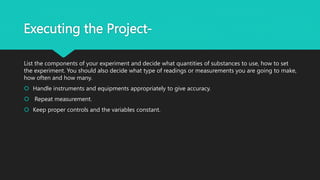
Executing the Project-
List the components of your experiment and decide what quantities of substances to use, how to set
the experiment. You should also decide what type of readings or measurements you are going to make,
how often and how many.
 Handle instruments and equipments appropriately to give accuracy.
 Repeat measurement.
 Keep proper controls and the variables constant.
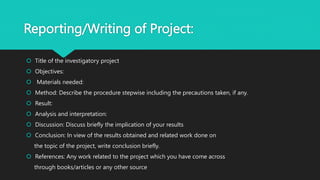
Reporting/Writing of Project:
 Title of the investigatory project
 Objectives:
 Materials needed:
 Method: Describe the procedure stepwise including the precautions taken, if any.
 Result:
 Analysis and interpretation:
 Discussion: Discuss briefly the implication of your results
 Conclusion: In view of the results obtained and related work done on
the topic of the project, write conclusion briefly.
 References: Any work related to the project which you have come across
through books/articles or any other source

Investigatory project 12 physics..pptx

  • 1.
  • 2.
    Investigations? Investigations are moreopen-ended than practical exercises involving a search to understand the unknown and begins with a question or a hypothesis. These give you more opportunity to plan your work For example, you might investigate what traits you and your classmates inherit from your parents and forefathers (both maternal and paternal).
  • 3.
    Projects ??  Projectsare even more open-ended than investigations. These are practical investigations carried out by an individual or a group of students.  It requires evaluation of your findings, redefining ideas and designing further investigations.  This may lead to evidence that enables answering the question posed at the outset.  Some of these projects would take about few hours to complete. Other may take few weeks. Some are laboratory based, others involve fieldwork.
  • 4.
    Investigatory Projects ?? Investigatory projects are part of obligatory assignment involving purely experimental procedures so that you report on, duplicate, or adapt something that someone else has already discovered  For example, you may undertake to investigate the richness and patterns of biodiversity (flora and fauna) in your school campus and prepare a mural of it or to investigate the effects of physical fitness on your pulse rate.
  • 5.
    Choosing an InvestigatoryProject  Review the available literature to find out what type of work has been done. This will help you to reject some of the alternatives, and possibly cause you to modify others. It may also be the source of new ideas.  By doing these investigatory projects you will gain experience of research besides providing opportunity for learning skills such as photography, electronics, etc.
  • 6.
    Identifying the Objectivesof the Project:  Keep the aim of your project simple. Investigate only one factor at a time and never allow yourself to be side-tracked.  Suppose your project involves studying the biodiversity of birds in your district/state, examine the data in the light of some questions (say, how do the birds in Rajasthan differ from those in Assam or Bihar?)
  • 7.
    Designing Projects-  Collectthe data you need in a scientific way to test the hypothesis  devise the procedure you would adopt to carry out your investigation.
  • 8.
    Planning Investigations-  Planof your investigation in some detail.These may include 1. What hypothesis can you make? 2. What instruments/equipment or techniques will you use to obtain relevant information? Identify suitable materials and equipment to be used. 3. How will you collect your data? 4. How do you plan to analyse your results?
  • 9.
    Executing the Project- Listthe components of your experiment and decide what quantities of substances to use, how to set the experiment. You should also decide what type of readings or measurements you are going to make, how often and how many.  Handle instruments and equipments appropriately to give accuracy.  Repeat measurement.  Keep proper controls and the variables constant.
  • 10.
    Reporting/Writing of Project: Title of the investigatory project  Objectives:  Materials needed:  Method: Describe the procedure stepwise including the precautions taken, if any.  Result:  Analysis and interpretation:  Discussion: Discuss briefly the implication of your results  Conclusion: In view of the results obtained and related work done on the topic of the project, write conclusion briefly.  References: Any work related to the project which you have come across through books/articles or any other source