THEBUSINESSYEAR 197
Executive Guide
Helpful hints and useful tips
to guide you through the nitty-
gritty of business ettiquette in
the country.
204
When in Peru: a selection of
the finest hotels from across the
country, to suit every business
traveler.
202
The human resources sector is
providing smart solutions to
increase labor market efficiency.
201
n monetary terms, poverty has been
reduced by half in recent years,
with more Peruvians living in better
conditions, with a brighter future.
Nowadays, Peru is a true economic miracle
nearly 20 years after the end of hyperinflation
and terrorism: these circumstances have given
way to the best possible conditions of stability,
respect, and promotion of investment in the
region, making Peru the fifth-largest economy
in South America—measured in purchasing
power parity—after Brazil, Argentina, Colom-
bia and Chile.
What to expect for Peru in the year 2025?
Today, Peru is considered one of the world’s
leading emerging markets, with a solid recent
history of economic stability based on an un-
interrupted average annual growth over the
past 15 years of 5.3% of its GDP, as well as a
people who are notable for their productiv-
ity and entrepreneurship. According to the
IIMF, Peru is part of the new wave of leading
emerging markets, and today has solid fun-
damentals, a framework of sensible policies,
and a prudent macroeconomic approach, all
of which enables it to enjoy sustained growth
and reduced vulnerability. This outlook gives
great expectations towards the country’s en-
vironment for doing business in 2025. In the
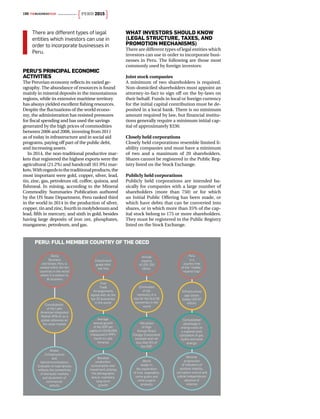
following chart, we present some of the goals
the country has to achieve over the period of
ten years.
BUSINESS ENVIRONMENT
Peru seeks to attract both domestic and foreign
investment in all sectors of the economy. To
achieve this, it has taken the necessary steps to
I
From the beginning of
the new millennium
through 2014, Peru
has achieved an
impressive cumulative
GDP growth of 116%
accompanied by a
cumulative inflation
during the same
period of just 52%—
the best rates of their
kind in Latin America.
INVEST THIS
R E V I E W D O I N G B U S I N E S S
establish a consistent investment policy that
eliminates barriers that foreign investors may
face. As a result, Peru is considered a country
with one of the most open investment systems
in the world. According to Doing Business
2015, Peru ranks 35th out of 189 countries in
terms of ease of starting a company and doing
business, and ranks second in Latin America,
as corroborated by Forbes.
Peru has achieved significant progress in its
macroeconomic performance in recent years,
with very dynamic GDP growth rates, stable
currency exchange rates, and low inflation.
This dynamism has been driven by the promo-
tion and diversification of exports, the world
commodity prices, market policies beneficial
to investors, and aggressive free trade strat-
egies. Over the past decade, Peru’s GDP has
tripled as a result of the country’s economic
growth, moving increasingly towards a middle
and upper-middle income economy.
The development strategy of Peru is based
on an economy opened to the world and com-
petitive in its export offer. It has been a suc-
cessful strategy that has permitted the coun-
try to consolidate its foreign trade in goods
and services as an instrument for economic
development and the reduction of poverty.
International trade negotiations, which have
benefited from rigorous macroeconomic
management and consequent stability, have
allowed the Peruvian economy to gradually
tackle and reduce its external vulnerability in
times of crisis such as the current internation-
al situation. In recent years, Peru has negoti-
ated Free Trade Agreements (FTA) with large-
and medium-sized markets.
THEBUSINESSYEAR198 PERU 2015
PERU’S PRINCIPAL ECONOMIC
ACTIVITIES
The Peruvian economy reflects its varied ge-
ography. The abundance of resources is found
mainly in mineral deposits in the mountainous
regions, while its extensive maritime territory
has always yielded excellent fishing resources.
Despite the fluctuations of the world econo-
my, the administration has resisted pressures
for fiscal spending and has used the savings
generated by the high prices of commodities
between 2006 and 2008, investing from 2011
as of today in infrastructure and in social aid
programs, paying off part of the public debt,
and increasing assets.
In 2014, the non-traditional productive mar-
kets that registered the highest exports were the
agricultural (21.2%) and handcraft (61.9%) mar-
kets.Withregardstothetraditionalproducts,the
most important were gold, copper, silver, lead,
tin, zinc, gas, petroleum oil, coffee, quinoa, and
fishmeal. In mining, according to the Mineral
Commodity Summaries Publication authored
by the US State Department, Peru ranked third
in the world in 2014 in the production of silver,
copper, tin and zinc, fourth in molybdenum and
lead, fifth in mercury, and sixth in gold, besides
having large deposits of iron ore, phosphates,
manganese, petroleum, and gas.
WHAT INVESTORS SHOULD KNOW
(LEGAL STRUCTURE, TAXES, AND
PROMOTION MECHANISMS)
There are different types of legal entities which
investors can use in order to incorporate busi-
nesses in Peru. The following are those most
commonly used by foreign investors:
Joint stock companies
A minimum of two shareholders is required.
Non-domiciled shareholders must appoint an
attorney-in-fact to sign off on the by-laws on
their behalf. Funds in local or foreign currency
for the initial capital contribution must be de-
posited in a local bank. There is no minimum
amount required by law, but financial institu-
tions generally require a minimum initial cap-
ital of approximately $330.
Closely held corporations
Closely held corporations resemble limited li-
ability companies and must have a minimum
of two and a maximum of 20 shareholders.
Shares cannot be registered in the Public Reg-
istry listed on the Stock Exchange.
Publicly held corporations
Publicly held corporations are intended ba-
sically for companies with a large number of
shareholders (more than 750) or for which
an Initial Public Offering has been made, or
which have debts that can be converted into
shares, or in which more than 35% of the cap-
ital stock belong to 175 or more shareholders.
They must be registered in the Public Registry
listed on the Stock Exchange.
There are different types of legal
entities which investors can use in
order to incorporate businesses in
Peru.
Doing
Business
and forbes: Peru is
ranked within the ten
countries in the world
where it is easiest to
do business
Consolidation
of the Latin
American integrated
Market (MILA) as a
global reference on
the stock market
Global
Infrastructure
and
telecommunications:
Indicator of road density
reflects the connectivity
of domestic markets
and dynamism of
commercial
activity
PERU: FULL MEMBER COUNTRY OF THE OECD
Average
annual growth
of the GDP per
capita of US$20,000
(measured in PPP):
fourth in Latin
America
Boosted
production,
consumption and
investment utilizing
the demographic
bonus: maintains
long-term
growth
Investment
grade AAA
risk free
Free
Trade
Arrangements
signed with all the
top 20 economies
in the world
Consolidated
advantage in
energy costs on
a regional level
(utilization of gas,
hydric and wind
energy)
Peru
is a
country free
of the "middle-
income trap"
General
progression
of indicators of
political stability,
corruption control and
judical independence:
absence of
violence
Infrastructure
gap closes
(today US$ 87
billion)
World
leader in
the exploration
of fruit, vegetables,
some grains and
niche organic
products
Annual
exports
of US$ 150
billion
Attraction
of High
Annual Direct
Foreign Investment,
constant and not
less than 6% of
the GDP
Elimination
of the
necessity of a
visa for the first 50
economies in the
world

Invest this

  • 1.
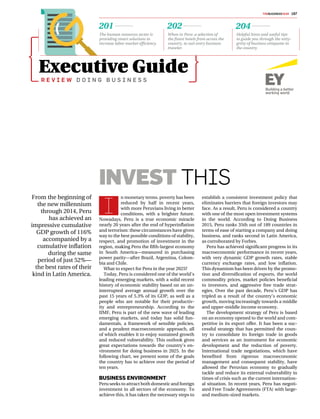
    THEBUSINESSYEAR 197 Executive Guide Helpfulhints and useful tips to guide you through the nitty- gritty of business ettiquette in the country. 204 When in Peru: a selection of the finest hotels from across the country, to suit every business traveler. 202 The human resources sector is providing smart solutions to increase labor market efficiency. 201 n monetary terms, poverty has been reduced by half in recent years, with more Peruvians living in better conditions, with a brighter future. Nowadays, Peru is a true economic miracle nearly 20 years after the end of hyperinflation and terrorism: these circumstances have given way to the best possible conditions of stability, respect, and promotion of investment in the region, making Peru the fifth-largest economy in South America—measured in purchasing power parity—after Brazil, Argentina, Colom- bia and Chile. What to expect for Peru in the year 2025? Today, Peru is considered one of the world’s leading emerging markets, with a solid recent history of economic stability based on an un- interrupted average annual growth over the past 15 years of 5.3% of its GDP, as well as a people who are notable for their productiv- ity and entrepreneurship. According to the IIMF, Peru is part of the new wave of leading emerging markets, and today has solid fun- damentals, a framework of sensible policies, and a prudent macroeconomic approach, all of which enables it to enjoy sustained growth and reduced vulnerability. This outlook gives great expectations towards the country’s en- vironment for doing business in 2025. In the following chart, we present some of the goals the country has to achieve over the period of ten years. BUSINESS ENVIRONMENT Peru seeks to attract both domestic and foreign investment in all sectors of the economy. To achieve this, it has taken the necessary steps to I From the beginning of the new millennium through 2014, Peru has achieved an impressive cumulative GDP growth of 116% accompanied by a cumulative inflation during the same period of just 52%— the best rates of their kind in Latin America. INVEST THIS R E V I E W D O I N G B U S I N E S S establish a consistent investment policy that eliminates barriers that foreign investors may face. As a result, Peru is considered a country with one of the most open investment systems in the world. According to Doing Business 2015, Peru ranks 35th out of 189 countries in terms of ease of starting a company and doing business, and ranks second in Latin America, as corroborated by Forbes. Peru has achieved significant progress in its macroeconomic performance in recent years, with very dynamic GDP growth rates, stable currency exchange rates, and low inflation. This dynamism has been driven by the promo- tion and diversification of exports, the world commodity prices, market policies beneficial to investors, and aggressive free trade strat- egies. Over the past decade, Peru’s GDP has tripled as a result of the country’s economic growth, moving increasingly towards a middle and upper-middle income economy. The development strategy of Peru is based on an economy opened to the world and com- petitive in its export offer. It has been a suc- cessful strategy that has permitted the coun- try to consolidate its foreign trade in goods and services as an instrument for economic development and the reduction of poverty. International trade negotiations, which have benefited from rigorous macroeconomic management and consequent stability, have allowed the Peruvian economy to gradually tackle and reduce its external vulnerability in times of crisis such as the current internation- al situation. In recent years, Peru has negoti- ated Free Trade Agreements (FTA) with large- and medium-sized markets.
  • 2.
    THEBUSINESSYEAR198 PERU 2015 PERU’SPRINCIPAL ECONOMIC ACTIVITIES The Peruvian economy reflects its varied ge- ography. The abundance of resources is found mainly in mineral deposits in the mountainous regions, while its extensive maritime territory has always yielded excellent fishing resources. Despite the fluctuations of the world econo- my, the administration has resisted pressures for fiscal spending and has used the savings generated by the high prices of commodities between 2006 and 2008, investing from 2011 as of today in infrastructure and in social aid programs, paying off part of the public debt, and increasing assets. In 2014, the non-traditional productive mar- kets that registered the highest exports were the agricultural (21.2%) and handcraft (61.9%) mar- kets.Withregardstothetraditionalproducts,the most important were gold, copper, silver, lead, tin, zinc, gas, petroleum oil, coffee, quinoa, and fishmeal. In mining, according to the Mineral Commodity Summaries Publication authored by the US State Department, Peru ranked third in the world in 2014 in the production of silver, copper, tin and zinc, fourth in molybdenum and lead, fifth in mercury, and sixth in gold, besides having large deposits of iron ore, phosphates, manganese, petroleum, and gas. WHAT INVESTORS SHOULD KNOW (LEGAL STRUCTURE, TAXES, AND PROMOTION MECHANISMS) There are different types of legal entities which investors can use in order to incorporate busi- nesses in Peru. The following are those most commonly used by foreign investors: Joint stock companies A minimum of two shareholders is required. Non-domiciled shareholders must appoint an attorney-in-fact to sign off on the by-laws on their behalf. Funds in local or foreign currency for the initial capital contribution must be de- posited in a local bank. There is no minimum amount required by law, but financial institu- tions generally require a minimum initial cap- ital of approximately $330. Closely held corporations Closely held corporations resemble limited li- ability companies and must have a minimum of two and a maximum of 20 shareholders. Shares cannot be registered in the Public Reg- istry listed on the Stock Exchange. Publicly held corporations Publicly held corporations are intended ba- sically for companies with a large number of shareholders (more than 750) or for which an Initial Public Offering has been made, or which have debts that can be converted into shares, or in which more than 35% of the cap- ital stock belong to 175 or more shareholders. They must be registered in the Public Registry listed on the Stock Exchange. There are different types of legal entities which investors can use in order to incorporate businesses in Peru. Doing Business and forbes: Peru is ranked within the ten countries in the world where it is easiest to do business Consolidation of the Latin American integrated Market (MILA) as a global reference on the stock market Global Infrastructure and telecommunications: Indicator of road density reflects the connectivity of domestic markets and dynamism of commercial activity PERU: FULL MEMBER COUNTRY OF THE OECD Average annual growth of the GDP per capita of US$20,000 (measured in PPP): fourth in Latin America Boosted production, consumption and investment utilizing the demographic bonus: maintains long-term growth Investment grade AAA risk free Free Trade Arrangements signed with all the top 20 economies in the world Consolidated advantage in energy costs on a regional level (utilization of gas, hydric and wind energy) Peru is a country free of the "middle- income trap" General progression of indicators of political stability, corruption control and judical independence: absence of violence Infrastructure gap closes (today US$ 87 billion) World leader in the exploration of fruit, vegetables, some grains and niche organic products Annual exports of US$ 150 billion Attraction of High Annual Direct Foreign Investment, constant and not less than 6% of the GDP Elimination of the necessity of a visa for the first 50 economies in the world