KENNETHF. LUMINDA
MAPEH TEACHER
These are games commonly played by children,
usually using native materials or instruments. In
the Philippines, due to limited resources of toys
of Filipino children, they usually come up on
inventing games without the need of anything
but the players themselves. With the flexibility
of a real human to think and act makes the
game more interesting and challenging.
Because it is a tradition for Filipinos to play in a
bigger and spacious area, most games are
usually played outside the house. Some games
are played or held during town fiestas in the
provinces. These games of Filipino children
include the following:
Bahay-Bahayan
Luksong-Baka
Palosebo
Piko
Lawin at Sisiw
("Hawk and Chicken")
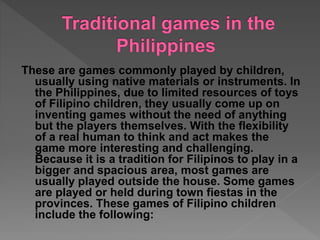
There are two teams with two bases. How
many players on each team depends on
the players. There are two bases which
each team claims as their own. The goal is
to tag the other team's base without getting
tagged. If you're tagged, you're transferred
to the other team and must be rescue.
There are several variations in which the
rules are changed, in some, you can connect other items on the
base so you can easily touch the base. There are usually set
points, such as first team to tag the other team 5 times wins. You
can tag other people who has touched their base before you and
are on the opposite team. If they've touched their base after you've
touched your base, they can tag you, and you can't tag them.
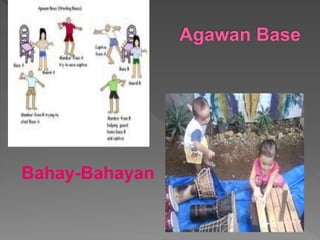
A role-playing game
where children act as
members of an imaginary
family, sometimes to the
extent that one of them becomes the
family "pet." They then act out various
household situations such as dinner,
going to mass, and the like.
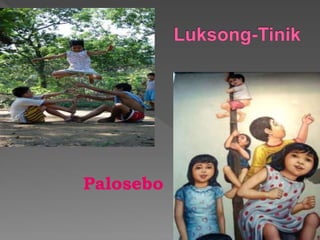
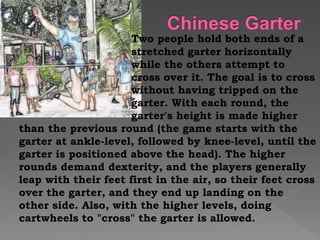
Two people hold both ends of a
stretched garter horizontally
while the others attempt to
cross over it. The goal is to cross
without having tripped on the
garter. With each round, the
garter's height is made higher
than the previous round (the game starts with the
garter at ankle-level, followed by knee-level, until the
garter is positioned above the head). The higher
rounds demand dexterity, and the players generally
leap with their feet first in the air, so their feet cross
over the garter, and they end up landing on the
other side. Also, with the higher levels, doing
cartwheels to "cross" the garter is allowed.
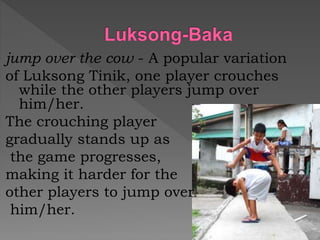
jump over the cow - A popular variation
of Luksong Tinik, one player crouches
while the other players jump over
him/her.
The crouching player
gradually stands up as
the game progresses,
making it harder for the
other players to jump over
him/her.
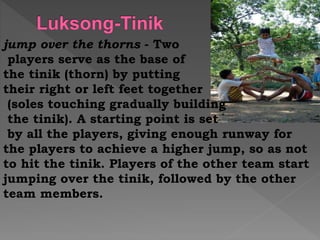
jump over the thorns - Two
players serve as the base of
the tinik (thorn) by putting
their right or left feet together
(soles touching gradually building
the tinik). A starting point is set
by all the players, giving enough runway for
the players to achieve a higher jump, so as not
to hit the tinik. Players of the other team start
jumping over the tinik, followed by the other
team members.
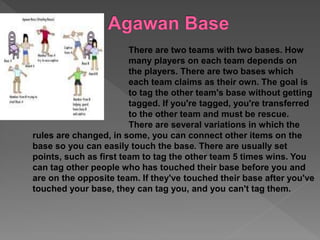
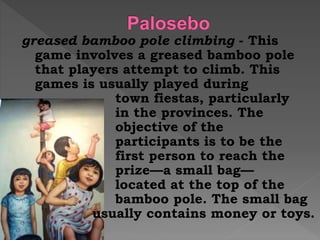
greased bamboo pole climbing - This
game involves a greased bamboo pole
that players attempt to climb. This
games is usually played during
town fiestas, particularly
in the provinces. The
objective of the
participants is to be the
first person to reach the
prize—a small bag—
located at the top of the
bamboo pole. The small bag
usually contains money or toys.
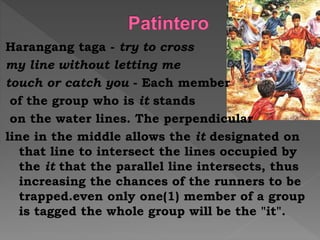
Harangang taga - try to cross
my line without letting me
touch or catch you - Each member
of the group who is it stands
on the water lines. The perpendicular
line in the middle allows the it designated on
that line to intersect the lines occupied by
the it that the parallel line intersects, thus
increasing the chances of the runners to be
trapped.even only one(1) member of a group
is tagged the whole group will be the "it".
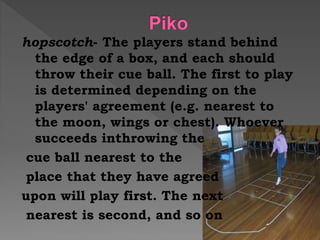
hopscotch- The players stand behind
the edge of a box, and each should
throw their cue ball. The first to play
is determined depending on the
players' agreement (e.g. nearest to
the moon, wings or chest). Whoever
succeeds inthrowing the
cue ball nearest to the
place that they have agreed
upon will play first. The next
nearest is second, and so on
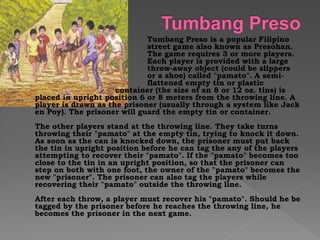
Tumbang Preso is a popular Filipino
street game also known as Presohan.
The game requires 3 or more players.
Each player is provided with a large
throw-away object (could be slippers
or a shoe) called "pamato". A semi-
flattened empty tin or plastic
container (the size of an 8 or 12 oz. tins) is
placed in upright position 6 or 8 meters from the throwing line. A
player is drawn as the prisoner (usually through a system like Jack
en Poy). The prisoner will guard the empty tin or container.
The other players stand at the throwing line. They take turns
throwing their "pamato" at the empty tin, trying to knock it down.
As soon as the can is knocked down, the prisoner must put back
the tin in upright position before he can tag the any of the players
attempting to recover their "pamato". If the "pamato" becomes too
close to the tin in an upright position, so that the prisoner can
step on both with one foot, the owner of the "pamato" becomes the
new "prisoner". The prisoner can also tag the players while
recovering their "pamato" outside the throwing line.
After each throw, a player must recover his "pamato". Should he be
tagged by the prisoner before he reaches the throwing line, he
becomes the prisoner in the next game.
This game is played by 10 or more players. It
can be played indoors or outdoors. One
player is chosen as the 'hawk' and
another as the 'hen'. The other players
are the 'chickens'. The chickens stand one behind the other,
each holding the waist of the one in front. The hen stands in
front of the file of chickens. The hawk will 'buy' a chicken from
the hen. The hawk will then take the chicken, asks him/her to
hunt for food and goes to sleep. While the hawk is asleep, the
chicken will return to the hen. The Hawk wakes up and tries to
get back the chicken he bought while the hen and other
chickens prevent the hawk from catching the chicken. If the
hawk succeeds, the chicken is taken and punished. If the hawk
fails to catch the chicken, the hawk will try to buy another
chicken.
Can you assess your
physical fitness through this
game?
INVATION GAME PE6.pptx

INVATION GAME PE6.pptx

  • 1.
  • 2.
    These are gamescommonly played by children, usually using native materials or instruments. In the Philippines, due to limited resources of toys of Filipino children, they usually come up on inventing games without the need of anything but the players themselves. With the flexibility of a real human to think and act makes the game more interesting and challenging. Because it is a tradition for Filipinos to play in a bigger and spacious area, most games are usually played outside the house. Some games are played or held during town fiestas in the provinces. These games of Filipino children include the following:
  • 3.
  • 4.
  • 5.
  • 6.
  • 7.
    Lawin at Sisiw ("Hawkand Chicken")
  • 9.
    There are twoteams with two bases. How many players on each team depends on the players. There are two bases which each team claims as their own. The goal is to tag the other team's base without getting tagged. If you're tagged, you're transferred to the other team and must be rescue. There are several variations in which the rules are changed, in some, you can connect other items on the base so you can easily touch the base. There are usually set points, such as first team to tag the other team 5 times wins. You can tag other people who has touched their base before you and are on the opposite team. If they've touched their base after you've touched your base, they can tag you, and you can't tag them.
  • 10.
    A role-playing game wherechildren act as members of an imaginary family, sometimes to the extent that one of them becomes the family "pet." They then act out various household situations such as dinner, going to mass, and the like.
  • 11.
    Two people holdboth ends of a stretched garter horizontally while the others attempt to cross over it. The goal is to cross without having tripped on the garter. With each round, the garter's height is made higher than the previous round (the game starts with the garter at ankle-level, followed by knee-level, until the garter is positioned above the head). The higher rounds demand dexterity, and the players generally leap with their feet first in the air, so their feet cross over the garter, and they end up landing on the other side. Also, with the higher levels, doing cartwheels to "cross" the garter is allowed.
  • 12.
    jump over thecow - A popular variation of Luksong Tinik, one player crouches while the other players jump over him/her. The crouching player gradually stands up as the game progresses, making it harder for the other players to jump over him/her.
  • 13.
    jump over thethorns - Two players serve as the base of the tinik (thorn) by putting their right or left feet together (soles touching gradually building the tinik). A starting point is set by all the players, giving enough runway for the players to achieve a higher jump, so as not to hit the tinik. Players of the other team start jumping over the tinik, followed by the other team members.
  • 14.
    greased bamboo poleclimbing - This game involves a greased bamboo pole that players attempt to climb. This games is usually played during town fiestas, particularly in the provinces. The objective of the participants is to be the first person to reach the prize—a small bag— located at the top of the bamboo pole. The small bag usually contains money or toys.
  • 15.
    Harangang taga -try to cross my line without letting me touch or catch you - Each member of the group who is it stands on the water lines. The perpendicular line in the middle allows the it designated on that line to intersect the lines occupied by the it that the parallel line intersects, thus increasing the chances of the runners to be trapped.even only one(1) member of a group is tagged the whole group will be the "it".
  • 16.
    hopscotch- The playersstand behind the edge of a box, and each should throw their cue ball. The first to play is determined depending on the players' agreement (e.g. nearest to the moon, wings or chest). Whoever succeeds inthrowing the cue ball nearest to the place that they have agreed upon will play first. The next nearest is second, and so on
  • 17.
    Tumbang Preso isa popular Filipino street game also known as Presohan. The game requires 3 or more players. Each player is provided with a large throw-away object (could be slippers or a shoe) called "pamato". A semi- flattened empty tin or plastic container (the size of an 8 or 12 oz. tins) is placed in upright position 6 or 8 meters from the throwing line. A player is drawn as the prisoner (usually through a system like Jack en Poy). The prisoner will guard the empty tin or container. The other players stand at the throwing line. They take turns throwing their "pamato" at the empty tin, trying to knock it down. As soon as the can is knocked down, the prisoner must put back the tin in upright position before he can tag the any of the players attempting to recover their "pamato". If the "pamato" becomes too close to the tin in an upright position, so that the prisoner can step on both with one foot, the owner of the "pamato" becomes the new "prisoner". The prisoner can also tag the players while recovering their "pamato" outside the throwing line. After each throw, a player must recover his "pamato". Should he be tagged by the prisoner before he reaches the throwing line, he becomes the prisoner in the next game.
  • 18.
    This game isplayed by 10 or more players. It can be played indoors or outdoors. One player is chosen as the 'hawk' and another as the 'hen'. The other players are the 'chickens'. The chickens stand one behind the other, each holding the waist of the one in front. The hen stands in front of the file of chickens. The hawk will 'buy' a chicken from the hen. The hawk will then take the chicken, asks him/her to hunt for food and goes to sleep. While the hawk is asleep, the chicken will return to the hen. The Hawk wakes up and tries to get back the chicken he bought while the hen and other chickens prevent the hawk from catching the chicken. If the hawk succeeds, the chicken is taken and punished. If the hawk fails to catch the chicken, the hawk will try to buy another chicken.
  • 19.
    Can you assessyour physical fitness through this game?