11
PCI in NSTEMIPCI in NSTEMI
22
Case ---Mr BCase ---Mr B
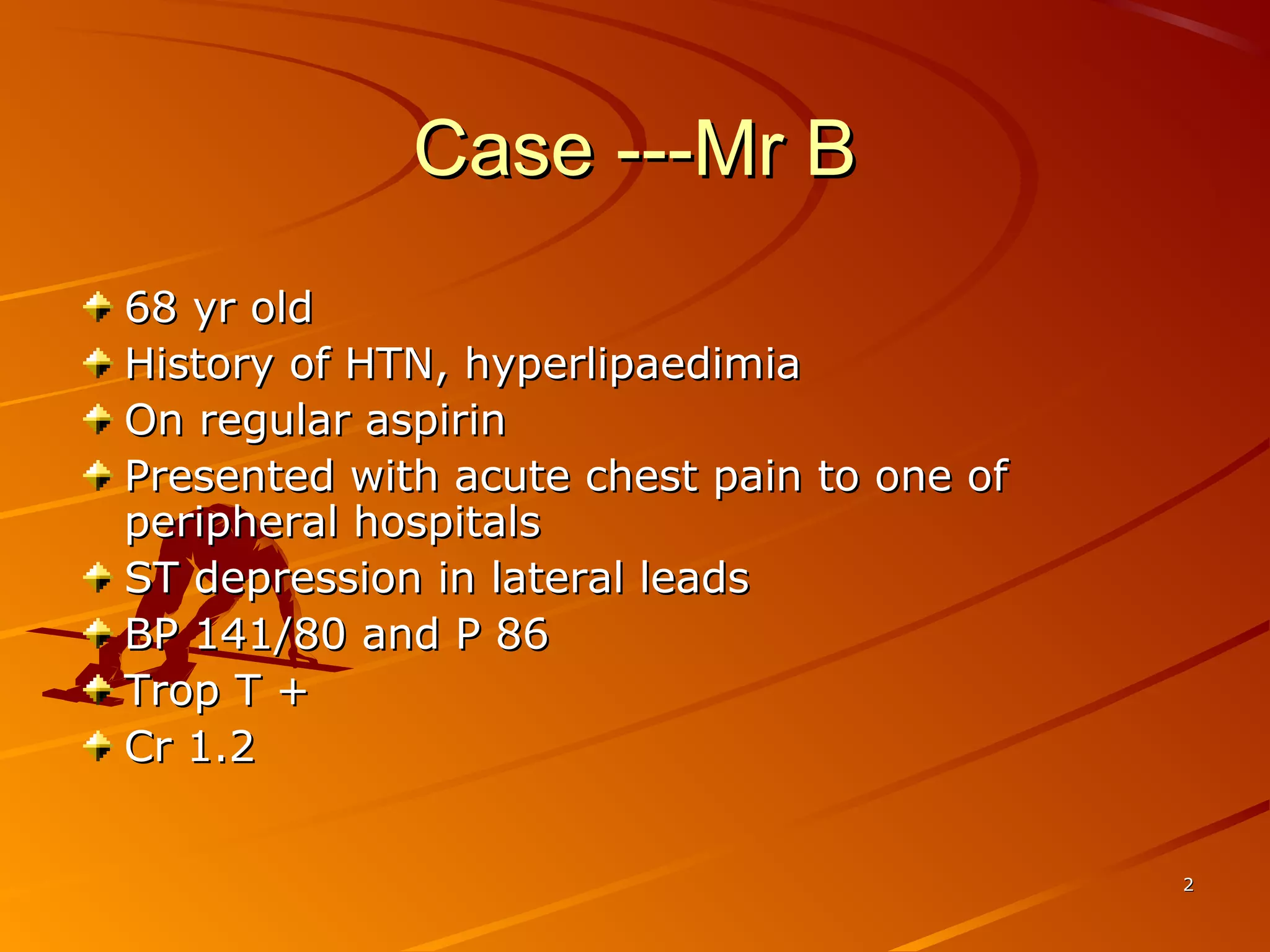
68 yr old68 yr old
History of HTN, hyperlipaedimiaHistory of HTN, hyperlipaedimia
On regular aspirinOn regular aspirin
Presented with acute chest pain to one ofPresented with acute chest pain to one of
peripheral hospitalsperipheral hospitals
ST depression in lateral leadsST depression in lateral leads
BP 141/80 and P 86BP 141/80 and P 86
Trop T +Trop T +
Cr 1.2Cr 1.2
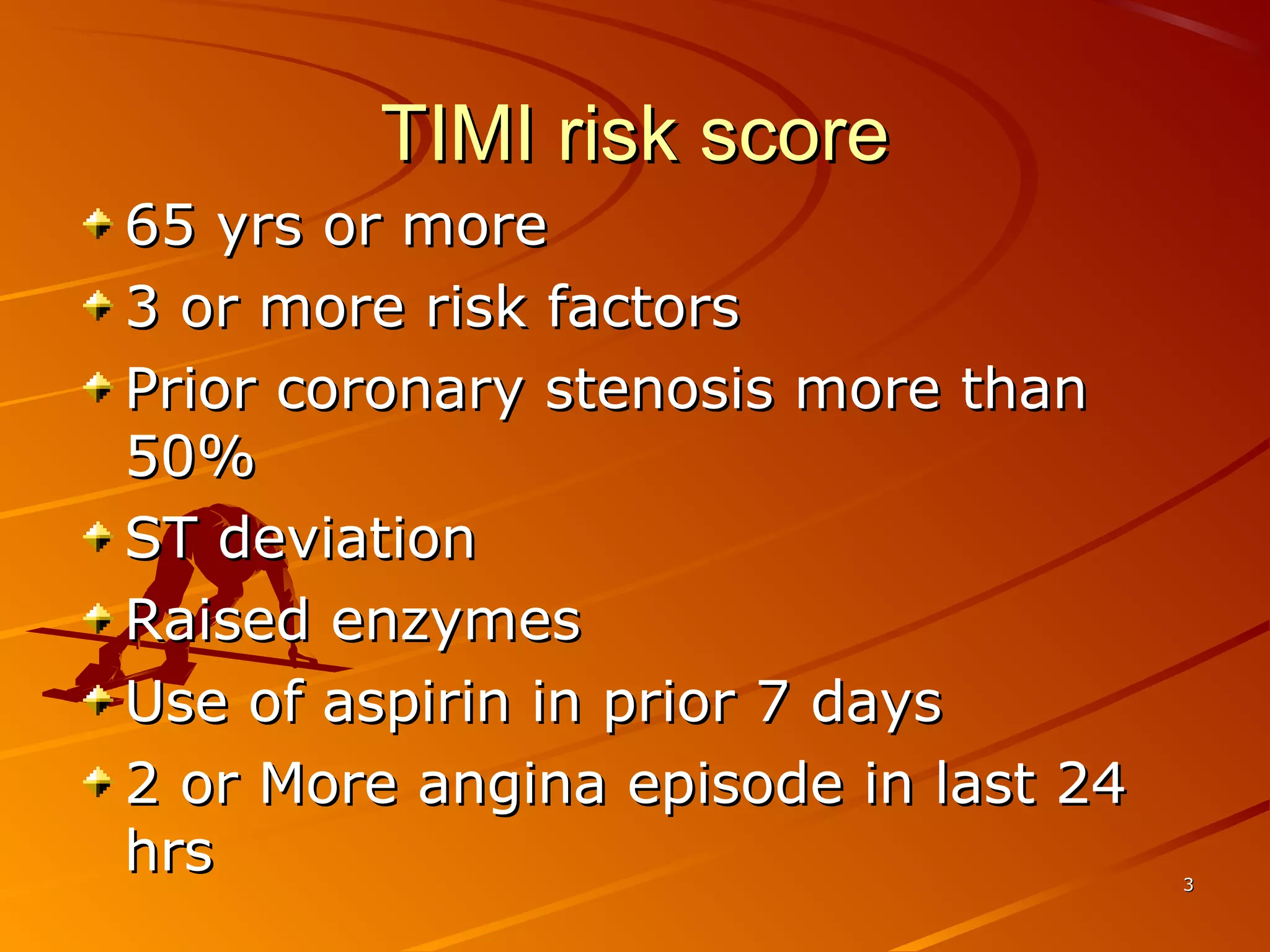
TIMI risk scoreTIMI risk score
33
65 yrs or more65 yrs or more
3 or more risk factors3 or more risk factors
Prior coronary stenosis more thanPrior coronary stenosis more than
50%50%
ST deviationST deviation
Raised enzymesRaised enzymes
Use of aspirin in prior 7 daysUse of aspirin in prior 7 days
2 or More angina episode in last 242 or More angina episode in last 24
hrshrs
44
GRACE risk scoreGRACE risk score
55
66
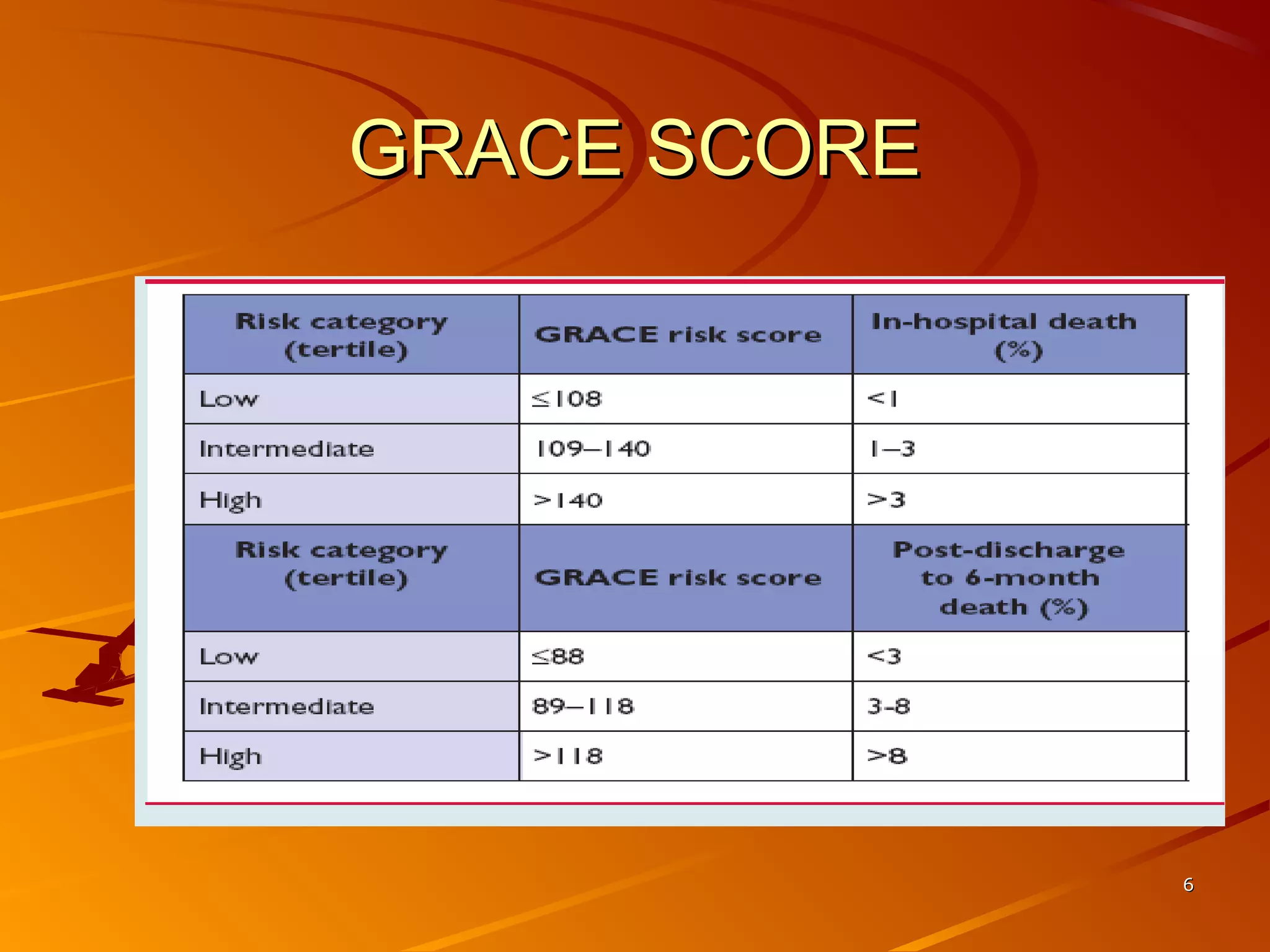
GRACE SCOREGRACE SCORE
77
Case ---Mr BCase ---Mr B
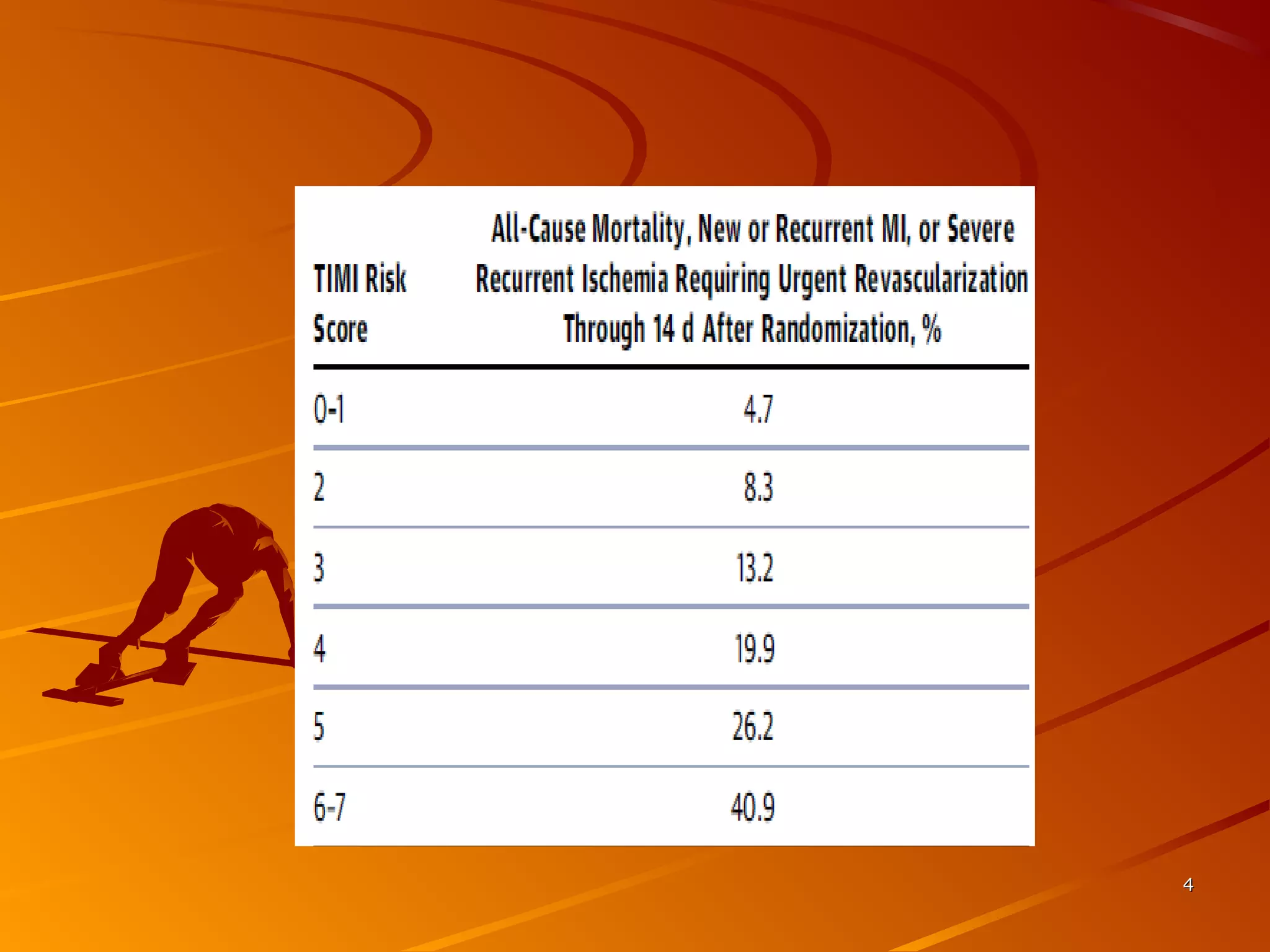
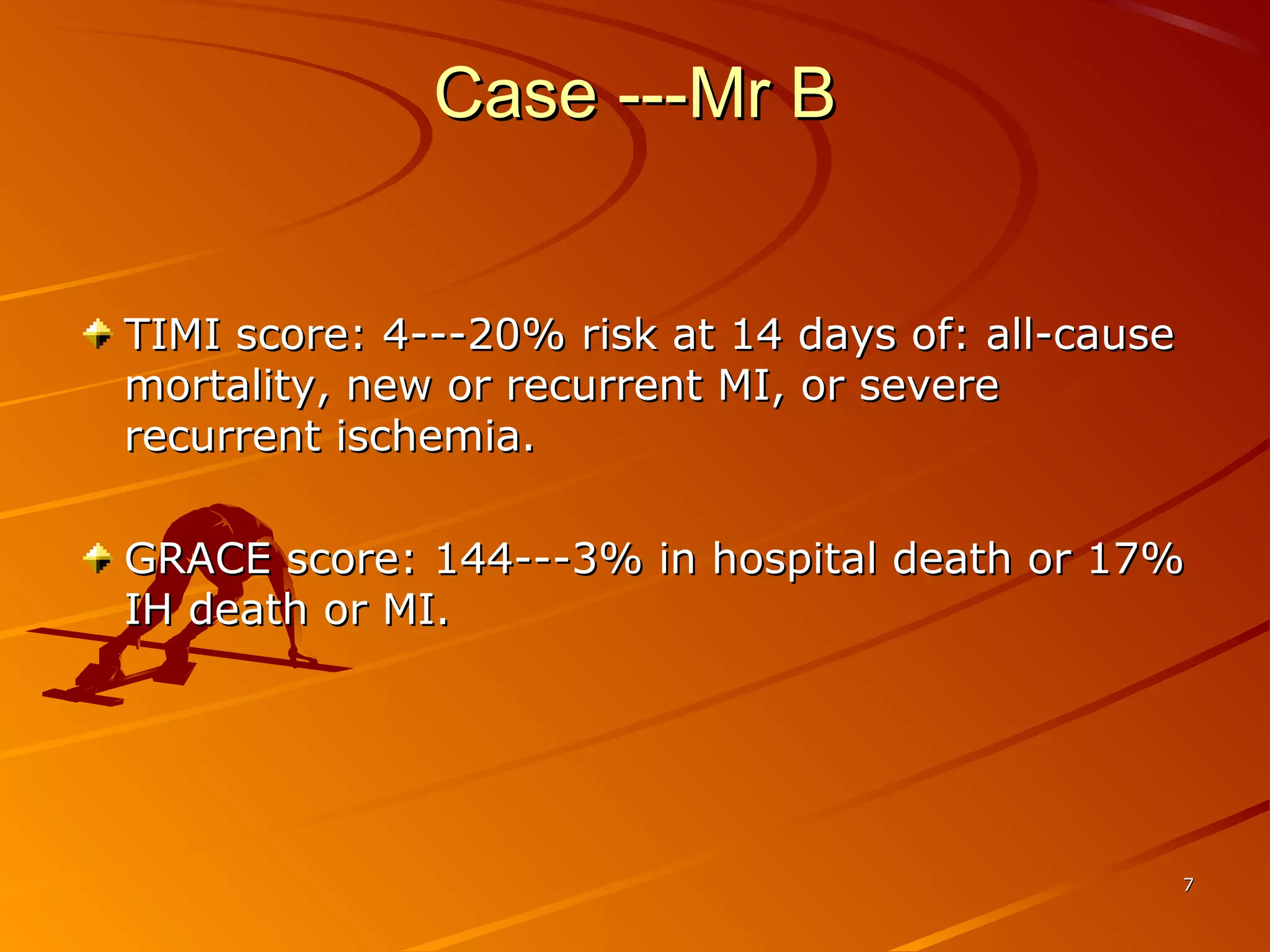
TIMI score: 4---20% risk at 14 days of: all-causeTIMI score: 4---20% risk at 14 days of: all-cause
mortality, new or recurrent MI, or severemortality, new or recurrent MI, or severe
recurrent ischemia.recurrent ischemia.
GRACE score: 144---3% in hospital death or 17%GRACE score: 144---3% in hospital death or 17%
IH death or MI.IH death or MI.
88
WHATWHAT
SHOULD WESHOULD WE
DO?DO?
99
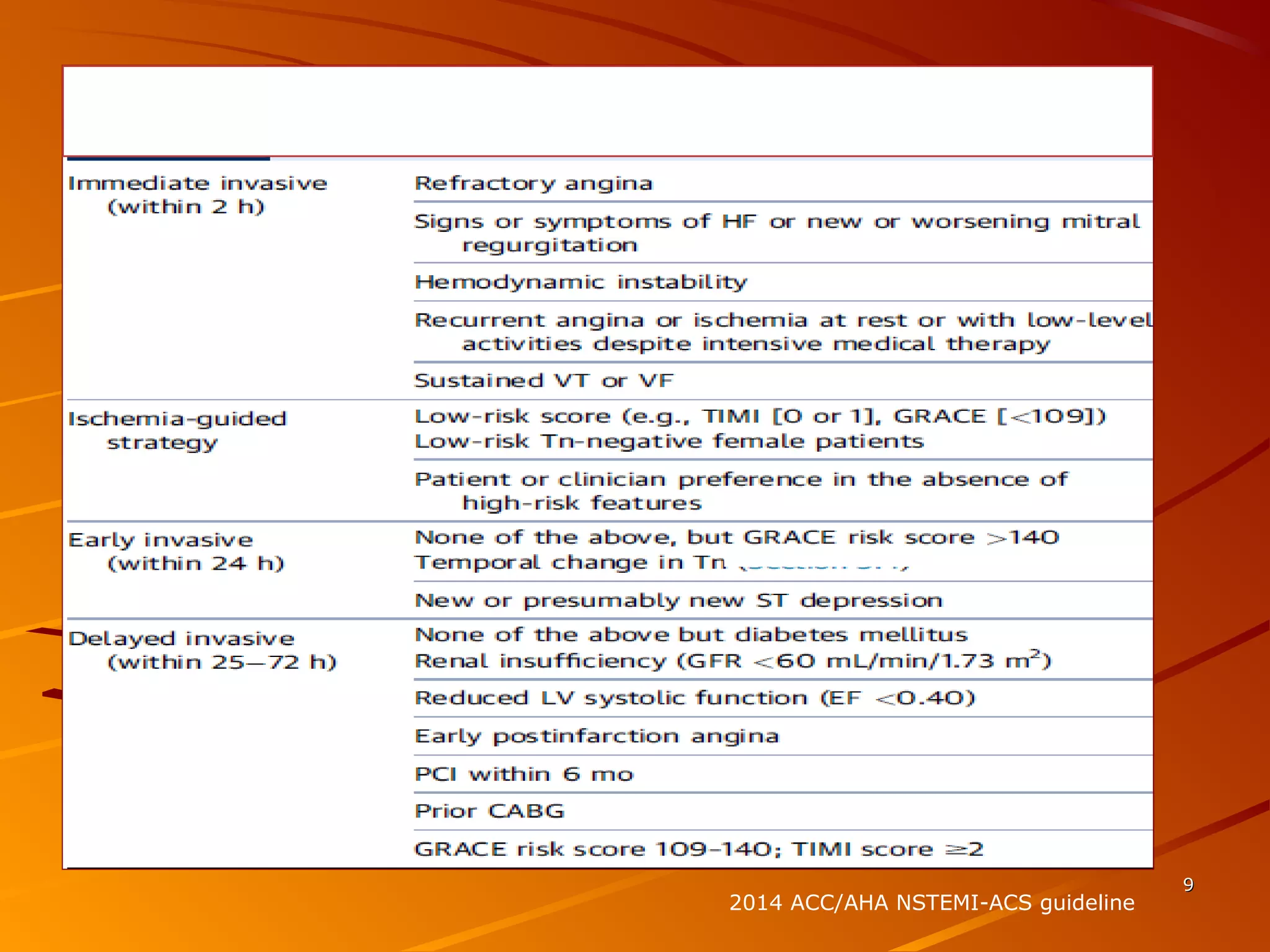
2014 ACC/AHA NSTEMI-ACS guideline
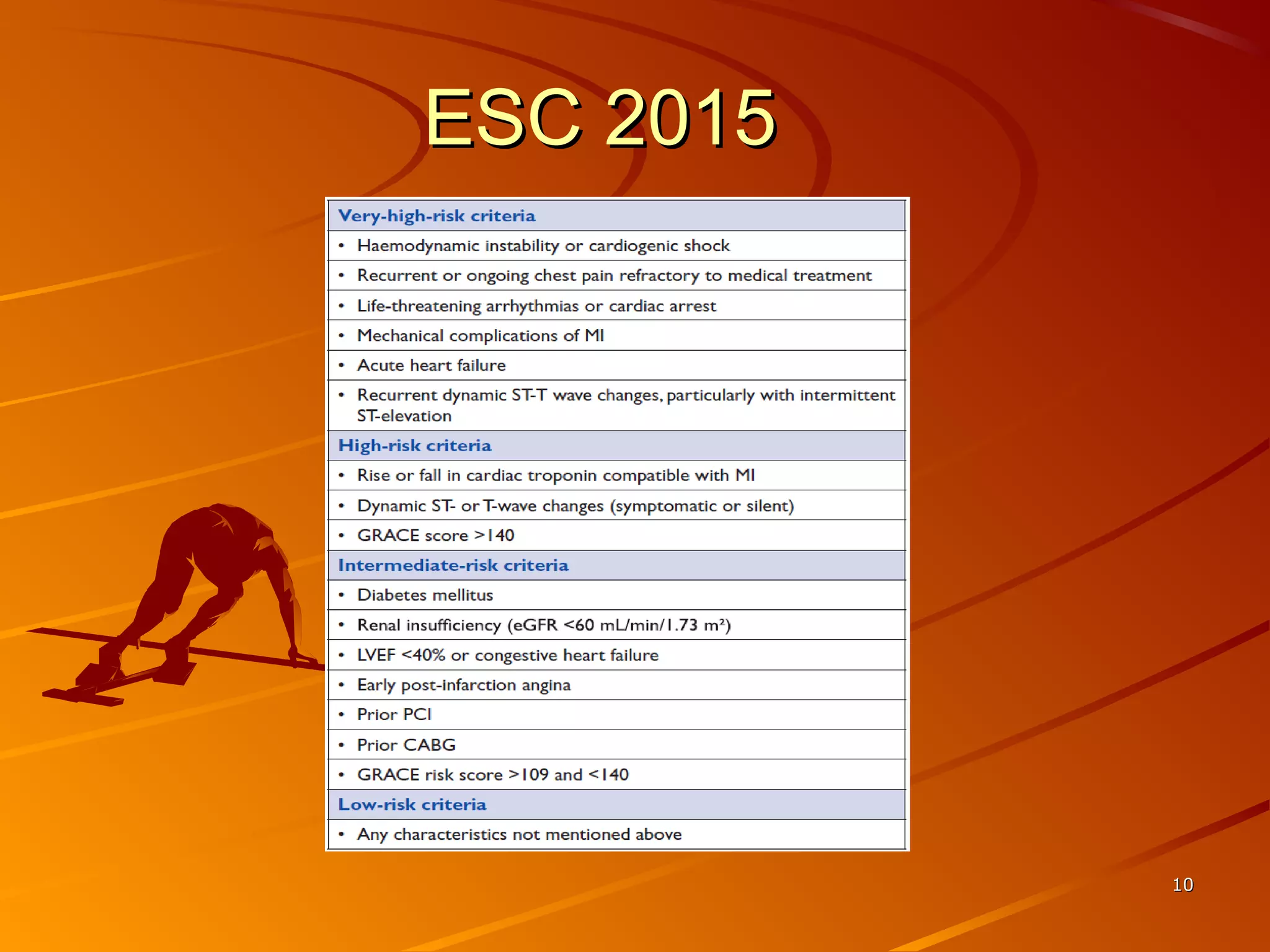
ESC 2015ESC 2015
1010
INVASIVEINVASIVE
VSVS
CONSERVATIVECONSERVATIVE
1111
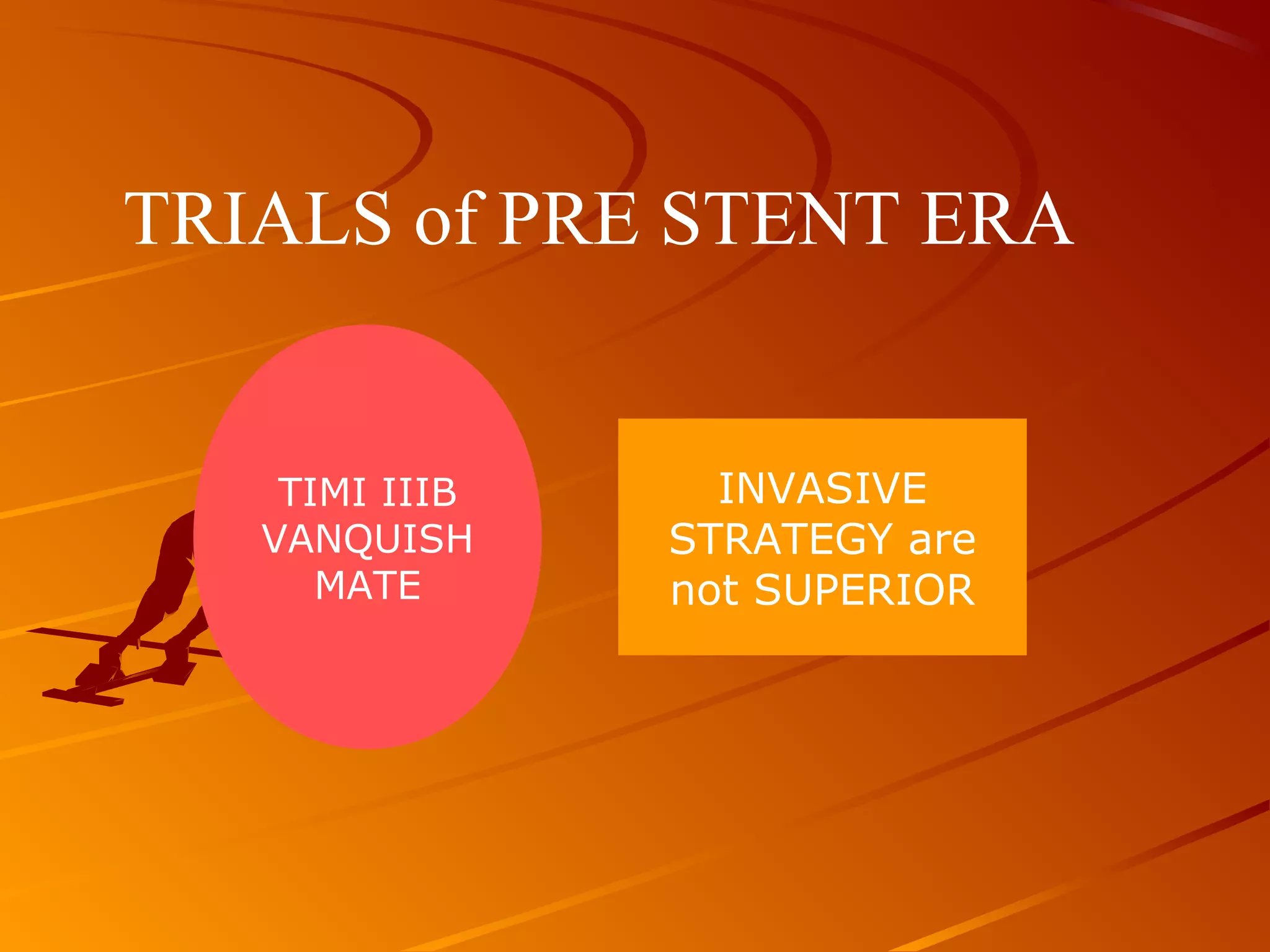
TIMI IIIB
VANQUISH
MATE
INVASIVE
STRATEGY are
not SUPERIOR
TRIALS of PRE STENT ERA
RECENT TRIALSRECENT TRIALS
FRISC IIFRISC II
ICTUSICTUS
RITA 3RITA 3
TACTICS TIMI 18TACTICS TIMI 18
VINOVINO
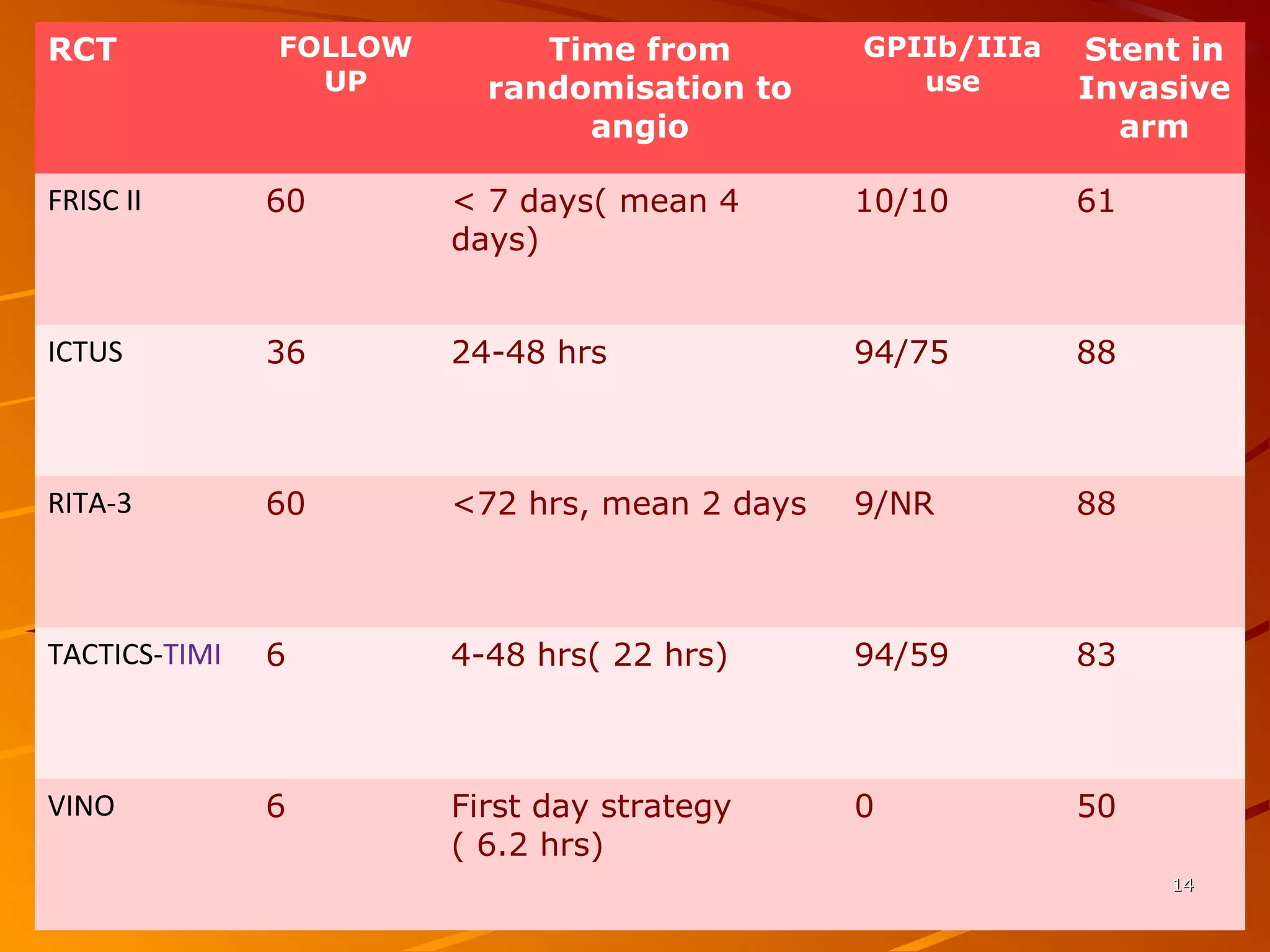
RCT FOLLOW
UP
Time from
randomisation to
angio
GPIIb/IIIa
use
Stent in
Invasive
arm
FRISC II 60 < 7 days( mean 4
days)
10/10 61
ICTUS 36 24-48 hrs 94/75 88
RITA-3 60 <72 hrs, mean 2 days 9/NR 88
TACTICS-TIMI 6 4-48 hrs( 22 hrs) 94/59 83
VINO 6 First day strategy
( 6.2 hrs)
0 50
1414
META analysisMETA analysis
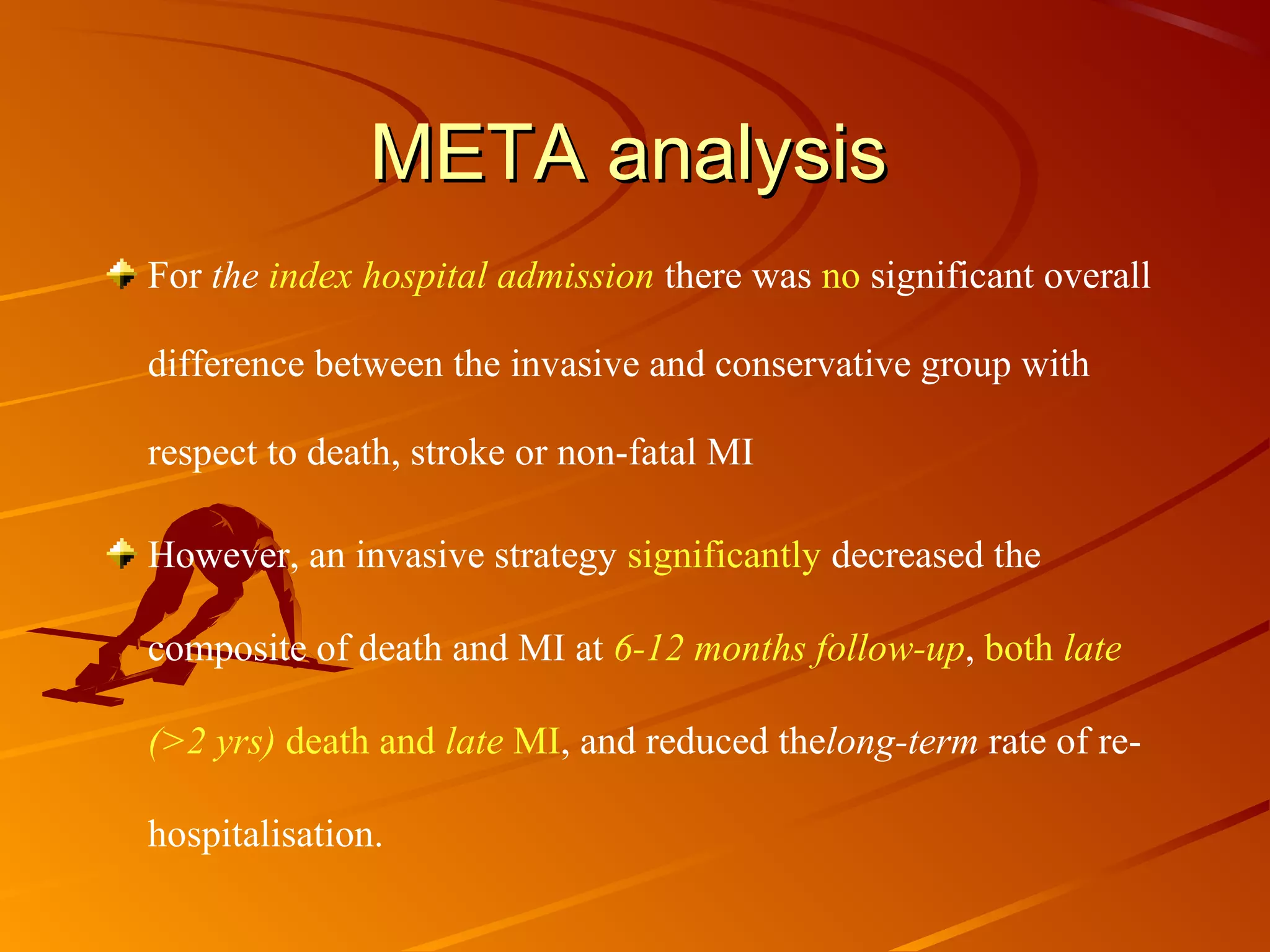
For the index hospital admission there was no significant overall
difference between the invasive and conservative group with
respect to death, stroke or non-fatal MI
However, an invasive strategy significantly decreased the
composite of death and MI at 6-12 months follow-up, both late
(>2 yrs) death and late MI, and reduced thelong-term rate of re-
hospitalisation.
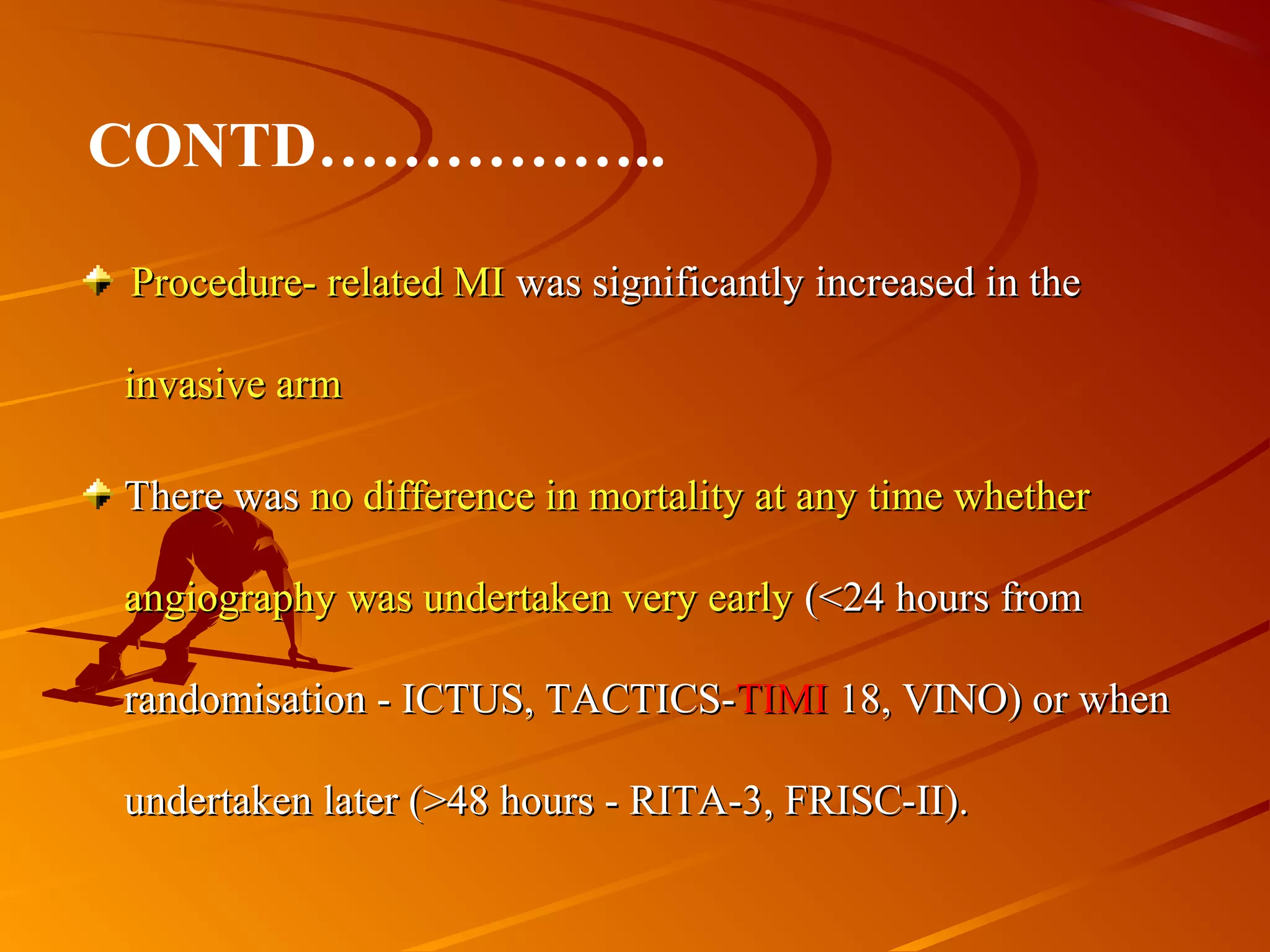
Procedure- related MIProcedure- related MI was significantly increased in thewas significantly increased in the
invasive arminvasive arm
There wasThere was no difference in mortality at any time whetherno difference in mortality at any time whether
angiography was undertaken very earlyangiography was undertaken very early (<24 hours from(<24 hours from
randomisation - ICTUS, TACTICS-randomisation - ICTUS, TACTICS-TIMITIMI 18, VINO) or when18, VINO) or when
undertaken later (>48 hours - RITA-3, FRISC-II).undertaken later (>48 hours - RITA-3, FRISC-II).
CONTD……………..
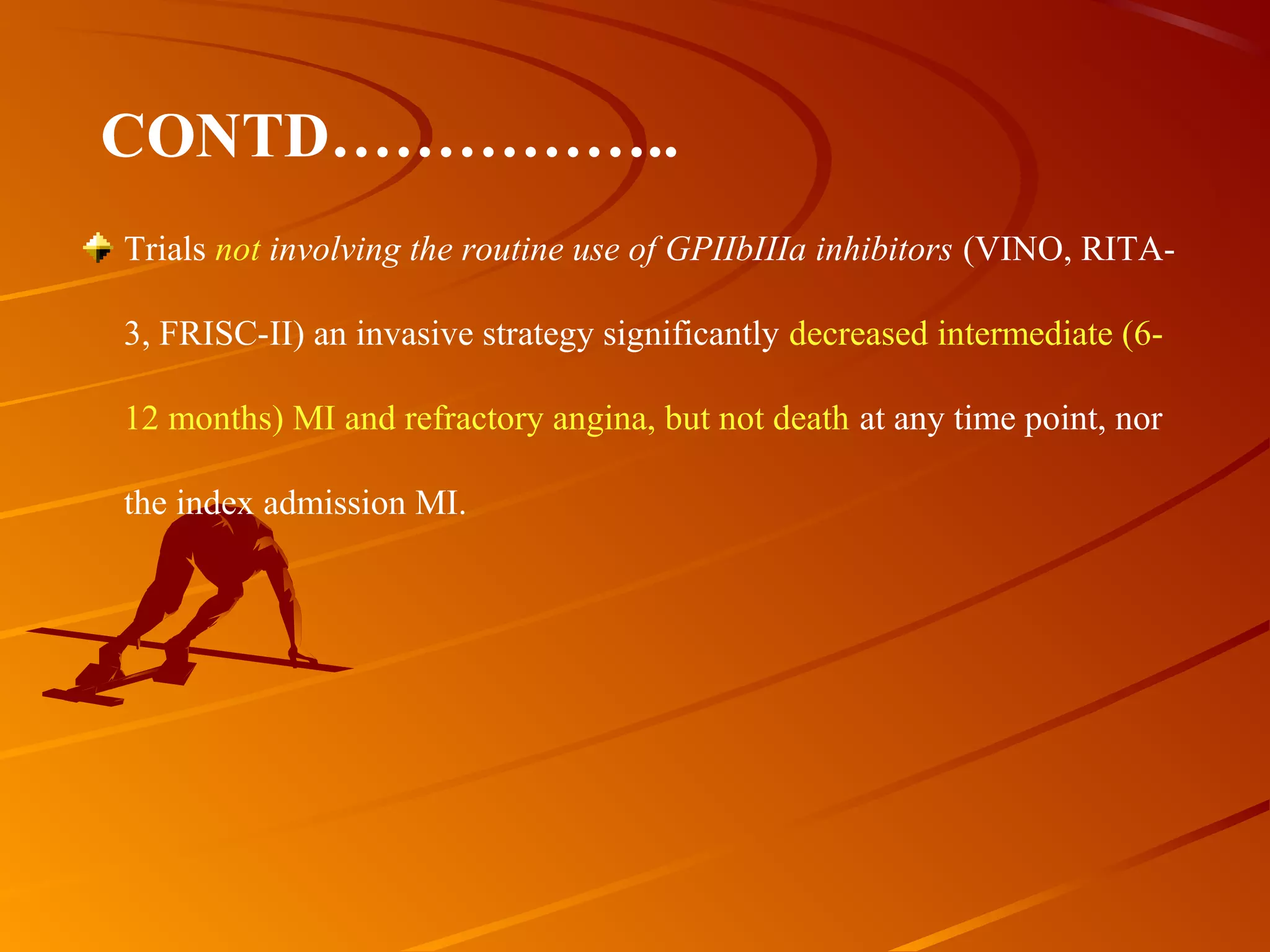
Trials not involving the routine use of GPIIbIIIa inhibitors (VINO, RITA-
3, FRISC-II) an invasive strategy significantly decreased intermediate (6-
12 months) MI and refractory angina, but not death at any time point, nor 
the index admission MI.
CONTD……………..
CONTD…….CONTD…….
Trials with the routine use of GPIs (mainly based on TACTICS-TIMI 18 but Trials with the routine use of GPIs (mainly based on TACTICS-TIMI 18 but 
including ICTUS - use of GPIs was 94% in the invasive arms of both trials) an including ICTUS - use of GPIs was 94% in the invasive arms of both trials) an 
invasive strategy significantly invasive strategy significantly reduced in-hospital non-fatal MI, the composite of reduced in-hospital non-fatal MI, the composite of 
death or non-fatal MI (but not death alone), death or non-fatal MI (but not death alone), suggesting that appropriate use of GPIs suggesting that appropriate use of GPIs 
reduces in-hospital MI reduces in-hospital MI when added to an invasive strategy. It also reduced when added to an invasive strategy. It also reduced 
rehospitalisation over 6-12 months follow-uprehospitalisation over 6-12 months follow-up
1818
CONTD…………CONTD…………
In the RITA-3 trial there was no difference between management strategies for In the RITA-3 trial there was no difference between management strategies for 
those at lowest risk, but those those at lowest risk, but those at highest risk at highest risk who were managed by an early who were managed by an early 
invasive strategy had a significantly reduced risk of death or MIup to 5 years invasive strategy had a significantly reduced risk of death or MIup to 5 years 
follow-up.follow-up.
In the FRISC-II trial, an invasive strategy significantly reduced the 
composite of death or non-fatal MI in those with either ST depression or 
troponin elevation (higher risk), but not in those without (lower risk), 
suggesting that the benefit of an invasive strategy was mostly in higher risk 
people. 
CONTD…….CONTD…….
In TACTICS TIMI trial benefit is confined to higher risk In TACTICS TIMI trial benefit is confined to higher risk 
patientspatients
Quality of life outcomes are better in early invasive Quality of life outcomes are better in early invasive 
group( FRISC II & RITA 3)group( FRISC II & RITA 3)
2121
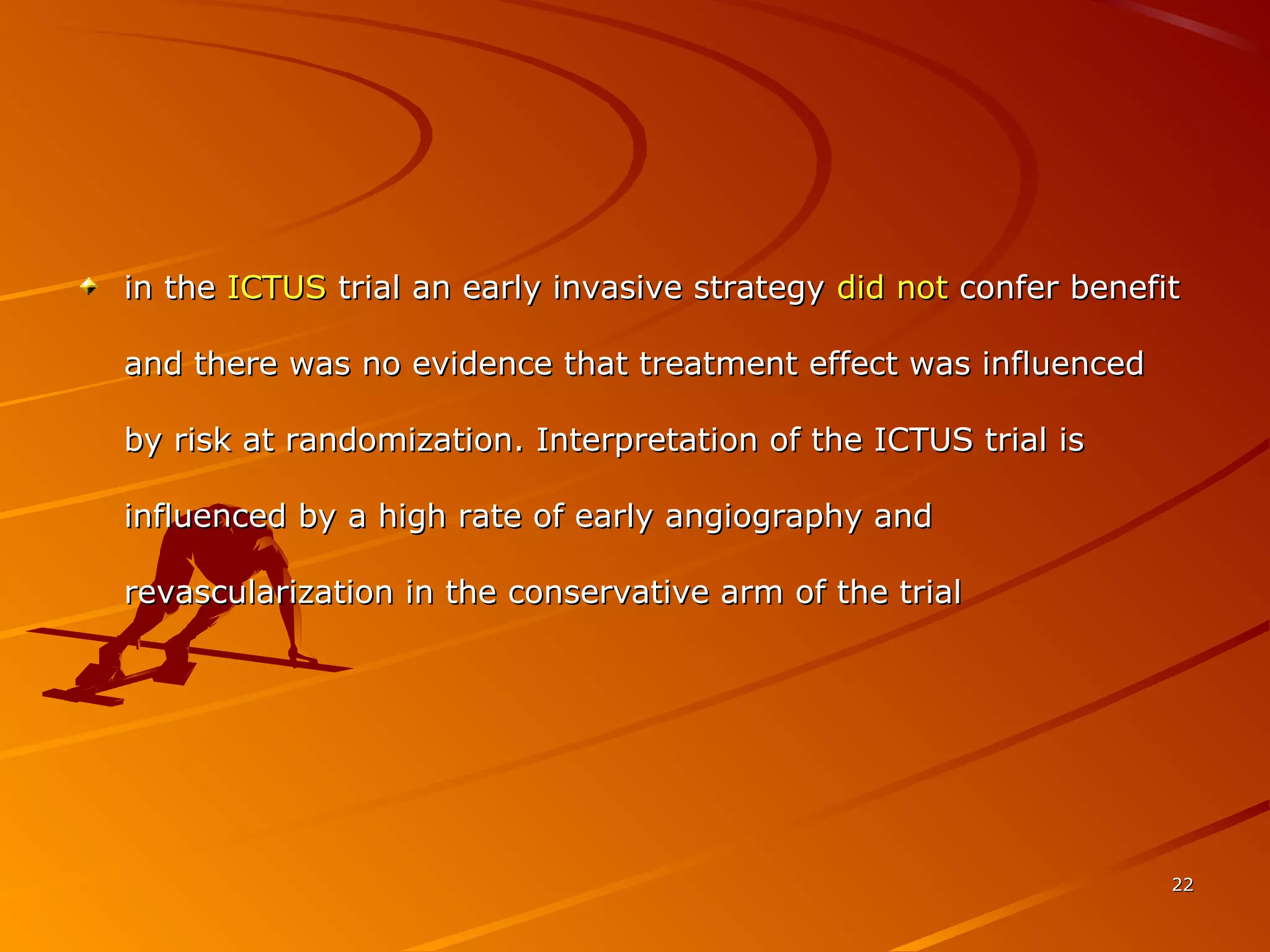
in thein the ICTUSICTUS trial an early invasive strategytrial an early invasive strategy did notdid not confer benefitconfer benefit
and there was no evidence that treatment effect was influencedand there was no evidence that treatment effect was influenced
by risk at randomization. Interpretation of the ICTUS trial isby risk at randomization. Interpretation of the ICTUS trial is
influenced by a high rate of early angiography andinfluenced by a high rate of early angiography and
revascularization in the conservative arm of the trialrevascularization in the conservative arm of the trial
2222
INVASIVE STRATEGYINVASIVE STRATEGY
HOW MUCH EARLY IT HOW MUCH EARLY IT 
SHOULD BE?SHOULD BE?
2323
2424
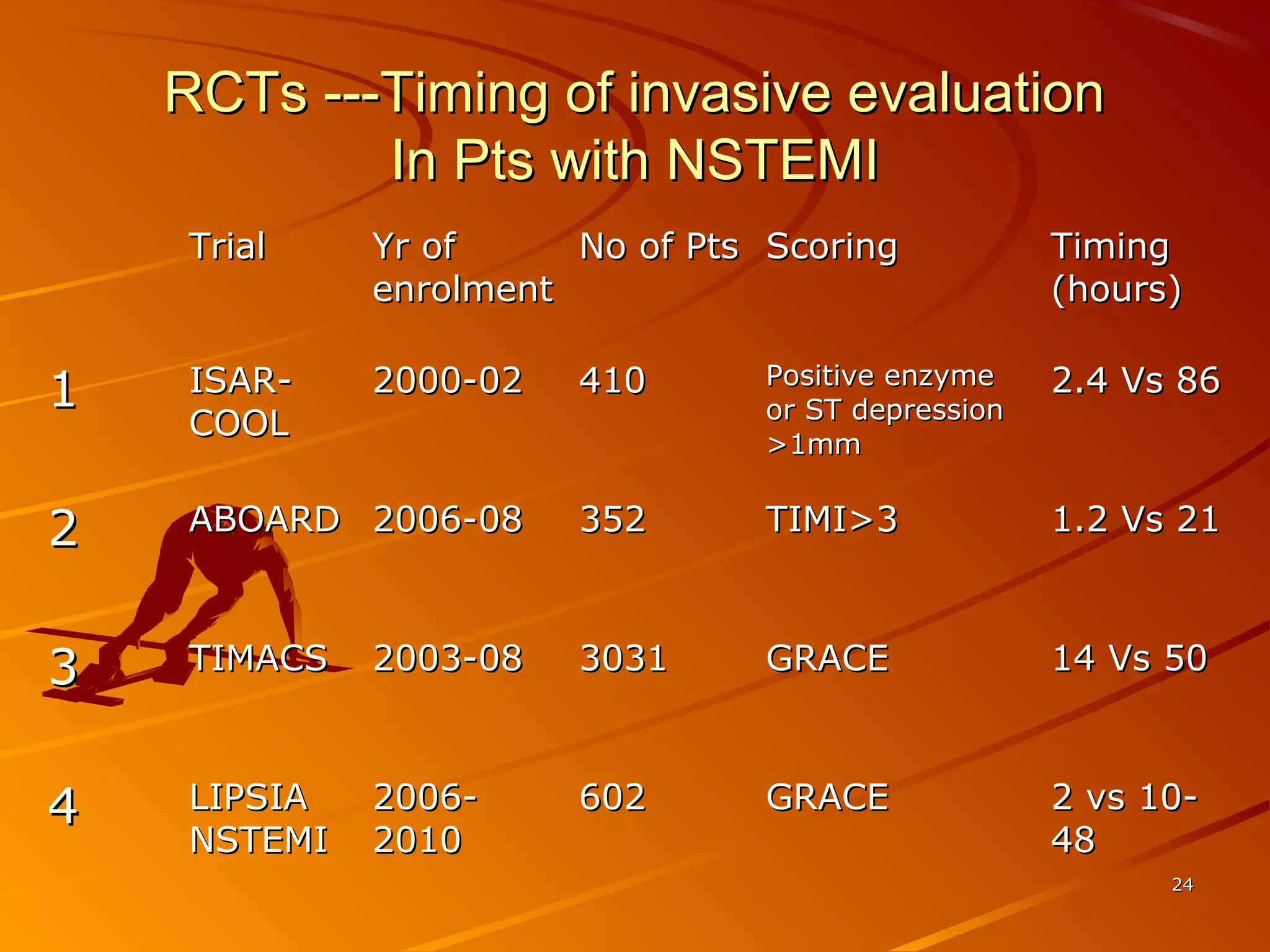
RCTs ---Timing of invasive evaluationRCTs ---Timing of invasive evaluation
In Pts with NSTEMIIn Pts with NSTEMI
TrialTrial Yr ofYr of
enrolmentenrolment
No of PtsNo of Pts ScoringScoring TimingTiming
(hours)(hours)
11 ISAR-ISAR-
COOLCOOL
2000-022000-02 410410 Positive enzymePositive enzyme
or ST depressionor ST depression
>1mm>1mm
2.4 Vs 862.4 Vs 86
22 ABOARDABOARD 2006-082006-08 352352 TIMI>3TIMI>3 1.2 Vs 211.2 Vs 21
33 TIMACSTIMACS 2003-082003-08 30313031 GRACEGRACE 14 Vs 5014 Vs 50
44 LIPSIALIPSIA
NSTEMINSTEMI
2006-2006-
20102010
602602 GRACEGRACE 2 vs 10-2 vs 10-
4848
TIMACS trialTIMACS trial
14 hr Vs 52 hr14 hr Vs 52 hr
Early versus Delayed InvasiveEarly versus Delayed Invasive
InterventionIntervention
in Acute Coronary Syndromesin Acute Coronary Syndromes
2525
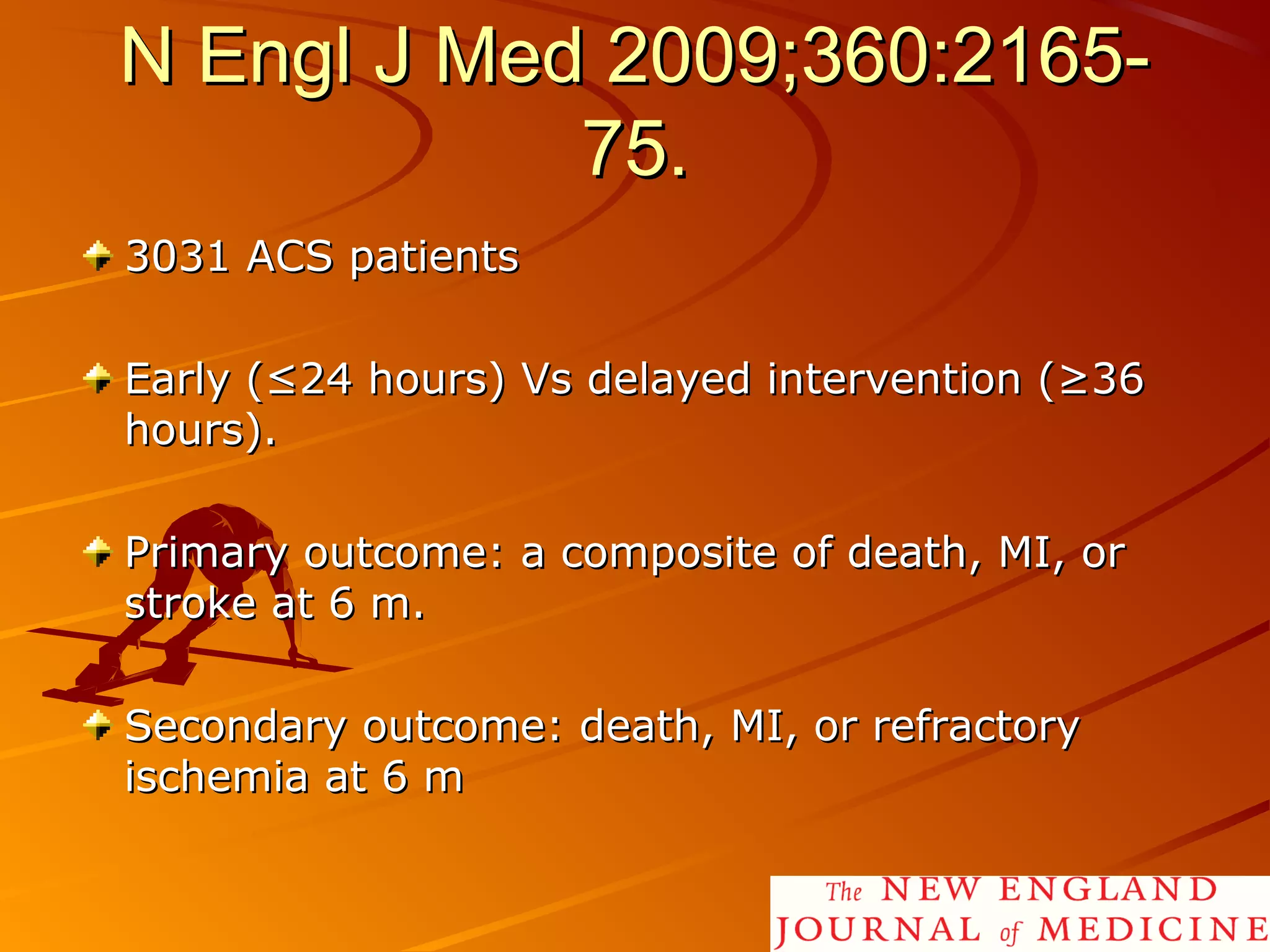
N Engl J Med 2009;360:2165-N Engl J Med 2009;360:2165-
75.75.
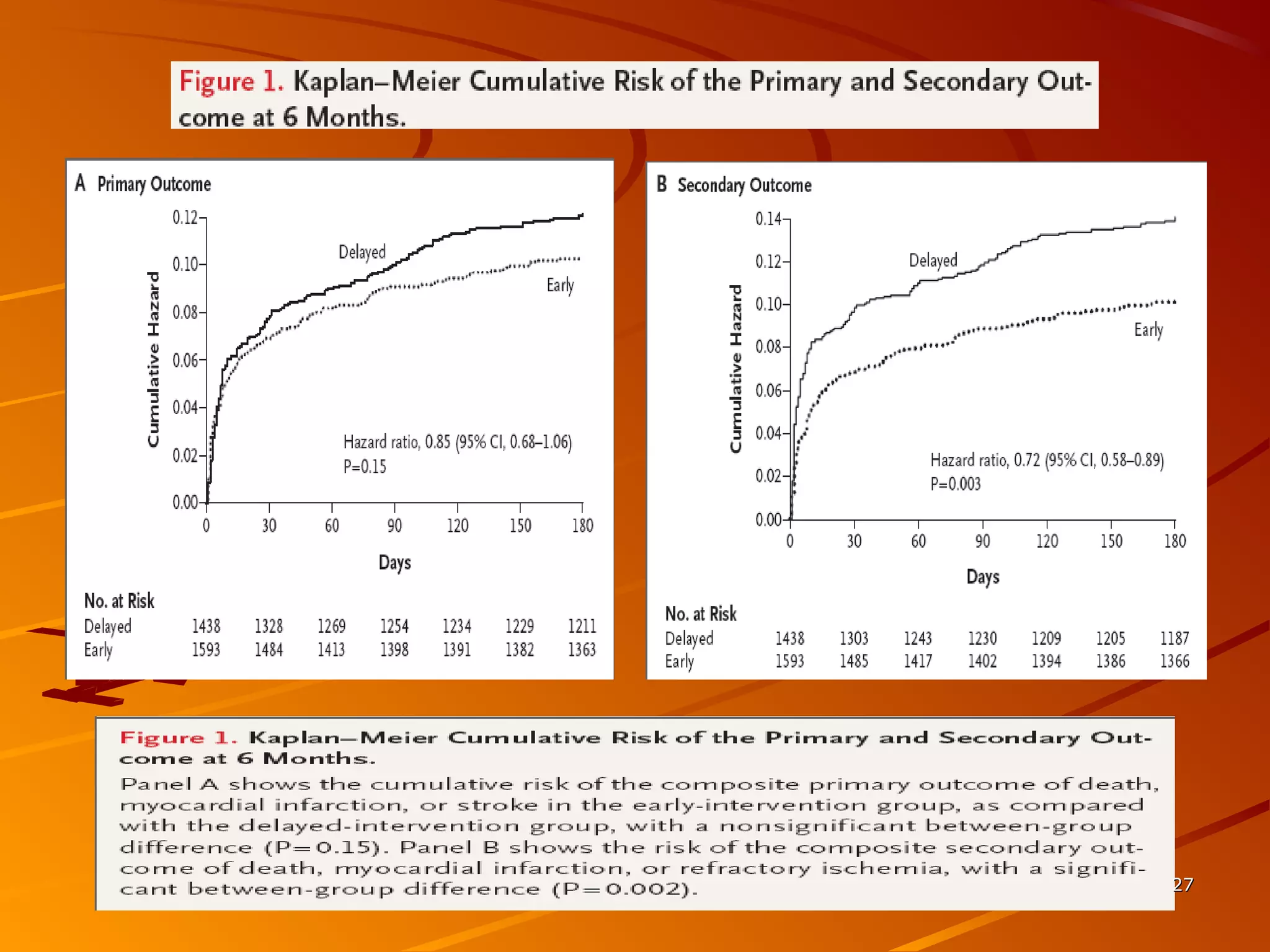
3031 ACS patients3031 ACS patients
Early (≤24 hours) Vs delayed intervention (≥36Early (≤24 hours) Vs delayed intervention (≥36
hours).hours).
Primary outcome: a composite of death, MI, orPrimary outcome: a composite of death, MI, or
stroke at 6 m.stroke at 6 m.
Secondary outcome: death, MI, or refractorySecondary outcome: death, MI, or refractory
ischemia at 6 mischemia at 6 m
2626
2727
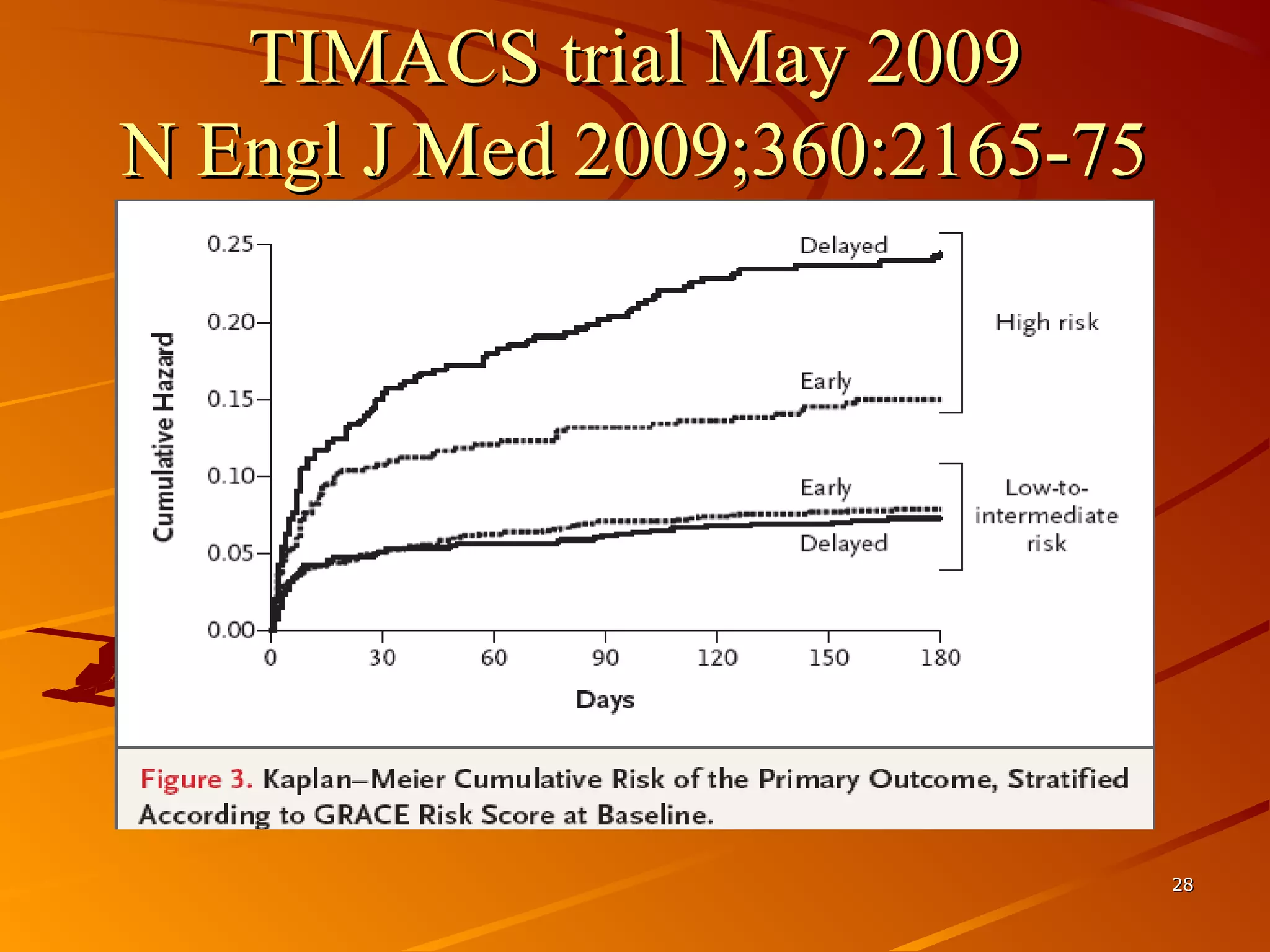
TIMACS trial May 2009TIMACS trial May 2009
N Engl J Med 2009;360:2165-75N Engl J Med 2009;360:2165-75
2828
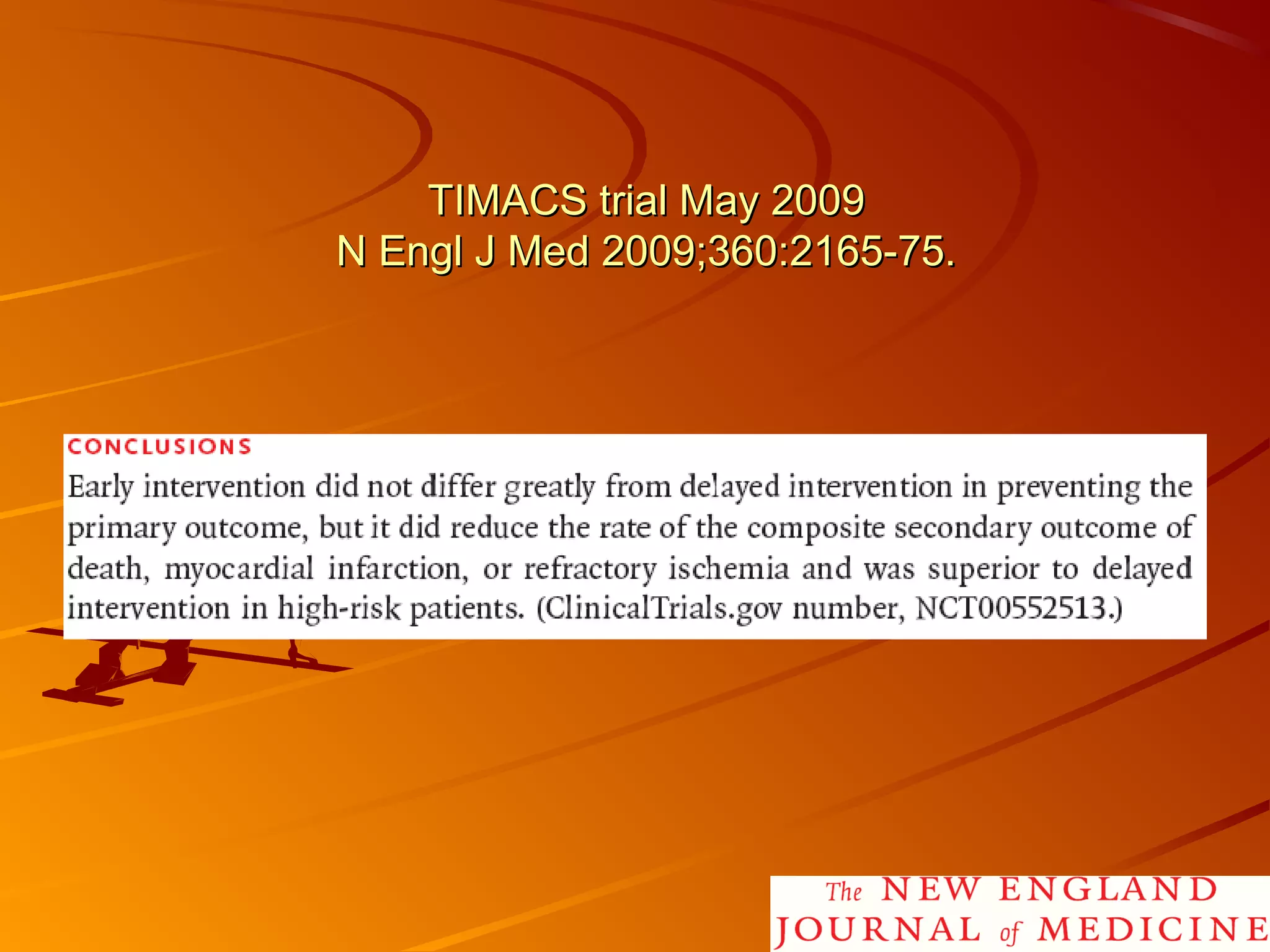
TIMACS trial May 2009TIMACS trial May 2009
N Engl J Med 2009;360:2165-75.N Engl J Med 2009;360:2165-75.
2929
3030
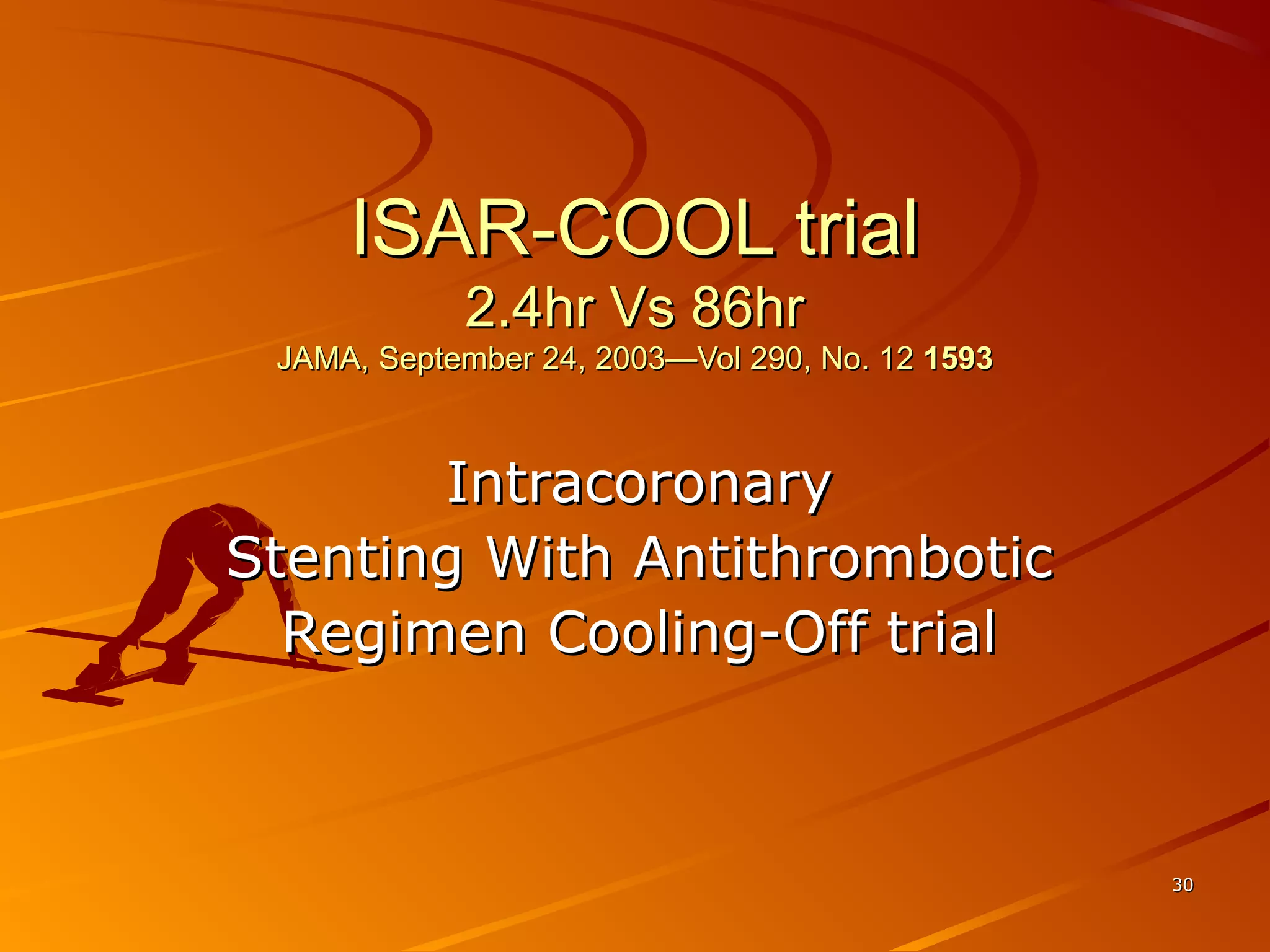
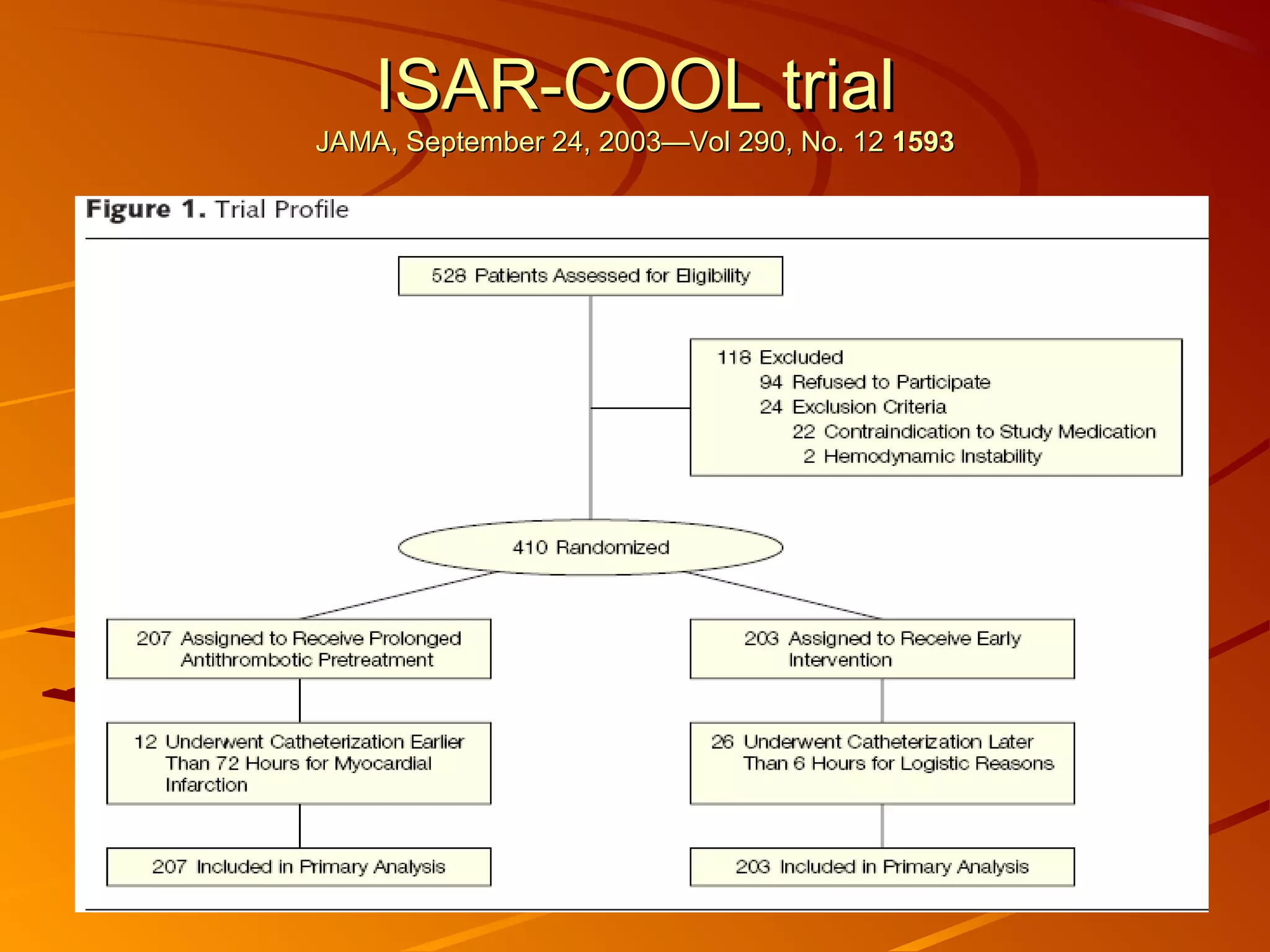
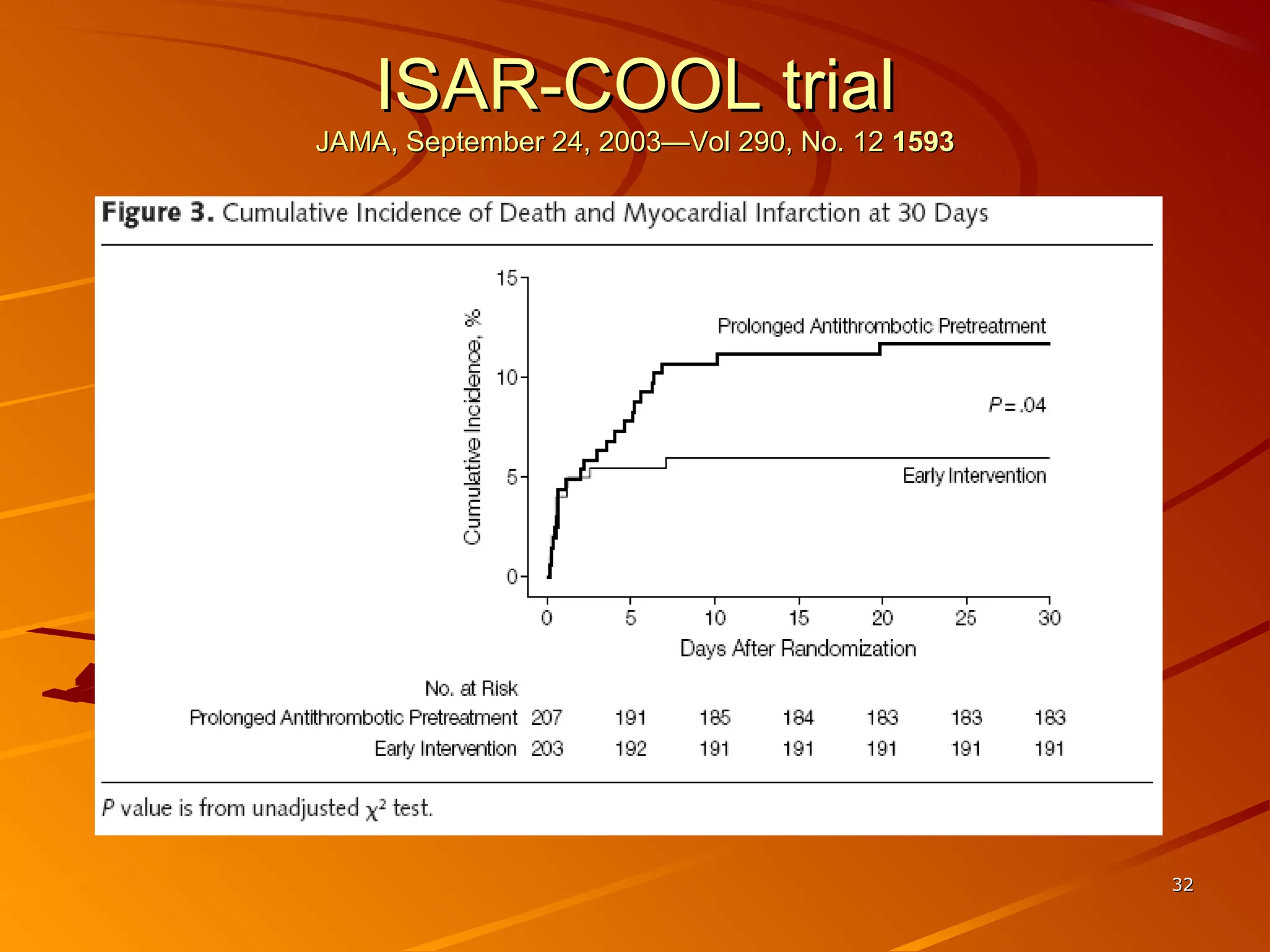
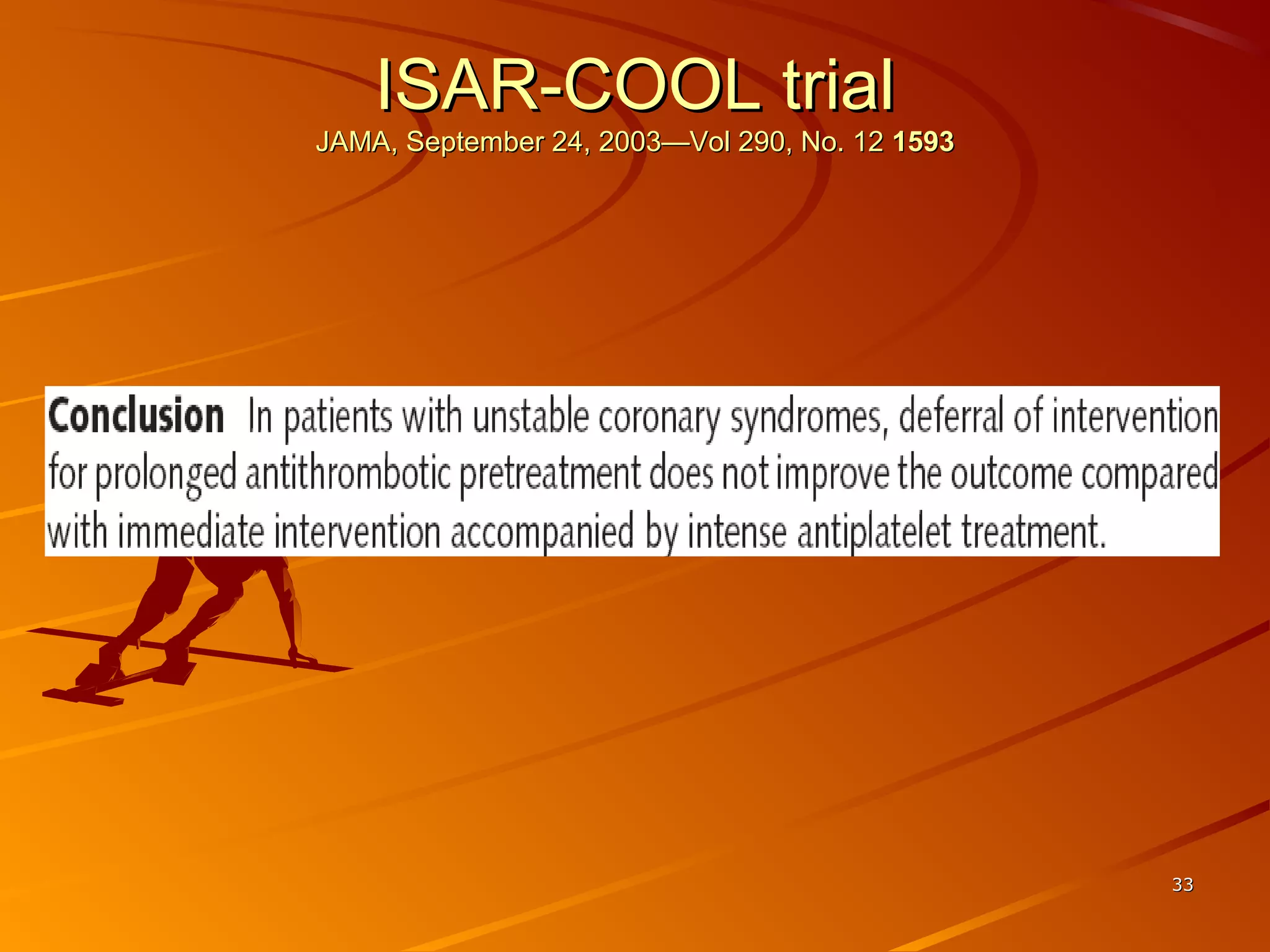
ISAR-COOL trialISAR-COOL trial
2.4hr Vs 86hr2.4hr Vs 86hr
JAMA, September 24, 2003—Vol 290, No. 12JAMA, September 24, 2003—Vol 290, No. 12 15931593
IntracoronaryIntracoronary
Stenting With AntithromboticStenting With Antithrombotic
Regimen Cooling-Off trialRegimen Cooling-Off trial
3131
ISAR-COOL trialISAR-COOL trial
JAMA, September 24, 2003—Vol 290, No. 12JAMA, September 24, 2003—Vol 290, No. 12 15931593
3232
ISAR-COOL trialISAR-COOL trial
JAMA, September 24, 2003—Vol 290, No. 12JAMA, September 24, 2003—Vol 290, No. 12 15931593
3333
ISAR-COOL trialISAR-COOL trial
JAMA, September 24, 2003—Vol 290, No. 12JAMA, September 24, 2003—Vol 290, No. 12 15931593
3434
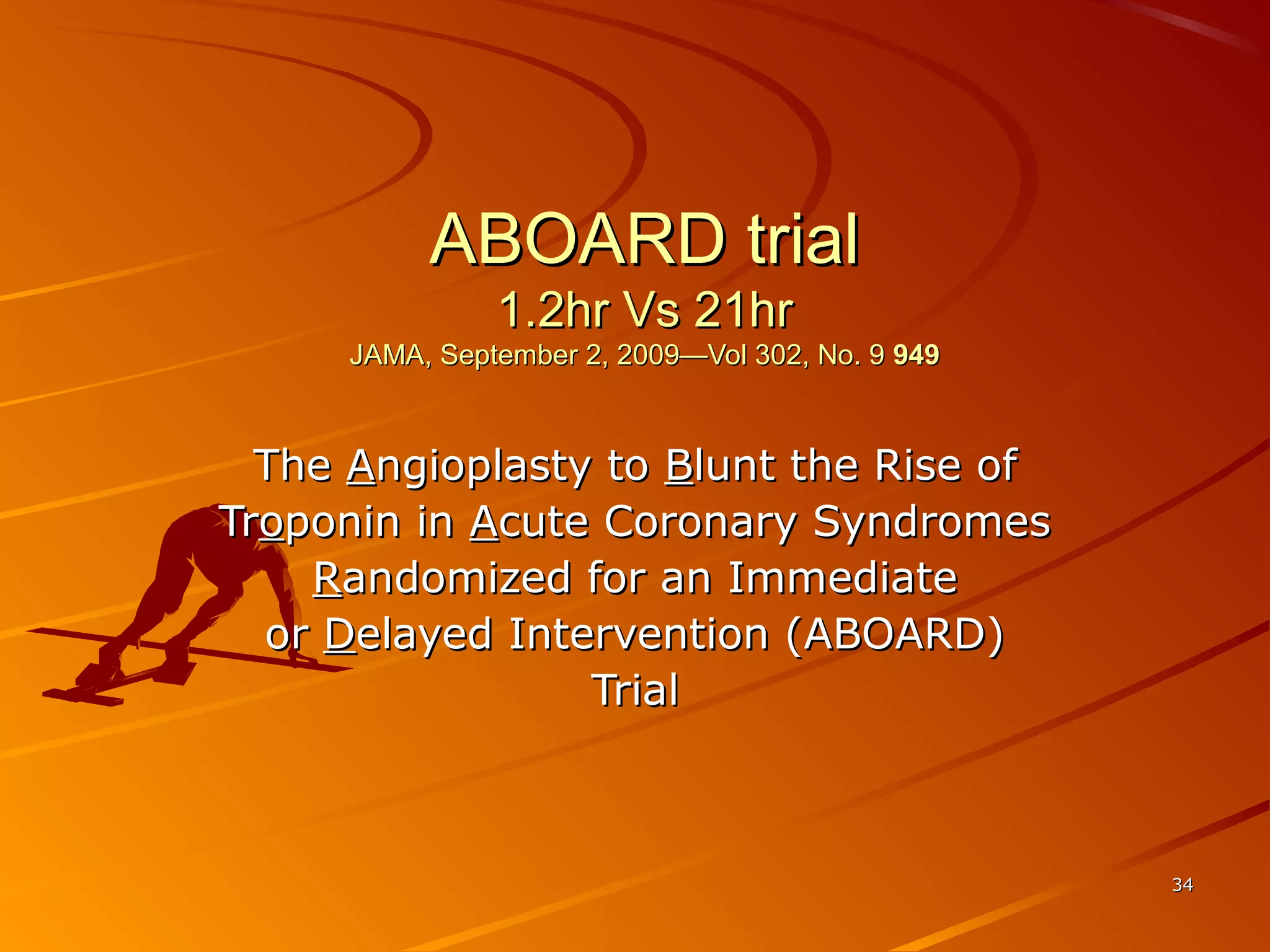
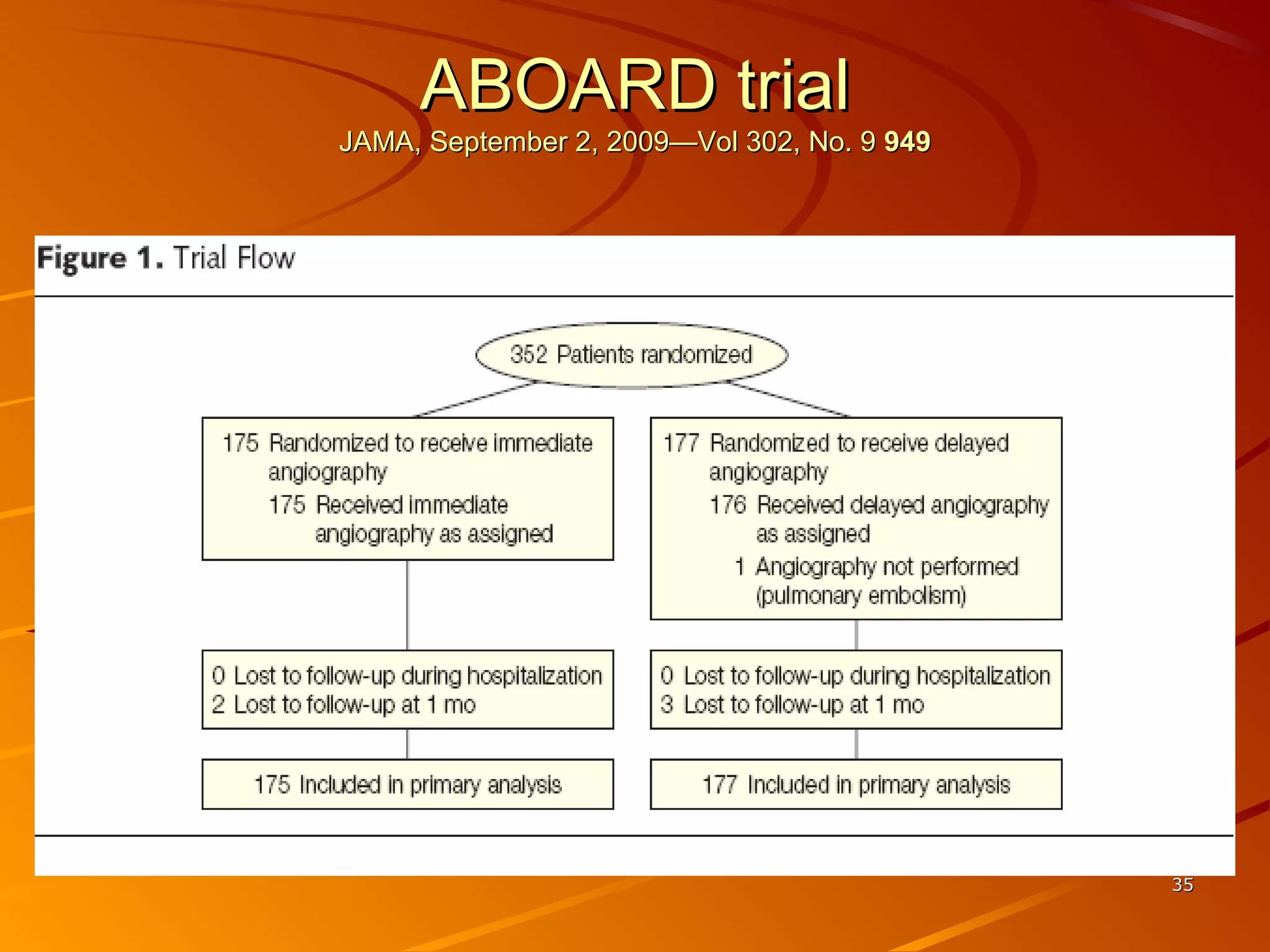
ABOARD trialABOARD trial
1.2hr Vs 21hr1.2hr Vs 21hr
JAMA, September 2, 2009—Vol 302, No. 9JAMA, September 2, 2009—Vol 302, No. 9 949949
TheThe AAngioplasty tongioplasty to BBlunt the Rise oflunt the Rise of
TrTrooponin inponin in AAcute Coronary Syndromescute Coronary Syndromes
RRandomized for an Immediateandomized for an Immediate
oror DDelayed Intervention (ABOARD)elayed Intervention (ABOARD)
TrialTrial
3535
ABOARD trialABOARD trial
JAMA, September 2, 2009—Vol 302, No. 9JAMA, September 2, 2009—Vol 302, No. 9 949949
3636
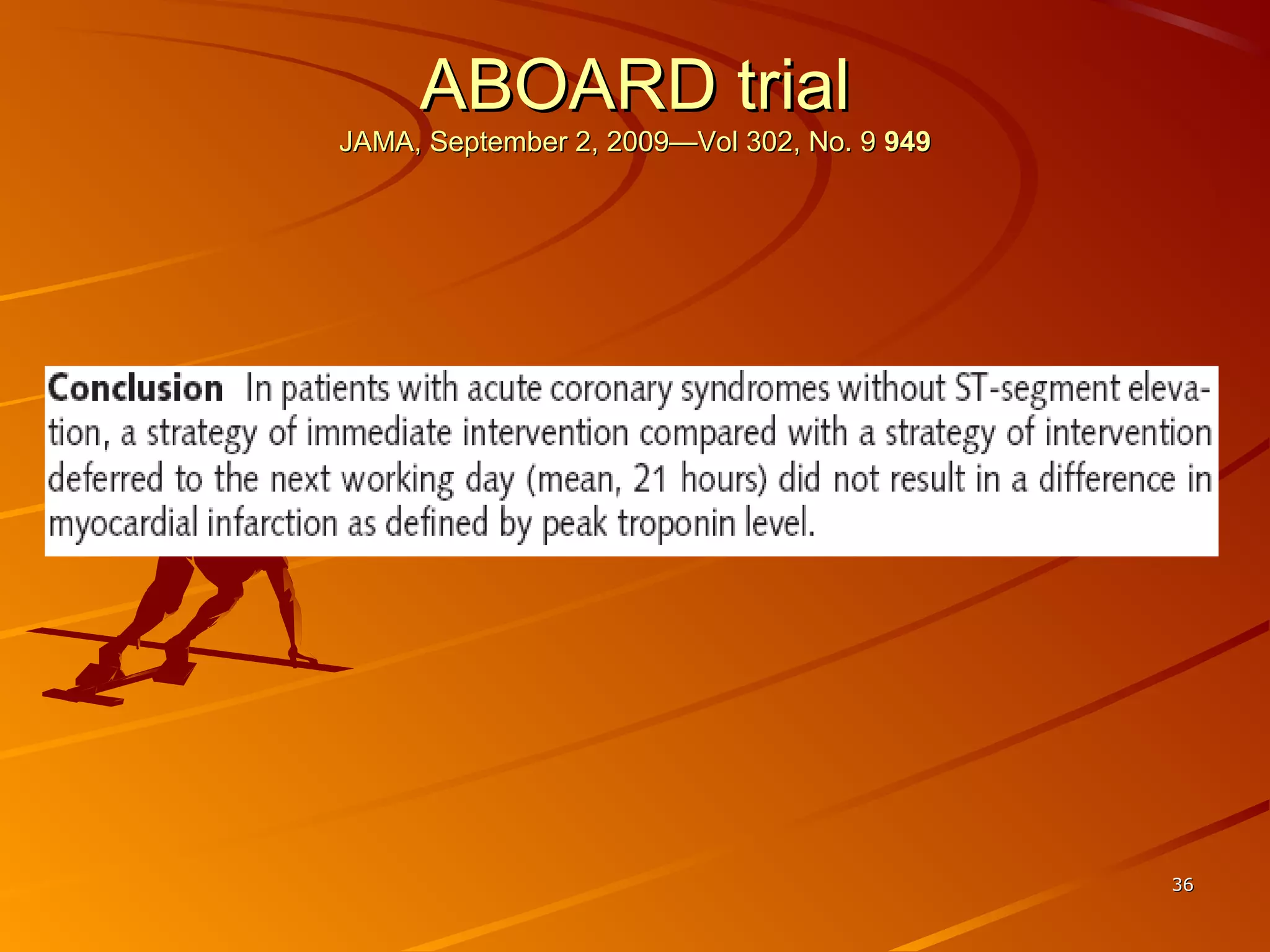
ABOARD trialABOARD trial
JAMA, September 2, 2009—Vol 302, No. 9JAMA, September 2, 2009—Vol 302, No. 9 949949
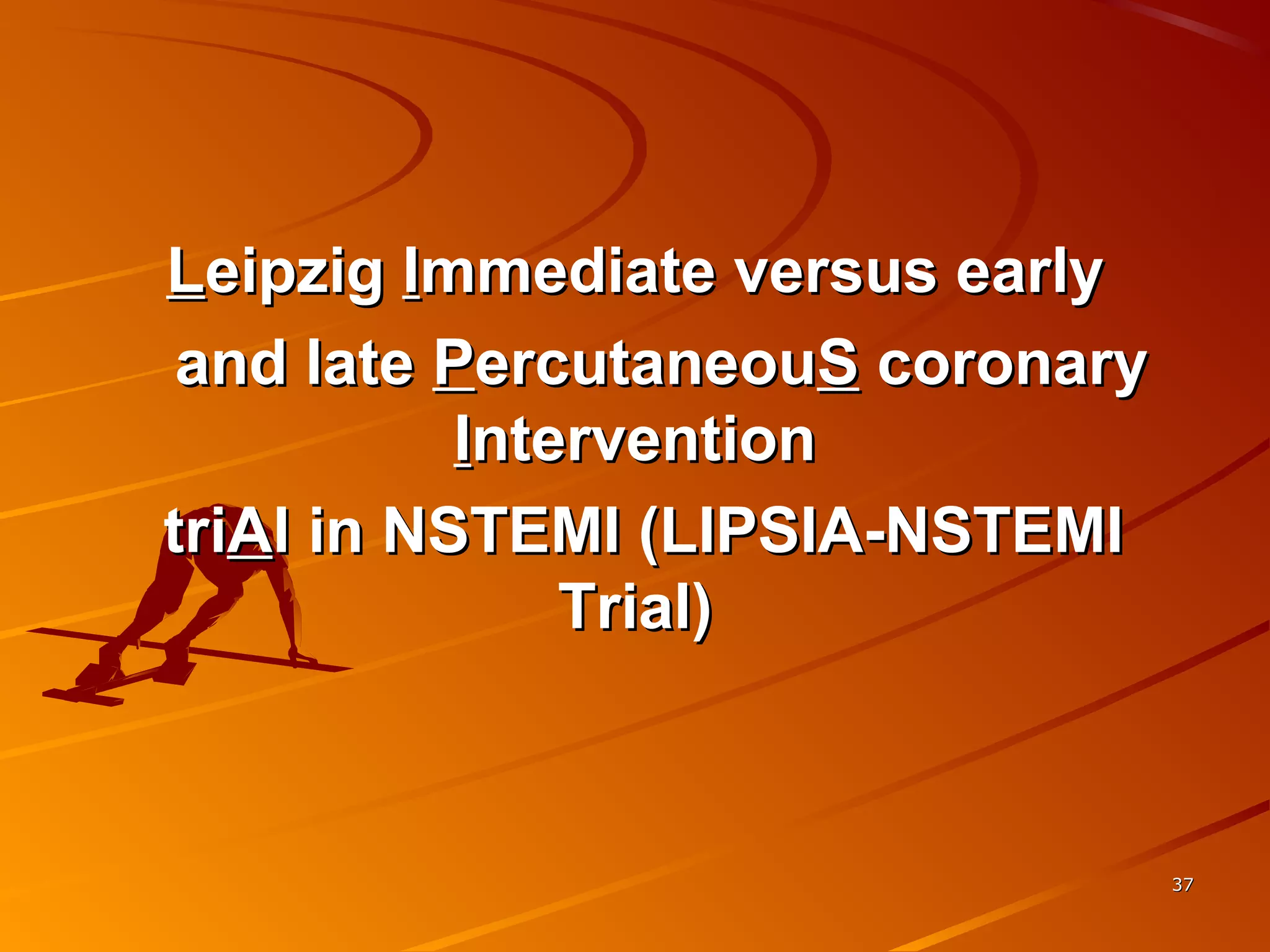
LLeipzigeipzig IImmediate versus earlymmediate versus early
and lateand late PPercutaneouercutaneouSS coronarycoronary
IInterventionntervention
tritriAAl in NSTEMI (LIPSIA-NSTEMIl in NSTEMI (LIPSIA-NSTEMI
Trial)Trial)
3737
3838
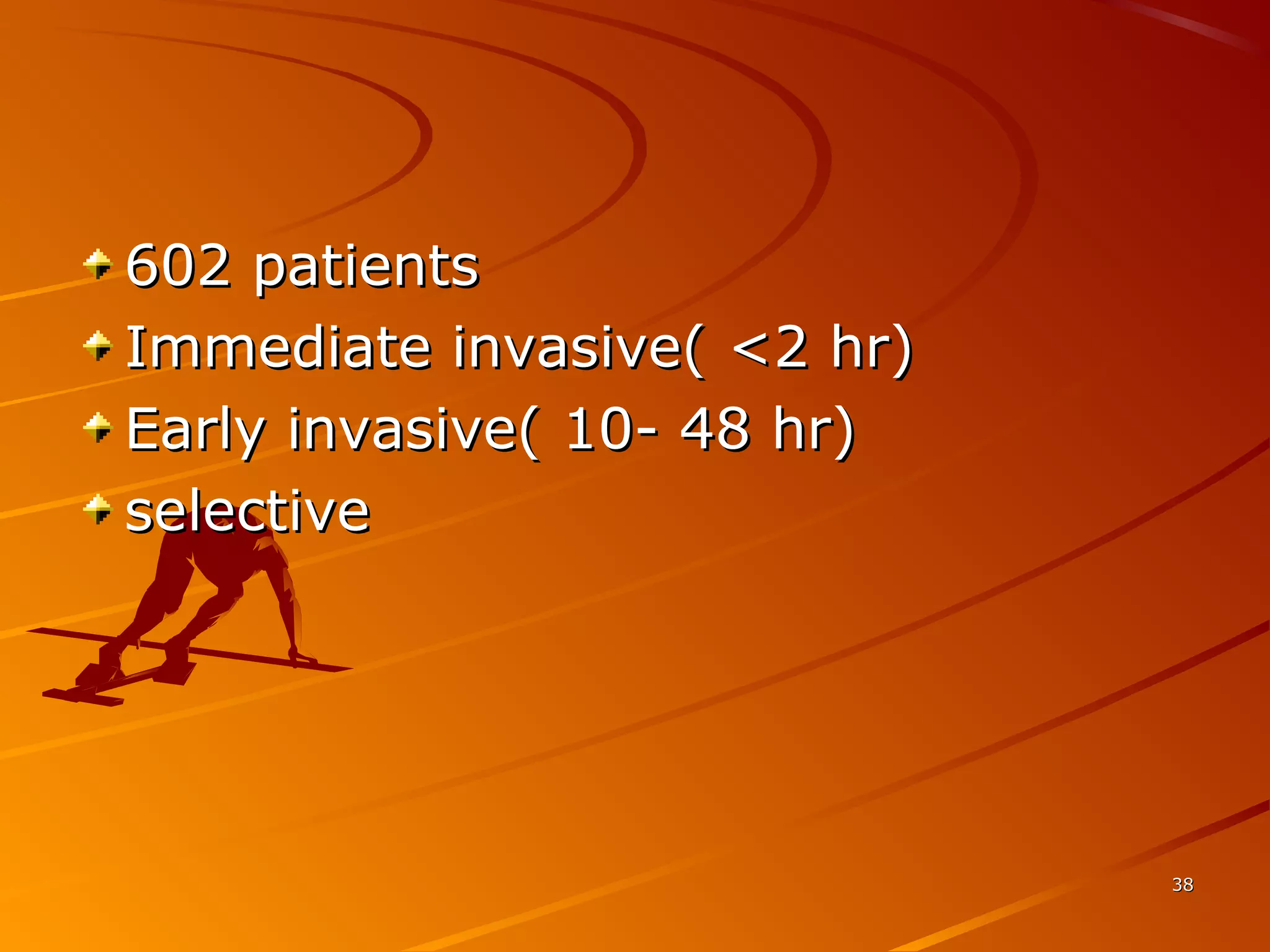
602 patients602 patients
Immediate invasive( <2 hr)Immediate invasive( <2 hr)
Early invasive( 10- 48 hr)Early invasive( 10- 48 hr)
selectiveselective
Primary OutcomePrimary Outcome
Peak CK-MB activityPeak CK-MB activity
Area under curve of CK MB releaseArea under curve of CK MB release
3939
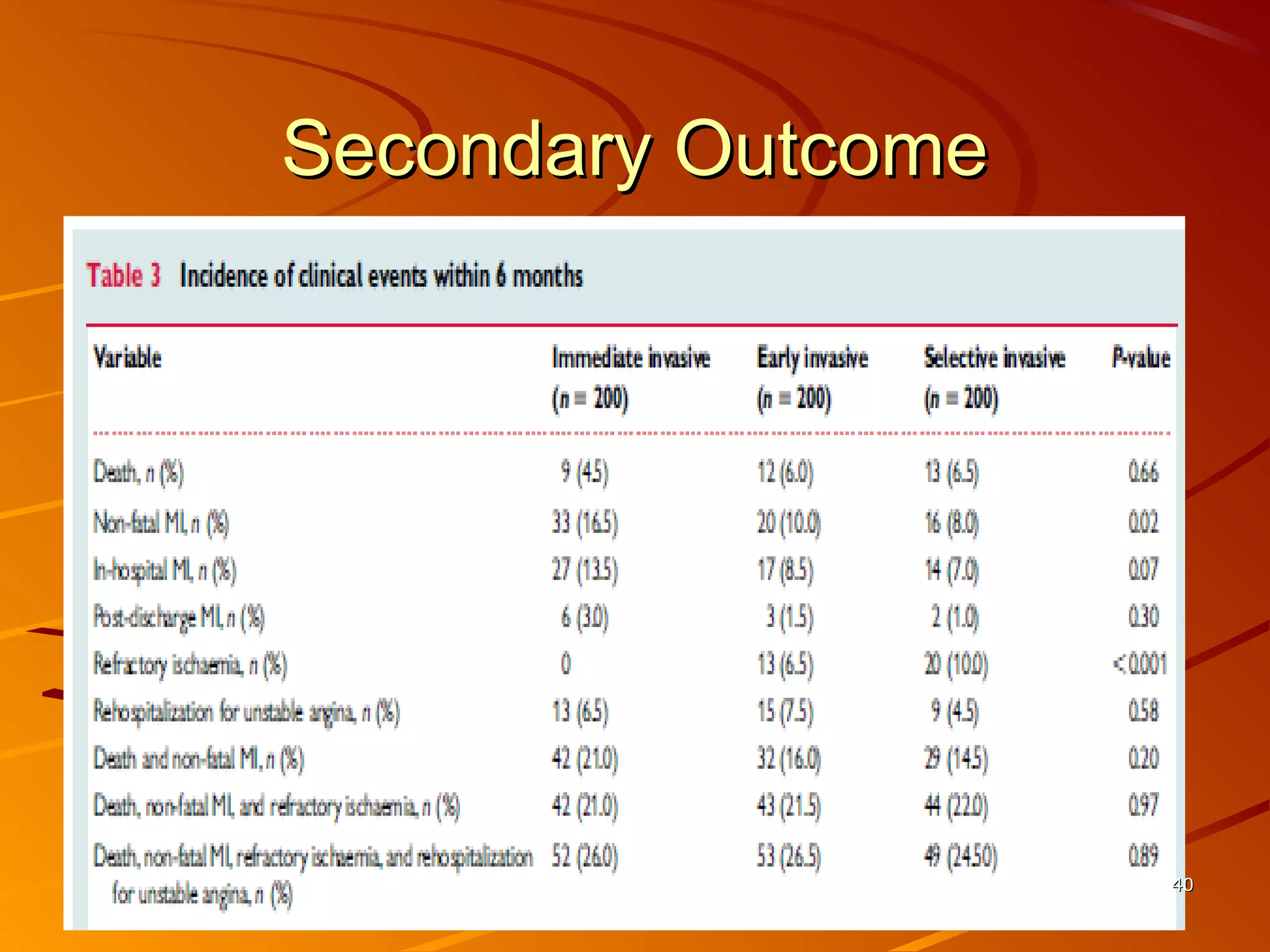
Not Different
Secondary OutcomeSecondary Outcome
4040
4141
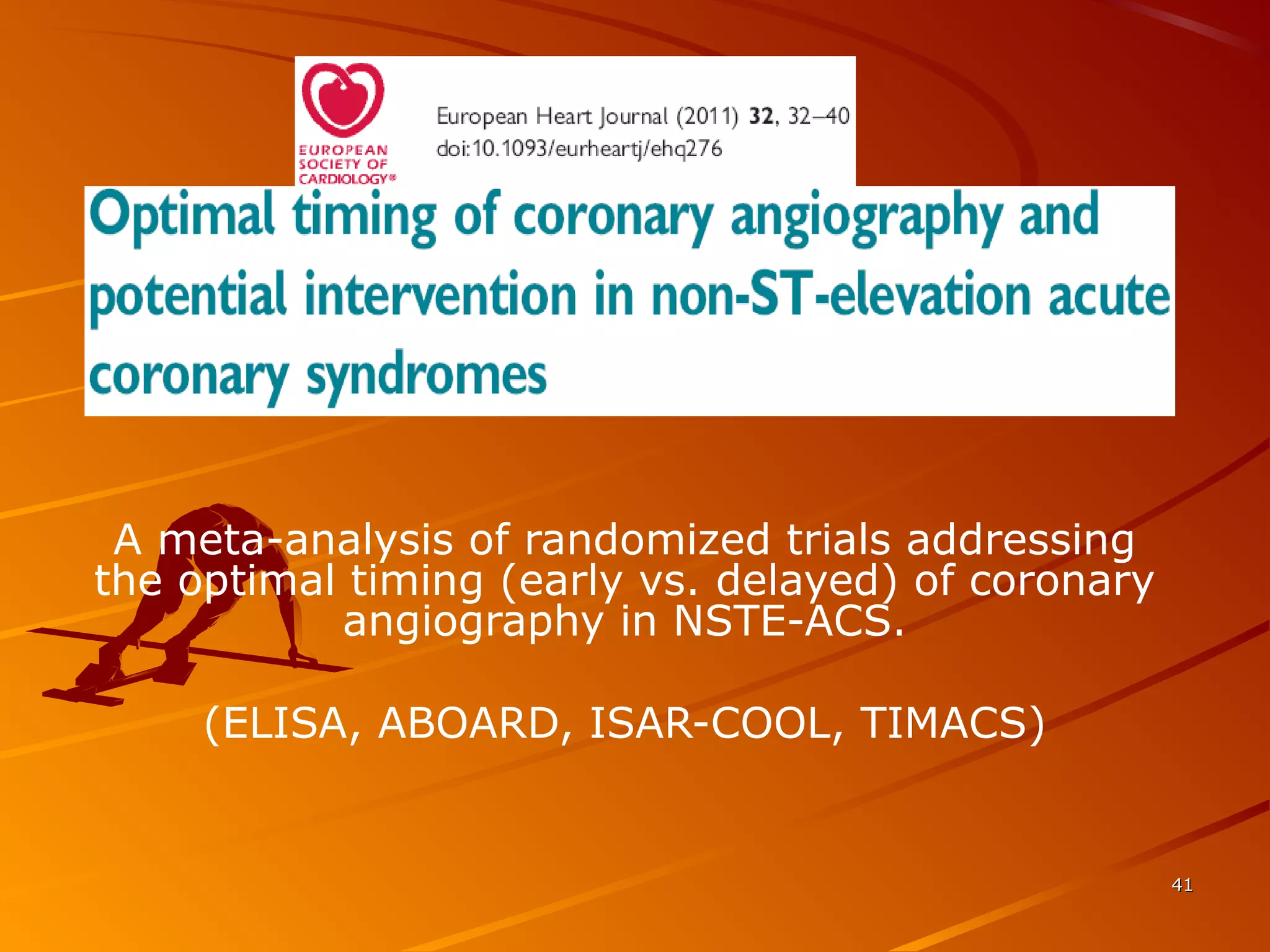
A meta-analysis of randomized trials addressing
the optimal timing (early vs. delayed) of coronary
angiography in NSTE-ACS.
(ELISA, ABOARD, ISAR-COOL, TIMACS)
4242
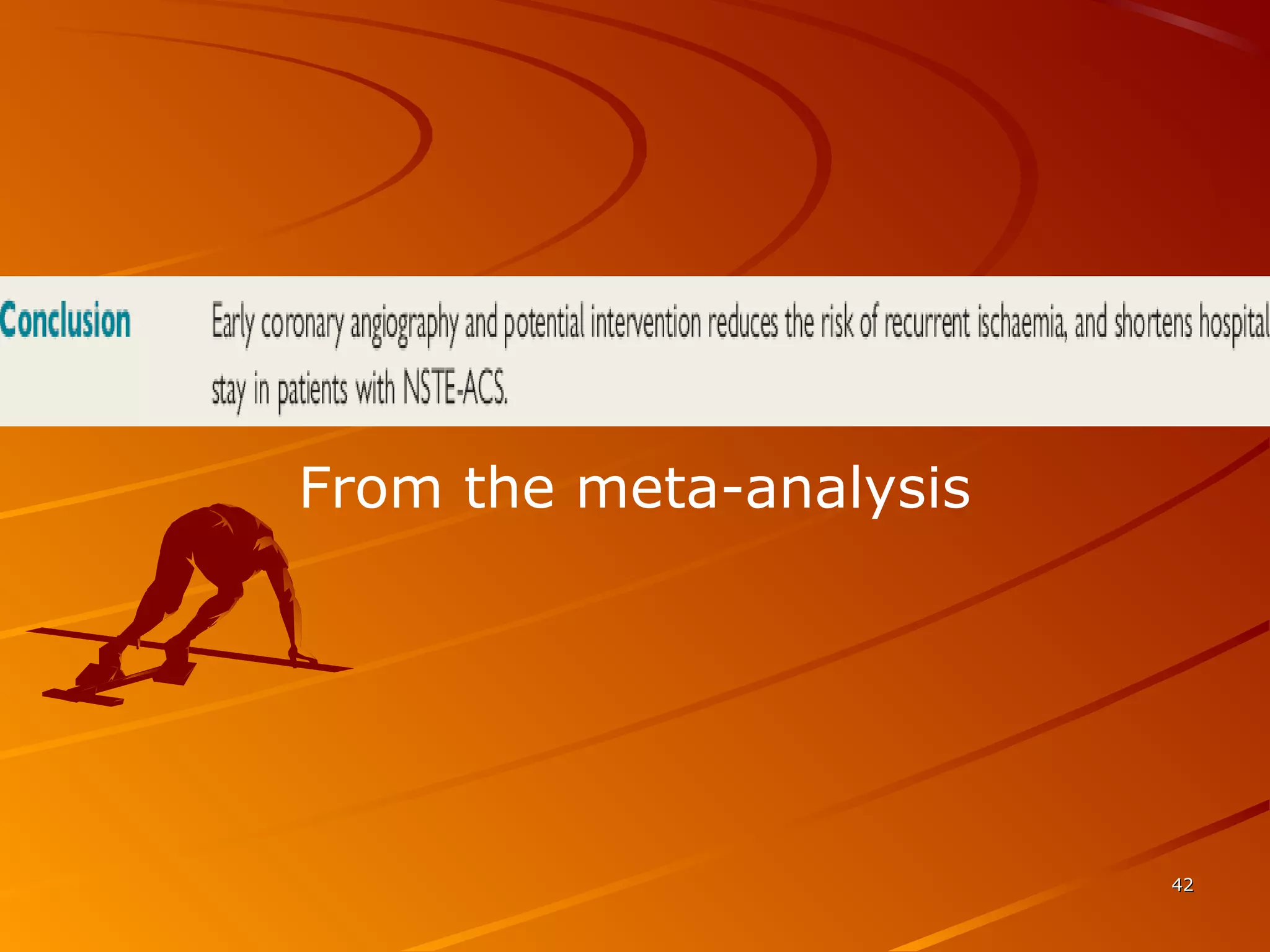
From the meta-analysis
DRUGS TO BEDRUGS TO BE
USEDUSED
4343
4444
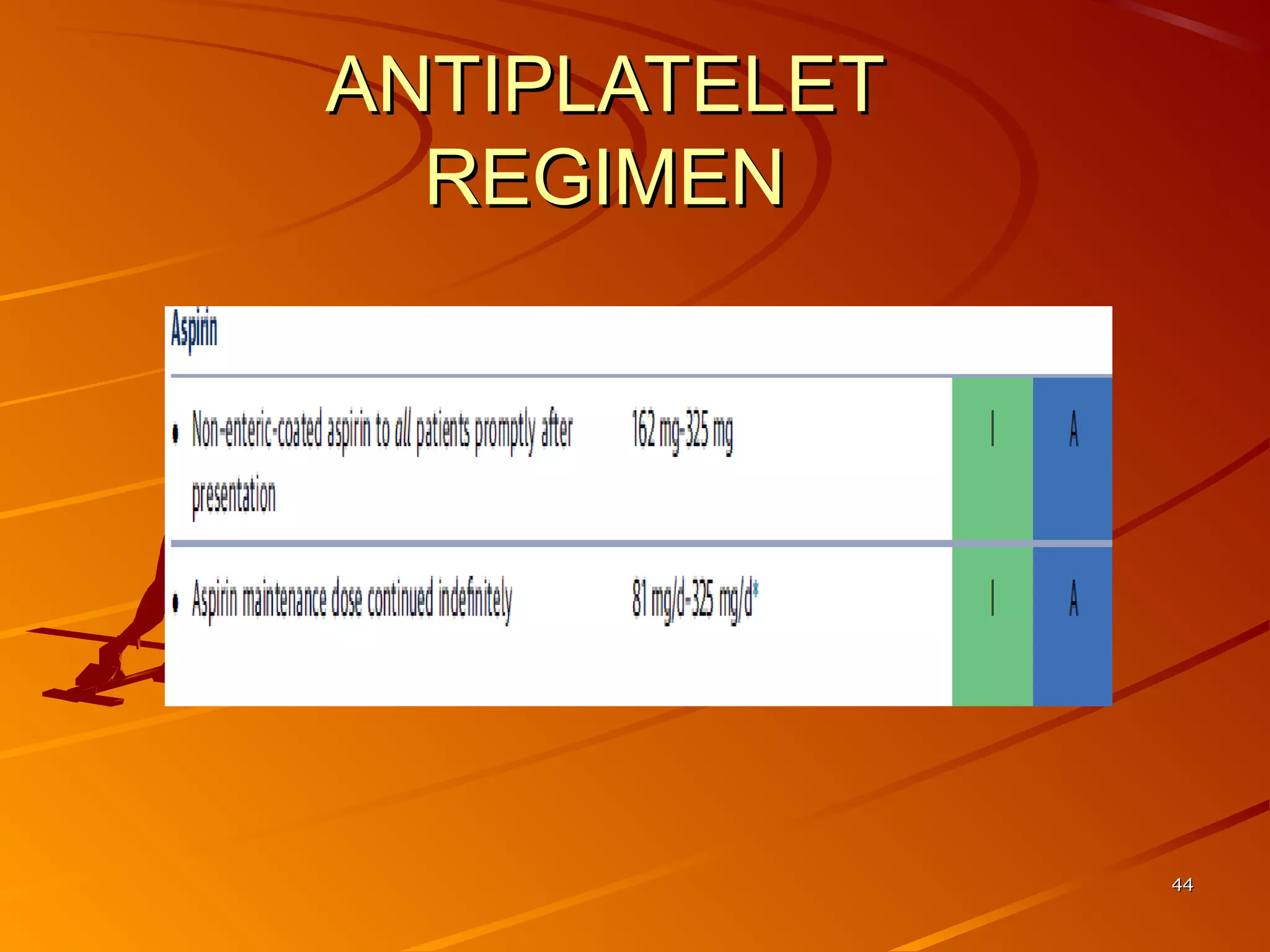
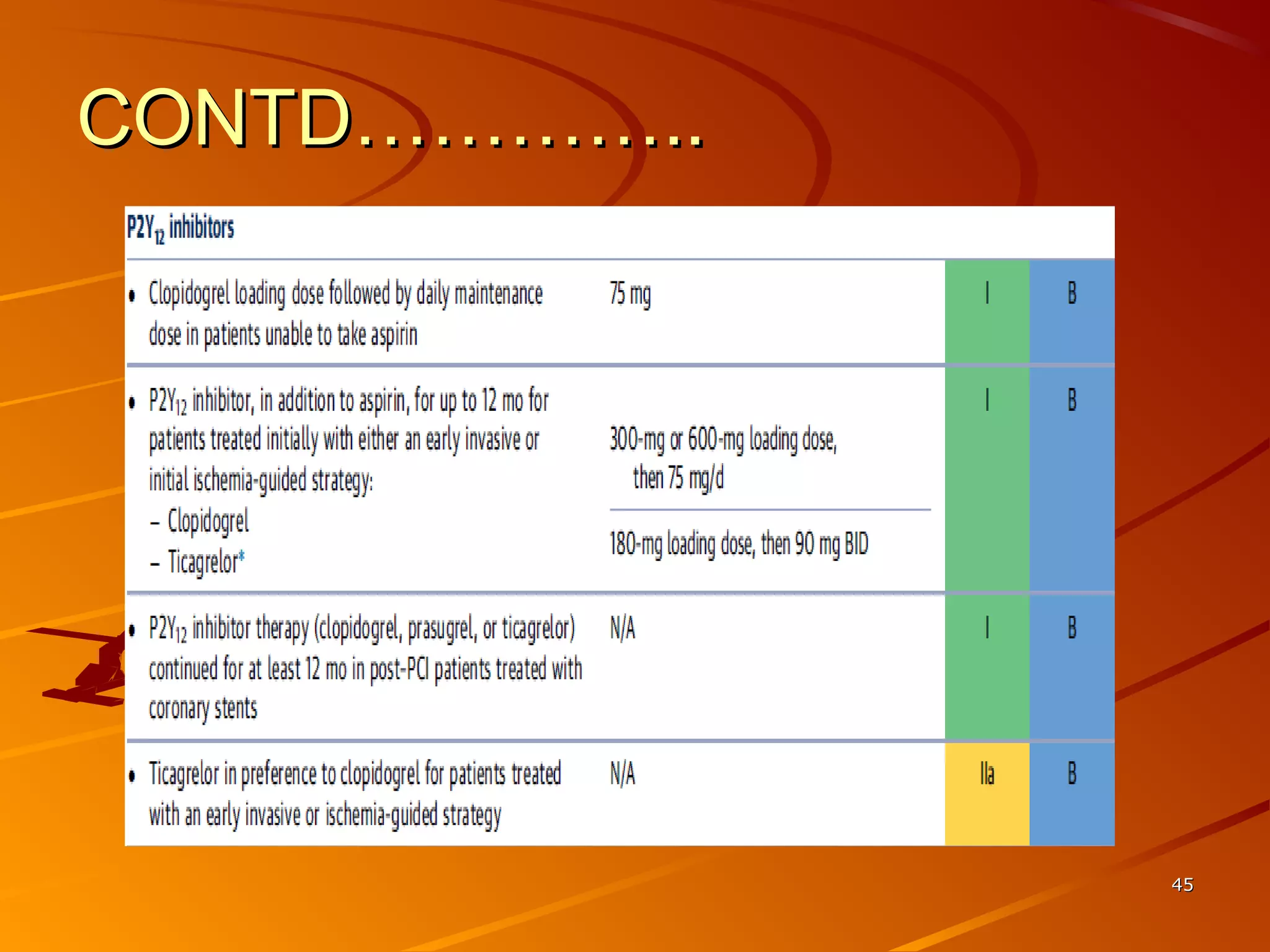
ANTIPLATELETANTIPLATELET
REGIMENREGIMEN
CONTD…………..CONTD…………..
4545
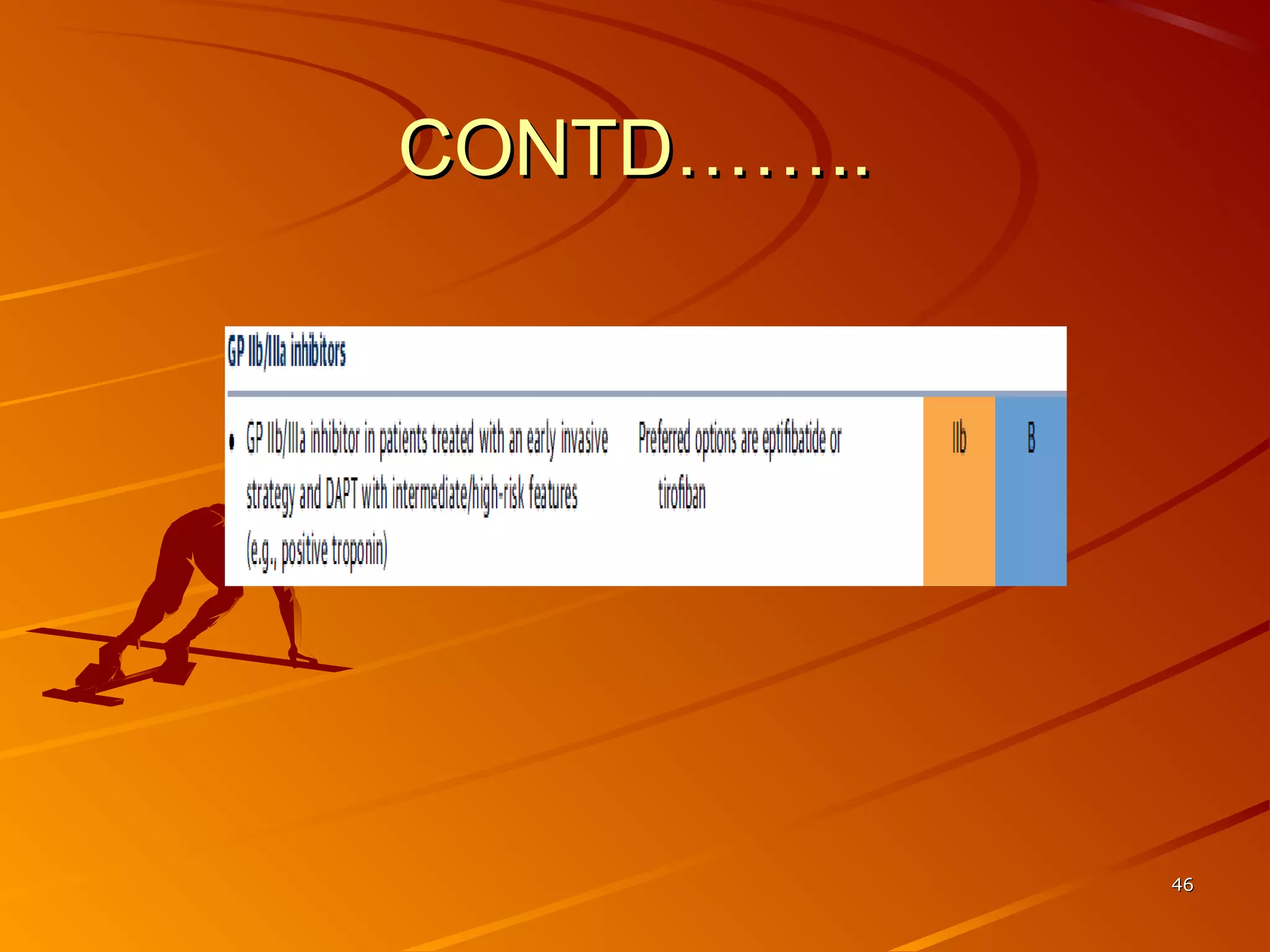
CONTD……..CONTD……..
4646
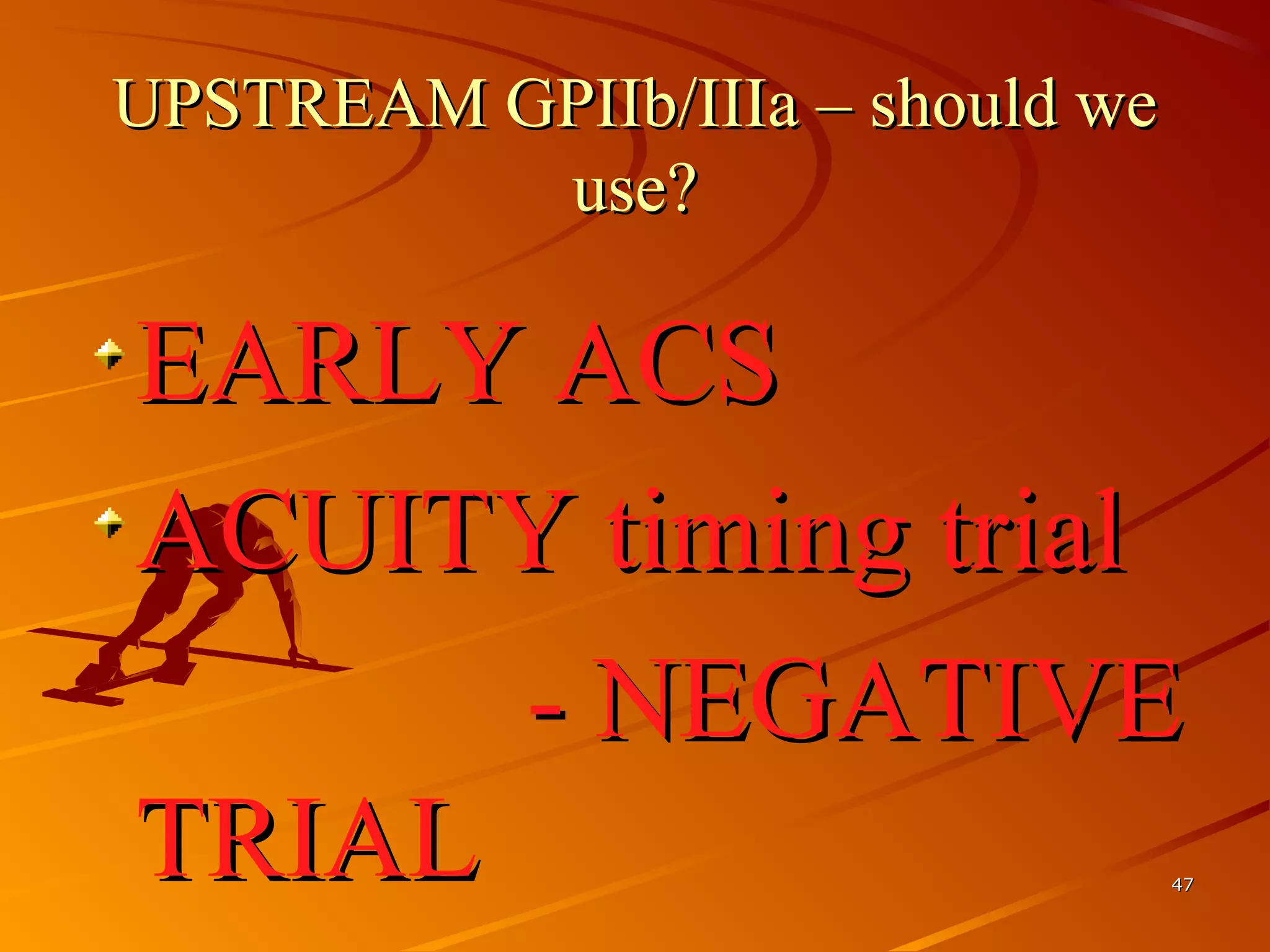
UPSTREAM GPIIb/IIIa – should weUPSTREAM GPIIb/IIIa – should we
use?use?
EARLY ACSEARLY ACS
ACUITY timing trialACUITY timing trial
- NEGATIVE- NEGATIVE
TRIALTRIAL 4747
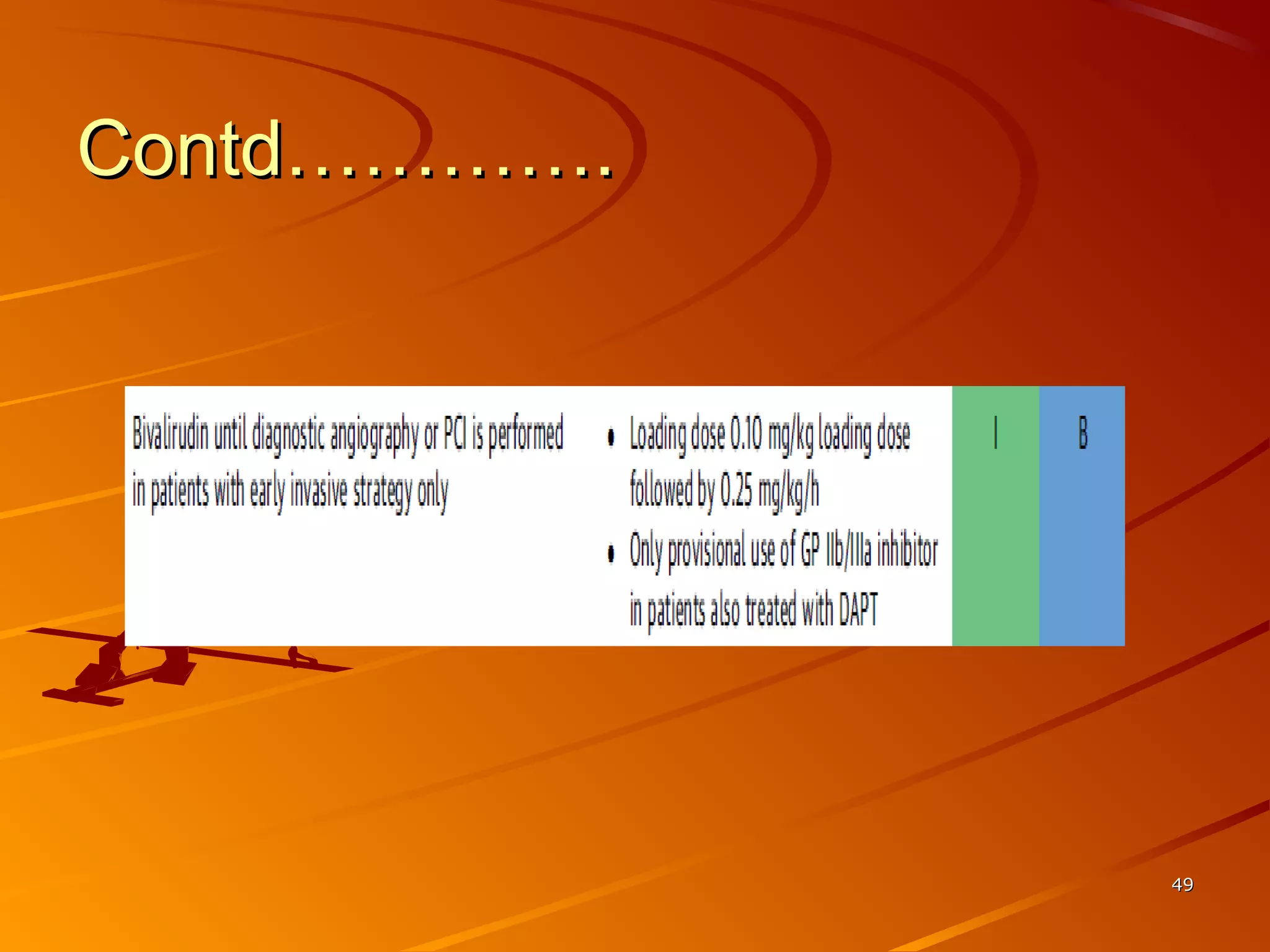
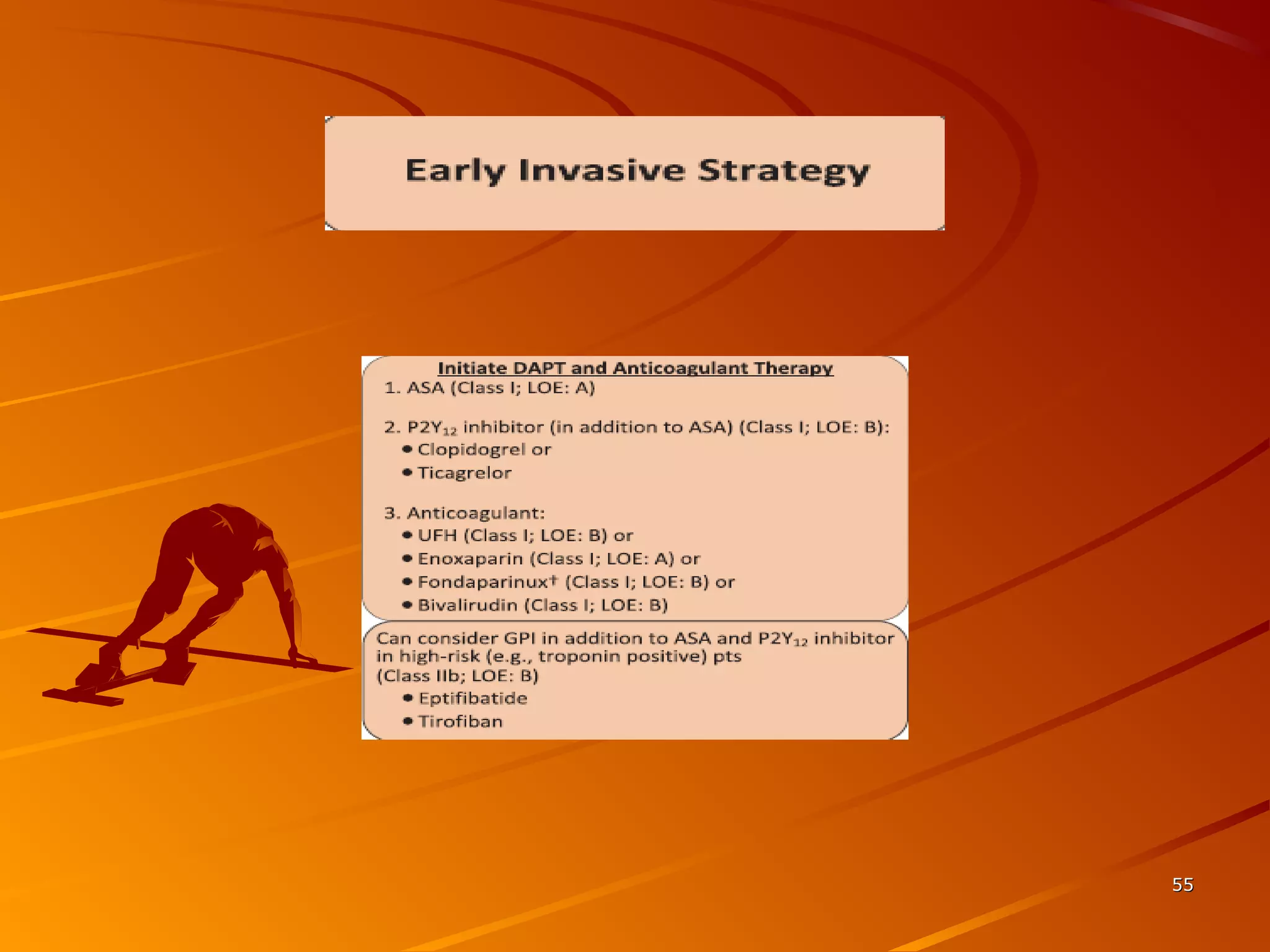
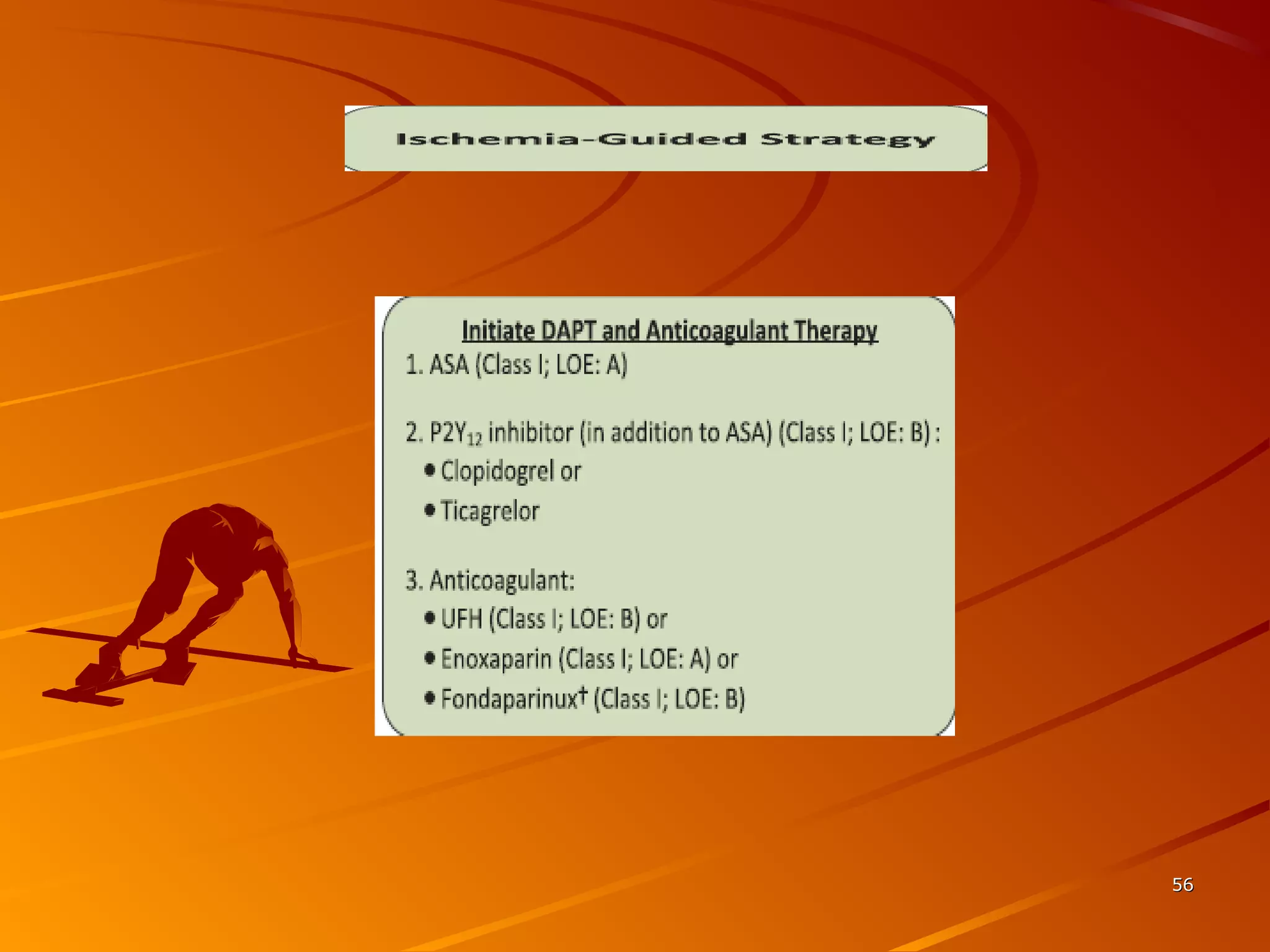
Anticoagulant StrategyAnticoagulant Strategy
4848
Contd………….Contd………….
4949
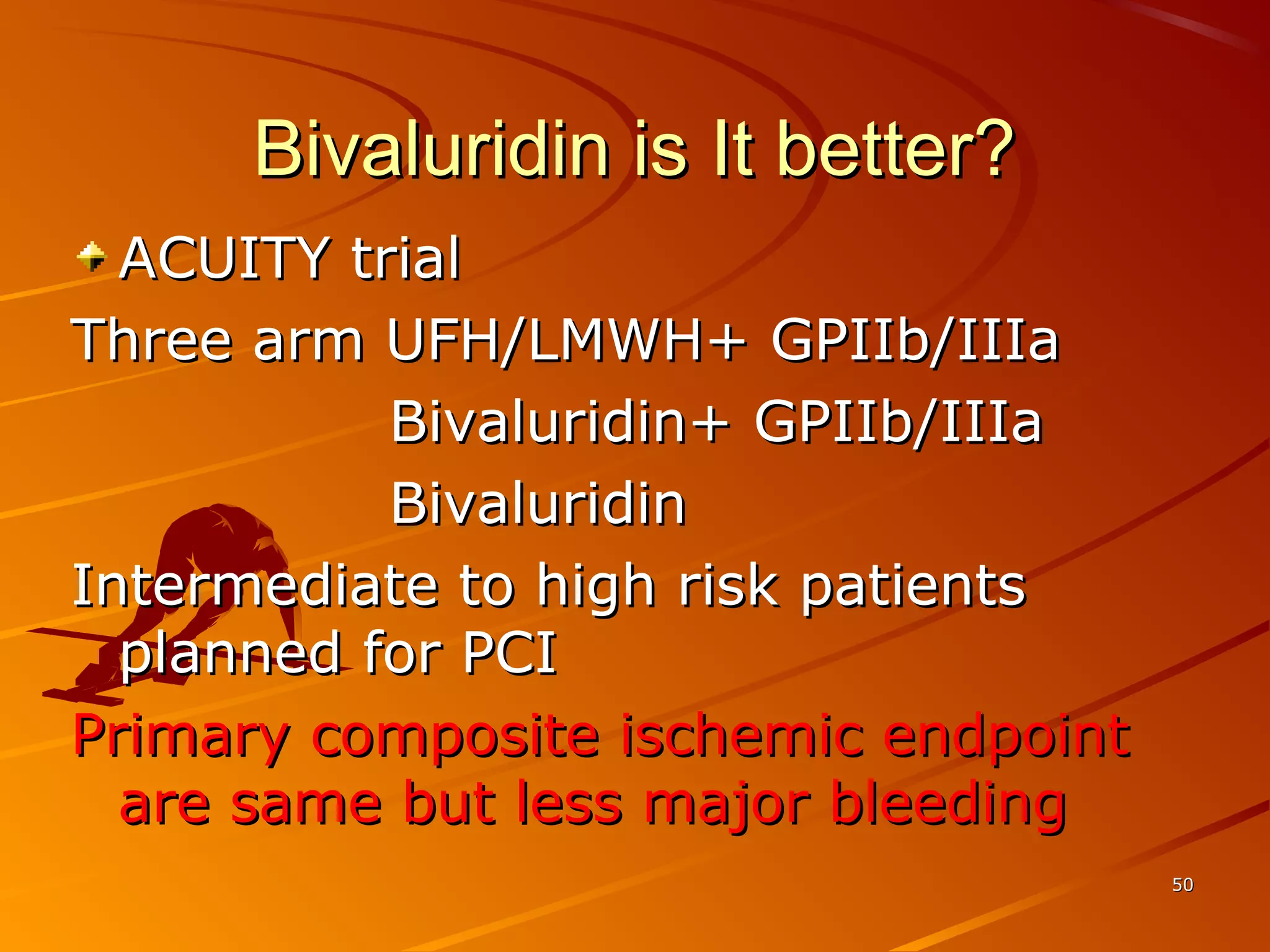
Bivaluridin is It better?Bivaluridin is It better?
ACUITY trialACUITY trial
Three arm UFH/LMWH+ GPIIb/IIIaThree arm UFH/LMWH+ GPIIb/IIIa
Bivaluridin+ GPIIb/IIIaBivaluridin+ GPIIb/IIIa
BivaluridinBivaluridin
Intermediate to high risk patientsIntermediate to high risk patients
planned for PCIplanned for PCI
Primary composite ischemic endpointPrimary composite ischemic endpoint
are same but less major bleedingare same but less major bleeding
5050
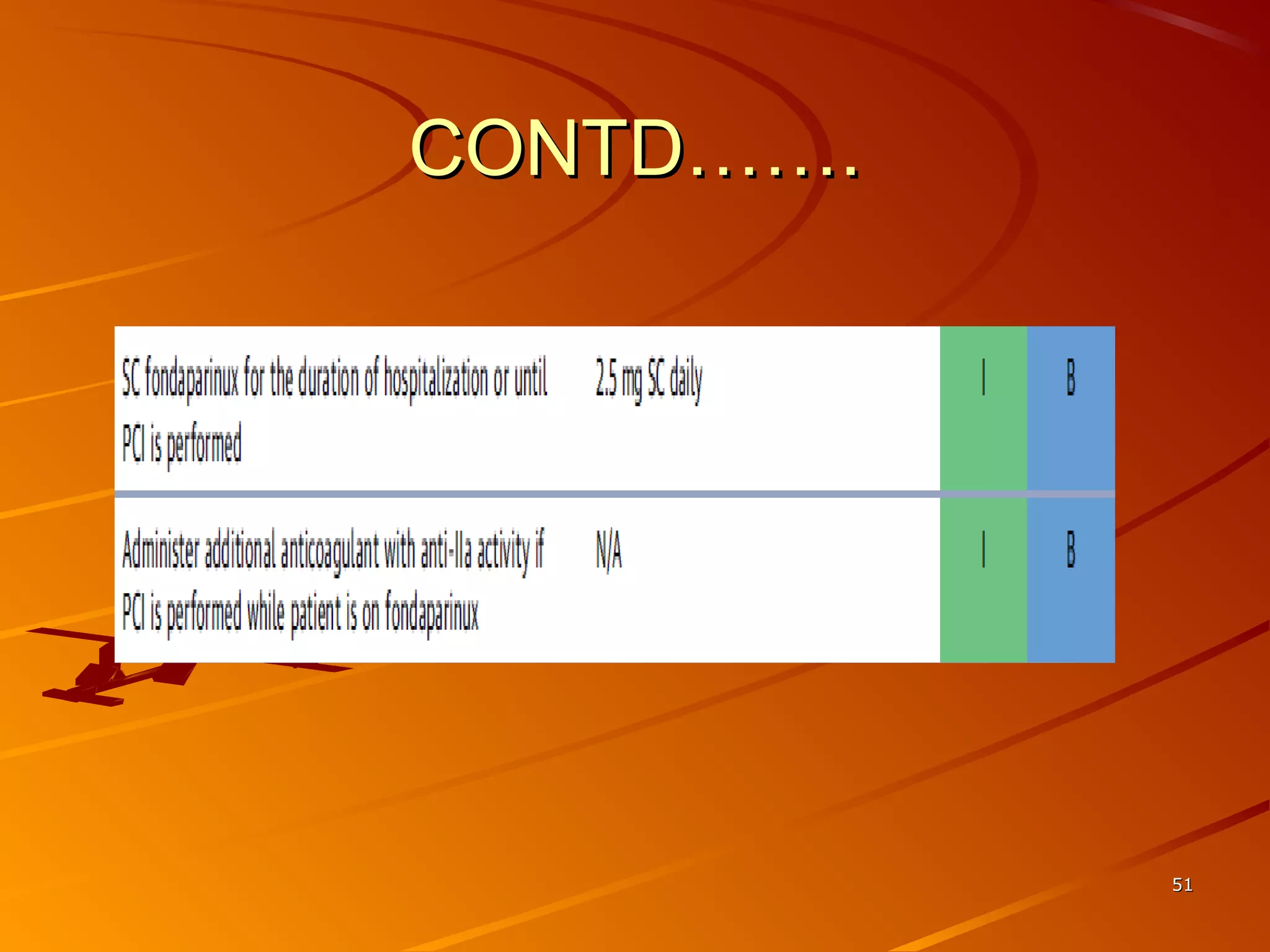
CONTD…….CONTD…….
5151
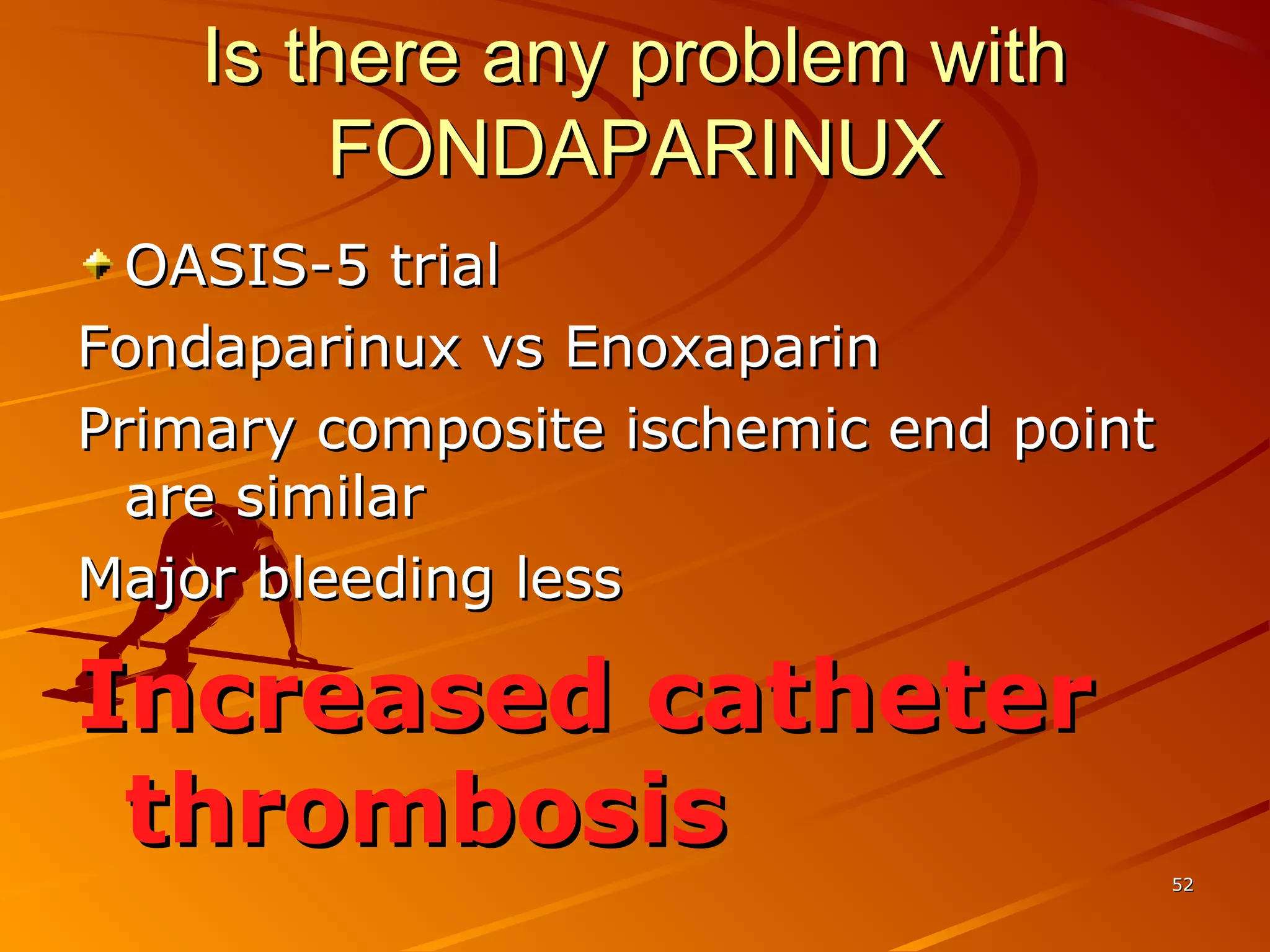
Is there any problem withIs there any problem with
FONDAPARINUXFONDAPARINUX
OASIS-5 trialOASIS-5 trial
Fondaparinux vs EnoxaparinFondaparinux vs Enoxaparin
Primary composite ischemic end pointPrimary composite ischemic end point
are similarare similar
Major bleeding lessMajor bleeding less
Increased catheterIncreased catheter
thrombosisthrombosis
5252
5353
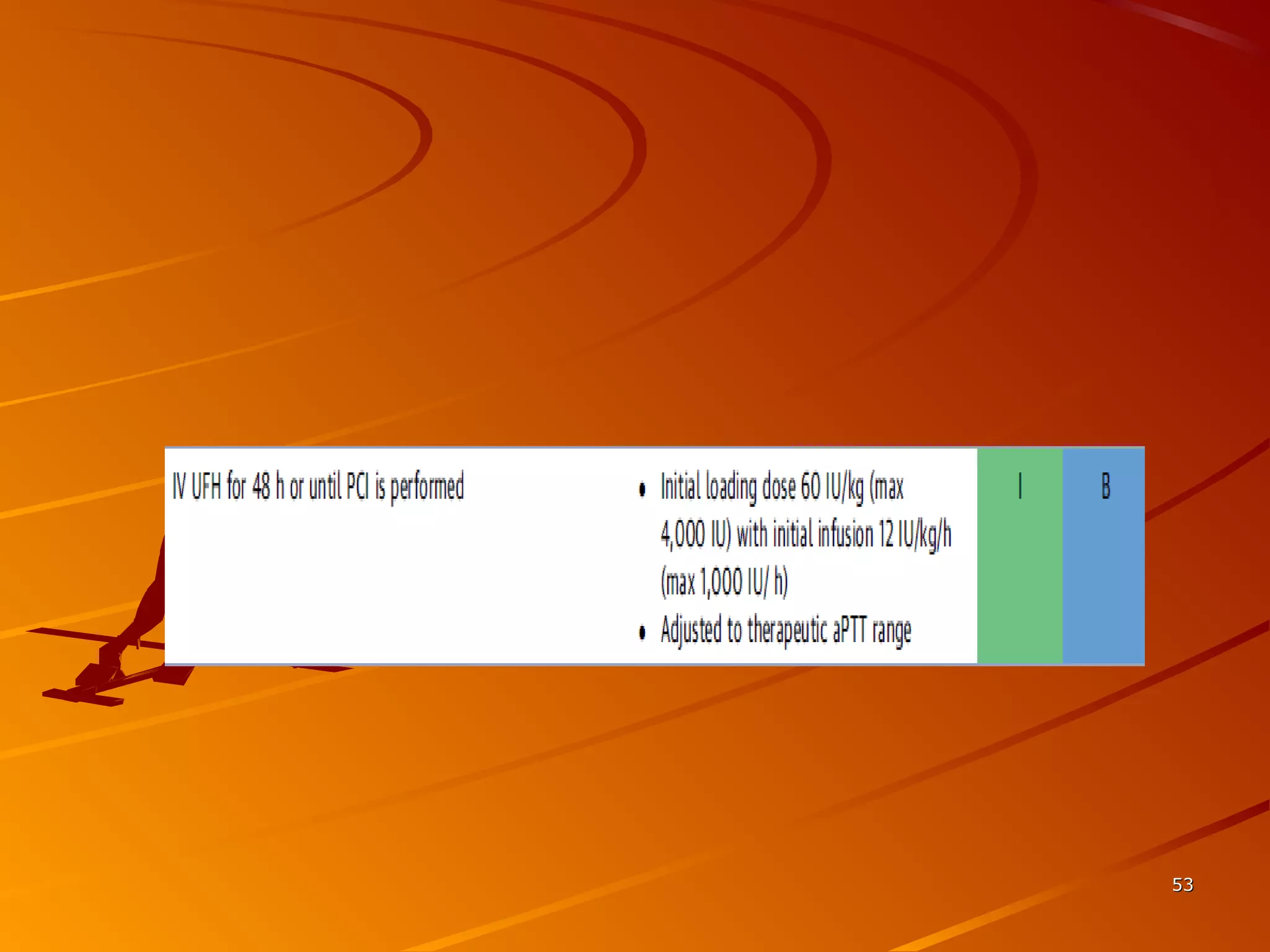
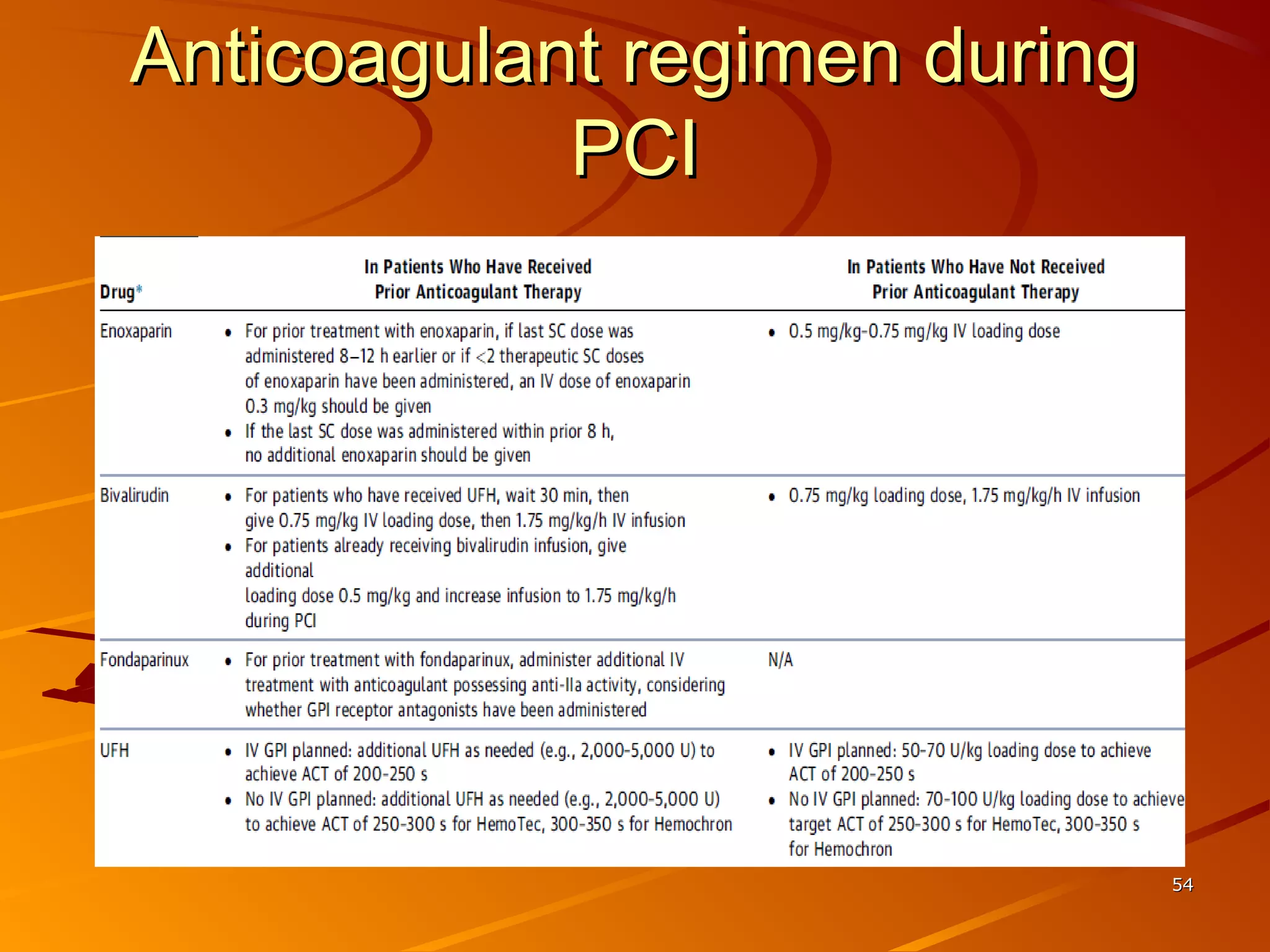
Anticoagulant regimen duringAnticoagulant regimen during
PCIPCI
5454
5555
5656
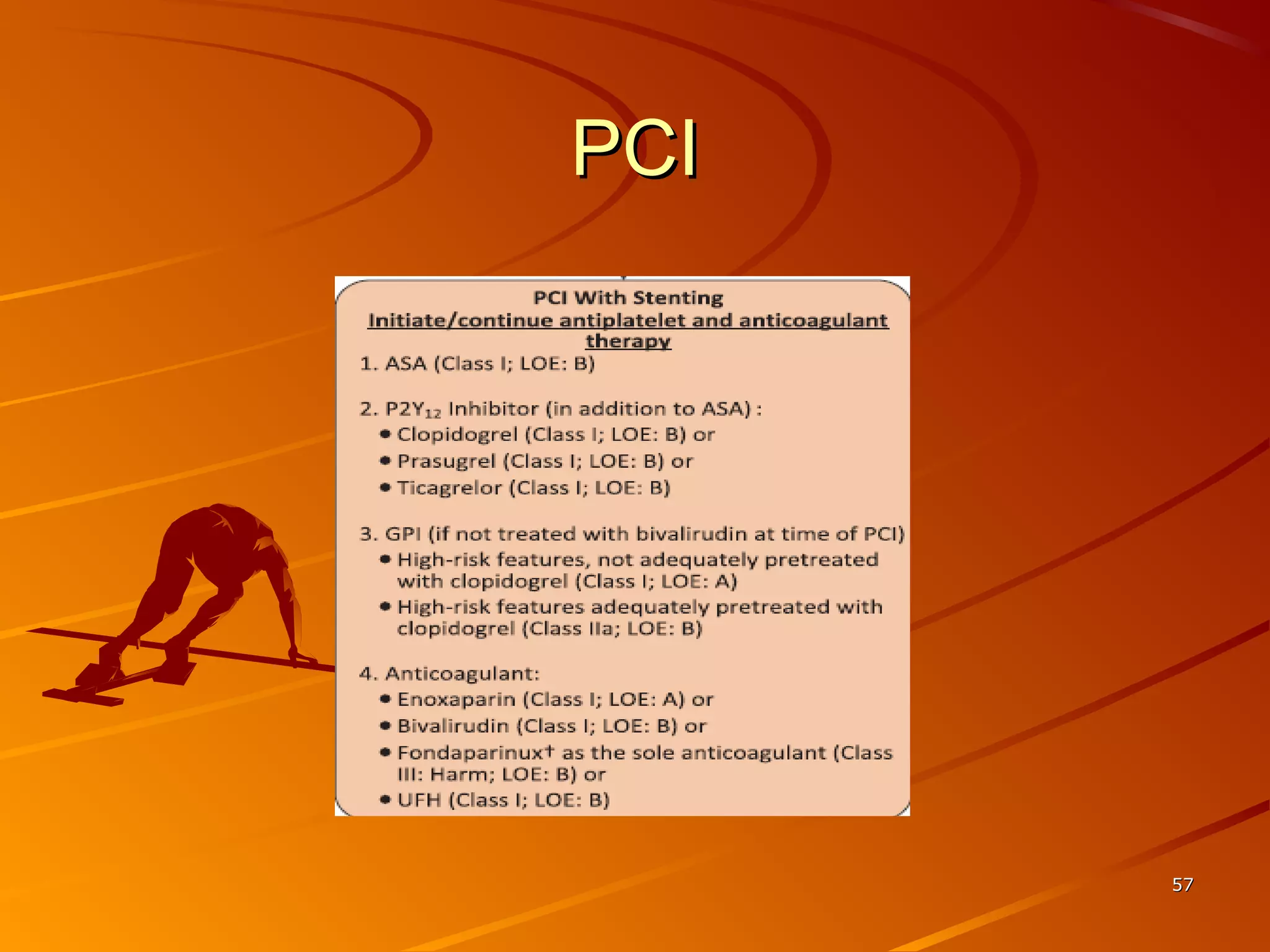
PCIPCI
5757
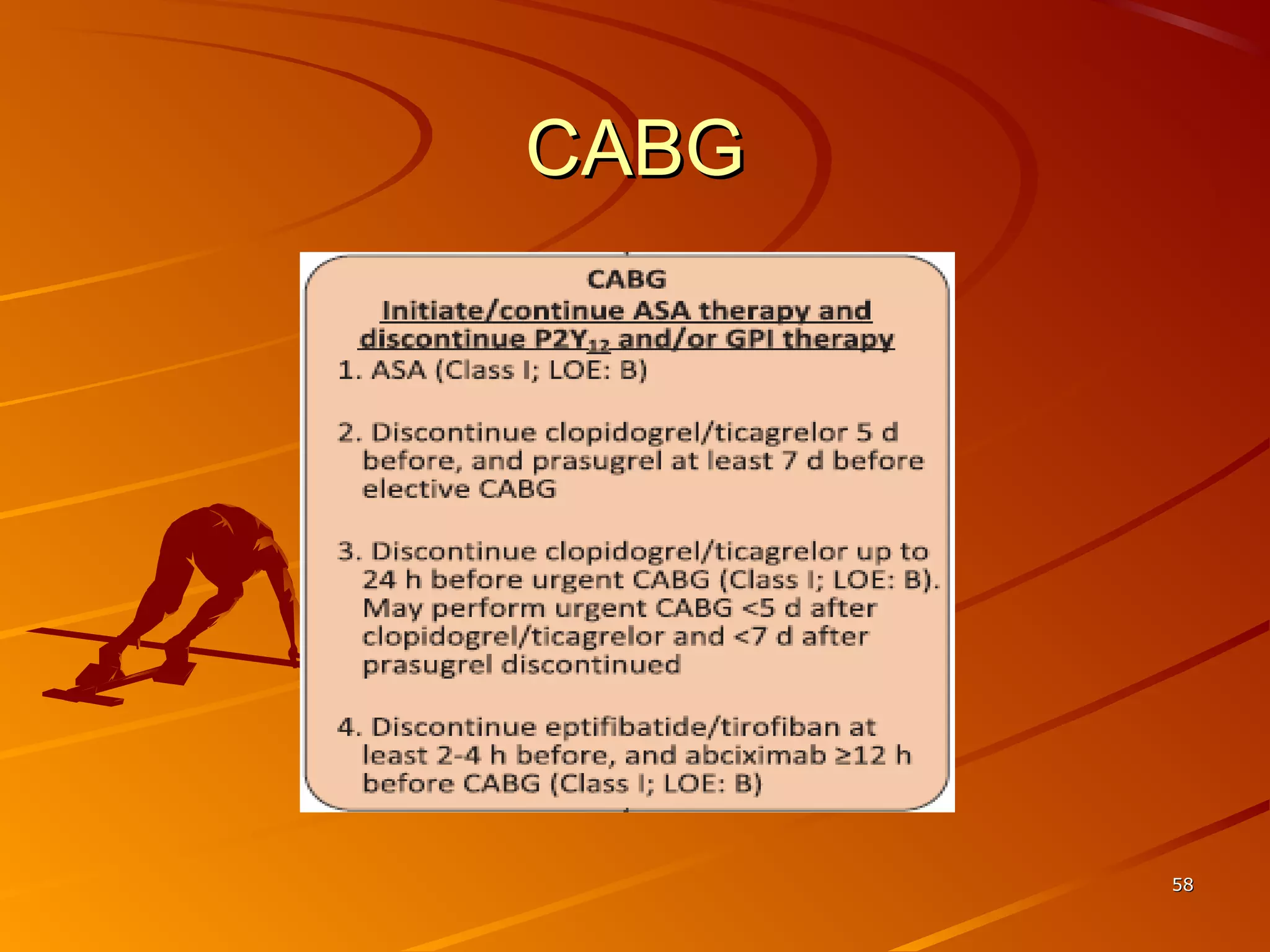
CABGCABG
5858
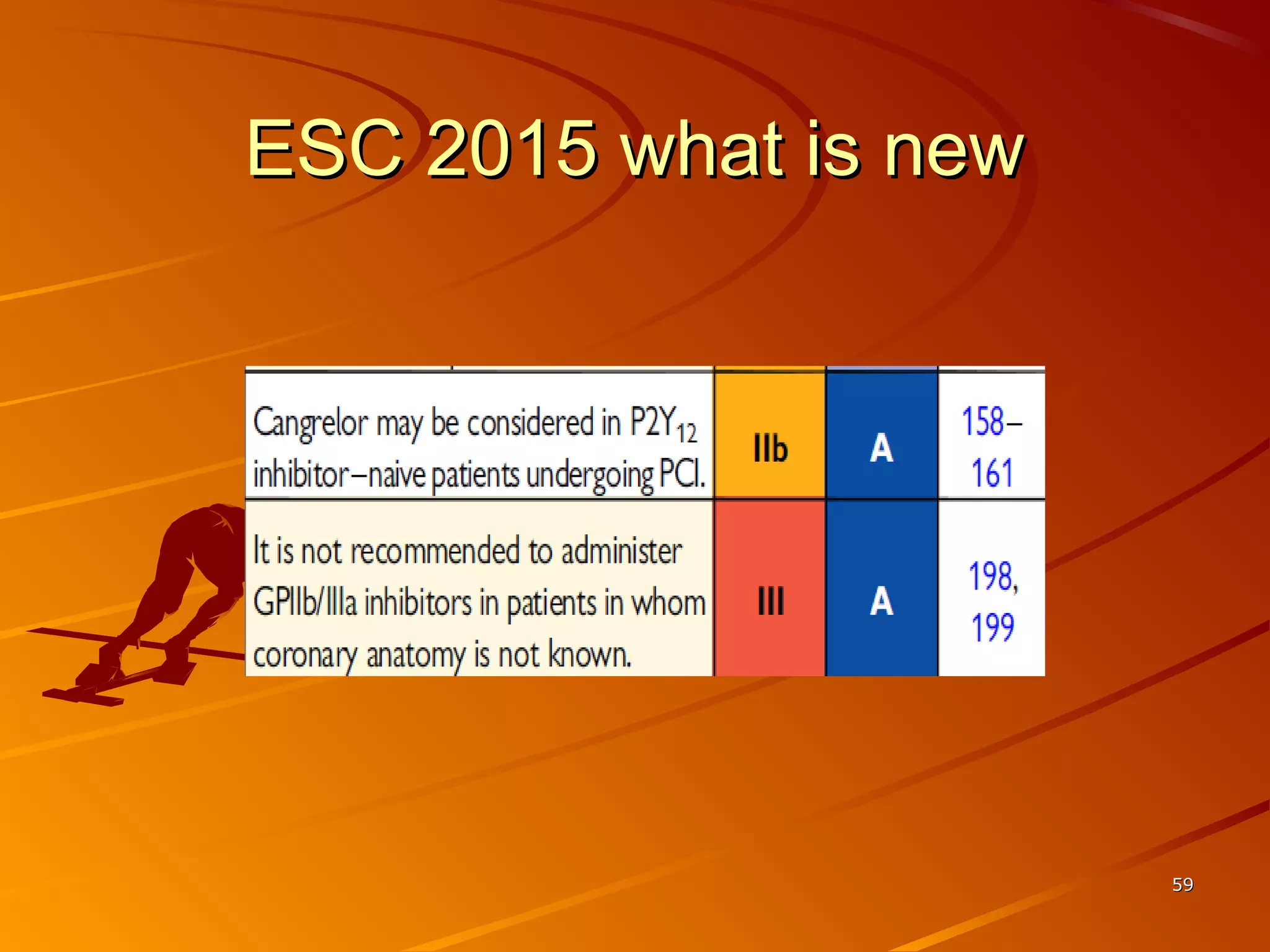
ESC 2015 what is newESC 2015 what is new
5959
6060
6161
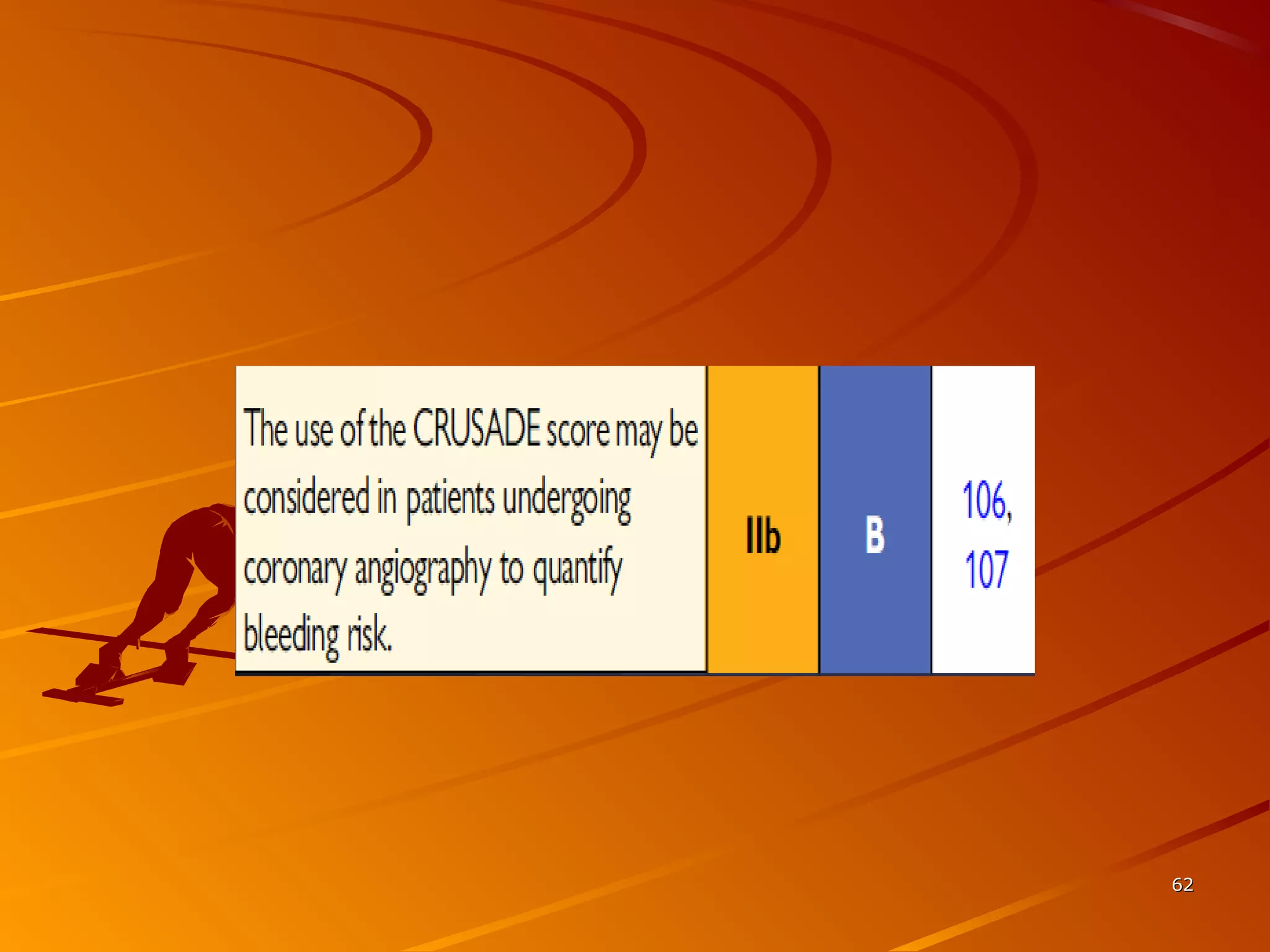
6262
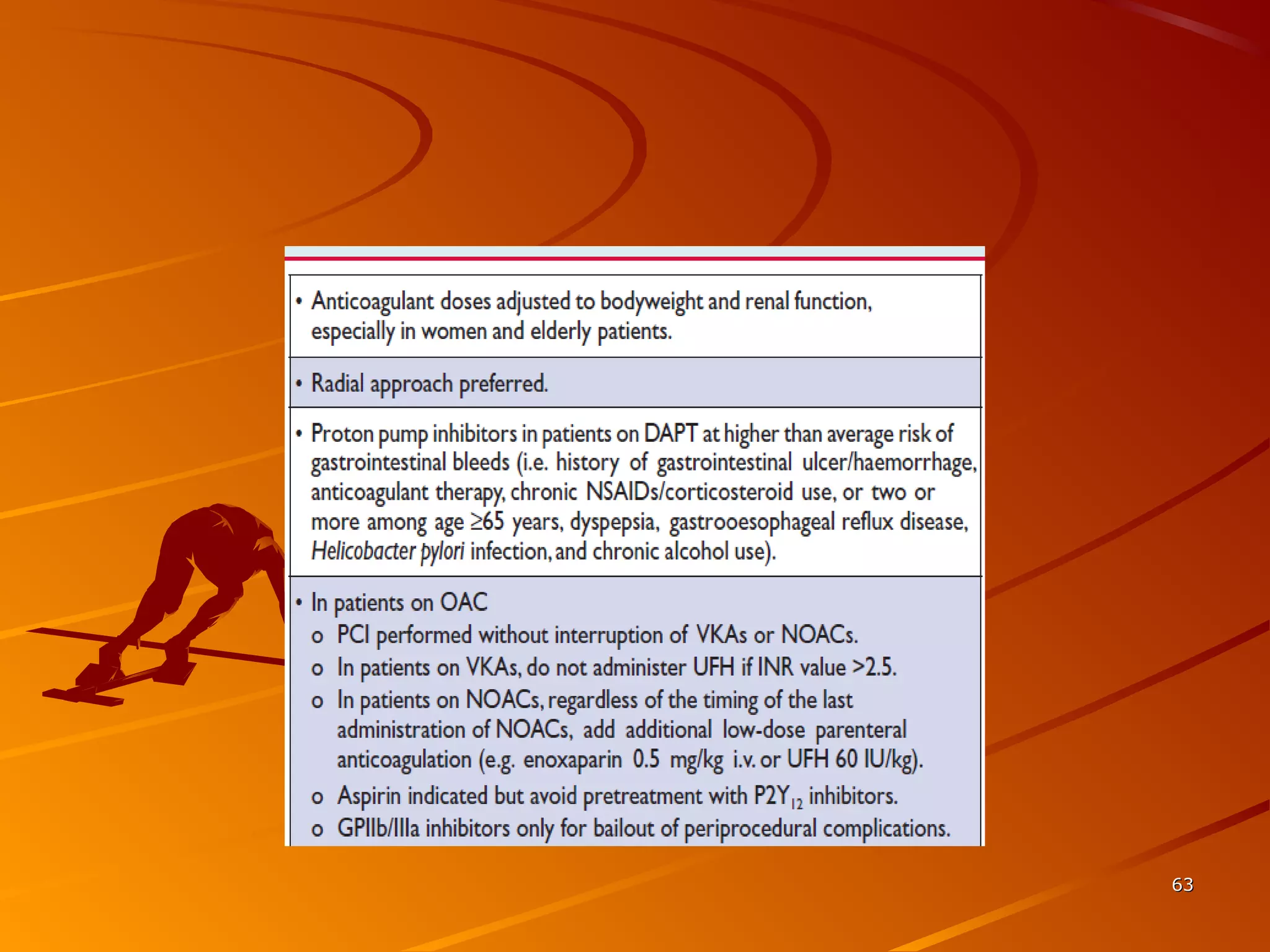
6363
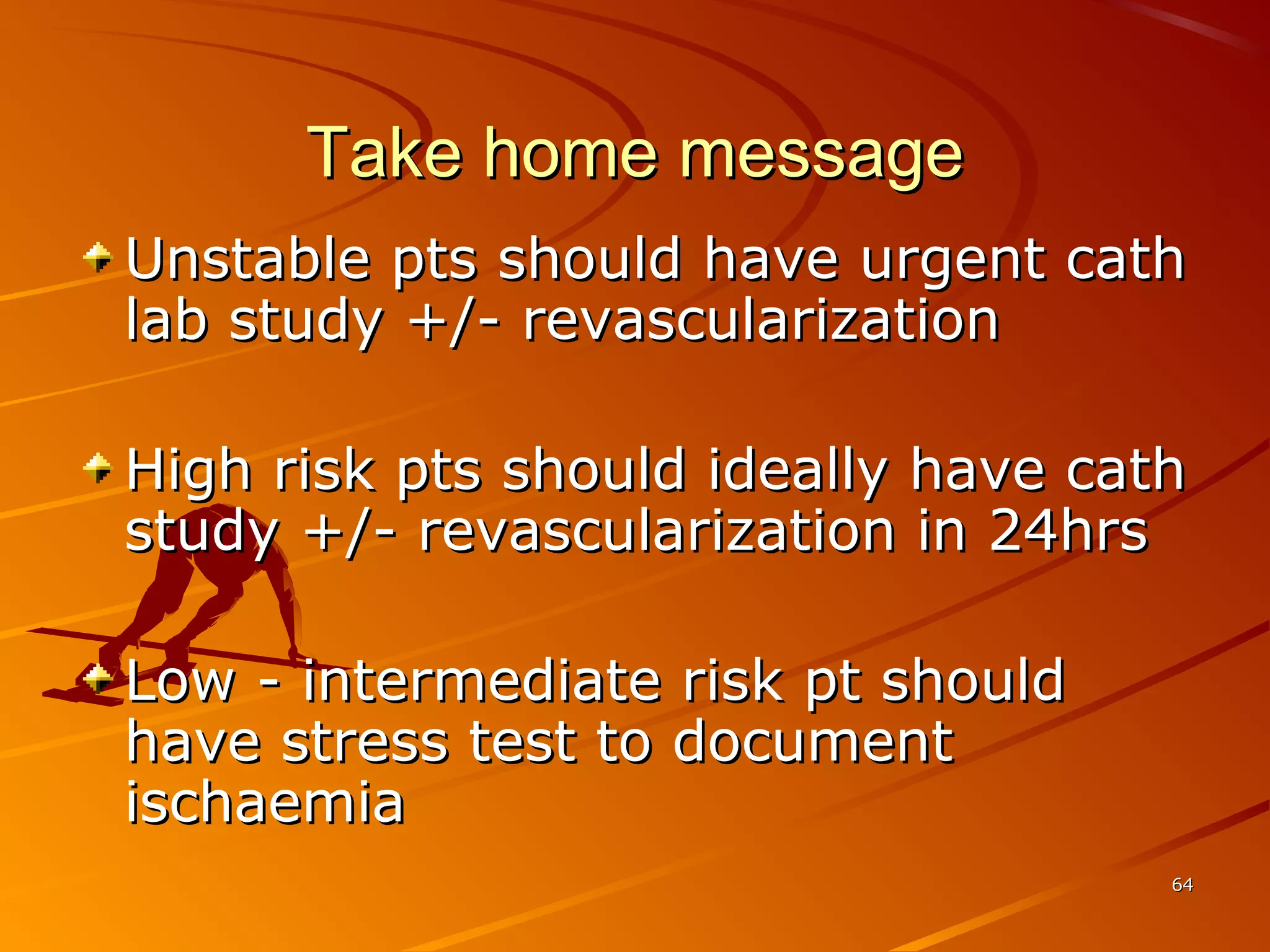
6464
Take home messageTake home message
Unstable pts should have urgent cathUnstable pts should have urgent cath
lab study +/- revascularizationlab study +/- revascularization
High risk pts should ideally have cathHigh risk pts should ideally have cath
study +/- revascularization in 24hrsstudy +/- revascularization in 24hrs
Low - intermediate risk pt shouldLow - intermediate risk pt should
have stress test to documenthave stress test to document
ischaemiaischaemia

Invasive evaluation timing in nstemi (1)