But first -getting to know you
Have you programmed before ? Which language ?
Any experience with command line ?
Why do you want to program :
to analyze data ?
to create scripts that serve as glue in my pipeline ?
to implement my cool new model ?
to become one of the cool kids ?
to have something to do on my Sundays ?
2.
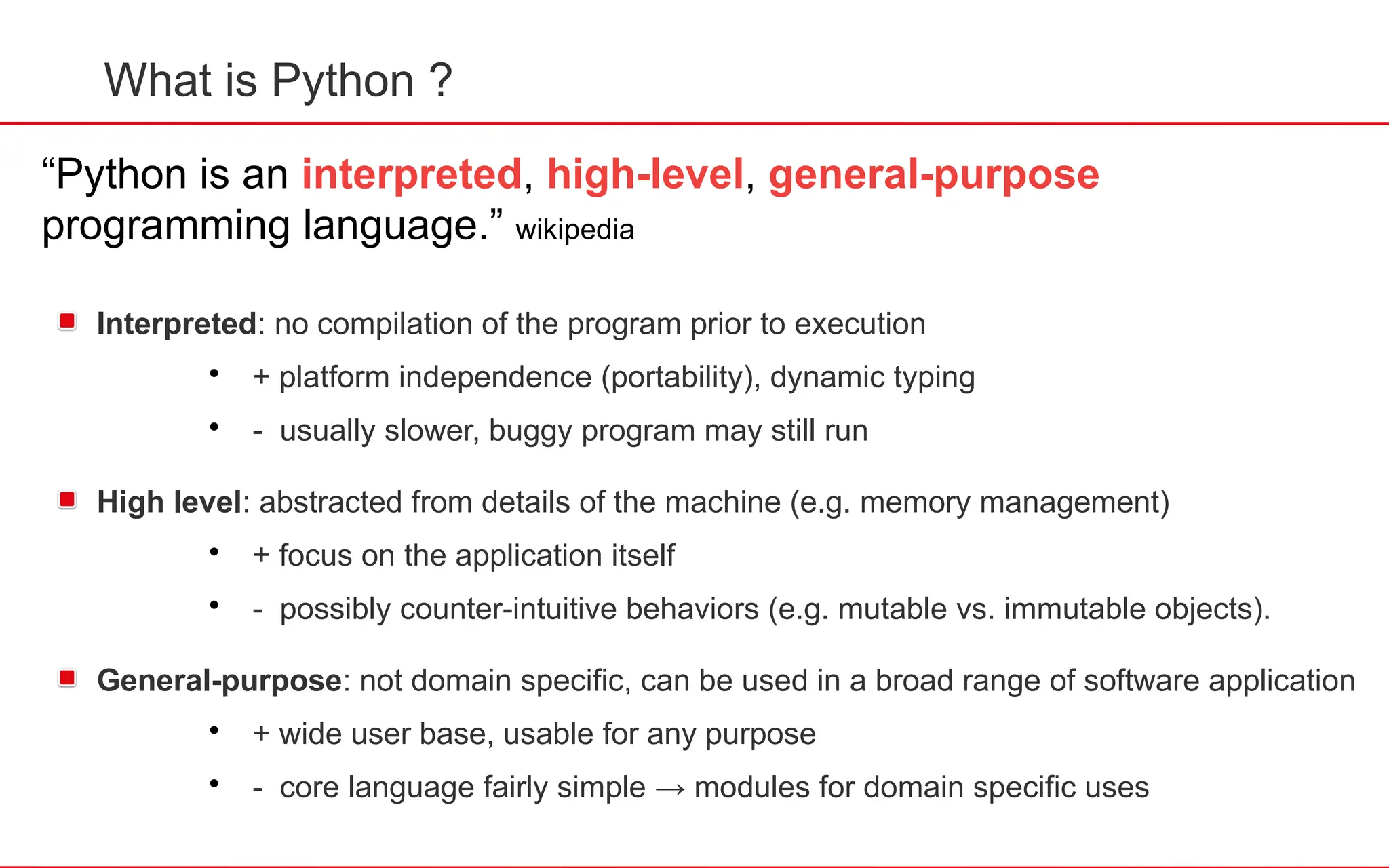
What is Python?
Interpreted: no compilation of the program prior to execution
+ platform independence (portability), dynamic typing
- usually slower, buggy program may still run
High level: abstracted from details of the machine (e.g. memory management)
+ focus on the application itself
- possibly counter-intuitive behaviors (e.g. mutable vs. immutable objects).
General-purpose: not domain specific, can be used in a broad range of software application
+ wide user base, usable for any purpose
- core language fairly simple → modules for domain specific uses
“Python is an interpreted, high-level, general-purpose
programming language.” wikipedia
3.
Python - abrief history
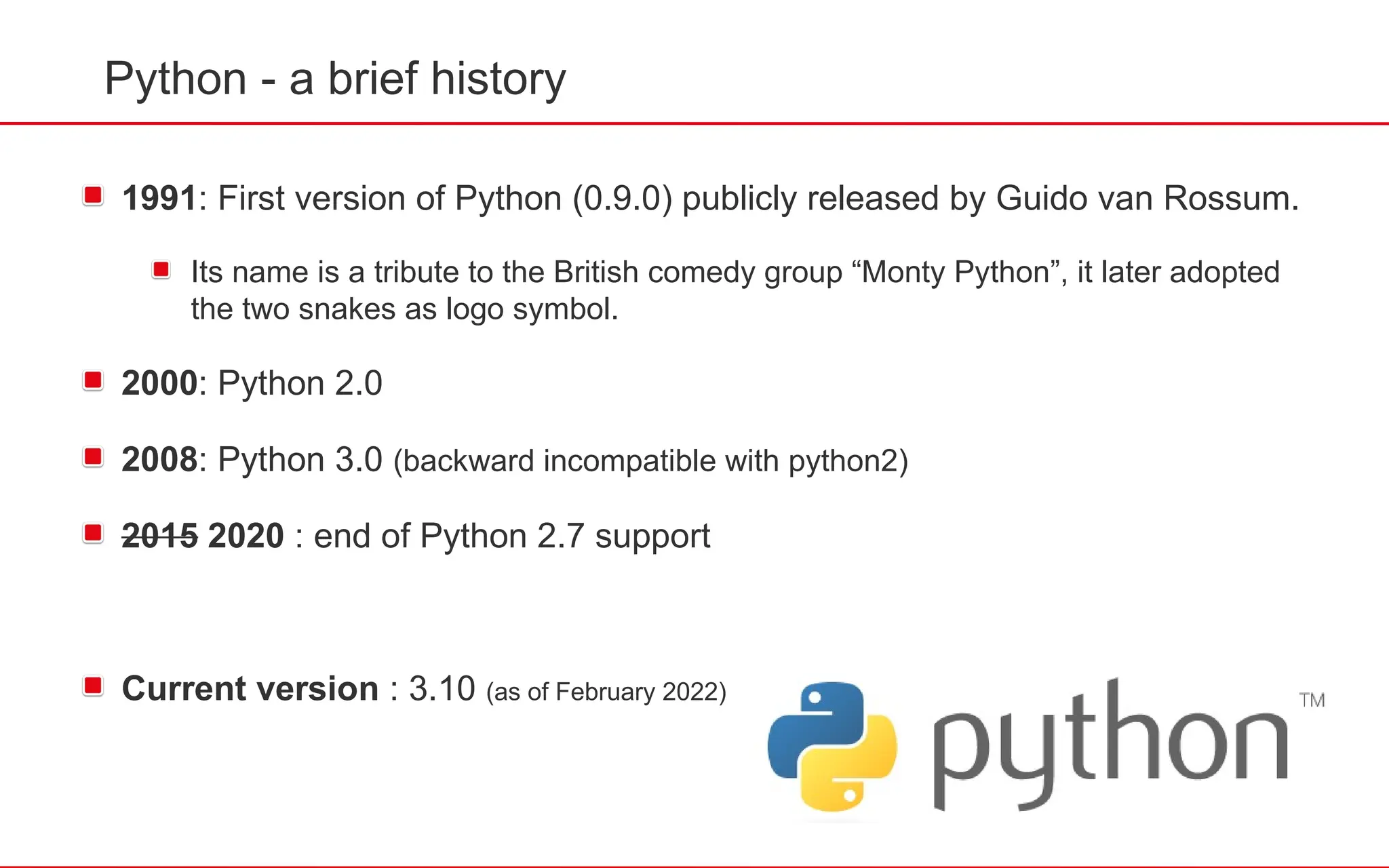
1991: First version of Python (0.9.0) publicly released by Guido van Rossum.
Its name is a tribute to the British comedy group “Monty Python”, it later adopted
the two snakes as logo symbol.
2000: Python 2.0
2008: Python 3.0 (backward incompatible with python2)
2015 2020 : end of Python 2.7 support
Current version : 3.10 (as of February 2022)
4.
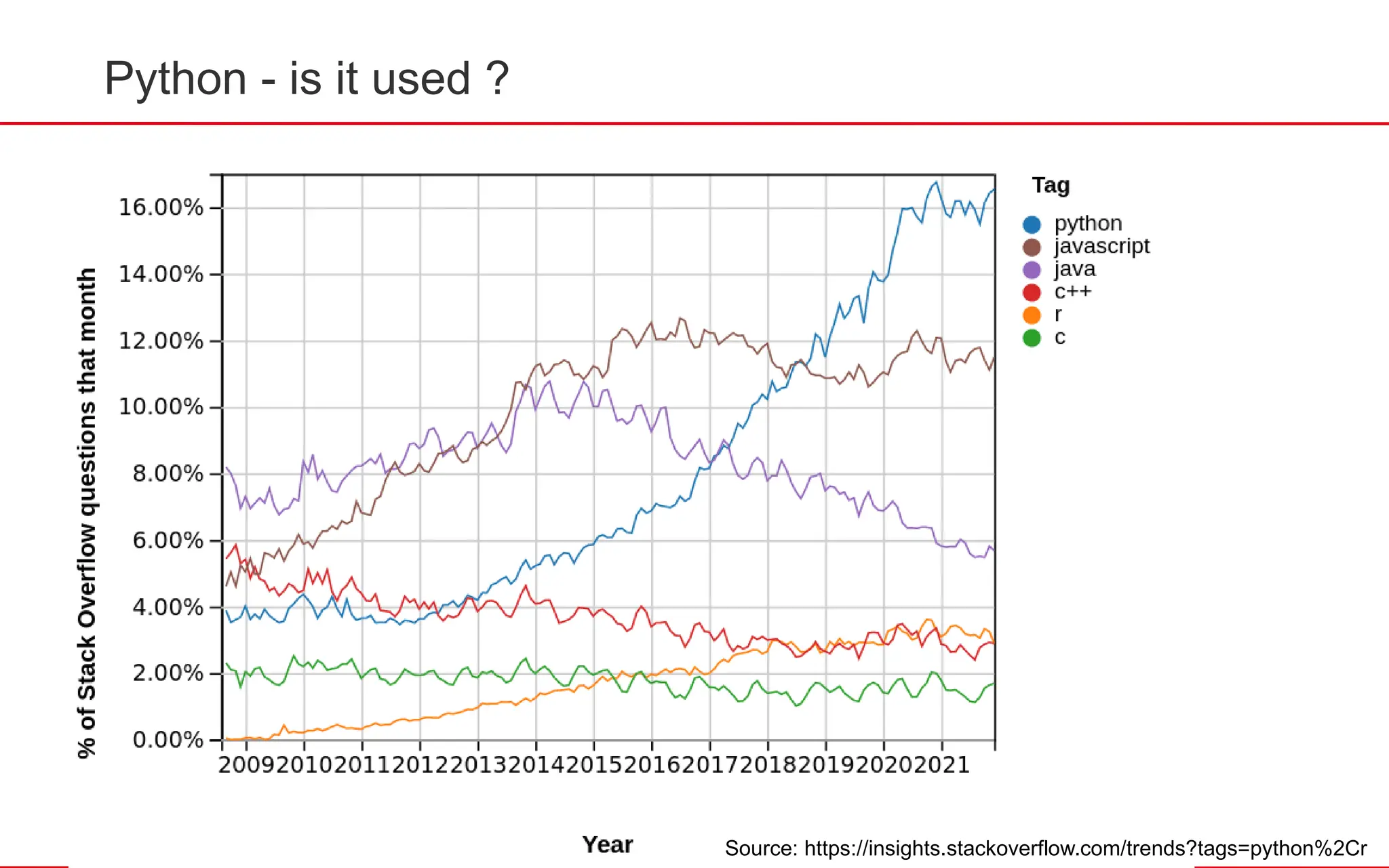
Python - isit used ?
Source: https://insights.stackoverflow.com/trends?tags=python%2Cr
5.
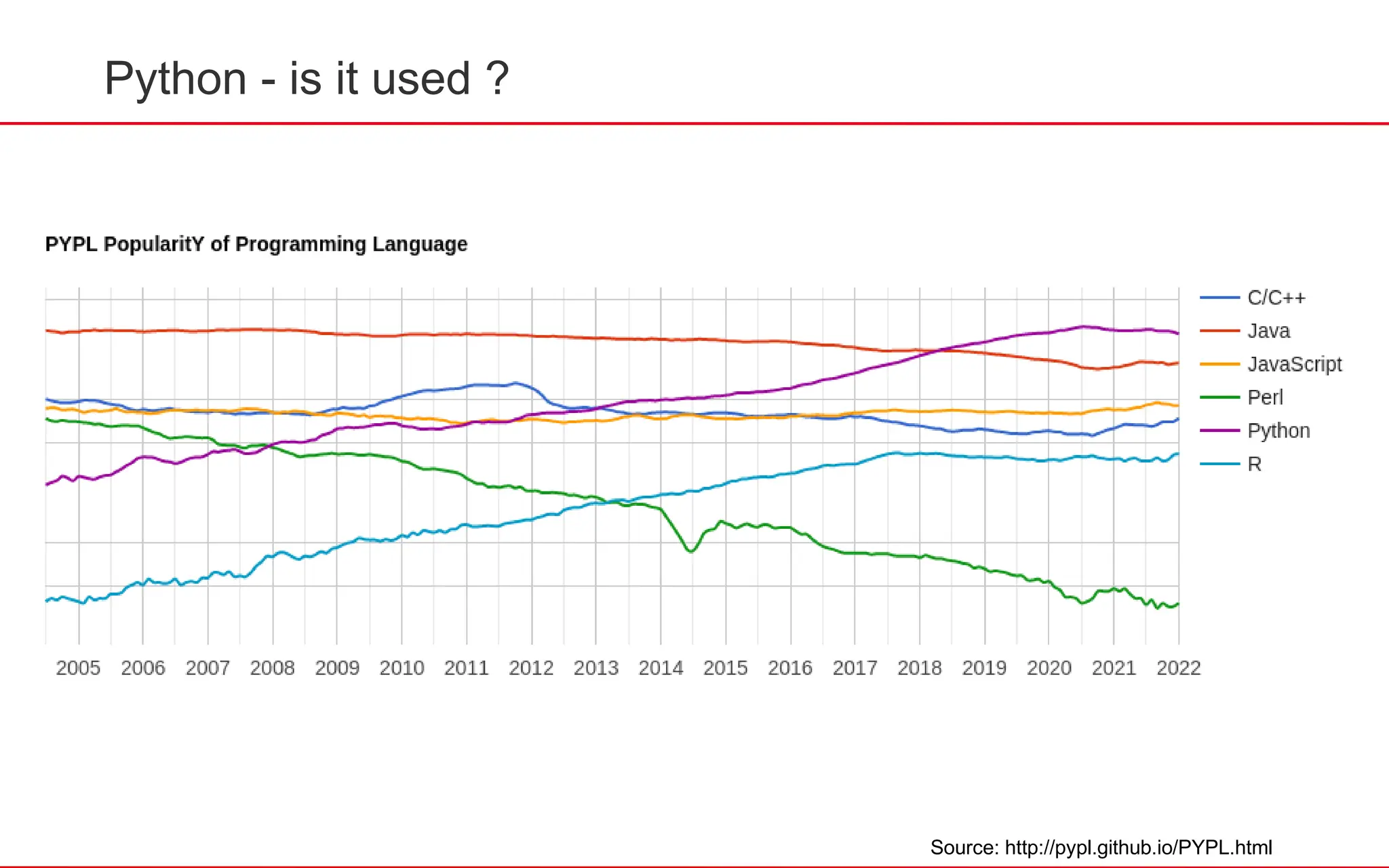
Python - isit used ?
Source: http://pypl.github.io/PYPL.html
6.
Python – sumup
Easy to learn - you will experience that first hand !
Portable: coding for Windows, MacOS or Linux is (almost) the same.
Broad range of applications: can be used for anything !
Widely used, including in science application:
Huge community to get help/tutorials.
Huge number of modules for domain specific applications.
“Python is an interpreted, high-level, general-purpose
programming language.” wikipedia