
Introduction to Python
By:- Nikhil Kapoor
Table of Contents
• Introduction
• History
• Why Named as Python?
• Features
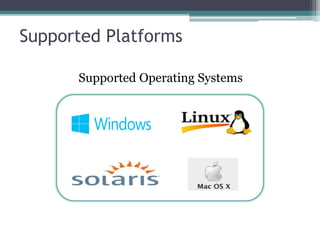
• Supported Platforms
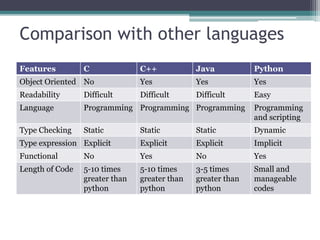
• Comparison with other languages
• Why should you learn Python?
• Big Names in Python’s Users
• Applications
• References
Introduction
• Python is an high level, interpreted, interactive and
object-oriented programming language created by Guido
Van Rossum in 1989
• Open source and community driven
• Source code is also available under the GNU General
Public License (GPL)
• Ideally designed for rapid prototyping of complex
applications
• It has simple easy-to-use syntax, making it the perfect
language for someone trying to learn computer
programming for the first time
History(1/2)
• Python was developed in the late eighties and early
nineties at the National Research Institute for
Mathematics and Computer Science in the Netherlands
• ABC programming language is said to be the predecessor
of Python language which was capable of Exception
Handling and interfacing with Amoeba Operating
System
• Guido Van Rossum published the first version of Python
code (version 0.9.0) at alt.sources in February 1991. This
release included already exception handling, functions,
and the core data types of list, dict, str and others. It was
also object oriented and had a module system
History(2/2)
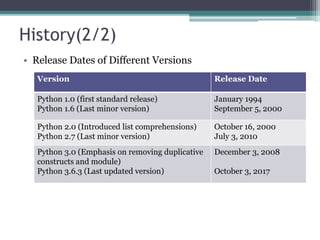
• Release Dates of Different Versions
Version Release Date
Python 1.0 (first standard release)
Python 1.6 (Last minor version)
January 1994
September 5, 2000
Python 2.0 (Introduced list comprehensions)
Python 2.7 (Last minor version)
October 16, 2000
July 3, 2010
Python 3.0 (Emphasis on removing duplicative
constructs and module)
Python 3.6.3 (Last updated version)
December 3, 2008
October 3, 2017
Why Named as Python?
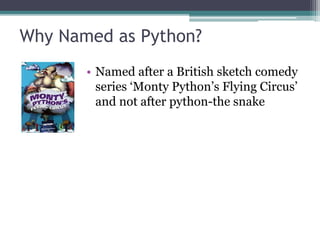
• Named after a British sketch comedy
series ‘Monty Python’s Flying Circus’
and not after python-the snake
Features(1/2)
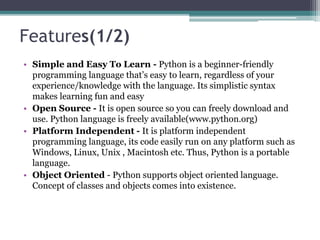
• Simple and Easy To Learn - Python is a beginner-friendly
programming language that’s easy to learn, regardless of your
experience/knowledge with the language. Its simplistic syntax
makes learning fun and easy
• Open Source - It is open source so you can freely download and
use. Python language is freely available(www.python.org)
• Platform Independent - It is platform independent
programming language, its code easily run on any platform such as
Windows, Linux, Unix , Macintosh etc. Thus, Python is a portable
language.
• Object Oriented - Python supports object oriented language.
Concept of classes and objects comes into existence.
Features(2/2)
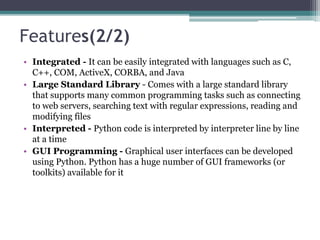
• Integrated - It can be easily integrated with languages such as C,
C++, COM, ActiveX, CORBA, and Java
• Large Standard Library - Comes with a large standard library
that supports many common programming tasks such as connecting
to web servers, searching text with regular expressions, reading and
modifying files
• Interpreted - Python code is interpreted by interpreter line by line
at a time
• GUI Programming - Graphical user interfaces can be developed
using Python. Python has a huge number of GUI frameworks (or
toolkits) available for it
Supported Platforms
Supported Operating Systems
Comparison with other languages
Features C C++ Java Python
Object Oriented No Yes Yes Yes
Readability Difficult Difficult Difficult Easy
Language Programming Programming Programming Programming
and scripting
Type Checking Static Static Static Dynamic
Type expression Explicit Explicit Explicit Implicit
Functional No Yes No Yes
Length of Code 5-10 times
greater than
python
5-10 times
greater than
python
3-5 times
greater than
python
Small and
manageable
codes
Why should you learn Python?
• As already discussed, Python has simple easy-to-use syntax, making
it the perfect language for someone trying to learn computer
programming for the first time
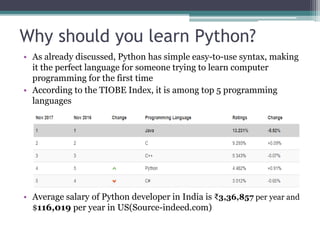
• According to the TIOBE Index, it is among top 5 programming
languages
• Average salary of Python developer in India is ₹3,36,857 per year and
$116,019 per year in US(Source-indeed.com)
Big Names in Python’s Users
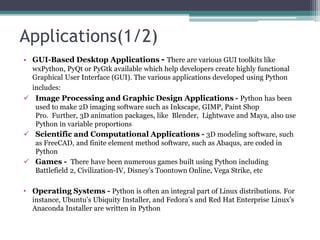
Applications(1/2)
• GUI-Based Desktop Applications - There are various GUI toolkits like
wxPython, PyQt or PyGtk available which help developers create highly functional
Graphical User Interface (GUI). The various applications developed using Python
includes:
 Image Processing and Graphic Design Applications - Python has been
used to make 2D imaging software such as Inkscape, GIMP, Paint Shop
Pro. Further, 3D animation packages, like Blender, Lightwave and Maya, also use
Python in variable proportions
 Scientific and Computational Applications - 3D modeling software, such
as FreeCAD, and finite element method software, such as Abaqus, are coded in
Python
 Games - There have been numerous games built using Python including
Battlefield 2, Civilization-IV, Disney’s Toontown Online, Vega Strike, etc
• Operating Systems - Python is often an integral part of Linux distributions. For
instance, Ubuntu’s Ubiquity Installer, and Fedora’s and Red Hat Enterprise Linux’s
Anaconda Installer are written in Python
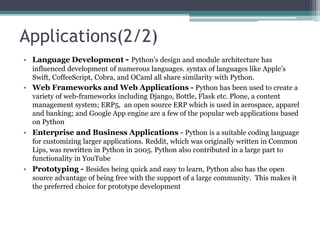
Applications(2/2)
• Language Development - Python’s design and module architecture has
influenced development of numerous languages. syntax of languages like Apple’s
Swift, CoffeeScript, Cobra, and OCaml all share similarity with Python.
• Web Frameworks and Web Applications - Python has been used to create a
variety of web-frameworks including Django, Bottle, Flask etc. Plone, a content
management system; ERP5, an open source ERP which is used in aerospace, apparel
and banking; and Google App engine are a few of the popular web applications based
on Python
• Enterprise and Business Applications - Python is a suitable coding language
for customizing larger applications. Reddit, which was originally written in Common
Lips, was rewritten in Python in 2005. Python also contributed in a large part to
functionality in YouTube
• Prototyping - Besides being quick and easy to learn, Python also has the open
source advantage of being free with the support of a large community. This makes it
the preferred choice for prototype development
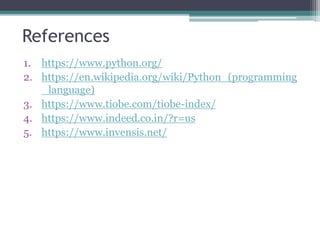
References
1. https://www.python.org/
2. https://en.wikipedia.org/wiki/Python_(programming
_language)
3. https://www.tiobe.com/tiobe-index/
4. https://www.indeed.co.in/?r=us
5. https://www.invensis.net/
Introduction to python

Introduction to python

  • 1.
  • 2.
    Table of Contents •Introduction • History • Why Named as Python? • Features • Supported Platforms • Comparison with other languages • Why should you learn Python? • Big Names in Python’s Users • Applications • References
  • 3.
    Introduction • Python isan high level, interpreted, interactive and object-oriented programming language created by Guido Van Rossum in 1989 • Open source and community driven • Source code is also available under the GNU General Public License (GPL) • Ideally designed for rapid prototyping of complex applications • It has simple easy-to-use syntax, making it the perfect language for someone trying to learn computer programming for the first time
  • 4.
    History(1/2) • Python wasdeveloped in the late eighties and early nineties at the National Research Institute for Mathematics and Computer Science in the Netherlands • ABC programming language is said to be the predecessor of Python language which was capable of Exception Handling and interfacing with Amoeba Operating System • Guido Van Rossum published the first version of Python code (version 0.9.0) at alt.sources in February 1991. This release included already exception handling, functions, and the core data types of list, dict, str and others. It was also object oriented and had a module system
  • 5.
    History(2/2) • Release Datesof Different Versions Version Release Date Python 1.0 (first standard release) Python 1.6 (Last minor version) January 1994 September 5, 2000 Python 2.0 (Introduced list comprehensions) Python 2.7 (Last minor version) October 16, 2000 July 3, 2010 Python 3.0 (Emphasis on removing duplicative constructs and module) Python 3.6.3 (Last updated version) December 3, 2008 October 3, 2017
  • 6.
    Why Named asPython? • Named after a British sketch comedy series ‘Monty Python’s Flying Circus’ and not after python-the snake
  • 7.
    Features(1/2) • Simple andEasy To Learn - Python is a beginner-friendly programming language that’s easy to learn, regardless of your experience/knowledge with the language. Its simplistic syntax makes learning fun and easy • Open Source - It is open source so you can freely download and use. Python language is freely available(www.python.org) • Platform Independent - It is platform independent programming language, its code easily run on any platform such as Windows, Linux, Unix , Macintosh etc. Thus, Python is a portable language. • Object Oriented - Python supports object oriented language. Concept of classes and objects comes into existence.
  • 8.
    Features(2/2) • Integrated -It can be easily integrated with languages such as C, C++, COM, ActiveX, CORBA, and Java • Large Standard Library - Comes with a large standard library that supports many common programming tasks such as connecting to web servers, searching text with regular expressions, reading and modifying files • Interpreted - Python code is interpreted by interpreter line by line at a time • GUI Programming - Graphical user interfaces can be developed using Python. Python has a huge number of GUI frameworks (or toolkits) available for it
  • 9.
  • 10.
    Comparison with otherlanguages Features C C++ Java Python Object Oriented No Yes Yes Yes Readability Difficult Difficult Difficult Easy Language Programming Programming Programming Programming and scripting Type Checking Static Static Static Dynamic Type expression Explicit Explicit Explicit Implicit Functional No Yes No Yes Length of Code 5-10 times greater than python 5-10 times greater than python 3-5 times greater than python Small and manageable codes
  • 11.
    Why should youlearn Python? • As already discussed, Python has simple easy-to-use syntax, making it the perfect language for someone trying to learn computer programming for the first time • According to the TIOBE Index, it is among top 5 programming languages • Average salary of Python developer in India is ₹3,36,857 per year and $116,019 per year in US(Source-indeed.com)
  • 12.
    Big Names inPython’s Users
  • 13.
    Applications(1/2) • GUI-Based DesktopApplications - There are various GUI toolkits like wxPython, PyQt or PyGtk available which help developers create highly functional Graphical User Interface (GUI). The various applications developed using Python includes:  Image Processing and Graphic Design Applications - Python has been used to make 2D imaging software such as Inkscape, GIMP, Paint Shop Pro. Further, 3D animation packages, like Blender, Lightwave and Maya, also use Python in variable proportions  Scientific and Computational Applications - 3D modeling software, such as FreeCAD, and finite element method software, such as Abaqus, are coded in Python  Games - There have been numerous games built using Python including Battlefield 2, Civilization-IV, Disney’s Toontown Online, Vega Strike, etc • Operating Systems - Python is often an integral part of Linux distributions. For instance, Ubuntu’s Ubiquity Installer, and Fedora’s and Red Hat Enterprise Linux’s Anaconda Installer are written in Python
  • 14.
    Applications(2/2) • Language Development- Python’s design and module architecture has influenced development of numerous languages. syntax of languages like Apple’s Swift, CoffeeScript, Cobra, and OCaml all share similarity with Python. • Web Frameworks and Web Applications - Python has been used to create a variety of web-frameworks including Django, Bottle, Flask etc. Plone, a content management system; ERP5, an open source ERP which is used in aerospace, apparel and banking; and Google App engine are a few of the popular web applications based on Python • Enterprise and Business Applications - Python is a suitable coding language for customizing larger applications. Reddit, which was originally written in Common Lips, was rewritten in Python in 2005. Python also contributed in a large part to functionality in YouTube • Prototyping - Besides being quick and easy to learn, Python also has the open source advantage of being free with the support of a large community. This makes it the preferred choice for prototype development
  • 15.
    References 1. https://www.python.org/ 2. https://en.wikipedia.org/wiki/Python_(programming _language) 3.https://www.tiobe.com/tiobe-index/ 4. https://www.indeed.co.in/?r=us 5. https://www.invensis.net/