INTRODUCTION
TO
CHRISTIANITY
3
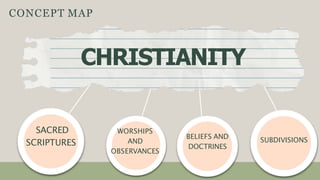
CONCEPT MAP
CHRISTIANITY
SACRED
SCRIPTURES
WORSHIPS
AND
OBSERVANCES
BELIEFS AND
DOCTRINES
SUBDIVISIONS
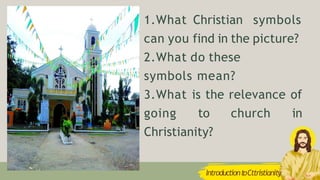
1.What Christian symbols
can you find in the picture?
2.What do these
symbols mean?
3.What is the relevance of
going to church in
Christianity?
IntroductiontoCttristianity
LESSON
PROPER
IntroductiontoCttristianity
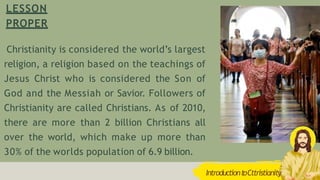
Christianity is considered the world’s largest
religion, a religion based on the teachings of
Jesus Christ who is considered the Son of
God and the Messiah or Savior. Followers of
Christianity are called Christians. As of 2010,
there are more than 2 billion Christians all
over the world, which make up more than
30% of the worlds population of 6.9 billion.
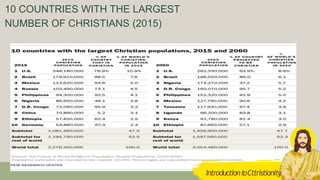
10 COUNTRIES WITH THE LARGEST
NUMBER OF CHRISTIANS (2015)
IntroductiontoCttristianity
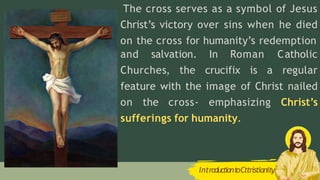
The cross serves as a symbol of Jesus
Christ’s victory over sins when he died
on the cross for humanity’s redemption
and salvation. In Roman
Churches, the crucifix is a
Catholic
regular
feature with the image of Christ nailed
on the cross- emphasizing Christ’s
sufferings for humanity.
IntroductiontoCttristianity 6
6
Historical
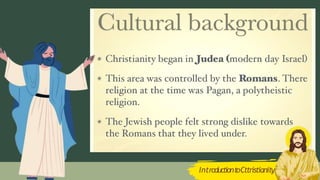
Christianity develop, developed in Palestine
around 100 C.E. it was
founded by Jesus considered to be the Son of God
and Messiah or Savior. Today Christianity is divided
into three major sects:
• Roman Catholicism;
• Eastern Orthodox and
• Protestantism. IntroductiontoCttristianity
IntroductiontoCttristianity 6
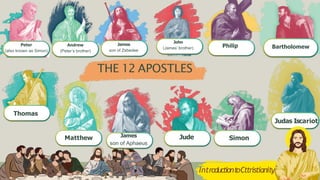
THE 12 APOSTLES
Peter
(also known as Simon)
Andrew
(Peter’s brother)
James
son of Zebedee
John
(James’ brother) Philip Bartholomew
Thomas
Matthew James
son of Aphaeus
Jude Simon
Judas Iscariot
IntroductiontoCttristianity
6
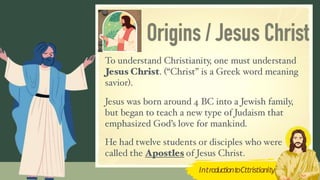
Jesus as the Founder of
Christianity
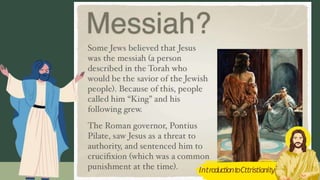
Christianity started with a prophecy in the Old
Testament that God will send his only begotten Son to
save humanity from eternal damnation. Jesus, through
his preaching and healing, was seen by his followers to
be the Messiah they were waiting for.
IntroductiontoCttristianity
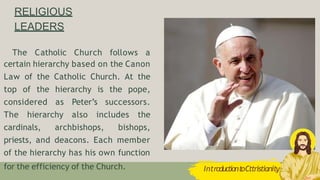
RELIGIOUS
LEADERS
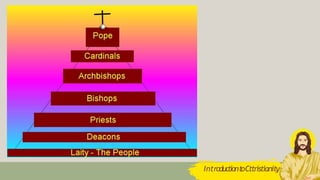
The Catholic Church follows a
certain hierarchy based on the Canon
Law of the Catholic Church. At the
top of the hierarchy is the pope,
considered as Peter’s successors.
The hierarchy also includes the
cardinals, archbishops, bishops,
priests, and deacons. Each member
of the hierarchy has his own function
for the efficiency of the Church. IntroductiontoCttristianity
IntroductiontoCttristianity
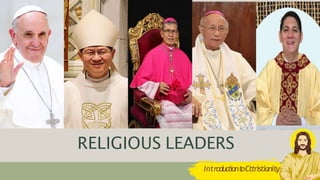
RELIGIOUS LEADERS
IntroductiontoCttristianity
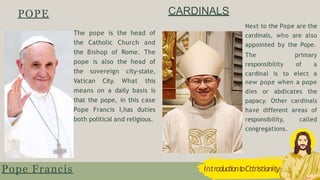
POPE
The pope is the head of
the Catholic Church and
the Bishop of Rome. The
pope is also the head of
the sovereign city-state,
Vatican City. What this
means on a daily basis is
that the pope, in this case
Pope Francis I,has duties
both political and religious.
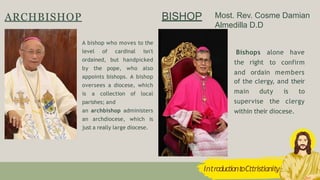
Next to the Pope are the
cardinals, who are also
appointed by the Pope.
The primary
responsibility
cardinal is to
of a
elect a
new pope when a pope
dies or abdicates the
papacy. Other cardinals
have different areas of
responsibility, called
congregations.
CARDINALS
IntroductiontoCttristianity
Pope Francis
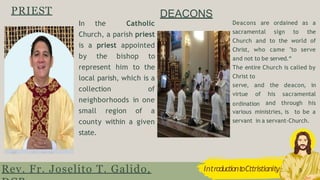
BISHOP
Bishops alone have
to confirm
the right
and ordain members
of the clergy, and their
main duty is to
supervise the clergy
within their diocese.
A bishop who moves to the
level of cardinal isn't
ordained, but handpicked
by the pope, who also
appoints bishops. A bishop
oversees a diocese, which
is a collection of local
parishes; and
an archbishop administers
an archdiocese, which is
just a really large diocese.
ARCHBISHOP
IntroductiontoCttristianity
Most. Rev. Cosme Damian
Almedilla D.D
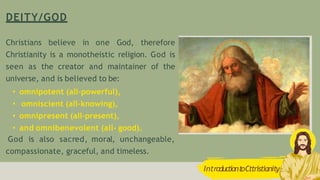
PRIEST
In the Catholic
Church, a parish priest
is a priest appointed
by the bishop to
represent him to the
local parish, which is a
collection of
neighborhoods in one
small region of a
county within a given
state.
Deacons are ordained as a
sacramental sign to the
Church and to the world of
Christ, who came "to serve
and not to be served.“
The entire Church is called by
Christ to
serve,
virtue
ordination
and the deacon, in
of his sacramental
and through his
various ministries, is to be a
servant in a servant-Church.
DEACONS
IntroductiontoCttristianity 5
Rev. Fr. Joselito T. Galido,
DEITY/GOD
IntroductiontoCttristianity
Christians believe in one God, therefore
Christianity is a monotheistic religion. God is
seen as the creator and maintainer of the
universe, and is believed to be:
• omnipotent (all-powerful),
• omniscient (all-knowing),
• omnipresent (all-present),
• and omnibenevolent (all- good).
God is also sacred, moral, unchangeable,
compassionate, graceful, and timeless.
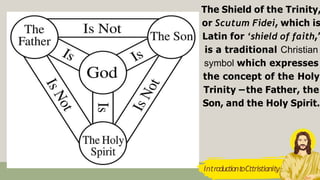
The Shield of the Trinity,
or Scutum Fidei, which is
Latin for ‘shield of faith,’
is a traditional Christian
symbol which expresses
the concept of the Holy
Trinity –the Father, the
Son, and the Holy Spirit.
IntroductiontoCttristianity
• In this context, the Holy Trinity concept relates
to the family, representing husband, wife, and
offspring.
• It also points to the direct connection
between mind, body, and soul, or, in other
words, our
thinking, actions, and feelings.
• As an ideal representation of eternity, it’s also
a symbol of the inseparability between past, present,
and future.
• Similarly, it portrays faith, love, and hope.
IntroductiontoCttristianity
SACRED SCRIPTURES
The Bible is considered the sacred scripture of Christianity.
• It is a collection of songs, stories, poetry, letters, history, as well as
literature.
• It is composed of two books, the Old Testament and the New
Testament.
• The Old Testament is considered the original Hebrew Bible, written
between 1200 and 165 B.C.E.
• The New Testament was written by Christians around 100C.E.
3
IntroductiontoCttristianity
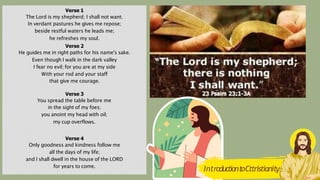
Verse 1
The Lord is my shepherd; I shall not want.
In verdant pastures he gives me repose;
beside restful waters he leads me;
he refreshes my soul.
Verse 2
He guides me in right paths for his name's sake.
Even though I walk in the dark valley
I fear no evil; for you are at my side
With your rod and your staff
that give me courage.
Verse 3
You spread the table before me
in the sight of my foes;
you anoint my head with oil;
my cup overflows.
Verse 4
Only goodness and kindness follow me
all the days of my life;
and I shall dwell in the house of the LORD
for years to come.
IntroductiontoCttristianity
THE OLD
TESTAMENT
The Old Testament is the first part of Christian Bibles, based primarily upon the
Hebrew Bible.
• a collection of ancient religious writings by the Israelites believed by most
Christians and religious Jews to be the sacred Word of God. The second
part of the Christian Bible is the New Testament.
IntroductiontoCttristianity
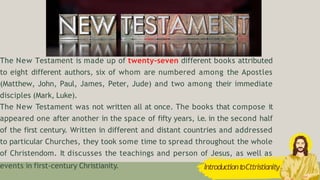
The New Testament is made up of twenty-seven different books attributed
to eight different authors, six of whom are numbered among the Apostles
(Matthew, John, Paul, James, Peter, Jude) and two among their immediate
disciples (Mark, Luke).
The New Testament was not written all at once. The books that compose it
appeared one after another in the space of fifty years, i.e. in the second half
of the first century. Written in different and distant countries and addressed
to particular Churches, they took some time to spread throughout the whole
of Christendom. It discusses the teachings and person of Jesus, as well as
events in first-century Christianity. IntroductiontoCttristianity
BELIEFS AND DOCTRINES
Beliefs and doctrines serve as moral guidelines for the
Christians. They should follow these teachings strictly
if they want to redeem God’s promise of eternal life.
Not following them would lessen their chances of
being called true Christians and reduces their chances
of salvation in the afterlife.
IntroductiontoCttristianity
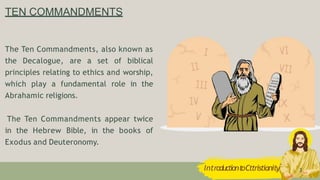
TEN COMMANDMENTS
IntroductiontoCttristianity 3
The Ten Commandments, also known as
the Decalogue, are a set of biblical
principles relating to ethics and worship,
which play a fundamental role in the
Abrahamic religions.
The Ten Commandments appear twice
in the Hebrew Bible, in the books of
Exodus and Deuteronomy.
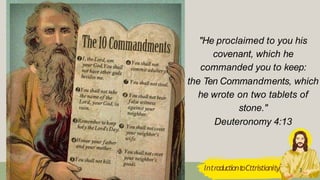
"He proclaimed to you his
covenant, which he
commanded you to keep:
the Ten Commandments, which
he wrote on two tablets of
stone."
Deuteronomy 4:13
IntroductiontoCttristianity 3

INTRODUCTION-TO-CHRISTIANITY-G11.pptx

  • 1.
  • 2.
  • 3.
    1.What Christian symbols canyou find in the picture? 2.What do these symbols mean? 3.What is the relevance of going to church in Christianity? IntroductiontoCttristianity
  • 4.
    LESSON PROPER IntroductiontoCttristianity Christianity is consideredthe world’s largest religion, a religion based on the teachings of Jesus Christ who is considered the Son of God and the Messiah or Savior. Followers of Christianity are called Christians. As of 2010, there are more than 2 billion Christians all over the world, which make up more than 30% of the worlds population of 6.9 billion.
  • 5.
    10 COUNTRIES WITHTHE LARGEST NUMBER OF CHRISTIANS (2015) IntroductiontoCttristianity
  • 6.
    The cross servesas a symbol of Jesus Christ’s victory over sins when he died on the cross for humanity’s redemption and salvation. In Roman Churches, the crucifix is a Catholic regular feature with the image of Christ nailed on the cross- emphasizing Christ’s sufferings for humanity. IntroductiontoCttristianity 6
  • 7.
    6 Historical Christianity develop, developedin Palestine around 100 C.E. it was founded by Jesus considered to be the Son of God and Messiah or Savior. Today Christianity is divided into three major sects: • Roman Catholicism; • Eastern Orthodox and • Protestantism. IntroductiontoCttristianity
  • 8.
  • 9.
  • 10.
    THE 12 APOSTLES Peter (alsoknown as Simon) Andrew (Peter’s brother) James son of Zebedee John (James’ brother) Philip Bartholomew Thomas Matthew James son of Aphaeus Jude Simon Judas Iscariot IntroductiontoCttristianity
  • 11.
  • 12.
    6 Jesus as theFounder of Christianity Christianity started with a prophecy in the Old Testament that God will send his only begotten Son to save humanity from eternal damnation. Jesus, through his preaching and healing, was seen by his followers to be the Messiah they were waiting for. IntroductiontoCttristianity
  • 13.
    RELIGIOUS LEADERS The Catholic Churchfollows a certain hierarchy based on the Canon Law of the Catholic Church. At the top of the hierarchy is the pope, considered as Peter’s successors. The hierarchy also includes the cardinals, archbishops, bishops, priests, and deacons. Each member of the hierarchy has his own function for the efficiency of the Church. IntroductiontoCttristianity
  • 14.
  • 15.
  • 16.
    POPE The pope isthe head of the Catholic Church and the Bishop of Rome. The pope is also the head of the sovereign city-state, Vatican City. What this means on a daily basis is that the pope, in this case Pope Francis I,has duties both political and religious. Next to the Pope are the cardinals, who are also appointed by the Pope. The primary responsibility cardinal is to of a elect a new pope when a pope dies or abdicates the papacy. Other cardinals have different areas of responsibility, called congregations. CARDINALS IntroductiontoCttristianity Pope Francis
  • 17.
    BISHOP Bishops alone have toconfirm the right and ordain members of the clergy, and their main duty is to supervise the clergy within their diocese. A bishop who moves to the level of cardinal isn't ordained, but handpicked by the pope, who also appoints bishops. A bishop oversees a diocese, which is a collection of local parishes; and an archbishop administers an archdiocese, which is just a really large diocese. ARCHBISHOP IntroductiontoCttristianity Most. Rev. Cosme Damian Almedilla D.D
  • 18.
    PRIEST In the Catholic Church,a parish priest is a priest appointed by the bishop to represent him to the local parish, which is a collection of neighborhoods in one small region of a county within a given state. Deacons are ordained as a sacramental sign to the Church and to the world of Christ, who came "to serve and not to be served.“ The entire Church is called by Christ to serve, virtue ordination and the deacon, in of his sacramental and through his various ministries, is to be a servant in a servant-Church. DEACONS IntroductiontoCttristianity 5 Rev. Fr. Joselito T. Galido,
  • 19.
    DEITY/GOD IntroductiontoCttristianity Christians believe inone God, therefore Christianity is a monotheistic religion. God is seen as the creator and maintainer of the universe, and is believed to be: • omnipotent (all-powerful), • omniscient (all-knowing), • omnipresent (all-present), • and omnibenevolent (all- good). God is also sacred, moral, unchangeable, compassionate, graceful, and timeless.
  • 20.
    The Shield ofthe Trinity, or Scutum Fidei, which is Latin for ‘shield of faith,’ is a traditional Christian symbol which expresses the concept of the Holy Trinity –the Father, the Son, and the Holy Spirit. IntroductiontoCttristianity
  • 21.
    • In thiscontext, the Holy Trinity concept relates to the family, representing husband, wife, and offspring. • It also points to the direct connection between mind, body, and soul, or, in other words, our thinking, actions, and feelings. • As an ideal representation of eternity, it’s also a symbol of the inseparability between past, present, and future. • Similarly, it portrays faith, love, and hope. IntroductiontoCttristianity
  • 22.
    SACRED SCRIPTURES The Bibleis considered the sacred scripture of Christianity. • It is a collection of songs, stories, poetry, letters, history, as well as literature. • It is composed of two books, the Old Testament and the New Testament. • The Old Testament is considered the original Hebrew Bible, written between 1200 and 165 B.C.E. • The New Testament was written by Christians around 100C.E. 3 IntroductiontoCttristianity
  • 23.
    Verse 1 The Lordis my shepherd; I shall not want. In verdant pastures he gives me repose; beside restful waters he leads me; he refreshes my soul. Verse 2 He guides me in right paths for his name's sake. Even though I walk in the dark valley I fear no evil; for you are at my side With your rod and your staff that give me courage. Verse 3 You spread the table before me in the sight of my foes; you anoint my head with oil; my cup overflows. Verse 4 Only goodness and kindness follow me all the days of my life; and I shall dwell in the house of the LORD for years to come. IntroductiontoCttristianity
  • 24.
    THE OLD TESTAMENT The OldTestament is the first part of Christian Bibles, based primarily upon the Hebrew Bible. • a collection of ancient religious writings by the Israelites believed by most Christians and religious Jews to be the sacred Word of God. The second part of the Christian Bible is the New Testament. IntroductiontoCttristianity
  • 25.
    The New Testamentis made up of twenty-seven different books attributed to eight different authors, six of whom are numbered among the Apostles (Matthew, John, Paul, James, Peter, Jude) and two among their immediate disciples (Mark, Luke). The New Testament was not written all at once. The books that compose it appeared one after another in the space of fifty years, i.e. in the second half of the first century. Written in different and distant countries and addressed to particular Churches, they took some time to spread throughout the whole of Christendom. It discusses the teachings and person of Jesus, as well as events in first-century Christianity. IntroductiontoCttristianity
  • 26.
    BELIEFS AND DOCTRINES Beliefsand doctrines serve as moral guidelines for the Christians. They should follow these teachings strictly if they want to redeem God’s promise of eternal life. Not following them would lessen their chances of being called true Christians and reduces their chances of salvation in the afterlife. IntroductiontoCttristianity
  • 27.
    TEN COMMANDMENTS IntroductiontoCttristianity 3 TheTen Commandments, also known as the Decalogue, are a set of biblical principles relating to ethics and worship, which play a fundamental role in the Abrahamic religions. The Ten Commandments appear twice in the Hebrew Bible, in the books of Exodus and Deuteronomy.
  • 28.
    "He proclaimed toyou his covenant, which he commanded you to keep: the Ten Commandments, which he wrote on two tablets of stone." Deuteronomy 4:13 IntroductiontoCttristianity 3