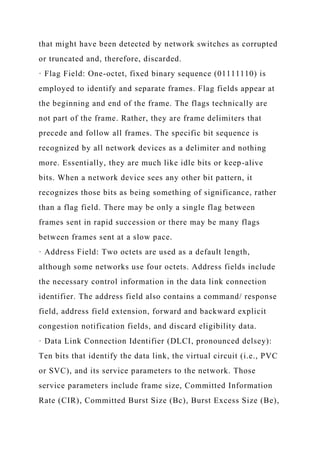
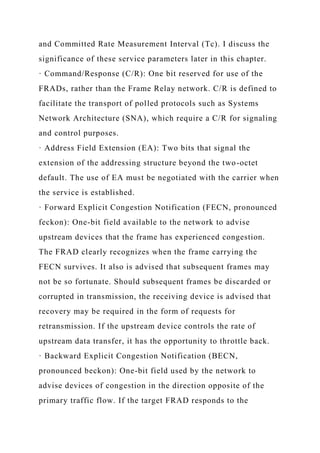
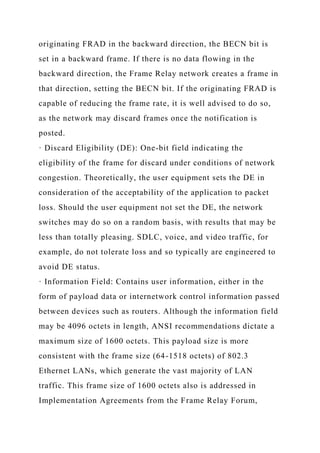
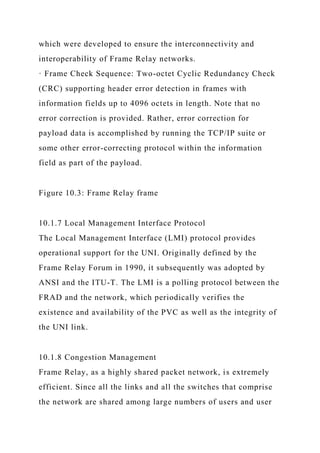
Introduction
This is an individual project. Each student must complete a
White Paper that proposes a telecommunications solution to
address a communications problem for a business organization.
The target audience will be the organization’s Chief
Information Officer (CIO). The White Paper deliverable is an
MS Word document. If you have never written a white paper,
you should conduct some research and review sample white
papers to understand the content and format associated with
these professional documents.
The completed White Paper deliverable is due by 11:59 PM
Eastern Time on the due date shown in the Course Schedule.
See the Additional Information section of the syllabus for the
penalty for late or missed assignments and projects.
The White Paper is valued at 12% of the course grade.Scenario
Ullman, Manly, & Ulysses Corporation
With 75,000 customers worldwide, 250 employees working in
four locations in the United States and three European offices,
and a catalog of more than 100,000 parts, Ullman, Manly &
Ulysses Corporation (UMUC) relies on its network for its
survival. In the past decade, UMUC has seen its business grow
from just one location and a few local customers to the
worldwide supplier it is today. But in the process of growing
exponentially, it has overwhelmed its telecommunications
network, which is currently managed by an outside
telecommunications network management company. The
network crashes frequently, resulting in customer service and e-
mail interruptions that are costly to the company. The network
management company is not responsive to UMUC, a relatively
small customer, and often disagrees that there is even a
problem. Since the contract with the service provider is about to
expire, UMUC has decided to seek a better network solution.
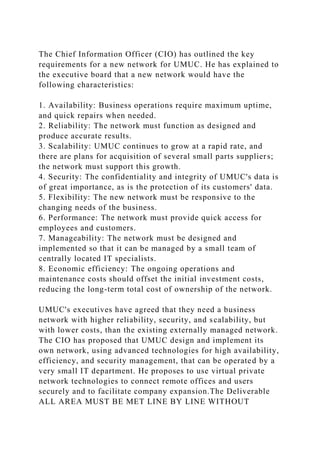
The Chief Information Officer (CIO) has outlined the key
requirements for a new network for UMUC. He has explained to
the executive board that a new network would have the
following characteristics:
1. Availability: Business operations require maximum uptime,
and quick repairs when needed.
2. Reliability: The network must function as designed and
produce accurate results.
3. Scalability: UMUC continues to grow at a rapid rate, and
there are plans for acquisition of several small parts suppliers;
the network must support this growth.
4. Security: The confidentiality and integrity of UMUC's data is
of great importance, as is the protection of its customers' data.
5. Flexibility: The new network must be responsive to the
changing needs of the business.
6. Performance: The network must provide quick access for
employees and customers.
7. Manageability: The network must be designed and
implemented so that it can be managed by a small team of
centrally located IT specialists.
8. Economic efficiency: The ongoing operations and
maintenance costs should offset the initial investment costs,
reducing the long-term total cost of ownership of the network.
UMUC's executives have agreed that they need a business
network with higher reliability, security, and scalability, but
with lower costs, than the existing externally managed network.
The CIO has proposed that UMUC design and implement its
own network, using advanced technologies for high availability,
efficiency, and security management, that can be operated by a
very small IT department. He proposes to use virtual private
network technologies to connect remote offices and users
securely and to facilitate company expansion.The Deliverable
ALL AREA MUST BE MET LINE BY LINE WITHOUT
MISSING A THINY DOT.
The CIO has asked you to develop a 3-pagewhite paper that
provides the following:
· definition of the business or technical problem
· discussion of the problem within the context of the scenario
· recommendation of the application of technology, processes,
and policies that solve the problem
· discussion of the impact or risks of the applied solution within
the context of business strategy and managerial perspective
· identification, analysis, and mitigation of risks of the
recommended solution
Briefly define the business problem, and discuss it in the
context of the scenario. Briefly describe the proposed
technology solution, processes, and policies to solve the
problem. You should demonstrate your critical thinking as you
incorporate the course concepts and explain the business needs
and solutions. Then discuss the impact or risks of the applied
solution within the context of the business strategy and
managerial perspective. Then discuss the challenges and
security risks that result from implementing the proposed
solution. Propose mitigation strategies for the challenges and
risks identified. The bolded attributes in the Scoring Rubric
(see below) must be used as the section headings in the white
paper.
Your deliverable will be a white paper three pages in length, not
counting the cover page and references page. At least two (2)
external sources (other than the assigned readings and other
course materials) total of 4 must be used, and citations and
references must be in APA format. Your paper will be scored
according to the Scoring Rubric below. Be sure you have
incorporated all required aspects of the assignment.
Project 2: White Paper Instructions
SEE RUBRIC BELOW
Page 6 of 6Scoring Rubric
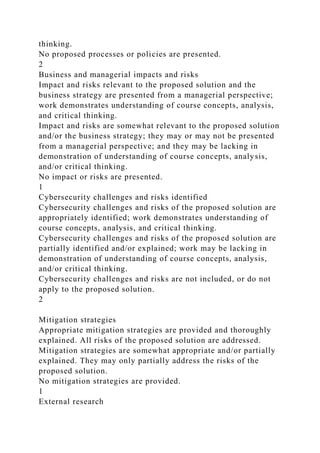
Attribute
Full points
Partial points
No points
Possible Points
The business problem
The business problem is defined and discussed in sufficient
depth to set the stage for the proposed solution, and
demonstrates critical thinking and understanding of the course
concepts.
The business problem is partially defined and/or discussed; it
may not adequately set the stage for the proposed solution
and/or may not demonstrate critical thinking and understanding
of course concepts.
The business problem is not defined.
1
Proposed technology solution
The proposed technology solution appropriately addresses the
business scenario/problem, and demonstrates understanding of
course concepts, analysis, and critical thinking.
The proposed technology solution somewhat addresses the
business scenario/problem; it may be lacking in demonstration
of understanding of course concepts, analysis, and/or critical
thinking.
No technology solution is proposed.
3
Proposed processes and policies
Processes and policies relevant to the proposed solution are
presented; work demonstrates understanding of course concepts,
analysis, and critical thinking.
The processes and policies somewhat address the business
scenario/problem; work may be lacking in demonstration of
understanding of course concepts, analysis, and/or critical
thinking.
No proposed processes or policies are presented.
2
Business and managerial impacts and risks
Impact and risks relevant to the proposed solution and the
business strategy are presented from a managerial perspective;
work demonstrates understanding of course concepts, analysis,
and critical thinking.
Impact and risks are somewhat relevant to the proposed solution
and/or the business strategy; they may or may not be presented
from a managerial perspective; and they may be lacking in
demonstration of understanding of course concepts, analysis,
and/or critical thinking.
No impact or risks are presented.
1
Cybersecurity challenges and risks identified
Cybersecurity challenges and risks of the proposed solution are
appropriately identified; work demonstrates understanding of
course concepts, analysis, and critical thinking.
Cybersecurity challenges and risks of the proposed solution are
partially identified and/or explained; work may be lacking in
demonstration of understanding of course concepts, analysis,
and/or critical thinking.
Cybersecurity challenges and risks are not included, or do not
apply to the proposed solution.
2
Mitigation strategies
Appropriate mitigation strategies are provided and thoroughly
explained. All risks of the proposed solution are addressed.
Mitigation strategies are somewhat appropriate and/or partially
explained. They may only partially address the risks of the
proposed solution.
No mitigation strategies are provided.
1
External research
More than two sources other than the assigned readings and
course materials are incorporated and used effectively.
One or two sources other than the assigned readings and course
materials, but they are not properly incorporated or used and/or
are not effective or appropriate.
No external research is incorporated.
1
Document format
The document reflects effective organization and correct
sentence structure, grammar, and spelling; it is presented in a
professional format; and references are appropriately
incorporated and cited, using APA style.
The document is not well-organized, and/or contains grammar
and/or spelling errors; and/or it does not follow APA style for
references and citations.
The document is extremely poorly written and does not convey
the information.
1
Total Points:
12
Reading ISBN ( for citations)
Telecommunications and Data Communications Handbook
by Ray Horak
John Wiley & Sons © 2007 (832 pages) Citation
ISBN:9780470396070
Watch video
https://www.youtube.com/watch?v=sHu5ZDxaMaI&index=10&l
ist=PLTr3GyMgrbb-7MZOfNmiYA7vr66JawWg
Chapter 9: Broadband Network Infrastructure
OVERVIEW
Et loquor et scribo, magis est quod fulmine iungo. I speak and I
write … but more, it's with light(ning) that I connect.
Poet Giovanni Pascoli, describing his views of the telegraph,
1911, translated from Latin
We appear to have developed a seemingly insatiable appetite for
bandwidth in the Wide Area Network (WAN) and Metropolitan
Area Network (MAN) as well as the Local Area Network
(LAN). A number of broadband network technologies have been
developed to address this need for speed. Some of those
technologies are specifically oriented toward data applications,
and others support the triple play, a marketing term derived
from American baseball to describe a full range of voice, data,
and video services. (Note: The term quadruple play is used by
some service providers who add the wireless component of
cellular communications. At this point, the baseball analogy
breaks down, however.) Some of these are access technologies
that are specific to the local loop while others are transport
technologies positioned in the core, or backbone.
Before going further, we should revisit the definition of the
term broadband. In a LAN context, as we discussed in Chapter
8, broadband refers to a multichannel system that supports
multiple transmissions through Frequency Division
Multiplexing (FDM). In a WAN context, the definition is all
about bandwidth and is oriented toward end–user services.
In 1992, the Regional Bell Operating Companies (RBOCs)
defined broadband as a fully symmetrical service running at the
T3 nominal rate of 45 Mbps. At the time, they were working to
convince the Federal Communications Commission (FCC) and
state Public Utility Commissions (PUCs) to support their
desires to replace the copper–based local loops with optical
fiber [1]. In 1999, the FCC defined high-speed services as
supporting a data rate of at least 200 kbps in at least one
direction and advanced telecommunications capability as at
least 200 kbps in both directions. The ITU-T defines broadband
in Recommendation I.113 as a transmission rate faster than the
primary rate [referring to Integrated Services Digital Network
(ISDN)], which translates into 1.544 Mbps in North America
and 2.048 Mbps in most of the rest of the world. Others offer
still different definitions designed to support their own agendas.
Manufacturers and carriers position Asymmetric Digital
Subscriber Line (ADSL) as a broadband local loop service, even
though ADSL rates in the United States often run well below
1.544 Mbps. Clearly, broadband is an imprecise, evolving term
referring to a circuit or channel providing a relatively large
amount of bandwidth. (You may quibble with my
characterization of an imprecise term as being clearly defined.)
I generally subscribe to the ITU–T's definition and, therefore,
use the term to describe capacity equal to or greater than the
primary rate, which generically is the DS–1 rate. So, in the
context of this book, pure broadband is defined as a
transmission rate greater than the nominal T1 rate of 1.544
Mbps, or the E − 1 rate of 2.048 Mbps, depending on the
context. Sometimes, however, I use the term in a more
vernacular sense to describe a service that offers a relatively
large amount of bandwidth, with ADSL being one example. All
of these definitions, of course, are oriented toward end–user
services that require more bandwidth than a dial–up connection
can provide.
In the network core, or backbone, the levels of bandwidth are
much greater and DS-1 has little significance. In this context,
broadband is more correctly defined as DS − 3 or better and
specifically T3 or better. The reason I choose this level is that
the T3 rate of 45 Mbps is the foundation for the Synchronous
Optical NETwork (SONET), the North American fiber–optic
transmission standard, and Synchronous Digital Hierarchy
(SDH), the international version of SONET.
Ultimately, of course, the focus has to be on the delivery of
end–user services, without which any technology in the core
would be totally irrelevant. Manufacturers and carriers are
incredibly intent on providing attractive broadband products and
services to end users. Governments, in general, and regulatory
agencies, in specific, increasingly are centered on ensuring that
as many end users as possible have access to broadband services
at affordable prices. The FCC, for example, has as a broadband
objective, which it has stated as follows [2]:
All Americans should have affordable access to robust and
reliable broadband products and services. Regulatory policies
must promote technological neutrality, competition, investment,
and innovation to ensure that broadband service providers have
sufficient incentive to develop and offer such products and
services.
Despite this stated level of commitment, the United States does
not lead the world in broadband deployment. The ITU–T ranks
the United States as 16th in the world in broadband penetration
per capita, although 1st in terms of total subscribers. The
Organisation for Economic Co–Operation and Development
(OECD), an organization of 30 member countries sharing a
commitment to democratic government and the market economy
(i.e., capitalism), conducts a great deal of research across a
wide range of subjects. The OECD estimates that broadband
subscribers in OECD nations increased by 18 million during the
first six months of 2005 to reach a total of 137 million and a
penetration rate of 11.8 subscribers per 100 inhabitants. South
Korea led with 25.5 subscribers per 100 inhabitants. The
Netherlands, Denmark, Iceland, and Switzerland rounded out
the top five countries. The United States came in at number 12
at 13.5 percent. The OECD study indicates that DSL is the
leading broadband platform in 28 of the 30 OECD countries and
that the United States and Canada are the only countries in
which broadband cable modem subscribers outnumber DSL
subscribers. In the United States, the OECD estimated that 5.5
percent of the population subscribed to DSL service, 8.0 percent
to cable modem service, and 1.1 percent to other broadband
services, including wireless. [Note: CATV and, therefore,
broadband cable modem access is largely a North American
phenome-non.] The breakdown of broadband technologies in
OECD countries, as of June 2005, is as follows:
· DSL: 61.2 percent
· Cable modem: 32.0 percent
· Other technologies: 6.8 percent [3]
The FCC estimated that, as of the end of 2004, there were 37.9
million high–speed access subscribers in the United States. Of
that total, there were 13.8 million DSLL installed, compared to
21.4 million cable modem connections. An additional 2.7
million high–speed connections were provided over satellite,
terrestrial wireless, fiber, powerline carrier, or other wireline
technologies.
Broadband access and transport technologies, according to the
FCC, encompass all evolving high–speed digital technologies
that provide consumers integrated access to voice, high–speed
data, video–on–demand, and interactive delivery services [2].
This chapter deals with a number of access, or local loop,
technologies, including Digital Subscriber Line (DSL),
Community Antenna TeleVision (CATV), Passive Optical
Network (PON), 802.16 and Worldwide interoperability for
Microwave Access (WiMAX), and Access Broadband over
Power Line (BPL). This chapter also details SONET and SDH,
the standards for optical fiber transmission in backbone carrier
networks, Dense Wavelength Division Multiplexing (DWDM),
Coarse Wavelength Division Multiplexing (CWDM), and
Resilient Packet Ring (RPR).
9.1 ACCESS TECHNOLOGIES
Access technologies are absolutely critical. The least capable
link defines the greatest level of performance of a circuit or
network, and the least capable link is the local loop. There has
been a great deal of hyperbole in the United States for a very
long time (at least 1992) about Fiber–To–The–Premises (FTTP)
but very little investment until very recently. Large user
organizations with offices in commercial office parks or high–
rise buildings in major markets often have direct access to
optical fiber. A privileged few residential and small–business
customers have fiber access. A great deal of distribution fiber
has been deployed in preparation for FTTP, but most of that
fiber has yet to be terminated and activated. So, most of us must
contend with the limitations of the copper loop. In the United
States and Canada, most broadband users currently subscribe to
cable modem service over CATV networks based on coaxial
cable. Internationally, most broadband users subscribe to DSL
services provided over the Incumbent Local Exchange Carrier
(ILEC) twisted–pair local loop. Several terrestrial wireless
technologies have been developed to extend broadband
capabilities to the premises, although they have yet to achieve
any appreciable level of success, and others are under
development. Broadband satellite service is an option but
usually is limited to remote rural areas where no alternatives
exist.
Some of the technologies are incremental in nature. In other
words, they are enhancements of existing copper local loop
[i.e., Unshielded Twisted–Pair (UTP) or coax] technologies.
These incremental approaches substantially improve the
performance of the underlying transmission media within the
limitations imposed by the regulators and the basic laws of
physics. Wireless local loops either overlay the traditional
copper network, bypassing it for a variety of reasons that
include cost and performance, or are an alternative where
wireline loops are either impossible or problematic to deploy.
Optical fiber loops generally involve either a complete
replacement of trunk facilities in the loop or an overlay.
Regardless of whether the access technology is characterized as
an enhancement, an overlay, or a replacement, the absolute cost
of its deployment is significant.
The cost of UTP local loops in North America ranges from
approximately $ 1000 to $ 7500, with the upper end of the range
applying where terrain is especially diffi-cult (e.g., rocky soil
or high water tables) or where population density is low. The
cost of an optical fiber loop is much higher, but they are
deployed in support of high–volume business in high–density
areas. As telco local loop revenues generally are low and costs
are high, there really is no stunning profit potential in the telco
local loop business. Rather, the profits are in the capabilities of
the networks and services to which they provide access and the
company that controls the local loop access to those networks
and services. Assuming that the environment is a competitive
one, a Competitive Local Exchange Carrier (CLEC) or service
provider has two basic choices—buy or build:
· Buy: In order to encourage competition, the regulator may
require that the ILEC lease local loops and other network
elements to the CLEC, most likely at some rate that is cost
based. The ILEC is unlikely to be in agreement with this
requirement and almost certainly will not be especially
enthusiastic or helpful in its implementation. However, leasing
embedded telco local loops certainly is the fastest way to gain
access to large numbers of customers.
· Build: Although it is expensive and time consuming to build
local loop facilities, the long–term advantages are significant. A
local loop built from the ground up, so to speak, likely will be
based on the most advanced and appropriate technologies and,
therefore, will be optimized to deliver the highest performance
at the lowest cost. The CLEC that builds its own network also
owns and controls it, which is very significant.
When considering local loop media alternatives, twisted pair is
almost out of the question except for an ILEC extending a last–
mile legacy network. Coaxial cable is out of the question except
for a CATV provider extending a last–mile legacy network.
Fiber optics really is the only choice for a wireline local loop,
for reasons that include bandwidth, error performance, distance,
and resiliency. There are wireless alternatives, although they
generally have failed in practice or remain either in
development or field trial at the moment.
9.1.1 Generic Digital Subscriber Line
Generic Digital Subscriber Line (xDSL) encompasses a group of
digital network access technologies largely intended for the
consumer class markets, including residential, Small
Office/Home Office (SOHO), and small–business applications.
However, several very significant DSL services are oriented
toward business class markets. DSL is provisioned over
conventional UTP local loop facilities, which comprise the vast
majority of network access facilities owned by the ILECs.
Beginning in 1880 and continuing through much of the
twentieth century, UTP was the only option, or the only viable
option, for most local loop applications. UTP inher-ently is the
most limited of all transmission media in terms of the
dimensions of bandwidth, error performance, and distance, but a
two–wire UTP circuit is quite sufficient in support of analog
voice and analog voice–grade data through modems. If properly
conditioned, it also is quite sufficient in support of ISDN BRI, a
digital service running at a total signaling rate of 144 Mbps.
UTP even supports Fractional T1, T1, E–1, and ISDN PRI at
signaling speeds up to 2.048 Mbps. The main reason that we
continue to deploy UTP is that it is relatively inexpensive and
simple to acquire and install as an extension of a legacy UTP–
based network.
However, the embedded twisted–pair local loop has become
strained under the pressure of increased demand for increased
speed of information transfer and improved error performance
in support of data communications. In large part, this demand is
due to the development of the Web and the resulting growth in
popularity of the commercialized Internet. As a result of these
factors and competition from CATV providers and others, the
ILECs have aggressively sought to develop technologies to
extend the life of the embedded UTP local loop through
improving its general performance characteristics.
xDSL, or DSL, is a group of Layer 1 (Physical Layer)
technologies including ADSL, HDSL, IDSL, SDSL, and VDSL.
All of these technologies are digital in nature and make use of
sophisticated compression algorithms and multiplexing
techniques to derive as much performance as possible from the
inherently limited UTP–based local loop. Each technology is
loop specific, requiring special equipment on each end of the
point–to–point local loop circuit. Most DSL technologies
support both voice and data; voice is afforded preferential
treatment, and data are supported at relatively high speed. A
number of options support video as well, and one supports data
only. Most of the technologies involve centralized splitters, also
called modems or filters, on the customer premises side of the
loop. Voice signals, which run at frequencies up to 4 kHz, cut
through the locally powered splitter in the event of a power
failure; therefore, and very much unlike ISDN, the phones still
work if the lights go off. A key advantage of all DSL
technologies is that they support always-on data access because
the circuit is always available from the PC through the on–
premises splitter to the centralized splitter and DSL Access
Multiplexer (DSLAM) in the Central Office (CO) or other
centralized location and to the Internet. Therefore, there are no
dial–up delays such as those you experience when establishing a
circuit–switched connection over the Public Switched
Telephone Network (PSTN) through a modem. Table 9.1
provides a comparison of some of the key DSL options.
Table 9.1: DSL Technology Comparisons
Open table as spreadsheet
DSL Type
ITU Standard
Maximum Rate Downstream[a]
Maximum Rate Upstream[b]
Maximum Reach; Extendable (Yes/No)
Applications
ADSL
G.992.1 (1999)
7 Mbps
800 kbps
18,000 ft (Y)
Consumer-class Internet
G.lite
G.992.2 (1999)
1.544 Mbps
512 Mbps
18,000 ft (Y)
Consumer-class Internet
ADSL2
G.992.3, G.992.4 (2002)
12 Mbps
1 Mbps
18,600 ft (N)
Consumer-class Internet
ADSL2+
G.992.5 (2003)
24.5 Mbps
1 Mbps
18,000 ft[c] (N)
Consumer-class, SME Internet
ADSL2-RE
G.992.3 (2003)
8 Mbps
1 Mbps
20,700[d] (N)
Consumer-class Internet
IDSL
N/A
144 kbps
144 kbps
18,000 ft (Y)
Consumer-class Internet
Symmetric HDSL
G.991.2 (2003)
4.6 Mbps
4.6 Mbps
6,000 ft (Y)
Business–class Internet
VDSL
G.993.1 (2004)
55 Mbps
15 Mbps
1,000 ft[e] (N)
Voice, data, video
VDSL2: 12 MHz
G.993.2 (2005)
55 Mbps
30 Mbps
1,000 ft[c] (N)
Voice, data, video
VDSL2: 30 MHz
G.993.2 (2005)
100. Mbps
100 Mbps
500 ft[f] (N)
Voice, data, video
[a]Downstream is from the network edge to the customer
premises.
[b]Upstream is from the customer premises to the network edge.
[c]Maximum achievable rates downstream and upstream are
achievable at distances up to 5000 ft. Considerably reduced
rates are achievable at distances up to 18,000 ft.
[d]Maximum achievable rates downstream and upstream are
achievable at distances up to 18,000 ft. Rates up to 192 kbps
downstream and 96 kbps upstream are achievable at distances
up to 20,700 ft.
[e]Maximum achievable rates downstream and upstream are
achievable at distances up to approximately 1000 ft, after which
rates drop precipitously. Considerably reduced rates are
achievable at distances up to 4000-5000 ft.
[f]Maximum achievable rates downstream and upstream are
achievable at distances up to approximately 500 ft, after which
rates drop precipitously. Considerably reduced rates are
achievable at distances up to 4000-5000 ft.
All xDSL technologies are fairly demanding of the local loop.
Some are absolutely unforgiving, and some are adaptive to local
loop anomalies. Before examining the specific technologies, I
want to examine the problems with electrically based local
loops, each of which has definite impact on xDSL performance:
· Loop length has a significant effect on signal strength and,
therefore, on error performance. This is particularly true at high
frequencies, which attenuate much more quickly (i.e., over a
shorter distance) than do low frequencies. Further, attenuation
especially is an issue given the narrow gauge (usually 24 or 26
gauge) of voice–grade, twisted–pair outside cable plants. As all
of the xDSL technologies are designed to support relatively
high speed data, they run at relatively high frequencies, at least
in comparison to the 4–kHz range over which analog voice is
supported. Many of the xDSL technologies are designed to work
over local loops as long as 18,000 ft, which describes the vast
majority of ILEC loops. Other xDSL technologies require loop
lengths in the range of 12,000 ft or less due to the higher
frequencies utilized. The reach of some of the technologies can
be extended through the use of loop extenders or line doublers,
which essentially are DSL repeaters. Other DSL types cannot be
extended and performance is highly sensitive to loop length,
with shorter loops offering better performance. Approximately
85 percent of all U.S. residential loops are within 18,000 ft (5.5
km), and approximately 75 percent are within 12,000 ft (3.7 km)
[4]. The same holds roughly true for the United Kingdom [5].
· Splices and mixed gauges can cause echo, or signal reflection,
which is a source of noise, or signal distortion. It is not at all
uncommon to find mixed 24–and 26–gauge cable in a given
local loop. It is not as though the ILEC craftspeople just closed
their eyes and reached into the warehouse for a reel of cable,
but the effect is the same as if they had. Telcordia Technologies
estimates that the average residential local loop involves 22
splices, each of which contributes to the problem [6]. Some of
those splices may not be mechanically sound, and some of the
splice casings may not be well insulated. The problem is likely
to be worse with longer loops, as they generally involve more
splices. Echo cancellers and error detection and correction
algorithms can compensate for much of this noise, but it is
always an issue.
· Bridged taps are sections of a cable pair not on the direct
electrical path between the CO and the customer premises. They
generally are in place because a previous customer between the
CO and the subject building was connected to the CO through
the same pair. When that customer disconnected service, the
splice was not removed. If a telephone is connected, the bridged
tap essentially splits the signal, which roughly halves the signal
power to the intended customer. If there is no telephone
connected to the bridged tap, the open cable acts as a signal
reflector, which causes signal distortion. DSL employs high-
frequency signals, which attenuate quickly and require a point–
to–point local loop for maximum performance. Bridged taps
must be removed for some xDSL services to work optimally and
for others to work at all.
· Load coils are passive devices that filter frequencies above 4
kHz in order to tune the copper circuit and optimize it for mid–
voice–band performance. As DSL circuits employ frequencies
well above 4 kHz, load coils must be removed.
· Electronics such as amplifiers, repeaters, and various types of
simple multiplexers and line splitters are installed on some
loops. They must be removed. DSL requires a dry copper pair
(i.e., a pair with no electronics), also known as a burglar alarm
circuit.
· Interference is an inherent problem with unshielded copper
conductors. UTP is susceptible to ambient noise from a variety
of sources, such as static electricity, radio and TV stations, and
electric motors in proximity. Also, in a multipair distribution
cable, a high–frequency DSL service on one cable pair can
adversely affect Plain Old Telephone Service (POTS), T1
service, or other DSL services on adjacent pairs and even pairs
in proximity. As I discussed in Chapter 2, an electrical signal
radiates from the center of the copper core, causing the signal to
attenuate and creating the potential for crosstalk between
adjacent pairs in a multipair cable as the signals couple.
Attenuation increases over distance, and weakened signals in
adjacent pairs are increasingly vulnerable to crosstalk. There
are several types of crosstalk that are of particular concern with
respect to DSL services:
· Near-End CrossTalk (NEXT) occurs at the near end of the
circuit, that is, at the end closest to the point of signal origin.
Since at that point the outgoing downstream signal is at
maximum strength and the incoming upstream signal is at
minimum strength, the signals can couple quite easily if the
Attenuation-to-Crosstalk Ratio (ACR) is not maintained at
acceptable levels. NEXT is a particularly significant issue
services at the network side of the connection for ADSL
services, as the pair count of the cables is quite high at the CO.
However, ACR can be managed much more effectively at the
edge of the telco network than at the customer premises.
· Far-End CrossTalk (FEXT) occurs at the far end of the loop,
that is, far away from the point of signal origin. It is at that end
that the attenuated downstream signal from the network can
experience crosstalk from the strong upstream signal emanating
from the customer equipment. FEXT is not a great issue for
ADSL services at the customer premises, as the cables are
successively smaller, containing fewer and fewer pairs, from the
CO to the premises.
In consideration of the phenomenon of crosstalk and the
differences between NEXT and FEXT, most DSL services are
asymmetric, with the higher frequencies on the downstream side
(i.e., from the edge of the telco network to the customer
premises) in support of greater bandwidth in that direction. Not
only is such asymmetry technically easier to provision, but it is
also entirely appropriate for DSL applications that require much
more downstream than upstream bandwidth, with Web surfing
being a prime example. Note that asymmetric DSL circuits
cannot be turned around to provide greater bandwidth upstream
and lesser downstream. A Web–based business, for example,
would typically not be well served by ADSL as its upstream
bandwidth requirements would be much greater than its
downstream requirements.
· Inside wire systems are of uncertain quality in residential,
SOHO, and small-business environments. In many cases, the
inside wire has been in place for many years and has been
spliced over and over again as buildings were remodeled and as
new jacks were added for analog telephones, fax machines, and
computer modems. Professionals completed some of this work,
and amateurs may have done the rest. My home office, for
example, is in a 1909 farmhouse. It's a great place to write a
book, but the inside wiring system is of uncertain nature. My
lovely wife, Margaret, telecommutes in connection with her
consulting practice, so we share the space. We have five lines
coming into our SOHO, and I can't even count the number of
jacks for our analog telephone sets, fax machine, computer
modems (she has to gain access to some client networks on a
dial–up basis), and DSL service. Margaret installed some of the
jacks, so I have to be careful what I put in print, but suffice it to
say that our wiring system is somewhat unusual. In any event,
running high–speed data to our workstations could be an
interesting, and uncertain, experience unless we recabled the
offices. [Note: We recabled the connection from the Network
Interface Unit (NIU) to our ADSL modem with Cat 5, used a
Cat 5 cable to our 802.11b Wireless LAN (WLAN)
bridge/router, used a Cat 5 cable to connect to my desktop, and
went wireless to our three laptops.]
· Voice instrument signaling states can impact data
communications in a DSL environment. While analog voice
circuits are standardized and voice terminals are certified, the
wide variety of devices vary enough in their electrical
characteristics to cause unpredictable problems when
integrating voice and data over a common inside wiring plan.
For that matter, the electrical characteristics of multiple phones
of the same manufacturer and model number can vary
considerably, even within the same manufacturing lot. DSL data
communications sessions can be dropped when analog
telephones ring (voltages can exceed 100 V), when they go off–
hook, and when they go back on–hook. The ultimate solution is
an adaptive splitter or modem. The interim solution, at least for
some versions of DSL, involves equipping all telephone sets,
fax machines, and other connected devices with inexpensive
high–pass microfilters that plug in between the set and the jack.
· Digital Loop Carrier (DLC) systems are voice–grade
multiplexers embedded in a local loop distribution plant to
increase its efficiency. Subscriber Line Carrier (SLC) 96, for
example, involves a four–wire copper circuit that runs from the
CO to a remote node and provides four T1 circuits in support of
96 voice–grade time division multiplexed (TDM) channels of 64
kbps. At the remote node are concentrated and multiplexed as
many as 96 individual voice-grade local loops that terminate at
customers' premises, as illustrated in Figure 9.1. SLC–96 and
other much more advanced DLC systems are highly cost
effective in support of voice–grade communications services to
areas that are far removed from the CO. DLC systems, however,
filter high–frequency signals such as DSL, shaping and
grooming them to fit into 64–kbps channels. Traditional DLCs,
therefore, render DSL inoperable, with the exception of IDSL.
The only viable solution is to split the voice and data channels
through a next-generation DLC (ngDLC), as illustrated in
Figure 9.2. An ngDLC deals with the voice channels in the
traditional manner, digitizing them into Pulse Code Modulation
(PCM) format and multiplexing them into 64–kbps (TDM)
channels. The ngDLC runs the video and data channels through
an embedded DSL Access Multiplexer (DSLAM), which is a
packet multiplexing device designed specifi-cally for that
purpose. The ngDLC is a hybrid solution, as it employs optical
fiber to the CO but makes use of the existing copper pairs to the
premises. In densely packed urban areas, relatively few DLCs
are required, while sparsely populated rural areas make
extensive use of DLCs.
Figure 9.1: SLC-96, illustrating digital loop carrier
Figure 9.2: Next-generation DLC with built-in DSLAM
Also, before exploring the specifics of the DSL technology
options, it is important to pause just a moment to examine some
of the network elements that generally are involved. Those
elements include splitters or modems, local loops, and
DSLAMs:
· Splitters or modems are interface units that must be installed
in matching pairs, with one at the customer premises and one at
the edge of the network. The splitter at the network edge
generally is embedded in a DSLAM. The premises-based unit
may be a centralized splitter in the form of an enhanced network
interface unit, which is the point of termination and
demarcation between the carrier–provided local loop and the
inside wire and cable system. A centralized NIU generally is
attached to the outside of the building or is positioned just
inside the basement wall, garage wall, or other point of entry.
Alternatively, the splitter may be in the form of a set-top box,
much like a CATV converter. The splitter functions as a hybrid
frequency division multiplexer and time division multiplexer.
Additionally, the splitter compresses the data transmissions.
The splitter also may function as a codec, digitizing analog
voice and fax transmissions as required.
· Local loops are the point–to–point dedicated circuits between
the customer premises and the edge of the network. As they are
dedicated circuits, there are no issues of contention or
congestion over the local loops themselves. At the customer
premises, the local loop terminates in an NIU, with the splitter
or modem functionally positioned between the NIU and the
terminal equipment. A matching splitter/modem is positioned at
the edge of the network. If the service provider is an ILEC, that
point of interface may be in the form of a DSL card associated
with a CO. In the upstream direction, the ILEC splitter splits off
the low–frequency voice signals for presentation to the PSTN
and the high–frequency data signals for presentation to the
Internet or other Public Data Network (PDN) through the
DSLAM. A service provider generally dedicates a complete
local loop to DSL service. But some DSL services, such as
ADSL, can support both data communications for Internet
access purposes and traditional analog POTS service over the
same local loop through frequency splitting. Under pressure
from the end user and competitive service provider
communities, the FCC in December 1999 rendered its line-
sharing decision. That decision requires that the ILECs open the
high–frequency portion of qualifying local loops to competing
DSL data services at any possible point. That point typically is
at the CO, where the CLEC installs its DSLAM. But that point
also can be at an ngDLC, in which case a subloop (i.e., portion
of a loop) is shared. In theory, at least, line sharing is a
reasonable solution to the struggles between the ILECs and the
CLECs. In practice, however, it rarely seemed to work, and the
FCC has since relaxed its position.
· DSL access multiplexers provide the interface between the
DSL local loop and the service provider's Point Of Presence
(POP). Most DSLAMs are based on Asynchronous Transfer
Mode (ATM), although some earlier models are based on Frame
Relay (FR), with the specific technology depending on what the
carrier has in place. In any case, the DSLAM and the DSL
modem on the user's premises must run matching protocols. In
an ADSL scenario, for example, the DSLAM receives upstream
DSL traffic and splits, or demultiplexes, the voice and data
traffic. The voice traffic then is encoded into PCM format and
time division multiplexed over a channelized T1, T3, or,
perhaps, SONET link to the PSTN. The data traffic is
multiplexed or concentrated in ATM cells over an
unchannelized T1, T3, or SONET circuit directly to the Internet
backbone or perhaps to an independent Internet Service
Provider (ISP). The DSLAM generally represents the first
potential point of contention and congestion that affects
upstream end–user traffic, as the local loop is a dedicated
circuit.
· Single-Point-Of-Termination (SPOT) frames typically are used
where a CLEC or ISP is leasing dry copper pairs from the ILEC
for purposes of provisioning xDSL data services. The SPOT
frame, and other hardware, is collocated in the ILEC CO,
generally in separately secured leased space. The ILEC cross-
connects the individual leased circuits at the Main Distribution
Frame (MDF) and terminates them in the SPOT frame, where
the CLEC or ISP connects them to the DSLAM.
The xDSL technologies discussed first are those intended
largely for the residential, SOHO, and small–business markets:
ADSL, IDSL, G.lite, and VDSL. The technologies discussed last
are those intended primarily for the larger business market:
HDSL, HDSL2, SDSL, and SHDSL.
9.1.1.1 Asymmetric Digital Subscriber Line
Asymmetric Digital Subscriber Line (ADSL), also known as
full-rate ADSL, is an advanced, high-bandwidth local loop
technology designed to extend the life of existing UTP loops for
the transmission of broadband signals. ADSL was developed by
Bellcore (now Telcordia Technologies) at the request of the
RBOCs in the United States and was later standardized in 1999
by ANSI as T1.413 and the ITU–T as G.922.1. ADSL provides
for very high capacity transmission over relatively short local
loops in the Carrier Serving Area (CSA). The DSL Forum, a
Special Interest Group (SIG) dedicated to the promotion of
xDSL technologies, promotes this technology [7].
The term asymmetric refers to the fact that ADSL bandwidth is
provided on an asymmetric (i.e., not symmetric, or unequal)
basis, with more bandwidth in the downstream direction than in
the upstream direction. This asymmetry is in recognition of the
FEXT and NEXT crosstalk issues discussed above and generally
suits the applications.
In addition to supporting POTS voice over a separate analog
channel running at 4 kHz and below, ADSL supports high–speed
data. The upstream data ride in what technically is a
bidirectional channel provided in increments of 64 kbps up to
640 kbps in a frequency band from 26 to 140 kHz. Downstream
transmission is in increments of 1.536 Mbps up to 6.144 Mbps,
based on T1 specifications, in a frequency band that runs from
approximately 140–552 kHz. While ADSL is primarily a Layer
1 (Physical Layer) specification, it includes Layer 2 (Data Link
Layer) elements. ADSL specifies three modes of operation:
· Synchronous Transfer Mode (STM), which is a bit
synchronous mode. In this mode, the ADSL loop is a bit pipe.
· Asynchronous Transfer Mode (ATM).
· Packet Mode is IP–centric, employing both Ethernet and a
variation of the High–level Data Link Control (HDLC) framing
convention at Layer 2.
ADSL makes use of Discrete MultiTone (DMT) modulation,
which gives rise to yet another moniker, G.dmt. Also known as
Orthogonal Frequency Division Multiplexing (OFDM), DMT
splits the signal into a stream of data symbols for massively
parallel simultaneous transmission over 256 narrowband, low–
data–rate subcarrier frequencies, each of which is 4 kHz wide.
Within each subcarrier, Quadrature Amplitude Modulation
(QAM) is employed to increase the efficiency of transmission.
The DMT modem is dynamically rate adaptive, automatically
adjusting the QAM constellation from 1 to 15 bits per baud,
depending on the subchannel capacity and the line conditions.
Under optimal conditions, therefore, a 4–kHz channel can
support a data rate up to 60 kbps (4 kHz × 15–bit QAM = 60
kbps). The ADSL modems can detect any impaired subcarriers
and shift data transmission away from them and to the
unimpaired subcarriers. Note: Variations of the DMT/OFDM
technique are used in 802.11 a (aka Wi-Fi5) and 802.11 g,
802.16, and WiMAX wireless systems, as well as Broadband
over Power Line (BPL). The OFDM signal is the sum of a
number of orthogonal subcarriers. (Note: Orthogonal is defined
mathematically as at right angles to or perpendicular to, which
in RF terminology means independent and mutually exclusive to
the extent that a receiver can recognize and reject an unwanted
signal or signal element.)
During the early stages of development, Carrierless Amplitude
Phase Modulation (CAP) was the de facto standard modulation
technique for ADSL modems. A non-standard variation of
QAM, CAP was replaced by DMT even before the ITU released
ADSL standards recommendations. Although it is unlikely that
any manufacturers still make use of CAP, there likely are some
CAP–based DSL modems remaining in use.
ADSL is a broadband local loop technology for broadband
access to a broadband WAN. The nature of the WAN is not at
issue, although interfaces to the circuit-switched PSTN, the IP–
based Internet, and other public networks are supported. The TV
signals generally travel via broadcast satellite to a head end,
which could be in the form of a tandem office, where they are
distributed to the lower level COs by microwave or fiber optics.
The programming may be stored on tape or disk in a video
server at the tandem or CO in support of delayed broadcasting
or Video On Demand (VOD). The voice input is handled at each
end of the connection through a frequency splitter that ensures
it is unaffected by the presence or absence of digital data. At
the network side of the loop, the video and data inputs are time
division multiplexed into an ADSL signal that originates in an
ADSL Transmission Unit—Centralized (ATU-C). The signal
then travels the local loop cable plant, terminating in a
matching ADSL Transmission Unit—Remote (ATU–R) located
on the customer premises, as illustrated in Figure 9.3. The
ATU–R acts as a modem, splitting the total bandwidth into three
channels: the downstream channel, the bidirectional channel,
and a voice channel. The ATU–R can be in the form of a stand–
alone unit or a printed circuit board in a PC or other host
computer. Alternatively, the ATU–R can be contained within a
set–top box in a video or TV application. The Bit Error Rate
(BER) of ADSL is 10 -9, which compares favorably even with
traditional DS–1 at 10 -7.
Figure 9.3: ADSL configuration in example residential
application, illustrating bandwidth, ATUs, and DSLAM
ADSL is intended for applications requiring a high–speed
downstream channel and a relatively low–speed upstream
channel. ADSL is entirely appropriate for residential Internet
access. In a small office/home office (SOHO) or medium-size
business environment, ADSL provides plenty of bandwidth for
most applications, including Internet access and file and image
transfer. Telecommuters and tele workers find ADSL highly
effective for remote LAN access.
The primary interest in ADSL has resided with the incumbent
telcos, as it runs over an embedded twisted–pair cable plant.
Where a competitive environment exists, CLECs may be
allowed to lease the telco loop and terminate it in their
collocated equipment. ILECs and CLECs, alike, find ADSL
effective in countering competition from CATV companies for
the residential voice and data market. As the CATV providers
increasingly compete for that business, they are upgrading
existing coaxial cable plant to add bidirectional, switched voice,
and data capabilities. In the face of that pressure, the telcos
have to consider a method of increasing the bandwidth in the
local loop to compete effectively. Their options include laying
new cable plant (fiber optic or coax), making use of wireless
technology, or increasing the capacity of the existing twisted–
pair plant. ADSL offers a relatively inexpensive solution,
accommodating entertainment TV, videoconferencing, and
higher speed data transfer over an existing cable plant of
varying gauges. Many telcos in the United States and other
countries with highly developed and competitive
telecommunications markets view ADSL as a short–term access
solution, filling the bandwidth gap until more substantial fiber–
optic cable plant is deployed, usually in the form of Passive
Optical Network (PON).
The video component is where ADSL has been disappointing.
Video is so bandwidth intensive and, therefore, so demanding of
the local loop that few UTP loops qualify at full rate, especially
over the longest loop lengths specified. Where ADSL signal
impairments such as bridged taps, load coils, and amplifiers or
repeaters exist, the loop must be conditioned to remove them.
Where the insulation of the cable pair or splice casing is
cracked or otherwise compromised, the cable plant must be
rehabilitated or replaced. In any case, at loop lengths of 12,000–
18,000 ft, there are likely to be 10–20 splices or more, and
performance drops as the signal transverses each of them. So
the telcos generally avoid video over ADSL and constrain the
bandwidth to a maximum of 1.536 Mbps (T1) or 2.048 Mbps
(E–1) downstream and 384 kbps upstream. Table 9.2 provides
comparative data for 24–and 26–gauge UTP. At these levels,
consumer–class and Small–to–Medium Enterprise (SME)
requirements for e-mail, Internet access, and remote LAN
access are satisfied. Once the cable plant is deemed acceptable,
a splitter must be installed at the customer premises , and the
circuit must be tested in order to meet the very tight tolerances.
The local loop demands and the installation of a splitter require
an ILEC truck roll, which makes the provisioning process fairly
labor intensive and, therefore, expensive [8].
Table 9.2: ADSL Data Rates, Wire Gauges, and Distance
Limitations
Open table as spreadsheet
Data Rate
American Wire Gauge (AWG)
Distance (ft)
Metric Gauge (mm)
Distance (km)
1.544/2.048 Mbps
24
18,000
0.5
5.5
1.544/2.048 Mbps
26
15,000
0.4
4.6
6.1 Mbps
24
12,000
0.5
3.7
6.1 Mbps
26
9,000
0.4
2.7
Source: DSL Forum.
Some ILECs (e.g., SBC in the United States) are addressing this
issue of video performance over copper loops through a hybrid
fiber/copper approach known variously as Fiber-To-The-
Neighborhood (FTTN) and Fiber-To-The-Curb (FTTC). FTTN
involves one or more high–speed fiber–optic links from the
network edge at the CO to an ngDLC that supports both fiber
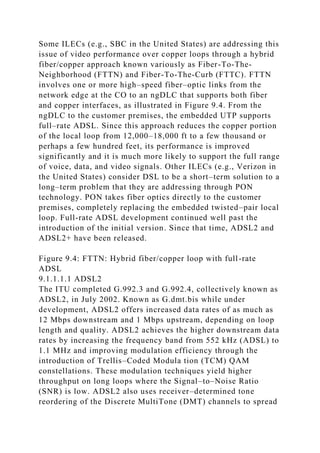
and copper interfaces, as illustrated in Figure 9.4. From the
ngDLC to the customer premises, the embedded UTP supports
full–rate ADSL. Since this approach reduces the copper portion
of the local loop from 12,000–18,000 ft to a few thousand or
perhaps a few hundred feet, its performance is improved
significantly and it is much more likely to support the full range
of voice, data, and video signals. Other ILECs (e.g., Verizon in
the United States) consider DSL to be a short–term solution to a
long–term problem that they are addressing through PON
technology. PON takes fiber optics directly to the customer
premises, completely replacing the embedded twisted–pair local
loop. Full-rate ADSL development continued well past the
introduction of the initial version. Since that time, ADSL2 and
ADSL2+ have been released.
Figure 9.4: FTTN: Hybrid fiber/copper loop with full-rate
ADSL
9.1.1.1.1 ADSL2
The ITU completed G.992.3 and G.992.4, collectively known as
ADSL2, in July 2002. Known as G.dmt.bis while under
development, ADSL2 offers increased data rates of as much as
12 Mbps downstream and 1 Mbps upstream, depending on loop
length and quality. ADSL2 achieves the higher downstream data
rates by increasing the frequency band from 552 kHz (ADSL) to
1.1 MHz and improving modulation efficiency through the
introduction of Trellis–Coded Modula tion (TCM) QAM
constellations. These modulation techniques yield higher
throughput on long loops where the Signal–to–Noise Ratio
(SNR) is low. ADSL2 also uses receiver–determined tone
reordering of the Discrete MultiTone (DMT) channels to spread
out the noise from Amplitude Modulation (AM) radio
interference and, thereby, to realize improved coding gain.
ADSL2 systems feature reduced framing overhead, enhanced
power management, faster startup, seamless rate adaption, and
improved diagnostics. ADSL2 also features an all–digital mode,
in which the analog voice channel can be used for digital data
transmission, thereby increasing aggregate upstream data
transmission rates by as much as 256 kbps. ADSL2 adds a
packet-mode capability that enables packet–based services such
as Ethernet. On long loops, ADSL2 can increase the data rate by
as much as 50 kbps and extend the reach by about 600 ft (200
m).
ADSL2 supports bonding in ATM, based on the ATM Forum
specification for Inverse Multiplexing over ATM (IMA). This
allows two ADSL pairs to be bonded together to yield roughly
double the single–pair rate across the full range of loop lengths.
Bonding has increasing application, as competition from CATV
providers and cellular services have led to the disconnection of
large numbers of telco-provided copper landlines. The
deployment of pair gain technologies such as ADSL and the
increasing use of fiber optics have combined to further reduce
the pair counts required to support primary and secondary lines
and trunks and have added to the excess of available copper
loops.
ADSL2 further supports channelization, which provides the
ability to split the bandwidth into different channels with
different link characteristics in support of different
applications. For example, a single ADSL2 loop might support a
business class videoconferencing application, which is
intolerant of both latency and bit errors, while simultaneously
supporting e-mail transfers, which are quite tolerant of both
latency and bit errors. Channelized Voice over DSL (CVoDSL)
allows multiple derived lines of TDM voice traffic to be
transported simultaneously over DSL in 64-kbps channels [9].
9.1.1.1.2 ADSL2+
The ITU–T reached agreement on G.992.5 in January 2003,
adding ADSL2 + to the ADSL suite. This specification doubles
the downstream data rate to as much as 24.5 Mbps over shorter
loops up to approximately 5000 ft (1500 m) in length. The
upstream rate remains at a maximum of 1 Mbps. In order to
achieve this enhanced data rate, ADSL2+ increases the
downstream frequency range from 552 kHz (ADSL) and 1.1
MHz (ADSL2) to 2.2 MHz (ADSL2+) and increases the number
of subcarriers to 512. The analog POTS channel remains at 4
kHz (ADSL and ADSL2), and the upstream data channel
remains capped at 140 kHz (ADSL2). Table 9.3 provides a
quick comparison of the frequency ranges of the various ADSL
technologies.
Table 9.3: ADSL Frequency Ranges
Open table as spreadsheet
Channel/ADSL Version
ADSL
ADSL2
ADSL2+
Downstream data
138-552 kHz
138 kHz-1.1 MHz
138 kHz-2.2 MHz
Upstream data
25–138 kHz
25–138 kHz
25–138 kHz
Voice
0-4 kHz
0-4 kHz
0-4 kHz
ADSL2+ also can be used to reduce crosstalk by using only the
frequencies between 1.1 and 2.2 MHz and masking those below
1.1 MHz. This can be useful when ADSL signals from a CO and
a remote terminal are present in the same 25–pair binder group
in a cable [9].
Recent developments in ADSL+ CPE support multiple 10/100
Mbps Ethernet interfaces and optional 802.11 b/g interfaces.
Combining these enhancements with the increased bandwidth of
ADSL2+ and its channelization capability allows the user
organization to derive multiple VLANs from a single ADSL2+
facility, with each VLAN enjoying its own Quality–of–Service
(QoS) level. Thereby, separate VLANs can be created for low–
latency voice and video as well as latency–tolerant data
communications applications in a triple–play scenario. ADSL2
and ADSL2+ certainly relieve the pressure on triple–play
bandwidth. MPEG–2 compression reduces the Standard
TeleVision (STV) requirement to 3.5 Mbps and that of High-
Definition TV (HDTV) to 8.0 Mbps, all of which is
downstream, of course. PCM-based voice requires bidirectional
bandwidth of only 64 kbps, which leaves plenty of room for
high–speed bidirectional data [10].
9.1.1.2 G.lite
Also known as ADSL Lite, Universal ADSL, and Splitterless
ADSL, G.lite is an interoperable extension of the ADSL
specification ANSI T1.413 and has been standardized by the
ITU–T as G.992.2. Three deployment options exist, all of which
support simultaneous voice and data communications over a
single UTP local loop of one physical pair:
· Splittered ADSL resembles the original standardized version
of ADSL, in that a single, professionally installed splitter is
installed at the point of termination of the local loop at the
customer premises. This approach ensures the highest level of
data performance, while ensuring that other signals in a
multipair cable are not affected by high–frequency ADSL data
signals. But this approach also involves an expensive truck roll.
· Distributed Splitter ADSL involves a number of ADSL
splitters, some front-ending PCs and others front–ending analog
telephone sets. This approach ensures that the voice and data
channels do not interfere with each other and avoids the costs
and delays associated with the professional installation of a
single splitter, as described in the Splittered ADSL option. This
version does not require professional installation.
· Splitterless ADSL (see Figure 9.5), which is the most
attractive, supports simultaneous voice and data without the
requirement for either a centralized splitter or multiple
distributed splitters. Rather, high–frequency data
communications are supported over an ADSL modem. This
version does not require professional installation.
Figure 9.5: Splitterless G.lite
G.lite operates on an asymmetric basis over loops up to 18,000
ft at speeds of up to 1.544 Mbps (T1) downstream and up to 512
kbps upstream, sensitive to loop specifics such as gauge.
Upstream and downstream speeds both are selectable in
increments of 32 kbps. Shared internal wiring is always an issue
but generally is resolved satisfactorily with microfilters
installed between the jacks and the analog voice sets and fax
machines. The filters prevent the analog devices from draining
the high–frequency signal power, thereby improving the signal–
to–noise ratio for the modem. Maximum performance can be
achieved by upgrading the internal wire to Cat 5, at least for the
PC connection, and by home–run cabling the jacks to the NIU
[11–13]. (Note: This is basically the approach we took at The
Context Corporation, and it worked beautifully. With the
exception of one desktop computer, however, all computers
were interconnected to the G.lite circuit through an 802.11b
WLAN.)
G.lite supports both voice and data over the same circuit, just as
does full–rate ADSL, but G.lite uses several mechanisms to
optimize their coexistence. Power back-off dynamically reduces
the modem power level at the customer premises in order to
eliminate the potential for interference (NEXT) with the analog
voice channel. Power back–off occurs automatically and reduces
the upstream data transmission rate for the duration of the
phone call. Fast retrain enables rapid recovery of the upstream
when the phone call is terminated. Fast retrain supports the
retention in memory of profiles for as many as 16 telephone
sets, thereby taking into consideration the specific electrical
attributes associated with each. Although early G.lite modems
ran Frame Relay as the Layer 2 protocol, contemporary modems
mostly run ATM [14]. As G.lite is limited in terms of
bandwidth, it never achieved great popularity but did introduce
the concept of Splitterless DSL.
9.1.1.3 ISDN Digital Subscriber Line
ISDN DSL uses ISDN BRI (Basic Rate Interface) technology to
deliver symmetrical transmission speeds of 128 or 144 kbps on
digital copper loops as long as 18,000 ft. Like ISDN BRI
(Chapter 7), IDSL terminates at the user premises on a standard
ISDN Terminal Adapter (TA). At this point, the two concepts
diverge. ISDN is a circuit–switched service that connects to a
CO at the edge of the carrier domain. IDSL is an always–on
data access service that terminates, more or less directly, in a
DSLAM. ISDN supports voice, data, video, and any other form
of traffic through one or more Bearer (B) channels, each with a
width of 64 kbps. ISDN also can support X.25 packet data over
a Delta (D) channel at speeds of up to 9.6 kbps. IDSL supports
data access through a contiguous slice of bandwidth with a
width 128 or 144 kbps. ISDN can support multiple
transmissions, each over a separate channel. IDSL supports a
single data transmission at a time over a single, wider channel.
IDSL (refer to Figure 9.6) is a dedicated access service for data
communications applications, only. At the Local Exchange
Carrier (LEC) CO, the loop terminates in collocated electronics
in the form of either an IDSL access switch or an IDSL modem
bank connected to a router or DSLAM. In the event that the
LEC is not serving as the ISP, the connection is made to the
third–party ISP POP via a high–bandwidth dedicated circuit,
such as unchannelized T1, T3, or SONET/SDH channel.
Figure 9.6: ISDN DSL configuration
IDSL offers several advantages over competing technologies.
IDSL is based on ISDN network technologies, which are
standardized, well understood, and widely implemented, at least
outside the United States. IDSL operates at frequencies that do
not interfere with other signals riding over adjacent pairs in a
multipair copper cable. IDSL makes use of standard, off–the–
shelf Data Communications Equipment (DCE) at the customer
premises in the form of a TA with a few modifications. IDSL
offers fully symmetric bandwidth, although it admittedly is less
than that offered by competing DSL technologies, particularly
in the downstream direction. IDSL does not require a truck roll
for CPE purposes, although the NIU must be installed and the
circuit may require conditioning, as is the case with traditional
ISDN. Finally, IDSL is the only DSL technology that operates
on local loops provisioned with conventional DLCs. On the
negative side again, IDSL is application specific, supporting
data only and, therefore, requiring an additional local loop.
IDSL never gained much traction in the United States, where
ISDN never achieved any appreciable level of success and
where other broadband access technologies are widely available.
Worldwide, IDSL has a market in areas where ISDN is already
in place and other broadband access technologies are not
available.
9.1.1.4 Very–High–Data–Rate Digital Subscriber Line
Very-high-data-rate Digital Subscriber Line (VDSL) is a high–
speed ADSL technology that was formalized in 2004 as
G.993.1. This initial specification provides for downstream data
rates up to 55 Mbps and upstream rates up to 15 Mbps over
distances up to 1000 ft (300 m) or so, depending on factors such
as local loop quality. In order to achieve these data rates, the
frequency range increases to approximately 8.8 MHz divided
among 2048 subcarriers. As attenuation is a considerable issue
at this high frequency, performance drops precipitously beyond
1000 ft. VDSL evolution was rapid. The ITU reached agreement
in 2005 on recommendation G.993.2, the specification for two
versions of VDSL2.
· Long Reach: The long-reach version runs at 12 MHz, divided
among 2872 subcarriers, to deliver asymmetric data rates of as
much as 55 Mbps downstream and 30 Mbps upstream over loops
up to 1000 ft, after which data rates drop precipitously.
Considerably reduced rates are achievable at distances up to
4000–5000 ft.
· Short Reach: The short-reach version runs variously at 17.6
MHz and up to 30 MHz, divided among as many as 4096 and
3478 subcarriers, respectively, to deliver symmetric
(downstream and upstream) data rates of as much as 100 Mbps
over loops up to 500 feet, after which data rates drop
precipitously. Again, considerably reduced rates are achievable
at distances up to 4000–5000 ft. This version will run in
asymmetric mode as well.
VDSL2 employs the same DMT modulation scheme as ADSL
but increases the number of subcarriers to 4096 in a typical
implementation and up to 3478 in others, as compared to the
512 subcarriers specified in ADSL2+. Trellis–Coded
Modulation (TCM) yields higher throughput on long loops
where the Signal–to–Noise Ratio (SNR) is low, although data
rates drop considerably beyond 500–1000 ft.
A versatile worldwide specification, VDSL2 defines eight
profiles for different services, including ATM and Ethernet.
Quality–of–Service (QoS) features are integrated into the
specification, as is channel bonding for extended reach or data
rate. Multiple bandplans (i.e., frequency definitions) are
specified for different regions. For example, there is a common
bandplan for North America, Japan, and the United Kingdom
(see Table 9.4) and quite another for other European countries.
Each bandplan divides the available spectrum into interleaved,
paired upstream and downstream channels. This approach
provides some flexibility in terms of the spectrum allocation
and overall speed rating under different application scenarios
and line conditions. In other words, VDSL2 services can run at
several different matched speeds, upstream and downstream.
Table 9.4: VDSL Frequency Band Allocations for North
America, Japan, and the United Kingdom
Open table as spreadsheet
Channel Width
Channel Designation
12-28 MHz
Upstream/downstream optional
8.5-12.0 MHz
Upstream
5.2-8.5 MHz
Downstream
3.75-5.2 MHz
Upstream
138 kHz-3.75 MHz
Downstream
25-138 kHz
Upstream
0 Hz-4 kHz
Analog voice
There are several application scenarios, all of which are based
on FTTN hybrid local loops, with fiber optics from the CO to
the neighborhood ngDLC and VDSL to the premises. In North
America, Europe, and China, there are plans to deploy VDSL2
at downstream rates up to 30 Mbps and upstream rates of 3
Mbps in support of consumer–class triple–play services,
including at least three Digital TV (DTV) or HDTV channels,
Internet access at rates up to 5 Mbps, and VoIP. Clearly VDSL
has application in servicing a MultiDwelling Unit (MDU), also
known as a MultiTenant Unit (MTU), where the bandwidth can
be shared among multiple tenants. In this Fiber-To-The-
Premises (FTTP) scenario, the ngDLC is positioned on the
premises, and the VDSL service runs over the inside wire and
cable system in the apartment building or office building, for
example [15].
As VDSL matures and implementations become more prevalent,
the pressure increases to increase the bandwidth levels and
speed ratings, to alter the bandplan toward symmetrical service,
and to increase the distances. In combination, these demands
will outstrip the capabilities of the specification. As a result,
there has been some movement toward the application of
Multiple-Input, Multiple-Output (MIMO) technology similar to
that used in 802.11 Wireless Local Area Networks (WLANs). In
a VDSL application, MIMO treats each binder group of 25 pairs
as a MIMO channel and the transceiver treats multiple pairs
together, thereby separating signal from crosstalk [16].
According to the DSL Forum, some manufacturers have
included MIMO in VDSL2 systems in advance of
standardization of MIMO technology.
9.1.1.5 High–Bit–Rate Digital Subscriber Line
Bellcore (now Telecordia Technologies) also developed High
Bit–Rate Digital Subscriber Line (HDSL) at the request of the
RBOCs as a more cost–effective means of providing T1 local
loop circuits over existing UTP. Standardized by the ANSI
T1E–1.4 committee, HDSL eliminates repeaters in the T1 local
loop for distances up to 12,000 ft, which can be extended
another 12,000 ft through the use of a line doubler, which
essentially is an HDSL repeater.
Recall from Chapter 7 that conventional T1 uses two pairs, each
of which operates in a simplex mode (one upstream and one
downstream) at the full T1 transmission rate of 1.544 Mbps (see
Figure 9.7). The line coding technique for T1 is Alternate Mark
Inversion (AMI), which yields 1.544 Mbps at a nominal carrier
frequency of 784 kHz, which is exactly half the T1 bit rate, plus
some overhead for error control. At such a high frequency,
issues of attenuation are significant. As a result, it is necessary
that repeaters be spaced at approximately 6000 ft to adjust for
distortion and signal loss. Also, the radiated electromagnetic
field is significant at T1 frequencies. Therefore, interference
between the T1 pairs and other pairs in the cable system is an
issue. Also recall that E–1 uses AMI as well, in support of the
E–1 transmission rate of 2.048 Mbps at a frequency of 1.168
MHz, which also is half the bit rate, plus some additional
overhead.
Figure 9.7: Comparison of T1 and HDSL
In the North American implementation of HDSL, the upstream
and downstream signals are split across both pairs, with each
pair operating in full–duplex (FDX) mode at 784 kbps, which is
half the T1 rate plus additional overhead. In the European
implementation, each of two pairs operates at 1.168 Mbps,
which is roughly half the E–1 rate plus additional overhead.
(Some implementations called for three pairs, each operating at
768 kbps.) The yield is that the transmission rate per pair is
roughly halved, and so is the frequency level. Therefore, the
signal loss is much less and the strength of the radiated
electromagnetic field is much less. The obvious yield of this
approach is that of longer transmission distances without
repeaters and with less distortion.
As a further improvement, HDSL uses the same 2B1Q (2
Binary, 1 Quaternary) coding scheme used in ISDN BRI. Note:
2B1Q also is known as 4–PAM (Pulse Amplitude Modulation).
Recall from Chapter 7 that 2B1Q impresses two bits on each
symbol (i.e., baud), with each symbol represented by one of
four voltage levels. The symbol rate, therefore, is one–fourth
the line rate, meaning that an HDSL T1 implementation at a line
rate of 784 kbps across each of two pairs requires a carrier
frequency of only 196 kHz, at least at the peak power level. At
this relatively low frequency, issues of attenuation and crosstalk
are further reduced.
On each end of the HDSL circuit, termination gear is installed.
On the transmit side, the HDSL modem accepts the T1/E–1
signal in AMI format from the Digital Signal Unit (DSU), splits
it, applies 2B1Q line coding, and places the signals on the two
pairs. On the receive end of the circuit, the HDSL modem
reverses the process and hands the T1/E–1 signal to the DSU.
For HDSL to function properly, as one might expect, the UTP
cable plant must be in good condition, although HDSL is
reasonably tolerant of mixed gauges, bridged taps, and certain
other circuit anomalies. Note that HDSL's limitation of circuit
length confines it to use in an access environment—HDSL is not
a technology to be used in long–haul, private–line, T1
applications.
As HDSL eliminates or reduces the number of repeaters, its
incremental cost is mitigated to some extent. Additionally, the
cable plant supporting HDSL does not require special
conditioning or engineering, further reducing costs, as well as
enabling service to be provisioned much more quickly. Finally,
HDSL offers error performance of approximately 10 -10, as
compared to the 10 -7 level offered by repeatered T1 over
twisted pair [17]. The bottom line is that T1 network access can
be provisioned much more quickly and much less expensively
with HDSL and with improved error performance as compared
to traditional T1 or E–1. The carriers, therefore, realize
revenues more quickly and at such reduced costs that many pass
on those cost savings to end users in the form of lower
installation charges and reduced monthly rates for the service.
Since its introduction in 1992, the vast majority of T1 and E–1
circuits installed have been HDSL loops.
HDSL2 is an HDSL variant that supports T1 speeds of 1.544
Mbps over a single twisted pair (two conductors) and over 24
AWG loops up to 13.2 kft, 768 kbps at up to 17.7 kft, and 384
kbps at up to 22.5 kft. The international E–1 version supports
signaling speeds up to 2.3 Mbps. An HDSL2 regenerator can
double the distance for each speed rating. A variation known as
HDSL4 can run over two copper loops (four physical
conductors) in order to extend the maximum transmission span
to as much as 16,500 ft. HDSL2's level of performance is
achieved through an advanced coding technique known as
Trellis-Coded Pulse Amplitude Modulation (TC-PAM). This
technique places three bits on a baud, which is an improvement
over the two bits per baud realized through the 2B1Q technique
used in HDSL. While the bandwidth required to support the
HDSL signal is sensitive to the implementation, TCM features
inherent Forward Error Correction (FEC) to overcome line
impairments and issues of Signal–to–Noise Ratio (SNR),
thereby offering excellent performance and the same reach as
HDSL but requiring only a single pair. With respect to
applications, HDSL is essentially a Layer 1 bit pipe that
replaces leased full–rate and fractional T1 and E–1 local loops
in support of any bit stream, including TDM voice, ATM, and
Frame Relay, for example. Although the standard version does
not support telephone service over the same line, some
equipment manufacturers offer a passive POTS splitter [18].
9.1.1.6 Symmetric Digital Subscriber Line
Symmetric DSL (SDSL), also known as Single-line DSL, is an
umbrella term for nonstandard variations on the HDSL theme
running over a single pair. SDSL uses the same 2B1Q line
coding as HDSL and runs at rates from 128 kbps to 2.32 Mbps.
Example speeds are 384 kbps for loop lengths of up to 18,000 ft
and 768 kbps for loop lengths of up to 12,000 ft (see Figure
9.8). Providers generally limit SDSL to transmission rates of
768 kbps, which is half the payload of a full T1. At that data
rate, the signaling rate is 784 kbps, including 16 kbps of error
control overhead. At a data rate of 384 kbps, which is one–
fourth a full T1, the signaling rate is 400 kbps.
Figure 9.8: Symmetric DSL
9.1.1.7 Symmetric High–Bit–Rate Digital Subscriber Line
Symmetric HDSL (SHDSL), also known as G.shdsl, is a
business class DSL technology ratified by the ITU–T in
February 2001 as G.991.2. SHDSL supports symmetric rate–
adaptive transmission ranging from 192 kbps at 20,000 ft (6 km)
to 2.312 Mbps at 10,000 ft (3 km) in increments of 8 kbps over
a single pair, sensitive to loop specifics. An optional two–pair
(four–wire) mode supports data rates ranging from 384 kbps to
4.624 Mbps in increments of 16 kbps. At the two–pair mode and
at a rate of 2.312 Mbps, the SHDSL reach is targeted at 16,000
ft (5 km). In either mode, repeaters can double the distance.
SHDSL uses the same Trellis-Coded Pulse Amplitude
Modulation (TC-PAM) advanced coding technology as HDSL2
and HDSL4. SHDSL operates in a rate–adaptive mode as well as
a fixed–rate mode at 784 kbps and 1.544 Mbps.
SHDSL can transport T1, E–1, ISDN, ATM, and IP signals, with
the specific framing requirements negotiated during the
handshaking process defined in G.994.1. Although SHDSL is
intended for data–only applications, newer techniques will
support voice as well [19–21]. Targeted applications include
Web hosting, videoconferencing, Virtual Private Network
(VPN) services, and remote LAN access. Note: SHDSL is
specified for North America in ANSI T1E–1.4/2001–174, for
Europe in ETSI TS 101524, and worldwide in ITU–T G.991.2.
9.1.1.8 Voice over DSL
Voice over DSL (VoDSL) refers to a nonstandard technique for
supporting voice over various business–class DSL technologies.
Spe-cifically, VoDSL runs over SDSL and SHDSL, with ATM
as the layer 2 protocol. At the customer premises in a VoDSL
implementation, both voice and data connect through a
centralized Integrated Access Device (IAD). The IAD serves, as
necessary, to convert the analog voice into G.711 PCM samples
through a codec embedded in a Digital Signal Processor (DSP)
contained within the IAD. The DSP then generally compresses
the voice streams by using one of a number of available
compression algorithms, with G.726 Adaptive Differential Pulse
Code Modulation (ADPCM) being widely used for this purpose.
The IAD then forms the uncompressed voice samples into ATM
cells using ATM Adaptation Layer 1 (AAL1), or the compressed
voice samples using AAL2, with the voice cells prioritized over
the AAL3/4 data cells in either case. VoDSL also can be
supported on an uncompressed G.711 PCM basis through AAL1.
(Note: ATM and AALs are discussed in detail in Chapter 10.)
At the service provider's CO or other Point Of Presence (POP),
the ATM-based DSLAM demultiplexes the cells, routing the
voice and data streams as appropriate, extracting them from the
ATM cell format as appropriate. While the specifics vary by
vendor, VoDSL commonly supports 4, 8, 12, or 16 voice
conversations over a circuit, depending on the line rate and the
compression algorithm employed. Some support as many as 40
voice conversations over full–rate (i.e., 1.544–Mbps) DSL, but
there always is an upper limit. VoDSL reserves the remaining
bandwidth in support of data communications, thereby ensuring
some level of bandwidth is available for both voice and data.
Should there be fewer than the maximum number of voice
conversations active at any given moment, data can lay claim to
that available bandwidth as long as it is available. This dynamic
bandwidth allocation serves to optimize the use of the DSL
circuit at all times [22–27].
9.1.2 Community Antenna Television
Cable television, formally known as Community Antenna
TeleVision (CATV), was born in the mountains in the state of
Pennsylvania in the United States. In the late 1940s, there were
only a few TV stations, all located in major cities. As TV
transmit and receive antennas operated exclusively over the air,
signal quality was sensitive to Line–of–Sight (LOS),
ElectroMagnetic Interference (EMI) and Radio Frequency
Interference (RFI), weather conditions, and other factors.
Reception was poor, even in the cities, and awful elsewhere. In
remote rural areas and particularly in mountainous areas where
LOS was not possible, reception was next to impossible, even
on the best of days. John and Margaret Walson, owners of the
Service Electric Company, a retail appliance store in Mahanoy
City, were having a difficult time selling TV sets as reception
was so poor in the valley where the town was situated, 90 miles
from Philadelphia. In order to demonstrate TV sets to their best
advantage, Mr. Walson placed an antenna on top of a tall utility
pole on a nearby mountaintop and ran antenna wire to the store.
In June 1948, he built some amplifiers to bring the signal to
customers who had bought his TV sets, thereby creating the first
CATV network. Walson also was the first to use microwave to
import TV signals from distant stations and the first to use
coaxial cable to improve reception. In 1972, Walson also was
the first to distribute Home Box Office (HBO), which marked
the beginning of pay TV and the start of the explosive growth of
the CATV industry [28, 29].
Until very recently, all CATV systems were analog in nature,
and many remain so. The community antenna actually consists
of multiple satellite and microwave antennas located at a head
end, which is the point of signal origin for the CATV network.
At the head end, multiple analog TV broadcast signals are
interwoven through a frequency division multiplexer and carried
over a coaxial cable system to the community or neighborhood
to be served. In the United States, each 6-MHz video channel
carries a signal in the National Television Standards Committee
(NTSC) format. [Note: In European and many other countries,
the Phase Alternate Line (PAL) format requires an 8-MHz
channel.] Within each 6-MHz channel, approximately 250 kHz
is transition bands, or guard bands, 4.2 MHz is required for the
video, another 300 kHz is required for the audio signal, and the
balance is due to the Vestigial SideBand Amplitude Modulation
(VSB-AM) technique utilized as the signal is placed on the
Radio Frequency (RF) carrier. Contemporary coax–based CATV
systems commonly support aggregate raw bandwidth of 500–850
MHz, thereby supporting a great number of TV channels, all of
which reside on the system simultaneously. CATV networks
conform to a tree-and-branch architecture comprising a trunk
system, a distribution system, and hundreds or perhaps
thousands of subscriber drops, as illustrated in Figure 9.9. At
each subscriber premises, the coax cable drops terminate in
converter boxes, or set-top boxes, which serve as frequency
division demultiplexers. As each individual channel is selected,
the set–top box selects the appropriate frequency range.
Traditionally, these networks have been analog, coax–based,
one–way networks for the downstream delivery of analog
entertainment TV. Few changes occurred in CATV networks
until the 1990s.
Figure 9.9: Traditional analog CATV network, with tree-and-
branch architecture
Beginning in the mid–1990s, a few large CATV providers began
to upgrade their aging coaxial cable systems. As many of those
networks were installed in the late 1960s and early 1970s, they
were in awful shape. Further, those networks were strained for
capacity as the CATV providers sought to increase revenues and
profits through the introduction of premium movie channels and
Pay-Per-View (PPV). The upgrades, in some cases, went beyond
simple coax upgrade and replacement to include optical fiber in
the trunk facilities from the head end to the neighborhood,
where they terminated in an optoelectric conversion box that
interfaced with the existing coax for ultimate termination at the
premises.
As the telecommunications domain in the United States was
deregulated with the Telecommunications Act of 1996, the
CATV providers began to consider operating as CLECs. The
technology existed to upgrade the coaxial cable system to
support two–way communications through frequency splitting
and advanced signal modulation techniques, much as is done
over twisted pair in xDSL technologies. The coax amplifiers and
set–top boxes could be upgraded as well. Further, the system
could be converted to digital by replacing the amplifiers with
repeaters, and TDM channels could run inside the FDM
channels, much like xDSL. The coax cable certainly offers
much more in the way of bandwidth and distance than does
twisted pair, and with an upgrade, error performance could be
improved to levels that would make twisted pair pale by
comparison. With optical fiber in the long–haul portion of the
network (i.e., from the head end to the neighborhood), it
became clear that CATV systems could compete very
effectively with the ILEC local loop. Further, the largely unreg-
ulated CATV providers could not be forced to wholesale their
local loops to competitors , unlike the requirements placed on
the ILECs by federal and state regulators at the time.
There were several problems with this scenario. Most of the
CATV operators were overburdened with debt and, therefore,
could not afford to make the necessary capital investments in
network upgrades. The requisite investment in the necessary
circuit and packet switches added greatly to the problem.
Further, the CATV providers lacked the necessary skills,
network management systems, and billing systems to support
transaction–based switched voice and data services. Also, no
standards existed for the set–top boxes, or much of anything
else actually. Also, the CATV networks generally were not
interconnected—not even those owned by the large Multiple-
System Operators (MSOs).
Major telecommunications companies began to acquire a
number of CATV providers in the late 1990s, addressing many
of the cash and management problems associated with this
scenario. Most notably, AT&T in early 1999 acquired TCI
(TeleCommunications, Inc.) and MediaOne, two of the largest
CATV providers in the United States, and invested billions of
dollars in system upgrades. The lack of standards for set–top
boxes was resolved in March 1997 by the Data Over Cable
Service Interface Specification (DOCSIS), developed by the
limited partnership known as the Multimedia Cable Network
Systems Partners Ltd. (MCNS) and now administered by
CableLabs, which has relabeled the initiative CableLabs
Certified CableMo-dem. Through matching DOCSIS Cable
Modems (CMs) at the head end and the customer premises, two–
way cable paths are provided over a Hybrid Fiber/Coax (HFC)
system. The head–end portion of the network is in the form of a
Cable Modem Termination System (CMTS), which supports a
packet data connection to an IEEE 802.3 10/100–Mbps Ethernet
port on a router. The system runs IP at Layer 3 (Network Layer)
in Ethernet frames at Layer 2 (Data Link Layer). Associated
with the CMTS are various servers for security, address
translation, data caching, video caching, and so on. A CMTS
can support as many as 2000 cable modem users on a single 6-
MHz channel (8 MHz in Europe), with issues of congestion for
shared bandwidth becoming more severe as the number of active
users increases. The modem on the customer premises is in the
form of a TV/data set–top box, which supports traditional coax
connections to multiple TV sets and a 10/100Base–T Ether-net
connection to a PC or to a hub serving multiple PCs. Figure
9.10 illustrates a typical CATV network configuration.
Figure 9.10: Contemporary HFC digital CATV network
supporting TV, Internet access, and voice
DOCSIS is both always on and generally asymmetric in nature,
as are most xDSL technologies. DOCSIS 2.0 specifications
address downstream and upstream channels:
· Downstream: The head end broadcasts downstream
transmissions to all premises on the shared point–to–multipoint
network. DOCSIS modems carve a downstream channel from
the coax cable in the form of one or more 6-MHz channels in
the range between 50 and 750–850 MHz, with the exact range
being system dependent. DOCSIS 2.0, the current version,
specifies 64-point Quadrature Amplitude Modulation (64-QAM)
for the downstream channels, yielding six bits per symbol and
yielding a potential of 36 Mbps per 6-MHz channel. (See Table
9.5.) Overhead for framing and Forward Error Correction (FEC)
reduces that level to approximately 27–31 Mbps of shared
bandwidth per 6-MHz channel. Alternatively, 128-QAM yields
seven bits per symbol, respectively, and the signaling speed to
42 Mbps, although it is more sensitive to noise. The standards
also provide for the use of 256-QAM, which increases the raw
signaling speed to 48 Mbps. These variations on QAM are
compatible with Moving Picture Experts Group–2 (MPEG–2),
the compression technique specified for digital video
transmission in CATV networks. Downstream data are
encapsulated into MPEG–2 packets of 188 bytes.
Table 9.5: DOCSIS Physical Layer
Open table as spreadsheet
FDMA+[a]
Channel Width (MHz)
Modulation
Bits/Symbol
Symbol Rate (Msps)
Signaling Speed (Mbps)
Downstream
TDMA
6
64-QAM
6
6
36
6
128-QAM
7
6
42
6
256-QAM
8
6
48
Upstream
TDMA
1.6
QPSK
2
1.28
2.56
1.6
8-QAM
3
1.28
3.84
3.2
16-QAM
4
2.56
10.24
3.2
32-QAM
5
2.56
12.8
6.4
64-QAM
6
5.12
30.72
S-CDMA
6.4
128-QAM TCM
7[b]
5.12
30.72
[a]Frequency Division Multiple Access.
[b]Six bits payload, 1 bit error control.
· Upstream: In early versions of DOCSIS, transmissions
upstream from the user premises to the head end are supported
either through the contentious CSMA/ CD access protocol used
in Ethernet LANs or through Time Division Multiple Access
(TDMA), depending on the specifics of the CATV provider's
implementation [30, 31]. According to DOCSIS 1.0 standards,
traffic in the upstream direction is supported over 6-MHz
channels in the range between 5 and 42 MHz for U.S. systems
and 8-MHz channels in the range between 5 and 65 MHz for
European systems, each of which can operate at about 12 Mbps
through use of the Quadrature Phase Shift Keying (QPSK)
modulation technique. Again, framing and FEC overhead reduce
the level of usable bandwidth, in this case to about 10 Mbps
[32–35]. In a field implementation, many systems use QPSK
across a 1.6-MHz channel, yielding 2.56 Mbps (2 bits per
symbol × 1.28 megasym-bols per second). DOCSIS 1.1 added
16-QAM to the mix, roughly doubling the data rate and
doubling the channel width to 3.2 MHz to double it yet again (4
bits per symbol × 2.56 megasymbols per second), for a four fold
increase to over 10 Mbps. QAM increases sensitivity to noise,
but DOCSIS deals with that through sophisticated noise
cancellation techniques. DOSCIS 2.0 triples the upstream rate
of DOCSIS 1.1 over a channel of 6.4 MHz using either TDMA
in combination with 64-QAM or Synchronous Code Division
Multiple Access (S–CDMA) in combination with 128-QAM
Trellis-Coded Modulation (TCM). S–CDMA transmits 128
orthogonal codes simultaneously (i.e., in the same time slot)
[36].
There also are telco-return modems that use the circuit–
switched PSTN for the upstream path, although this approach
generally proves less than totally satisfactory. Not only does the
telco–return approach require the use of a telco–provided local
loop, which adds costs to the equation, but it slows the upstream
path to modem speeds. Also, the widely mismatched speeds on
the upstream and downstream paths cause the downstream
server to slow down, therefore running at less than optimum
efficiency. DOCSIS 3.0 standards currently under development
are expected to increase upstream data rates to 120 Mbps and
downstream rates to 160 Mbps.
CATV networks also support voice in several possible ways.
The most common approach at this time is the very same TDM
and PCM approach used in the circuit-switched PSTN, although
some CATV networks use ADPCM modulation with silence
suppression. At a rate of roughly one bit per hertz, a 6-MHz
channel supports a considerable number of PCM–based voice
channels. (Refer to Chapter 7 for detailed discussions of TDM,
PCM, ADPCM, and silence suppression.) The current focus is
on VoIP, with protocol conversion from VoIP encoding to PCM
encoding occurring at a gateway located at the CATV provider's
head end. The ultimate goal is that of end–to–end VoIP, with
the CATV provider connecting voice directly from the CMTS to
a VoIP backbone. The first approach of TDM–based voice
involves separate voice channels, both upstream and
downstream. VoIP rides over the shared packet data channels,
with the CMTS and cable modems providing priority access in
order to support the QoS demanded for toll–quality voice
communications. Cable telephony requires local power, unlike
traditional telco telephony. In the event that the lights go out,
local battery backup provides telephony support for a few hours
[37, 38], which is especially important in support of calls to
emergency services (e.g., 911). Various estimates indicate that
cable operators in the United States and Canada had signed up
approximately 3.2 million VoIP subscribers as of the end of
2005 and that the rate of growth is about 250,000 per month.
Including the TDM voice customers, cable operators boasted
total voice subscribers numbering about six million [39].
DOCSIS 1.1 provided a number of enhancements, in addition to
QoS support. Fragmentation allows large Ethernet frames to be
fragmented, which naturally improves voice latency. Rather
than having to wait in a buffer until a large Ethernet data frame
can be fully transmitted, the VoIP packet (once framed) can
transit the network after a smaller Ethernet fragment has
completed its journey. Payload header suppression can serve to
reduce overhead, which is especially important for VoIP
packets. Concatenation is a mechanism that links together
multiple packets, which then can be processed as a single entity
in a supperrate service context. Concatenation speeds
processing, which reduces overall network latency. Dynamic
channel allocation allows the CMTS to accomplish dynamically
load balancing, shifting traffic flows between channels in order
to reduce overall network congestion levels. Security is added
in the form of authentication, and support for Simple Network
Management Protocol version 3 (SNMPv3) adds network
management capabilities.
The CATV networks remain troubled by several inherent
limitations. First, CATV networks are consumer oriented,
primarily serving residential neighborhoods and not extending
to most businesses. (After all, you are supposed to work at
work, not watch TV.) Second, CATV networks are multipoint
bus networks, much like a classic Ethernet 10Base5 LAN
(Chapter 8). Since your voice and data transmissions pass every
other house connected to the coax cable, security is a major
concern in the absence of an effective encryption mechanism.
Third, much like 10Base5 Ethernet and very much unlike DSL,
the CATV local loop network is shared. Therefore, the more
active users are on the network, the worse the performance.
While the CATV providers speak of total bandwidth of as much
as 500 Mbps and user access at rates of as much as 10 Mbps,
those are best case figures quoted on the assumption that the
load on the shared medium is light enough to support
transmission rates of 10 Mbps for all active users. DOCSIS
cable modems work on an asymmetric basis, as do most xDSL
options. Specifically, the maximum aggregate usable bandwidth
of a downstream channel currently is 31 Mbps, and the
maximum aggregate usable upstream bandwidth ranges from
200 kbps to 10.0 Mbps, depending on the specifics of the field
implementation of a network conforming to DOCSIS 1.1
specifications.
Especially with the strength of AT&T (i.e., AT&T prior to the
merger with SBC) behind it, it seemed as though CATV network
providers had an excellent chance of securing a large segment
of the market for high–speed Internet access. The CATV
providers did, indeed, enjoy considerable success, although
financial problems caused AT&T Broadband to merge with
(read be acquired by) Comcast in 2001, only two years after it
was formed. About the same time, AT&T's primary ISP, At
Home Corp., ceased operations, and its [email protected]
customers were left stranded for several days until AT&T and
other CATV providers managed to switch them to their in–
house ISP networks. Since that time, Comcast and other CATV
providers in the United States have enjoyed tremendous success.
According to the Telecommunications Industry Association
(TIA) 2005 Telecommunications Market Review and Forecast,
there currently are about 22.0 million cable modem subscribers
compared with about 15.1 million DSL subscribers in the United
States, and cable modems access is expected to continue to
surpass DSL access through 2008.
9.1.3 Wireless Local Loop
Wireline local loops are problematic. Cabled media are
expensive and time consuming to deploy. Right–of–way must be
secured, trenches must be plowed and conduits placed, poles
must be planted and crossarms must be hung, conductors must
be spliced, amplifiers and repeaters must be connected, and so
on. The vast majority of loops are copper twisted pair, which
tends to offer relatively little in terms of bandwidth and error
performance and is highly distance limited, especially at the
higher frequencies required to maximize data rates. The ILECs
own most of the conventional local loops, CATV providers own
the coaxial cable networks, and neither of them is the least bit
inclined to share them, except as required by the regulators. As
I discussed earlier in this chapter, the decision boils down to
one of build or buy (i.e., lease), and buy is not always an
option.
In building local loops, the advantages of Wireless Local Loop
(WLL), also known as fixed wireless, are fairly obvious at this
point in our discussion of communications systems and
networks:
· WLL systems often can be deployed much more quickly and
much less expensively that wireline systems.
· The aggregate bandwidth of a WLL system can be apportioned
to end users on a channelized basis and often very flexibly so.
· The system can be configured and reconfigured remotely,
often without a truck roll
The disadvantages of WLL also are fairly obvious:
· Interference always is an issue, and one that in many ways is
out of the control of both the service provider and the user
organization. While licensed frequency bands are protected
from direct interference from others who might covet the same
frequencies, unlicensed bands are available for all to share.
Regardless of whether the band is licensed or not, Radio
Frequency Interference (RFI) and Electromagnetic Interference
(EMI) are always issues. Such interference can be caused by
electric motors, radio systems transmitting out of their assigned
bands or in excess of their prescribed power levels, and forces
of nature such as lightning, static electricity, and solar flares.
Additionally, the quality of the airwaves is always an issue, as
the quality of the signal can be negatively affected by
precipitation, fog, humidity, dust, smoke, pollution, and
temperature.
· Distances of terrestrial systems are limited due to factors such
as quality of the airwaves and the frequencies used. The systems
operating in the higher frequency ranges (e.g., 28–31 GHz)
suffer from attenuation to a much greater extent than those in
the lower frequency ranges (e.g., 2.5–2.7 GHz).
· Line–Of–Sight (LOS) is always preferable and is absolutely
required at the higher frequencies.
· The licensing process can be lengthy and expensive, especially
given the great demand for licensed spectrum.
· Security is always an issue with RF–based systems.
The WLL options available are numerous and include
nonstandard and standard approaches and both licensed and
unlicensed frequency bands. This discussion of WLL options
includes the most significant and what I consider to be some of
the most interesting. Regardless of the specific technology, RF–
based WLL configurations include centralized antennas, or base
stations, that either are located at the edge of the carrier
network or are connected to the network edge via optical fiber,
DSL, T1/E–1 facilities, or perhaps microwave. The base stations
connect to matching antennas at the customer premises, as
illustrated in Figure 9.11. Free Space Optics (FSO) solutions
involve infrared (IR) transmitter/receivers.
Figure 9.11: WLL configuration
9.1.3.1 Local Multipoint Distribution Service
Bernard B. Broussard developed Local Multipoint Distribution
Service (LMDS). Together with Shant and Vahak Hovnanian,
Broussard formed CellularVision, a New York wireless cable
TV firm that provided 49 TV channels and later added high–
speed Internet access. The technical rights to LMDS technology
later were spun off into a separate company. In the United
States, the FCC first auctioned licenses for LMDS radio in early
1998. The 104 successful bidders yielded revenues of
approximately $ 578 million, which certainly underscored the
interest in WLL. Notably, and in consideration of the emphasis
on competition in the local loop, the RBOCs and CATV
providers were not permitted to participate and further were
prevented from holding any LMDS licenses for a period of three
years in order to encourage competition. Licenses were awarded
in two blocks for each of 492 markets known as Basic Trading
Areas (BTAs). The A block has a width of 1.15 GHz in the
frequency ranges of 27.5–28.35 GHz, 29.1–29.25 GHz, and
31.0–31.15 GHz. The B block has a width of 150 MHz in the
spectrum between 31.15 and 31.3 GHz. Outside of North
America, LMDS operates in the 20–and 45-GHz bands. Given
the high frequencies used, LMDS requires Line–Of–Sight (LOS)
and generally is limited in distance to a cell diameter of 10–15
miles, although cell sizes generally are much smaller. LMDS
can carve a 360 ° cell into four quadrants of alternating antenna
polarity (H and V, i.e., Horizontal and Vertical), thereby
improving traffic capacity. LMDS offers excellent error
performance, with rain fade compensation through the use of
adaptive power controls. LMDS supports both point–to–point
and point–to–multipoint service configurations. LMDS is
flexible enough to support local loops ranging from 1.544 Mbps
(T1) to 155 Mbps and even 622 Mbps and in either symmetric or
asymmetric configurations. Individual subscribers in office
complexes or Multi–Dwelling Units (MDUs) can gain access to
bandwidth in increments of 64 kbps (DS–0). Multiplexing
access methods include Frequency Division Multiple Access
(FDMA), Time Division Multiple Access (TDMA), and Code
Division Multiple Access (CDMA). TDMA modulation options
include Phase Modulation (BPSK, DQPSK, QPSK, and 8PSK)
and Amplitude Modulation (QAM, 16–QAM, and 64–QAM).
As noted above, LMDS generated a lot of excitement in 1998
and again in the 1999–2000 time frame, and hundreds of
millions of dollars were spent securing LMDS licenses at
spectrum auctions in the United States. Most of the successful
bidders (e.g., Teligent, WinStar, and Advanced Ratio Telecom)
have since declared bankruptcy. XO Communications
(previously Nextlink) invested a total of approximately $ 900
million in those licenses and now holds licenses in 73 major
cities in the United States. XO installed a small number of
systems over the intervening years but never was able to
achieve any real success with LMDS due to technological
problems and high equipment costs. In early 2006, however, XO
announced a new LMDS initiative targeted at cellular backhaul
as well as enterprises and government agencies looking for
access alternatives, redundancy, and disaster recovery solutions
[40–42]. [Note: In this context, backhaul refers to the
transporting of traffic between distributed sites, such as cellular
base stations, and a backbone or centralized network or site,
such as a Mobile Traffic Switching Office (MTSO), or other
point of concentration or switching.] Most of the current
interest in WLL is on IEEE 802.16, aka WiMAX, which I
discuss later in this chapter.
9.1.3.2 Multichannel Multipoint Distribution Service
Operating in five bands in the range 2.15–2.68 GHz in the
United States and Canada and in the 3.5-GHz range elsewhere,
Multichannel Multipoint Distribution Service (MMDS), also
known as wireless cable, initially was developed for one–way
TV transmission. As the name suggests, MMDS is a point–to–
multipoint technology that operates from an antenna typically
placed on a hilltop or other location in order to maximize Line–
Of–Sight (LOS) connectivity. The antenna may be
omnidirectional or may be sectorized in order to improve
spectrum efficiency, and distances of up to 31 miles (50 km)
can be achieved at allowable power levels due to the excellent
signal propagation characteristics in this relatively low range of
the microwave spectrum.
The first generation of MMDS stalled in the 2001–2002 time
frame for several reasons, including technological and cost
issues. The first generation of MMDS equipment was geared for
one–way TV transmission but was tweaked for two–way
applications such as Internet access and required LOS.
Competition from DSL, cable modems, and LMDS certainly did
not help. Further, MMDS definitely is bandwidth limited at only
200 MHz, which does not compare favorably with most
alternative access technologies. Sprint and Worldcom were the
most notable providers of first–generation services based on
MMDS, having invested a total of approximately $ 1 billion in
MMDS licenses in the late 1990s [43–47]. The deployment
strategies were quite aggressive during that time and a number
of systems were installed in major metropolitan markets in the
United States, but those networks subsequently were capped.
Nextel later acquired the Worldcom licenses during bankruptcy
proceedings, so when Sprint acquired Nextel, it became by far
the largest holder of MMDS licenses. There currently is a
resurgence of interest in MMDS, which now works well in Non–
Line–Of–Sight (NLOS) applications. BellSouth, Verizon, and
Sprint all have conducted tests of second–generation systems.
Clearwire offers MMDS service for Internet access in a number
of cities in competition with 802.11 b/g commercial hotspot
services. A number of small CATV providers employ MMDS in
its original wireless cable application mode to extend CATV
networks in areas where cabled transmission systems are
impractical. Elsewhere, Walker Wireless in New Zealand has
deployed MMDS in support of high–speed fixed and portable
broadband access, including full mobility. In this
implementation, MMDS competes directly with 802.11 b/g and
3G cellular systems [48]. Most of the current interest is WLL is
on IEEE 802.16, aka WiMAX, which I discuss later in this
chapter.
9.1.3.3 IEEE 802.16 and Worldwide Interoperability for
Microwave Access
Today, the world is still enjoying the results of new scientific
discoveries that are constantly being made, and the one that
seemed most marvelous when they were first announced,
become commonplace after a few years have passed…. It was a
triumph when his [Marconi's] experiments resulted in
communications at will without wires over distance of 250
miles.
W. J. Jackman et al, The World's Workshop, The C. F. Beezley
Company, 1911
Worldwide Interoperability for Microwave Access (WiMAX) is
a Broadband Wireless Access (BWA) solution that has a
maximum range of approximately 30 miles, which would hardly
impress Marconi's fans but offers bandwidth that they would not
have appreciated at the time. WiMAX is based on the standards
recommendations from the IEEE 802.16 Working Group and the
European Telecommunications Standards Institute (ETSI)
HiperMAN group. WiMAX is promoted by the WiMAX Forum,
a special–interest group with members from the manufacturing,
carrier, service provider, and consulting communities. Although
WiMAX and 802.16 are not exactly the same, technically
speaking, most people, including myself, use the terms
interchangeably. WiMAX is just easier to say and it looks better
in print. The same goes for Ethernet and 802.3
The IEEE set up the 802.16 group to standardize LMDS and
MMDS, both of which were highly touted technologies that
would allow competitive carriers and service providers to
provision wireless local loops quickly and inexpensively,
bypassing the ILEC copper loops in the process. However, it
soon became clear that the first–generation LMDS and MMDS
systems were too costly and unreliable. They also suffered from
various performance issues, especially given the LOS
requirements. About the same time, the economy stumbled. As a
result, LMDS and MMDS were commercial failures. While there
is a resurgence of interest in both LMDS and MMDS, much of
the current focus is on 802.16, aka WiMAX. Officially known
as the WirelessMAN Air Interface for Broadband Wireless
Access, the 802.16 standard evolved over a number of years:
· 802.16 (2001) standardized LMDS. This first specification
focused on fixed wireless solutions in both point-to-point and
point-to-multipoint configurations. 802.16 specified frequencies
in the range 10–66 GHz and required LOS. This first standard
garnered little support.
· 802.16a (2003) was based on MMDS and the European
HiperMAN system. This extension operates in the range 2–11
GHz, which includes both licensed and license–exempt bands.
In the lower end of the range, LOS is not a requirement,
although it is always preferable. 802.16a specifications include
both point-to-point and point-to-multipoint configurations.
· 802.16d, aka 802.16–2004 (2004), is a compilation and
modification of previous versions and amendments 802.16a, b,
and c. 802.16d specifies frequencies in the range 2–11 GHz and
includes point-to-point, point-to-multipoint, and mesh
topologies. This specification recommends, but does not
require, LOS and includes support for indoor CPE.
· 802.16e (October 2005), formally known as Mobile
WirelessMAN, adds hand-off capability, thereby supporting
portability and pedestrian speed mobility for users of laptop,
tablet, and hand–held computers. Operating in the range 2–6
GHz, it is designed for point–to–multipoint applications and
does not require LOS.
9.1.3.3.1 Technical Specifics
WiMAX standards address both LOS and NLOS scenarios.
Where LOS can be achieved, WiMAX cell radius is as much as
50 km (31 miles). Under NLOS conditions, the maximum cell
radius is approximately 9 km (5.6 miles). The fixed wireless
standards provide for aggregate raw bandwidth up to about 70
Mbps per Base Station (BS), although the data payload is much
less due to overhead. The level of actual throughput depends on
LOS, distance, air quality, EMI and RFI, and other signal
impairments. Mobile network deployments (802.16e) are
expected to provide up to 15 Mbps of aggregate raw bandwidth
within a cell radius of up to 3 km. Whether the specification is
fixed or mobile, WiMAX data rates and distance are tightly and
inversely related. In other words, the maximum signaling rate of
70 Mbps and the maximum throughput of approximately 40
Mbps can be realized over the shortest distance between the BS
and the user antenna under LOS conditions. Over the maximum
distance of 50 km under LOS conditions, or the maximum
distance of 9 km under NLOS conditions, throughput drops
considerably. WiMAX specifications address NLOS
performance issues through a number of mechanisms, including
the following:
· Orthogonal frequency division multiplexing subdivides the
spectrum into a number of independent, narrowband subcarriers,
across which it sends the signal in parallel fashion. The
receiving antenna monitors all subcarriers, reassembling the
multiple parallel signals into one high–speed serial output.
· Subchannelization concentrates signal power into fewer
OFDM subcarriers, thereby extending the reach of the system,
mitigating the effects of physical obstructions in an NLOS
environment and reducing CPE power consumption.
Subchannelization is an option only for the uplink, that is, the
link from the remote terminal back to the Base Station (BS) at
the head end of the network.
· Antenna design clearly impacts signal strength. The fixed
wireless specifications call for directional antennas in order to
reduce multipath fading and, thereby, improve signal strength
and cohesiveness. The directional antenna at the customer
premises may be in the form of an adaptive, passive array pizza
box, so called because it is about the size and shape of a pizza
box. Such an antenna possesses beamforming properties that
permit it to adjust its logical focus to maximize the strength of
the incoming signal from the BS at the network head end. These
adjustments in focus are accomplished passively, as no physical
(i.e., mechanical) reorientation is required.
· Multiple Input, Multiple Output (MIMO) antennas employ
space/time coding to compensate for multipath fading over long
loops. Copies of the same RF signal are transmitted by multiple
antennas separated by physical space and received by multiple
antennas also spatially separated. These intelligent antenna
systems can compensate for multipath fading and realize
diversity gain, that is, increase in signal strength. This same
technique is specified in 802.11n and VDSL and has been used
in long–haul microwave systems for many years.
· Rate-adaptive modulation dynamically adjusts the signal
modulation technique of each carrier, individually, to
compensate for variations in signal quality at that carrier
frequency. When the signal is strong, an intelligent WiMAX
system can use the most sophisticated modulation scheme,
which yields the highest transmission rate. As the signal fades
due to factors such as temperature and interference, error
performance degrades and link stability is jeopardized. In such
a situation, the system can shift to successively more robust
modulation schemes, but slower and more overhead intensive, to
compensate for those conditions. While transmission rates drop
accordingly, at least the link is maintained. The modulation
schemes employed, from the most efficient to the least, are
specified as 256–QAM, 64–QAM, 16–QAM, QPSK, and BPSK.
· Reed–Solomon Forward Error Correction (FEC) is employed
to deal with issues of signal quality. While FEC inherently
involves some degree of bit–level redundancy, it provides the
receiver with enough data to reconstruct a large percentage of
frames errored in transit. Automatic Repeat reQuest (ARQ) is
employed to request retransmission of any remaining errored
frames.
· Power control is the responsibility of the base station, which
analyzes signal strength and advises the remote terminals. On
the basis of that information, the remote terminals can
dynamically adjust their transmission levels to conserve power
and to minimize the likelihood of cochannel interference with
other CPE in proximity.
802.16 specifications include several multiplexing options.
Time Division Duplex (TDD) supports Half–DupleX (HDX)
communications and Frequency Division Duplex (FDD)
supports both HDX and FDX.
Although 802.16 standards address the range 2–11 GHz,
spectrum allocations are not completely harmonized throughout
the world. WiMAX emphasis in the United States is on the
MMDS bands, which mostly are in the range 2.5–2.7 GHz. In
Europe and other regions of the world, the emphasis is on the
3.5–and 10.5-GHz bands [49]. The WiMAX Forum describes
coverage range in terms of two scenarios. A standard BS
includes only mandatory capabilities, including output power. A
full–featured BS includes higher RF output power,
transmit/receive diversity, subchannelization capability, and
ARQ logic. Table 9.6 assumes that the system runs in the 3.5-
GHz band, that each channel is 3.5 MHz wide, and that the
system is sectorized at 60 ° to yield six sectors.
Table 9.6: IEEE 802.16, aka WiMAX, Coverage Scenarios
Open table as spreadsheet
Dimension
Specifics
Standard
Full Featured
Cell radius
LOS
10-16 km
30-50 km
NLOS
1-2 km
4-9 km
Indoor self-install CPE
0.3-0.5 km
1-2 km
Maximum throughput
Downlink
11.3-8 Mbps
11.3-8 Mbps
per 60° sector
Uplink
11.3-8 Mbps
11.3-8 Mbps
Maximum throughput
Downlink
11.3-2.8 Mbps
11.3-2.8 Mbps
per CPE at cell edge
Uplink
11.3-2.8 Mbps
0.7-0.175[a] Mbps
Maximum number
Less
More
of subscribers
[a]This assumes that a single subchannel is used to extend the
range as far as possible.
Note that the transmission rate in Table 9.6 is stated in terms of
throughput, in consideration of overhead and assuming
reasonable signal performance. In a 3.5-MHz channel and at a
maximum of 5 bits/Hz, the raw signaling rate is 17.5 Mbps. In
consideration of overhead factors such as framing and error
control, the maximum actual bidirectional data throughput is
anticipated to be approximately 11 Mbps for a standard system
operating at short range and 8 Mbps for a full-featured system
operating at long range, as illustrated in Figure 9.12. 802.16
includes provisions for improved efficiency through header
suppression, concatenation, and fragmentation.
Figure 9.12: Full–featured LOS WiMAX configuration at
maximum distance
Also note that the transmission rate is symmetrical, that is, the
same for uplink (upstream) as for downlink (downstream)
transmission. This is unlike the typical high–speed modem,
cable modem, DSL, and PON implementations, which are
asymmetrical. The sole exception to this symmetry is in the case
of full–featured CPE at the cell edge, where uplink transmission
rates are constrained by power limitations. This forces the
invocation of slower subchannelization options in order to avoid
crosstalk and adaptive modulation options that reduce the
symbol rate to extend the range as far as possible.
The 802.16 security protocol is built on enhancements to the
Privacy-Key Management (PKM) developed for cable modem
communications. The protocol uses X.509 digital certificates
with Rivest–Shamir–Adleman (RSA) encryption for
authentication and key exchange. Traffic encryption options are
Data Encryption Standard (DES) and Advanced Encryption
Standard (AES).
9.1.3.3.2 Quality of Service
The 802.16 specifications include convergence sub layers
designed for mapping services to and from 802.16 connections.
The ATM convergence sublayer is for ATM services and the
packet convergence sublayer is for packet services such as IPv4,
IPv6, Ethernet, and Virtual LAN (VLAN). As 802.16 is
connection oriented, all services, including those inherently
connectionless (e.g., SMTP and UDP) in nature, are mapped to a
connection. This approach pro vides a mechanism for requesting
bandwidth, negotiating service parameters, and establishing
Quality of Service (QoS) levels. Downstream transmission is on
the basis of a TDM signal, with individual stations allocated
time slots serially. As the link is under the control of the BS,
downstream QoS is straightforward. Upstream access is by
TDMA and QoS is the function of a set of scheduling schemes
that the BS has at its disposal in order to optimize performance.
An important feature of the Medium Access Control (MAC)
layer is an option that allows the BS to grant bandwidth to an
intelligent subscriber station, rather than to the individual
connection it supports. This allows the station to manage its
bandwidth allocation among the users and applications it
supports, which provides for more efficient bandwidth
allocation in multiuser and multitenant applications [49]. 802.16
defines four polling schedules, as follows:
· Unsolicited Grant Service (UGS) is designed for services that
periodically generate fixed units of data. TDM services T1 and
E–1 are examples.
· Real-time polling service is designed for services that are
dynamic in nature but require periodic dedicated request
opportunities to meet real–time demands. Examples include
real–time compressed voice services such as VoIP and IP-based
streaming audio and video.
· Non-real-time polling service is identical to real–time polling
service, except that connections may use random transmit
opportunities. Internet access with a minimum guaranteed
connection rate is an example of such an application.
· Best effort service provides neither throughput nor latency
guarantees.
9.1.3.3.3 Strengths and Weaknesses
WiMAX offers some real strengths com pared to alternative
broadband solutions, whether wired or wireless. As a standards-
based solution, WiMAX enjoys broad consensus–level support
from the manufacturer, carrier, and service provider
communities. The existence of specifications for both fixed and
mobile systems adds an element of flexibility that is unusual.
Line of sight is not an absolute requirement, although it is
always desirable. Dynamic link adaptation through adaptive
modulation, time–space coding, adaptive antennas, subchan-
nelization, and power control ensures that each link performs
optimally, even over long loops in the absence of LOS.
Configuration flexibility is an advantage, as point-to-point,
point-to-multipoint, and mesh topologies all are defined. QoS,
which is extremely important for an integrated voice/data
network, is a distinctive feature of WiMAX in the context of
wireless systems specifications. Finally, the aggregate
bandwidth is considerable, at 70 Mbps per base station.
WiMAX has its share of weaknesses as well. EMI and RFI are
always issues with RF–based wireless systems, which places
WiMAX at somewhat of a disadvantage compared to DSL and
PON. DSL and PON also offer dedicated bandwidth, while
WiMAX bandwidth is shared, much like that of cable modems.
Also, PON, cable modems, and VDSL all offer higher levels of
bandwidth. Competition from the IEEE 802.20 Working Group
will also be an issue. That group is chartered to develop similar
standards for wireless access systems operating in licensed
bands below 3.5 GHz. The technical goal is that of optimizing
IP–based data transport, targeting peak data rates per user at
over 1 Mbps and supporting vehicular traffic at speeds up to
250 km/h (155 mph). There also will be competition from the
IEEE 802.22 Working Group, which is developing a standard
intended for wireless data over UHF and VHF spectra currently
used for broadcast TV. Also known as Wi-Fi TV, 802.22 targets
the Radio Area Network (RAN), which it defines as having a
range of up to 30 miles. Competition extends to Europe and
Asia as well. ETSI chartered the Broadband Radio Access
Networks (BRAN) project. HiperAccess is for frequencies
above 11 GHz and HiperMAN for below 11 GHz. ETSI and
IEEE 802.16 cooperate to some extent. South Korea's
Electronics and Telecommunications Research Institute (ETRI)
developed Wireless Broadband (WiBro) for 100 MHz of
spectrum allocated in the 2.3-GHz band by the Korean
government. WiBro offers aggregate throughput of 30–50 Mbps
and has a reach of 1–5 km. Spectrum issues around the world
exist, even though WiMAX includes both licensed and license-
exempt bands. WiMAX-targeted spectra include license-exempt
2.4- and 5.8-GHz bands, which invite interference. Sprint
controls much of the licensed 2.5-GHz band in the United States
and that same band already is used for fixed wireless and cable
transmission in Mexico [50–54].
9.1.3.3.4 Applications and Futures
While there certainly are a number of issues swirling around
WiMAX, there is a tremendous amount of interest in it. The
numerous applications include full–rate and fractional T1 and
E1 services, especially for remote rural or developing areas
where broadband telco or cable access is unavailable. ILECs
and CLECs, alike, have shown interest in WiMAX for
provisioning circuits in urban areas where telco or cable
upgrades are not easily, quickly, or cost effectively
implemented. Backhaul applications for Wi-Fi hotspots and
cellular net-works are a natural application, as is disaster
recovery. Several manufacturers have announced multimode
chips that will allow portable computers to connect via both Wi-
Fi and WiMAX, and 802.16e supports portability and mobility
for users of laptop and hand–held computers. The 802.16e air
interface also likely will be included in trimode voice handsets
that will interoperate with Wi-Fi and cellular networks.
Although there are no commercial WiMAX systems in operation
at this time (June 2006), there are several trials in progress.
AT&T is conducting trials with several customers in New
Jersey. Miami University (Oxford, Ohio) is engaged in a trial
with NCE Unified
Solution
s to cover students on campus and living off campus within a
radius of 3–5 miles. This application certainly is an interesting
broadband private network solution in a campus environment
and what is essentially a wireless local loop extension of a
campus network [54].
9.1.3.4 Licensed Microwave
In the frequency ranges of 24 and 38 GHz, microwave has been
licensed by the FCC to a number of service providers for point–
to-point WLL applications. The licenses are for aggregate
channel capacity of 100 MHz. Some carriers hold multiple
licenses, which yield aggregate bandwidth of 400–500 MHz or
more. In these microwave frequency ranges, LOS is required
and distances are limited to approximately 5 miles. Typically,
the cells are much smaller, in consideration of the advantages of
frequency reuse. Error performance for these digital microwave
systems is in the range of 10 -13, which compares very
favorably with UTP-based T1 at 10 -7, and under optimal
conditions, it compares with optical fiber. The paired
transmit/receive antennas typically are about 1 ft in diameter.
Larger antennas and variable power levels are employed to
compensate for rain fade in areas where rainfall is heavy and
prolonged. As is the case with LMDS, licensed microwave
generated a lot of excitement in the 1999–2000 time frame, and
hundreds of millions of dollars were spent securing spectrum at
FCC auctions in the United States. Most of the successful
bidders (e.g., Advanced Radio Telecom, Teligent, and WinStar)
since have declared bankruptcy and the licenses have been
acquired by others.
9.1.3.5 Personal Communications Services
Personal Communications Services (PCS), the U.S. term for the
Personal Communications Network (PCN) concept originally
developed in the United Kingdom, is a service concept that is
technology dependent and operates on a set of frequencies set
aside specifically for that purpose. PCS ultimately intends to
provide a full range of enhanced services through a single
device and utilizing one telephone number, which will work
anywhere and anytime, for life. Note: The term PCS also is used
in the United States for a digital cellular telephony alternative
using analog AMPS bands in the range 800–900 MHz. Actually,
at this point, PCS means just about anything. In this section, I
explore PCS in the context of the FCC licenses, with a focus on
WLL.
While the spectrum allocation varies by country or region, the
designated U.S. frequencies include narrowband, broadband,
and unlicensed PCS. Actually, much of the PCS spectrum was
already spoken for by high–band microwave systems, and
clearing that spectrum is the responsibility of the PCS licensees.
For the first time in U.S. history, that spectrum was auctioned
(and reauctioned in some cases, after default on down
payments—a long story) by geographic area. The 1995 auctions
of two frequency blocks brought in $ 7.7 billion, and the 1996
auctions accounted for another $ 10.22 billion.
· Narrowband PCS has been allocated spectrum in the ranges of
900–901 MHz, 930–931MHz, and 940–941MHz. That AMPS
spectrum is used to extend the capabilities of pagers and cell
phones to include acknowledgment paging, two-way messaging,
and digital voice.
· Broadband PCS is allocated 120 MHz in the ranges 1.85–1.91
GHz and 1.93–1.99 GHz. This spectrum is intended for the
delivery of next–generation, high-tier wireless communications,
including WLL, voice and data services, and cellular–like
services for pedestrian traffic in high-density areas [55].
· Unlicensed PCS spectrum serves low–tier applications such as
wireless LANs, wireless PBXs, PDAs, and PCS voice and data
services within a building or campus environment. Unlicensed
PCS spectrum has been set aside in two ranges, with 20 MHz in
the range 1.91–1.93 GHz and 10 MHz in the range 2.39–
2.40GHz.
There are no mandatory service offerings associated with PCS
licenses. Rather, each license holder defines its own services
and applications.
9.1.3.6 Free Space Optics
In a local loop context, infrared (IR) light transmission systems
also are known as Free Space Optics (FSO) and sometimes
characterized as wireless fiber. FSO systems are airwave
systems that use the infrared light spectrum in the terahertz
range to send a focused light beam to a small receiver that often
resembles a Direct Broadcast Satellite (DBS) dish. The
transmitter/receivers can be mounted on rooftops or even
indoors behind windows.
Contemporary IR systems offer substantial bandwidth at
relatively low cost. FSO systems currently operate at rates of
1.544 Mbps (T1), 45 Mbps (T3), 155 Mbps (OC-3), and 622
Mbps (OC–12). Some vendors have advertised systems
operating at 1 Gbps in support of GbE (Gigabit Ethernet) and 10
Gbps in support of 10GbE, and systems running at up to 160
Gbps have been demonstrated in the labs. Like microwave
systems, FSO systems require LOS. In fact, some systems are so
sensitive to LOS as to require autotracking mechanisms where
they must adjust to the movements of high–rise office buildings
due to wind sway, tremors, and other forces of nature. FSO
systems also suffer from environmental interference,
particularly fog, which acts like a prism to scatter the light
beam. Under optimum conditions, distances are limited to about
2–5 km, although most tests have shown optimum performance
at distances 500m to 1 km. In areas where there is a lot of fog,
links more typically are limited to about 200 m, and some
manufacturers offer redundancy via RF systems running in
unlicensed bands. Under optimum conditions, error performance
is in the range of 10 -8, which compares favorably with UTP
and microwave.
Despite the limiting factors, FSO is enjoying increasing
popularity due to its low relative cost when compared to
microwave and fiber optics. FSO systems also can be deployed
very quickly, as there currently are no FCC licensing
requirements and few other regulatory restrictions on its use.
The applications are all short haul in nature. FSO, for example,
is an attractive alternative to leased lines or private cabled
systems for building–to–building connectivity in a campus
environment or other short haul point–to–point applications,
especially in bridging LANs. Carriers also use FSO as a
replacement for various licensed RF–based WLL technologies.
In those WLL applications, FSO typically is deployed in a mesh
configuration for purposes of redundancy, in consideration of
the potential for link failures due to fog and other
environmental or LOS issues. More detail on FSO is presented
in Chapter 2.
9.1.3.7 Wi-Fi Hotspots
Strictly speaking, 802.11b, aka Wi-Fi, does not fall into the
realm of broadband access infrastructure, but it certainly merits
discussion alongside WiMAX. In fact, WiMAX sometimes is
(incorrectly) characterized as the big brother to Wi-Fi. Some
suggest that the two compete directly, but I suggest that they
are complementary.
Wi-Fi certainly enjoys great popularity, which has increased
considerably with the introduction of 802.11g, and 802.11n
promises to build on that popularity with increased transmission
speeds and ranges due to the incorporation of MIMO
technology. In addition to private LAN applications, Wi-Fi
works well in public settings. Wi-Fi hotspots are now quite
commonplace in public venues such as airports and coffee shops
and even on airplanes, usually on a pay–per–minute basis. A
number of municipalities (e.g., Philadelphia, Pennsylvania) in
the United States have installed free Wi-Fi hotspots in
downtown areas to encourage people to frequent those areas and
patronize local merchants, and great many more municipalities
plan to offer such services in the future. Google, one of the
leading ISPs, announced in August 2006 that it invested
approximately US $ 1 million to build a Wi-Fi network of 380
radio antennas designed to provide free Internet access to the
entire population of its home town, Mountain View, California.
The town covers some 11.5 square miles and has a population of
approximately 72,000. Commercial ISPs quite naturally are
opposed to Internet access as a public utility and are not
particularly happy about Google's initiative, but they so far
have had only very limited success in battling this trend.
Interestingly, groups of residential end users have installed Wi-
Fi hotspots in some neighborhoods for their joint use. This
approach is reminiscent of some of the old co–op CATV
networks.
In any case, a public Wi-Fi hotspot essentially is a WLAN
positioned as a highly localized wireless access point. The Wi-
Fi network connects to the Internet via a truly broadband local
loop technology such as ADSL, WLL, or PON.
9.1.3.8 Direct Broadcast Satellite
While it may be a bit of a stretch to characterize satellite TV
networks as wireless local loop technologies, such networks
certainly are wireless and they certainly do offer yet another
option for Internet access. Although Teledesic and a number of
similar Low-Earth Orbiting (LEO) satellite networks (Chapter
11) planned to offer broadband Internet access, currently
available offerings are based on Geosynchronous Earth-Orbiting
(GEO) satellites and use the Ku or Ka band. As discussed at
some length in Chapter 2, GEOs are effective for broadcast
applications because their footprints, or areas of coverage, are
substantial and stable. In terms of the downstream path from the
Internet, GEOs offer considerable bandwidth, although it is
shared much as is the bandwidth provided over a CATV
network. This issue can be mitigated to a considerable extent
through the use of highly focused spot beams that segment the
aggregate footprint of the satellite into smaller areas of
coverage. This allows coverage to be segmented and frequencies
to be reused, much like the cells of a cellular telephony network
or a Wi-Fi network. The upstream channel also is an issue, as
two–way satellite dishes are considerably more expensive than
one–way dishes. Further, a two–way connection via a GEO in
equatorial orbit at an altitude of approximately 22,300 miles
imposes round–trip signal propagation delays of at least 0.64 s.
While these subsec-ond delays are tolerable for most
applications, they render this Internet access technique
unacceptable for users engaged in multiuser twitch games
involving rapid action. Neither is the service appropriate for
those engaged in real–time online financial trading or other
activities requiring subsecond response times. Note that some
GEO–based Internet access services use a telco-return access
technique for the upstream channel. This technique involves
dial–up access through an ISP over the PSTN for the upstream
channel, with the downstream channel supported over a one–
way satellite link. Satellite–based Internet access services
available in the United States currently include HughesNet and
Starband:
· HughesNet (previously known as DirecWay and originally
DirecPC) is a service of Hughes Network Systems, which also
launched DirecTV, the first high-powered DBS service. While
DirecPC and DirecTV historically required separate satellite
dishes, the technology quickly evolved to support both through
a service dubbed DirecDuo. Subsequently, Hughes sold its
interest in DirectTV and now, once again, a separate dish is
required. (There is a lesson in there somewhere.) HughesNet
offers downstream speeds of up to 1 Mbps, depending on system
load in consideration of the total number of users and the total
level of activity on the system at any given time. The upstream
channel also is via a satellite link and has a maximum speed of
200 kbps. Bandwidth is apportioned among users on the basis of
a fair access policy that imposes bandwidth restrictions on users
who exhibit patterns of system usage that exceed certain
thresholds for an extended period of time. The thresholds are
sensitive to the nature of the subscription agreement, for
example, home, professional, small office, and business
Internet. The service supports a Virtual Private Network (VPN),
but the associated security mechanisms slow the link speed to
that of a dial-up connection [56].
· StarBand is an Internet access service of Spacenet offered
throughout the United States, Canada, Puerto Rico, the U.S.
Virgin Islands, and several Caribbean and Central American
countries, providing service running over one of two GEO
systems—GE–4 or Telstar 7. Television programming is
available through the DISH network via the EchoStar satellite,
with the same Starband antenna (24 × 36 in. in the continental
United States and 1.2m in diameter in Alaska, Hawaii, Puerto
Rico, and the U.S. Virgin Islands) capable of supporting both
applications. Download speeds are up to 1 Mbps, with the target
minimum speed being at least 150 kbps and upload speeds are
as high as 256 kbps. The service supports a VPN, but the
associated security mechanisms slow the link speed to that of a
dial–up connection [57].
Internet access speeds via satellite generally do not compare
favorably with the speeds offered by DSL, WLL, PON, or other
terrestrial services. Satellite–based service also introduces
issues of fair use and latency and requires the professional
installation of a transmit/receive dish. Satellite access,
therefore, generally is restricted to areas where alternative
broadband access methods are not available, with examples
including rural and remote areas, and developing countries.
There are easily a dozen providers in Africa, for example, and
about half that number serving Australia.
9.1.4 Passive Optical Network
Passive Optical Network (PON), comprises a family of Physical
Layer (Layer 1) access technologies based on the specifications
developed by the Full-Service AccessNetwork (FSAN) initiative
for an ATM–based Passive Optical Network (APON) scheme
developed by an international consortium of vendors and
ratified by the ITU–T within the G.983.1 standard (October
1998). A PON is a fiber-optic local loop network without active
electronics, such as repeaters, which can be both costly and
troublesome. Rather, a PON uses inexpensive passive optical
splitters and couplers to deliver signals from the network edge
to multiple customer premises. The PON splitters are placed at
each fiber junction, or connection, throughout the network,
providing a tremendous fan–out of fiber to a large number of
end points. By eliminating the dependence on expensive active
network elements and the ongoing powering and maintenance
costs associated with them, carriers can realize significant cost
savings. PON technology generally is used in the local loop to
connect customer premises to an all–fiber network.
9.1.4.1 PON Elements and Configurations
Elements of a PON (Figure 9.13) comprise an Optical Line
Terminal (OLT), an Optical Network Terminal (ONT), an
Optical Network Unit (ONU), a passive splitter, and optical
fiber:
· Optical Line Terminal (OLT): The OLT is located in the
carrier's CO, or head end, where it serves to terminate the
optical local loop at the edge of the network. The OLT can
either generate optical signals on its own or pass SONET
signals from a collocated SONET cross–connect or other device,
broadcasting them downstream through one or more ports. The
OLT also receives the upstream signals from the ONTs and
ONUs.
· Optical Network Terminal (ONT): The ONT terminates the
circuit at the far end. An ONT is used to terminate the circuit
inside the premises in a Fiber-To-The-Premises (FTTP)
scenario, also known as Fiber-To-The-Home (FTTH) and Fiber-
To-The-Business (FTTB), where it serves to interface the
optical fiber to the copper–based inside wire. This approach
maximizes the performance advantages of fiber-optic
transmission.
· Optical Network Unit (ONU): An ONU is used in a Fiber-To-
The-Curb (FTTC) scenario, in which the fiber stops at the curb,
with the balance of the local loop provisioned over embedded
coax in CATV networks or UTP in conventional telco networks.
An ONU also is used in a Fiber-To-The-Neighbor-hood (FTTN)
scenario, in which it is positioned at a centralized location in
the neighborhood, with the balance of the local loop being
provisioned over embedded coax or UTP. While this FTTN
scenario maximizes the use of embedded cable plant and
therefore minimizes the costs associated with cable plant
replacement, it compromises performance to some extent.
· Splitter: The passive optical splitter sits in the local loop
between the OLT and the ONUs or ONTs. The splitter divides
the downstream signal from the OLT at the network edge into
multiple, identical signals that are broadcast to the subtending
ONUs. Optical splitters typically are implemented using
cascading 1:2 power splits, each of which more or less evenly
splits the incoming signal into two outgoing signals, thereby
introducing insertion loss (i.e., the loss of signal strength
between the inserted signal and the extracted signal) of 3.0 dB,
which reduces the power of each by 50 percent. The splitter
illustrated in Figure 9.14 comprises three 1: 2 splits for a total
split ratio of 1: 8, with the outgoing signal over each
distribution fiber having a power level equivalent to
approximately 12.5 percent (one–eighth) that of the incoming
signal. As a passive network, PON does not amplify the signal.
As each split approximately halves the signal power, trunk
lengths and the number of signal splits are limited. A given
splitter might have a split ratio of 1: 2 (one split), 1: 4 (two
splits), 1: 8 (three splits), 1: 16 (four splits), 1: 32 (five splits),
1: 64 (six splits), or 1: 128 (seven splits). The logical reach
(i.e., the maximum fiber loop length, without regard to the loss
budget, i.e., the allowable amount of signal attenuation) can be
up to 60 km (37 miles), depending on the PON type. In
consideration of the physical reach (i.e., the maximum fiber
loop length in consideration of the loss budget), the loops
generally are limited to approximately half that distance. With
respect to upstream transmissions, the splitter serves as a
passive signal concentrator.
Figure 9.13: PON architecture
Figure 9.14: Optical splitter
· Optical Fiber: The ITU-T specifies two types of optical fiber
to be employed in a PON. G.652 describes a standard type of
Single–Mode Fiber (SMF). G.652c/d describes low/zero water
peak fiber. The fiber link can be organized in either simplex or
duplex configuration, the definitions of which are quite
different from those used in the context of transmission mode
discussion in Chapter 6:
· Simplex refers to a single–fiber configuration supporting
transmission in both directions. In this configuration, the
downstream transmissions are supported in the 1480–1580–nm
window, with voice and data over a wavelength of 1490 nm and
video at 1550 nm. The upstream transmissions are supported in
the 1260–1360–nm window, with voice and data over a
wavelength of 1310 nm.
· Duplex refers to a two–fiber configuration. One fiber supports
downstream transmissions and another supports upstream
transmissions, both generally in the 1260–1360-nm window.
9.1.4.2 PON Standards
There are several variations on the PON theme, each of which
specifies Data Link Layer (Layer 2) protocols, transmission
speeds, loop lengths, split ratios, multiplexing techniques,
maximum loss levels, and distance limitations. Those standards
are listed below and compared in Table 9.7:
· ATM–based Passive Optical Network (APON) is the term
applied to the original specifications set by FSAN and ratified
by the ITU–T as G.983.1 (1998). As the underlying bearer
protocol, APON specifies Asynchronous Transfer Mode (ATM),
which was favored by the ILECs for DSL and for their internal
backbone networks. In contemporary terminology, APON
generally is known as Broadband Passive Optical Network
(BPON), which is described in G.983.3 (2001). APON runs in
asymmetric mode at 622 Mbps downstream and 155 Mbps
upstream or in symmetric mode at 155 Mbps. BPON supports as
many as 32 splits over a distance of as much as 20 km (12
miles). The BPON supports voice, data, and video in ATM
format.
· Ethernet-based Passive Optical Network (EPON) is the term
for IEEE 802.3ah (2004). EPON specifies 802.3 (aka Ethernet)
at the data link layer. EPON runs at 1.244 Gbps in symmetric
configuration. As many as 16 splits are supported, and the
maximum logical reach is approximately 20 km (12 miles). As
all services are framed in Ethernet format, EPON inherently
supports IP–based applications. EPON is not specifically
designed for voice or video but certainly will support VoIP and
IPTV. EPON does not specify a video wavelength.
Table 9.7: Passive Optical Network (PON) Standards
Comparison
Open table as spreadsheet
Dimension/Protocol
BPON
EPON
GPON
Standard
ITU G.983
IEEE 802.3ah
ITU-T G.984
Data Link Layer
ATM
Ethernet
ATM, Ethernet, TDM
Data rate: Downstream
155 Mbps, 622 Mbps
1.244 Gbps
1.244 Gbps, 2.488 Gbps
Data rate: Upstream
155 Mbps
1.244 Gbps
155 Mbps, 622 Mbps, 1.244 Gbps, 2.488 Gbps
Number of splits
32
16
32, 64,128
Maximum reach
20 km
10 km, 20 km
30 km, 60 km
Security/Encryption
Churning
None
AES
Video wavelength
Standard
None
Standard
· Gigabit Passive Optical Network (GPON), formally known as
ITU–T G.984 (2004), describes both asymmetric and symmetric
configurations and currently supports transmission rates as high
as 2.488 Gbps. GPON supports as many as 32 or 64 splits, with
future expectations of 128 splits, and a maximum logical reach
of approximately 60 km (37 miles). At full speed of 2.488 Gbps
with the maximum of 64 splits, each user has access to
sustained bandwidth of more than 35 Mbps, which is far beyond
that offered by other access technologies. GPON supports voice,
data, and video in ATM format. GPON also supports voice in
native PCM/TDM format and data in Ethernet format.
The ITU–T standards for Wavelength Division Multiplexing
(WDM) certainly apply to BPON and GPON, both of which
specify one wavelength for downstream voice and data and
another for video. BPON supports 16 wavelengths with 200-
GHz spacing and 32 wavelengths with 100-GHz spacing
between channels. Upstream transmissions do not make use of
WDM, as there is not upstream video requirement. EPON does
not make use of WDM at this time.
Security is somewhat of an issue in a PON network, as the OLT
is shared among a large number of users. So, PON makes
several provisions for enhanced security. First, there are
provisions for any number of higher layer encryption
mechanisms to act on the downstream transmission. GPON, for
example, currently specifies Advanced Encryption Standard
(AES) for downstream transmissions. Encryption occurs at the
OLT, and decryption occurs at the ONT or ONU. Encryption of
the upstream transmissions is considered unnecessary as the
shared OLT is at the head end, which is under the control of the
service provider, which is a trusted party, and other users do not
have access to the upstream channel. BPON provides for
enhanced security through a technique known as churning.
Downstream transmissions are encrypted through the use of a
byte–oriented churn key exchanged between the OLT and the
ONU. The ONU or ONT generates the key and sends it to the
OLT, which uses it to encrypt downstream transmissions. The
key is changed at least once a second—hence the term churning.
Again, no security is deemed necessary on the upstream
transmissions.
Upstream signals are supported by a TDMA mechanism, with
the transmitters in the ONUs operating in burst mode. In this
scheme, each subscriber takes turns transmitting upstream, with
the length of the transmission window determined by the head
end based on the upstream bandwidth subscription. BPON
supports only an asymmetric transmission mode, EPON supports
only symmetric, and GPON supports both.
9.1.4.3 Deployment Options
PON unquestionably is the future of wireline local loops, at
least in areas where its considerable costs can be offset by
revenue potential. BPON and GPON are both oriented toward
the triple play of voice, high-speed data (i.e., Internet access
and VPN), and entertainment TV applications in the residential
market. EPON clearly is oriented toward high–speed data
applications in the business market. The cost/revenue equation
depends on a number of factors, one of which certainly has to
do with demographics, that is, the density of potential
subscribers with the requisite applications requirements and the
financial means to subscribe to the services that will satisfy
them. In other words, if there are enough potential customers
with enough bandwidth–intensive needs and enough money to
afford to satisfy them, PON is an attractive technology for
deployment. Competition must be considered, of course, in
countries where it is permitted and where either CATV
operators or wireless service providers are active. The service
provider, generally in the form of an ILEC, also must consider
whether copper facilities are already in place. In this context,
the deployment opportunity commonly is characterized in one of
three ways—greenfield, brownfield, or overlay:
· Greenfield deployments are those in new subdivisions, newly
developed areas, or other areas where there is no existing
telecommunications wireline infrastructure. The nature of this
opportunity is such that, while trenches must be dug, conduits
placed, poles planted, and so on, the deployment is engineered
specifically for fiber optics. A greenfield deployment most
likely would be in the form of FTTP, which takes fiber directly
to the premises.
· Brownfield deployments take place where there is existing
wireline infrastructure in the form of twisted pair, which is
removed to create space for PON. A brownfield deployment
typically takes the form of FTTN or FTTC, in which case the
distribution cables and Digital Loop Carrier (DLC) systems are
removed and replaced with optical fiber and PON ONUs. The
link from the ONU to the premises is in the form of ADSL or
perhaps VDSL over the embedded twisted pair, which yields a
hybrid fiber/copper configuration.
· Overlay deployments are those in which the new infrastructure
parallels that of the existing infrastructure. This approach
allows the service provider to construct the new system and
provide service to PON subscribers as required, while
continuing to serve others subscribing to more basic services
from the old cable plant. This phased approach generally is
preferred for FTTP deployments where there is existing
infrastructure [58, 59].
9.1.4.4 PON in Practice
The vast majority of the interest in PON is on the part of the
ILECs, particularly in the United States, where the CATV
providers have captured the greatest share of the broadband
access market with cable modem technology. As PON will once
again provide the ILECs with a competitive advantage, they are
deploying it aggressively in major markets, with the current
emphasis on BPON, although GPON will likely supplant it once
standards–based equipment becomes widely available. Render,
Vanderslice & Associates estimated in a report dated September
2005 that there were FTTH deployments in 652 communities in
43 states, with a total of 2.7 million potential customers passed
and 323,000 subscribers [60]. While I find the number of PON
subscribers a bit difficult to believe in the context of that time
frame, I certainly do not doubt that PON deployment is moving
forward quickly.
Verizon is by far the most aggressive of the U.S. ILECs with
respect to PON. Verizon's FiOS (Fiber-Optic Service) offering
is an FTTP architecture based on BPON and using ATM as the
underlying bearer protocol for data. Video is on a separate
wavelength, with all channels delivered simultaneously in
analog format. FiOS delivers an aggregate of 622 Mbps
downstream, with 32 splits, thereby yielding raw bandwidth of
over 19 Mbps to each premise. The service offerings are
detailed in Table 9.8.
Table 9.8: Verizon FiOS Internet Access Service Offerings [60]
Open table as spreadsheet
Downstream Rate (Mbps)
Upstream Rate (Mbps)
Monthly Rate[a]
5
2
$34.95
15
2
$44.95
30
5
$179.95
[a]Based on a one–year contract.
The Verizon service includes up to nine e-mail accounts,
Yahoo! or MSN Premium service, and 10 MB of personal Web
space. The inside wire to the wired or wireless router must be
upgraded to Cat 5 UTP. If a wireless router is used, 802.11b is
acceptable for the low–speed service offering but 802.11g is
required for the two higher speed offerings. The customer is
responsible for providing an electrical outlet close to the
location where the ONT is to be mounted in order to provide
power to the battery backup unit. The core offering of the
English language FiOS Premier TV is available at $ 39.95 per
month, while the Spanish language La Conexion is available for
$ 27.95, assuming that the subscriber also has Verizon voice
service. Prices are slightly higher for standalone TV service.
Various other packages, add–ons, on-demand content, and Pay–
Per–View (PPV) services are additional. As many as 350 TV
channels are available in total. Pricing is sensitive to bundling,
with the lowest prices offered to those subscribing to the full
triple play of voice, Internet access, and TV service. While
Verizon FiOS is not available everywhere in Verizon territory,
the company spent over US $ 1 billion in 2005 on FiOS–related
capital expenditures. At an estimated cost of $ 1250–$ 1350 per
premises for FTTP, $ 1 billion can go pretty quickly [61].
AT&T (previously SBC) largely is taking a dual approach in its
US $ 4 billion capital initiative known as Project Lightspeed. In
most new subdivisions and other greenfield scenarios, the
company will employ FTTP. In brownfield scenarios, the
company favors a hybrid fiber/copper approach, which it calls
Fiber-to-the-Node (FTTN), with each node delivering 20–25
Mbps to as many as 300–500 homes. AT&T will use copper to
provide ADSL and VDSL services from the node to the
customer premises. As the UTP portion of the loop is shortened
considerably in an FTTN scenario, many of the associated
performance issues are much reduced. BellSouth has taken a
relatively passive Fiber–to–the–Curb (FTTC) approach which is
quite complementary to the AT&T approach, and that fact quite
likely had some impact on the merger discussions between the
two companies [62, 63]. FTTN costs are estimated to be in the
range of $ 250 for overlays, which compares favorably with the
cost of FTTP.
Elsewhere, EPON is being aggressively deployed in Japan,
where it is known as GigE PON (Gigabit Ethernet PON), and is
the overwhelming choice throughout Asia. PON spending and
penetration levels in Japan currently far exceed those in the
United States, while Europe currently lags well behind.
9.1.5 Access Broadband over Power Line
Electricity is the world–power, the most powerful and terrible
of nature's hidden forces. Yet, when man has learned how to
harness its fiery energies, electricity becomes the most docile
and useful of his servants … it propels our trains, lights our
houses and streets, warms us, cooks for us, and performs a
thousand and one other tasks at the turn of a button or at the
thrust of a switch.
Joseph H. Adams, Harper's Electricity Book for Boys, Harper &
Brothers Publishers, 1907
Broadband over Power Line (BPL) has given fresh spark to an
old technology known as PowerLine Carrier (PLC), which Bell
Telephone Laboratories invented in 1928 as a means of
supporting voice and data communications over electric power
distribution cabling. Although it proved too unreliable for
commercial use at the time, electric utility companies have
continued to use PLC for telemetry applications and controlling
equipment at remote substations. Telephone companies have
used PLC for many years in rural areas to provide Plain Old
Telephone Service (POTS) to extremely remote customers who
had electric service but for whom it would be too costly to
provide telephone service over dedicated twisted–pair local
loops. BPL is a much advanced broadband version of PLC that
represents an alternative to more visible technologies being
deployed by the LECs and CATV providers.
As I noted in Chapter 2, PLC uses existing power distribution
cabling and inside wire running 120 or 240 V, depending on the
electric grid standards in place. In Europe, for example, the
standards for the 240–V grid allow for communications at
frequencies from 30 to 150 kHz. In the United States, the
standards for the 120–V grid allow the use of frequencies above
150 kHz as well. Power utilities use the frequencies below 490
kHz for internal telemetry and equipment control purposes.
The U.S. Federal Communications Commission (FCC) adopted a
Notice of Inquiry (NOI) on April 23, 2003, expressing
enthusiasm in BPL as an alternative broadband access
technology. That NOI mentioned two forms of BPL: access BPL
and in-house BPL, with the latter being akin to an Ethernet LAN
running over the inside wire and cable system within the
premises. I discuss in–house BPL at consid-erable length in
Chapter 8.
9.1.5.1 BPL Elements and Configurations
Access BPL is a form of PLC that uses certain elements of the
existing electrical power distribution grid as a broadband local
loop. The typical power grid comprises generators, High–
Voltage (HV) lines, substations, Medium–Voltage (MV) lines,
transformers, and Low–Voltage (LV) lines. The HV
transmission lines are unsuitable for BPL as there is too much
hum and buzz (i.e., noise) at 155,000–765,000 V, and the power
jumps all over the frequency spectrum in a completely
unpredictable manner. MV and LV lines are quite usable,
however.
Access BPL uses special modems and couplers to transmit over
MV lines in the electric power utilities' distribution networks.
While the full MV range is defined as 1000–40,000 V, MV
distribution lines generally operate at a much more manageable
7200 V, approximately. As illustrated in Figure 9.15, utility
substations contain transformers that step the HV power down
to the MV level. In a typical access BPL scenario, it is at the
utility substation that a fiber–optic network connection
terminates in a modem that accomplishes the optoelectric
conversion process. The modem connects to an inductive
coupler that wraps around the MV power line without touching
it. The coupler serves as an injector, injecting the
communications signals onto the distribution lines in a
frequency range between 2 and 80MHz, with the RF carrier
sharing the same line with the electrical signals. This is
Frequency Division Multiplexing (FDM) of telecommunications
and electrical power. From the utility substation to the customer
premises, repeaters are spaced every 300m or so. At the far end,
an extractor removes the communications signals from the
power lines. This typically takes place just ahead of the
transformer, which typically serves a number of households and
steps the voltage down from the MV level of 7200 V to the LV
level of 110/220 V used within the premises. The extractor
typically bypasses the transformer and couples the BPL signal
directly between the MV distribution line and the LV drop to
the premises. Alternatively, the extractor connects to a Wi-Fi
transceiver, and the final link to the customer premises is via
WLAN technology. The purest approach is to use an extractor
that amplifies the BPL signal enough that it can travel through
the transformer to the LV drop serving the premises, but this
technique is problematic. In any case, the extractor not only
serves as a demul-tiplexer for downstream signals from the
network to the premises but also as a multiplexer for upstream
signals.
Figure 9.15: Access BPL
The National Telecommunication and Information
Administration (NTIA) of the U.S. Department of Commerce
describes three BPL system types:
· System 1 injectors and extractors share a common frequency
band on the MV power lines for both upstream and downstream
communications through the use of a version of Orthogonal
Frequency Division Multiplexing (OFDM) specially tailored for
powerline environments. [Note: OFDM also is used in 802.11a
(Wi-Fi5) and 802.11g, ADSL, and 802.16 (WiMAX).] The
head–end injector couples the fiber to the MV line. Contention
for channel access is managed through Carrier Sense Multiple
Access with Collision Avoidance (CSMA/CA), the same
Medium Access Control (MAC) technique used in Wi-Fi LANs.
Thereby, multiple premises can share the same single–phase
MV line. This system may be sufficiently tolerant of
interference to permit multiple systems to be installed on
adjacent lines in a two–or three–phase MV distribution line.
· System 2 differs from System 1 only in that it bypasses the LV
drop altogether through the use of Wi-Fi technology.
· System 3 employs Direct-Sequence Spread Spectrum (DSSS)
in addition to Carrier Sense Multiple Access with Collision
Detection (CSMA/CD) for data transmission over the MV
distribution lines. DSSS is a packet radio technique in which the
signal is spread across a wide carrier frequency in a redundant
fashion. Thereby, multiple transmissions can share the same
wideband, with the transmissions separated from each other
through the use of a unique code sequence prepended to each
data packet. Multiple systems may be installed on adjacent lines
in a two–or three–phase MV distribution line. CSMA/CD is the
same MAC used in 802.3 (Ethernet) wired LANs [64].
Access BPL configurations can be either asymmetric or
symmetric in nature, with the aggregate amount of bandwidth
sensitive to the specific nature of the power grid, for example,
one-, two-, or three–phase MV distribution lines. As the BPL
local loop is shared, the aggregate bandwidth is shared, and the
bandwidth available to each subscriber is highly dependent on
system loading and the level of activity at any given moment,
much as is the case with CATV cable modem networks and
WiMAX networks. Note that as both access BPL and in–house
BPL operate over power lines, they cease to work when the
lights go out, and there is no point in battery backup. It remains
important to have an Uninterruptible Power Supply (UPS) with
battery backup to allow graceful shutdown of computer
equipment, of course.
Keeping in mind that access BPL is an emerging technology, yet
to be standardized, early tests and trials in the United States
have been quite positive, and there are a small number of
commercial service offerings. In some cases, access speeds are
in the range of 200–300 kbps, fully symmetric. Current
Communications, which operates in the area of Cincinnati,
Ohio, offers fully symmetric access speeds of 1 and 3Mbps.
9.1.5.2 Standards, Rules, and Regulations
The IEEE currently is developing P1675, "Standard for
Broadband over Power Line Hardware," which is intended to
provide electric utilities with a comprehensive standard for the
injectors and extractors used on the MV distribution lines. The
standard was targeted for completion in 2006 but that year came
and went.
The FCC has shown considerable interest in access BPL, in
particular, and most of that interest is in encouraging the
deployment of broadband in sparsely populated rural areas
where DSL, PON, and cable modem options are unlikely to exist
and where the business case cannot be made for WiMAX or
other Wireless Local Loop (WLL) technologies. The FCC also
is concerned with potential interference issues. As HV and MV
power transmission lines largely are unshielded and aerial, they
emit considerable electromagnetic fields that potentially can
interfere with short–wave and other radio signals. Therefore,
the FCC has established certain excluded frequency bands to
avoid interference with amateur radio (i.e., ham radio) and
aircraft radio. FCC rules also establish exclusion zones in
proximity to sensitive operations such as Coast Guard, Navy,
and radio astronomy stations. The In–house BPL modems that
plug into the wall must comply with FCC Part 15 rules, of
course, just as do cordless phones, garage door openers, and
Wi-Fi components.
With the exception of the interstate power grid, power utilities
tend to be regulated at the state and local levels, at least in the
United States. Many power utilities are not only regulated by
but are owned by municipalities, which creates a considerable
conflict of interest. In recognition of this conflict and the
inherent unfairness of a municipality's competing with a private
sector telecommunications company, at least 14 states have
passed laws preventing municipally owned utilities from
offering telecom services, and others are considering similar
measures [65–68].
Chapter 9 - Broadband Network Infrastructure
Telecommunications and Data Communications Handbook
by Ray Horak
John Wiley & Sons © 2007 Citation
Recommend?
9.2 SONET/SDH
Synchronous Optical Network (SONET) is a set of North
American standards for broadband communications over
SingleMode Fiber (SMF) optic transmission systems, thereby
enabling manufacturers to build equipment that supports full
inter-connectivity and interoperability. Synchronous Digital
Hierarchy (SDH) is the internationalized version of SONET, as
specified by the CCITT (now ITU–T). As SONET and SDH
differ primarily with respect to low–level line rates and some
terminology, I lump them together. SONET/SDH uses a transfer
mode that defines switching and multiplexing aspects of a
transmission protocol, supporting both asynchronous and
synchronous traffic in any form on bit–transparent TDM
channels. Intended primarily for the carrier networks,
SONET/SDH also can be deployed to the user premises,
although such implementations are reserved for sites where
there are significant bandwidth requirements. The Network-to-
Network Interface (NNI), also known as Network Node
Interface, specification allows the blending of national and
regional networks into a cohesive global network. The User
Network Interface (UNI) provides a standard basis for
connection from the user premises to SONET/SDH.
SONET/SDH describes the characteristics of a fiber–optic
Physical Layer (Layer 1) infrastructure, rather than a set of
services. A number of broadband services, however, depend on
the bandwidth, error performance, flexibility, and scalability
that can be provided best over a SONET infrastructure.
Examples of such services certainly include Frame Relay and
ATM, which I discuss in Chapter 10. Additionally, T–carrier,
DDS, ISDN, X.25, and DSL network traffic benefits from the
performance characteristics of the SONET infrastructure. For
that matter, even voice traffic gains advantage in terms of
improved performance and lower cost of transport.
SONET grew out of the SYNTRAN (SYNchronous
TRANsmission) standard developed at Bellcore. Designed for
operation at rates up to 45 Mbps (T3), SYNTRAN called for
multiplexing all signals on the basis of a single master clocking
source. Thereby, stuff bits could be eliminated, reducing
overhead. Further, DS-0s and DS–1s could be added to (i.e.,
multiplexed directly into) and dropped from (i.e., demultiplexed
directly from), a DS–3 frame, thereby eliminating the
intermediate DS–2 level. This synchronous add/drop
multiplexing concept formed the basis for SONET, which was
proposed as a solution for higher data rate applications. At the
time, each manufacturer's products were designed according to
proprietary specifications, so systems of disparate origin were
incompatible—they simply did not interconnect, much less
interoperate. Therefore, each fiber–optic link (e.g., from CO to
CO) absolutely was required to have equipment of the same
origin (i.e., manufacturer) at both ends. This limitation
effectively forced the carriers to select a single equipment
vendor, thereby limiting the ability of other manufacturers to
compete and stifling technical creativity. Additionally, the
interconnecting carriers limited fiber–optic systems either to a
single vendor or to optoelectric interfaces that limited the
capacity to far less than that actually supported by the
individual systems. (The highest common denominator always
rules.) Therefore, the economic and technical benefits of a
multivendor market were limited and largely unrealized.
Initial SONET standardization efforts began in 1984, when MCI
(now part of Verizon) proposed the development of connectivity
standards, or midspan fiber meets, to the Interexchange Carrier
Compatibility Forum (ICCF). The ICCF then requested that the
Exchange Carriers Standards Association (ECSA) develop those
standards [69]. In 1985, Bellcore proposed SONET to the ANSI
T1X1 committee, and the process continued until final approval
for a much–revised SONET was gained in June 1988. The
resulting ANSI specification for SONET Phase 1 was released
in T1.105–1988 and T1.106–1988, specifying a basic
transmission level of 51.84 Mbps, which carries a signal
originating as the electrically based T3 of 45 Mbps, plus
additional overhead for optical processing and network
management.
The CCITT (now ITU–T) began the initial efforts to
internationalize SONET as SDH in 1986. In 1988, the CCITT
accepted the SONET standards, with modifications that were
mostly at the lower multiplexing levels. These differences
largely are due to the requirement to accommodate the
complexities of internetworking the disparate national and
regional networks. The ITU–T Recommendations referenced are
G.707, G.708, and G.709.
Standards work continues on SONET/SDH, with the
involvement of standards bodies and associations including
ANSI, EIA, ECSA, IEEE, ITU–T, and Telcordia Technologies:
· American National Standards Institute (ANSI): Founded in
1918, ANSI coordinates and harmonizes private sector standards
development in the United States. ANSI also serves as the U.S.
representative to the International Organization for
Standardization (ISO), the originator of the Open Systems
Interconnection (OSI) Reference Model.
· Electronic Industries Alliance (EIA; previously Electronic
Industries Association): Founded in 1924 as the Radio
Manufacturers Association, the EIA is a trade organization
representing the interests of U.S. electronics manufacturers. The
EIA assists in the development of physical layer interfaces,
including optoelectric interfaces and test procedures for
SONET. The EIA is best known for its physical layer
specification EIA-232, nee RS-232.
· Exchange Carriers Standards Association (ECSA): Formed in
1984, ECSA represents the interests of the U.S. IntereXchange
Carriers (IXCs). The ECSA T1 committee addresses issues of
functionality and characteristics of intercon-nection and
interoperability. The T1X1 committee addresses issues of
digital hierarchy and synchronization.
· Institute of Electrical and Electronics Engineers (IEEE): The
IEEE is a worldwide professional association dealing with
SONET only peripherally. The IEEE has significant
responsibility for the development of LAN and MAN standards.
· International Organization for Standardization (ISO): An
organization comprising the national standards organizations
(e.g., ANSI) of the various nations and regions, ISO heavily
influences international standards set by the ITU–T. In the
context of telecommunications, ISO is perhaps best known for
its involvement in the Open Systems Interconnection (OSI)
Reference Model.
· International Telecommunication Union—
Radiocommunications Sector (ITU-R): The ITU–R is the sector
that deals with issues of radio standards. The ITU–R parallels
the ITU–T, which is responsible for the wireline domain.
· International Telecommunication Union-Telecommunications
Standardization Sector (ITU-T): Previously the CCITT, the
ITU–T is an agency of the United Nations. The ITU–T develops
international standards in order to promote a world order of
interconnectivity and interoperability in the wireline domain.
ITU–T sometimes also is abbreviated as ITU–TS or ITU–TSS.
The ITU–T predecessor organizations date to 1865.
· Telcordia Technologies: Previously Bellcore (Bell
Communications Research), Telcordia was formed in 1984
under the terms of the Modified Final Judgement (MFJ), which
forced AT&T to divest the Bell Operating Companies (BOCs).
Bellcore was the research and development arm of the RBOCs,
its client/ owners. Bellcore originally focused on standards
development, test procedures, and Operations Support System
(OSS) development, rather than the physical sciences. Bellcore
was privatized and acquired by SAIC in 1998, as the interests of
the RBOCs were no longer common in a deregulated,
competitive environment. The name was changed to Telcordia
Technologies in April 1999, with the stated focus of emerging
technologies. Telcordia is now a private, stand–alone
organization involved in the development of Operations Support
Systems (OSSs) and network management software as well as
consulting, testing services, and research services.
9.2.1 SONET Standards Development
SONET standards were developed in three phases. Phase I
(1988) defines transmission rates and characteristics, signal
formats, and optical interfaces. Phase I also defines Optical
Carrier (OC) levels and Data Communications Channels (DCCs)
used for network management purposes in support of midspan
meet at the payload level. While Phase I does not support
network management from end to end, neither does it preclude
that potential. Phase II refines the physical portion of the
standards and defines protocols used on data communications
channels DS–1 to DS–3. Phase II also defines interoperability
parameters for midspan meet, network management, OSI
Common Management Information Service Elements (CMISEs),
and Add/ Drop Multiplexer (ADM) capabilities. Phase II further
defines Operations, Administration, Management, and
Provisioning (OAM&P) procedures and connectivity to B–
ISDN. Phase III provides all network management requirements
for midspan meet. Phase III also defines all network
management standard message sets (e.g., alarm state, circuit–
pack failure, and intermittent failure) and addressing schemes
for interconnection. Finally, Phase III provides for ring and
nested protection switching standards [69, 70].
9.2.2 SONET/SDH Transmission Hierarchy
SONET defines the Synchronous Transport Signal level N (STS-
N) as the electrical signal, which remains necessary until all–
optical switching is developed. When converted to an optical
signal for transport over a standard fiber-optic medium, the
term Optical Carrier N (OC-N) is applied. As noted in Table
9.9, the basic building block of the digital hierarchy is OC–1 at
51.84 Mbps and currently tops out at the OC–768 rate of 40
Gbps. Notably, the various STS levels are considerate of the
existing digital signal hierarchy, thereby achieving backward
compatibility with legacy systems. In other words and by way
of example, a T3 frame maps comfortably into an STS–1 signal
that becomes an OC–1 frame. Similarly, multiple T1 frames can
be aggregated to map into and form an STS–1 signal, which
then becomes an OC-1 frame.
Table 9.9: SONET/SDH Signal Hierarchy
Open table as spreadsheet
Optical Carrier Level[a]
SONET STS Level
SDH STM Level
Signaling Rate
Equivalent DS–3 (45–Mbps) Channels
Equivalent DS–0 (64–kbps) Channels
OC-1
STS-1
-
51.84 Mbps
1
672
OC-2
STS-2
-
103.68 Mbps
2
1,344
OC-3
STS-3
STM-1
155.52 Mbps
3
2,016
OC-4
STS-4
STM-3
207.36 Mbps
4
2,688
OC-9
STS-9
STM-3
466.56 Mbps
9
6,048
OC-12
STS-12
STM-4
622.08 Mbps
12
8,064
OC-18
STS-18
STM-6
933.12 Mbps
18
12,096
OC-24
STS-24
STM-8
1.24416 Gbps
24
16,128
OC-36
STS-36
STM-12
1.86624 Gbps
36
24,192
OC-48
STS-48
STM-16
2.48832 Gbps
48
32,256
OC-96
STS-96
STM-32
4.976 Gbps
96
64,512
OC-192
STS-192
STM-64
9.953 Gbps
192
129,024
OC-768
STS-768
STM-256
39.813 Gbps
768
516,096
OC-1536[b]
STS-1536
STM-512
79.626 Gbps
1,536
1,032,192
OC-3072 b
STS-3072
STM-1024
159.252 Gbps
3,072
2,064,384
[a]OC–2, OC–9, OC–18, OC–36, and OC–96 are considered to
be orphaned rates. OC–3 was defined by the CCITT as the basic
transport rate for Broadband ISDN (B–ISDN) [71].
[b]This level is not fully defined.
At OC–1, for example, a T3 bit stream of 44.736 Mbps is
padded and presented as an STS–1 signal of 51.84 Mbps, with
an actual maximum payload rate of 49.54 Mbps [72]. When
converted from an electrical signal to a fiber–optic photonic
signal, the bit stream is known as OC–1. The OC–1 comprises
810–byte frames transmitted at a rate of 8000 frames per
second, or every 125 μs, based on the requirement that a PCM–
encoded voice byte must be transmitted at that rate. SONET
levels fully define the range from OC–1 (51.84 Mbps) to OC–
768 (39.813 Gbps), which is composed of 768 OC–1 frames. At
OC–768, the entire string of 768 OC–1 frames must be
transmitted every 125 μs based on that same PCM requirement.
It merits reinforcing the point that SONET is based on T–
carrier, which is optimized for real–time, uncompressed voice.
Fractional speeds are achievable at virtually any level, as
subrate transmissions below OC–1 are multiplexed to form an
OC–1 channel. SONET terms of significance include the
following:
· Optical Carrier (OC) is the definition of the SONET optical
signal. The fully defined OC levels begin at OC–1 (51.84 Mbps)
and culminate in OC–768 (39.813 Gbps). All SONET/SDH
levels are expressed in multiples of OC–1.
· Synchronous Transport Signal (STS) is the electrical
equivalent of the SONET optical signal; it is known as
Synchronous Transport Module (STM) in SDH. The signal
begins in electrical format and converts to optical format for
transmission over the SONET optical fiber facilities. Each STS–
1 frame is transmitted in 125 μs, yielding raw bandwidth of
51.84 Mbps. The STS frame includes five elements:
· Synchronous Payload Envelope (SPE) carries the user payload
data. It is analogous to the payload envelope of an X.25 packet.
The SPE consists of 783 octets (87 columns and 9 rows of data
octets).
· Transport Overhead (TO) consists of Section Overhead and
Line Overhead:
· Section OverHead (SOH) of nine octets is dedicated to the
transport of status, messages, and alarm indications for the
maintenance of SONET links between ADMs.
· Line OverHead (LOH) of 18 bytes controls the reliable
transport of payload data between any two network elements.
· Path Overhead (PO), contained within the SPE, comprises nine
octets for the relay of OAM&P information in support of end–
to–end network management.
· Payload is the actual data content of the SONET frame and
rides within the SPE. Total usable payload at the OC–1 level
consists of up to 49.54 Mbps, into which a T3 frame fits quite
nicely. The balance of the 51.84 Mbps is consumed by
Transport Overhead and Path Overhead.
Multiplexing is on the basis of direct TDM. Either full SONET
speeds or lesser asynchronous and synchronous data streams can
be multiplexed into the STS–N payload, which then converts
into an OC–N payload. In other words, an appropriate
combination of DS–0, DS–1, DS–2, and DS–3 signals can be
multiplexed directly into an electrical STS–1 payload, which
then converts to an optical OC–1 payload. The multiplexing
process involves byte interleaving, much as described for
traditional TDMs.
9.2.3 SONET/SDH Topology
SONET networks are highly redundant. Although they can be
laid out in a linear, star, ring, or hybrid fashion, the optimum
physical topology is that of a dual counter-rotating ring in
which one fiber transmits in one direction and the other
transmits in the other direction. Such a layout makes it highly
unlikely that any device on the network can be isolated through
a catastrophic failure, such as a cable-seekingbackhoe. Should
such a failure occur, the Automatic Protection Switching (APS)
feature of SONET permits the self-healing network to recover.
There are two primary implementations of the SONET physical
topology: path–switched and line-switched rings:
· Path-switched rings employ two active fibers. All traffic
moves in both directions, thereby providing protection from
network failure. A path–switched approach also improves error
performance because the receiving stations examine both data
streams, selecting the better signal. Should the primary ring
fail, the secondary ring is already active in the reverse
direction.
· Line-switched rings involve either two or four fibers. The
single-ring implementation comprises two fibers, one of which
is active and the other of which is held in reserve. Traffic
moves in one direction across the active fiber. In the event of a
network failure, the backup ring is activated to enable
transmission in the reverse direction as well. A four–fiber
implementation, which is preferred and typical in carrier–class
networks, supports transmission in one direction over one fiber
in each of the two rings. By way of example, fibers 1 in rings 1
and 2 might transmit in a clockwise direction, while fibers 2 in
rings 1 and 2 transmit in a counterclockwise direction. The
second fiber in each ring acts to support transmission in the
reverse direction in the event of a failure in the primary ring.
Line–switched rings smaller than 1200 km in route distance
offer standard restoral intervals of 50 ms or less [73]. Larger
rings, such as long–haul transport rings in IXC networks,
involve longer restoral intervals due to the increased time of
signal propagation.
As illustrated in Figure 9.16, a typical SONET network involves
a number of rings operating at multiple speeds. The backbone,
for example, might run at the OC–192 nominal rate of 10 Gbps,
with subtended metro rings running at the OC–48 rate of 2.5
Gbps and further subtended local rings running at the OC–3 rate
of 155Mbps.
Figure 9.16: Line-switched SONET configuration illustrating an
OC–192 backbone ring with multiple subtended OC–48 metro
rings with multiple subtended OC–3 local rings
9.2.4 Paths, Tributaries, and Containers
SONET is capable of carrying information at Gbps speeds with
excellent performance characteristics, including error
performance and network management. The pipe also can carry
any variety of asynchronous and synchronous information (e.g.,
voice, data, video, and image) and present it in a number of
frame sizes. While the STS–1 frame is the basic building block,
multiple STS–1 frames can be linked together in a process
known as concatenation. Concatenated STS–Nc (N = Number; c
= concatenated) signals are multiplexed, switched, and
transported over the network as a single entity. This approach,
which currently is defined for STS–3c and STS–12c, offers
clear advantages where larger increments of bandwidth are
required, because the overall level of overhead is reduced,
thereby increasing the payload size. Example applications for
concatenation include imaging and HDTV (High Definition
TV). The SONET pipe consists of a path, virtual Tributaries,
and tributary units:
· Path: A path is an end–to–end communications path (i.e., route
or circuit) that carries traffic from one end point to another.
· Virtual Tributary and Virtual Container: A Virtual Tributary
(VT) carries one form of signal, such as a DS–1, DS–2, or DS–3
signal within a byte–interleaved frame. SONET can map as
many as seven Virtual Tributary Groups (VTGs) into a single
Virtual Path, and as many as four VTs into a VTG, as illustrated
in Figure 9.17. (Note: The math matches T–carrier, which maps
28 T1s into a T3. Recall that SONET is based on T3.) A VT is a
bit–transparent TDM connection that may be channelized (e.g.,
a 24–channel T1 for voice) or unchannelized (e.g., a clear
channel T1 for full–motion video). VTs are sized to
accommodate the originating signal and in consideration of the
legacy digital hierarchy. VT1.5, for example, operates at 1.544
Mbps (T1), VT2 at 2.048 Mbps (E–1), VT3 at 3.152 Mbps
(T1c), and VT6 at 6.312 Mbps (T2). Individual VTs are
distinguished by the use of a pointer, which identifies the
position of the VT within a VTG, which might comprise a group
of VT1.5s, within the STS frame. The pointer also provides
synchronization in a SONET environment. The SDH equivalent
of a VT is a Virtual Container (VC).
Figure 9.17: SONET frame structure
· Tributary Unit: A Tributary Unit (TU) is a VT along with a
pointer that enables switching and cross-connecting.
9.2.5 SONET Frame Format
The STS–1 frame (see Figure 9.17) is the basic building block
for SONET, much like the respective DS–1 frame formats in T–
carrier and E–carrier environments. The STS–1 frame can be
considered logically as a matrix of 9 rows of 90 octets, yielding
810 octets in total. The data are transmitted from top to bottom,
one row at a time and from left to right. SONET accommodates
payloads in increments of 765 octets, logically organized in
matrixes of 9 rows by 85 columns. The payload is contained
within a Synchronous Payload Envelope (SPE) in increments of
774 bytes (9 rows by 86 columns), with the additional column
attributable to Path OverHead (POH). Where superrate services
require more than a single STS–1, they are mapped into a higher
level, concatenated STS–N c, with the constituent STS–1s kept
together [74]. For example, a 135–Mbps B–ISDN H4 frame
requires a huge amount of contiguous, unbroken bandwidth.
SONET accommodates this requirement by linking three STS-1s
into an STS-3c [75].
The SPE, which contains the payload data, actually floats within
the SONET frame. While SONET is a synchronized
transmission system, with all devices relying on a common
clocking signal, variations in clocking can occur. Those
clocking variations can result from differences in local clocks,
thermal expansion and contraction in individual fiber–optic
cables, and other phenomena. Rather than buffering individual
frames to effect synchronization, floating mode operation
enables the network to adjust to frame float with the SPE
identified by the pointer. The floating mode reduces cost and
delay that would be caused by the use of buffers to synchronize
each frame and SPE exactly [75].
The SONET overhead structure mirrors that of the existing
digital carrier network for purposes of nonintrusive, end–to–end
network management. Overhead layers include transport
overhead (TO), which is further divided into section overhead,
line overhead, and path overhead.9.2.5.1 Section Overhead
Section Overhead (SOH) of 9 bytes provides for management of
optical network segments between Section-Terminating
Equipment (STE), which can be repeaters, Add/Drop
Multiplexers, or anything else that attaches to either end of a
fiber link. The repeaters can be stand alone or built into
switches, such as Digital Cross–Connect Systems (DCCSs or
DXCs). At the section layer, every repeater in the network
performs the SOH functions. These include framing, span
performance and error monitoring, and STS ID numbering.
These functions resemble those performed by traditional point–
to–point protocols such as SDLC and LAP–D. The 9 bytes of
SOH include
· 1 byte STS–1 signal ID
· 2 bytes Bit Interleaved Parity (BIP) for error monitoring
· 1 byte Orderwire (connection request)
· 3 bytes Data Communication Channel (DCC)9.2.5.2 Line
Overhead
Line Overhead (LOH) of 18 bytes controls the reliable transport
of payload data between major network elements. A Digital
Cross–Connect System (DXC) performs Line Layer functions,
including error control, switching and multiplexing, orderwire,
express orderwire (priority connection request), automatic
protection switching to back–up circuits, insertion of payload
pointers, and synchronization control. The 18 bytes of LOH
comprise
· 3 bytes STS-1 pointer
· 1 byte Bit Interleaved Parity (BIP) for error monitoring
· 2 bytes Automatic Protection Switching (APS)
· 9 bytes Data Communication Channel (DCC)
· 1 byte Orderwire
· 2 bytes reserved for future use9.2.5.3 Path Overhead
Path Overhead (POH) of 9 bytes comprises all aspects of end–
to–end performance monitoring and statistical reporting. Path
management is an essential responsibility of the Add/Drop
Multiplexers (ADMs). Functions performed at the Path Layer
include end–to–end performance monitoring, statistical
reporting, STS mapping, and DS–to–OC mapping. The 9 bytes
of POH comprise
· 1 byte trace
· 1 byte Bit Interleaved Parity (BIP) for error monitoring
· 1 byte Payload ID
· 1 byte maintenance status
· 1 byte user ID
· 1 byte frame alignment
· 3 bytes reserved for future use
9.2.6 SONET/SDH Hardware
The hardware aspects of SONET are difficult to describe in
discrete terms because many of the functional elements overlap.
Just as manufacturers of traditional voice and data equipment
often build multiple functional elements under the skin of a
single box, so do SONET/SDH equipment manufacturers. Given
that caveat, the following is a description of the discrete
functional elements of hardware devices:
· Terminal multiplexers are Path-Terminating Equipment (PTE)
that provide user access to the SONET network (see Figure
9.18), operating in a manner similar to a T3/E–3 time division
multiplexer. Multiple DS–0s, for example, can be multiplexed
to form a VT1.5, several of which would then form a VTG and
an STS–1 frame. Terminal multiplexers also accomplish the
conversion from electrical STS-N signals into Optical Carrier
(OC–N) signals.
Figure 9.18: DXC and ADM in SONET application
· Concentrators perform the equivalent functions as traditional
electrical concentrators and hubs. SONET concentrators
combine multiple OC–3 and OC–12 interfaces into higher OC–N
levels of transmission.
· Add/Drop Multiplexers do not have exact equivalents in the
electrical (Digital Signal, or DS) world, although they perform
roughly the same functions as traditional T–carrier TDMs.
Generally found in the Central Office Exchange (COE), they
provide the capability to insert or drop individual DS–1, DS–2,
or DS–3 channels into a SONET transmission pipe. ADMs
accomplish the process electrically, with the OC–N channel
being converted prior to the process and reconverted
subsequently. ADMs offer great advantage over traditional DS–
N MUXs. The T–carrier approach, for example, requires that a
DS–3 frame be demultiplexed into its DS–2 and then DS–1
frames, which must be broken down into 24 DS–0 channels in
order to extract and route an individual channel. Once that is
accomplished, the process must be reversed to reconstitute the
DS–3, minus the extracted DS–0, and send it on its way. ADMs
perform the additional functions of dynamic bandwidth
allocation, providing operation and protection channels, optical
hubbing, and ring protection.
· Digital Cross-Connects perform approximately the same
functions as their electrical equivalents (DACs/DCCSs),
providing switching and circuit grooming down to the DS–1
level. They provide a means of cross–connecting SONET/ SDH
channels through a software–driven, electronic common control
cross-connect panel with a PC user interface. The routing of
traffic through a DXC is accomplished through the use of
payload pointers, which point to the payload in the OC–N frame
and provide synchronization. Importantly, DXCs also serve to
connect the fiber rings, which might take the form of a
backbone ring and multiple subtended rings, as illustrated in
Figures 9.15 and 9.18. DXCs perform the additional functions
of monitoring and testing, network provisioning, maintenance,
and network restoral.
· Regenerators perform the same function as their traditional
electrical equivalents. Often found under the skin of other
SONET equipment, they are opto-electric devices that adjust the
amplitude, timing, and shape of the signal.
9.2.7 SONET Advantages and Disadvantages
SONET offers a number of advantages, in addition to the
inherent advantages of fiber–optic transmission systems, in
general. Certainly, the fact that SONET is highly standardized
offers the benefits of interconnectivity and interoperability
between equipment of different manufacturers. That
standardization translates into freedom of vendor choice and
yields lower costs through competition. Additionally,
SONET/SDH is extendable to the premises on a fully
interoperable basis. The increasing availability of SONET local
loops provides end–to–end advantages of enhanced bandwidth,
error performance, dynamic bandwidth allocation, and network
management.
In bandwidth–intensive applications, the high absolute cost of
SONET can be offset by virtue of its extraordinarily high
capacity. Whether deployed in a carrier network or extended to
the user premises, SONET supports the aggregation of all forms
of traffic, including voice, data, video, image, facsimile, and
multimedia. As a result, a SONET infrastructure can obviate the
need for multiple transmission facilities in support of individual
services. The simplicity of multiplexing and demultiplexing via
ADMs serves to reduce costs, delay, and error. Clearly,
SONET/SDH offers the considerable advantage of network
resiliency through its inherent redundancy and self-healing
capabilities.
Finally, SONET offers tremendous security, as with fiber-optic
transmission systems, in general. Fiber is difficult, if not
impossible, to physically tap without detection. Perhaps just as
important is the fact that it is difficult to identify the one
channel for detection out of the thousands of information
channels supported in a SONET mode. As Francis Bacon said in
1625, "There is no secrecy comparable to celerity" (Of Delay,
Essays)—celerity, or speed, is a hallmark of SONET.
SONET also has its disadvantages. As is true of many things, its
greatest strengths are also its greatest weaknesses. SONET's
redundancy, resiliency, and strong network management all
come at a price—hence, SONET's legendarily high cost.
Further, SONET's network management strengths translate into
overhead intensity, which means that a good deal of raw
bandwidth is consumed for management, rather than payload,
purposes. SONET's redundancy also means that one–half to
three–quarters of the available bandwidth is wasted at any given
moment, assuming that the primary ring is operating properly.
Finally, and perhaps most importantly, much of SONET's
network management overhead and its careful timing
mechanisms are considered to be wasted on packet data traffic,
which neither expects nor appreciates its elegance.
Generally speaking, incumbent carriers from the heavily
regulated voice world of the PSTN tend to place great value in
SONET's attributes, which they view as strengths. The insurgent
CLECs with a data orientation tend to view those same
attributes as weaknesses. Therefore, stripped down, nonstandard
versions of SONET have been developed. These versions run at
SONET speeds and preserve the framing format. But they do not
make full use of the redundancy and network management
features provided in standards–based SONET ring architectures.
9.2.8 SONET Applications
SONET primarily is deployed in backbone carrier networks,
where its many attributes can be put to full use. Particularly in a
convergence scenario, the carriers have the potential to realize
considerable cost savings by using a single–fiber infrastructure
in support of bandwidth–intensive video and image streams, in
addition to voice, facsimile, and voice–grade data traffic. The
value of SONET as a backbone technology is ever more evident
with the increasing penetration of broadband local loop
technologies such as ADSL, cable modems, PON, and WiMAX.
In a hybrid network configuration such as FTTN or FTTC, the
fiber portion of the loop from the CO to the DLC may be
SONET in nature.
It is interesting to track the developments in SONET speeds
over the past decade or so using a few select examples. In 1994,
Sprint announced the completion of the Silicon Valley Test
Track, linking seven companies and several learning institutions
to test ATM switching technologies. Plans called for the initial
OC–1 ring to be upgraded to OC–3 in early 1995 and to OC–12
later in the year [76]. Shortly thereafter, Sprint deployed the
first international SONET ring, linking New York City with
three cities in Canada. The capacity of that OC–48 (2.5 Gbps)
SONET ring increased to 10 Gbps through the use of Wave
Division Multiplexing (WDM) equipment in order to derive four
OC–48 channels [77]. In May 1996 AT&T announced plans to
beef up its network with WDM equipment to realize 20 Gbps
over OC–48 SONET fiber—an eightfold increase [78].
An interesting application of SONET technology is that of the
1996 Summer Olympics in Atlanta, Georgia. BellSouth, the
incumbent LEC, deployed 40 OC–48 SONET rings to transport
CD–quality voice, broadcast–quality video, and data
simultaneously to nine cities in the Greater Atlanta area where
the 26 various competitions took place. All information flowed
through the SONET pipes, including competition results,
accreditation, data, voice, and video. The uncompressed digital
video signals traveled to the International Broadcast Center,
where the signals were sold to other broadcasters to produce 40
worldwide video satellite feeds for approximately 3000 hours of
Olympic coverage [79].
A wide variety of carriers currently deploy fresh SONET
networks, and upgrade existing networks, to operate at OC–192
speeds of 10 Gbps. Certain portions of those networks operate
at OC–768 speeds of 40 Gbps. These carriers include not only
the incumbent voice and data IXCs but also the ILECs and
CLECs. Most impressive, perhaps, is the rate at which some of
the next–generation carriers deploy SONET. Literally from the
ground up, where justified by anticipated traffic, these carriers
commonly deploy SONET at speeds up to OC–192 in their
long–haul networks. Their overall costs range up to $ 10 billion
and more, in anticipation of huge volumes of voice, data, and
video traffic, using various combinations of circuit switching,
Frame Relay, ATM, and I P. XO Communications (previously
Nextlink), for example, laid optical pipe along its rights–of–
way at a rate of as many as 688 fibers per route. Each fiber runs
at a speed of as much as 10 Gbps (OC–192) and currently runs
WDM (Wavelength Division Multiplexing) through four
windows or more, with each wavelength supporting a 10–Gbps
data stream. While this currently is a dim fiber network (i.e., a
network in which some fibers are lit only partially, with not all
wavelengths activated, and some are left dark for future use),
the potential is incredible. If all fibers were lit at OC–192 and
32 optical wavelengths were lit, that portion of the network
would run at an aggregate rate of approximately 220,160 Gbps,
or 220.160 Tbps. At that rate, the cost of billing a customer for
the transport of a 1–MB file might well exceed the cost of
actually providing the service. The ultimate issue, of course,
involves getting the bandwidth where it is needed. That is where
access technologies are just as important as transport
technologies and where fiber in the local loop becomes very
important.
End–user organizations can gain the advantage of SONET local
loops with increasing ease through a number of service
providers. Particularly where data traffic requirements are
significant, SONET offers the advantage of direct and seamless
high–speed access to the SONET backbones. For high–speed T3
(45 Mbps) access to Frame Relay networks, SONET local loops
have become increasingly advantageous. For ATM at speeds of
155 Mbps and 622 Mbps, SONET access is virtually a
requirement, as T1 and even T3 do not address these levels of
bandwidth.
SONET also finds application in campus environments,
including not only institutions of higher learning but also
business campuses. In such an environment, significant volumes
of data and image information often are transmitted between
buildings, perhaps between mainframes, Gigabit Ethernet
switches, or routers. In such applications, optical fiber makes
sense (in fact, it may be the only viable solution), and SONET
often makes even more sense. Mission–critical environments,
such as airports, find the redundancy and resulting resiliency of
a SONET infrastructure particularly attractive.
9.2.9 Wavelength Division Multiplexing
Something of a debate continues to swirl around the subject of
SONET versus Wavelength Division Multiplexing (WDM) and,
particularly, Dense Wavelength Division Multiplexing
(DWDM). The debate centers on issues of cost and complexity;
SONET is relatively expensive, overhead intensive, and
complex.
As I discussed in Chapter 2, WDM enables multiple
wavelengths to be introduced into a single fiber through a
process that, simply stated, is Frequency Division Multiplexing
(FDM) at the optical level. In order to accomplish this feat,
multiple diode lasers transmit optical signals through a window,
or range of wavelengths, with wavelength, or lambda (λ), being
the inverse of frequency. Now, each signal is transmitted at a
given nominal wavelength, which would be seen as a visible
color of light if our eyes were that finely tuned, over a
SingleMode Fiber (SMF). As the system adds a wavelength in a
window, the bandwidth of the system is increased as though a
new fiber were added to the mix. A system operating at 10
Gbps, for example, enjoys a bandwidth increase of 10 Gbps as
each wavelength is added. DWDM is defined in the ITU–T
Recommendations G.692 and G.959.1 as supporting eight or
more wavelengths in the 1530–1565–nm C–band (Conventional
band) and the 1565–1625–nm L–band (Long band). DWDM
currently supports channel spacings of 200 GHz (1.6 nm at 1550
nm) and 100 GHz, with spacings of 50 GHz and even 25 GHz
expected in the future. As these tight channel spacings require
expensive cooled laser sources to prevent wavelength drift, the
ITU–T subsequently defined Coarse Wavelength Division
Multiplexing (CWDM), which specifies 18 wavelengths in the
range 1270–1610 nm, with spacing of 20 nm (2500 GHz at 1550
nm). Targeted at networks with a reach of 50 km or less,
CWDM offers the advantage of using uncooled laser sources
and filters, which are not only less expensive but also consume
less power and possess smaller footprints. Although CWDM
does not allow channels to be packed as tightly as DWDM, it
offers a cost–effective alternative for short–haul metropolitan
and local rings supporting applications such as GbE and 10GbE
[80, 81].
There also exist a number of nonstandard versions of DWDM.
In March 2001, for example, NEC announced a DWDM system
capable of supporting 273 lambdas, each modulated at OC–768
rates of 40 Gbps, yielding an aggregate 10.9 Tbps over a single
physical fiber [82]. As is the case with FDM in general, the
optical signals do not interfere with each, as they are separated
by frequency. In terms of bandwidth, therefore, WDM and
DWDM offer significant cost advantages over SONET, which
requires that the laser diode light sources and the Avalanche
PhotoDiode (APD) light detectors be upgraded to run at higher
speeds. Currently, 40 Gbps (OC–768) is the maximum speed
fully defined for SONET/SDH. At that speed, and certainly at
higher speeds, Polarization Mode Dispersion (PMD) becomes a
limiting factor, so dispersion compensators must be installed.
While there are technical limits to the speed at which the laser
diodes and APDs can operate and there also are finite speed
limitations to optical transmission, at least based on our current
understanding of the laws of physics, several higher levels are
in the process being defined by the ITU–T. OC–1536 is
intended to run at a nominal speed of 80 Gbps and OC-3072 at
160 Gbps. Some suggest that those levels will not be cost
effective in comparison to DWDM.
The nature of the repeating devices in the optical network also
yields cost advantages for WDM. Erbium-Doped Fiber
Amplifiers (EDFAs), or light pumps, which are discussed at
some length in Chapter 2, are used to maximum effect in
conjunction with WDM systems because they simultaneously
can amplify multiple wavelengths in the operating range of
1550 nm. SONET, on the other hand, specifies optical repeaters,
which essentially are back–to–back optoelectric conversion
devices tuned to a specific optical wavelength. At the inbound
port, the repeater accepts the optical signal, converts it to an
electrical signal, boosts and filters the signal, converts it back
to an optical signal, and sends it over the outbound port. EDFAs
work quite effectively and at lower cost than optical repeaters.
EDFAs can be spaced at intervals of 80–120 km, and an optical
signal can travel through as many as 10 cascading EDFAs over
a maximum distance of as much as 800 km before requiring
regeneration by an Optical–Electrical–Optical (OEO) repeater.
Optical repeaters, if used as the sole means of signal boosting,
often are spaced at intervals of 50–100 km, although current
technology allows spacing of as much as 600 km. The exact
spacing of the repeaters or amplifiers is sensitive to a number of
design factors, as one might expect. A key advantage of an
EDFA is its ability to simultaneously amplify multiple
wavelengths in both directions. A SONET OEO–based repeater
can act only on a single wavelength in a single direction.
Raman amplification requires no fiber doping and usually is
accomplished throughout the length of the transmission fiber
itself in a configuration known as distributed amplification,
rather than in a special length of fiber contained within an
amplification device in a configuration known as discrete
amplification, or lumped amplification. Raman amplification
occurs as a high–energy pump wavelength is sent in the reverse
direction from the output end of the fiber span, where the
incoming signal is weakest. The pump wavelength, which
generally is in the 1450–nm range, interacts with atoms in the
crystalline lattice of the fiber core. The atoms absorb the
photons and, when stimulated by the counterflowing signal,
quickly release photons with energy equal to the signal photon
plus/minus atomic vibration. In other words, a
frequency/wavelength shift occurs as the pump wavelength
propagates along the fiber in the reverse direction. The energy
lost in the pump wavelength is shifted to longer wavelength
signals in the forward direction, thereby serving to amplify
them. Raman amplifiers offer the advantage of amplifying
signals in the broad range extending from 1300 to 1700 nm.
Further, they perform better than EDFAs in terms of signal-to-
noise ratio (SNR). Raman amplifiers increasingly are used as
preampli-fiers to enhance the performance of EDFAs in DWDM
systems.
Finally, the nature of the multiplexers differs greatly in WDM
and SONET. SONET makes use of very sophisticated and
expensive ADMs, which can deal with SONET frames at the
STS–1 level, VTs within VTGs, or even individual VCs. Some
WDM systems, on the other hand, make use of Optical
Add/Drop Multiplexers (OADMs), which multiplex at the
lambda level, as illustrated in Figure 9.19. The OADMs also
effectively perform a process of optical switching, or photonic
switching, at the lambda level, thereby obviating the
requirement for complex and expen-sive SONET DXCs.
Figure 9.19: Optical ADM, switching optical signals at the
lambda level
The missing element in our discussion of DWDM and its
variants is that of network management. SONET offers the
advantage of very robust and highly standardized network
management, but DWDM does not include any network
management mechanisms. The ITU–T addressed this void
through its G.709 (2003) specification, "Interface for the
Optical Transport Network (OTN)," for a digital wrapper. This
specification includes framing conventions, nonintrusive
performance monitoring, error control, rate adaption,
multiplexing mechanisms, ring protection, and network
restoration mechanisms operating on a wavelength basis. A key
element of G.709 is a Reed–Solomon FEC mechanism that
improves error performance on noisy links, which enables the
deployment of longer optical spans at the expense of some
additional overhead. The resulting line rate is approximately 7
percent higher than the corresponding SONET/SDH line rate,
which becomes the OTN payload. Table 9.10 lists the G.709
Optical Transport Unit (OTU) line rates and the matching
SONET/SDH line rates. In addition to the G.709 interface
specification, an interface for 10GbE clients exists, utilizing the
same overhead structure and FEC mechanism, which results in a
line rate of 11.095 Gbps [83].
Table 9.10: G.709 Line Rates and Corresponding SONET/SDH
Line Rates [83]
Open table as spreadsheet
G.709
SONET/SDH
Interface
Line Rate (Gbps)
OC/STM Level
Line Rate (Gbps)
OTU-1
2.666
OC-48/STM-16
2.488
OTU-2
10.709
OC-192/STM-64
9.953
OTU-3
43.018
OC-768/STM-256
39.813
Some suggest that DWDM, rather than SONET, is the future of
optical transmission. Others, including myself, feel that this is
not so. Rather, SONET and DWDM will coexist quite nicely
into the future. Those promoting DWDM at the expense of
SONET assume that a user or carrier can make effective use of a
full lambda. Certainly, a large user organization may be able to
make effective use of an OC–1 (52Mbps), OC-3 (155Mbps), or
even OC-12 (622Mbps) lightstream for access or transport
purposes, perhaps in support of integrated voice, data, and
video over ATM. But carriers cannot cost effectively dedicate a
full lightstream for that purpose when they can run it at OC–192
rates of 10 Mbps in support of a large number of end users and
a great variety of native data types. Because SONET is TDM
based, it can handle any type of data; in fact and as previously
discussed, SONET can support multiple data types over the
same facility. Rather, the long–haul carriers typically will use
SONET at the access level. For long–haul transport, they will
run SONET transparently inside each DWDM wavelength,
thereby realizing the advantages of each. The SONET frame
format will be supported inside DWDM, EDFAs will be used in
conjunction with Raman amplification, OADMs will switch
signals at the optical level, and SONET devices will switch
signals at the STS–1 level. An additional argument in support of
this approach centers on the robust nature of SONET
Operations, Administration, and Management (OA&M) features,
on which the carriers rely greatly to manage and maintain their
networks. Further, WDM is purely a point–to–point technology,
with no inherent provisions for recovery in the event of a
network failure; the self–healing feature of SONET is of great
value in optical networking.
9.2.10 Packet over SONET
Packet over SONET (POS) is a MAN/WAN technology touted
as one of the latest threats to ATM. POS offers the advantage of
supporting packet data such as IP through either a direct optical
interface to a router or through a SONET demarc in the form of
a Terminating Multiplexer (TM). POS uses SONET as the layer
1 protocol, encapsulating packet traffic in High–Level Data
Link Control (HDLC) frames and using Point–to–Point Protocol
(PPP) for layer 2 link control, with the IP packet traffic running
at layer 3. The result is that the combined overhead factor
(SONET + PPP + IP) is only approximately 5 percent for a
1500–byte IP datagram. This level of efficiency compares very
favorably with ATM, which boasts an overhead factor of about
11 percent for the same IP datagram. This level of performance
can be achieved only if packet data are to be transmitted and
only if the service is provided over the equivalent of a SONET–
based, point–to–point private line, provisioned in the form of a
Virtual Tributary (VT). Thereby, POS traffic bypasses any ATM
switches that might be in place in the carrier network. If
multiple data types (e.g., voice, packet data traffic, SDLC data
traffic, video, and fax) require support and if multiple Quality
of Service (QoS) guarantees are required, ATM remains the
solution [84,
9.3 IEEE 802.17, RESILIENT PACKET RING
The IEEE 802.17 Resilient Packet Ring Working Group
published both the base standard and the 802.17a amendment in
2004 and is continuing work on the 802.17b amendment for
advanced bridging as well as a maintenance specification and a
set of interpretations. Resilient Packet Ring (RPR) is a Medium
Access Control (MAC) layer protocol that uses Ethernet
switching and a dual counterrotating ring topology to optimize
the transport of Ethernet/IP packet data traffic over optical fiber
rings while maintaining the resiliency of SONET/SDH, but at a
much reduced level of overhead. RPR is Layer 1 independent;
therefore it can be implemented over existing SONET/SDH
physical rings using Layer 1 only or it can run on a stand-alone
basis.
RPR calls for dual counterrotating ringlets that interconnect
nodes where data traffic is intended to drop. The stations
connecting through the nodes generally are pure Ethernet,
unless TDM circuit emulation or some other option has been
added. RPR also uses statistical multiplexing, which allows
bandwidth to be oversubscribed, while establishing Committed
Information Rate (CIR) and peak–rate thresholds per
application. The nodes negotiate bandwidth requirements among
themselves based on fairness algorithms and in consideration of
a classification scheme that recognizes and provides higher
priority access to traffic sensitive to latency and jitter. At the
same time, best effort traffic, such as Internet traffic, is ensured
equal access and a fair share of the remaining bandwidth. RPR
addresses QoS issues through the definition of three Class-of-
Service (CoS) levels:
· Class A traffic is intolerant of latency and jitter. RPR
addresses class A traffic through a high Committed Information
Rate (CIR) that ensures the availability of an average suitable
amount of bandwidth for high priority traffic. Class A traffic
includes real–time voice and video.
· Class B is more tolerant of latency and jitter, yet still has QoS
requirements in that regard. RPR addresses class B traffic either
through a lower CIR that ensures the availability of an average
amount of bandwidth suitable for medium-priority applications
that have less stringent QoS requirements or through an Excess
Information Rate (EIR) option. In the event of network
congestion, class B traffic is subject to fairness–based flow
control. Class B is intended for business-class data traffic such
as transaction processing.
· Class C traffic is best effort traffic with no latency or jitter
requirements and therefore is strictly EIR traffic. In the event of
network congestion, class C traffic is subject to fairness–based
flow control. Class C traffic includes low–priority applications
such as consumer–level Internet access.
The RPR protection scheme uses Physical Layer (Layer 1) alarm
information and Data Link Layer (Layer 2) communications to
detect node and link failures. Once a failure is detected, the
RPR switching mechanism can restore the network in 50 ms or
less, which is the SONET/SDH benchmark. There are two
restoral mechanisms:
· Wrap: The wrap option calls for data to travel around the ring
until it reaches the node nearest the break, as illustrated in
Figure 9.20. That node turns the traffic around and sends it in
the reverse direction over the counterrotating ring.
Figure 9.20: RPR protection schemes
· Steer: Using the steer option, the originating station
intelligently places the traffic on the ring that retains
continuity.
The RPR dual counterrotating ringlets design calls for packet
data traffic to travel over both fibers (one in each direction)
simultaneously, which is much more efficient than the SONET
approach. RPR employs statistical packet multiplexing to
optimize the ring for packet data transport. This is unlike
SONET/SDH, which employs TDM and, therefore, is optimized
for PCM–based voice traffic. RPR further increases efficiency
through a spatial reuse mechanism. Older LAN ring protocols
such as Token Ring and FDDI require a data packet to traverse
the entire ring, even if the destination node is only a single hop
away from the originating node. RPR allows data inserted into
the ring to be sent directly to the destination node, where it
drops off and makes the bandwidth once again available to other
stations in the forward direction.
A Metropolitan Area Network (MAN) infrastructure technology,
RPR is largely oriented toward business–class data applications,
with emphasis on Ethernet. Notably, however, RPR traffic
classes provide sufficient Grade-of-Service (GoS) distinctions
to make it viable in appropriate triple–play implementations
[86–89].
Chapter 10: Broadband Network ServicesOVERVIEW
The speed of communications is wondrous to behold. It is also
true that speed can multiply the distribution of information that
we know to be untrue.
Edward R. Murrow (1908-1965), U.S. broadcaster and journalist
The concept of broadband networking has its roots in the early
1970s when the CCITT (now ITU-T) first defined Broadband
ISDN in anticipation of the development of highly bandwidth-
intensive applications and the demand for them. Since that time,
the demand for computer internetworking grew at rates that
astounded even the most astute computer and data network
pundits. Imaging systems developed and increasingly required
networking. The potential for videoconferencing applications
became apparent. The development and commercialization of
the Internet and the Web truly has been mind-boggling. Finally,
entertainment networking now captures the attention of telcos
and others as they compete to develop networks that will carry
television and movies as well as voice, data, video, image,
facsimile, and all other forms of data over a single network
infrastructure. These applications—and more—are the drivers of
technology.
The focus here is on network service offerings. Frame Relay
(FR) and Asynchronous Transfer Mode (ATM) fall under the
umbrella term fast packet services (see Figure 10.1).
Metropolitan Ethernet is the latest addition to this distinguished
grouping. Fast, of course, refers to the fact that they rely on a
broadband transmission infrastructure in the form of fiber optics
and on very fast and capable switching systems. Packet is a
generic term referring to the manner in which data are
organized—into packets, frames, blocks, cells, and so on—and
variously relayed, transferred, switched, and routed through the
network. Services is the operative word here. From the Latin
servitium, it refers to the condition of a slave, whose function is
to give good by providing usefulness to others. No matter how
elegant the underlying technologies, their ultimate value is in
enabling the creation and delivery of services of value. At the
bottom of Figure 10.1, note the access standards defined by the
ITU-T.
(Source: Frame Relay Forum.)
Figure 10.1: Fast packet services networking
This chapter concludes with a brief exploration of B-ISDN and
Advanced Intelligent Networks (AINs). AINs reflect the
marriage of computer, database, and network technologies,
offering tremendous potential in the creation and delivery of
services.
Chapter 10 - Broadband Network Services Telecommunications
and Data Communications Handbook
by Ray Horak
John Wiley & Sons © 2007 Citation
Recommend?
10.1 FRAME RELAY
Gunpowder, since its invention, has been used for signaling,
and still is employed in rockets, flares and railroad-track
torpedoes. Cannons, since their invention, have been fired as
warnings or to announce events. … The greatest distance
covered by cannon signals was 428 miles from Buffalo to New
York City when the Erie Canal was opened, October 26, 1825.
Relays of guns got the message through in an hour and twenty
minutes.
Telephone Almanac for 1956, Bell Telephone System
Relays of guns may have been effective in 1825 but were
obsoleted by the telegraph beginning in 1844. Frame Relay
experienced unprecedented growth for at least a decade from the
time of its commercial introduction by Wiltel (since acquired by
LDDS Worldcom, which was acquired by MCI, which is now
part of Verizon) in 1992, before suffering from competition
against Virtual Private Networks (VPNs) based on Internet
Protocol (IP). Clearly, users in the United States have had the
greatest appetite for Frame Relay, although it also enjoyed great
popularity in the European Union (EU) and remains widely
available at an international level.
10.1.1 Frame Relay Defined
Frame Relay is a network interface, or access, standard that was
defined in 1988 by the ITU-T in its I.122 Recommendation,
Framework for Providing Additional Packet Mode Bearer
Services. Access to a Frame Relay network is accomplished
using Link Access Procedure for Frame Mode Services (LAP-F),
as specified in Q.922. LAP-F is an adaptation of the Link
Access Procedure—Data channel (LAP-D) signaling protocol
developed for ISDN, as Frame Relay originally was intended as
an ISDN framing convention for a bearer service, that is,
information-bearing service. As Frame Relay standards address
Layers 1 and 2 of the Open Systems Interconnection (OSI)
Reference Model, they do not specify internal network
operations. As with X.25 packet networks, issues of packet
switching and transport are left to manufacturers and service
providers [1]. The vast majority of Frame Relay access is at
rates of Fractional T1, DS-0 (64 kbps) [2], and below because
the vast majority of connected sites are small, remote locations
in a larger enterprise network. Access speeds of T1/E-1 are
common for connection of centralized data centers, with
multiple circuits often aggregated for higher speed access. Most
Frame Relay service providers also support T3/E-3, at least in
the major metropolitan serving areas. Notably, Frame Relay is
backward compatible, as it considers the characteristics of the
embedded networks and the standards on which they are based.
Electrical and optical interfaces are not rigidly defined for
Frame Relay specifically but use established standards such as
T1 and V.35 serial interfaces.
Very much analogous to a streamlined and supercharged form of
X.25 packet switching, Frame Relay can set up and tear down
calls with control packets although no carrier ever activated
these features for Switched Virtual Circuits (SVCs) in a public
network. Frame Relay also forwards packets of data in the form
of frames. Similar to X.25, Frame Relay statistically
multiplexes frames of data over a shared network of virtual
circuits for maximum network efficiency. The interface is in a
Frame Relay Access Device (FRAD) that can be implemented
on the customer premises and which is analogous to an X.25
Packet Assembler/Disassembler (PAD). Like X.25, Frame Relay
is intended for bursty data traffic, although it works quite well
with fixed-bit-rate applications. While both X.25 and Frame
Relay can support voice, video, and audio, the inherently
unpredictable levels of packet delay and packet loss over such a
highly shared network can yield results that are less than totally
satisfactory.
Beyond the basic conceptual levels, the two technologies
diverge, as reflected in Table 10.1. Frame Relay is a
connection-oriented service working under the assumption of
error-free broadband transmission facilities for both network
access and transport. While Frame Relay includes an error
detection mechanism, it assumes no responsibility for error
correction because there are assumed to be no errors in
transmission or switching as the frames transverse the network.
In the event of a detected error, the frame is simply discarded
and no attempt is made to advise the end-user equipment.
Recognition of the loss and recovery of the lost frames is the
responsibility of the end equipment. Frame Relay makes no
guarantees of frame delivery, there is no sequence numbering,
and there are no acknowledgments of any sort provided. Ceding
this responsibility to the end user reduces the load on the
computational and bandwidth resources of the network, thereby
reducing latency significantly and yielding faster processing
and relaying of each frame of data and reducing overall network
costs.
Table 10.1: Comparison of X.25 and Frame Relay
Open table as spreadsheet
Attribute
X.25
Frame Relay
Infrastructure assumption
Analog
Digital
Maximum payload (octets)
16, 32, 64, 128, 256, 512, 1024
4096
Maximum access speed
DS-1
DS-3
Link Layer protocol
LAP-B
LAP-D/LAP-F
Latency
High
Moderate
Connection(less)
Connection oriented
Connection oriented
Error recovery
Network, link by link
CPE
Primary application
Interactive data
LAN-to-LAN
Frame Relay standards specify a frame payload that is variable
in length up to 4096 octets, which supports a payload as large as
that of 4-Mbps Token Ring, which generally is considered
obsolete. Subsequently, the Frame Relay Forum (FRF)
developed an Implementation Agreement (IA) that sets the
minimum size at 1600 octets for purposes of interconnectivity
and interoperability of FR networks and the switches, routers,
and other devices that form the heart of the networks. This
frame size easily supports the largest standard 802.3 Ethernet
frame of 1518 octets. As Ethernet clearly is the dominant LAN
standard and as FR was designed for LAN-to-LAN
internetworking, this frame size generally is adequate.
Regardless of the minimum frame size, the frames vary in
length, just as do LAN frames. This variability results in some
level of unpredictability, which contributes to congestion.
10.1.2 Frame Relay Standards
A wide range of manufacturers and carriers, both domestic and
international, support Frame Relay. Standards bodies include
the American National Standards Institute (ANSI), European
Telecommunications Standards Institute (ETSI), and ITU-T.
Table 10.2 notes select relevant standards.
Table 10.2: Frame Relay Standards
Open table as spreadsheet
Subject Area
ITU-T
ANSI
Architecture and service description
I.233
T1.606
Data Link Layer core aspects
Q.922 Annex A
T1.618
PVC Management
Q.933 Annex A
T1.617 Annex D
Congestion management
I.370
T1.606a
SVC signaling
Q.933
T1.617
Source: DigiNet Corp.
The Frame Relay Forum (now merged with the ATM Forum and
MPLS Forum to form the MFA Forum), a voluntary group of
manufacturers and other interested parties, developed and
promoted Implementation Agreements (IAs), which address
manufacturer interoperability issues. IAs include the following:
· FRF.1.2: User-to-Network Interface (UNI) Implementation
Agreement (April 2000)
· FRF.2.1: Frame Relay Network-to-Network Interface (NNI)
Implementation Agreement (July 1995)
· FRF.3.2: Multiprotocol Encapsulation Implementation
Agreement (MEI) (April 2000)
· FRF.4.1: SVC User-to-Network Interface (UNI)
Implementation Agreement (January 2000)
· FRF.5: Frame Relay/ATM PVC Network Interworking
Implementation (December 1994)
· FRF.6.1: Frame Relay Service Customer Network Management
Implementation Agreement (MIB) (September 2002)
· FRF.7: Frame Relay PVC Multicast Service and Protocol
Description (October 1994)
· FRF.8.2: Frame Relay/ATM PVC Service Interworking
Implementation Agreement (February 2004)
· FRF.9: Data Compression Over Frame Relay Implementation
Agreement (January 1996)
· FRF.10.1: Frame Relay Network-to-Network SVC
Implementation Agreement (September 1996)
· FRF.11.1: Voice over Frame Relay Implementation Agreement
(May 1997, Annex J added March 1999)
· FRF.12: Frame Relay Fragmentation Implementation
Agreement (December 1997)
· FRF.13: Service Level Definitions Implementation Agreement
(August 1998)
· FRF.14: Physical Layer Interface Implementation Agreement
(December 1998)
· FRF.15: End-to-End Multilink Frame Relay Implementation
Agreement (August 1999)
· FRF.16.1: Multilink Frame Relay UNI/NNI Implementation
Agreement (May 2002)
· FRF.17: Frame Relay Privacy Implementation Agreement
(January 2000)
· FRF.18: Network-to-Network FR/ATM SVC Service
Interworking Implementation Agreement (April 2000)
· FRF.19: Frame Relay Operations, Administration and
Maintenance Implementation Agreement (March 2001)
· FRF.20: Frame Relay IP Header Compression Implementation
Agreement (June 2001)
10.1.3 Frame Relay Access
Frame Relay access is on the basis of a dedicated digital link
into a FR node. The speed of the access link can range up to
44.736 Mbps (T3) and can be in the form of Dataphone Digital
Service (DDS), Switched 56/64, ISDN BRI or PRI, Fractional
T1, T1/E-1 (DS-1), and T3/E-3 (DS-3). Many service providers
also offer Multilink Frame Relay (MFR) service, which allows
multiple T1s to be bundled in support of access speeds between
T1 and T3. Essentially a form of inverse multiplexing, MFR is
an inexpensive and readily available solution compared with T3
or Fractional T3. In addition to offering a bandwidth option
between DS-1 and DS-3, MFR offers a significant measure of
redundancy as the access speed can throttle down should one or
more of the bundled T1s fail. A common MFR example
comprises four bundled T1s running at a nominal speed of 6
Mbps. MFR typically supports as many as eight bundled T1s for
an aggregate nominal speed of 12 Mbps. The Frame Relay
Forum published the specifications for MFR in its End-to-End
MFR (FRF.15) and UNI/ NNI MFR (FRF.16), with the latter
specifying the various network interfaces.
Customer DCE is the form of a Frame Relay Access Device
(FRAD). The FRAD can be a stand-alone device that performs
the sole function of assembling and disassembling frames,
although it generally is embedded under the skin of another
device, such as a router or Channel Service Unit (CSU). From
the FRAD, access is gained to the link and, subsequently, to the
Frame Relay network node at the edge of the carrier network. At
the node resides the Frame Relay Network Device (FRND). The
User Network Interface (UNI), as defined by ANSI and ITU-T,
defines the nature of this access interface. Many service
providers also offer access to Frame Relay on a dial-up modem
basis, in which case the FRAD resides at the edge of the carrier
network.
10.1.4 Frame Relay Network
The Frame Relay network (Figure 10.2) consists of specified
network interfaces in the form of the User Network Interface
(UNI) and Network-to-Network Interface (NNI). The specifics
of the internal carrier network are based on ISDN, generally
making use of Permanent Virtual Circuits (PVCs) between ATM
switches. Some carriers also support Switched Virtual Circuits
(SVCs), although it is extremely unusual. Frame Relay networks
can be public, private, or hybrid.
· User Network Interface (UNI) is the demarcation point
between the user Data Terminal Equipment (DTE) and the
network and is in the form of a Frame Relay Access Device
(FRAD) and a Frame Relay Network Device (FRND). The
FRAD, which is a Data Communications Equipment (DCE)
device, may be standalone or may be contained under the skin
of another device, such as a router. The FRAD typically is on
the customer premises, although it may be included in the
FRND for use on a dial-up basis. The FRND is an edge network
device, typically in the form of a carrier-class router.
· Network-to-Network Interface (NNI) is defined as the
interface between FRNDs in different Frame Relay networks
and is based on multinetwork PVCs. Most network-to-network
connections are provided over digital SONET/SDH optical fiber
trunks and through ATM switches. This current method of
internetwork connection has implications relative to Implicit
Congestion Notification (ICN) and network management. An
NNI is required, for example, if a user organization wishes to
connect from an intraLATA Frame Relay network provided by a
Regional Bell Operating Company (RBOC) to an interLATA
network pro-vided by a long-haul carrier. The NNI is provided
at additional cost.
· Integrated Services Digital Network (ISDN) is the basis of the
internal Frame Relay network, as the LAP-F protocol that
governs the user links is an adaptation of the ISDN LAP-D
protocol. The links generally are not ISDN, however, for
reasons that include lack of availability, lack of capacity, and
additional cost.
· Permanent Virtual Circuits (PVCs) define fixed paths through
the network for each source-destination pair. The network
administrators permanently fix the path definitions in network
routing tables, until such time as they permanently change them.
As bandwidth over the physical path is used only when
required, the circuit is virtual in nature. As Frame Relay is a
shared packet network, a great many source-destination pairs
may share each PVC. Once defined and regardless of the
network traffic load, the PVC is always used to serve a given
source-destination pair. In order to protect against a
catastrophic failure affecting a PVC element (e.g., link or
switch), a backup PVC can be provisioned, at additional cost,
over a separate physical path. Frame Relay networks generally
are based on PVCs, as depicted in Figure 10.2. PVCs typically
are fully symmetric, with equal bandwidth in each direction.
They also may be asymmetric, with more bandwidth in one
direction than in the other.
· Switched Virtual Circuits (SVCs) are set up call by call, based
on programmed network routing options. These options are
triggered by a message sent from the FRAD to the FRND,
asking for a connection to a unique address, which is the
equivalent of a Frame Relay telephone number. An SVC call is
established as the originating FRAD sends a request to the
network node, including a destination address and bandwidth
parameters for the call. The network node responds with a link
designation in the form of a Data Link Connection Identifier
(DLCI), the originating FRAD responds with an acceptance
message, and the data transfer ensues. At the end of the call, the
SVCs are torn down. The next SVC provided for the same
source-destination pair could differ greatly, depending on
network availability. SVCs offer the advantage of improved
performance through automatic load balancing, as they are
defined on a call-by-call basis. SVCs also offer any-to-any
flexibility (like a dial-up call of any type) and resiliency, as the
VCs are selected and set up in consideration of the overall
performance of the network from end to end. A Frame Relay
network based on SVCs offers the option of defining a Closed
User Group (CUG) for purposes of security. The CUG prevents
both the initiation of a call to and the reception of a call from
any site not defined in the CUG. Note: Few carriers support
SVCs due to their complexity.
· Mesh networking is easily accomplished with Frame Relay,
and on a scalable basis. In other words, the cost of Frame Relay
implementation is relatively proportionate to the task at hand.
As more sites are added to the network, more FRADs, access
links, and FRNDs can be added. As the bandwidth requirement
increases at any given site, the capacity of the access link can
be increased. The costs grow relatively gracefully as the
network expands to provide access to additional sites and as
bandwidth increases on a site-by-site basis. While full mesh
networking is unusual, it can be accomplished at significantly
lower cost than with a private, leased-line network, which
requires a separate access link at every site for every other site.
Frame Relay networks can be classified as VPNs, as they are
virtually equivalent to a private network, at least in many
respects.
· Network processing is not performed in Frame Relay, at least
not to the extent experienced in X.25 networks. A Frame Relay
network assumes that the link is error free. As the link is digital
(ideally fiber optic) and based on ISDN, there is no compelling
requirement to check for errors, although every switch does so.
Once the frame is identified as valid and the address is
recognized, the frame is relayed through the core of the network
to the next node and, ultimately, to the end user. If a frame is
errored or somehow mutilated, Frame Relay simply discards it,
making no attempt to inform the endpoints. Frame Relay does
not support sequence numbers and sends no acknowledgments to
endpoints. This is the equivalent of removing OSI Layer 3
functions from the X.25 model. When compared with X.25 and
traditional packet switching, this reduction in network
processing yields lower cost and reduced packet latency,
somewhat counterbalancing the effect of the variable-size frame
to reduce issues of overall network congestion.
Figure 10.2: Frame Relay network with fully meshed PVCs
10.1.5 Frame Relay Equipment
Frame Relay, as a service offering, depends on certain hardware
and firmware in order to accomplish the interface. That
equipment includes the FRAD, the FRND, and the FR switch:
· Frame Relay Access Devices (FRADs) also known as Frame
Relay Assembler/ Disassemblers, are CPE that are analogous to
Packet Assembler/Disassemblers (PADs) in an X.25 packet-
switched network. The FRAD essentially organizes the user data
into Protocol Data Units (PDUs) that can vary in size up to
4096 octets. The FRAD then encapsulates the PDUs into Frame
Relay frames, placing the necessary control information around
each and appending a Cyclic Redundancy Check (CRC) for error
detection. FRADs can be standalone units, serving multiple
hardwired devices. FRADs also can be incorporated into X.25
PADs, T-carrier muxes, or even PBXs for dedicated networks.
More likely, they are incorporated into high-end routers serving
LANs. CO-based FRADs eliminate the end-user investment in
such equipment. Although they are limited in functionality as
they largely are intended to support the conversion of
Synchronous Data Link Control (SDLC) traffic to frame format,
CO-based FRADs offer advantages to user organizations
seeking to transition from dedicated networks connecting large
data centers [3–5].
· Frame Relay Network Devices (FRNDs) are Frame Relay
switches at the network side of the connection. The FRND
(pronounced friend) is provided by a friendly service provider,
which seems like an amicable arrangement. Frame Relay
switches are nodal processors capable of switching frames at
very high speed. They contain buffers for flow control purposes.
Within limits, the buffers can absorb incoming frames until the
switch can act on them as well as absorb outgoing frames until
the forward link becomes available. The switches contain very
high speed switching matrixes and internal buses. They have
sufficient intelligence, in the form of routing tables, to read the
control information embedded in the frame header and route the
frames correctly over the PVC identified previously in the call
set-up process. The nodal processors also have intelligence
sufficient to check for errors in the frame. Additionally, the
nodal processors may have the intelligence to prioritize certain
types of delay-sensitive traffic, such as SDLC and real-time
uncompressed voice and video. Since the switches perform no
error correction or protocol conversion functions, they act on
the frames very quickly, thereby minimizing latency. Frame
Relay nodal processors can be managed from a centralized
Network Operations Center (NOC), thereby enhancing the
scalability of the network [6]. The switch also may contain a
voice compression module. While Frame Relay is intended for
LAN internetworking, it can accommodate voice with varying
degrees of quality.
10.1.6 Frame Relay Protocol: Frame Structure
The Frame Relay protocol involves the relaying of frames of
user data across the network. In a typical data application, the
preponderance of the frame is payload in the form of user data,
with relatively little control information included. As illus-
trated in Figure 10.3, the five data fields in the ANSI T1.618
frame format comprise beginning and ending High-level Data
Link Control (HDLC) flags, an address field, an information
field, and a Frame Check Sequence (FCS), which is a CRC.
Although the Frame Relay protocol is a subset of the HDLC
protocol used in other data communications environments, it
lacks control information such as frame sequence number. In the
Frame Relay environment, it is the responsibility of the user to
identify and correct for frame sequence errors or missing frames
that might have been detected by network switches as corrupted
or truncated and, therefore, discarded.
· Flag Field: One-octet, fixed binary sequence (01111110) is
employed to identify and separate frames. Flag fields appear at
the beginning and end of the frame. The flags technically are
not part of the frame. Rather, they are frame delimiters that
precede and follow all frames. The specific bit sequence is
recognized by all network devices as a delimiter and nothing
more. Essentially, they are much like idle bits or keep-alive
bits. When a network device sees any other bit pattern, it
recognizes those bits as being something of significance, rather
than a flag field. There may be only a single flag between
frames sent in rapid succession or there may be many flags
between frames sent at a slow pace.
· Address Field: Two octets are used as a default length,
although some networks use four octets. Address fields include
the necessary control information in the data link connection
identifier. The address field also contains a command/ response
field, address field extension, forward and backward explicit
congestion notification fields, and discard eligibility data.
· Data Link Connection Identifier (DLCI, pronounced delsey):
Ten bits that identify the data link, the virtual circuit (i.e., PVC
or SVC), and its service parameters to the network. Those
service parameters include frame size, Committed Information
Rate (CIR), Committed Burst Size (Bc), Burst Excess Size (Be),
and Committed Rate Measurement Interval (Tc). I discuss the
significance of these service parameters later in this chapter.
· Command/Response (C/R): One bit reserved for use of the
FRADs, rather than the Frame Relay network. C/R is defined to
facilitate the transport of polled protocols such as Systems
Network Architecture (SNA), which require a C/R for signaling
and control purposes.
· Address Field Extension (EA): Two bits that signal the
extension of the addressing structure beyond the two-octet
default. The use of EA must be negotiated with the carrier when
the service is established.
· Forward Explicit Congestion Notification (FECN, pronounced
feckon): One-bit field available to the network to advise
upstream devices that the frame has experienced congestion.
The FRAD clearly recognizes when the frame carrying the
FECN survives. It also is advised that subsequent frames may
not be so fortunate. Should subsequent frames be discarded or
corrupted in transmission, the receiving device is advised that
recovery may be required in the form of requests for
retransmission. If the upstream device controls the rate of
upstream data transfer, it has the opportunity to throttle back.
· Backward Explicit Congestion Notification (BECN,
pronounced beckon): One-bit field used by the network to
advise devices of congestion in the direction opposite of the
primary traffic flow. If the target FRAD responds to the
originating FRAD in the backward direction, the BECN bit is
set in a backward frame. If there is no data flowing in the
backward direction, the Frame Relay network creates a frame in
that direction, setting the BECN bit. If the originating FRAD is
capable of reducing the frame rate, it is well advised to do so,
as the network may discard frames once the notification is
posted.
· Discard Eligibility (DE): One-bit field indicating the
eligibility of the frame for discard under conditions of network
congestion. Theoretically, the user equipment sets the DE in
consideration of the acceptability of the application to packet
loss. Should the user equipment not set the DE, the network
switches may do so on a random basis, with results that may be
less than totally pleasing. SDLC, voice, and video traffic, for
example, do not tolerate loss and so typically are engineered to
avoid DE status.
· Information Field: Contains user information, either in the
form of payload data or internetwork control information passed
between devices such as routers. Although the information field
may be 4096 octets in length, ANSI recommendations dictate a
maximum size of 1600 octets. This payload size is more
consistent with the frame size (64-1518 octets) of 802.3
Ethernet LANs, which generate the vast majority of LAN
traffic. This frame size of 1600 octets also is addressed in
Implementation Agreements from the Frame Relay Forum,
which were developed to ensure the interconnectivity and
interoperability of Frame Relay networks.
· Frame Check Sequence: Two-octet Cyclic Redundancy Check
(CRC) supporting header error detection in frames with
information fields up to 4096 octets in length. Note that no
error correction is provided. Rather, error correction for
payload data is accomplished by running the TCP/IP suite or
some other error-correcting protocol within the information
field as part of the payload.
Figure 10.3: Frame Relay frame
10.1.7 Local Management Interface Protocol
The Local Management Interface (LMI) protocol provides
operational support for the UNI. Originally defined by the
Frame Relay Forum in 1990, it subsequently was adopted by
ANSI and the ITU-T. The LMI is a polling protocol between the
FRAD and the network, which periodically verifies the
existence and availability of the PVC as well as the integrity of
the UNI link.
10.1.8 Congestion Management
Frame Relay, as a highly shared packet network, is extremely
efficient. Since all the links and all the switches that comprise
the network are shared among large numbers of users and user
organizations, the network is subject to variable and somewhat
unpredictable levels of congestion. Indeed, it is designed for
congestion as a natural occurrence and in support of bursty
LAN-to-LAN internetworking applications, which are tolerant
of delay and loss and have the time and ability to adjust and
recover. This fact serves to reduce the overall cost of the
network service, although it compromises the level of
performance. This is a classic network optimization scenario in
which an appropriate balance is struck between cost and
performance. Congestion management is addressed through the
following parameters, specified in an addendum to ANSI T1.606
[6–8]:
· Access Rate: Maximum data rate of the access channel, as
defined by the bandwidth of the access link available for data
transmission (e.g., a DS-0 of 64 kbps, a Fractional T1 of 768
kbps, a full T1 of 1.536 Mbps, an E-1 of 2.048 Mbps, or a T3 of
44.736 Mbps). Data can be transmitted or received over the
access link at lesser rates, of course.
· Committed Information Rate (CIR): The data rate that the
network guaran-tees to handle across the Virtual Circuit (VC),
which can be either a PVC or an SVC, under normal conditions
over a period of time. While the standards do not specify the
time period, the CIR typically is an average data rate over a
period of a few seconds. The CIR is based on mutual agreement
between the carrier and the customer and should be based on the
average maximum amount of traffic required to be supported
reliably over the VC during the busiest hour of the day. The VC
is defined as a matched source-destination pair, which can be
either symmetric or asymmetric in terms of bandwidth. In the
event that the CIR is exceeded, the network reserves the option
to mark excess frames as Discard Eligible (DE) if the DCE has
not already done so. The marking function typically takes place
in the entry node at the edge of the network, after which
discarding is done by any switch that experiences congestion. In
order to obviate any issues of unnecessary congestion in the
network core, the first edge device may discard frames rather
than just mark them. There is no model for the relationship
between the CIR and Access Rate. Some carriers permit zero
CIR, meaning that the CIR is set at 0 percent. At zero CIR, all
Offered Load is handled on a best effort basis, with absolutely
no commitments or guarantees. Some carriers permit, or even
require, the CIR to be set at 100 percent, meaning that all
offered load will be guaranteed, with the maximum offered load
determined by the Access Rate and Port Speed. Some carriers
require that the CIR for a VC be set at no less than 50 percent
of the Access Rate and Port Speed, with that relationship
capped at T1/E-1 speeds—at E-3 levels of 34 Mbps and
certainly at T3 levels of 45 Mbps, the bursts are too wildly
variable to be managed effectively. Significantly, multiple VCs
can be supported over a single access line.
· Offered Load: The data rate offered to the network for
delivery measured in bps. The aggregate offered load can be
less than the Access Rate supported by the access link and/or
the port speed of the FRND but can never exceed whichever is
less. As is always the case, the lowest common denominator
defines the maximum level of performance.
· Committed Burst Size (B c): Maximum amount of data that the
carrier agrees to handle without discard under normal
conditions. The Bc and line rate affect the calculation of the
CIR for a VC.
· Excess Burst Size (B e): Maximum amount of data that the
network will accept in a block from a user without discard if
bandwidth is available and over a specified time (T). In
recognition of the bursty nature of LAN-to-LAN
communications, the transmitting device may burst above the
CIR/ Bc for a brief period of time; the network attempts to
accommodate such bursts within limits of burst size and burst
interval. The network reserves the option to mark the excess
data above Bc as Discard Eligible (DE) should the user CPE not
have done so already. The last parts of larger bursts usually are
discarded.
· Measurement Interval (T): Time interval measuring burst rates
above the CIR and the length of such bursts.
Additional congestion management terminology includes the
following:
· Discard Eligibility (DE): Indicates the eligibility of the frame
for discard, in the event of congestion. Either the FRAD or the
FRND may set discard eligibility. Theoretically, at least, the
FRAD is programmed to recognize when the CIR is exceeded
and to volunteer frames for discard should the network suffer
congestion. The FRAD must make DE decisions in
consideration of the user-layer application's tolerance for frame
loss. As SDLC data, voice, and video, for example, are not
tolerant of loss, such data must be confined to the CIR and must
not be marked DE. Ethernet LAN data, on the other hand, are
tolerant of loss; such data can exceed the CIR for the VC and
can be marked DE without compromising the best effort
expectations of the user-layer application.
· Explicit Congestion Notification (ECN): The means by which
the network advises devices of network congestion. Forward
Explicit Congestion Notification (FECN) advises the target
device of network congestion so it can adjust its expectations.
Backward Explicit Congestion Notification (BECN) advises the
transmitting device of network congestion so it can reduce its
rate of transmission accordingly. Theoretically, it is the
responsibility of the various devices on the originating end of
the data communication to adjust in some way. While not all
FRADs have the ability to adjust, high-end routers can impose a
certain amount of flow control through buffering and
withholding acknowledgments to sources. The switches and
hubs behind the FRAD have no ability to adjust other than
filling their buffers, which typically are highly limited in
capacity, if they exist at all. The originating terminal devices
and peripherals have no ability to adjust, other than filling their
very limited buffers, if any, and then simply stopping. If the
devices run TCP/IP, then TCP slows down when it detects a lost
frame.
· Implicit Congestion Notification: Inference by user equipment
that congestion has occurred. Such inference is triggered by
realization of the user device (e.g., FRAD, mainframe, or
server) that one or more frames have been lost. Based on
control mechanisms at the upper protocol layers of the end
devices, the frames are resent to recover from such loss.
Aside from the congestion mechanisms specified in the frame
standards, there are two types of congestion control algorithms.
Open-loop algorithms permit the acceptance of the frames with
no prior knowledge of the likelihood of their successful
delivery. Closed-loop algorithms prevent frames from entering
the network unless there is an extremely high probability of
their being accepted, transported, and delivered without discard.
The closed-loop algorithm fairly allocates backbone trunk
bandwidth among all the PVCs configured on a particular trunk
and in proportion to the CIRs [9]. Closed-loop networks clearly
are more sophisticated and offer better performance, although at
some additional cost.
10.1.9 How Frame Relay Networks Work
Frame Relay networks typically are logically configured as a
star, or hub and spoke, as illustrated in Figure 10.4. In this
example, 96 remote sites connect to a centralized data center.
The access links serving the remote sites are defined as DS-0 at
64 kbps, and the access link serving the centralized data center
is an unchannelized T1 at a signaling rate of 1.544 Mbps, of
which 1.536 Mbps is available for data transmission and 0.008
Mbps is used for signaling and control purposes. Each PVC
between the remote sites and the centralized data center is set at
a CIR of 32 kbps, which is 50 percent of the access rate for each
remote site. The aggregate rate of the CIRs for the 96 PVCs is
double the access rate of the link serving the centralized data
center; this relationship is a common maximum for Frame Relay
service providers.
Figure 10.4: Frame Relay network, based on PVCs with CIRs
set at 32 kbps between a centralized data center and remote sites
in a star configuration
In this example, 48 of the remote sites can initiate a data
session to the centralized data center at a rate of 32 kbps, which
is within the CIR of each PVC and is exactly the access rate of
the T1 link to the data center. On the average, at least, the
carrier supports the CIR without frame loss. Should any of the
48 active remote sites burst above the CIR, the excess frames
are marked as DE and are subject to discard if the network
suffers congestion. Frames are marked DE by the transmitting
FRAD in consideration of the tolerance of the user-layer
application for loss. Should the excess frames not be subject to
immediate discard, the carrier nodes buffer the excess frames,
since the access rate of the T1 is oversubscribed. As the level of
data destined for the data center diminishes, the excess frames
are accommodated, assuming that the buffers in the carrier
nodes have not overfilled and the excess frames, therefore,
subsequently have been discarded. In a closed-loop scenario,
should any other of the 48 remaining sites attempt to initiate a
call to the centralized data center, that call is denied because
the access link to the data center is oversubscribed. If the public
Frame Relay network suffers congestion, overall, network
routers set FECN and BECN bits in frames flowing in both
directions so that both the originating and the destination
FRADs are advised of the condition and have the option of
adjusting accordingly, if capable of doing so. As the PVCs are
susceptible to catastrophic failure, backup PVCs (not shown)
also typically are in place. Should both SNA traffic and LAN
traffic be supported over the subject network, either the
demanding and well-behaved SNA traffic is assigned to the CIR
by the FRAD, with the LAN traffic sent in frames marked DE,
or a separate PVC is provided in its support.
In addition to public, carrier-based Frame Relay services, a
number of end-user organizations run the Frame Relay protocol
over their legacy T/E-carrier, leased-line private networks. This
approach takes advantage of both the performance
characteristics of the legacy network and the protocol
independence of Frame Relay, thereby enabling the sharing of
the existing infrastructure for a wide variety of data traffic
(e.g., SDLC, LAN-to-LAN, and IP-based traffic). As the leased-
line network is private and dedicated, rather than public and
shared, issues of congestion management are entirely under the
control of the user organization. Therefore, desired performance
levels are easily established and controlled. In such an
environment, issues of congestion that might affect voice and
video in a negative way are eliminated. Virtually all the major
manufacturers of T/E-carrier nodal MUXs support Frame Relay
through special interface cards.
10.1.10 Voice over Frame Relay
The very concept of transmitting voice over any sort of data
network, much less a packet data network, would have been
viewed as completely bizarre not so long ago. Voice over packet
data networks includes Voice over Frame Relay (VoFR), Voice
over Internet Protocol (VoIP), and Voice over Asynchronous
Transfer Mode (VoATM). Frame Relay certainly was not
originally designed for voice traffic, and neither was I P,
although ATM was designed from the ground up for all types of
traffic. For the moment, let us focus on VoFR, as specified in
the Frame Relay Forum's FRF11.1, Voice over Frame Relay
Implementation Agreement (May 1997).
While Frame Relay is intended as a data networking service,
specifically and originally for LAN-to-LAN internetworking, it
also can be used in support of isochronous voice and voice-band
data (i.e., fax and analog modem) traffic. But you must consider
the fact that issues of delay can affect the quality of the voice
transmission over time. Even within the constraints of the CIR,
the level of bandwidth is measured and ensured only as an
average over a period of time, rather than on an instantaneous
basis. Because Frame Relay is a packet-switching, rather than a
circuit-switching, network service technology, there is no
provision for temporary, continuous, and exclusive bandwidth
through a Frame Relay network. As a result, voice frames suffer
from delay, loss, and error at levels that are variable and
unpredictable in nature. The result can be less than aesthetically
pleasing. In the event that the received voice stream becomes
unintelligible, the listener always can resort to the Huh?
protocol, as in "Huh? What did you say?"
Assuming, however, that the end-user organization is prepared
to accept some level of unpredictability with respect to quality,
Frame Relay supports voice and other voice-band data and at
very reasonable cost. Generally speaking, you should use the
Frame Relay network predominantly for data networking.
Assuming, however, that excess capacity exists at the CIR level
and that the network is not experiencing congestion at the
moment (i.e., no explicit congestion notifications have been
delivered and no implicit congestion notifications have
occurred), near-toll-quality voice is possible over a Frame
Relay network. Why would you even consider VoFR? There
really is only one answer: It's FREE—or at least very
inexpensive, especially over flat-rate PVCs or SVCs.
Actually, it turns out that there might be another reason, or at
least an additional reason. A number of major domestic and
international carriers offer, and even promote, VoFR as part of
an integrated network solution for the data-heavy enterprise.
Those carriers particularly promote VoFR as part of a managed-
service offering. Such an offering involves the carrier's
managing the service and equipment from end to end, thereby
ensuring its ability to strike the proper network design to
support business class voice over a packet data network. That
design may include separate VoFR PVCs and adequately sized
(i.e., oversized) CIRs. Ultimately, however, the only reason to
consider VoFR is that it can ride free within the CIR limits of a
Frame Relay network intended for LAN-to-LAN
communications. Ironically, people hesitant to put voice on
Frame Relay eagerly put voice on IP when that VoIP packet
may very well be encapsulated in Frame Relay and transmitted
over an ATM network.10.1.10.1 Vofr Theory: Compression is
the Key
In consideration of the fact that the voice information stream is
not constant and certainly is not constantly changing at a high
rate of speed, VoFR can take advantage of various compression
techniques to relax the amount of bandwidth required for the
voice stream. Specifically, only the changes in speech patterns
from one set of samples to another need to transmit across the
network. The natural and predictable pauses in human speech,
for example, can be noted, eliminated on the transmit side, and
reinserted on the receive side through a process known as
silence suppression. Similarly, redundant or repetitive speech
sounds can be removed on the transmit side and reinserted on
the receive side. Once the silence is suppressed and the
redundancy noted, the remainder of the set of voice samples can
be further compressed and inserted into relatively small frames.
The small frame size allows a number of sound bytes to be
presented to and delivered through the network on a frequent
basis. While this approach is somewhat overhead intensive, it
provides for a relatively normal flow of speech information.
There exist a number of low-bit-rate compression algorithms,
both standard and proprietary, that are implemented by various
router manufacturers. The most popular are those in the CELP
(Code-Excited Linear Prediction) family. CELP and other
compression algorithms support very reasonable business-
quality voice (under conditions of low network congestion or
where the voice traffic remains within its CIR) at bit rates as
low as 8 kbps. Additionally, the Frame Relay Forum adopted
Conjugate Structure-Algebraic Code-Excited Linear Prediction
(CS-ACELP) as FRF.11. According to the Frame Relay Forum,
only 22 percent of normal speech comprises essential
components, with the balance comprising either pauses or
repetitive speech patterns [10].
· Code-Excited Linear Prediction (CELP): Key to CELP and its
derivatives is the creation and maintenance of a codebook,
which is a binary description of a set of voice samples.
Specifically, and as illustrated in Figure 10.5, CELP involves
the binary description of a set of 80 Pulse Code Modulation
(PCM) voice samples, representing 10 ms (10 milliseconds, or
1/100th of a second) of a voice stream, gathered in a buffer.
Then, the data set is compressed to remove silence and
redundancy, the volume level is normalized, and the resulting
data set is compared to a set of candidate shapes in the
codebook. The data transmitted across the network include the
index number of the selected code description and the average
loudness level of the set of samples. Every 10 ms, the code is
sent across the network in a block of 160 bits, yielding a data
rate of 16 kbps, which compares very favorably with PCM voice
over circuit-switched TDM networks at 64 kbps. The
compression ratio is 4: 1. At the receiving end of the
transmission, the transmitted code is compared to the codebook,
the PCM signal is reconstructed, and, eventually, the analog
signal is reconstructed. The reproduction is not perfect but
generally is close enough to yield good perceived quality. The
devices that perform these processes of compression and
decompression are Digital Signal Processors (DSPs), which
include the basic codec function.
Figure 10.5: CELP compression
· Low-Delay Code-Excited Linear Prediction (LD-CELP): As
defined in ITU-T G.728, LD-CELP also is geared to a rate of 16
kbps, although bit rates as low as 12.8 kbps can be achieved.
The lower level of delay suggested by the designation is due to
the fact that only five PCM samples, representing 0.625 ms of
the voice stream, are accumulated in a block. Considering that
each sample is expressed as a 2-bit value and that five samples
equal a pattern of 10 adjacent bits, 2 10 yields 1024 possible
combinations, each of which describes a section or shape from
the codebook and each of which is part of an overall voice
stream. The more frequent transmission of the shorter data
blocks yields lower levels of delay through faster processing by
the DSPs, and the compression technique yields more efficient
use of bandwidth. LD-CELP yields quality that generally is
considered to be on a par with Adaptive Differential Pulse Code
Modulation (ADPCM), which I discussed in Chapter 8.
· Conjugate Structure-Algebraic Code-Excited Linear Prediction
(CS-ACELP):As defined in ITU-T G.729, ACELP improves on
the CELP concept through the algebraic expression, rather than
the numeric description, of each entry in the codebook. ACELP
yields quality that is considered to be as good as ADPCM, but
requiring bandwidth of only 8 kbps. CS-ACELP is geared
toward multichannel operation. Proprietary versions of ACELP
exist as well [11].
Other, nonstandard compression algorithms take the bit rate as
low as 4.8 kbps (or lower), but with considerable loss of
quality. Current ITU-T standards for voice compression used in
various VoFR codecs include those presented in Table 10.3, all
of which begin with PCM voice. In addition to the base
compression algorithms, various continuity algorithms are
employed to intelligently fill the void of missing or errored
compressed voice frames by stretching the previous voice
frames or blending several frames together.
Table 10.3: ITU-T Standard Voice Compression Algorithms
Open table as spreadsheet
Compression Algorithm, Year
ITU-T Recommendation
Bit Rate (kbps)
Compression Delay (ms)
Mean Opinion Score (MOS)[a]
Pulse Code
G.711
64
0.75
4.4
Modulation
(PCM), 1988
Adaptive Differential
G.721
32
1.0
4.2
Pulse Code
G.722
64
Modulation
G.723
20,40
(ADPCM), 1991
G.726 (FRF.11)
16, 24, 32, 40
G.727
16, 24, 32, 40
Dual Rate Speech Coder for Multimedia Communications, 1996
G.723, G.723.1
(H.324 umbrella)
6.3, 5.3
30.0
3.5-3.98
Low Delay-Code Excited Linear Prediction (LD-CELP), 1994
G.723.1
G.728
5.3, 6.4
16
13.0-5.0
4.2
Conjugate Structure-Algebraic Code Excited Linear Prediction
(CS-ACELP), 1996
G.729 (FRF.11)
8
10.0
4.2
Source: [12–14].
[a]These are representative scores. Actual MOS values are
dependent on the skill with which the manufacturer implements
the algorithm, the specifics of the DSP, and other factors.
The perceived quality of the voice signal is based on exhaustive
tests, the most common of which is defined in the ITU-T P.800
specification, Methods for Subjective Determination of Voice
Quality. P.800 involves the subjective evaluation of preselected
voice samples of voice encoding and compression algorithms.
The evaluation is conducted by a panel of expert listeners
comprising a mixed group of men and women under controlled
conditions. The result of the evaluation is a Mean Opinion
Score (MOS) in a range from 1 to 5, with 1 being bad and 5
being excellent. The components of the MOS are as follows:
· Opinion Scale: conversation test (bad to excellent), difficulty
scale (yes or no)
· Opinion Scale: listening test (bad to excellent), listening effort
scale ("No meaning understood with any reasonable effort" to
"complete relaxation possible, no effort required")
· Loudness: preference scale ("Much quieter than preferred" to
"Much louder than preferred").
An MOS of 4.0 is considered to be toll quality. While P.800 is
an effective means of quantifying such a highly subjective
perception, it is expensive and time consuming. In the mid-
1990s, therefore, the ITU-T began the process of automating the
objective measurement and testing of end-to-end voice quality
across both circuit-switched and packet-switched networks. The
strongest of those techniques include the following:
· Perceptual Analysis/Measurement System (PAMS)
· Perceptual Speech Quality Measurement (PSQM), standardized
as P.861
· Perceptual Evaluation of Speech Quality (PESQ), standardized
as P.862
· Single Ended Method for Objective Speech Quality
Assessment in Narrow-Band Telephony Applications,
standardized as P.563
Regardless of the compression technique employed, VoFR
suffers from some additional loss of quality due to issues of
echo, delay, delay variability (i.e., jitter), and loss. Through
network buffering and voice frame prioritization, these factors
can at least be mitigated but never entirely be overcome.
Additionally, some FRAD manufacturers support the definition
of a separate PVC for delay-sensitive traffic such as voice,
while others support multiplexing of voice data frames only
over the same PVC as that used in support of data. Some
manufacturers support both small frame sizes for voice and
large frame sizes for data, while others force all data into the
smaller frame size more appropriate for voice; the latter
approach forces all data into the less efficient (more overhead
intensive) frame size. Notably, VoFR FRADs are proprietary in
nature, thereby requiring a single-vendor VoFR network [12–
20].
In order to mitigate the inherent difficulties of transmitting
delay-sensitive voice traffic over Frame Relay, some
manufacturers and carriers offer various priority management
techniques. Several manufacturers of multifunction FRADs and
routers, for example, support the identification of high-priority
traffic in the frame header. Some service providers also offer
PVCs of varying levels of delay/priority, usually by mapping
the Frame Relay connection to an ATM connection with these
properties. Priority levels generally are defined as follows [21]:
· Real-Time Variable Frame Rate: Top priority; suited to delay-
sensitive, mission-critical applications such as voice and SNA;
premium pricing
· Non Real-Time Variable Frame Rate: No-priority designation;
suited to LAN and business-class Internet and intranet IP
traffic, which can tolerate some level of delay
· Available/Unspecified Frame Rate: Low-priority designation;
suited to Internet access, e-mail, file transfer, monitoring, and
other low-priority applications that can tolerate relatively
significant levels of delay
As it turns out, much of the voice carried over Frame Relay
links is, in fact, VoIP traffic. While a more detailed discussion
of VoIP occurs in Chapter 12, the subject of VoIP over Frame
Relay merits some discussion now. VoIP is very overhead
intensive, with a VoIP packet comprising 44 octets of various
headers and 20 octets consumed by the payload. As a result, a
64-kbps Frame Relay PVC can support only two G.729
compressed voice conversations. To improve the efficiency of
VoFR, the Frame Relay Forum developed FRF.20, Frame Relay
IP Header Compression Implementation Agreement. The
algorithm described in FRF.20 examines the 44 octets of VoIP
header, looking for redundancy and other opportunities to send
only a reference to the header, rather than the entire header.
This compression technique reduces the header to as few as two
to four octets, with the process reversed at the receiving end of
the circuit. Thereby, as many as five VoIP calls can be
supported over the same 64-kbps PVC [22].
VoFR efficiency can be improved further through subchannel
multiplexing. A single data link connection (DLCI) can support
multiple VoFR transmissions and multiple data transmissions
between two locations in an enterprise over a public or private
Frame Relay network, although the voice and data payloads are
carried in separate frames. As illustrated in Figure 10.6,
multiple VoFR payloads associated with multiple conversations
(or even a single conversation) are multiplexed into subframes,
or subchannels, each of which adds a header of at least one
octet, containing the least significant bits of the Sub-Channel
IDentification (CID), and extension and length indications. If
the Extension Indication (EI) bit also is set, the second octet
contains the most significant bits of the voice/data channel
identification. If the Length Indication (LI) bit is set, the third
octet contains the payload length, which is sensitive to the
compression algorithm employed.
Figure 10.6: VoFR subframes
10.1.11 Frame Relay Costs
The costs of Frame Relay vary widely among equipment
manufacturers and carriers. It is clear, however, that Frame
Relay is highly cost effective for internetworking large numbers
of sites at rates up to 44.736 Mbps (T3). Such a network can be
configured as a full mesh, a partial mesh, or a star.
Equipment on the premises comprises a FRAD, which can be
either stand alone or built under the skin of a bridge or router.
A DSU/CSU, which also may be stand alone or built in,
provides interface to an electrically based digital access link. In
addition to the cost of the FRAD, the carriers' charges typically
include some combination of port charge (bandwidth sensitive),
access link (bandwidth and distance sensitive), and Committed
Information Rate (CIR) per Virtual Circuit (VC), related to the
burst size Bc. The Bc is sensitive to time interval T and is
calculated as CIR = Bc/T.
Frame Relay networks originally were priced on a case-by-case
basis. In consideration of the widespread popularity of the
service, however, in October 1995 the Federal Communications
Commission (FCC) classified Frame Relay as a basic service in
the United States. This reclassification required that the major
carriers file tariffs that included rate structures, which enabled
smaller users to comparison shop, which simplified the
comparison process and likely reduced their costs. Larger users,
on the other hand, lost some bargaining power.
Prices have varied considerably in the United States and
worldwide since the FCC decision. In the highly competitive
Frame Relay market, mesh or even partial-mesh networking can
be accomplished for far less than the cost of a comparable FT1
network. Costs can be mitigated to some extent through the use
of compression devices, which permit transmission at lower port
speeds and CIRs through the recognition of patterns within data
frames intended for multicasting or transmission to multiple
addresses.
10.1.12 Frame Relay Attributes and Issues
FR unique characteristics offer some advantages over its
predecessor technologies of X.25, Switched 56/64 kbps, and
leased lines. Additionally, Frame Relay is widely available both
domestically and internationally. Also, the market is highly
competitive, which puts it in an advantageous position relative
to ATM. However, the recent market shift toward IP has caused
not only a slowing in Frame Relay demand but actually a
decline in Frame Relay service penetration. The International
Data Corporation (IDC) estimated that there were approximately
1.3 million Frame Relay ports in the United States at the end of
2005, but that number was expected to drop to 1.2 million in
2006 and fall to 751,000 in 2008. The IDC reports that not only
is Frame Relay decreasing but also carriers are now beginning
to eliminate it completely in favor of IP-based VPNs
[23].10.1.12.1 Frame Relay Advantages
Advantages of Frame Relay include its excellent support for
bandwidth-intensive data and image traffic. Even stream-
oriented traffic such as real-time voice and video can be
supported with reasonable quality. The absolute speed of Frame
Relay, its improved congestion control, and reduced latency
certainly are improvements over X.25 networks. Because Frame
Relay is protocol insensitive, it can carry virtually any form of
data in variable-size frames. Bandwidth on demand, within the
limit of the access line, is provided, generally with reasonable
costs for high-speed bursts. Additionally, the network is highly
redundant, thereby providing improved network resiliency.
SVCs are especially resilient, although few carriers support
them.
As a VPN service technology, the elimination of dedicated
circuits makes Frame Relay highly cost effective when
compared to services such as DDS and T/E-carrier, which have
cost components calculated based on distance. Frame Relay is
reasonably priced due to both its highly shared VPN nature and
the fact that the service is widely available and highly
competitive, with savings of 30–40 percent over leased lines
being quite common. Frame Relay costs also are somewhat
scalable, maintaining a reasonably graceful relationship with
the needs of the user organization in terms of bandwidth and
number of terminating locations, at least in comparison to
leased lines. Full-mesh, partial-mesh, and hub-and-spoke
networking, therefore, all can be accomplished at reasonable
cost on either a symmetric or an asymmetric basis. Frame Relay
also offers a considerable measure of security, with each
enterprise network essentially forming a Closed User Group
(CUG).10.1.12.2 Frame Relay Issues
Disadvantages of Frame Relay include its latency, which is
inherent in any highly shared data-oriented VPN, including
X.25 and IP-based networks. Although Frame Relay's latency
level is an improvement over X.25, it does not compare well
with ATM. The latency issue can be significant when Frame
Relay is used in support of SNA traffic, although FRADs can
spoof SDLC. The latency issue generally renders it largely
unsuitable for highly intensive voice and video, at least when
measured in terms of traditional toll quality, although priority
mechanisms go a long way toward resolving that issue.
Frame Relay also offers no inherent mechanisms for frame
sequencing and error correction for the user payload, unlike its
predecessor X.25, which performed these on a hop-by-hop basis
at the network nodes. As Frame Relay assumes that these
functions are accomplished at higher layers in the end-user
domain, Frame Relay is relieved of these responsibilities.
Stripping out these functions offers the advantage of reduced
processing at the network nodes and, therefore, reduced latency,
congestion, and cost. But the elimination of these functions also
compromises the reliability of the data stream. In order to
compensate for this shortcoming, data applications typically
involve running TCP/IP inside the information field as part of
the user payload. As a result, the error control is performed on
an end-to-end basis in the CPE domain. Since TCP/IP
commonly is used in support of LAN communications, this
additional step and the additional overhead associated with
TCP/IP is not considered particularly burdensome—after all,
Frame Relay is intended for LAN-to-LAN internetworking.
Where real-time voice and video applications are supported over
Frame Relay, User Datagram Protocal (UDP) replaces TCP in
the protocol mix because there is no time to recover from loss
or error through retransmission, in any event.
Note that Frame Relay originally was marketed as a lower cost
replacement for leased lines and generally is provisioned on the
basis of PVCs, which are preordained source–destination paths.
Like private, leased-line networks, such paths are susceptible to
catastrophic failure and require backup. Backup PVCs can
satisfy this requirement because they are invoked virtually
immediately if the primary PVC fails. SVCs are more reliable,
as they automatically seek a reliable path on a call-by-call
basis. If the entire network fails, however, neither option is
satisfactory. For example, the entire AT&T Frame Relay
network failed in April 1998 for a period of up to 23 h,
depending on which press releases you believe. The problem
apparently had to do with bugs in some software upgrades on a
Cascade (now Cisco) switch, again depending on which press
releases you believe [24, 25]. A more effective backup strategy
in the event of such a catastrophic failure is carrier redundancy,
rather than PVC redundancy, or even SVCs. Some carriers also
offer redundancy in the form of redirected PVCs, which are
inactive PVCs that can be activated very quickly to direct
traffic around a point of failure in the network or in the access
loop. Redirected PVCs also can be used to redirect traffic to a
backup data center should the primary data center suffer a
failure. Perhaps the most effective backup is in the form of both
carrier and service redundancy, such as ISDN, which is a
common backup strategy for Frame Relay in environments
where data connectivity is both mission critical and time
sensitive.
Frame Relay has been criticized for its lack of scalability. Large
and complex Frame Relay networks require a considerable
number of PVCs, especially in a mesh or partial-mesh
configuration. SVCs avoid this requirement but are not
universally available. One solution to this scalability issue is
that of IP-Enabled Frame Relay, also known as Private IP,
which makes use of virtual routers to route frames at Layer 3
(Network Layer) of the OSI Reference Model. The IP
addressing information contained in the data payload and
immediately following the Frame Relay header provides the
addressing information required for flexible routing on a
switched basis. IP-enabled Frame Relay typically makes use of
MultiProtocol Label Switching (MPLS) to speed frame
processing and provide QoS support. I discuss IP and MPLS in
considerable detail in Chapter 12.
10.1.13 Frame Relay Applications
Frame Relay was designed to fill the gap between packet-
switched networks (X.25), circuit-switched networks (Switched
56/64 kbps), and dedicated data networks (DDS, T/E-carrier). It
is intended for intensive data communications involving block-
level communications of data and image information. Frame
Relay supports voice and low-speed video, although the quality
can be spotty due to intrinsic issues of frame latency, jitter, and
loss in a poorly designed network.
Frame Relay applications primarily, therefore, are data or image
in nature. LAN internetworking is the driving force behind
Frame Relay, although controller-to-host, terminal-to-host, and
host-to-host applications abound. The more recent availability
of dial-up access also makes the service cost effective for
bandwidth-intensive telecommuting application. Internet
Service Providers (ISPs) and Internet backbone providers make
significant use of Frame Relay, both for user access to the ISP
and for backbone network application. In Internet applications
(indeed, a great many data applications), the TCP/IP protocol
suite runs inside Frame Relay in order to ensure the reliability
of the data stream.
An excellent example of the application of Frame Relay is that
of the airline reservation networks, all of which are
transitioning from X.25. In 1995, Apollo Travel Services
converted its reservations network to Frame Relay to connect
approximately 15,000 travel agency workstations at 1000 sites.
Owned by United Airlines, USAir, and Air Canada, Apollo
expected response time to improve to 2s from the previous 4s.
The network runs at 56 kbps, as opposed to X.25 speeds of
2400–4800 bps. Using AT&T's InterSpan Frame Relay Service,
Apollo is able to establish end-to-end TCP/IP connections from
each agency to the Apollo reservations center. The service also
supports mesh networking between travel agencies, thereby
eliminating the requirement for all traffic to go through the
Apollo head end [26].
Voice over Frame Relay (VoFR), over both private and public
networks, is an option that has created a lot of interest.
Although the voice stream is subject to intrinsic Frame Relay
delays and although the service is overhead intensive for such
an application, it does enable the user organization to take
advantage of occasional excess bandwidth to connect voice for
free, or at least at very low cost once the cost of the voice
FRADs is factored into the equation. Through the use of
advanced compression techniques such as standards-based
ACELP and LD-CELP, VoFR can support good-quality voice at
16 bps, 8 kbps, and even 4.8 kbps.
10.2 SWITCHED MULTIMEGABIT DATA SERVICE
Switched Multimegabit Data Service (SMDS) is an offshoot of
the Distributed Queue Dual Bus (DQDB) technology defined by
the IEEE 802.6 standard for Metropolitan Area Networks
(MANs) as a means of extending the reach of the LAN across a
metropolitan area. The original work on the DQDB concept was
done at the University of Western Australia where it was known
as Queued Packet Synchronous Exchange (QPSX).
Subsequently, the original technology was licensed to QPSX
Ltd., formed by the University of Western Australia and
Telecom Australia [6]. The commercial success, although highly
limited, of SMDS is attributable to further development work by
Bellcore (now Telcordia Technologies) at the request of the
RBOCs. Bell Atlantic (now part of Verizon) introduced the first
commercial offering in 1992 at 5 Mbps based on a test
implementation at Temple University [27].
Since then, SMDS enjoyed limited, short-lived success in the
United States through deployment by most of the RBOCs and
GTE (now part of Verizon). As the RBOCs and their subsidiary
BOCs were primarily Local Exchange Carriers (LECs) generally
limited to providing service within the confines of the LATA at
the time, they exhibited particular interest in network
technologies that were appropriate for providing service in
confined geographic areas. The geographical limitation of
SMDS, therefore, did not pose a practical limitation for the
LECs.
SMDS was originally described by Bellcore (now Telcordia
Technologies) as a high-speed, connectionless, public, packet-
switching service that extends LAN-like performance beyond
the subscriber's premises, across a metropolitan or wide area.
SMDS is a MAN network service based on cell-switching
technology. Generally delivered over a SONET/SDH ring,
SMDS has a maximum effective serving radius of approximately
30 miles (50 km). SMDS is a connectionless service that accepts
user data in the form of a Protocol Data Unit (PDU) up to 9188
octets in length over access lines of up to 45 Mbps (T3). The
user data are segmented into 53-octet cells, 48 octets of which
are payload and 5 octets of which are overhead. The
segmentation process can occur either at the network node or in
the user equipment.
SMDS is designed to support LAN-to-LAN traffic under the
IEEE 802.6 standards, although other data applications are
supported effectively. SMDS offers excellent performance
characteristics, including a guaranteed rate of access, transport,
and delivery. SMDS also provides a smooth migration path to
ATM. In fact, the 53-octet cell format was chosen specifically
for this reason.
While some of the RBOCs deployed SMDS fairly aggressively
in the past, their ardor cooled noticeably beginning in 1996.
Clearly, the simplicity of Frame Relay contributed to its
popularity, which affected SMDS adversely. Further, in their
backbones the RBOCs also increasingly deployed ATM, which
is not geographically restrained and is much more flexible.
SMDS is no longer offered or supported by any carriers in the
United States.
SMDS also enjoyed moderate success in Western Europe, where
the nations tend to be small in geographic terms and where the
population density of large businesses is high in the major
metropolitan areas. The European version of SMDS was known
as CBDS (Connectionless Broadband Data Service). CBDS is
available in Australia (Telecom Australia), Germany (DBP), and
England (BT).
The history of the SMDS Interest Group (SIG) underscores the
overall failure of SMDS. The SIG was a consortium of vendors
and consultants that worked to advance SMDS as a standards-
based, interoperable solution for high-performance data
connectivity. On June 17, 1997, the board of trustees announced
that its mission of advancing the cause of SMDS was fulfilled
and the group was disbanded, turning all its responsibilities
over to unnamed regional organizations. Essentially, the SIG
lost the battle, declared victory, and everyone went home a
winner. At this point, SMDS is essentially a historical footnote
that promoted the cause of high-performance data
communications and served as a technological precursor to
ATM.
10.3 ASYNCHRONOUS TRANSFER MODE
It seems the only people using the machines were a small
number of prostitutes and gamblers who didn't want to deal with
tellers face to face.
Luther George Simjian (1905–1997), inventor of the Bankmatic
Automatic Teller Machine, discussing the slow pace of its early
adoption
The automatic teller machine (usually called ATM), also known
by at least a dozen other names including cash machine, has
little to do with Asynchronous Transfer Mode (ATM), except
for the fact that the two technologies share a common acronym.
Actually, there are some ATMs that interconnect over networks
running the ATM protocol, but the real reason that I selected
this quote is that I couldn't find any interesting—much less
entertaining—quotes about the ATM protocol. This quote also
illustrates the dangers of using an Internet search engine when
researching a topic for a technical book. In the event that you
are interested in the history of the ATM, aka hole-in-the-wall
machine, Simjian's Bankmatic cash-dispensing machine was
installed in a City Bank of New York branch in New York City
in 1939. It was removed after only six months, due to lack of
acceptance. The modern ATM was invented in 1963 or 1968,
depending on which website you believe, by a trio of Docutel
engineers, Don Wentzel, Tom Barnes, and George Chastain. The
patent for that device was issued in 1973 and the first machine
was installed in a New York Chemical Bank [28–30].
Asynchronous Transfer Mode (ATM) was developed in concept
by the ITU-T as an outgrowth of ISDN standards that developed
in the early 1980s. While the concept of Narrowband ISDN (N-
ISDN) was intriguing, it soon became clear that the demand
would emerge for a wide range of bandwidth-intensive services
that would go beyond the scope of narrowband (N × 64-kbps)
transmission facilities and circuit-switched connections. Given
that assumption, which has since proven correct, the ITU-T cast
an eye toward the future of broadband networking, which it
defined as a rate greater than the primary rate, referring to
ISDN Primary Rate Interface (PRI) at 1.544 Mbps or Primary
Rate Access (PRA) at 2.048 Mbps. The conceptual result of the
ITU-T deliberations is Broadband ISDN (B-ISDN), which is
founded on ATM network technology. While B-ISDN has never
materialized in full form, ATM has made a considerable mark
on the broadband network landscape.
The first ATM network in the United States was a testbed
gigabit network known as the National Research and Education
Network (NREN). Sponsored by the U.S. Advanced Research
Project Agency (ARPA) and the National Science Foundation
(NSF), the project began in 1990. In Europe, a consortium of
carriers, end users, and universities sponsored the Research for
Advanced Communications in Europe (RACE) project 1022,
which was initialized in 1987 to demonstrate the feasibility of
ATM. The result of the RACE initiative was the R1022 ATM
Technology Testbed (RATT). RACE project 2061, also known
as EXPLOIT, is a more recent RACE project intended to prove
the viability of Integrated Broadband Communications (IBC) in
the European Community (EC). Advanced Communications
Technologies and Services (ACTS) was developed as the
successor program to RACE and continues that work on ATM
networking and some 200 other projects.
Beginning in the early 1990s and for nearly a decade, ATM was
highly touted as the ultimate network-switching solution, given
its high speed, its ability to serve all information types, and its
ability to guarantee each information type an appropriate
Quality of Service (QoS). ATM was ultimately expected by
many to replace all of the existing circuit-and packet-and frame-
switching technologies currently in place, but that now appears
highly unlikely. ATM remains widely used as a backbone
switching technology, where it was heavily favored by the
incumbent LECs and IXCs until just recently, when Internet
Protocol (IP) and Multiprotocol Label Switching (MPLS) based
networking found support. ATM remains favored in Asymmetric
Digital Subscriber Line (ADSL) applications and as the Data
Link Layer protocol for Broadband Passive Optical Network
(BPON) and Gigabit PON (GPON) broadband local loop.
10.3.1 Atm Defined
Asynchronous transfer mode is a fast-packet, connection-
oriented, cell-switching technology for broadband signals. ATM
is designed, from concept up, to accommodate any form of
information—voice, facsimile, data, video, image, and
multimedia—whether compressed or uncompressed, at
broadband speeds. Further, all such data can be supported with
a very small set of network protocols, regardless of whether the
network is local, metropolitan, or wide area in nature. In terms
of user access rates, ATM generally operates at minimum access
speeds of DS-1 and DS-3. The OC-1 (51.84 Mbps) interface was
defined but not commonly implemented, and OC-3 (155 Mbps)
is not unusual. The backbone transmission rates are DS-3 and
OC-1 at a minimum and generally OC-3 or better.
ATM traffic consists of three basic types. Constant Bit Rate
(CBR) traffic, such as uncompressed voice based on Pulse Code
Modulation (PCM) and Time Division Multiplexing (TDM),
requires the presentation of time slots on a regular and
unswerving basis. Variable Bit Rate (VBR) traffic, such as
compressed voice and video and bursty data traffic, requires
access to time slots at a rate that can vary dramatically from
time to time. Available Bit Rate (ABR) traffic, also known as
best effort ATM, supports bursty LAN traffic and other traffic
that can deal with time slot access on an as-available basis.
Whether CBR, VBR, or ABR, all ATM traffic enjoys
specifically defined QoS parameters.
In any case, the data are presented to and accepted by the
network on an asynchronous basis, and the ATM switches
transfer the data from switch to switch in a hop-by-hop mode,
hence the term asynchronous transfer mode. The optical fiber
transmission facilities, of course, are tightly synchronized. The
ATM switch and all other network elements are synchronized
with the pipe as well.
The user data are sent to the network over a digital facility. At
the workstation, router, or ATM switch, data are organized into
48-octet cells. Each cell is prepended with a header of five
octets to create a cell of 53 octets. The cells are multiplexed
and contend for access to a broadband facility that ideally is
SONET in nature. In combination with SONET/SDH, ATM was
intended to be the ultimate and complete integrated network
solution, supporting a theoretically infinite range of services:
B-ISDN.
The small cell size reaps several advantages. First, it can
accommodate any form of data—digital voice, facsimile, data,
video, and so on. Second, the fixed length of the cell offers the
network switches the advantage of predictability, as compared
to a variable-length frame. Third, the fixed cell size facilitates
the implementation of switching functions in hardware (i.e.,
silicon), which enables processes to be accomplished at
significantly greater speed than does software, especially if
processing variable-size frames. These last two considerations
yield decreased delay, as data move through the switching
systems and across the transmission links in frequent little
blasts. Long, and especially variably long, frames occupy the
attention of the network for relatively long periods of time,
causing delay as other data wait to be processed.
ATM is the first network technology to offer truly guaranteed
bandwidth on demand, as the bandwidth can vary during the
course of the call [7]. True enough, other services offer
bandwidth that can vary with each call, but none can offer the
ability to adjust the amount of bandwidth required to support a
call once the call is established and to guarantee that it will be
available when required. A high-quality videoconference, for
example, might require 1.544-Mbps (T1) capacity as a rule. Yet,
with the sophistication of contemporary compression
techniques, that call might require much less bandwidth much of
the time. Once that call is set up, a full T1 is dedicated to it,
regardless of the actual bandwidth requirement moment by
moment. ATM is not so rigid; it can adapt dynamically to the
bandwidth actually required.
ATM networks provide for error detection of the header only
and not the payload. ATM networks make no provision for error
correction. The main concern is to deliver a cell to only the
addressee. If the address is corrupted, the cell is discarded, and
the endpoint is responsible for determining that fact and
recovering from the loss through a request for retransmission.
The advantages of this simplified approach to error control are
increased speed of switching, reduced latency, and lowered
cost, as the ATM switches require less memory and processing
power.
10.3.2 Atm Standards
The ITU-T sets ATM standards. The first set of B-ISDN
standards recommendations began in 1988, inexorably linking
ATM and B-ISDN. In 1992, the ATM Forum formed as a
voluntary organization of manufacturers, consultants, and
interested parties; that forum developed interoperability
specifications based on member consensus. The Internet
Engineering TaskForce (IETF) also has gotten involved because
ATM has significant implications relative to the Internet, at
least at a backbone level. The Frame Relay Forum (FRF) also
worked with the ATM Forum in the development and publishing
of joint IAs that specify the protocol interworking functions
between Frame Relay and ATM networks. (Note: The ATM
Forum, Frame Relay Forum, and MPLS Forum have since
merged into the MFA Forum). ITU-T Standards
Recommendations of significance include the following:
· I.113: B-ISDN Vocabulary
· I.121: Broadband Aspects of ISDN
· I.150: B-ISDN ATM Functional Characteristics
· I.211: B-ISDN Service Aspects
· I.321: B-ISDN Protocol Reference Model
· I.327: B-ISDN Functional Architecture Aspects
· I.361: B-ISDN ATM Layer Specification
· I.362: B-ISDN ATM Adaptation Layer Functional Description
· I.363: B-ISDN ATM Adaptation Layer Specification
· I.413: B-ISDN User-Network Interface
· I.432: B-ISDN User-Network Interface-Physical Layer
Specification
· I.555: Frame Relay and ATM Internetworking
· I.610: B-ISDN Operations and Maintenance Principles and
Functions
Significant ATM Forum implementation documents include the
following:
· ATM User-Network Interface (UNI) Specification for PVCs
· ATM Broadband InterCarrier Interface (BICI) Specification
· ATM Data Exchange Interface (DXI) Specification
Internet Engineering TaskForce (IETF) RFCs (Requests for
Comment) include the following:
· RFC 1821: Integration of Real-Time Services in an IP-ATM
Network Architecture
· RFC 2225: Classical IP and ARP (Address Resolution
Protocol) over ATM
· RFC 2684: Multiprotocol Encapsulation over ATM Adaptation
Layer 5
In 1996, the ATM Forum realized that the plethora of ATM
standards was creating confusion in the manufacturer
community and that issues of backward compatibility were
developing as the newer standards leapfrogged the widespread
implementations of earlier standards. To alleviate this situation,
the Anchorage Accord, a milestone ATM Forum document
(April 12, 1998), so named because of the meeting location,
outlined which versions of ATM Forum specifications vendors
should implement. The approximately 60 baseline specifications
designated for successful market entry of ATM products and
services include Broadband InterCarrier Interface (BICI),
Interim Local Management Interface (ILMI), LAN Emulation
(LANE), network management, Private Network Node Interface
(PNNI), signaling, Switched Multimegabit Data Service
(SMDS), IP over ATM, traffic management, and a number of
physical interfaces. The accord also limits the conditions under
which specifications are revised in order to reduce the potential
for future confusion [31,32].
10.3.3 Atm Access
Access to an ATM backbone network occurs at rates of DS-1 or
greater. Whether access is from an end-user CPE environment, a
Frame Relay or X.25 network switch, or an IP-based router, the
access rate is DS-1, DS-3, or a higher rate such as OC-3 (155
Mbps) or OC-12 (622 Mbps). Access is provided through a User
Network Interface (UNI) specified by the MFA Forum:
· User Network Interface (UNI) specifically refers to a UNI
between a user device and an ATM network. A private UNI is
employed in a private ATM network (e.g., LAN domain) and for
access to a public network. A public UNI is used between
switches in a public ATM network. As the UNI is cell based,
end-user CPE converts the user Protocol Data Units (PDUs) into
ATM PDUs and cells.
· Data Exchange Interface (DXI) is a private UNI for end-user
access to an ATM network from DTE/DCE such as a bridge,
router, or ATM DSU The DXI concept enables the sharing of
protocol responsibility between the user and the network
provider. At the physical layer, the DXI permits connection via
V.35, EIA 449/530, or EIA 612/613 HSSI connection. A
variation of the HDLC pro-tocol is used at the data link layer.
The user information is encapsulated within a DXI (HDLC)
frame and converted to the appropriate, class-specific ATM
protocol at the DCE. The DCE assumes responsibility for
functions through Segmentation and Reassembly (SAR),
presenting the data to the ATM network switch in ATM cells.
Several DXI modes exist that correspond to AAL 3/4 and AAL
5.
· The Network-to-Network Interface (NNI), also known as B-
ISDN InterCarrier Interface (B-ICI), is a public UNI for
interconnection of public networks via PVCs. NNIs exist for
interconnection of ATM networks and for interconnection of
ATM and Frame Relay networks. Interoperability issues that
need to be addressed include protocol conversion, mapping
between virtual circuits, alignment of traffic management
parameters, and mapping of local network management
information.
· Frame UNI (FUNI) is a derivative of the DXI standard to
extend ATM access to smaller sites at rates from 56 kbps to
1.544 Mbps (T1). Low-speed data enter a router, which
forwards the data to the ATM switch as frames similar to Frame
Relay frames. Those frames then are converted to cells.
10.3.4 Atm Network and Equipment
The ATM network consists of CPE, Broadband Switching
Systems (BSSs), and interconnecting transmission facilities (see
Figure 10.7) [8, 33]:
Figure 10.7: ATM network
10.3.4.1 Customer Premises Equipment
Customer Premises Equipment(CPE) comprises Data Terminal
Equipment (DTE), Data Communications Equipment (DCE), and
voice and video switches, servers, and terminal equipment.
· DTE includes mainframe, midrange, and PC-server host
computers connected through the UNI.
· DCE comprises ATM-equipped bridges, switches, routers, and
gateways connected through the DXI UNI. A number of vendors
offer ATM premises switches. Such switches are used for LAN
interconnection, employing a highly redundant cell-switching
fabric capable of switching speeds that can reach as high as OC-
12 (622 Mbps).
· CPE includes ATM-based PBXs and video servers connected
via the UNI or the DXI. These devices were always somewhat
unusual and now have been superseded by IP-based devices.
10.3.4.2 Broadband Switching Systems
Broadband Switching Systems (BSSs)are carrier exchange
switches capable of broadband switching and transport. They
employ highly redundant cell-switching fabrics that currently
can operate in a range up to 1 Tbps in terms of aggregate bus
speed. Maximum port speeds generally are OC-12 (622 Mbps).
ATM switches also are highly intelligent, providing buffering,
routing, and flow control as well as segmentation and
reassembly. The switches are highly redundant and fault
tolerant. They fall into two categories, core and edge switches:
· Edge switches also are known as access nodes or service
nodes. They are distributed in proximity to ATM users and
connect to the core switches via fiber facilities, much like a CO
in the voice world. In fact, they often are collocated with a CO
switch. Edge switches involve cell-switching fabrics that
generally operate at aggregate rates of 5 Gbps or more.
· Core switches also are known as backbone switches. They
generally are housed in a wire center, along with a traditional
CO circuit switch or tandem. Core switches involve cell-
switching fabrics that generally operate at aggregate rates of up
to 1 Tbps.
10.3.4.3 Transmission Facilities
Transmission facilities at the Network-to-Network (NNI) level
and between network nodes most commonly are SDH/SONET
fiber optic in nature, although other media are possible. Local
loop facilities (UNI and DXI) can be any medium capable of
supporting transmission speeds of DS-1 (T1 at 1.544 and E1 at
2.048 Mbps) or better, although fiber always is preferable. For
very short distances in a premises-based ATM environment,
Category 5e (Cat 5e) UTP supports ATM speeds up to 155
Mbps. Cat 6 cable supports data rates up to 622 Mbps and
beyond.
Inverse Multiplexing over ATM (IMA) commonly is used for
high-speed access to a public ATM network when speeds above
T1/E-1 are required but T3/E-3 or fractional services are not
available. IMA also is used when a T3 or FT3 is not cost
effective, with the crossover point generally in the range of 12
Mbps or 8 T1s. With that crossover point in mind, IMA permits
as many as 8 T1s to link together to support aggregate
bandwidth of up to 12.288 Mbps (1.536 Mbps × 8). The ATM
cell stream is spread across the separate T1s in a round-robin
fashion and is resynchronized and reconstituted at the edge
switch. While the preferred communications link is in the form
of SONET optical fiber, it is not always available.
Significantly, IMA actually provides some benefit at this
bandwidth level in the form of redundancy. As an integrated
network service, ATM can support all information types but
typically requires an optical fiber link, which is susceptible to
catastrophic failure. Multiple T1 links provide some level of
redundancy in an IMA scenario, as all are unlikely to fail at the
same time, unless one very powerful backhoe manages to rip an
entire copper cable out of the ground. And, assuming that the
T1 circuits travel different physical routes, even backhoes pose
manageable threats [34].
10.3.5 Atm Protocols and Cell Structure
ATM is based on a 53-octet cell structure comprising 48 octets
of payload and 5 octets of header, as illustrated in Figure 10.8.
Contained within the payload, there also is some amount of
overhead in the form of a Convergence Sublayer (CS) header.
The choice of 48 octets was a compromise between the U.S.
Exchange Carriers Standards Association (ECSA) T1S1
committee and the ETSI. The ECSA promoted a cell size of 64
octets, while ETSI favored 32 octets, each reflecting the
bandwidth required for the parochial PCM voice-encoding
technique. The decision to use 48 octets was a perfect
mathematical compromise [35]. It is worth noting that the cell
size and composition are very overhead intensive, at about 10
percent, plus Convergence Sublayer and Layer 2 and Layer 3
headers. Standard PCM-encoded voice, at eight bits per sample,
can deal effectively with a small cell payload. Data, on the
other hand, generally is presented in much larger packets,
blocks, frames, and so on. Hence, the data world would have
preferred a much larger cell, while many in the voice world
actually would have preferred a smaller cell. So, 48 octets was a
perfect example of a compromise—none of the parties to the
negotiation was ecstatic about it, but all could accept it.
(Source: TA-NWT-00113. Copyright 1993 by Bellcore.)
Figure 10.8: ATM cell structure
While this level of overhead, commonly known as the cell tax,
might seem wasteful of bandwidth, the advantages far
outweighed the drawbacks—at least initially—a classic trade-
off between effectiveness and efficiency. The small cell size
offers the advantage of supporting any type of data, including
voice, fax, text, image, video, and multimedia—whether
compressed or uncompressed. The fixed cell size offers the
advantage of predictability, very unlike the variable-length
frames of X.25, FR, and Ethernet. This level of predictability
yields much improved access control and congestion control.
Bandwidth is cheap over optical pipes, especially given the
development of DWDM (Dense Wavelength Division
Multiplexing) and its variants. ATM switches are geared to
process ATM cells in hardware at very high speeds. Finally,
ATM switches currently operate at an aggregate internal bus
speed in the range of 1 Tbps or more, which makes bandwidth
cheap in the switch as well. In any event, the 48-octet payload
was set as a standard for the ATM cell.
The cell header provides limited Data Link Layer (Layer 2)
functionality, managing the allocation of the resources of the
underlying Physical Layer (Layer 1) of the transmission facility,
which ideally is SONET/SDH in nature. The ATM cell switches
also perform layer 1 functions such as clocking, bit encoding,
and physical-medium connection. The header also is used for
channel identification, thereby ensuring that all cells travel the
same physical path and, therefore, arrive in sequence [36]. The
header is structured as follows:
· Generic Flow Control (GFC): Four bits that provide local flow
control but which field has no significance on an end-to-end
basis. The four-bit field supports 16 (2 4) GFC states.
Intermediate ATM switches overwrite this field with additional
Virtual Path Identifier (VPI) information [8]. In other words
and for example, GFC is significant in order to control data
flow across a UNI but is unnecessary at an NNI level. Flow
control is a congestion control mechanism which requires that
the various ATM switches and other equipment in both the
network core and at the edges communicate with each other to
determine the level of congestion along a defined path. If the
network suffers congestion in the path, the ATM switches can
buffer finite amounts of data; if the limits of the buffers are
exceeded, data will be lost. To avoid that potential loss, the
network must communicate with end-user devices to constrain
the amount of data entering the network so as not to invite
further congestion. A rate-based mechanism is an end-to-end
flow control scheme that considers resources edge to edge,
communicating the level of available resources through a
feedback loop. This approach requires that the transmitting end-
user device adjust its rate of transmission downward across the
UNI in consideration of congestion. A credit-based approach
either allows or disallows the end-user device to transmit data
across the UNI, based on end-to-end consideration of whether
sufficient buffer space is available on each link of the network.
· Virtual Path Identifier (VPI): Eight bits identifying the Virtual
Path (VP). The path is determined at the input port and is fixed
for each call but is shared among multiple calls. The path is
from the switch input port, through the switching matrix, to the
output port, and then across a link between any two consecutive
ATM entities. The VPI and Virtual Channel Identifier (VCI)
jointly can be considered as a label for the allocation of
resources across an end-to-end path, realizing that the label may
require translation (change in value) from link to link; this
translation process would take place at the ATM switching
nodes or cross-connect points. As ATM switches, like all
switches, work at Layers 1 (Physical Layer) and 2 (Data Link
Layer) of the OSI Reference Model, they work on a link-by-link
basis. That is to say that the cell address has local significance
only.
· Virtual Channel Identifier (VCI): Sixteen bits identifying the
Virtual Channel (VC), which is established each time a call is
set up in the ATM network. A VC is a unidirectional channel
for transporting cells between two consecutive ATM entities
(e.g., switches) across a link.
· Payload-Type Indicator (PTI): Three bits distinguishing
between cells carrying user information and cells carrying
service information.
· Cell Loss Priority (CLP): One bit identifying the priority level
of the cell to determine the eligibility of that cell for discard in
the event of network congestion. Clearly, some applications,
such as LAN-to-LAN traffic, are tolerant of loss. Other
applications, such as real-time voice, are highly intolerant of
loss.
· Header Error Control (HEC): Eight bits providing error
checking of the header but not the payload. There is no
provision for error correction.
The ATM reference model is multidimensional, with three
planes and four layers, as illustrated in Figure 10.9. The lower
two layers of this reference model loosely compare to the
Physical Layer of the OSI Reference Model. As in the OSI
model, each layer of the ATM model functions independently to
perform its designated functions, all layers are tightly linked,
and the functions are highly coordinated. The layers of the ATM
reference model are the Physical Layer, ATM Layer, ATM
Adaptation Layer, and higher layers and functions. The planes
include the Control Plane, User Plane, and Management Plane.
(Source: Network VAR.)
Figure 10.9: ATM protocol reference model
10.3.5.1 Physical Layer
PHYsical Layer (PHY) functions are addressed through two
sublayers: the Physical Medium (PM) and Transmission
Convergence (TC). The ATM Forum's specifications for various
User Network Interfaces (UNIs) address the implementation of
the Physical Layer. The B-UNI, or Public UNI, is the
specification for carrier internetworks. The UNI and DXI are
Private UNIs, describing the implementation specifics for user
access to the ATM network:
· Physical Medium (PM) sublayer specifies the physical and
electro-optical interfaces with the transmission media on both
the transmit and receive sides. Timing functions are provided at
this level. SDH/SONET optical fiber is the preferred physical
medium.
· Transmission Convergence (TC) sublayer handles frame
generation, frame adaption, cell delineation, header error
control, and cell rate decoupling. The frame generation function
takes the frame of data presented by the transmitting device
across the PM sublayer for presentation to the ATM Layer and
subsequent segmentation into cells. On the receive side, the TC
sublayer receives data in cells and decouples it to reconstitute
the frame of data, checking all the while for header errors
before presenting the data to the PM sublayer, which passes the
data to the end-user device.
10.3.5.2 Atm Layer
ATM Layer (ATM) functions include multiplexing of cells,
selection of appropriate VPIs and VCIs, generation of headers,
and flow control. At this layer, all multiplexing, switching, and
routing take place for presentation to the appropriate Virtual
Paths (VPs) and Virtual Channels (VCs) of the SONET fiber
optic transport system, which interfaces through the Physical
Layer. Virtual Channels exist within Virtual Tributaries (VTs).
For example, VT1.5 (i.e., T1 frame) might carry 24 channels,
each of which carries a single voice communication in a time
slotor a data communication in multiple time slots. That
individual voice or data trans mission comprises a VC. As
illustrated in Figure 10.10, a VC travels over a VP, which is
neither fixed nor dedicated.
Figure 10.10: Relationship of path, VP, and VC
10.3.5.3 Atm Adaptation Layer
ATM Adaptation Layer (AAL) functions are divided into two
sublayers: the Convergence Sublayer (CS) and the Segmentation
And Reassembly (SAR) sublayer:
· Convergence Sublayer (CS) functions are determined by the
specifics of the service supported by that particular AAL.
Service classes are designated as A, B, C, and D.
· Segmentation and Reassembly (SAR) sublayer functions
segment the user data into payloads for insertion into cells on
the transmit side. On the receive side, the SAR extracts the
payload from the cells and reassembles the data into the
information stream as originally transmitted. In other words, the
process of segmentation takes place at the ingress edge of the
ATM domain. Across the entire ATM network, from switch to
switch and from edge to edge, data flows in a cell stream. The
cells decouple and the data reassemble (reconstitute to original
form) at the egress edge of the ATM domain.
· AAL Types are supported by the functions of the Convergence
Sublayer (CS). There exist defined AAL Types 1, 2, 3/4, and 5,
each of which supports a specific class of traffic (see Table
10.4). AAL information is nested within the payload of user
information cells.
Table 10.4: ATM Adaptation Layer (AAL) Service
Classes/Categories
Open table as spreadsheet
ITU-T Service Class[a]
Class A
Class B
Class C
Class D
Class X
AAL type
1
2
3/4; 5 in message mode, only
3/4
5
ATM Forum service categoryb
CBR
Real-Time VBR (rt-VBR)
Non Real-Time VBR (nrt-VBR)
UBR
ABR
Bit rate
Constant Bit Rate (CBR)
Variable Bit Rate (VBR)
Unspecified Bit Rate (UBR)
Available Bit Rate (ABR)
Timing relationship, source-destination pair
Required
Not required
Connection mode
Connection-Oriented
Connectionless
Connection oriented or Connectionless
Traffic contract parameters
Peak Cell Rate (PCR), Cell Delay Variation Tolerance (CDVT)
Peak Cell Rate (PCR), Cell Delay Variation Tolerance (CDVT),
Sustainable Cell Rate (SCR), Maximum Burst Size (MBS),
Burst Tolerance (BT)
Peak Cell Rate (PCR), Cell Delay Variation Tolerance (CDVT)
Peak Cell Rate (PCR), Cell Delay Variation Tolerance (CDVT),
Minimum Cell Rate (MCR)
Quality-of-Service (QoS) parameters
Cell Delay Variation (CDV), Cell Transfer Delay (CTD), Cell
Loss Ratio (CLR)
Cell Loss Ratio (CLR)
Not specified
Example applications
Uncompressed voice, audio, and video; Circuit Emulation
Service (CES)
Compressed voice, audio, and video; SNA
X.25, FR, transaction processing
SMDS; LAN traffic; non-real-time buffered video
Signaling and control, network management, e-mail; (FTP);
World Wide Web, remote LAN access and telecommuting, LAN
internetworking; LAN Emulation (LANE); IP traffic including
VoIP (Voice over IP)
[a]The ITU-T service classes are listed here largely for purposes
of historical context. They generally are considered to be
obsolete, having been replaced by the MFA Forum service
categories.
· AAL Type 1 supports Class A traffic, which is connection-
oriented Constant Bit Rate (CBR) traffic timed between source
and sink. Such traffic is stream oriented and intolerant of delay.
Isochronous traffic such as digitized, uncompressed voice is
supported via Class 1 AAL, which essentially permits the
emulation of a T/E-carrier circuit. All such traffic is carefully
timed and must depend on a guaranteed rate of network access,
transport, and delivery. Such traffic is marked as high priority
in the cell header, as transmission delays could considerably
impact presentation quality. Class A traffic is transmitted over a
Virtual Path (VP) and in a Virtual Channel (VC) appropriate for
such high-priority traffic.
· AAL Type 2 supports Class B traffic, which is connection-
oriented, real-time Variable Bit Rate (rt-VBR), isochronous
traffic timed between source and sink. Compressed audio and
video are Class B. Class B traffic, for example, includes
compressed voice using the relatively simple Digital Speech
Interpolation (DSI) technique for silence suppression.
Compressed video using the Moving Pictures Experts Group
(MPEG) compression algorithms also are Class B. Class B
traffic is marked as high priority in the cell header and
transmitted over an appropriate VP and VC.
· AAL Type 3/4 supports Class C or Class D traffic, which is
non-real-time Variable Bit Rate (nrt-VBR) data traffic with no
timing relationship between source and sink. Class C traffic,
such as X.25 packet data and Frame Relay data, is connection-
oriented VBR traffic with no timing relationship between source
and sink. Class D traffic, such as LAN and SMDS data, is
connectionless VBR traffic that is sensitive to loss but not
highly sensitive to delay [8]. AAL Type 3/4 supports message
mode and streaming mode service. Message mode service is
used for framed data in which only one Interface Data Unit
(IDU) is passed. In other words, it is a single-frame message of
up to 65,535 octets (2 16-1). Streaming mode service is used for
framed data in which multiple IDUs are passed in a stream. The
IDUs can be up to 65,535 octets, with a 10-bit CRC added at the
SAR layer as part of the trailer. As SMDS disappeared, this
AAL all but disappeared, in favor of AAL 5.
· AAL Type 5 supports Class C traffic in message mode only.
Such traffic is Variable Bit Rate (VBR) traffic with no timing
relationship between source and sink and consisting of only 1
IDU, as illustrated in Figure 10.11. AAL Type 5 also is known
as Simple and Efficient AAL (SEAL), as some of the overhead
has been stripped out of the Convergence Layer. AAL Type 5
initially was intended solely for use in signaling and control
(e.g., NNI applications) and network management (e.g., Local
Management Interface, or LMI). The IDUs can vary in length,
up to 65,535 octets. A 32-bit CRC is appended to the IDU at the
Convergence Layer as part of the trailer. AAL 5 also supports
Class X traffic, which is either Unspecified Bit Rate (UBR) or
Available Bit Rate (ABR). Such traffic is VBR and either
connection oriented or connectionless [37]. AAL 5 is used in
support of a wide variety of data traffic, including LAN
Emulation (LANE) and IP.
Figure 10.11: AAL Type 5 operation
10.3.5.4 Atm Service Categories
ATM-defined service categories, which relate back to AAL
types and are reflected in Table 10.4, include CBR, rt-VBR, nrt-
VBR, UBR, and ABR. Guaranteed Frame Rate (GFR) is the
most recently defined service:
· Constant Bit Rate (CBR) is a class of service that supports
uncompressed voice and video and circuit emulation. CBR
traffic is characterized by a continuous rate of data flow, which
is intolerant of loss and delay. CBR looks much like a nailed-up
circuit. Traffic parameters include Peak Cell Rate (PCR) and
Cell Delay Variation Tolerance (CDVT). QoS parameters
include Cell Delay Variation (CDV), Cell Transfer Delay
(CTD), and Cell Loss Ratio (CLR). PCM-encoded voice, certain
forms of audio, and video encoding intended for TDM channels
are examples of CBR traffic.
· Real-Time Variable Bit Rate (rt-VBR) traffic is bursty in
nature but depends on timing and control information to ensure
the integrity of the data stream. Traffic parameters include Peak
Cell Rate (PCR), Cell Delay Variation Tolerance (CDVT),
Sustainable Cell Rate (SCR), Maximum Burst Size (MBS), and
Burst Tolerance (BT). The QoS parameter is Cell Loss Ratio
(CLR). Voice, audio, and video encoded at variable bit rates are
examples of rt-VBR traffic.
· Non-Real-Time Variable Bit Rate (nrt-VBR) traffic is bursty,
but its non-real time nature is not dependent on loss or delay
because there is time to recover. Traffic parameters include
Peak Cell Rate (PCR), Cell Delay Variation Tolerance (CDVT),
Sustainable Cell Rate (SCR), Maximum Burst Size (MBS), and
Burst Tolerance (BT). The QoS parameter is Cell Loss Ratio
(CLR). Examples include data traffic such as X.25, Frame
Relay, transaction processing, LAN-to-LAN, and non-real-time
buffered voice and video.
· Unspecified Bit Rate (UBR) traffic is a best effort type.
Traffic parameters include Peak Cell Rate (PCR) and Cell Delay
Variation Tolerance (CDVT). No QoS commitment is made.
Traditional computer applications, such as file transfer and e-
mail, fall into this category.
· Available Bit Rate (ABR) is a best effort category in which
the network attempts to pass the maximum number of cells but
with no absolute guarantees. Subsequent to the establishment of
the connection, the network may change the transfer
characteristics through a flow control mechanism that
communicates to the originating end-user device. This flow
control feedback mechanism is in the form of Resource
Management (RM) cells. In other words, during periods of
congestion, the network can buffer cells and advise the sender
to throttle back on the rate of transmission. ABR supports VBR
traffic with flow control, a minimum transmission rate, and
specified performance parameters. Traffic parameters include
Peak Cell Rate (PCR), Cell Delay Variation Tolerance (CDVT),
and Minimum Cell Rate (MCR). No QoS commitment is made.
ABR service is not intended to support real-time applications.
· Guaranteed Frame Rate (GFR) is intended to support non-real-
time applications that may require a minimum rate guarantee
and can benefit from accessing additional bandwidth
dynamically as it becomes available. GFR does not require
adherence to a flow control protocol. The GFR service
guarantee is based on AAL5 Protocol Data Units (PDUs), which
also are known as AAL5 frames. During periods of network
congestion, GFR attempts to discard entire frames, rather than
cells that are segments of frames. Discarding entire frames is
highly beneficial in reducing overall network congestion.
Traffic descriptors in both the forward and backward directions
include Maximum Frame Size (MFS), Burst Cell Tolerance
(BCT), Minimum Cell Rate (MCR), and Peak CellRate (PCR).
Specific applications have yet to be identified. GFR is the most
recently defined (August 2001) service category.
10.3.5.5 Atm Qos Parameters
The aforementioned references to AAL Service Classes and
Service Categories would be incomplete without defining the
key QoS parameters. ATM network performance parameters are
defined in ITU-T Recommendation I.356. Those parameters are
used to measure B-ISDN performance of an end-to-end user-
oriented connection in terms of quality of service specific to
each service class and category. The ATM Forum extended this
standard through the definition of QoS parameters and reference
configurations for the User Network Interface (UNI). The
relevant ATM Forum (now MFA Forum) document is Traffic
Management Specification Version 4.0 (af-tm-0056.000, April
1996). QoS objectives are not strictly defined.
Performance parameters defined by the ITU-T address accuracy,
dependability, and speed. Accuracy parameters include Cell
Delay Variation (CDV), Cell Error Ratio (CER), Cell Loss
Ratio (CLR), Cell Misinsertion Rate (CMR), Cell Transfer
Delay (CTD), and Severely Errored Cell Block Ratio (SECBR):
· Cell Delay Variation (CDV) is the variation in an individual
cell's Cell Transfer Delay (CTD) and its expected transfer
delay. CTD is a form of jitter, which can seriously degrade the
quality of voice and video payloads. If cells arrive sooner than
expected, the clumping can cause the PCR (Peak Cell Rate) to
be exceeded and the excess cells to be discarded. If some cells
arrive too late, the result may be gaps in the received
information stream. Cell Delay Variation Tolerance (CDVT) is
a measurement of the maximum allowable CDV tolerance
between two end stations. Peak-to-peak CDV is negotiated
between the end station and the network; peak to peak refers to
the best case compared with the worst case, that is, the
difference between the earliest and the latest arriving cells on a
connection.
· Cell Error Ratio (CER) is a dependability parameter expressed
as the ratio of the number of errored cells to the total number of
transmitted cells sent over a measurement interval. CER is not
negotiated.
· Cell Loss Ratio (CLR) is a dependability parameter expressed
as the ratio of the number of lost cells to the number of
transmitted cells. Cell loss can occur for reasons that include
misdirection of cells by a switch, a congestion problem causing
a discard in consideration of buffer capacity, a station
exceeding its PCR resulting in cell discard, or a cell that
exceeds the maximum CTD and arrives too late for
consideration and processing. CLR is negotiated between the
end stations and the network and applies to the lifetime of the
connection. CLR applies to all service categories except UBR.
· Cell Misinsertion Rate (CMR) is a dependability parameter
expressed as the number of cells received over a time interval at
a destination endpoint that were not transmitted originally by
the source endpoint. CMR is expressed as a rate, rather than as
a ratio, because the number of misinserted cells is beyond the
control of both the originating and destination endpoints. CMR
can result from the corruption of a cell header, which would
cause a cell to be misinserted into the cell stream of another
source-destination pair of endpoints; in other words, the cell
would be misdirected. Also, the fifth octet of the cell header
checks the address but may miss a small fraction of changed
addresses if another field in the header changes at the same
time. CMR is not a negotiated parameter.
· Cell Transfer Delay (CTD) is the average time it takes a cell
to transverse the network from source to destination across a
UNI. CTD is the sum of all delays imposed by coding and
decoding, segmentation and reassembly, propagation across
transmission media, cell processing at the nodes, queuing of the
cell in input and output buffers, and loss and recovery. If a cell
arrives too late at the receiving station, it may be considered
lost or late and may be disregarded. If the subject cell is a
segment of a larger data packet, the entire packet must be
discarded and forgotten or retransmitted. Maximum CTD
(maxCTD) is negotiated between the end stations and the
network.
· Severely Errored Cell Block Ratio (SECBR) refers to a
sequence of some number (n) of cells transmitted consecutively
(sent in a block) on a given connection, perhaps between
OA&M cells. SECBR is a dependability parameter expressed as
the number of severely errored cell blocks compared with the
total number of cell blocks sent over a period of time, or
measurement interval. A severely errored cell block outcome is
realized when more than some number of cells in a block is
errored, lost, or misinserted. SECBR is not a negotiated
parameter.
10.3.5.6 Atm Traffic Contract
An ATM traffic contract specifies all characteristics of a
connection negotiated between a source endpoint and an ATM
network. Traffic parameters are descriptions of the traffic
characteristics of a source endpoint; they may be quantitative or
qualitative in nature. Traffic parameters include (PCR),
Sustainable Cell Rate (SCR), Maximum Burst Size (MBS),
Maximum Frame Size (MFS), and Minimum Cell Rate (MCR).
A traffic descriptor is the entire set of traffic parameters
associated with a source endpoint. The traffic descriptors used
during connection establishment include the following:
· Peak Cell Rate (PCR) is the maximum number of cells per
second, in a burst, that is, within a short interval, that the
network agrees to accept and transfer for a given UNI. Excess
cells may be discarded by the ingress switch or marked as
eligible for discard. For CBR service, the PCR is the guaranteed
Constant Bit Rate for the virtual circuit. Enforcement of the
PCR enables the network to allocate sufficient resources to
ensure that the QoS parameters (e.g., Cell Loss Ratio and Cell
Transfer Delay) are met. PCR can apply to all service
categories.
· Sustainable Cell Rate (SCR) is the maximum average rate at
which the network agrees to accept cells and support their
transfer from end to end for each UNI. In other words, SCR is
the average throughput. Enforcement of the SCR enables the
network to allocate sufficient resources to ensure that the QoS
parameters (e.g., Cell Loss Ratio and Cell Transfer Delay) are
met over a period of time. SCR applies to VBR services.
· Maximum Burst Size (MBS) is the maximum size of a burst of
traffic that can transmit within the PCR, given the Burst
Tolerance (BT), or Burst CellTolerance (BCT), of the network.
MBS is expressed as a number of consecutive cells.
· Maximum Frame Size (MFS) is the maximum size of a PDU,
or frame, supported by the network. MFS relates specifically to
the Guaranteed Frame Rate (GFR) service category.
· Minimum Cell Rate (MCR) is the minimum number of cells
per second that the network agrees to support for a given
originating endpoint across a UNI. This ABR service descriptor,
expressed in cells per second, is that rate at which the
originating endpoint can always transmit during the course of
the connection.
10.3.5.7 Higher Layer Protocols and Functions
These relate to the specifics of the user Protocol Data Unit
(PDU), such as an SDLC frame or Frame Relay frame:
· Control Plane functions include all aspects of network
signaling and control, such as call control and connection
control.
· User Plane functions deal with issues of user-to-user
information transfer and associated controls (e.g., flow control
and error control mechanisms).
· Management Plane functions involve the management of the
ATM switch or hub. The Management Plane is divided into
Plane Management and Layer Management. Plane Management
acts on the management of the switch as a whole, with no
layered approach. Management of and coordination between the
various planes is accomplished in Plane Management. Layer
Management acts on the management of the resources at each
specific layer of the model, for example, Operation,
Administration, and Maintenance (OA&M) information.
10.3.6 Lan Emulation
LAN Emulation (LANE) is a specification (LANE 1.0, January
1995) from the ATM Forum for an ATM service in support of
native Ethernet (802.3) and Token Ring (802.5) LAN
communications over an ATM network. Supported by software
in the end systems (e.g., an ATM-based host or router, known as
a proxy in LANE terminology), the ATM network emulates a
native LAN environment. LANE acts as a layer 2 bridge in
support of connectionless LAN traffic, with the connection-
oriented ATM service being transparent to the user application.
In the LANE environment, the end system is known as a LAN
Emulation Client (LEC), which connects to the ATM network
over a LAN Emulation User-to-Network Interface (LUNI). The
network-based LAN Emulation Server (LES) registers the LAN
MAC (Medium Access Control) addresses and resolves them
against (i.e., translates them into) ATM addresses. The LES
maps between MAC and ATM addresses through the Address
Resolution Protocol (ARP). Each LEC (LAN Emulation Client)
is assigned to an Emulated LAN (ELAN) by a network-based
LAN Emulation Configuration Server (LECS), which is an
optional component of LANE. Each LEC also is associated with
a Broadcast and Unknown Server (BUS) that handles broad-cast
and multicast traffic as well as initial unicast frames before
address resolution. The BUS broadcasts queries to all stations
on an ELAN in order to identify the MAC and ATM addresses
of unknown edge devices; that information then is passed to the
LES. Referring back to Table 10.4, LANE traffic generally is
Class C Variable Bit Rate (VBR) traffic in Message Mode, and
is supported over AAL 5. LANE 2.0 (July 1997) supports up to
eight sets of QoS parameters, over different VCs (Virtual
Channels), with different priority levels set for LANE traffic as
CBR, VBR, ABR, or UBR traffic. LANE can be supported over
either PVCs or SVCs. A key advantage of LANE is that it
obviates the short-term requirement for wholesale changes to
either applications or infrastructure. Rather, it positions the user
organization for a relatively smooth future transition to true
ATM Wide Area Network (WAN) services.
Note, however, that LANE cannot resolve translational
problems between disparate LANs (i.e., Ethernet and Token
Ring); rather, a router must accomplish protocol conversion.
LANE also supports only Ethernet and Token Ring; FDDI, for
example, cannot be supported without the intervention of a
router. Also, a router or router function is required to support
communications between ELANs, which operate as closed user
groups, much like Virtual LANs (VLANs) [31, 38–40].
10.3.7 Multiprotocol over Atm
MultiProtocol Over ATM (MPOA) is a specification (July 1997)
from the ATM Forum designed to enhance LANE by enabling
interELAN communications without the intervention of a router
and the associated packet delay. MPOA provides high-
performance, scalable routing functionality over an ATM
platform. MPOA expands on LANE, Classical IP over ATM
(RFC 1577), and the IETF's Next Hop Resolution Protocol
(NHRP) in order to create a standardized notion of a virtual
router within an ATM network. Between any two MPOA-
capable end devices (e.g., MPOA-enhanced LANE hosts,
bridges, or switches), MPOA maps routed and bridged flows of
connectionless LAN traffic over cut-through ATM Switched
Virtual Channels (SVCs), offloading the packet-by-packet
processing steps performed by traditional routers. A route
server in the ATM network contains the core intelligence to
dynamically track the network topology and performance,
thereby providing guaranteed bandwidth, reduced latency, and
QoS. Since the routing intelligence is divorced from the packet-
forwarding function, MPOA offers a scalable and flexible
solution for LAN interconnectivity, corporate intranets, and
multimedia applications such as distance learning, desktop
videoconferencing, and collaborative work sessions. MPOA
supports protocols such as Ethernet, Token Ring, FDDI, and I P.
Through the NHRP protocol from the IETF, routing entities
within the MPOA network can intercommunicate to determine
the most appropriate path for a communication between edge
devices on an interELAN basis. MPOA essentially synthesizes
bridging and routing of connectionless interLAN traffic over a
connection-oriented ATM network [31, 38, 40].
10.3.8 Frame-Based Atm Transport over Ethernet
The Frame-based ATM Transport over Ethernet (FATE)
specification from the ATM Forum (February 2000 and July
2002) allows ATM services to be provided over Ethernet media
by transporting ATM data within an Ethernet frame. AAL5
applies in FATE applications. At this point, the specification is
defined only for the UNI, with FATE for NNI having been
targeted for further study. FATE has particular application in
the context of an ATM-based ADSL environment interfacing to
an Ethernet LAN through a switch or hub on the customer
premises [41].
10.3.9 Framed Atm over Sonet/Sdh Transport
The Framed ATM over SONET/SDH Transport (FAST)
specification from the ATM Forum (July 2000) defines the
mechanisms and procedures required to support the transport of
variable-length datagrams, known as ATM frames, over an ATM
infrastructure using SONET/SDH facilities. Interoperability
with existing ATM infrastructure is ensured through the use of
existing ATM control and management plane functions such as
signaling, routing, addressing, and OAM&P. The ATM Forum
has specified both FAST UNI and FAST NNI interfaces. The
FAST interfaces are functionally equivalent to their cell-based
counterparts with the exception of the maximum size of the
Service Data Unit (SDU), which is defined as a unit of interface
information whose identity is preserved from one end of a layer
connection to another.
Two encapsulation formats are defined. Frame encapsulation
supports the transmission of variable-length frames with a
maximum size of 9216 octets and using the AAL5 Adaptation
Layer. This approach involves minimal overhead. Cell
encapsulation involves the encapsulation of ATM cells within a
FAST frame, supporting an SDU with a maximum size of
65,535 octets, with the specific size sensitive to the AAL used.
FAST is similar to DXI (Data eXchange Interface) and FUNI
(Frame User Network Interface) with several major exceptions.
DXI and FUNI are designed for access to an ATM network over
relatively low speed plesiochronous transmission facilities,
while FAST is designed for access and/or interswitch trunking
over very high speed SONET/SDH transmission facilities [42].
10.3.10 Atm Attributes, Issues, and Applications
ATM clearly offered the great advantage of lots of bandwidth,
with access rates usually at a minimum of T1/E-1 and backbone
interfaces as high as OC-192 (10 Gbps). The advantages of
SONET optical fiber, for both access and transport, include
bandwidth, error performance, and fault tolerance. ATM is
linked closely to SONET/ SDH, which is not to say that ATM is
not medium independent. While the backbone ATM networks
are designed around a SONET/SDH fiber-optic transmission
system, UTP and STP can attach workstations to an ATM LAN
switch. The local access facilities generally are copper or
microwave at the T1 and T3 levels, but fiber is required at
higher speeds. ATM over VSATs is available internationally at
rates up to 34/45 Mbps (E-3/T3) to leapfrog national wireline
networks that do not support ATM.
Further, ATM is the first service to offer truly guaranteed
bandwidth on demand. In combination, ATM's strong error
performance, access control, and congestion control yield
outstanding levels of throughput. ATM also is highly flexible,
as it supports any form of data—voice, facsimile, data, image,
video, and multimedia—and with guaranteed QoS levels geared
to match traffic requirements. Further, the traffic can be
asynchronous, synchronous, or isochronous in nature and in any
combination. ATM interconnects with X.25, Frame Relay, and
IP networks. In fact, ATM commonly is at the core of those
networks, which is transparent to the end user, of course.
Much as I discussed relative to Frame Relay, ATM offers mesh
networking of virtual circuits with a single access circuit at
each site without the need for complex and expensive leased
lines. As a result, network configuration and reconfiguration are
much simplified. Finally, ATM networks and associated costs
are highly scalable, as is the case with any VPN technology. In
other words, the cost of the network is very much in proportion
to the scale of the network in terms of attached devices,
networked locations, and bandwidth requirements.
The incumbent LECs and IXCs, worldwide, aggressively began
deploying ATM in the cores of their data networks in the early
1990s. As they experienced growth in voice traffic, some
gradually transitioned voice to those backbones, rather than
continuing to invest in circuit-switching technology. However,
ATM is a forklift upgrade and a very expensive and complex
one at that.
Since roughly 2000, Ethernet and IP have greatly increased in
popularity at the expense of both ATM and SONET. Ethernet
now offers port speeds up to 40 Gbps, a speed that ATM
switches likely will never achieve, as development has stopped.
The CO remains an ATM stronghold, however, where ATM over
OC-3 SONET interfaces is popular as the new highest common
denominator for patching together devices from multiple
vendors, all of which implement this interface in the same way.
ATM is intended to support any application that the
contemporary mind can conceive, and it does an excellent job.
The driving force behind ATM development and deployment
was primarily that of data applications, where most of the
growth was and where it remains, but ATM supports voice,
video, and multimedia exceptionally well also and
simultaneously with guaranteed QoS.
As a backbone technology, however, the ATM's cost and
inherent complexity have not positioned it well against a
combination of IP and MPLS. In fact, it was cost and
complexity that prevented ATM from taking over the LAN
domain, despite its technical elegance. Ultimately, Ethernet's
low cost and simplicity prevailed. However, ATM has found its
way into the broadband local loop, specifically ADSL and
several versions of Passive Optical Network (PON). Notably,
the impetus for ATM, ADSL, and PON all originated in the
telco domain, where guaranteed QoS is a way of life.
Chapter 10 - Broadband Network Services Telecommunications
and Data Communications Handbook
by Ray Horak
John Wiley & Sons © 2007 Citation
Recommend?
10.4 METROPOLITAN ETHERNET
As you may have discovered, I discussed Ethernet and its
variations in quite some detail in Chapter 8 and devoted
considerable ink to Gigabit Ethernet (GbE) and 10GbE.
Notably, GbE and 10GbE are not limited to the LAN domain. A
number of service providers now offer them as Metropolitan
Area Network (MAN) services intended for multisite enterprises
confined to a metropolitan area. This service involves centrally
positioning one or more GbE or 10GbE switches in the MAN
and providing the enterprise with access via a variety of
technologies. Although fiber optics clearly is the most attractive
access technology from a performance standpoint, alternatives
include unchannelized T-carrier, Very-high-data-rate Digital
Subscriber Line (VDSL), various wireless options, and Ethernet
Passive Optical Network (EPON). The real advantage to GbE in
the MAN is that all traffic is carried in native Ethernet format
(layer 2), with no requirement for introducing SONET, Frame
Relay, ATM, or other Layer 1 or Layer 2 protocols that can
increase both complexity and cost while adding overhead.
At 10 Gbps, 10GbE is particularly suitable as a MAN
technology, although we always seem to be able to find a way to
consume more and more bandwidth closer and closer to the
desktop, where Ethernet rules. Estimates are that more than 95
percent of Internet traffic begins life as Ethernet frames [43].
10GbE will run in full-duplex (FDX) and over fiber only. Fiber
options include SONET and Resilient Packet Ring (RPR),
Coarse Wavelength Division Multiplexing (CWDM), and EPON,
which is restricted to the local loop level. As I discussed in
Chapter 9, RPR runs at SONET rates, either preserves the
SONET frame structure or uses Ethernet, and offers SONET-
like sub-50-ms cutover times but without the overhead-intensive
Automatic Protection Switching (APS) functionality of SONET.
The LAN interface specifies MultiMode Fiber (MMF) over
distances up to 300 m. The WAN interface calls for Single-
Mode Fiber (SMF) over distances up to 40 km. In the long term,
end-user applications for end-to-end 10GbE include Storage
Area Networks (SANs), data center disaster recovery, and
multimedia transport. In the short term, 10GbE is positioned as
a core switch technology for interconnecting GbE edge switches
providing native GbE services, as illustrated in Figure 10.12.
Internet access via 10GbE is the next logical step, which will
not be far behind [44–51].
Figure 10.12: GbE and 10GbE in the MAN
10.5 BROADBAND ISDN
Potential means that you haven't done anything yet.
Ray Horak, 2006
Broadband ISDN (B-ISDN) was addressed formally in 1988
through the first set of B-ISDN standards from the ITU-T
(I.121). Those standards were revised formally in 1990 and
continue to experience revision and augmentation. The ATM
Forum, formed in 1992 and since merged into the MFA Forum,
built on those standards through the development and promotion
of specifications for equipment interfaces in the ATM network.
As noted previously, B-ISDN builds on the services foundation
of Narrowband ISDN (N-ISDN). But B-ISDN is based on cell-
switching technology, whereas N-ISDN is a circuit-switched
standard. B-ISDN makes use of ATM as the backbone network
switching and transport technology, with SDH/SONET as the
backbone transmission medium.
Deployment of N-ISDN varies widely from country to country
and within each nation on a state, province, and metropolitan
area basis. N-ISDN has not been well received in the United
States, although it was quite popular in certain countries within
Western Europe and was widely deployed in parts of Asia. As
the ITU-T anticipated quite early on, N-ISDN proved to be
underpowered in the context of the contemporary appetite for
bandwidth-intensive applications.
10.5.1 B-Isdn Defined
B-ISDN is defined by the ITU-T as a service requiring
transmission channels capable of supporting rates greater than
the primary rate. The primary rate, of course, is defined in the
North American Primary Rate Interface (PRI) as 1.544 Mbps
and in the European Primary Rate Access (PRA) as 2.048 Mbps.
There are three underlying sets of technologies and standards
that are absolutely critical to B-ISDN. First, Signaling System 7
(SS7) is viewed as the signaling and control that supports B-
ISDN, just as it supports N-ISDN. Second, Asynchronous
Transfer Mode (ATM) is the backbone network switching and
multiplexing technology. Third, SDH/SONET is the physical
backbone network transmission technology.
10.5.2 B-Isdn Access
B-ISDN user access is broadband in nature, relying on
SDH/SONET fiber-optic transmission standards. Currently,
there are two access interfaces specified. User-Network
Interface A (UNI A) operates at OC-3 rates of 155 Mbps, while
User-Network Interface B (UNI B) operates at OC-12 rates of
622 Mbps. Network-to-Network Interfaces (NNIs) are required
for network access to B-ISDN from FR and N-ISDN networks.
10.5.3 B-Isdn Services
The ITU-T defines two types of B-ISDN services, interactive
and distribution:
· Interactive services involve bidirectional transmission and
include three classes of service. Conversational services include
voice, interactive data, and interactive video. Messaging
services include compound document mail and video mail.
Retrieval services include text retrieval, data retrieval, image
retrieval, video retrieval, and compound document retrieval.
· Distribution services may or may not involve user presentation
control. By way of example, interactive TV is a service
requiring presentation control. Interactive TV actually enables
the viewer to interact with the program, perhaps to select a
product marketed over TV, to influence the ending of a movie,
or to change the camera angle to view a football play from a
different perspective. Conventional broadcast TV exemplifies a
service requiring no presentation control.
10.5.4 B-Isdn Equipment
B-ISDN user equipment is an extension of that described for N-
ISDN. Broadband Terminal Equipment 1 (B-TE1) is defined as
B-ISDN-compatible CPE. While the exact nature of the B-TE1
remains undetermined, it is likely that it will take the form of
ATM-compatible B-ISDN communications servers. Those
servers will combine the functions of a PBX, data switch, and
video switch. At the extreme, they will take the form of ATM-
based multimedia communications servers.
Broadband Terminal Equipment Type 2 (B-TE2) is defined as
terminal equipment that supports a broadband interface other
than B-ISDN. Terminal Equipment Type 2 (TE2) continues to
be defined as terminal equipment that supports an interface
other than ISDN. Both B-TE2 and TE2 equipment will interface
with the network through a Broadband Terminal Adapter (B-
TA). All of this may well be moot now, as IP seems to have
relegated B-ISDN to an historical pipe dream.
10.5.5 B-Isdn Attributes and Issues
N-ISDN was intended to be available universally. This did not
happen, of course, as many nations and regions did not see the
value in upgrading the infrastructure to support it. B-ISDN
seems headed for the same fate, although for a different reason.
There certainly has been no lack of interest in and commitment
to the underlying technologies but, over time, the low cost and
inherent simplicity of other technologies seem to have rudely
shoved them aside. ATM is on the decline, at least in the
backbone, in favor of a combination of IP and MPLS. Ethernet
is gaining ground over ATM in PON local loops and in the
MAN. SS7 is on the decline in favor of SIP.
There is no question that B-ISDN has a lot of potential, but as a
famous author (that would be me) once said, "Potential means
you haven't done anything yet." That statement is perhaps a bit
harsh when it comes to B-ISDN, as all of the underlying
technologies and standards were in place and made considerable
impact on telecommunications. It is highly unlikely, however,
that B-ISDN will ever be fully specified, and much less that it
will ever take full form as the ubiquitous integrated network
solution, end to end.
10.6 ADVANCED INTELLIGENT NETWORKS (AINs)
Once upon a time, the networks were truly dumb. Through the
1960s and even into the 1970s, they remained fairly dumb. In
other words, the networks were composed largely of switches
and pipes that could do little more than connect calls as directed
based on a hierarchical order of limited switching intelligence.
That intelligence was in the form of very limited programmed
logic housed in databases that interacted at a minimal level.
Each switch performed its own job, with little thought of the
network as a whole.
Intelligent Network Version 1 (IN/1) was conceived at Bell
Labs and born in 1976 with the introduction of IN-WATS (800)
services and the first Common Channel Signaling (CCS) system.
IN/1 provided for the switches to consult centralized, service-
and customer-specific databases for routing instructions and
authorization code verification, as illustrated in Figure 10.13.
IN/1 services include INWATS, calling card verification, and
voice Virtual Private Networks (VPNs).
Figure 10.13: IN supporting 800 services and credit card
verification
The linchpin of the intelligent network is the Service Creation
Element (SCE), which is a set of modular programming tools
permitting services to be developed independently of the switch,
the nature and capability of which can vary by manufacturer and
software generic. The SCE divorces the service-specific
programmed logic from the switch logic, thereby enabling the
independent development of the service. The service, therefore,
is available to all switches in the network. The concept of a
sparse network is one of dumb switches supported by
centralized intelligence with connectivity between distributed
switches and centralized logic provided over high-speed digital
circuits. In the context of a complex network, this concept is
highly viable in terms of both performance and economics.
10.6.1 Ain Defined
Bellcore defined AIN in the early 1980s as AIN Software
Release 1.0. This release is intended to provide a generic and
modular set of tools that enable the creation, deployment, and
management of services on a flexible basis. The software tools
yield a suite of service offerings that are accessible to all
network switches but which operate independently from the
switch logic. The services, therefore, can be defined, developed,
and deployed quickly and in a multivendor environment.
The depth and complexity of AIN Software Release 1 caused the
telcos to move forward with their own various AIN releases,
known as Releases 0.X. All Releases 0.X are fully compatible
with Bellcore's Release 1.0, which likely will never be
implemented in its original and defined form. AIN Release 0.0
addresses basic call modeling functions for Service Switching
Points (SSPs) and database functions for Service Control Points
(SCPs). AIN Release 0.1 defines generic call model for
interaction between SSPs and SCPs; it includes features in
support of N-ISDN services. AIN Release 0.2 adds Intelligent
Peripherals (IPs) [52].
Characteristics of AINs include service creation toolkits, which
enable the creation of centralized logic residing in centralized
databases for the development and delivery of features across
the network. AINs support all ISDN features, including caller
ID, selective call blocking, and distinctive ringing. Finally,
AINs are intended to provide support for Personal
Communications Services (PCS), which permit subscribed
features to be supported across networks of all types. PCS, not
to be confused with the PCS cellular service, currently is
conceptual.
10.6.2 Service Creation Environment
The Service Creation Environment (SCE) is the key distinction
of an AIN. The SCE offers the carrier a toolkit for the
development of service offerings, which can be provided on a
network basis. The services can be generic or customer specific.
Often, you can create the customer-specific services through
linking generic services and varying the available options and
parameters. Additionally, the SCE can be opened to the user
organization, which then can customize the service offering as
desired.
10.6.3 Ain Architecture
The architecture of the AIN differs greatly from that of the
traditional network and even from that of IN/1. Those
differences largely deal with the nature and location of the
programmed logic and the databases, which drive the service
offerings. The AIN architecture (refer to Figure 10.14) includes
SS7, Service Switching Points, Signal Transfer Points, Service
Management Systems, Adjunct Processors, and Intelligent
Peripherals.
· Common Channel Signaling System 7 (SS7) is an out-of-band
signaling system for communication between devices in the
carrier networks, as is discussed in several previous chapters.
SS7 is an absolute requirement for both ISDN and AIN. SS7 is
deployed throughout advanced voice networks worldwide.
· Service Switching Points (SSPs) are PSTN switches that act
on the instructions dictated by AIN centralized databases. SSPs
can be end offices or tandem switches, as is defined in the
discussion of the PSTN.
· Signal Transfer Points (STPs) are packet switches that route
signaling and control messages between SSPs and SCPs and
between STPs.
· Signal Control Points (SCPs) contain all customer information
in databases that reside on centralized network servers. SCPs
provide routing and other instructions to SSPs, as requested and
required.
· Service Management Systems (SMSs) are network control
interfaces that enable the service provider to vary the
parameters of the AIN services. Under certain circumstances,
the user organization may be provided access to a partition of
the SMS.
· Adjunct Processors (APs) are decentralized SCPs that support
service offerings limited either to a single SSP or to a regional
subset of SSPs. APs might support routing tables or
authorization schemes specific to a single switch or regional
subset of switches.
· Intelligent Peripherals (IPs) provide intelligent peripheral
capabilities to enhance the delivery of certain services by
offloading processing demands from the SCPs and providing a
basic set of services to the SCPs. The role of the intelligent
peripheral typically includes collection of digits, collection and
playing of voice prompts, collection of voice responses and
their conversion to digits, menu services, and database lookups.
Voice processing and voice recognition, for example, might be
implemented in support of the processing of "collect" calls.
Services such as Verizon's 1-800-COLLECT enable the
processing of a collect or third-party, billed call without
operator intervention. Voice recognition also can be used for
voice printing, which permits user authentication in highly
secure applications. A number of LECs provide automated
directory assistance services, accomplishing database lookups
based on voice recognition inputs through intelligent
peripherals. As the term IP (Intelligent Peripheral) has become
confused with IP (Internet Protocol), the term Special Resource
Function (SRF) often is used to describe these peripherals and
the functions they perform.
Figure 10.14: AIN configuration supporting networked call
centers
10.6.4 Ain Services
AIN services truly are open to the imagination. But the
availability of AINs is very uneven within the United States
and, certainly, around the world. AIN services are of wide
variety, including the following:
· Find-me service provides flexible and selective call
forwarding. The numbers to which the calls are to be forwarded
can be programmed and reprogrammed from any location. Caller
priority access can be subject to entry of proper passwords
provided by the called party. Such capabilities have appeared in
the commercial market, based on Intelligent Peripherals (IPs)
known as Personal Assistants. Such systems also provide for
scheduling of follow-up calls, provide scheduled reminder
messages, and maintain contact lists [53].
· Follow-me service provides for call forwarding on a
predetermined schedule. A telecommuter, for example, might
have the network forward calls to the home office three days a
week during normal business hours. Calls would be directed to
the traditional office two days a week. Calls clearly outside of
normal business hours automatically would be directed to a
voice mail system.
· Computer security service automatically would serve to
provide secure access to networked hosts based on Calling Line
ID (CLID) and supplemented by authorization codes.
Additionally, the network automatically would keep a log of all
access and access attempts, thereby providing an audit trail.
· Call pickup service also known as call notification service,
provides for calls to be answered automatically by a voice
processor. The called party can be notified of a deposited voice
message by pager, fax, e-mail, or other means. The caller can
enter a privilege code provided by the called party to
distinguish the priority of the calling party. To pick up the call,
the called party dials a DISA (Direct Inward System Access)
port on the network switch and enters password codes in a
manner similar to that used to access contemporary voice mail
systems.
· Store locator service also known as single-number dialing,
provides the ability to advertise a single number. The network
routes calls to the closest store location in terms of either
geography or time zone based on the originating address (i.e.,
telephone number) of the caller. This service is deployed widely
in the United States in support of businesses offering delivery
services. It also is used widely for directing calls to networked
incoming call centers such as reservation centers (e.g., airlines,
auto rental agencies, and hotel chains).
· Multilocation extension dialing provides for network routing
of calls based on abbreviated numbers. This VPN service
resembles a coordinated dialing plan in a networked PBX
environment.
· Call blocking can work on incoming or outgoing basis. On an
incoming basis, the feature allows the subscriber to program
some number of telephone numbers from which incoming calls
are denied. Incoming call blocking is widely available. On an
outgoing basis, this feature typically supports the blocking of
calls to international destinations, either in total or to specific
country codes. Content blocking supports the blocking of calls
to specific numbers, such as 900/976 numbers. This capability
is deployed fairly commonly in many foreign networks but is
not widely available in the U.S. PSTN. Cellular radio providers
have made extensive use of such capability on a systemwide
basis to avoid cellular fraud involving certain countries in the
Middle East, The Bahamas, and South and Central America.
Ameritech (now part of SBC) conducted trials of its Call
Control Service as early as 1994, enabling residential customers
to block calls to specific numbers or to all numbers except those
on an allowed list. Widespread deployment of outgoing call
blocking is unlikely in the near future.
· Caller name is a variation of caller ID, more correctly known
as Calling Line ID (CLID), with linkage to directory services.
The incoming call is identified on a Visual Display Unit (VDU)
by originating number and associated directory listing. The
VDU can be built into the telephone or can be in the form of an
adjunct unit that sits between the telephone and the circuit. In a
CT (Computer Telephony) scenario, the VDU can be in the form
of a PC or computer workstation.
· Enhanced call return enables the subscriber to access what is,
in effect, a highly sophisticated, network-based voice mail
system. Bell Atlantic (now part of Verizon) trialed an offering
that enabled the user to call the system and enter security codes
to gain access to the switch and data stores. A voice
announcement identified the date, time, and phone number of
the last incoming call, at which point the return call could be
launched by pressing a number on the telephone keypad [54].
· Enhanced call routing is a network-based enhancement to toll-
free calling. The callers are presented with options that enable
them to specify their needs and then be connected with the
offices or individuals best able to satisfy them. MCI (Verizon)
and Stentor (Canada) conducted trials on such a system in early
1995, providing seamless interconnection between the U.S. and
Canadian networks [55].
· Call completion service enables the directory assistance
operator to extend the call automatically, perhaps at an
additional charge. This capability is offered by cellular
providers to avoid accidents caused by "driving and dialing."
· Number portability serves to provide portability of telephone
numbers such as INWATS and 900 numbers. This function is
utilized increasingly as the regulators insist on portability of
local numbers between LECs (Local Exchange Carriers). Local
Number Portability (LNP) is essential to facilitate local
competition, as decreed by the Telecommunications Act of
1996.
10.6.5 Ain Futures
The future of the AIN, at least as defined by Bellcore, is a bit
cloudy. Many of the large carriers have developed their own
versions of IN in support of toll-free services, calling card
verification, and various other services. Whether they will move
toward a standardized version is not clear, although it appears
unlikely. As AIN capabilities continue to roll out on a gradual
basis, you likely never will see headlines announcing the arrival
of AIN. Rather, it has crept into the networks and will continue
to do so. Driving forces over the last decade or so in the United
States include FCC (May 4, 1995) and state Public Utility
Commission (PUC) decisions in support of caller ID and name
ID, which require SS7 and some level of AIN. A number of
carriers have offered automated directory assistance; that trend
is likely to continue. The Telecommunications Act of 1996
introduced local competition in the United States, and the states
then took the initiative of requiring local number portability and
equal access at a local exchange level, with AINs being the key
to implementing such flexibility. Similar forces and trends have
influenced the gradual deployment of AIN services elsewhere in
the world. AIN is less of a factor in developing countries, as
one might imagine.
More exotic AIN functionality, as illustrated in Figure 10.14,
involves a reservation system's taking advantage of processing
power embedded in the network; indeed, the following
approximate scenario has been followed in several cases. A
hotel reservation network might involve incoming call centers
in New York, Chicago, and San Francisco. Those call centers
are networked so callers might be directed to the closest call
center that can handle the call based on criteria such as queue
length, average holding time, and priority level of the caller as
determined by caller ID or PIN. In cooperation with a third-
party vendor, the hotel company might write a generic software
program to accomplish the routing of calls. That program would
enable inquiries against a relational database in which resides
customer profiles so calls can be handled in the most
appropriate way. The program and database might reside on a
centralized computer platform located in the Chicago call
center, in the data center of the third-party vendor, or perhaps
even in the carrier's wire center. The centralized network
control and routing system would make frequent status checks
against the individual Automatic Call Distributors (ACDs) in
the call centers to determine traffic load and make performance
comparisons against QoS parameters, which are user definable.
Based on this process, each call would be routed in the most
effective manner. Once this system is deployed and performing
effectively, it could be made available on a licensed basis to
other hotel chains, rental car agencies, and other reservation
networks. Each licensed user then might have similar
capabilities, with system administrators remotely accessing
physical and logical partitions of the programmed logic and
databases to support their own reservation network supported by
an appropriate interexchange carrier. Through the development
of such a scenario, multiple users take advantage of computer
and database technologies embedded in the carrier network and
supporting multiple reservation networks. The interaction
between the carriers takes place over SS7 links.
These types of services do not necessarily require broadband
networks to support them, although broadband is always good.
For that matter and in this world oriented toward instant
gratification, more is always better and faster is better still.
Broadband networks certainly fill that need with more
bandwidth that supports faster communications.
Title of PaperYour NameMonth Day, Year
Running head: BASIC PAPER TEMPLATE1
2
Running head: BASIC PAPER TEMPLATE
Introduction
Paragraph. Use the Normal Indent style to indent your
paragraphs as First Line Indent by ½ inch. This style will also
double space between lines. Do not hit the ENTER key until you
have finished your paragraph. Let MS Word wrap lines within
the paragraph itself.
In your reference section, use the Reference style from the style
gallery to indent your entries as Hanging Indent by ½ inch. This
style will also double space your references for you. Do NOT
hit the ENTER key until you come to the END of a reference
entry. If you want to force MS Word to wrap long URLs, use
the Insert->Symbol feature to insert a no width optional break
character. Or, turn on paragraph marks (so that you can see the
symbol for the character) and copy/paste this character
(immediately to the left of the opening parenthesis for this
clause you should see two gray squares, one inside the other). If
you do not see the character, then you do not have paragraph
marks turned on (click on the ¶ symbol in the paragraph
formatting group on the Home Ribbon).Analysis
Paragraphs. Use sub-headings as necessary and only if you have
at least two sub-sections underneath a major section heading.
First Sub-section
Paragraph
Second Sub-section
ParagraphSummary and Conclusions
Paragraph
References
Reynolds, G. W. (2010). Ethics in the information age (3rd ed.).
Boston, MA: Course Technology.
APA Writing Sample: Extortion on the JobValorie J. King,
PhDApril 2, 2014
Running Head: APA WRITING SAMPLE1
Running Head: APA WRITING SAMPLE5
Introduction
Writing as Anonymous (2003), the Chief Information Security
Officer (CISO) of a major United States (US) corporation told a
chilling tale of email based extortion attempts against
employees who had received extortion threats via email sent to
their corporate email addresses. The corporation, its managers,
and the individual employees who were targeted faced a number
of issues and dilemmas as they responded to security incident
caused by the extortion attempts. In the following analysis, one
issue–the enforcement of acceptable use policies–is discussed
and critiqued.Analysis
The Attack
Drive by download attacks occur when a legitimate Web server
has been infected with malware or malicious scripts which
deliver malware, pornography, or other objectionable material
along with the Web page content that the visitor was expecting
to see (Microsoft, 2014; Niki, 2009). These types of attacks are
difficult to detect and often result in the infection of large
numbers of visitors before the infection is detected and removed
from the Web site.
In this attack, computers used by the affected employees
(victims) were compromised by a drive by download attack
(Microsoft, 2014) which resulted in the download of
pornographic materials while they were browsing websites
which, in turn, had been compromised (Anonymous, 2003). The
attackers also obtained each visitor’s email address from the
Web browser. Extortion emails were sent to victims demanding
credit card payment of hush fees. The extortionists told the
victims exactly where the contraband files were located on the
computer hard drive and assured the victims that it was
impossible to remove those files.
Why the Problem Went Unreported
Anonymous (2003) discovered that he was dealing with
“paranoid users who don't trust security people” (p. 1). There
are many possible reasons why employees turn into paranoid
users who are unwilling to self-report for security incidents,
even those which are accidental. Two such reasons are
enforcement of zero tolerance for violations and perceptions of
unfairness or a lack of justice.
Zero tolerance. The previous CISO implemented a zero
tolerance policy with respect to acceptable use policy (AUP)
violations (Anonymous, 2003). Under this zero-tolerance
policy, a number of employees were terminated (fired), without
due process or hearings to establish guilt or innocence. When
employees began receiving extortion emails and threats, they
believed that their jobs could be placed at risk, regardless of
their innocence or guilt with respect to downloading of
pornography to company computers, if they reported the
presence of pornographic files (pushed to the computer by the
extortionists).
Perceptions of fairness and justice. When employees feel that IT
policy enforcement is unfair, the situation is usually
accompanied by extreme and long-lasting negative feelings or
emotions (Flint et al., 2005). The overall result (consequences)
in this instance was an increase in unethical behavior as victims
attempted to hide or cover-up the extortion attempts (lying)
rather than asking their employer for assistance and protection
from harm (Moor, 1999). This undesirable result is, in part, due
to the employer’s failure to consider the consequences of the
application of the zero tolerance policy.
Incident Response
The new CISO treated the extortion situation as a security
incident rather than as an employee disciplinary problem
(Anonymous, 2003). He and his IT Security Staff investigated
the situation and learned that (a) the company’s employees
regularly received such threats and (b) some of them had paid
the extortionists rather than risk losing their jobs. The CISO
directed the IT Security Staff to reconfigure firewalls and other
network security appliances to block all further emails
containing extortion keywords or from the known IP addresses
for the extortionists. The CISO also met with IT staff members
to determine what additional protective actions could be taken.
Finally, the new CISO met with the IT staff and other selected
employees to determine what actions needed to be taken to
encourage employees to come forward (self-report) in the future
and decrease the atmosphere of fear and distrust that he had
inherited.Summary and Conclusions
In this article, the author highlighted some of the problems that
can arise when employers emphasize adherence to rules rather
than seeking a balance between rules and outcomes
(Anonymous, 2003). The company’s zero-tolerance enforcement
of its acceptable use policy resulted in undesirable outcomes,
particularly the creation of an atmosphere of fear and secretive
behavior. This, in turn, resulted in employees being unwilling to
report security incidents. To avoid this problem in the future,
corporate management should review the potential negative
consequences or outcomes of policy enforcement and address
specific circumstances with compassion rather than hardline
enforcement (Reynolds, 2007).
References
Anonymous. (2003, February 3). A sordid tale. Chief Security
Officer. CSO Online. Retrieved from https://web.archive.org/
web/20031119054351/http://www.csoonline.com/read/020103/
undercover.html
Flint, D., Hernandez-Marrero, P., & Wielemaker, M. (2005).
The role of affect and cognition in the perception of outcome
acceptability under different justice conditions. The Journal of
American Academy of Business, 7(1), 269-277.
Microsoft. (2014). Microsoft security intelligence report.
Retrieved from
http://www.microsoft.com/security/sir/glossary/drive-by-
download-sites.aspx
Moor, J. H. (1999). Just consequentialism and computing.
Ethics and Information Technology, 1(1), 61-69.
Niki, A. (2009, December). Drive-by download attacks: Effects
and detection methods. Paper presented at the 3rd IT Student
Conference for the Next Generation. Retrieved from
http://www.kaspersky.com/fr/images/drive-
by_download_attacks_effects_and_detection_methods.pdf
Reynolds, G. W. (2007). Ethics in information technology (2nd
ed.). Boston, MA: Thompson Course Technology.

IntroductionThis is an individual project. Each student must comp.docx

  • 1.
    Introduction This is anindividual project. Each student must complete a White Paper that proposes a telecommunications solution to address a communications problem for a business organization. The target audience will be the organization’s Chief Information Officer (CIO). The White Paper deliverable is an MS Word document. If you have never written a white paper, you should conduct some research and review sample white papers to understand the content and format associated with these professional documents. The completed White Paper deliverable is due by 11:59 PM Eastern Time on the due date shown in the Course Schedule. See the Additional Information section of the syllabus for the penalty for late or missed assignments and projects. The White Paper is valued at 12% of the course grade.Scenario Ullman, Manly, & Ulysses Corporation With 75,000 customers worldwide, 250 employees working in four locations in the United States and three European offices, and a catalog of more than 100,000 parts, Ullman, Manly & Ulysses Corporation (UMUC) relies on its network for its survival. In the past decade, UMUC has seen its business grow from just one location and a few local customers to the worldwide supplier it is today. But in the process of growing exponentially, it has overwhelmed its telecommunications network, which is currently managed by an outside telecommunications network management company. The network crashes frequently, resulting in customer service and e- mail interruptions that are costly to the company. The network management company is not responsive to UMUC, a relatively small customer, and often disagrees that there is even a problem. Since the contract with the service provider is about to expire, UMUC has decided to seek a better network solution.
  • 2.
    The Chief InformationOfficer (CIO) has outlined the key requirements for a new network for UMUC. He has explained to the executive board that a new network would have the following characteristics: 1. Availability: Business operations require maximum uptime, and quick repairs when needed. 2. Reliability: The network must function as designed and produce accurate results. 3. Scalability: UMUC continues to grow at a rapid rate, and there are plans for acquisition of several small parts suppliers; the network must support this growth. 4. Security: The confidentiality and integrity of UMUC's data is of great importance, as is the protection of its customers' data. 5. Flexibility: The new network must be responsive to the changing needs of the business. 6. Performance: The network must provide quick access for employees and customers. 7. Manageability: The network must be designed and implemented so that it can be managed by a small team of centrally located IT specialists. 8. Economic efficiency: The ongoing operations and maintenance costs should offset the initial investment costs, reducing the long-term total cost of ownership of the network. UMUC's executives have agreed that they need a business network with higher reliability, security, and scalability, but with lower costs, than the existing externally managed network. The CIO has proposed that UMUC design and implement its own network, using advanced technologies for high availability, efficiency, and security management, that can be operated by a very small IT department. He proposes to use virtual private network technologies to connect remote offices and users securely and to facilitate company expansion.The Deliverable ALL AREA MUST BE MET LINE BY LINE WITHOUT
  • 3.
    MISSING A THINYDOT. The CIO has asked you to develop a 3-pagewhite paper that provides the following: · definition of the business or technical problem · discussion of the problem within the context of the scenario · recommendation of the application of technology, processes, and policies that solve the problem · discussion of the impact or risks of the applied solution within the context of business strategy and managerial perspective · identification, analysis, and mitigation of risks of the recommended solution Briefly define the business problem, and discuss it in the context of the scenario. Briefly describe the proposed technology solution, processes, and policies to solve the problem. You should demonstrate your critical thinking as you incorporate the course concepts and explain the business needs and solutions. Then discuss the impact or risks of the applied solution within the context of the business strategy and managerial perspective. Then discuss the challenges and security risks that result from implementing the proposed solution. Propose mitigation strategies for the challenges and risks identified. The bolded attributes in the Scoring Rubric (see below) must be used as the section headings in the white paper. Your deliverable will be a white paper three pages in length, not counting the cover page and references page. At least two (2) external sources (other than the assigned readings and other course materials) total of 4 must be used, and citations and references must be in APA format. Your paper will be scored according to the Scoring Rubric below. Be sure you have incorporated all required aspects of the assignment. Project 2: White Paper Instructions
  • 4.
    SEE RUBRIC BELOW Page6 of 6Scoring Rubric Attribute Full points Partial points No points Possible Points The business problem The business problem is defined and discussed in sufficient depth to set the stage for the proposed solution, and demonstrates critical thinking and understanding of the course concepts. The business problem is partially defined and/or discussed; it may not adequately set the stage for the proposed solution and/or may not demonstrate critical thinking and understanding of course concepts. The business problem is not defined. 1 Proposed technology solution The proposed technology solution appropriately addresses the business scenario/problem, and demonstrates understanding of course concepts, analysis, and critical thinking. The proposed technology solution somewhat addresses the business scenario/problem; it may be lacking in demonstration of understanding of course concepts, analysis, and/or critical thinking. No technology solution is proposed. 3 Proposed processes and policies Processes and policies relevant to the proposed solution are presented; work demonstrates understanding of course concepts, analysis, and critical thinking. The processes and policies somewhat address the business scenario/problem; work may be lacking in demonstration of understanding of course concepts, analysis, and/or critical
  • 5.
    thinking. No proposed processesor policies are presented. 2 Business and managerial impacts and risks Impact and risks relevant to the proposed solution and the business strategy are presented from a managerial perspective; work demonstrates understanding of course concepts, analysis, and critical thinking. Impact and risks are somewhat relevant to the proposed solution and/or the business strategy; they may or may not be presented from a managerial perspective; and they may be lacking in demonstration of understanding of course concepts, analysis, and/or critical thinking. No impact or risks are presented. 1 Cybersecurity challenges and risks identified Cybersecurity challenges and risks of the proposed solution are appropriately identified; work demonstrates understanding of course concepts, analysis, and critical thinking. Cybersecurity challenges and risks of the proposed solution are partially identified and/or explained; work may be lacking in demonstration of understanding of course concepts, analysis, and/or critical thinking. Cybersecurity challenges and risks are not included, or do not apply to the proposed solution. 2 Mitigation strategies Appropriate mitigation strategies are provided and thoroughly explained. All risks of the proposed solution are addressed. Mitigation strategies are somewhat appropriate and/or partially explained. They may only partially address the risks of the proposed solution. No mitigation strategies are provided. 1 External research
  • 6.
    More than twosources other than the assigned readings and course materials are incorporated and used effectively. One or two sources other than the assigned readings and course materials, but they are not properly incorporated or used and/or are not effective or appropriate. No external research is incorporated. 1 Document format The document reflects effective organization and correct sentence structure, grammar, and spelling; it is presented in a professional format; and references are appropriately incorporated and cited, using APA style. The document is not well-organized, and/or contains grammar and/or spelling errors; and/or it does not follow APA style for references and citations. The document is extremely poorly written and does not convey the information. 1 Total Points: 12 Reading ISBN ( for citations) Telecommunications and Data Communications Handbook by Ray Horak John Wiley & Sons © 2007 (832 pages) Citation ISBN:9780470396070 Watch video https://www.youtube.com/watch?v=sHu5ZDxaMaI&index=10&l ist=PLTr3GyMgrbb-7MZOfNmiYA7vr66JawWg Chapter 9: Broadband Network Infrastructure OVERVIEW Et loquor et scribo, magis est quod fulmine iungo. I speak and I write … but more, it's with light(ning) that I connect. Poet Giovanni Pascoli, describing his views of the telegraph, 1911, translated from Latin
  • 7.
    We appear tohave developed a seemingly insatiable appetite for bandwidth in the Wide Area Network (WAN) and Metropolitan Area Network (MAN) as well as the Local Area Network (LAN). A number of broadband network technologies have been developed to address this need for speed. Some of those technologies are specifically oriented toward data applications, and others support the triple play, a marketing term derived from American baseball to describe a full range of voice, data, and video services. (Note: The term quadruple play is used by some service providers who add the wireless component of cellular communications. At this point, the baseball analogy breaks down, however.) Some of these are access technologies that are specific to the local loop while others are transport technologies positioned in the core, or backbone. Before going further, we should revisit the definition of the term broadband. In a LAN context, as we discussed in Chapter 8, broadband refers to a multichannel system that supports multiple transmissions through Frequency Division Multiplexing (FDM). In a WAN context, the definition is all about bandwidth and is oriented toward end–user services. In 1992, the Regional Bell Operating Companies (RBOCs) defined broadband as a fully symmetrical service running at the T3 nominal rate of 45 Mbps. At the time, they were working to convince the Federal Communications Commission (FCC) and state Public Utility Commissions (PUCs) to support their desires to replace the copper–based local loops with optical fiber [1]. In 1999, the FCC defined high-speed services as supporting a data rate of at least 200 kbps in at least one direction and advanced telecommunications capability as at least 200 kbps in both directions. The ITU-T defines broadband in Recommendation I.113 as a transmission rate faster than the primary rate [referring to Integrated Services Digital Network (ISDN)], which translates into 1.544 Mbps in North America and 2.048 Mbps in most of the rest of the world. Others offer still different definitions designed to support their own agendas. Manufacturers and carriers position Asymmetric Digital
  • 8.
    Subscriber Line (ADSL)as a broadband local loop service, even though ADSL rates in the United States often run well below 1.544 Mbps. Clearly, broadband is an imprecise, evolving term referring to a circuit or channel providing a relatively large amount of bandwidth. (You may quibble with my characterization of an imprecise term as being clearly defined.) I generally subscribe to the ITU–T's definition and, therefore, use the term to describe capacity equal to or greater than the primary rate, which generically is the DS–1 rate. So, in the context of this book, pure broadband is defined as a transmission rate greater than the nominal T1 rate of 1.544 Mbps, or the E − 1 rate of 2.048 Mbps, depending on the context. Sometimes, however, I use the term in a more vernacular sense to describe a service that offers a relatively large amount of bandwidth, with ADSL being one example. All of these definitions, of course, are oriented toward end–user services that require more bandwidth than a dial–up connection can provide. In the network core, or backbone, the levels of bandwidth are much greater and DS-1 has little significance. In this context, broadband is more correctly defined as DS − 3 or better and specifically T3 or better. The reason I choose this level is that the T3 rate of 45 Mbps is the foundation for the Synchronous Optical NETwork (SONET), the North American fiber–optic transmission standard, and Synchronous Digital Hierarchy (SDH), the international version of SONET. Ultimately, of course, the focus has to be on the delivery of end–user services, without which any technology in the core would be totally irrelevant. Manufacturers and carriers are incredibly intent on providing attractive broadband products and services to end users. Governments, in general, and regulatory agencies, in specific, increasingly are centered on ensuring that as many end users as possible have access to broadband services at affordable prices. The FCC, for example, has as a broadband objective, which it has stated as follows [2]: All Americans should have affordable access to robust and
  • 9.
    reliable broadband productsand services. Regulatory policies must promote technological neutrality, competition, investment, and innovation to ensure that broadband service providers have sufficient incentive to develop and offer such products and services. Despite this stated level of commitment, the United States does not lead the world in broadband deployment. The ITU–T ranks the United States as 16th in the world in broadband penetration per capita, although 1st in terms of total subscribers. The Organisation for Economic Co–Operation and Development (OECD), an organization of 30 member countries sharing a commitment to democratic government and the market economy (i.e., capitalism), conducts a great deal of research across a wide range of subjects. The OECD estimates that broadband subscribers in OECD nations increased by 18 million during the first six months of 2005 to reach a total of 137 million and a penetration rate of 11.8 subscribers per 100 inhabitants. South Korea led with 25.5 subscribers per 100 inhabitants. The Netherlands, Denmark, Iceland, and Switzerland rounded out the top five countries. The United States came in at number 12 at 13.5 percent. The OECD study indicates that DSL is the leading broadband platform in 28 of the 30 OECD countries and that the United States and Canada are the only countries in which broadband cable modem subscribers outnumber DSL subscribers. In the United States, the OECD estimated that 5.5 percent of the population subscribed to DSL service, 8.0 percent to cable modem service, and 1.1 percent to other broadband services, including wireless. [Note: CATV and, therefore, broadband cable modem access is largely a North American phenome-non.] The breakdown of broadband technologies in OECD countries, as of June 2005, is as follows: · DSL: 61.2 percent · Cable modem: 32.0 percent · Other technologies: 6.8 percent [3] The FCC estimated that, as of the end of 2004, there were 37.9 million high–speed access subscribers in the United States. Of
  • 10.
    that total, therewere 13.8 million DSLL installed, compared to 21.4 million cable modem connections. An additional 2.7 million high–speed connections were provided over satellite, terrestrial wireless, fiber, powerline carrier, or other wireline technologies. Broadband access and transport technologies, according to the FCC, encompass all evolving high–speed digital technologies that provide consumers integrated access to voice, high–speed data, video–on–demand, and interactive delivery services [2]. This chapter deals with a number of access, or local loop, technologies, including Digital Subscriber Line (DSL), Community Antenna TeleVision (CATV), Passive Optical Network (PON), 802.16 and Worldwide interoperability for Microwave Access (WiMAX), and Access Broadband over Power Line (BPL). This chapter also details SONET and SDH, the standards for optical fiber transmission in backbone carrier networks, Dense Wavelength Division Multiplexing (DWDM), Coarse Wavelength Division Multiplexing (CWDM), and Resilient Packet Ring (RPR). 9.1 ACCESS TECHNOLOGIES Access technologies are absolutely critical. The least capable link defines the greatest level of performance of a circuit or network, and the least capable link is the local loop. There has been a great deal of hyperbole in the United States for a very long time (at least 1992) about Fiber–To–The–Premises (FTTP) but very little investment until very recently. Large user organizations with offices in commercial office parks or high– rise buildings in major markets often have direct access to optical fiber. A privileged few residential and small–business customers have fiber access. A great deal of distribution fiber has been deployed in preparation for FTTP, but most of that fiber has yet to be terminated and activated. So, most of us must contend with the limitations of the copper loop. In the United States and Canada, most broadband users currently subscribe to cable modem service over CATV networks based on coaxial cable. Internationally, most broadband users subscribe to DSL
  • 11.
    services provided overthe Incumbent Local Exchange Carrier (ILEC) twisted–pair local loop. Several terrestrial wireless technologies have been developed to extend broadband capabilities to the premises, although they have yet to achieve any appreciable level of success, and others are under development. Broadband satellite service is an option but usually is limited to remote rural areas where no alternatives exist. Some of the technologies are incremental in nature. In other words, they are enhancements of existing copper local loop [i.e., Unshielded Twisted–Pair (UTP) or coax] technologies. These incremental approaches substantially improve the performance of the underlying transmission media within the limitations imposed by the regulators and the basic laws of physics. Wireless local loops either overlay the traditional copper network, bypassing it for a variety of reasons that include cost and performance, or are an alternative where wireline loops are either impossible or problematic to deploy. Optical fiber loops generally involve either a complete replacement of trunk facilities in the loop or an overlay. Regardless of whether the access technology is characterized as an enhancement, an overlay, or a replacement, the absolute cost of its deployment is significant. The cost of UTP local loops in North America ranges from approximately $ 1000 to $ 7500, with the upper end of the range applying where terrain is especially diffi-cult (e.g., rocky soil or high water tables) or where population density is low. The cost of an optical fiber loop is much higher, but they are deployed in support of high–volume business in high–density areas. As telco local loop revenues generally are low and costs are high, there really is no stunning profit potential in the telco local loop business. Rather, the profits are in the capabilities of the networks and services to which they provide access and the company that controls the local loop access to those networks and services. Assuming that the environment is a competitive one, a Competitive Local Exchange Carrier (CLEC) or service
  • 12.
    provider has twobasic choices—buy or build: · Buy: In order to encourage competition, the regulator may require that the ILEC lease local loops and other network elements to the CLEC, most likely at some rate that is cost based. The ILEC is unlikely to be in agreement with this requirement and almost certainly will not be especially enthusiastic or helpful in its implementation. However, leasing embedded telco local loops certainly is the fastest way to gain access to large numbers of customers. · Build: Although it is expensive and time consuming to build local loop facilities, the long–term advantages are significant. A local loop built from the ground up, so to speak, likely will be based on the most advanced and appropriate technologies and, therefore, will be optimized to deliver the highest performance at the lowest cost. The CLEC that builds its own network also owns and controls it, which is very significant. When considering local loop media alternatives, twisted pair is almost out of the question except for an ILEC extending a last– mile legacy network. Coaxial cable is out of the question except for a CATV provider extending a last–mile legacy network. Fiber optics really is the only choice for a wireline local loop, for reasons that include bandwidth, error performance, distance, and resiliency. There are wireless alternatives, although they generally have failed in practice or remain either in development or field trial at the moment. 9.1.1 Generic Digital Subscriber Line Generic Digital Subscriber Line (xDSL) encompasses a group of digital network access technologies largely intended for the consumer class markets, including residential, Small Office/Home Office (SOHO), and small–business applications. However, several very significant DSL services are oriented toward business class markets. DSL is provisioned over conventional UTP local loop facilities, which comprise the vast majority of network access facilities owned by the ILECs. Beginning in 1880 and continuing through much of the twentieth century, UTP was the only option, or the only viable
  • 13.
    option, for mostlocal loop applications. UTP inher-ently is the most limited of all transmission media in terms of the dimensions of bandwidth, error performance, and distance, but a two–wire UTP circuit is quite sufficient in support of analog voice and analog voice–grade data through modems. If properly conditioned, it also is quite sufficient in support of ISDN BRI, a digital service running at a total signaling rate of 144 Mbps. UTP even supports Fractional T1, T1, E–1, and ISDN PRI at signaling speeds up to 2.048 Mbps. The main reason that we continue to deploy UTP is that it is relatively inexpensive and simple to acquire and install as an extension of a legacy UTP– based network. However, the embedded twisted–pair local loop has become strained under the pressure of increased demand for increased speed of information transfer and improved error performance in support of data communications. In large part, this demand is due to the development of the Web and the resulting growth in popularity of the commercialized Internet. As a result of these factors and competition from CATV providers and others, the ILECs have aggressively sought to develop technologies to extend the life of the embedded UTP local loop through improving its general performance characteristics. xDSL, or DSL, is a group of Layer 1 (Physical Layer) technologies including ADSL, HDSL, IDSL, SDSL, and VDSL. All of these technologies are digital in nature and make use of sophisticated compression algorithms and multiplexing techniques to derive as much performance as possible from the inherently limited UTP–based local loop. Each technology is loop specific, requiring special equipment on each end of the point–to–point local loop circuit. Most DSL technologies support both voice and data; voice is afforded preferential treatment, and data are supported at relatively high speed. A number of options support video as well, and one supports data only. Most of the technologies involve centralized splitters, also called modems or filters, on the customer premises side of the loop. Voice signals, which run at frequencies up to 4 kHz, cut
  • 14.
    through the locallypowered splitter in the event of a power failure; therefore, and very much unlike ISDN, the phones still work if the lights go off. A key advantage of all DSL technologies is that they support always-on data access because the circuit is always available from the PC through the on– premises splitter to the centralized splitter and DSL Access Multiplexer (DSLAM) in the Central Office (CO) or other centralized location and to the Internet. Therefore, there are no dial–up delays such as those you experience when establishing a circuit–switched connection over the Public Switched Telephone Network (PSTN) through a modem. Table 9.1 provides a comparison of some of the key DSL options. Table 9.1: DSL Technology Comparisons Open table as spreadsheet DSL Type ITU Standard Maximum Rate Downstream[a] Maximum Rate Upstream[b] Maximum Reach; Extendable (Yes/No) Applications ADSL G.992.1 (1999) 7 Mbps 800 kbps 18,000 ft (Y) Consumer-class Internet G.lite G.992.2 (1999) 1.544 Mbps 512 Mbps 18,000 ft (Y) Consumer-class Internet ADSL2 G.992.3, G.992.4 (2002) 12 Mbps 1 Mbps
  • 15.
    18,600 ft (N) Consumer-classInternet ADSL2+ G.992.5 (2003) 24.5 Mbps 1 Mbps 18,000 ft[c] (N) Consumer-class, SME Internet ADSL2-RE G.992.3 (2003) 8 Mbps 1 Mbps 20,700[d] (N) Consumer-class Internet IDSL N/A 144 kbps 144 kbps 18,000 ft (Y) Consumer-class Internet Symmetric HDSL G.991.2 (2003) 4.6 Mbps 4.6 Mbps 6,000 ft (Y) Business–class Internet VDSL G.993.1 (2004) 55 Mbps 15 Mbps 1,000 ft[e] (N) Voice, data, video VDSL2: 12 MHz G.993.2 (2005) 55 Mbps 30 Mbps
  • 16.
    1,000 ft[c] (N) Voice,data, video VDSL2: 30 MHz G.993.2 (2005) 100. Mbps 100 Mbps 500 ft[f] (N) Voice, data, video [a]Downstream is from the network edge to the customer premises. [b]Upstream is from the customer premises to the network edge. [c]Maximum achievable rates downstream and upstream are achievable at distances up to 5000 ft. Considerably reduced rates are achievable at distances up to 18,000 ft. [d]Maximum achievable rates downstream and upstream are achievable at distances up to 18,000 ft. Rates up to 192 kbps downstream and 96 kbps upstream are achievable at distances up to 20,700 ft. [e]Maximum achievable rates downstream and upstream are achievable at distances up to approximately 1000 ft, after which rates drop precipitously. Considerably reduced rates are achievable at distances up to 4000-5000 ft. [f]Maximum achievable rates downstream and upstream are achievable at distances up to approximately 500 ft, after which rates drop precipitously. Considerably reduced rates are achievable at distances up to 4000-5000 ft. All xDSL technologies are fairly demanding of the local loop. Some are absolutely unforgiving, and some are adaptive to local loop anomalies. Before examining the specific technologies, I want to examine the problems with electrically based local loops, each of which has definite impact on xDSL performance: · Loop length has a significant effect on signal strength and, therefore, on error performance. This is particularly true at high frequencies, which attenuate much more quickly (i.e., over a shorter distance) than do low frequencies. Further, attenuation especially is an issue given the narrow gauge (usually 24 or 26
  • 17.
    gauge) of voice–grade,twisted–pair outside cable plants. As all of the xDSL technologies are designed to support relatively high speed data, they run at relatively high frequencies, at least in comparison to the 4–kHz range over which analog voice is supported. Many of the xDSL technologies are designed to work over local loops as long as 18,000 ft, which describes the vast majority of ILEC loops. Other xDSL technologies require loop lengths in the range of 12,000 ft or less due to the higher frequencies utilized. The reach of some of the technologies can be extended through the use of loop extenders or line doublers, which essentially are DSL repeaters. Other DSL types cannot be extended and performance is highly sensitive to loop length, with shorter loops offering better performance. Approximately 85 percent of all U.S. residential loops are within 18,000 ft (5.5 km), and approximately 75 percent are within 12,000 ft (3.7 km) [4]. The same holds roughly true for the United Kingdom [5]. · Splices and mixed gauges can cause echo, or signal reflection, which is a source of noise, or signal distortion. It is not at all uncommon to find mixed 24–and 26–gauge cable in a given local loop. It is not as though the ILEC craftspeople just closed their eyes and reached into the warehouse for a reel of cable, but the effect is the same as if they had. Telcordia Technologies estimates that the average residential local loop involves 22 splices, each of which contributes to the problem [6]. Some of those splices may not be mechanically sound, and some of the splice casings may not be well insulated. The problem is likely to be worse with longer loops, as they generally involve more splices. Echo cancellers and error detection and correction algorithms can compensate for much of this noise, but it is always an issue. · Bridged taps are sections of a cable pair not on the direct electrical path between the CO and the customer premises. They generally are in place because a previous customer between the CO and the subject building was connected to the CO through the same pair. When that customer disconnected service, the splice was not removed. If a telephone is connected, the bridged
  • 18.
    tap essentially splitsthe signal, which roughly halves the signal power to the intended customer. If there is no telephone connected to the bridged tap, the open cable acts as a signal reflector, which causes signal distortion. DSL employs high- frequency signals, which attenuate quickly and require a point– to–point local loop for maximum performance. Bridged taps must be removed for some xDSL services to work optimally and for others to work at all. · Load coils are passive devices that filter frequencies above 4 kHz in order to tune the copper circuit and optimize it for mid– voice–band performance. As DSL circuits employ frequencies well above 4 kHz, load coils must be removed. · Electronics such as amplifiers, repeaters, and various types of simple multiplexers and line splitters are installed on some loops. They must be removed. DSL requires a dry copper pair (i.e., a pair with no electronics), also known as a burglar alarm circuit. · Interference is an inherent problem with unshielded copper conductors. UTP is susceptible to ambient noise from a variety of sources, such as static electricity, radio and TV stations, and electric motors in proximity. Also, in a multipair distribution cable, a high–frequency DSL service on one cable pair can adversely affect Plain Old Telephone Service (POTS), T1 service, or other DSL services on adjacent pairs and even pairs in proximity. As I discussed in Chapter 2, an electrical signal radiates from the center of the copper core, causing the signal to attenuate and creating the potential for crosstalk between adjacent pairs in a multipair cable as the signals couple. Attenuation increases over distance, and weakened signals in adjacent pairs are increasingly vulnerable to crosstalk. There are several types of crosstalk that are of particular concern with respect to DSL services: · Near-End CrossTalk (NEXT) occurs at the near end of the circuit, that is, at the end closest to the point of signal origin. Since at that point the outgoing downstream signal is at maximum strength and the incoming upstream signal is at
  • 19.
    minimum strength, thesignals can couple quite easily if the Attenuation-to-Crosstalk Ratio (ACR) is not maintained at acceptable levels. NEXT is a particularly significant issue services at the network side of the connection for ADSL services, as the pair count of the cables is quite high at the CO. However, ACR can be managed much more effectively at the edge of the telco network than at the customer premises. · Far-End CrossTalk (FEXT) occurs at the far end of the loop, that is, far away from the point of signal origin. It is at that end that the attenuated downstream signal from the network can experience crosstalk from the strong upstream signal emanating from the customer equipment. FEXT is not a great issue for ADSL services at the customer premises, as the cables are successively smaller, containing fewer and fewer pairs, from the CO to the premises. In consideration of the phenomenon of crosstalk and the differences between NEXT and FEXT, most DSL services are asymmetric, with the higher frequencies on the downstream side (i.e., from the edge of the telco network to the customer premises) in support of greater bandwidth in that direction. Not only is such asymmetry technically easier to provision, but it is also entirely appropriate for DSL applications that require much more downstream than upstream bandwidth, with Web surfing being a prime example. Note that asymmetric DSL circuits cannot be turned around to provide greater bandwidth upstream and lesser downstream. A Web–based business, for example, would typically not be well served by ADSL as its upstream bandwidth requirements would be much greater than its downstream requirements. · Inside wire systems are of uncertain quality in residential, SOHO, and small-business environments. In many cases, the inside wire has been in place for many years and has been spliced over and over again as buildings were remodeled and as new jacks were added for analog telephones, fax machines, and computer modems. Professionals completed some of this work, and amateurs may have done the rest. My home office, for
  • 20.
    example, is ina 1909 farmhouse. It's a great place to write a book, but the inside wiring system is of uncertain nature. My lovely wife, Margaret, telecommutes in connection with her consulting practice, so we share the space. We have five lines coming into our SOHO, and I can't even count the number of jacks for our analog telephone sets, fax machine, computer modems (she has to gain access to some client networks on a dial–up basis), and DSL service. Margaret installed some of the jacks, so I have to be careful what I put in print, but suffice it to say that our wiring system is somewhat unusual. In any event, running high–speed data to our workstations could be an interesting, and uncertain, experience unless we recabled the offices. [Note: We recabled the connection from the Network Interface Unit (NIU) to our ADSL modem with Cat 5, used a Cat 5 cable to our 802.11b Wireless LAN (WLAN) bridge/router, used a Cat 5 cable to connect to my desktop, and went wireless to our three laptops.] · Voice instrument signaling states can impact data communications in a DSL environment. While analog voice circuits are standardized and voice terminals are certified, the wide variety of devices vary enough in their electrical characteristics to cause unpredictable problems when integrating voice and data over a common inside wiring plan. For that matter, the electrical characteristics of multiple phones of the same manufacturer and model number can vary considerably, even within the same manufacturing lot. DSL data communications sessions can be dropped when analog telephones ring (voltages can exceed 100 V), when they go off– hook, and when they go back on–hook. The ultimate solution is an adaptive splitter or modem. The interim solution, at least for some versions of DSL, involves equipping all telephone sets, fax machines, and other connected devices with inexpensive high–pass microfilters that plug in between the set and the jack. · Digital Loop Carrier (DLC) systems are voice–grade multiplexers embedded in a local loop distribution plant to increase its efficiency. Subscriber Line Carrier (SLC) 96, for
  • 21.
    example, involves afour–wire copper circuit that runs from the CO to a remote node and provides four T1 circuits in support of 96 voice–grade time division multiplexed (TDM) channels of 64 kbps. At the remote node are concentrated and multiplexed as many as 96 individual voice-grade local loops that terminate at customers' premises, as illustrated in Figure 9.1. SLC–96 and other much more advanced DLC systems are highly cost effective in support of voice–grade communications services to areas that are far removed from the CO. DLC systems, however, filter high–frequency signals such as DSL, shaping and grooming them to fit into 64–kbps channels. Traditional DLCs, therefore, render DSL inoperable, with the exception of IDSL. The only viable solution is to split the voice and data channels through a next-generation DLC (ngDLC), as illustrated in Figure 9.2. An ngDLC deals with the voice channels in the traditional manner, digitizing them into Pulse Code Modulation (PCM) format and multiplexing them into 64–kbps (TDM) channels. The ngDLC runs the video and data channels through an embedded DSL Access Multiplexer (DSLAM), which is a packet multiplexing device designed specifi-cally for that purpose. The ngDLC is a hybrid solution, as it employs optical fiber to the CO but makes use of the existing copper pairs to the premises. In densely packed urban areas, relatively few DLCs are required, while sparsely populated rural areas make extensive use of DLCs. Figure 9.1: SLC-96, illustrating digital loop carrier Figure 9.2: Next-generation DLC with built-in DSLAM Also, before exploring the specifics of the DSL technology options, it is important to pause just a moment to examine some of the network elements that generally are involved. Those elements include splitters or modems, local loops, and DSLAMs: · Splitters or modems are interface units that must be installed in matching pairs, with one at the customer premises and one at
  • 22.
    the edge ofthe network. The splitter at the network edge generally is embedded in a DSLAM. The premises-based unit may be a centralized splitter in the form of an enhanced network interface unit, which is the point of termination and demarcation between the carrier–provided local loop and the inside wire and cable system. A centralized NIU generally is attached to the outside of the building or is positioned just inside the basement wall, garage wall, or other point of entry. Alternatively, the splitter may be in the form of a set-top box, much like a CATV converter. The splitter functions as a hybrid frequency division multiplexer and time division multiplexer. Additionally, the splitter compresses the data transmissions. The splitter also may function as a codec, digitizing analog voice and fax transmissions as required. · Local loops are the point–to–point dedicated circuits between the customer premises and the edge of the network. As they are dedicated circuits, there are no issues of contention or congestion over the local loops themselves. At the customer premises, the local loop terminates in an NIU, with the splitter or modem functionally positioned between the NIU and the terminal equipment. A matching splitter/modem is positioned at the edge of the network. If the service provider is an ILEC, that point of interface may be in the form of a DSL card associated with a CO. In the upstream direction, the ILEC splitter splits off the low–frequency voice signals for presentation to the PSTN and the high–frequency data signals for presentation to the Internet or other Public Data Network (PDN) through the DSLAM. A service provider generally dedicates a complete local loop to DSL service. But some DSL services, such as ADSL, can support both data communications for Internet access purposes and traditional analog POTS service over the same local loop through frequency splitting. Under pressure from the end user and competitive service provider communities, the FCC in December 1999 rendered its line- sharing decision. That decision requires that the ILECs open the high–frequency portion of qualifying local loops to competing
  • 23.
    DSL data servicesat any possible point. That point typically is at the CO, where the CLEC installs its DSLAM. But that point also can be at an ngDLC, in which case a subloop (i.e., portion of a loop) is shared. In theory, at least, line sharing is a reasonable solution to the struggles between the ILECs and the CLECs. In practice, however, it rarely seemed to work, and the FCC has since relaxed its position. · DSL access multiplexers provide the interface between the DSL local loop and the service provider's Point Of Presence (POP). Most DSLAMs are based on Asynchronous Transfer Mode (ATM), although some earlier models are based on Frame Relay (FR), with the specific technology depending on what the carrier has in place. In any case, the DSLAM and the DSL modem on the user's premises must run matching protocols. In an ADSL scenario, for example, the DSLAM receives upstream DSL traffic and splits, or demultiplexes, the voice and data traffic. The voice traffic then is encoded into PCM format and time division multiplexed over a channelized T1, T3, or, perhaps, SONET link to the PSTN. The data traffic is multiplexed or concentrated in ATM cells over an unchannelized T1, T3, or SONET circuit directly to the Internet backbone or perhaps to an independent Internet Service Provider (ISP). The DSLAM generally represents the first potential point of contention and congestion that affects upstream end–user traffic, as the local loop is a dedicated circuit. · Single-Point-Of-Termination (SPOT) frames typically are used where a CLEC or ISP is leasing dry copper pairs from the ILEC for purposes of provisioning xDSL data services. The SPOT frame, and other hardware, is collocated in the ILEC CO, generally in separately secured leased space. The ILEC cross- connects the individual leased circuits at the Main Distribution Frame (MDF) and terminates them in the SPOT frame, where the CLEC or ISP connects them to the DSLAM. The xDSL technologies discussed first are those intended largely for the residential, SOHO, and small–business markets:
  • 24.
    ADSL, IDSL, G.lite,and VDSL. The technologies discussed last are those intended primarily for the larger business market: HDSL, HDSL2, SDSL, and SHDSL. 9.1.1.1 Asymmetric Digital Subscriber Line Asymmetric Digital Subscriber Line (ADSL), also known as full-rate ADSL, is an advanced, high-bandwidth local loop technology designed to extend the life of existing UTP loops for the transmission of broadband signals. ADSL was developed by Bellcore (now Telcordia Technologies) at the request of the RBOCs in the United States and was later standardized in 1999 by ANSI as T1.413 and the ITU–T as G.922.1. ADSL provides for very high capacity transmission over relatively short local loops in the Carrier Serving Area (CSA). The DSL Forum, a Special Interest Group (SIG) dedicated to the promotion of xDSL technologies, promotes this technology [7]. The term asymmetric refers to the fact that ADSL bandwidth is provided on an asymmetric (i.e., not symmetric, or unequal) basis, with more bandwidth in the downstream direction than in the upstream direction. This asymmetry is in recognition of the FEXT and NEXT crosstalk issues discussed above and generally suits the applications. In addition to supporting POTS voice over a separate analog channel running at 4 kHz and below, ADSL supports high–speed data. The upstream data ride in what technically is a bidirectional channel provided in increments of 64 kbps up to 640 kbps in a frequency band from 26 to 140 kHz. Downstream transmission is in increments of 1.536 Mbps up to 6.144 Mbps, based on T1 specifications, in a frequency band that runs from approximately 140–552 kHz. While ADSL is primarily a Layer 1 (Physical Layer) specification, it includes Layer 2 (Data Link Layer) elements. ADSL specifies three modes of operation: · Synchronous Transfer Mode (STM), which is a bit synchronous mode. In this mode, the ADSL loop is a bit pipe. · Asynchronous Transfer Mode (ATM). · Packet Mode is IP–centric, employing both Ethernet and a variation of the High–level Data Link Control (HDLC) framing
  • 25.
    convention at Layer2. ADSL makes use of Discrete MultiTone (DMT) modulation, which gives rise to yet another moniker, G.dmt. Also known as Orthogonal Frequency Division Multiplexing (OFDM), DMT splits the signal into a stream of data symbols for massively parallel simultaneous transmission over 256 narrowband, low– data–rate subcarrier frequencies, each of which is 4 kHz wide. Within each subcarrier, Quadrature Amplitude Modulation (QAM) is employed to increase the efficiency of transmission. The DMT modem is dynamically rate adaptive, automatically adjusting the QAM constellation from 1 to 15 bits per baud, depending on the subchannel capacity and the line conditions. Under optimal conditions, therefore, a 4–kHz channel can support a data rate up to 60 kbps (4 kHz × 15–bit QAM = 60 kbps). The ADSL modems can detect any impaired subcarriers and shift data transmission away from them and to the unimpaired subcarriers. Note: Variations of the DMT/OFDM technique are used in 802.11 a (aka Wi-Fi5) and 802.11 g, 802.16, and WiMAX wireless systems, as well as Broadband over Power Line (BPL). The OFDM signal is the sum of a number of orthogonal subcarriers. (Note: Orthogonal is defined mathematically as at right angles to or perpendicular to, which in RF terminology means independent and mutually exclusive to the extent that a receiver can recognize and reject an unwanted signal or signal element.) During the early stages of development, Carrierless Amplitude Phase Modulation (CAP) was the de facto standard modulation technique for ADSL modems. A non-standard variation of QAM, CAP was replaced by DMT even before the ITU released ADSL standards recommendations. Although it is unlikely that any manufacturers still make use of CAP, there likely are some CAP–based DSL modems remaining in use. ADSL is a broadband local loop technology for broadband access to a broadband WAN. The nature of the WAN is not at issue, although interfaces to the circuit-switched PSTN, the IP– based Internet, and other public networks are supported. The TV
  • 26.
    signals generally travelvia broadcast satellite to a head end, which could be in the form of a tandem office, where they are distributed to the lower level COs by microwave or fiber optics. The programming may be stored on tape or disk in a video server at the tandem or CO in support of delayed broadcasting or Video On Demand (VOD). The voice input is handled at each end of the connection through a frequency splitter that ensures it is unaffected by the presence or absence of digital data. At the network side of the loop, the video and data inputs are time division multiplexed into an ADSL signal that originates in an ADSL Transmission Unit—Centralized (ATU-C). The signal then travels the local loop cable plant, terminating in a matching ADSL Transmission Unit—Remote (ATU–R) located on the customer premises, as illustrated in Figure 9.3. The ATU–R acts as a modem, splitting the total bandwidth into three channels: the downstream channel, the bidirectional channel, and a voice channel. The ATU–R can be in the form of a stand– alone unit or a printed circuit board in a PC or other host computer. Alternatively, the ATU–R can be contained within a set–top box in a video or TV application. The Bit Error Rate (BER) of ADSL is 10 -9, which compares favorably even with traditional DS–1 at 10 -7. Figure 9.3: ADSL configuration in example residential application, illustrating bandwidth, ATUs, and DSLAM ADSL is intended for applications requiring a high–speed downstream channel and a relatively low–speed upstream channel. ADSL is entirely appropriate for residential Internet access. In a small office/home office (SOHO) or medium-size business environment, ADSL provides plenty of bandwidth for most applications, including Internet access and file and image transfer. Telecommuters and tele workers find ADSL highly effective for remote LAN access. The primary interest in ADSL has resided with the incumbent telcos, as it runs over an embedded twisted–pair cable plant. Where a competitive environment exists, CLECs may be
  • 27.
    allowed to leasethe telco loop and terminate it in their collocated equipment. ILECs and CLECs, alike, find ADSL effective in countering competition from CATV companies for the residential voice and data market. As the CATV providers increasingly compete for that business, they are upgrading existing coaxial cable plant to add bidirectional, switched voice, and data capabilities. In the face of that pressure, the telcos have to consider a method of increasing the bandwidth in the local loop to compete effectively. Their options include laying new cable plant (fiber optic or coax), making use of wireless technology, or increasing the capacity of the existing twisted– pair plant. ADSL offers a relatively inexpensive solution, accommodating entertainment TV, videoconferencing, and higher speed data transfer over an existing cable plant of varying gauges. Many telcos in the United States and other countries with highly developed and competitive telecommunications markets view ADSL as a short–term access solution, filling the bandwidth gap until more substantial fiber– optic cable plant is deployed, usually in the form of Passive Optical Network (PON). The video component is where ADSL has been disappointing. Video is so bandwidth intensive and, therefore, so demanding of the local loop that few UTP loops qualify at full rate, especially over the longest loop lengths specified. Where ADSL signal impairments such as bridged taps, load coils, and amplifiers or repeaters exist, the loop must be conditioned to remove them. Where the insulation of the cable pair or splice casing is cracked or otherwise compromised, the cable plant must be rehabilitated or replaced. In any case, at loop lengths of 12,000– 18,000 ft, there are likely to be 10–20 splices or more, and performance drops as the signal transverses each of them. So the telcos generally avoid video over ADSL and constrain the bandwidth to a maximum of 1.536 Mbps (T1) or 2.048 Mbps (E–1) downstream and 384 kbps upstream. Table 9.2 provides comparative data for 24–and 26–gauge UTP. At these levels, consumer–class and Small–to–Medium Enterprise (SME)
  • 28.
    requirements for e-mail,Internet access, and remote LAN access are satisfied. Once the cable plant is deemed acceptable, a splitter must be installed at the customer premises , and the circuit must be tested in order to meet the very tight tolerances. The local loop demands and the installation of a splitter require an ILEC truck roll, which makes the provisioning process fairly labor intensive and, therefore, expensive [8]. Table 9.2: ADSL Data Rates, Wire Gauges, and Distance Limitations Open table as spreadsheet Data Rate American Wire Gauge (AWG) Distance (ft) Metric Gauge (mm) Distance (km) 1.544/2.048 Mbps 24 18,000 0.5 5.5 1.544/2.048 Mbps 26 15,000 0.4 4.6 6.1 Mbps 24 12,000 0.5 3.7 6.1 Mbps 26 9,000 0.4 2.7 Source: DSL Forum.
  • 29.
    Some ILECs (e.g.,SBC in the United States) are addressing this issue of video performance over copper loops through a hybrid fiber/copper approach known variously as Fiber-To-The- Neighborhood (FTTN) and Fiber-To-The-Curb (FTTC). FTTN involves one or more high–speed fiber–optic links from the network edge at the CO to an ngDLC that supports both fiber and copper interfaces, as illustrated in Figure 9.4. From the ngDLC to the customer premises, the embedded UTP supports full–rate ADSL. Since this approach reduces the copper portion of the local loop from 12,000–18,000 ft to a few thousand or perhaps a few hundred feet, its performance is improved significantly and it is much more likely to support the full range of voice, data, and video signals. Other ILECs (e.g., Verizon in the United States) consider DSL to be a short–term solution to a long–term problem that they are addressing through PON technology. PON takes fiber optics directly to the customer premises, completely replacing the embedded twisted–pair local loop. Full-rate ADSL development continued well past the introduction of the initial version. Since that time, ADSL2 and ADSL2+ have been released. Figure 9.4: FTTN: Hybrid fiber/copper loop with full-rate ADSL 9.1.1.1.1 ADSL2 The ITU completed G.992.3 and G.992.4, collectively known as ADSL2, in July 2002. Known as G.dmt.bis while under development, ADSL2 offers increased data rates of as much as 12 Mbps downstream and 1 Mbps upstream, depending on loop length and quality. ADSL2 achieves the higher downstream data rates by increasing the frequency band from 552 kHz (ADSL) to 1.1 MHz and improving modulation efficiency through the introduction of Trellis–Coded Modula tion (TCM) QAM constellations. These modulation techniques yield higher throughput on long loops where the Signal–to–Noise Ratio (SNR) is low. ADSL2 also uses receiver–determined tone reordering of the Discrete MultiTone (DMT) channels to spread
  • 30.
    out the noisefrom Amplitude Modulation (AM) radio interference and, thereby, to realize improved coding gain. ADSL2 systems feature reduced framing overhead, enhanced power management, faster startup, seamless rate adaption, and improved diagnostics. ADSL2 also features an all–digital mode, in which the analog voice channel can be used for digital data transmission, thereby increasing aggregate upstream data transmission rates by as much as 256 kbps. ADSL2 adds a packet-mode capability that enables packet–based services such as Ethernet. On long loops, ADSL2 can increase the data rate by as much as 50 kbps and extend the reach by about 600 ft (200 m). ADSL2 supports bonding in ATM, based on the ATM Forum specification for Inverse Multiplexing over ATM (IMA). This allows two ADSL pairs to be bonded together to yield roughly double the single–pair rate across the full range of loop lengths. Bonding has increasing application, as competition from CATV providers and cellular services have led to the disconnection of large numbers of telco-provided copper landlines. The deployment of pair gain technologies such as ADSL and the increasing use of fiber optics have combined to further reduce the pair counts required to support primary and secondary lines and trunks and have added to the excess of available copper loops. ADSL2 further supports channelization, which provides the ability to split the bandwidth into different channels with different link characteristics in support of different applications. For example, a single ADSL2 loop might support a business class videoconferencing application, which is intolerant of both latency and bit errors, while simultaneously supporting e-mail transfers, which are quite tolerant of both latency and bit errors. Channelized Voice over DSL (CVoDSL) allows multiple derived lines of TDM voice traffic to be transported simultaneously over DSL in 64-kbps channels [9]. 9.1.1.1.2 ADSL2+ The ITU–T reached agreement on G.992.5 in January 2003,
  • 31.
    adding ADSL2 +to the ADSL suite. This specification doubles the downstream data rate to as much as 24.5 Mbps over shorter loops up to approximately 5000 ft (1500 m) in length. The upstream rate remains at a maximum of 1 Mbps. In order to achieve this enhanced data rate, ADSL2+ increases the downstream frequency range from 552 kHz (ADSL) and 1.1 MHz (ADSL2) to 2.2 MHz (ADSL2+) and increases the number of subcarriers to 512. The analog POTS channel remains at 4 kHz (ADSL and ADSL2), and the upstream data channel remains capped at 140 kHz (ADSL2). Table 9.3 provides a quick comparison of the frequency ranges of the various ADSL technologies. Table 9.3: ADSL Frequency Ranges Open table as spreadsheet Channel/ADSL Version ADSL ADSL2 ADSL2+ Downstream data 138-552 kHz 138 kHz-1.1 MHz 138 kHz-2.2 MHz Upstream data 25–138 kHz 25–138 kHz 25–138 kHz Voice 0-4 kHz 0-4 kHz 0-4 kHz ADSL2+ also can be used to reduce crosstalk by using only the frequencies between 1.1 and 2.2 MHz and masking those below 1.1 MHz. This can be useful when ADSL signals from a CO and a remote terminal are present in the same 25–pair binder group in a cable [9]. Recent developments in ADSL+ CPE support multiple 10/100
  • 32.
    Mbps Ethernet interfacesand optional 802.11 b/g interfaces. Combining these enhancements with the increased bandwidth of ADSL2+ and its channelization capability allows the user organization to derive multiple VLANs from a single ADSL2+ facility, with each VLAN enjoying its own Quality–of–Service (QoS) level. Thereby, separate VLANs can be created for low– latency voice and video as well as latency–tolerant data communications applications in a triple–play scenario. ADSL2 and ADSL2+ certainly relieve the pressure on triple–play bandwidth. MPEG–2 compression reduces the Standard TeleVision (STV) requirement to 3.5 Mbps and that of High- Definition TV (HDTV) to 8.0 Mbps, all of which is downstream, of course. PCM-based voice requires bidirectional bandwidth of only 64 kbps, which leaves plenty of room for high–speed bidirectional data [10]. 9.1.1.2 G.lite Also known as ADSL Lite, Universal ADSL, and Splitterless ADSL, G.lite is an interoperable extension of the ADSL specification ANSI T1.413 and has been standardized by the ITU–T as G.992.2. Three deployment options exist, all of which support simultaneous voice and data communications over a single UTP local loop of one physical pair: · Splittered ADSL resembles the original standardized version of ADSL, in that a single, professionally installed splitter is installed at the point of termination of the local loop at the customer premises. This approach ensures the highest level of data performance, while ensuring that other signals in a multipair cable are not affected by high–frequency ADSL data signals. But this approach also involves an expensive truck roll. · Distributed Splitter ADSL involves a number of ADSL splitters, some front-ending PCs and others front–ending analog telephone sets. This approach ensures that the voice and data channels do not interfere with each other and avoids the costs and delays associated with the professional installation of a single splitter, as described in the Splittered ADSL option. This version does not require professional installation.
  • 33.
    · Splitterless ADSL(see Figure 9.5), which is the most attractive, supports simultaneous voice and data without the requirement for either a centralized splitter or multiple distributed splitters. Rather, high–frequency data communications are supported over an ADSL modem. This version does not require professional installation. Figure 9.5: Splitterless G.lite G.lite operates on an asymmetric basis over loops up to 18,000 ft at speeds of up to 1.544 Mbps (T1) downstream and up to 512 kbps upstream, sensitive to loop specifics such as gauge. Upstream and downstream speeds both are selectable in increments of 32 kbps. Shared internal wiring is always an issue but generally is resolved satisfactorily with microfilters installed between the jacks and the analog voice sets and fax machines. The filters prevent the analog devices from draining the high–frequency signal power, thereby improving the signal– to–noise ratio for the modem. Maximum performance can be achieved by upgrading the internal wire to Cat 5, at least for the PC connection, and by home–run cabling the jacks to the NIU [11–13]. (Note: This is basically the approach we took at The Context Corporation, and it worked beautifully. With the exception of one desktop computer, however, all computers were interconnected to the G.lite circuit through an 802.11b WLAN.) G.lite supports both voice and data over the same circuit, just as does full–rate ADSL, but G.lite uses several mechanisms to optimize their coexistence. Power back-off dynamically reduces the modem power level at the customer premises in order to eliminate the potential for interference (NEXT) with the analog voice channel. Power back–off occurs automatically and reduces the upstream data transmission rate for the duration of the phone call. Fast retrain enables rapid recovery of the upstream when the phone call is terminated. Fast retrain supports the retention in memory of profiles for as many as 16 telephone sets, thereby taking into consideration the specific electrical
  • 34.
    attributes associated witheach. Although early G.lite modems ran Frame Relay as the Layer 2 protocol, contemporary modems mostly run ATM [14]. As G.lite is limited in terms of bandwidth, it never achieved great popularity but did introduce the concept of Splitterless DSL. 9.1.1.3 ISDN Digital Subscriber Line ISDN DSL uses ISDN BRI (Basic Rate Interface) technology to deliver symmetrical transmission speeds of 128 or 144 kbps on digital copper loops as long as 18,000 ft. Like ISDN BRI (Chapter 7), IDSL terminates at the user premises on a standard ISDN Terminal Adapter (TA). At this point, the two concepts diverge. ISDN is a circuit–switched service that connects to a CO at the edge of the carrier domain. IDSL is an always–on data access service that terminates, more or less directly, in a DSLAM. ISDN supports voice, data, video, and any other form of traffic through one or more Bearer (B) channels, each with a width of 64 kbps. ISDN also can support X.25 packet data over a Delta (D) channel at speeds of up to 9.6 kbps. IDSL supports data access through a contiguous slice of bandwidth with a width 128 or 144 kbps. ISDN can support multiple transmissions, each over a separate channel. IDSL supports a single data transmission at a time over a single, wider channel. IDSL (refer to Figure 9.6) is a dedicated access service for data communications applications, only. At the Local Exchange Carrier (LEC) CO, the loop terminates in collocated electronics in the form of either an IDSL access switch or an IDSL modem bank connected to a router or DSLAM. In the event that the LEC is not serving as the ISP, the connection is made to the third–party ISP POP via a high–bandwidth dedicated circuit, such as unchannelized T1, T3, or SONET/SDH channel. Figure 9.6: ISDN DSL configuration IDSL offers several advantages over competing technologies. IDSL is based on ISDN network technologies, which are standardized, well understood, and widely implemented, at least outside the United States. IDSL operates at frequencies that do
  • 35.
    not interfere withother signals riding over adjacent pairs in a multipair copper cable. IDSL makes use of standard, off–the– shelf Data Communications Equipment (DCE) at the customer premises in the form of a TA with a few modifications. IDSL offers fully symmetric bandwidth, although it admittedly is less than that offered by competing DSL technologies, particularly in the downstream direction. IDSL does not require a truck roll for CPE purposes, although the NIU must be installed and the circuit may require conditioning, as is the case with traditional ISDN. Finally, IDSL is the only DSL technology that operates on local loops provisioned with conventional DLCs. On the negative side again, IDSL is application specific, supporting data only and, therefore, requiring an additional local loop. IDSL never gained much traction in the United States, where ISDN never achieved any appreciable level of success and where other broadband access technologies are widely available. Worldwide, IDSL has a market in areas where ISDN is already in place and other broadband access technologies are not available. 9.1.1.4 Very–High–Data–Rate Digital Subscriber Line Very-high-data-rate Digital Subscriber Line (VDSL) is a high– speed ADSL technology that was formalized in 2004 as G.993.1. This initial specification provides for downstream data rates up to 55 Mbps and upstream rates up to 15 Mbps over distances up to 1000 ft (300 m) or so, depending on factors such as local loop quality. In order to achieve these data rates, the frequency range increases to approximately 8.8 MHz divided among 2048 subcarriers. As attenuation is a considerable issue at this high frequency, performance drops precipitously beyond 1000 ft. VDSL evolution was rapid. The ITU reached agreement in 2005 on recommendation G.993.2, the specification for two versions of VDSL2. · Long Reach: The long-reach version runs at 12 MHz, divided among 2872 subcarriers, to deliver asymmetric data rates of as much as 55 Mbps downstream and 30 Mbps upstream over loops up to 1000 ft, after which data rates drop precipitously.
  • 36.
    Considerably reduced ratesare achievable at distances up to 4000–5000 ft. · Short Reach: The short-reach version runs variously at 17.6 MHz and up to 30 MHz, divided among as many as 4096 and 3478 subcarriers, respectively, to deliver symmetric (downstream and upstream) data rates of as much as 100 Mbps over loops up to 500 feet, after which data rates drop precipitously. Again, considerably reduced rates are achievable at distances up to 4000–5000 ft. This version will run in asymmetric mode as well. VDSL2 employs the same DMT modulation scheme as ADSL but increases the number of subcarriers to 4096 in a typical implementation and up to 3478 in others, as compared to the 512 subcarriers specified in ADSL2+. Trellis–Coded Modulation (TCM) yields higher throughput on long loops where the Signal–to–Noise Ratio (SNR) is low, although data rates drop considerably beyond 500–1000 ft. A versatile worldwide specification, VDSL2 defines eight profiles for different services, including ATM and Ethernet. Quality–of–Service (QoS) features are integrated into the specification, as is channel bonding for extended reach or data rate. Multiple bandplans (i.e., frequency definitions) are specified for different regions. For example, there is a common bandplan for North America, Japan, and the United Kingdom (see Table 9.4) and quite another for other European countries. Each bandplan divides the available spectrum into interleaved, paired upstream and downstream channels. This approach provides some flexibility in terms of the spectrum allocation and overall speed rating under different application scenarios and line conditions. In other words, VDSL2 services can run at several different matched speeds, upstream and downstream. Table 9.4: VDSL Frequency Band Allocations for North America, Japan, and the United Kingdom Open table as spreadsheet Channel Width Channel Designation
  • 37.
    12-28 MHz Upstream/downstream optional 8.5-12.0MHz Upstream 5.2-8.5 MHz Downstream 3.75-5.2 MHz Upstream 138 kHz-3.75 MHz Downstream 25-138 kHz Upstream 0 Hz-4 kHz Analog voice There are several application scenarios, all of which are based on FTTN hybrid local loops, with fiber optics from the CO to the neighborhood ngDLC and VDSL to the premises. In North America, Europe, and China, there are plans to deploy VDSL2 at downstream rates up to 30 Mbps and upstream rates of 3 Mbps in support of consumer–class triple–play services, including at least three Digital TV (DTV) or HDTV channels, Internet access at rates up to 5 Mbps, and VoIP. Clearly VDSL has application in servicing a MultiDwelling Unit (MDU), also known as a MultiTenant Unit (MTU), where the bandwidth can be shared among multiple tenants. In this Fiber-To-The- Premises (FTTP) scenario, the ngDLC is positioned on the premises, and the VDSL service runs over the inside wire and cable system in the apartment building or office building, for example [15]. As VDSL matures and implementations become more prevalent, the pressure increases to increase the bandwidth levels and speed ratings, to alter the bandplan toward symmetrical service, and to increase the distances. In combination, these demands will outstrip the capabilities of the specification. As a result, there has been some movement toward the application of Multiple-Input, Multiple-Output (MIMO) technology similar to
  • 38.
    that used in802.11 Wireless Local Area Networks (WLANs). In a VDSL application, MIMO treats each binder group of 25 pairs as a MIMO channel and the transceiver treats multiple pairs together, thereby separating signal from crosstalk [16]. According to the DSL Forum, some manufacturers have included MIMO in VDSL2 systems in advance of standardization of MIMO technology. 9.1.1.5 High–Bit–Rate Digital Subscriber Line Bellcore (now Telecordia Technologies) also developed High Bit–Rate Digital Subscriber Line (HDSL) at the request of the RBOCs as a more cost–effective means of providing T1 local loop circuits over existing UTP. Standardized by the ANSI T1E–1.4 committee, HDSL eliminates repeaters in the T1 local loop for distances up to 12,000 ft, which can be extended another 12,000 ft through the use of a line doubler, which essentially is an HDSL repeater. Recall from Chapter 7 that conventional T1 uses two pairs, each of which operates in a simplex mode (one upstream and one downstream) at the full T1 transmission rate of 1.544 Mbps (see Figure 9.7). The line coding technique for T1 is Alternate Mark Inversion (AMI), which yields 1.544 Mbps at a nominal carrier frequency of 784 kHz, which is exactly half the T1 bit rate, plus some overhead for error control. At such a high frequency, issues of attenuation are significant. As a result, it is necessary that repeaters be spaced at approximately 6000 ft to adjust for distortion and signal loss. Also, the radiated electromagnetic field is significant at T1 frequencies. Therefore, interference between the T1 pairs and other pairs in the cable system is an issue. Also recall that E–1 uses AMI as well, in support of the E–1 transmission rate of 2.048 Mbps at a frequency of 1.168 MHz, which also is half the bit rate, plus some additional overhead. Figure 9.7: Comparison of T1 and HDSL In the North American implementation of HDSL, the upstream and downstream signals are split across both pairs, with each
  • 39.
    pair operating infull–duplex (FDX) mode at 784 kbps, which is half the T1 rate plus additional overhead. In the European implementation, each of two pairs operates at 1.168 Mbps, which is roughly half the E–1 rate plus additional overhead. (Some implementations called for three pairs, each operating at 768 kbps.) The yield is that the transmission rate per pair is roughly halved, and so is the frequency level. Therefore, the signal loss is much less and the strength of the radiated electromagnetic field is much less. The obvious yield of this approach is that of longer transmission distances without repeaters and with less distortion. As a further improvement, HDSL uses the same 2B1Q (2 Binary, 1 Quaternary) coding scheme used in ISDN BRI. Note: 2B1Q also is known as 4–PAM (Pulse Amplitude Modulation). Recall from Chapter 7 that 2B1Q impresses two bits on each symbol (i.e., baud), with each symbol represented by one of four voltage levels. The symbol rate, therefore, is one–fourth the line rate, meaning that an HDSL T1 implementation at a line rate of 784 kbps across each of two pairs requires a carrier frequency of only 196 kHz, at least at the peak power level. At this relatively low frequency, issues of attenuation and crosstalk are further reduced. On each end of the HDSL circuit, termination gear is installed. On the transmit side, the HDSL modem accepts the T1/E–1 signal in AMI format from the Digital Signal Unit (DSU), splits it, applies 2B1Q line coding, and places the signals on the two pairs. On the receive end of the circuit, the HDSL modem reverses the process and hands the T1/E–1 signal to the DSU. For HDSL to function properly, as one might expect, the UTP cable plant must be in good condition, although HDSL is reasonably tolerant of mixed gauges, bridged taps, and certain other circuit anomalies. Note that HDSL's limitation of circuit length confines it to use in an access environment—HDSL is not a technology to be used in long–haul, private–line, T1 applications. As HDSL eliminates or reduces the number of repeaters, its
  • 40.
    incremental cost ismitigated to some extent. Additionally, the cable plant supporting HDSL does not require special conditioning or engineering, further reducing costs, as well as enabling service to be provisioned much more quickly. Finally, HDSL offers error performance of approximately 10 -10, as compared to the 10 -7 level offered by repeatered T1 over twisted pair [17]. The bottom line is that T1 network access can be provisioned much more quickly and much less expensively with HDSL and with improved error performance as compared to traditional T1 or E–1. The carriers, therefore, realize revenues more quickly and at such reduced costs that many pass on those cost savings to end users in the form of lower installation charges and reduced monthly rates for the service. Since its introduction in 1992, the vast majority of T1 and E–1 circuits installed have been HDSL loops. HDSL2 is an HDSL variant that supports T1 speeds of 1.544 Mbps over a single twisted pair (two conductors) and over 24 AWG loops up to 13.2 kft, 768 kbps at up to 17.7 kft, and 384 kbps at up to 22.5 kft. The international E–1 version supports signaling speeds up to 2.3 Mbps. An HDSL2 regenerator can double the distance for each speed rating. A variation known as HDSL4 can run over two copper loops (four physical conductors) in order to extend the maximum transmission span to as much as 16,500 ft. HDSL2's level of performance is achieved through an advanced coding technique known as Trellis-Coded Pulse Amplitude Modulation (TC-PAM). This technique places three bits on a baud, which is an improvement over the two bits per baud realized through the 2B1Q technique used in HDSL. While the bandwidth required to support the HDSL signal is sensitive to the implementation, TCM features inherent Forward Error Correction (FEC) to overcome line impairments and issues of Signal–to–Noise Ratio (SNR), thereby offering excellent performance and the same reach as HDSL but requiring only a single pair. With respect to applications, HDSL is essentially a Layer 1 bit pipe that replaces leased full–rate and fractional T1 and E–1 local loops
  • 41.
    in support ofany bit stream, including TDM voice, ATM, and Frame Relay, for example. Although the standard version does not support telephone service over the same line, some equipment manufacturers offer a passive POTS splitter [18]. 9.1.1.6 Symmetric Digital Subscriber Line Symmetric DSL (SDSL), also known as Single-line DSL, is an umbrella term for nonstandard variations on the HDSL theme running over a single pair. SDSL uses the same 2B1Q line coding as HDSL and runs at rates from 128 kbps to 2.32 Mbps. Example speeds are 384 kbps for loop lengths of up to 18,000 ft and 768 kbps for loop lengths of up to 12,000 ft (see Figure 9.8). Providers generally limit SDSL to transmission rates of 768 kbps, which is half the payload of a full T1. At that data rate, the signaling rate is 784 kbps, including 16 kbps of error control overhead. At a data rate of 384 kbps, which is one– fourth a full T1, the signaling rate is 400 kbps. Figure 9.8: Symmetric DSL 9.1.1.7 Symmetric High–Bit–Rate Digital Subscriber Line Symmetric HDSL (SHDSL), also known as G.shdsl, is a business class DSL technology ratified by the ITU–T in February 2001 as G.991.2. SHDSL supports symmetric rate– adaptive transmission ranging from 192 kbps at 20,000 ft (6 km) to 2.312 Mbps at 10,000 ft (3 km) in increments of 8 kbps over a single pair, sensitive to loop specifics. An optional two–pair (four–wire) mode supports data rates ranging from 384 kbps to 4.624 Mbps in increments of 16 kbps. At the two–pair mode and at a rate of 2.312 Mbps, the SHDSL reach is targeted at 16,000 ft (5 km). In either mode, repeaters can double the distance. SHDSL uses the same Trellis-Coded Pulse Amplitude Modulation (TC-PAM) advanced coding technology as HDSL2 and HDSL4. SHDSL operates in a rate–adaptive mode as well as a fixed–rate mode at 784 kbps and 1.544 Mbps. SHDSL can transport T1, E–1, ISDN, ATM, and IP signals, with the specific framing requirements negotiated during the handshaking process defined in G.994.1. Although SHDSL is
  • 42.
    intended for data–onlyapplications, newer techniques will support voice as well [19–21]. Targeted applications include Web hosting, videoconferencing, Virtual Private Network (VPN) services, and remote LAN access. Note: SHDSL is specified for North America in ANSI T1E–1.4/2001–174, for Europe in ETSI TS 101524, and worldwide in ITU–T G.991.2. 9.1.1.8 Voice over DSL Voice over DSL (VoDSL) refers to a nonstandard technique for supporting voice over various business–class DSL technologies. Spe-cifically, VoDSL runs over SDSL and SHDSL, with ATM as the layer 2 protocol. At the customer premises in a VoDSL implementation, both voice and data connect through a centralized Integrated Access Device (IAD). The IAD serves, as necessary, to convert the analog voice into G.711 PCM samples through a codec embedded in a Digital Signal Processor (DSP) contained within the IAD. The DSP then generally compresses the voice streams by using one of a number of available compression algorithms, with G.726 Adaptive Differential Pulse Code Modulation (ADPCM) being widely used for this purpose. The IAD then forms the uncompressed voice samples into ATM cells using ATM Adaptation Layer 1 (AAL1), or the compressed voice samples using AAL2, with the voice cells prioritized over the AAL3/4 data cells in either case. VoDSL also can be supported on an uncompressed G.711 PCM basis through AAL1. (Note: ATM and AALs are discussed in detail in Chapter 10.) At the service provider's CO or other Point Of Presence (POP), the ATM-based DSLAM demultiplexes the cells, routing the voice and data streams as appropriate, extracting them from the ATM cell format as appropriate. While the specifics vary by vendor, VoDSL commonly supports 4, 8, 12, or 16 voice conversations over a circuit, depending on the line rate and the compression algorithm employed. Some support as many as 40 voice conversations over full–rate (i.e., 1.544–Mbps) DSL, but there always is an upper limit. VoDSL reserves the remaining bandwidth in support of data communications, thereby ensuring some level of bandwidth is available for both voice and data.
  • 43.
    Should there befewer than the maximum number of voice conversations active at any given moment, data can lay claim to that available bandwidth as long as it is available. This dynamic bandwidth allocation serves to optimize the use of the DSL circuit at all times [22–27]. 9.1.2 Community Antenna Television Cable television, formally known as Community Antenna TeleVision (CATV), was born in the mountains in the state of Pennsylvania in the United States. In the late 1940s, there were only a few TV stations, all located in major cities. As TV transmit and receive antennas operated exclusively over the air, signal quality was sensitive to Line–of–Sight (LOS), ElectroMagnetic Interference (EMI) and Radio Frequency Interference (RFI), weather conditions, and other factors. Reception was poor, even in the cities, and awful elsewhere. In remote rural areas and particularly in mountainous areas where LOS was not possible, reception was next to impossible, even on the best of days. John and Margaret Walson, owners of the Service Electric Company, a retail appliance store in Mahanoy City, were having a difficult time selling TV sets as reception was so poor in the valley where the town was situated, 90 miles from Philadelphia. In order to demonstrate TV sets to their best advantage, Mr. Walson placed an antenna on top of a tall utility pole on a nearby mountaintop and ran antenna wire to the store. In June 1948, he built some amplifiers to bring the signal to customers who had bought his TV sets, thereby creating the first CATV network. Walson also was the first to use microwave to import TV signals from distant stations and the first to use coaxial cable to improve reception. In 1972, Walson also was the first to distribute Home Box Office (HBO), which marked the beginning of pay TV and the start of the explosive growth of the CATV industry [28, 29]. Until very recently, all CATV systems were analog in nature, and many remain so. The community antenna actually consists of multiple satellite and microwave antennas located at a head end, which is the point of signal origin for the CATV network.
  • 44.
    At the headend, multiple analog TV broadcast signals are interwoven through a frequency division multiplexer and carried over a coaxial cable system to the community or neighborhood to be served. In the United States, each 6-MHz video channel carries a signal in the National Television Standards Committee (NTSC) format. [Note: In European and many other countries, the Phase Alternate Line (PAL) format requires an 8-MHz channel.] Within each 6-MHz channel, approximately 250 kHz is transition bands, or guard bands, 4.2 MHz is required for the video, another 300 kHz is required for the audio signal, and the balance is due to the Vestigial SideBand Amplitude Modulation (VSB-AM) technique utilized as the signal is placed on the Radio Frequency (RF) carrier. Contemporary coax–based CATV systems commonly support aggregate raw bandwidth of 500–850 MHz, thereby supporting a great number of TV channels, all of which reside on the system simultaneously. CATV networks conform to a tree-and-branch architecture comprising a trunk system, a distribution system, and hundreds or perhaps thousands of subscriber drops, as illustrated in Figure 9.9. At each subscriber premises, the coax cable drops terminate in converter boxes, or set-top boxes, which serve as frequency division demultiplexers. As each individual channel is selected, the set–top box selects the appropriate frequency range. Traditionally, these networks have been analog, coax–based, one–way networks for the downstream delivery of analog entertainment TV. Few changes occurred in CATV networks until the 1990s. Figure 9.9: Traditional analog CATV network, with tree-and- branch architecture Beginning in the mid–1990s, a few large CATV providers began to upgrade their aging coaxial cable systems. As many of those networks were installed in the late 1960s and early 1970s, they were in awful shape. Further, those networks were strained for capacity as the CATV providers sought to increase revenues and profits through the introduction of premium movie channels and
  • 45.
    Pay-Per-View (PPV). Theupgrades, in some cases, went beyond simple coax upgrade and replacement to include optical fiber in the trunk facilities from the head end to the neighborhood, where they terminated in an optoelectric conversion box that interfaced with the existing coax for ultimate termination at the premises. As the telecommunications domain in the United States was deregulated with the Telecommunications Act of 1996, the CATV providers began to consider operating as CLECs. The technology existed to upgrade the coaxial cable system to support two–way communications through frequency splitting and advanced signal modulation techniques, much as is done over twisted pair in xDSL technologies. The coax amplifiers and set–top boxes could be upgraded as well. Further, the system could be converted to digital by replacing the amplifiers with repeaters, and TDM channels could run inside the FDM channels, much like xDSL. The coax cable certainly offers much more in the way of bandwidth and distance than does twisted pair, and with an upgrade, error performance could be improved to levels that would make twisted pair pale by comparison. With optical fiber in the long–haul portion of the network (i.e., from the head end to the neighborhood), it became clear that CATV systems could compete very effectively with the ILEC local loop. Further, the largely unreg- ulated CATV providers could not be forced to wholesale their local loops to competitors , unlike the requirements placed on the ILECs by federal and state regulators at the time. There were several problems with this scenario. Most of the CATV operators were overburdened with debt and, therefore, could not afford to make the necessary capital investments in network upgrades. The requisite investment in the necessary circuit and packet switches added greatly to the problem. Further, the CATV providers lacked the necessary skills, network management systems, and billing systems to support transaction–based switched voice and data services. Also, no standards existed for the set–top boxes, or much of anything
  • 46.
    else actually. Also,the CATV networks generally were not interconnected—not even those owned by the large Multiple- System Operators (MSOs). Major telecommunications companies began to acquire a number of CATV providers in the late 1990s, addressing many of the cash and management problems associated with this scenario. Most notably, AT&T in early 1999 acquired TCI (TeleCommunications, Inc.) and MediaOne, two of the largest CATV providers in the United States, and invested billions of dollars in system upgrades. The lack of standards for set–top boxes was resolved in March 1997 by the Data Over Cable Service Interface Specification (DOCSIS), developed by the limited partnership known as the Multimedia Cable Network Systems Partners Ltd. (MCNS) and now administered by CableLabs, which has relabeled the initiative CableLabs Certified CableMo-dem. Through matching DOCSIS Cable Modems (CMs) at the head end and the customer premises, two– way cable paths are provided over a Hybrid Fiber/Coax (HFC) system. The head–end portion of the network is in the form of a Cable Modem Termination System (CMTS), which supports a packet data connection to an IEEE 802.3 10/100–Mbps Ethernet port on a router. The system runs IP at Layer 3 (Network Layer) in Ethernet frames at Layer 2 (Data Link Layer). Associated with the CMTS are various servers for security, address translation, data caching, video caching, and so on. A CMTS can support as many as 2000 cable modem users on a single 6- MHz channel (8 MHz in Europe), with issues of congestion for shared bandwidth becoming more severe as the number of active users increases. The modem on the customer premises is in the form of a TV/data set–top box, which supports traditional coax connections to multiple TV sets and a 10/100Base–T Ether-net connection to a PC or to a hub serving multiple PCs. Figure 9.10 illustrates a typical CATV network configuration. Figure 9.10: Contemporary HFC digital CATV network supporting TV, Internet access, and voice
  • 47.
    DOCSIS is bothalways on and generally asymmetric in nature, as are most xDSL technologies. DOCSIS 2.0 specifications address downstream and upstream channels: · Downstream: The head end broadcasts downstream transmissions to all premises on the shared point–to–multipoint network. DOCSIS modems carve a downstream channel from the coax cable in the form of one or more 6-MHz channels in the range between 50 and 750–850 MHz, with the exact range being system dependent. DOCSIS 2.0, the current version, specifies 64-point Quadrature Amplitude Modulation (64-QAM) for the downstream channels, yielding six bits per symbol and yielding a potential of 36 Mbps per 6-MHz channel. (See Table 9.5.) Overhead for framing and Forward Error Correction (FEC) reduces that level to approximately 27–31 Mbps of shared bandwidth per 6-MHz channel. Alternatively, 128-QAM yields seven bits per symbol, respectively, and the signaling speed to 42 Mbps, although it is more sensitive to noise. The standards also provide for the use of 256-QAM, which increases the raw signaling speed to 48 Mbps. These variations on QAM are compatible with Moving Picture Experts Group–2 (MPEG–2), the compression technique specified for digital video transmission in CATV networks. Downstream data are encapsulated into MPEG–2 packets of 188 bytes. Table 9.5: DOCSIS Physical Layer Open table as spreadsheet FDMA+[a] Channel Width (MHz) Modulation Bits/Symbol Symbol Rate (Msps) Signaling Speed (Mbps) Downstream
  • 48.
  • 49.
    3.84 3.2 16-QAM 4 2.56 10.24 3.2 32-QAM 5 2.56 12.8 6.4 64-QAM 6 5.12 30.72 S-CDMA 6.4 128-QAM TCM 7[b] 5.12 30.72 [a]Frequency DivisionMultiple Access. [b]Six bits payload, 1 bit error control. · Upstream: In early versions of DOCSIS, transmissions upstream from the user premises to the head end are supported either through the contentious CSMA/ CD access protocol used in Ethernet LANs or through Time Division Multiple Access (TDMA), depending on the specifics of the CATV provider's implementation [30, 31]. According to DOCSIS 1.0 standards, traffic in the upstream direction is supported over 6-MHz channels in the range between 5 and 42 MHz for U.S. systems and 8-MHz channels in the range between 5 and 65 MHz for
  • 50.
    European systems, eachof which can operate at about 12 Mbps through use of the Quadrature Phase Shift Keying (QPSK) modulation technique. Again, framing and FEC overhead reduce the level of usable bandwidth, in this case to about 10 Mbps [32–35]. In a field implementation, many systems use QPSK across a 1.6-MHz channel, yielding 2.56 Mbps (2 bits per symbol × 1.28 megasym-bols per second). DOCSIS 1.1 added 16-QAM to the mix, roughly doubling the data rate and doubling the channel width to 3.2 MHz to double it yet again (4 bits per symbol × 2.56 megasymbols per second), for a four fold increase to over 10 Mbps. QAM increases sensitivity to noise, but DOCSIS deals with that through sophisticated noise cancellation techniques. DOSCIS 2.0 triples the upstream rate of DOCSIS 1.1 over a channel of 6.4 MHz using either TDMA in combination with 64-QAM or Synchronous Code Division Multiple Access (S–CDMA) in combination with 128-QAM Trellis-Coded Modulation (TCM). S–CDMA transmits 128 orthogonal codes simultaneously (i.e., in the same time slot) [36]. There also are telco-return modems that use the circuit– switched PSTN for the upstream path, although this approach generally proves less than totally satisfactory. Not only does the telco–return approach require the use of a telco–provided local loop, which adds costs to the equation, but it slows the upstream path to modem speeds. Also, the widely mismatched speeds on the upstream and downstream paths cause the downstream server to slow down, therefore running at less than optimum efficiency. DOCSIS 3.0 standards currently under development are expected to increase upstream data rates to 120 Mbps and downstream rates to 160 Mbps. CATV networks also support voice in several possible ways. The most common approach at this time is the very same TDM and PCM approach used in the circuit-switched PSTN, although some CATV networks use ADPCM modulation with silence suppression. At a rate of roughly one bit per hertz, a 6-MHz channel supports a considerable number of PCM–based voice
  • 51.
    channels. (Refer toChapter 7 for detailed discussions of TDM, PCM, ADPCM, and silence suppression.) The current focus is on VoIP, with protocol conversion from VoIP encoding to PCM encoding occurring at a gateway located at the CATV provider's head end. The ultimate goal is that of end–to–end VoIP, with the CATV provider connecting voice directly from the CMTS to a VoIP backbone. The first approach of TDM–based voice involves separate voice channels, both upstream and downstream. VoIP rides over the shared packet data channels, with the CMTS and cable modems providing priority access in order to support the QoS demanded for toll–quality voice communications. Cable telephony requires local power, unlike traditional telco telephony. In the event that the lights go out, local battery backup provides telephony support for a few hours [37, 38], which is especially important in support of calls to emergency services (e.g., 911). Various estimates indicate that cable operators in the United States and Canada had signed up approximately 3.2 million VoIP subscribers as of the end of 2005 and that the rate of growth is about 250,000 per month. Including the TDM voice customers, cable operators boasted total voice subscribers numbering about six million [39]. DOCSIS 1.1 provided a number of enhancements, in addition to QoS support. Fragmentation allows large Ethernet frames to be fragmented, which naturally improves voice latency. Rather than having to wait in a buffer until a large Ethernet data frame can be fully transmitted, the VoIP packet (once framed) can transit the network after a smaller Ethernet fragment has completed its journey. Payload header suppression can serve to reduce overhead, which is especially important for VoIP packets. Concatenation is a mechanism that links together multiple packets, which then can be processed as a single entity in a supperrate service context. Concatenation speeds processing, which reduces overall network latency. Dynamic channel allocation allows the CMTS to accomplish dynamically load balancing, shifting traffic flows between channels in order to reduce overall network congestion levels. Security is added
  • 52.
    in the formof authentication, and support for Simple Network Management Protocol version 3 (SNMPv3) adds network management capabilities. The CATV networks remain troubled by several inherent limitations. First, CATV networks are consumer oriented, primarily serving residential neighborhoods and not extending to most businesses. (After all, you are supposed to work at work, not watch TV.) Second, CATV networks are multipoint bus networks, much like a classic Ethernet 10Base5 LAN (Chapter 8). Since your voice and data transmissions pass every other house connected to the coax cable, security is a major concern in the absence of an effective encryption mechanism. Third, much like 10Base5 Ethernet and very much unlike DSL, the CATV local loop network is shared. Therefore, the more active users are on the network, the worse the performance. While the CATV providers speak of total bandwidth of as much as 500 Mbps and user access at rates of as much as 10 Mbps, those are best case figures quoted on the assumption that the load on the shared medium is light enough to support transmission rates of 10 Mbps for all active users. DOCSIS cable modems work on an asymmetric basis, as do most xDSL options. Specifically, the maximum aggregate usable bandwidth of a downstream channel currently is 31 Mbps, and the maximum aggregate usable upstream bandwidth ranges from 200 kbps to 10.0 Mbps, depending on the specifics of the field implementation of a network conforming to DOCSIS 1.1 specifications. Especially with the strength of AT&T (i.e., AT&T prior to the merger with SBC) behind it, it seemed as though CATV network providers had an excellent chance of securing a large segment of the market for high–speed Internet access. The CATV providers did, indeed, enjoy considerable success, although financial problems caused AT&T Broadband to merge with (read be acquired by) Comcast in 2001, only two years after it was formed. About the same time, AT&T's primary ISP, At Home Corp., ceased operations, and its [email protected]
  • 53.
    customers were leftstranded for several days until AT&T and other CATV providers managed to switch them to their in– house ISP networks. Since that time, Comcast and other CATV providers in the United States have enjoyed tremendous success. According to the Telecommunications Industry Association (TIA) 2005 Telecommunications Market Review and Forecast, there currently are about 22.0 million cable modem subscribers compared with about 15.1 million DSL subscribers in the United States, and cable modems access is expected to continue to surpass DSL access through 2008. 9.1.3 Wireless Local Loop Wireline local loops are problematic. Cabled media are expensive and time consuming to deploy. Right–of–way must be secured, trenches must be plowed and conduits placed, poles must be planted and crossarms must be hung, conductors must be spliced, amplifiers and repeaters must be connected, and so on. The vast majority of loops are copper twisted pair, which tends to offer relatively little in terms of bandwidth and error performance and is highly distance limited, especially at the higher frequencies required to maximize data rates. The ILECs own most of the conventional local loops, CATV providers own the coaxial cable networks, and neither of them is the least bit inclined to share them, except as required by the regulators. As I discussed earlier in this chapter, the decision boils down to one of build or buy (i.e., lease), and buy is not always an option. In building local loops, the advantages of Wireless Local Loop (WLL), also known as fixed wireless, are fairly obvious at this point in our discussion of communications systems and networks: · WLL systems often can be deployed much more quickly and much less expensively that wireline systems. · The aggregate bandwidth of a WLL system can be apportioned to end users on a channelized basis and often very flexibly so. · The system can be configured and reconfigured remotely, often without a truck roll
  • 54.
    The disadvantages ofWLL also are fairly obvious: · Interference always is an issue, and one that in many ways is out of the control of both the service provider and the user organization. While licensed frequency bands are protected from direct interference from others who might covet the same frequencies, unlicensed bands are available for all to share. Regardless of whether the band is licensed or not, Radio Frequency Interference (RFI) and Electromagnetic Interference (EMI) are always issues. Such interference can be caused by electric motors, radio systems transmitting out of their assigned bands or in excess of their prescribed power levels, and forces of nature such as lightning, static electricity, and solar flares. Additionally, the quality of the airwaves is always an issue, as the quality of the signal can be negatively affected by precipitation, fog, humidity, dust, smoke, pollution, and temperature. · Distances of terrestrial systems are limited due to factors such as quality of the airwaves and the frequencies used. The systems operating in the higher frequency ranges (e.g., 28–31 GHz) suffer from attenuation to a much greater extent than those in the lower frequency ranges (e.g., 2.5–2.7 GHz). · Line–Of–Sight (LOS) is always preferable and is absolutely required at the higher frequencies. · The licensing process can be lengthy and expensive, especially given the great demand for licensed spectrum. · Security is always an issue with RF–based systems. The WLL options available are numerous and include nonstandard and standard approaches and both licensed and unlicensed frequency bands. This discussion of WLL options includes the most significant and what I consider to be some of the most interesting. Regardless of the specific technology, RF– based WLL configurations include centralized antennas, or base stations, that either are located at the edge of the carrier network or are connected to the network edge via optical fiber, DSL, T1/E–1 facilities, or perhaps microwave. The base stations connect to matching antennas at the customer premises, as
  • 55.
    illustrated in Figure9.11. Free Space Optics (FSO) solutions involve infrared (IR) transmitter/receivers. Figure 9.11: WLL configuration 9.1.3.1 Local Multipoint Distribution Service Bernard B. Broussard developed Local Multipoint Distribution Service (LMDS). Together with Shant and Vahak Hovnanian, Broussard formed CellularVision, a New York wireless cable TV firm that provided 49 TV channels and later added high– speed Internet access. The technical rights to LMDS technology later were spun off into a separate company. In the United States, the FCC first auctioned licenses for LMDS radio in early 1998. The 104 successful bidders yielded revenues of approximately $ 578 million, which certainly underscored the interest in WLL. Notably, and in consideration of the emphasis on competition in the local loop, the RBOCs and CATV providers were not permitted to participate and further were prevented from holding any LMDS licenses for a period of three years in order to encourage competition. Licenses were awarded in two blocks for each of 492 markets known as Basic Trading Areas (BTAs). The A block has a width of 1.15 GHz in the frequency ranges of 27.5–28.35 GHz, 29.1–29.25 GHz, and 31.0–31.15 GHz. The B block has a width of 150 MHz in the spectrum between 31.15 and 31.3 GHz. Outside of North America, LMDS operates in the 20–and 45-GHz bands. Given the high frequencies used, LMDS requires Line–Of–Sight (LOS) and generally is limited in distance to a cell diameter of 10–15 miles, although cell sizes generally are much smaller. LMDS can carve a 360 ° cell into four quadrants of alternating antenna polarity (H and V, i.e., Horizontal and Vertical), thereby improving traffic capacity. LMDS offers excellent error performance, with rain fade compensation through the use of adaptive power controls. LMDS supports both point–to–point and point–to–multipoint service configurations. LMDS is flexible enough to support local loops ranging from 1.544 Mbps (T1) to 155 Mbps and even 622 Mbps and in either symmetric or
  • 56.
    asymmetric configurations. Individualsubscribers in office complexes or Multi–Dwelling Units (MDUs) can gain access to bandwidth in increments of 64 kbps (DS–0). Multiplexing access methods include Frequency Division Multiple Access (FDMA), Time Division Multiple Access (TDMA), and Code Division Multiple Access (CDMA). TDMA modulation options include Phase Modulation (BPSK, DQPSK, QPSK, and 8PSK) and Amplitude Modulation (QAM, 16–QAM, and 64–QAM). As noted above, LMDS generated a lot of excitement in 1998 and again in the 1999–2000 time frame, and hundreds of millions of dollars were spent securing LMDS licenses at spectrum auctions in the United States. Most of the successful bidders (e.g., Teligent, WinStar, and Advanced Ratio Telecom) have since declared bankruptcy. XO Communications (previously Nextlink) invested a total of approximately $ 900 million in those licenses and now holds licenses in 73 major cities in the United States. XO installed a small number of systems over the intervening years but never was able to achieve any real success with LMDS due to technological problems and high equipment costs. In early 2006, however, XO announced a new LMDS initiative targeted at cellular backhaul as well as enterprises and government agencies looking for access alternatives, redundancy, and disaster recovery solutions [40–42]. [Note: In this context, backhaul refers to the transporting of traffic between distributed sites, such as cellular base stations, and a backbone or centralized network or site, such as a Mobile Traffic Switching Office (MTSO), or other point of concentration or switching.] Most of the current interest in WLL is on IEEE 802.16, aka WiMAX, which I discuss later in this chapter. 9.1.3.2 Multichannel Multipoint Distribution Service Operating in five bands in the range 2.15–2.68 GHz in the United States and Canada and in the 3.5-GHz range elsewhere, Multichannel Multipoint Distribution Service (MMDS), also known as wireless cable, initially was developed for one–way TV transmission. As the name suggests, MMDS is a point–to–
  • 57.
    multipoint technology thatoperates from an antenna typically placed on a hilltop or other location in order to maximize Line– Of–Sight (LOS) connectivity. The antenna may be omnidirectional or may be sectorized in order to improve spectrum efficiency, and distances of up to 31 miles (50 km) can be achieved at allowable power levels due to the excellent signal propagation characteristics in this relatively low range of the microwave spectrum. The first generation of MMDS stalled in the 2001–2002 time frame for several reasons, including technological and cost issues. The first generation of MMDS equipment was geared for one–way TV transmission but was tweaked for two–way applications such as Internet access and required LOS. Competition from DSL, cable modems, and LMDS certainly did not help. Further, MMDS definitely is bandwidth limited at only 200 MHz, which does not compare favorably with most alternative access technologies. Sprint and Worldcom were the most notable providers of first–generation services based on MMDS, having invested a total of approximately $ 1 billion in MMDS licenses in the late 1990s [43–47]. The deployment strategies were quite aggressive during that time and a number of systems were installed in major metropolitan markets in the United States, but those networks subsequently were capped. Nextel later acquired the Worldcom licenses during bankruptcy proceedings, so when Sprint acquired Nextel, it became by far the largest holder of MMDS licenses. There currently is a resurgence of interest in MMDS, which now works well in Non– Line–Of–Sight (NLOS) applications. BellSouth, Verizon, and Sprint all have conducted tests of second–generation systems. Clearwire offers MMDS service for Internet access in a number of cities in competition with 802.11 b/g commercial hotspot services. A number of small CATV providers employ MMDS in its original wireless cable application mode to extend CATV networks in areas where cabled transmission systems are impractical. Elsewhere, Walker Wireless in New Zealand has deployed MMDS in support of high–speed fixed and portable
  • 58.
    broadband access, includingfull mobility. In this implementation, MMDS competes directly with 802.11 b/g and 3G cellular systems [48]. Most of the current interest is WLL is on IEEE 802.16, aka WiMAX, which I discuss later in this chapter. 9.1.3.3 IEEE 802.16 and Worldwide Interoperability for Microwave Access Today, the world is still enjoying the results of new scientific discoveries that are constantly being made, and the one that seemed most marvelous when they were first announced, become commonplace after a few years have passed…. It was a triumph when his [Marconi's] experiments resulted in communications at will without wires over distance of 250 miles. W. J. Jackman et al, The World's Workshop, The C. F. Beezley Company, 1911 Worldwide Interoperability for Microwave Access (WiMAX) is a Broadband Wireless Access (BWA) solution that has a maximum range of approximately 30 miles, which would hardly impress Marconi's fans but offers bandwidth that they would not have appreciated at the time. WiMAX is based on the standards recommendations from the IEEE 802.16 Working Group and the European Telecommunications Standards Institute (ETSI) HiperMAN group. WiMAX is promoted by the WiMAX Forum, a special–interest group with members from the manufacturing, carrier, service provider, and consulting communities. Although WiMAX and 802.16 are not exactly the same, technically speaking, most people, including myself, use the terms interchangeably. WiMAX is just easier to say and it looks better in print. The same goes for Ethernet and 802.3 The IEEE set up the 802.16 group to standardize LMDS and MMDS, both of which were highly touted technologies that would allow competitive carriers and service providers to provision wireless local loops quickly and inexpensively, bypassing the ILEC copper loops in the process. However, it soon became clear that the first–generation LMDS and MMDS
  • 59.
    systems were toocostly and unreliable. They also suffered from various performance issues, especially given the LOS requirements. About the same time, the economy stumbled. As a result, LMDS and MMDS were commercial failures. While there is a resurgence of interest in both LMDS and MMDS, much of the current focus is on 802.16, aka WiMAX. Officially known as the WirelessMAN Air Interface for Broadband Wireless Access, the 802.16 standard evolved over a number of years: · 802.16 (2001) standardized LMDS. This first specification focused on fixed wireless solutions in both point-to-point and point-to-multipoint configurations. 802.16 specified frequencies in the range 10–66 GHz and required LOS. This first standard garnered little support. · 802.16a (2003) was based on MMDS and the European HiperMAN system. This extension operates in the range 2–11 GHz, which includes both licensed and license–exempt bands. In the lower end of the range, LOS is not a requirement, although it is always preferable. 802.16a specifications include both point-to-point and point-to-multipoint configurations. · 802.16d, aka 802.16–2004 (2004), is a compilation and modification of previous versions and amendments 802.16a, b, and c. 802.16d specifies frequencies in the range 2–11 GHz and includes point-to-point, point-to-multipoint, and mesh topologies. This specification recommends, but does not require, LOS and includes support for indoor CPE. · 802.16e (October 2005), formally known as Mobile WirelessMAN, adds hand-off capability, thereby supporting portability and pedestrian speed mobility for users of laptop, tablet, and hand–held computers. Operating in the range 2–6 GHz, it is designed for point–to–multipoint applications and does not require LOS. 9.1.3.3.1 Technical Specifics WiMAX standards address both LOS and NLOS scenarios. Where LOS can be achieved, WiMAX cell radius is as much as 50 km (31 miles). Under NLOS conditions, the maximum cell radius is approximately 9 km (5.6 miles). The fixed wireless
  • 60.
    standards provide foraggregate raw bandwidth up to about 70 Mbps per Base Station (BS), although the data payload is much less due to overhead. The level of actual throughput depends on LOS, distance, air quality, EMI and RFI, and other signal impairments. Mobile network deployments (802.16e) are expected to provide up to 15 Mbps of aggregate raw bandwidth within a cell radius of up to 3 km. Whether the specification is fixed or mobile, WiMAX data rates and distance are tightly and inversely related. In other words, the maximum signaling rate of 70 Mbps and the maximum throughput of approximately 40 Mbps can be realized over the shortest distance between the BS and the user antenna under LOS conditions. Over the maximum distance of 50 km under LOS conditions, or the maximum distance of 9 km under NLOS conditions, throughput drops considerably. WiMAX specifications address NLOS performance issues through a number of mechanisms, including the following: · Orthogonal frequency division multiplexing subdivides the spectrum into a number of independent, narrowband subcarriers, across which it sends the signal in parallel fashion. The receiving antenna monitors all subcarriers, reassembling the multiple parallel signals into one high–speed serial output. · Subchannelization concentrates signal power into fewer OFDM subcarriers, thereby extending the reach of the system, mitigating the effects of physical obstructions in an NLOS environment and reducing CPE power consumption. Subchannelization is an option only for the uplink, that is, the link from the remote terminal back to the Base Station (BS) at the head end of the network. · Antenna design clearly impacts signal strength. The fixed wireless specifications call for directional antennas in order to reduce multipath fading and, thereby, improve signal strength and cohesiveness. The directional antenna at the customer premises may be in the form of an adaptive, passive array pizza box, so called because it is about the size and shape of a pizza box. Such an antenna possesses beamforming properties that
  • 61.
    permit it toadjust its logical focus to maximize the strength of the incoming signal from the BS at the network head end. These adjustments in focus are accomplished passively, as no physical (i.e., mechanical) reorientation is required. · Multiple Input, Multiple Output (MIMO) antennas employ space/time coding to compensate for multipath fading over long loops. Copies of the same RF signal are transmitted by multiple antennas separated by physical space and received by multiple antennas also spatially separated. These intelligent antenna systems can compensate for multipath fading and realize diversity gain, that is, increase in signal strength. This same technique is specified in 802.11n and VDSL and has been used in long–haul microwave systems for many years. · Rate-adaptive modulation dynamically adjusts the signal modulation technique of each carrier, individually, to compensate for variations in signal quality at that carrier frequency. When the signal is strong, an intelligent WiMAX system can use the most sophisticated modulation scheme, which yields the highest transmission rate. As the signal fades due to factors such as temperature and interference, error performance degrades and link stability is jeopardized. In such a situation, the system can shift to successively more robust modulation schemes, but slower and more overhead intensive, to compensate for those conditions. While transmission rates drop accordingly, at least the link is maintained. The modulation schemes employed, from the most efficient to the least, are specified as 256–QAM, 64–QAM, 16–QAM, QPSK, and BPSK. · Reed–Solomon Forward Error Correction (FEC) is employed to deal with issues of signal quality. While FEC inherently involves some degree of bit–level redundancy, it provides the receiver with enough data to reconstruct a large percentage of frames errored in transit. Automatic Repeat reQuest (ARQ) is employed to request retransmission of any remaining errored frames. · Power control is the responsibility of the base station, which analyzes signal strength and advises the remote terminals. On
  • 62.
    the basis ofthat information, the remote terminals can dynamically adjust their transmission levels to conserve power and to minimize the likelihood of cochannel interference with other CPE in proximity. 802.16 specifications include several multiplexing options. Time Division Duplex (TDD) supports Half–DupleX (HDX) communications and Frequency Division Duplex (FDD) supports both HDX and FDX. Although 802.16 standards address the range 2–11 GHz, spectrum allocations are not completely harmonized throughout the world. WiMAX emphasis in the United States is on the MMDS bands, which mostly are in the range 2.5–2.7 GHz. In Europe and other regions of the world, the emphasis is on the 3.5–and 10.5-GHz bands [49]. The WiMAX Forum describes coverage range in terms of two scenarios. A standard BS includes only mandatory capabilities, including output power. A full–featured BS includes higher RF output power, transmit/receive diversity, subchannelization capability, and ARQ logic. Table 9.6 assumes that the system runs in the 3.5- GHz band, that each channel is 3.5 MHz wide, and that the system is sectorized at 60 ° to yield six sectors. Table 9.6: IEEE 802.16, aka WiMAX, Coverage Scenarios Open table as spreadsheet Dimension Specifics Standard Full Featured Cell radius LOS 10-16 km 30-50 km NLOS 1-2 km 4-9 km
  • 63.
    Indoor self-install CPE 0.3-0.5km 1-2 km Maximum throughput Downlink 11.3-8 Mbps 11.3-8 Mbps per 60° sector Uplink 11.3-8 Mbps 11.3-8 Mbps Maximum throughput Downlink 11.3-2.8 Mbps 11.3-2.8 Mbps per CPE at cell edge Uplink 11.3-2.8 Mbps 0.7-0.175[a] Mbps Maximum number Less More of subscribers [a]This assumes that a single subchannel is used to extend the range as far as possible. Note that the transmission rate in Table 9.6 is stated in terms of throughput, in consideration of overhead and assuming reasonable signal performance. In a 3.5-MHz channel and at a maximum of 5 bits/Hz, the raw signaling rate is 17.5 Mbps. In consideration of overhead factors such as framing and error control, the maximum actual bidirectional data throughput is anticipated to be approximately 11 Mbps for a standard system
  • 64.
    operating at shortrange and 8 Mbps for a full-featured system operating at long range, as illustrated in Figure 9.12. 802.16 includes provisions for improved efficiency through header suppression, concatenation, and fragmentation. Figure 9.12: Full–featured LOS WiMAX configuration at maximum distance Also note that the transmission rate is symmetrical, that is, the same for uplink (upstream) as for downlink (downstream) transmission. This is unlike the typical high–speed modem, cable modem, DSL, and PON implementations, which are asymmetrical. The sole exception to this symmetry is in the case of full–featured CPE at the cell edge, where uplink transmission rates are constrained by power limitations. This forces the invocation of slower subchannelization options in order to avoid crosstalk and adaptive modulation options that reduce the symbol rate to extend the range as far as possible. The 802.16 security protocol is built on enhancements to the Privacy-Key Management (PKM) developed for cable modem communications. The protocol uses X.509 digital certificates with Rivest–Shamir–Adleman (RSA) encryption for authentication and key exchange. Traffic encryption options are Data Encryption Standard (DES) and Advanced Encryption Standard (AES). 9.1.3.3.2 Quality of Service The 802.16 specifications include convergence sub layers designed for mapping services to and from 802.16 connections. The ATM convergence sublayer is for ATM services and the packet convergence sublayer is for packet services such as IPv4, IPv6, Ethernet, and Virtual LAN (VLAN). As 802.16 is connection oriented, all services, including those inherently connectionless (e.g., SMTP and UDP) in nature, are mapped to a connection. This approach pro vides a mechanism for requesting bandwidth, negotiating service parameters, and establishing Quality of Service (QoS) levels. Downstream transmission is on the basis of a TDM signal, with individual stations allocated
  • 65.
    time slots serially.As the link is under the control of the BS, downstream QoS is straightforward. Upstream access is by TDMA and QoS is the function of a set of scheduling schemes that the BS has at its disposal in order to optimize performance. An important feature of the Medium Access Control (MAC) layer is an option that allows the BS to grant bandwidth to an intelligent subscriber station, rather than to the individual connection it supports. This allows the station to manage its bandwidth allocation among the users and applications it supports, which provides for more efficient bandwidth allocation in multiuser and multitenant applications [49]. 802.16 defines four polling schedules, as follows: · Unsolicited Grant Service (UGS) is designed for services that periodically generate fixed units of data. TDM services T1 and E–1 are examples. · Real-time polling service is designed for services that are dynamic in nature but require periodic dedicated request opportunities to meet real–time demands. Examples include real–time compressed voice services such as VoIP and IP-based streaming audio and video. · Non-real-time polling service is identical to real–time polling service, except that connections may use random transmit opportunities. Internet access with a minimum guaranteed connection rate is an example of such an application. · Best effort service provides neither throughput nor latency guarantees. 9.1.3.3.3 Strengths and Weaknesses WiMAX offers some real strengths com pared to alternative broadband solutions, whether wired or wireless. As a standards- based solution, WiMAX enjoys broad consensus–level support from the manufacturer, carrier, and service provider communities. The existence of specifications for both fixed and mobile systems adds an element of flexibility that is unusual. Line of sight is not an absolute requirement, although it is always desirable. Dynamic link adaptation through adaptive modulation, time–space coding, adaptive antennas, subchan-
  • 66.
    nelization, and powercontrol ensures that each link performs optimally, even over long loops in the absence of LOS. Configuration flexibility is an advantage, as point-to-point, point-to-multipoint, and mesh topologies all are defined. QoS, which is extremely important for an integrated voice/data network, is a distinctive feature of WiMAX in the context of wireless systems specifications. Finally, the aggregate bandwidth is considerable, at 70 Mbps per base station. WiMAX has its share of weaknesses as well. EMI and RFI are always issues with RF–based wireless systems, which places WiMAX at somewhat of a disadvantage compared to DSL and PON. DSL and PON also offer dedicated bandwidth, while WiMAX bandwidth is shared, much like that of cable modems. Also, PON, cable modems, and VDSL all offer higher levels of bandwidth. Competition from the IEEE 802.20 Working Group will also be an issue. That group is chartered to develop similar standards for wireless access systems operating in licensed bands below 3.5 GHz. The technical goal is that of optimizing IP–based data transport, targeting peak data rates per user at over 1 Mbps and supporting vehicular traffic at speeds up to 250 km/h (155 mph). There also will be competition from the IEEE 802.22 Working Group, which is developing a standard intended for wireless data over UHF and VHF spectra currently used for broadcast TV. Also known as Wi-Fi TV, 802.22 targets the Radio Area Network (RAN), which it defines as having a range of up to 30 miles. Competition extends to Europe and Asia as well. ETSI chartered the Broadband Radio Access Networks (BRAN) project. HiperAccess is for frequencies above 11 GHz and HiperMAN for below 11 GHz. ETSI and IEEE 802.16 cooperate to some extent. South Korea's Electronics and Telecommunications Research Institute (ETRI) developed Wireless Broadband (WiBro) for 100 MHz of spectrum allocated in the 2.3-GHz band by the Korean government. WiBro offers aggregate throughput of 30–50 Mbps and has a reach of 1–5 km. Spectrum issues around the world exist, even though WiMAX includes both licensed and license-
  • 67.
    exempt bands. WiMAX-targetedspectra include license-exempt 2.4- and 5.8-GHz bands, which invite interference. Sprint controls much of the licensed 2.5-GHz band in the United States and that same band already is used for fixed wireless and cable transmission in Mexico [50–54]. 9.1.3.3.4 Applications and Futures While there certainly are a number of issues swirling around WiMAX, there is a tremendous amount of interest in it. The numerous applications include full–rate and fractional T1 and E1 services, especially for remote rural or developing areas where broadband telco or cable access is unavailable. ILECs and CLECs, alike, have shown interest in WiMAX for provisioning circuits in urban areas where telco or cable upgrades are not easily, quickly, or cost effectively implemented. Backhaul applications for Wi-Fi hotspots and cellular net-works are a natural application, as is disaster recovery. Several manufacturers have announced multimode chips that will allow portable computers to connect via both Wi- Fi and WiMAX, and 802.16e supports portability and mobility for users of laptop and hand–held computers. The 802.16e air interface also likely will be included in trimode voice handsets that will interoperate with Wi-Fi and cellular networks. Although there are no commercial WiMAX systems in operation at this time (June 2006), there are several trials in progress. AT&T is conducting trials with several customers in New Jersey. Miami University (Oxford, Ohio) is engaged in a trial with NCE Unified Solution s to cover students on campus and living off campus within a radius of 3–5 miles. This application certainly is an interesting broadband private network solution in a campus environment
  • 68.
    and what isessentially a wireless local loop extension of a campus network [54]. 9.1.3.4 Licensed Microwave In the frequency ranges of 24 and 38 GHz, microwave has been licensed by the FCC to a number of service providers for point– to-point WLL applications. The licenses are for aggregate channel capacity of 100 MHz. Some carriers hold multiple licenses, which yield aggregate bandwidth of 400–500 MHz or more. In these microwave frequency ranges, LOS is required and distances are limited to approximately 5 miles. Typically, the cells are much smaller, in consideration of the advantages of frequency reuse. Error performance for these digital microwave systems is in the range of 10 -13, which compares very favorably with UTP-based T1 at 10 -7, and under optimal conditions, it compares with optical fiber. The paired transmit/receive antennas typically are about 1 ft in diameter. Larger antennas and variable power levels are employed to compensate for rain fade in areas where rainfall is heavy and prolonged. As is the case with LMDS, licensed microwave generated a lot of excitement in the 1999–2000 time frame, and hundreds of millions of dollars were spent securing spectrum at FCC auctions in the United States. Most of the successful bidders (e.g., Advanced Radio Telecom, Teligent, and WinStar) since have declared bankruptcy and the licenses have been acquired by others.
  • 69.
    9.1.3.5 Personal CommunicationsServices Personal Communications Services (PCS), the U.S. term for the Personal Communications Network (PCN) concept originally developed in the United Kingdom, is a service concept that is technology dependent and operates on a set of frequencies set aside specifically for that purpose. PCS ultimately intends to provide a full range of enhanced services through a single device and utilizing one telephone number, which will work anywhere and anytime, for life. Note: The term PCS also is used in the United States for a digital cellular telephony alternative using analog AMPS bands in the range 800–900 MHz. Actually, at this point, PCS means just about anything. In this section, I explore PCS in the context of the FCC licenses, with a focus on WLL. While the spectrum allocation varies by country or region, the designated U.S. frequencies include narrowband, broadband, and unlicensed PCS. Actually, much of the PCS spectrum was already spoken for by high–band microwave systems, and clearing that spectrum is the responsibility of the PCS licensees. For the first time in U.S. history, that spectrum was auctioned (and reauctioned in some cases, after default on down payments—a long story) by geographic area. The 1995 auctions of two frequency blocks brought in $ 7.7 billion, and the 1996 auctions accounted for another $ 10.22 billion. · Narrowband PCS has been allocated spectrum in the ranges of
  • 70.
    900–901 MHz, 930–931MHz,and 940–941MHz. That AMPS spectrum is used to extend the capabilities of pagers and cell phones to include acknowledgment paging, two-way messaging, and digital voice. · Broadband PCS is allocated 120 MHz in the ranges 1.85–1.91 GHz and 1.93–1.99 GHz. This spectrum is intended for the delivery of next–generation, high-tier wireless communications, including WLL, voice and data services, and cellular–like services for pedestrian traffic in high-density areas [55]. · Unlicensed PCS spectrum serves low–tier applications such as wireless LANs, wireless PBXs, PDAs, and PCS voice and data services within a building or campus environment. Unlicensed PCS spectrum has been set aside in two ranges, with 20 MHz in the range 1.91–1.93 GHz and 10 MHz in the range 2.39– 2.40GHz. There are no mandatory service offerings associated with PCS licenses. Rather, each license holder defines its own services and applications. 9.1.3.6 Free Space Optics In a local loop context, infrared (IR) light transmission systems also are known as Free Space Optics (FSO) and sometimes characterized as wireless fiber. FSO systems are airwave systems that use the infrared light spectrum in the terahertz range to send a focused light beam to a small receiver that often resembles a Direct Broadcast Satellite (DBS) dish. The
  • 71.
    transmitter/receivers can bemounted on rooftops or even indoors behind windows. Contemporary IR systems offer substantial bandwidth at relatively low cost. FSO systems currently operate at rates of 1.544 Mbps (T1), 45 Mbps (T3), 155 Mbps (OC-3), and 622 Mbps (OC–12). Some vendors have advertised systems operating at 1 Gbps in support of GbE (Gigabit Ethernet) and 10 Gbps in support of 10GbE, and systems running at up to 160 Gbps have been demonstrated in the labs. Like microwave systems, FSO systems require LOS. In fact, some systems are so sensitive to LOS as to require autotracking mechanisms where they must adjust to the movements of high–rise office buildings due to wind sway, tremors, and other forces of nature. FSO systems also suffer from environmental interference, particularly fog, which acts like a prism to scatter the light beam. Under optimum conditions, distances are limited to about 2–5 km, although most tests have shown optimum performance at distances 500m to 1 km. In areas where there is a lot of fog, links more typically are limited to about 200 m, and some manufacturers offer redundancy via RF systems running in unlicensed bands. Under optimum conditions, error performance is in the range of 10 -8, which compares favorably with UTP and microwave. Despite the limiting factors, FSO is enjoying increasing popularity due to its low relative cost when compared to
  • 72.
    microwave and fiberoptics. FSO systems also can be deployed very quickly, as there currently are no FCC licensing requirements and few other regulatory restrictions on its use. The applications are all short haul in nature. FSO, for example, is an attractive alternative to leased lines or private cabled systems for building–to–building connectivity in a campus environment or other short haul point–to–point applications, especially in bridging LANs. Carriers also use FSO as a replacement for various licensed RF–based WLL technologies. In those WLL applications, FSO typically is deployed in a mesh configuration for purposes of redundancy, in consideration of the potential for link failures due to fog and other environmental or LOS issues. More detail on FSO is presented in Chapter 2. 9.1.3.7 Wi-Fi Hotspots Strictly speaking, 802.11b, aka Wi-Fi, does not fall into the realm of broadband access infrastructure, but it certainly merits discussion alongside WiMAX. In fact, WiMAX sometimes is (incorrectly) characterized as the big brother to Wi-Fi. Some suggest that the two compete directly, but I suggest that they are complementary. Wi-Fi certainly enjoys great popularity, which has increased considerably with the introduction of 802.11g, and 802.11n promises to build on that popularity with increased transmission speeds and ranges due to the incorporation of MIMO
  • 73.
    technology. In additionto private LAN applications, Wi-Fi works well in public settings. Wi-Fi hotspots are now quite commonplace in public venues such as airports and coffee shops and even on airplanes, usually on a pay–per–minute basis. A number of municipalities (e.g., Philadelphia, Pennsylvania) in the United States have installed free Wi-Fi hotspots in downtown areas to encourage people to frequent those areas and patronize local merchants, and great many more municipalities plan to offer such services in the future. Google, one of the leading ISPs, announced in August 2006 that it invested approximately US $ 1 million to build a Wi-Fi network of 380 radio antennas designed to provide free Internet access to the entire population of its home town, Mountain View, California. The town covers some 11.5 square miles and has a population of approximately 72,000. Commercial ISPs quite naturally are opposed to Internet access as a public utility and are not particularly happy about Google's initiative, but they so far have had only very limited success in battling this trend. Interestingly, groups of residential end users have installed Wi- Fi hotspots in some neighborhoods for their joint use. This approach is reminiscent of some of the old co–op CATV networks. In any case, a public Wi-Fi hotspot essentially is a WLAN positioned as a highly localized wireless access point. The Wi- Fi network connects to the Internet via a truly broadband local
  • 74.
    loop technology suchas ADSL, WLL, or PON. 9.1.3.8 Direct Broadcast Satellite While it may be a bit of a stretch to characterize satellite TV networks as wireless local loop technologies, such networks certainly are wireless and they certainly do offer yet another option for Internet access. Although Teledesic and a number of similar Low-Earth Orbiting (LEO) satellite networks (Chapter 11) planned to offer broadband Internet access, currently available offerings are based on Geosynchronous Earth-Orbiting (GEO) satellites and use the Ku or Ka band. As discussed at some length in Chapter 2, GEOs are effective for broadcast applications because their footprints, or areas of coverage, are substantial and stable. In terms of the downstream path from the Internet, GEOs offer considerable bandwidth, although it is shared much as is the bandwidth provided over a CATV network. This issue can be mitigated to a considerable extent through the use of highly focused spot beams that segment the aggregate footprint of the satellite into smaller areas of coverage. This allows coverage to be segmented and frequencies to be reused, much like the cells of a cellular telephony network or a Wi-Fi network. The upstream channel also is an issue, as two–way satellite dishes are considerably more expensive than one–way dishes. Further, a two–way connection via a GEO in equatorial orbit at an altitude of approximately 22,300 miles imposes round–trip signal propagation delays of at least 0.64 s.
  • 75.
    While these subsec-onddelays are tolerable for most applications, they render this Internet access technique unacceptable for users engaged in multiuser twitch games involving rapid action. Neither is the service appropriate for those engaged in real–time online financial trading or other activities requiring subsecond response times. Note that some GEO–based Internet access services use a telco-return access technique for the upstream channel. This technique involves dial–up access through an ISP over the PSTN for the upstream channel, with the downstream channel supported over a one– way satellite link. Satellite–based Internet access services available in the United States currently include HughesNet and Starband: · HughesNet (previously known as DirecWay and originally DirecPC) is a service of Hughes Network Systems, which also launched DirecTV, the first high-powered DBS service. While DirecPC and DirecTV historically required separate satellite dishes, the technology quickly evolved to support both through a service dubbed DirecDuo. Subsequently, Hughes sold its interest in DirectTV and now, once again, a separate dish is required. (There is a lesson in there somewhere.) HughesNet offers downstream speeds of up to 1 Mbps, depending on system load in consideration of the total number of users and the total level of activity on the system at any given time. The upstream channel also is via a satellite link and has a maximum speed of
  • 76.
    200 kbps. Bandwidthis apportioned among users on the basis of a fair access policy that imposes bandwidth restrictions on users who exhibit patterns of system usage that exceed certain thresholds for an extended period of time. The thresholds are sensitive to the nature of the subscription agreement, for example, home, professional, small office, and business Internet. The service supports a Virtual Private Network (VPN), but the associated security mechanisms slow the link speed to that of a dial-up connection [56]. · StarBand is an Internet access service of Spacenet offered throughout the United States, Canada, Puerto Rico, the U.S. Virgin Islands, and several Caribbean and Central American countries, providing service running over one of two GEO systems—GE–4 or Telstar 7. Television programming is available through the DISH network via the EchoStar satellite, with the same Starband antenna (24 × 36 in. in the continental United States and 1.2m in diameter in Alaska, Hawaii, Puerto Rico, and the U.S. Virgin Islands) capable of supporting both applications. Download speeds are up to 1 Mbps, with the target minimum speed being at least 150 kbps and upload speeds are as high as 256 kbps. The service supports a VPN, but the associated security mechanisms slow the link speed to that of a dial–up connection [57]. Internet access speeds via satellite generally do not compare favorably with the speeds offered by DSL, WLL, PON, or other
  • 77.
    terrestrial services. Satellite–basedservice also introduces issues of fair use and latency and requires the professional installation of a transmit/receive dish. Satellite access, therefore, generally is restricted to areas where alternative broadband access methods are not available, with examples including rural and remote areas, and developing countries. There are easily a dozen providers in Africa, for example, and about half that number serving Australia. 9.1.4 Passive Optical Network Passive Optical Network (PON), comprises a family of Physical Layer (Layer 1) access technologies based on the specifications developed by the Full-Service AccessNetwork (FSAN) initiative for an ATM–based Passive Optical Network (APON) scheme developed by an international consortium of vendors and ratified by the ITU–T within the G.983.1 standard (October 1998). A PON is a fiber-optic local loop network without active electronics, such as repeaters, which can be both costly and troublesome. Rather, a PON uses inexpensive passive optical splitters and couplers to deliver signals from the network edge to multiple customer premises. The PON splitters are placed at each fiber junction, or connection, throughout the network, providing a tremendous fan–out of fiber to a large number of end points. By eliminating the dependence on expensive active network elements and the ongoing powering and maintenance costs associated with them, carriers can realize significant cost
  • 78.
    savings. PON technologygenerally is used in the local loop to connect customer premises to an all–fiber network. 9.1.4.1 PON Elements and Configurations Elements of a PON (Figure 9.13) comprise an Optical Line Terminal (OLT), an Optical Network Terminal (ONT), an Optical Network Unit (ONU), a passive splitter, and optical fiber: · Optical Line Terminal (OLT): The OLT is located in the carrier's CO, or head end, where it serves to terminate the optical local loop at the edge of the network. The OLT can either generate optical signals on its own or pass SONET signals from a collocated SONET cross–connect or other device, broadcasting them downstream through one or more ports. The OLT also receives the upstream signals from the ONTs and ONUs. · Optical Network Terminal (ONT): The ONT terminates the circuit at the far end. An ONT is used to terminate the circuit inside the premises in a Fiber-To-The-Premises (FTTP) scenario, also known as Fiber-To-The-Home (FTTH) and Fiber- To-The-Business (FTTB), where it serves to interface the optical fiber to the copper–based inside wire. This approach maximizes the performance advantages of fiber-optic transmission. · Optical Network Unit (ONU): An ONU is used in a Fiber-To- The-Curb (FTTC) scenario, in which the fiber stops at the curb,
  • 79.
    with the balanceof the local loop provisioned over embedded coax in CATV networks or UTP in conventional telco networks. An ONU also is used in a Fiber-To-The-Neighbor-hood (FTTN) scenario, in which it is positioned at a centralized location in the neighborhood, with the balance of the local loop being provisioned over embedded coax or UTP. While this FTTN scenario maximizes the use of embedded cable plant and therefore minimizes the costs associated with cable plant replacement, it compromises performance to some extent. · Splitter: The passive optical splitter sits in the local loop between the OLT and the ONUs or ONTs. The splitter divides the downstream signal from the OLT at the network edge into multiple, identical signals that are broadcast to the subtending ONUs. Optical splitters typically are implemented using cascading 1:2 power splits, each of which more or less evenly splits the incoming signal into two outgoing signals, thereby introducing insertion loss (i.e., the loss of signal strength between the inserted signal and the extracted signal) of 3.0 dB, which reduces the power of each by 50 percent. The splitter illustrated in Figure 9.14 comprises three 1: 2 splits for a total split ratio of 1: 8, with the outgoing signal over each distribution fiber having a power level equivalent to approximately 12.5 percent (one–eighth) that of the incoming signal. As a passive network, PON does not amplify the signal. As each split approximately halves the signal power, trunk
  • 80.
    lengths and thenumber of signal splits are limited. A given splitter might have a split ratio of 1: 2 (one split), 1: 4 (two splits), 1: 8 (three splits), 1: 16 (four splits), 1: 32 (five splits), 1: 64 (six splits), or 1: 128 (seven splits). The logical reach (i.e., the maximum fiber loop length, without regard to the loss budget, i.e., the allowable amount of signal attenuation) can be up to 60 km (37 miles), depending on the PON type. In consideration of the physical reach (i.e., the maximum fiber loop length in consideration of the loss budget), the loops generally are limited to approximately half that distance. With respect to upstream transmissions, the splitter serves as a passive signal concentrator. Figure 9.13: PON architecture Figure 9.14: Optical splitter · Optical Fiber: The ITU-T specifies two types of optical fiber to be employed in a PON. G.652 describes a standard type of Single–Mode Fiber (SMF). G.652c/d describes low/zero water peak fiber. The fiber link can be organized in either simplex or duplex configuration, the definitions of which are quite different from those used in the context of transmission mode discussion in Chapter 6: · Simplex refers to a single–fiber configuration supporting transmission in both directions. In this configuration, the
  • 81.
    downstream transmissions aresupported in the 1480–1580–nm window, with voice and data over a wavelength of 1490 nm and video at 1550 nm. The upstream transmissions are supported in the 1260–1360–nm window, with voice and data over a wavelength of 1310 nm. · Duplex refers to a two–fiber configuration. One fiber supports downstream transmissions and another supports upstream transmissions, both generally in the 1260–1360-nm window. 9.1.4.2 PON Standards There are several variations on the PON theme, each of which specifies Data Link Layer (Layer 2) protocols, transmission speeds, loop lengths, split ratios, multiplexing techniques, maximum loss levels, and distance limitations. Those standards are listed below and compared in Table 9.7: · ATM–based Passive Optical Network (APON) is the term applied to the original specifications set by FSAN and ratified by the ITU–T as G.983.1 (1998). As the underlying bearer protocol, APON specifies Asynchronous Transfer Mode (ATM), which was favored by the ILECs for DSL and for their internal backbone networks. In contemporary terminology, APON generally is known as Broadband Passive Optical Network (BPON), which is described in G.983.3 (2001). APON runs in asymmetric mode at 622 Mbps downstream and 155 Mbps upstream or in symmetric mode at 155 Mbps. BPON supports as many as 32 splits over a distance of as much as 20 km (12
  • 82.
    miles). The BPONsupports voice, data, and video in ATM format. · Ethernet-based Passive Optical Network (EPON) is the term for IEEE 802.3ah (2004). EPON specifies 802.3 (aka Ethernet) at the data link layer. EPON runs at 1.244 Gbps in symmetric configuration. As many as 16 splits are supported, and the maximum logical reach is approximately 20 km (12 miles). As all services are framed in Ethernet format, EPON inherently supports IP–based applications. EPON is not specifically designed for voice or video but certainly will support VoIP and IPTV. EPON does not specify a video wavelength. Table 9.7: Passive Optical Network (PON) Standards Comparison Open table as spreadsheet Dimension/Protocol BPON EPON GPON Standard ITU G.983 IEEE 802.3ah ITU-T G.984 Data Link Layer ATM Ethernet
  • 83.
    ATM, Ethernet, TDM Datarate: Downstream 155 Mbps, 622 Mbps 1.244 Gbps 1.244 Gbps, 2.488 Gbps Data rate: Upstream 155 Mbps 1.244 Gbps 155 Mbps, 622 Mbps, 1.244 Gbps, 2.488 Gbps Number of splits 32 16 32, 64,128 Maximum reach 20 km 10 km, 20 km 30 km, 60 km Security/Encryption Churning None AES Video wavelength Standard None Standard
  • 84.
    · Gigabit PassiveOptical Network (GPON), formally known as ITU–T G.984 (2004), describes both asymmetric and symmetric configurations and currently supports transmission rates as high as 2.488 Gbps. GPON supports as many as 32 or 64 splits, with future expectations of 128 splits, and a maximum logical reach of approximately 60 km (37 miles). At full speed of 2.488 Gbps with the maximum of 64 splits, each user has access to sustained bandwidth of more than 35 Mbps, which is far beyond that offered by other access technologies. GPON supports voice, data, and video in ATM format. GPON also supports voice in native PCM/TDM format and data in Ethernet format. The ITU–T standards for Wavelength Division Multiplexing (WDM) certainly apply to BPON and GPON, both of which specify one wavelength for downstream voice and data and another for video. BPON supports 16 wavelengths with 200- GHz spacing and 32 wavelengths with 100-GHz spacing between channels. Upstream transmissions do not make use of WDM, as there is not upstream video requirement. EPON does not make use of WDM at this time. Security is somewhat of an issue in a PON network, as the OLT is shared among a large number of users. So, PON makes several provisions for enhanced security. First, there are provisions for any number of higher layer encryption mechanisms to act on the downstream transmission. GPON, for example, currently specifies Advanced Encryption Standard
  • 85.
    (AES) for downstreamtransmissions. Encryption occurs at the OLT, and decryption occurs at the ONT or ONU. Encryption of the upstream transmissions is considered unnecessary as the shared OLT is at the head end, which is under the control of the service provider, which is a trusted party, and other users do not have access to the upstream channel. BPON provides for enhanced security through a technique known as churning. Downstream transmissions are encrypted through the use of a byte–oriented churn key exchanged between the OLT and the ONU. The ONU or ONT generates the key and sends it to the OLT, which uses it to encrypt downstream transmissions. The key is changed at least once a second—hence the term churning. Again, no security is deemed necessary on the upstream transmissions. Upstream signals are supported by a TDMA mechanism, with the transmitters in the ONUs operating in burst mode. In this scheme, each subscriber takes turns transmitting upstream, with the length of the transmission window determined by the head end based on the upstream bandwidth subscription. BPON supports only an asymmetric transmission mode, EPON supports only symmetric, and GPON supports both. 9.1.4.3 Deployment Options PON unquestionably is the future of wireline local loops, at least in areas where its considerable costs can be offset by revenue potential. BPON and GPON are both oriented toward
  • 86.
    the triple playof voice, high-speed data (i.e., Internet access and VPN), and entertainment TV applications in the residential market. EPON clearly is oriented toward high–speed data applications in the business market. The cost/revenue equation depends on a number of factors, one of which certainly has to do with demographics, that is, the density of potential subscribers with the requisite applications requirements and the financial means to subscribe to the services that will satisfy them. In other words, if there are enough potential customers with enough bandwidth–intensive needs and enough money to afford to satisfy them, PON is an attractive technology for deployment. Competition must be considered, of course, in countries where it is permitted and where either CATV operators or wireless service providers are active. The service provider, generally in the form of an ILEC, also must consider whether copper facilities are already in place. In this context, the deployment opportunity commonly is characterized in one of three ways—greenfield, brownfield, or overlay: · Greenfield deployments are those in new subdivisions, newly developed areas, or other areas where there is no existing telecommunications wireline infrastructure. The nature of this opportunity is such that, while trenches must be dug, conduits placed, poles planted, and so on, the deployment is engineered specifically for fiber optics. A greenfield deployment most likely would be in the form of FTTP, which takes fiber directly
  • 87.
    to the premises. ·Brownfield deployments take place where there is existing wireline infrastructure in the form of twisted pair, which is removed to create space for PON. A brownfield deployment typically takes the form of FTTN or FTTC, in which case the distribution cables and Digital Loop Carrier (DLC) systems are removed and replaced with optical fiber and PON ONUs. The link from the ONU to the premises is in the form of ADSL or perhaps VDSL over the embedded twisted pair, which yields a hybrid fiber/copper configuration. · Overlay deployments are those in which the new infrastructure parallels that of the existing infrastructure. This approach allows the service provider to construct the new system and provide service to PON subscribers as required, while continuing to serve others subscribing to more basic services from the old cable plant. This phased approach generally is preferred for FTTP deployments where there is existing infrastructure [58, 59]. 9.1.4.4 PON in Practice The vast majority of the interest in PON is on the part of the ILECs, particularly in the United States, where the CATV providers have captured the greatest share of the broadband access market with cable modem technology. As PON will once again provide the ILECs with a competitive advantage, they are deploying it aggressively in major markets, with the current
  • 88.
    emphasis on BPON,although GPON will likely supplant it once standards–based equipment becomes widely available. Render, Vanderslice & Associates estimated in a report dated September 2005 that there were FTTH deployments in 652 communities in 43 states, with a total of 2.7 million potential customers passed and 323,000 subscribers [60]. While I find the number of PON subscribers a bit difficult to believe in the context of that time frame, I certainly do not doubt that PON deployment is moving forward quickly. Verizon is by far the most aggressive of the U.S. ILECs with respect to PON. Verizon's FiOS (Fiber-Optic Service) offering is an FTTP architecture based on BPON and using ATM as the underlying bearer protocol for data. Video is on a separate wavelength, with all channels delivered simultaneously in analog format. FiOS delivers an aggregate of 622 Mbps downstream, with 32 splits, thereby yielding raw bandwidth of over 19 Mbps to each premise. The service offerings are detailed in Table 9.8. Table 9.8: Verizon FiOS Internet Access Service Offerings [60] Open table as spreadsheet Downstream Rate (Mbps) Upstream Rate (Mbps) Monthly Rate[a] 5 2
  • 89.
    $34.95 15 2 $44.95 30 5 $179.95 [a]Based on aone–year contract. The Verizon service includes up to nine e-mail accounts, Yahoo! or MSN Premium service, and 10 MB of personal Web space. The inside wire to the wired or wireless router must be upgraded to Cat 5 UTP. If a wireless router is used, 802.11b is acceptable for the low–speed service offering but 802.11g is required for the two higher speed offerings. The customer is responsible for providing an electrical outlet close to the location where the ONT is to be mounted in order to provide power to the battery backup unit. The core offering of the English language FiOS Premier TV is available at $ 39.95 per month, while the Spanish language La Conexion is available for $ 27.95, assuming that the subscriber also has Verizon voice service. Prices are slightly higher for standalone TV service. Various other packages, add–ons, on-demand content, and Pay– Per–View (PPV) services are additional. As many as 350 TV channels are available in total. Pricing is sensitive to bundling, with the lowest prices offered to those subscribing to the full
  • 90.
    triple play ofvoice, Internet access, and TV service. While Verizon FiOS is not available everywhere in Verizon territory, the company spent over US $ 1 billion in 2005 on FiOS–related capital expenditures. At an estimated cost of $ 1250–$ 1350 per premises for FTTP, $ 1 billion can go pretty quickly [61]. AT&T (previously SBC) largely is taking a dual approach in its US $ 4 billion capital initiative known as Project Lightspeed. In most new subdivisions and other greenfield scenarios, the company will employ FTTP. In brownfield scenarios, the company favors a hybrid fiber/copper approach, which it calls Fiber-to-the-Node (FTTN), with each node delivering 20–25 Mbps to as many as 300–500 homes. AT&T will use copper to provide ADSL and VDSL services from the node to the customer premises. As the UTP portion of the loop is shortened considerably in an FTTN scenario, many of the associated performance issues are much reduced. BellSouth has taken a relatively passive Fiber–to–the–Curb (FTTC) approach which is quite complementary to the AT&T approach, and that fact quite likely had some impact on the merger discussions between the two companies [62, 63]. FTTN costs are estimated to be in the range of $ 250 for overlays, which compares favorably with the cost of FTTP. Elsewhere, EPON is being aggressively deployed in Japan, where it is known as GigE PON (Gigabit Ethernet PON), and is the overwhelming choice throughout Asia. PON spending and
  • 91.
    penetration levels inJapan currently far exceed those in the United States, while Europe currently lags well behind. 9.1.5 Access Broadband over Power Line Electricity is the world–power, the most powerful and terrible of nature's hidden forces. Yet, when man has learned how to harness its fiery energies, electricity becomes the most docile and useful of his servants … it propels our trains, lights our houses and streets, warms us, cooks for us, and performs a thousand and one other tasks at the turn of a button or at the thrust of a switch. Joseph H. Adams, Harper's Electricity Book for Boys, Harper & Brothers Publishers, 1907 Broadband over Power Line (BPL) has given fresh spark to an old technology known as PowerLine Carrier (PLC), which Bell Telephone Laboratories invented in 1928 as a means of supporting voice and data communications over electric power distribution cabling. Although it proved too unreliable for commercial use at the time, electric utility companies have continued to use PLC for telemetry applications and controlling equipment at remote substations. Telephone companies have used PLC for many years in rural areas to provide Plain Old Telephone Service (POTS) to extremely remote customers who had electric service but for whom it would be too costly to provide telephone service over dedicated twisted–pair local loops. BPL is a much advanced broadband version of PLC that
  • 92.
    represents an alternativeto more visible technologies being deployed by the LECs and CATV providers. As I noted in Chapter 2, PLC uses existing power distribution cabling and inside wire running 120 or 240 V, depending on the electric grid standards in place. In Europe, for example, the standards for the 240–V grid allow for communications at frequencies from 30 to 150 kHz. In the United States, the standards for the 120–V grid allow the use of frequencies above 150 kHz as well. Power utilities use the frequencies below 490 kHz for internal telemetry and equipment control purposes. The U.S. Federal Communications Commission (FCC) adopted a Notice of Inquiry (NOI) on April 23, 2003, expressing enthusiasm in BPL as an alternative broadband access technology. That NOI mentioned two forms of BPL: access BPL and in-house BPL, with the latter being akin to an Ethernet LAN running over the inside wire and cable system within the premises. I discuss in–house BPL at consid-erable length in Chapter 8. 9.1.5.1 BPL Elements and Configurations Access BPL is a form of PLC that uses certain elements of the existing electrical power distribution grid as a broadband local loop. The typical power grid comprises generators, High– Voltage (HV) lines, substations, Medium–Voltage (MV) lines, transformers, and Low–Voltage (LV) lines. The HV transmission lines are unsuitable for BPL as there is too much
  • 93.
    hum and buzz(i.e., noise) at 155,000–765,000 V, and the power jumps all over the frequency spectrum in a completely unpredictable manner. MV and LV lines are quite usable, however. Access BPL uses special modems and couplers to transmit over MV lines in the electric power utilities' distribution networks. While the full MV range is defined as 1000–40,000 V, MV distribution lines generally operate at a much more manageable 7200 V, approximately. As illustrated in Figure 9.15, utility substations contain transformers that step the HV power down to the MV level. In a typical access BPL scenario, it is at the utility substation that a fiber–optic network connection terminates in a modem that accomplishes the optoelectric conversion process. The modem connects to an inductive coupler that wraps around the MV power line without touching it. The coupler serves as an injector, injecting the communications signals onto the distribution lines in a frequency range between 2 and 80MHz, with the RF carrier sharing the same line with the electrical signals. This is Frequency Division Multiplexing (FDM) of telecommunications and electrical power. From the utility substation to the customer premises, repeaters are spaced every 300m or so. At the far end, an extractor removes the communications signals from the power lines. This typically takes place just ahead of the transformer, which typically serves a number of households and
  • 94.
    steps the voltagedown from the MV level of 7200 V to the LV level of 110/220 V used within the premises. The extractor typically bypasses the transformer and couples the BPL signal directly between the MV distribution line and the LV drop to the premises. Alternatively, the extractor connects to a Wi-Fi transceiver, and the final link to the customer premises is via WLAN technology. The purest approach is to use an extractor that amplifies the BPL signal enough that it can travel through the transformer to the LV drop serving the premises, but this technique is problematic. In any case, the extractor not only serves as a demul-tiplexer for downstream signals from the network to the premises but also as a multiplexer for upstream signals. Figure 9.15: Access BPL The National Telecommunication and Information Administration (NTIA) of the U.S. Department of Commerce describes three BPL system types: · System 1 injectors and extractors share a common frequency band on the MV power lines for both upstream and downstream communications through the use of a version of Orthogonal Frequency Division Multiplexing (OFDM) specially tailored for powerline environments. [Note: OFDM also is used in 802.11a (Wi-Fi5) and 802.11g, ADSL, and 802.16 (WiMAX).] The head–end injector couples the fiber to the MV line. Contention
  • 95.
    for channel accessis managed through Carrier Sense Multiple Access with Collision Avoidance (CSMA/CA), the same Medium Access Control (MAC) technique used in Wi-Fi LANs. Thereby, multiple premises can share the same single–phase MV line. This system may be sufficiently tolerant of interference to permit multiple systems to be installed on adjacent lines in a two–or three–phase MV distribution line. · System 2 differs from System 1 only in that it bypasses the LV drop altogether through the use of Wi-Fi technology. · System 3 employs Direct-Sequence Spread Spectrum (DSSS) in addition to Carrier Sense Multiple Access with Collision Detection (CSMA/CD) for data transmission over the MV distribution lines. DSSS is a packet radio technique in which the signal is spread across a wide carrier frequency in a redundant fashion. Thereby, multiple transmissions can share the same wideband, with the transmissions separated from each other through the use of a unique code sequence prepended to each data packet. Multiple systems may be installed on adjacent lines in a two–or three–phase MV distribution line. CSMA/CD is the same MAC used in 802.3 (Ethernet) wired LANs [64]. Access BPL configurations can be either asymmetric or symmetric in nature, with the aggregate amount of bandwidth sensitive to the specific nature of the power grid, for example, one-, two-, or three–phase MV distribution lines. As the BPL local loop is shared, the aggregate bandwidth is shared, and the
  • 96.
    bandwidth available toeach subscriber is highly dependent on system loading and the level of activity at any given moment, much as is the case with CATV cable modem networks and WiMAX networks. Note that as both access BPL and in–house BPL operate over power lines, they cease to work when the lights go out, and there is no point in battery backup. It remains important to have an Uninterruptible Power Supply (UPS) with battery backup to allow graceful shutdown of computer equipment, of course. Keeping in mind that access BPL is an emerging technology, yet to be standardized, early tests and trials in the United States have been quite positive, and there are a small number of commercial service offerings. In some cases, access speeds are in the range of 200–300 kbps, fully symmetric. Current Communications, which operates in the area of Cincinnati, Ohio, offers fully symmetric access speeds of 1 and 3Mbps. 9.1.5.2 Standards, Rules, and Regulations The IEEE currently is developing P1675, "Standard for Broadband over Power Line Hardware," which is intended to provide electric utilities with a comprehensive standard for the injectors and extractors used on the MV distribution lines. The standard was targeted for completion in 2006 but that year came and went. The FCC has shown considerable interest in access BPL, in particular, and most of that interest is in encouraging the
  • 97.
    deployment of broadbandin sparsely populated rural areas where DSL, PON, and cable modem options are unlikely to exist and where the business case cannot be made for WiMAX or other Wireless Local Loop (WLL) technologies. The FCC also is concerned with potential interference issues. As HV and MV power transmission lines largely are unshielded and aerial, they emit considerable electromagnetic fields that potentially can interfere with short–wave and other radio signals. Therefore, the FCC has established certain excluded frequency bands to avoid interference with amateur radio (i.e., ham radio) and aircraft radio. FCC rules also establish exclusion zones in proximity to sensitive operations such as Coast Guard, Navy, and radio astronomy stations. The In–house BPL modems that plug into the wall must comply with FCC Part 15 rules, of course, just as do cordless phones, garage door openers, and Wi-Fi components. With the exception of the interstate power grid, power utilities tend to be regulated at the state and local levels, at least in the United States. Many power utilities are not only regulated by but are owned by municipalities, which creates a considerable conflict of interest. In recognition of this conflict and the inherent unfairness of a municipality's competing with a private sector telecommunications company, at least 14 states have passed laws preventing municipally owned utilities from offering telecom services, and others are considering similar
  • 98.
    measures [65–68]. Chapter 9- Broadband Network Infrastructure Telecommunications and Data Communications Handbook by Ray Horak John Wiley & Sons © 2007 Citation Recommend? 9.2 SONET/SDH Synchronous Optical Network (SONET) is a set of North American standards for broadband communications over SingleMode Fiber (SMF) optic transmission systems, thereby enabling manufacturers to build equipment that supports full inter-connectivity and interoperability. Synchronous Digital Hierarchy (SDH) is the internationalized version of SONET, as
  • 99.
    specified by theCCITT (now ITU–T). As SONET and SDH differ primarily with respect to low–level line rates and some terminology, I lump them together. SONET/SDH uses a transfer mode that defines switching and multiplexing aspects of a transmission protocol, supporting both asynchronous and synchronous traffic in any form on bit–transparent TDM channels. Intended primarily for the carrier networks, SONET/SDH also can be deployed to the user premises, although such implementations are reserved for sites where there are significant bandwidth requirements. The Network-to- Network Interface (NNI), also known as Network Node Interface, specification allows the blending of national and regional networks into a cohesive global network. The User Network Interface (UNI) provides a standard basis for connection from the user premises to SONET/SDH. SONET/SDH describes the characteristics of a fiber–optic Physical Layer (Layer 1) infrastructure, rather than a set of services. A number of broadband services, however, depend on the bandwidth, error performance, flexibility, and scalability that can be provided best over a SONET infrastructure. Examples of such services certainly include Frame Relay and ATM, which I discuss in Chapter 10. Additionally, T–carrier, DDS, ISDN, X.25, and DSL network traffic benefits from the performance characteristics of the SONET infrastructure. For that matter, even voice traffic gains advantage in terms of
  • 100.
    improved performance andlower cost of transport. SONET grew out of the SYNTRAN (SYNchronous TRANsmission) standard developed at Bellcore. Designed for operation at rates up to 45 Mbps (T3), SYNTRAN called for multiplexing all signals on the basis of a single master clocking source. Thereby, stuff bits could be eliminated, reducing overhead. Further, DS-0s and DS–1s could be added to (i.e., multiplexed directly into) and dropped from (i.e., demultiplexed directly from), a DS–3 frame, thereby eliminating the intermediate DS–2 level. This synchronous add/drop multiplexing concept formed the basis for SONET, which was proposed as a solution for higher data rate applications. At the time, each manufacturer's products were designed according to proprietary specifications, so systems of disparate origin were incompatible—they simply did not interconnect, much less interoperate. Therefore, each fiber–optic link (e.g., from CO to CO) absolutely was required to have equipment of the same origin (i.e., manufacturer) at both ends. This limitation effectively forced the carriers to select a single equipment vendor, thereby limiting the ability of other manufacturers to compete and stifling technical creativity. Additionally, the interconnecting carriers limited fiber–optic systems either to a single vendor or to optoelectric interfaces that limited the capacity to far less than that actually supported by the individual systems. (The highest common denominator always
  • 101.
    rules.) Therefore, theeconomic and technical benefits of a multivendor market were limited and largely unrealized. Initial SONET standardization efforts began in 1984, when MCI (now part of Verizon) proposed the development of connectivity standards, or midspan fiber meets, to the Interexchange Carrier Compatibility Forum (ICCF). The ICCF then requested that the Exchange Carriers Standards Association (ECSA) develop those standards [69]. In 1985, Bellcore proposed SONET to the ANSI T1X1 committee, and the process continued until final approval for a much–revised SONET was gained in June 1988. The resulting ANSI specification for SONET Phase 1 was released in T1.105–1988 and T1.106–1988, specifying a basic transmission level of 51.84 Mbps, which carries a signal originating as the electrically based T3 of 45 Mbps, plus additional overhead for optical processing and network management. The CCITT (now ITU–T) began the initial efforts to internationalize SONET as SDH in 1986. In 1988, the CCITT accepted the SONET standards, with modifications that were mostly at the lower multiplexing levels. These differences largely are due to the requirement to accommodate the complexities of internetworking the disparate national and regional networks. The ITU–T Recommendations referenced are G.707, G.708, and G.709. Standards work continues on SONET/SDH, with the
  • 102.
    involvement of standardsbodies and associations including ANSI, EIA, ECSA, IEEE, ITU–T, and Telcordia Technologies: · American National Standards Institute (ANSI): Founded in 1918, ANSI coordinates and harmonizes private sector standards development in the United States. ANSI also serves as the U.S. representative to the International Organization for Standardization (ISO), the originator of the Open Systems Interconnection (OSI) Reference Model. · Electronic Industries Alliance (EIA; previously Electronic Industries Association): Founded in 1924 as the Radio Manufacturers Association, the EIA is a trade organization representing the interests of U.S. electronics manufacturers. The EIA assists in the development of physical layer interfaces, including optoelectric interfaces and test procedures for SONET. The EIA is best known for its physical layer specification EIA-232, nee RS-232. · Exchange Carriers Standards Association (ECSA): Formed in 1984, ECSA represents the interests of the U.S. IntereXchange Carriers (IXCs). The ECSA T1 committee addresses issues of functionality and characteristics of intercon-nection and interoperability. The T1X1 committee addresses issues of digital hierarchy and synchronization. · Institute of Electrical and Electronics Engineers (IEEE): The IEEE is a worldwide professional association dealing with SONET only peripherally. The IEEE has significant
  • 103.
    responsibility for thedevelopment of LAN and MAN standards. · International Organization for Standardization (ISO): An organization comprising the national standards organizations (e.g., ANSI) of the various nations and regions, ISO heavily influences international standards set by the ITU–T. In the context of telecommunications, ISO is perhaps best known for its involvement in the Open Systems Interconnection (OSI) Reference Model. · International Telecommunication Union— Radiocommunications Sector (ITU-R): The ITU–R is the sector that deals with issues of radio standards. The ITU–R parallels the ITU–T, which is responsible for the wireline domain. · International Telecommunication Union-Telecommunications Standardization Sector (ITU-T): Previously the CCITT, the ITU–T is an agency of the United Nations. The ITU–T develops international standards in order to promote a world order of interconnectivity and interoperability in the wireline domain. ITU–T sometimes also is abbreviated as ITU–TS or ITU–TSS. The ITU–T predecessor organizations date to 1865. · Telcordia Technologies: Previously Bellcore (Bell Communications Research), Telcordia was formed in 1984 under the terms of the Modified Final Judgement (MFJ), which forced AT&T to divest the Bell Operating Companies (BOCs). Bellcore was the research and development arm of the RBOCs, its client/ owners. Bellcore originally focused on standards
  • 104.
    development, test procedures,and Operations Support System (OSS) development, rather than the physical sciences. Bellcore was privatized and acquired by SAIC in 1998, as the interests of the RBOCs were no longer common in a deregulated, competitive environment. The name was changed to Telcordia Technologies in April 1999, with the stated focus of emerging technologies. Telcordia is now a private, stand–alone organization involved in the development of Operations Support Systems (OSSs) and network management software as well as consulting, testing services, and research services. 9.2.1 SONET Standards Development SONET standards were developed in three phases. Phase I (1988) defines transmission rates and characteristics, signal formats, and optical interfaces. Phase I also defines Optical Carrier (OC) levels and Data Communications Channels (DCCs) used for network management purposes in support of midspan meet at the payload level. While Phase I does not support network management from end to end, neither does it preclude that potential. Phase II refines the physical portion of the standards and defines protocols used on data communications channels DS–1 to DS–3. Phase II also defines interoperability parameters for midspan meet, network management, OSI Common Management Information Service Elements (CMISEs), and Add/ Drop Multiplexer (ADM) capabilities. Phase II further
  • 105.
    defines Operations, Administration,Management, and Provisioning (OAM&P) procedures and connectivity to B– ISDN. Phase III provides all network management requirements for midspan meet. Phase III also defines all network management standard message sets (e.g., alarm state, circuit– pack failure, and intermittent failure) and addressing schemes for interconnection. Finally, Phase III provides for ring and nested protection switching standards [69, 70]. 9.2.2 SONET/SDH Transmission Hierarchy SONET defines the Synchronous Transport Signal level N (STS- N) as the electrical signal, which remains necessary until all– optical switching is developed. When converted to an optical signal for transport over a standard fiber-optic medium, the term Optical Carrier N (OC-N) is applied. As noted in Table 9.9, the basic building block of the digital hierarchy is OC–1 at 51.84 Mbps and currently tops out at the OC–768 rate of 40 Gbps. Notably, the various STS levels are considerate of the existing digital signal hierarchy, thereby achieving backward compatibility with legacy systems. In other words and by way of example, a T3 frame maps comfortably into an STS–1 signal that becomes an OC–1 frame. Similarly, multiple T1 frames can be aggregated to map into and form an STS–1 signal, which then becomes an OC-1 frame. Table 9.9: SONET/SDH Signal Hierarchy
  • 106.
    Open table asspreadsheet Optical Carrier Level[a] SONET STS Level SDH STM Level Signaling Rate Equivalent DS–3 (45–Mbps) Channels Equivalent DS–0 (64–kbps) Channels OC-1 STS-1 - 51.84 Mbps 1 672 OC-2 STS-2 - 103.68 Mbps 2 1,344 OC-3 STS-3 STM-1 155.52 Mbps 3 2,016
  • 107.
  • 108.
    STS-24 STM-8 1.24416 Gbps 24 16,128 OC-36 STS-36 STM-12 1.86624 Gbps 36 24,192 OC-48 STS-48 STM-16 2.48832Gbps 48 32,256 OC-96 STS-96 STM-32 4.976 Gbps 96 64,512 OC-192 STS-192
  • 109.
    STM-64 9.953 Gbps 192 129,024 OC-768 STS-768 STM-256 39.813 Gbps 768 516,096 OC-1536[b] STS-1536 STM-512 79.626Gbps 1,536 1,032,192 OC-3072 b STS-3072 STM-1024 159.252 Gbps 3,072 2,064,384 [a]OC–2, OC–9, OC–18, OC–36, and OC–96 are considered to be orphaned rates. OC–3 was defined by the CCITT as the basic transport rate for Broadband ISDN (B–ISDN) [71].
  • 110.
    [b]This level isnot fully defined. At OC–1, for example, a T3 bit stream of 44.736 Mbps is padded and presented as an STS–1 signal of 51.84 Mbps, with an actual maximum payload rate of 49.54 Mbps [72]. When converted from an electrical signal to a fiber–optic photonic signal, the bit stream is known as OC–1. The OC–1 comprises 810–byte frames transmitted at a rate of 8000 frames per second, or every 125 μs, based on the requirement that a PCM– encoded voice byte must be transmitted at that rate. SONET levels fully define the range from OC–1 (51.84 Mbps) to OC– 768 (39.813 Gbps), which is composed of 768 OC–1 frames. At OC–768, the entire string of 768 OC–1 frames must be transmitted every 125 μs based on that same PCM requirement. It merits reinforcing the point that SONET is based on T– carrier, which is optimized for real–time, uncompressed voice. Fractional speeds are achievable at virtually any level, as subrate transmissions below OC–1 are multiplexed to form an OC–1 channel. SONET terms of significance include the following: · Optical Carrier (OC) is the definition of the SONET optical signal. The fully defined OC levels begin at OC–1 (51.84 Mbps) and culminate in OC–768 (39.813 Gbps). All SONET/SDH levels are expressed in multiples of OC–1. · Synchronous Transport Signal (STS) is the electrical equivalent of the SONET optical signal; it is known as
  • 111.
    Synchronous Transport Module(STM) in SDH. The signal begins in electrical format and converts to optical format for transmission over the SONET optical fiber facilities. Each STS– 1 frame is transmitted in 125 μs, yielding raw bandwidth of 51.84 Mbps. The STS frame includes five elements: · Synchronous Payload Envelope (SPE) carries the user payload data. It is analogous to the payload envelope of an X.25 packet. The SPE consists of 783 octets (87 columns and 9 rows of data octets). · Transport Overhead (TO) consists of Section Overhead and Line Overhead: · Section OverHead (SOH) of nine octets is dedicated to the transport of status, messages, and alarm indications for the maintenance of SONET links between ADMs. · Line OverHead (LOH) of 18 bytes controls the reliable transport of payload data between any two network elements. · Path Overhead (PO), contained within the SPE, comprises nine octets for the relay of OAM&P information in support of end– to–end network management. · Payload is the actual data content of the SONET frame and rides within the SPE. Total usable payload at the OC–1 level consists of up to 49.54 Mbps, into which a T3 frame fits quite nicely. The balance of the 51.84 Mbps is consumed by Transport Overhead and Path Overhead. Multiplexing is on the basis of direct TDM. Either full SONET
  • 112.
    speeds or lesserasynchronous and synchronous data streams can be multiplexed into the STS–N payload, which then converts into an OC–N payload. In other words, an appropriate combination of DS–0, DS–1, DS–2, and DS–3 signals can be multiplexed directly into an electrical STS–1 payload, which then converts to an optical OC–1 payload. The multiplexing process involves byte interleaving, much as described for traditional TDMs. 9.2.3 SONET/SDH Topology SONET networks are highly redundant. Although they can be laid out in a linear, star, ring, or hybrid fashion, the optimum physical topology is that of a dual counter-rotating ring in which one fiber transmits in one direction and the other transmits in the other direction. Such a layout makes it highly unlikely that any device on the network can be isolated through a catastrophic failure, such as a cable-seekingbackhoe. Should such a failure occur, the Automatic Protection Switching (APS) feature of SONET permits the self-healing network to recover. There are two primary implementations of the SONET physical topology: path–switched and line-switched rings: · Path-switched rings employ two active fibers. All traffic moves in both directions, thereby providing protection from network failure. A path–switched approach also improves error performance because the receiving stations examine both data
  • 113.
    streams, selecting thebetter signal. Should the primary ring fail, the secondary ring is already active in the reverse direction. · Line-switched rings involve either two or four fibers. The single-ring implementation comprises two fibers, one of which is active and the other of which is held in reserve. Traffic moves in one direction across the active fiber. In the event of a network failure, the backup ring is activated to enable transmission in the reverse direction as well. A four–fiber implementation, which is preferred and typical in carrier–class networks, supports transmission in one direction over one fiber in each of the two rings. By way of example, fibers 1 in rings 1 and 2 might transmit in a clockwise direction, while fibers 2 in rings 1 and 2 transmit in a counterclockwise direction. The second fiber in each ring acts to support transmission in the reverse direction in the event of a failure in the primary ring. Line–switched rings smaller than 1200 km in route distance offer standard restoral intervals of 50 ms or less [73]. Larger rings, such as long–haul transport rings in IXC networks, involve longer restoral intervals due to the increased time of signal propagation. As illustrated in Figure 9.16, a typical SONET network involves a number of rings operating at multiple speeds. The backbone, for example, might run at the OC–192 nominal rate of 10 Gbps, with subtended metro rings running at the OC–48 rate of 2.5
  • 114.
    Gbps and furthersubtended local rings running at the OC–3 rate of 155Mbps. Figure 9.16: Line-switched SONET configuration illustrating an OC–192 backbone ring with multiple subtended OC–48 metro rings with multiple subtended OC–3 local rings 9.2.4 Paths, Tributaries, and Containers SONET is capable of carrying information at Gbps speeds with excellent performance characteristics, including error performance and network management. The pipe also can carry any variety of asynchronous and synchronous information (e.g., voice, data, video, and image) and present it in a number of frame sizes. While the STS–1 frame is the basic building block, multiple STS–1 frames can be linked together in a process known as concatenation. Concatenated STS–Nc (N = Number; c = concatenated) signals are multiplexed, switched, and transported over the network as a single entity. This approach, which currently is defined for STS–3c and STS–12c, offers clear advantages where larger increments of bandwidth are required, because the overall level of overhead is reduced, thereby increasing the payload size. Example applications for concatenation include imaging and HDTV (High Definition TV). The SONET pipe consists of a path, virtual Tributaries, and tributary units:
  • 115.
    · Path: Apath is an end–to–end communications path (i.e., route or circuit) that carries traffic from one end point to another. · Virtual Tributary and Virtual Container: A Virtual Tributary (VT) carries one form of signal, such as a DS–1, DS–2, or DS–3 signal within a byte–interleaved frame. SONET can map as many as seven Virtual Tributary Groups (VTGs) into a single Virtual Path, and as many as four VTs into a VTG, as illustrated in Figure 9.17. (Note: The math matches T–carrier, which maps 28 T1s into a T3. Recall that SONET is based on T3.) A VT is a bit–transparent TDM connection that may be channelized (e.g., a 24–channel T1 for voice) or unchannelized (e.g., a clear channel T1 for full–motion video). VTs are sized to accommodate the originating signal and in consideration of the legacy digital hierarchy. VT1.5, for example, operates at 1.544 Mbps (T1), VT2 at 2.048 Mbps (E–1), VT3 at 3.152 Mbps (T1c), and VT6 at 6.312 Mbps (T2). Individual VTs are distinguished by the use of a pointer, which identifies the position of the VT within a VTG, which might comprise a group of VT1.5s, within the STS frame. The pointer also provides synchronization in a SONET environment. The SDH equivalent of a VT is a Virtual Container (VC). Figure 9.17: SONET frame structure · Tributary Unit: A Tributary Unit (TU) is a VT along with a pointer that enables switching and cross-connecting.
  • 116.
    9.2.5 SONET FrameFormat The STS–1 frame (see Figure 9.17) is the basic building block for SONET, much like the respective DS–1 frame formats in T– carrier and E–carrier environments. The STS–1 frame can be considered logically as a matrix of 9 rows of 90 octets, yielding 810 octets in total. The data are transmitted from top to bottom, one row at a time and from left to right. SONET accommodates payloads in increments of 765 octets, logically organized in matrixes of 9 rows by 85 columns. The payload is contained within a Synchronous Payload Envelope (SPE) in increments of 774 bytes (9 rows by 86 columns), with the additional column attributable to Path OverHead (POH). Where superrate services require more than a single STS–1, they are mapped into a higher level, concatenated STS–N c, with the constituent STS–1s kept together [74]. For example, a 135–Mbps B–ISDN H4 frame requires a huge amount of contiguous, unbroken bandwidth. SONET accommodates this requirement by linking three STS-1s into an STS-3c [75]. The SPE, which contains the payload data, actually floats within the SONET frame. While SONET is a synchronized transmission system, with all devices relying on a common clocking signal, variations in clocking can occur. Those clocking variations can result from differences in local clocks, thermal expansion and contraction in individual fiber–optic
  • 117.
    cables, and otherphenomena. Rather than buffering individual frames to effect synchronization, floating mode operation enables the network to adjust to frame float with the SPE identified by the pointer. The floating mode reduces cost and delay that would be caused by the use of buffers to synchronize each frame and SPE exactly [75]. The SONET overhead structure mirrors that of the existing digital carrier network for purposes of nonintrusive, end–to–end network management. Overhead layers include transport overhead (TO), which is further divided into section overhead, line overhead, and path overhead.9.2.5.1 Section Overhead Section Overhead (SOH) of 9 bytes provides for management of optical network segments between Section-Terminating Equipment (STE), which can be repeaters, Add/Drop Multiplexers, or anything else that attaches to either end of a fiber link. The repeaters can be stand alone or built into switches, such as Digital Cross–Connect Systems (DCCSs or DXCs). At the section layer, every repeater in the network performs the SOH functions. These include framing, span performance and error monitoring, and STS ID numbering. These functions resemble those performed by traditional point– to–point protocols such as SDLC and LAP–D. The 9 bytes of SOH include · 1 byte STS–1 signal ID · 2 bytes Bit Interleaved Parity (BIP) for error monitoring
  • 118.
    · 1 byteOrderwire (connection request) · 3 bytes Data Communication Channel (DCC)9.2.5.2 Line Overhead Line Overhead (LOH) of 18 bytes controls the reliable transport of payload data between major network elements. A Digital Cross–Connect System (DXC) performs Line Layer functions, including error control, switching and multiplexing, orderwire, express orderwire (priority connection request), automatic protection switching to back–up circuits, insertion of payload pointers, and synchronization control. The 18 bytes of LOH comprise · 3 bytes STS-1 pointer · 1 byte Bit Interleaved Parity (BIP) for error monitoring · 2 bytes Automatic Protection Switching (APS) · 9 bytes Data Communication Channel (DCC) · 1 byte Orderwire · 2 bytes reserved for future use9.2.5.3 Path Overhead Path Overhead (POH) of 9 bytes comprises all aspects of end– to–end performance monitoring and statistical reporting. Path management is an essential responsibility of the Add/Drop Multiplexers (ADMs). Functions performed at the Path Layer include end–to–end performance monitoring, statistical reporting, STS mapping, and DS–to–OC mapping. The 9 bytes of POH comprise · 1 byte trace
  • 119.
    · 1 byteBit Interleaved Parity (BIP) for error monitoring · 1 byte Payload ID · 1 byte maintenance status · 1 byte user ID · 1 byte frame alignment · 3 bytes reserved for future use 9.2.6 SONET/SDH Hardware The hardware aspects of SONET are difficult to describe in discrete terms because many of the functional elements overlap. Just as manufacturers of traditional voice and data equipment often build multiple functional elements under the skin of a single box, so do SONET/SDH equipment manufacturers. Given that caveat, the following is a description of the discrete functional elements of hardware devices: · Terminal multiplexers are Path-Terminating Equipment (PTE) that provide user access to the SONET network (see Figure 9.18), operating in a manner similar to a T3/E–3 time division multiplexer. Multiple DS–0s, for example, can be multiplexed to form a VT1.5, several of which would then form a VTG and an STS–1 frame. Terminal multiplexers also accomplish the conversion from electrical STS-N signals into Optical Carrier (OC–N) signals. Figure 9.18: DXC and ADM in SONET application
  • 120.
    · Concentrators performthe equivalent functions as traditional electrical concentrators and hubs. SONET concentrators combine multiple OC–3 and OC–12 interfaces into higher OC–N levels of transmission. · Add/Drop Multiplexers do not have exact equivalents in the electrical (Digital Signal, or DS) world, although they perform roughly the same functions as traditional T–carrier TDMs. Generally found in the Central Office Exchange (COE), they provide the capability to insert or drop individual DS–1, DS–2, or DS–3 channels into a SONET transmission pipe. ADMs accomplish the process electrically, with the OC–N channel being converted prior to the process and reconverted subsequently. ADMs offer great advantage over traditional DS– N MUXs. The T–carrier approach, for example, requires that a DS–3 frame be demultiplexed into its DS–2 and then DS–1 frames, which must be broken down into 24 DS–0 channels in order to extract and route an individual channel. Once that is accomplished, the process must be reversed to reconstitute the DS–3, minus the extracted DS–0, and send it on its way. ADMs perform the additional functions of dynamic bandwidth allocation, providing operation and protection channels, optical hubbing, and ring protection. · Digital Cross-Connects perform approximately the same functions as their electrical equivalents (DACs/DCCSs), providing switching and circuit grooming down to the DS–1
  • 121.
    level. They providea means of cross–connecting SONET/ SDH channels through a software–driven, electronic common control cross-connect panel with a PC user interface. The routing of traffic through a DXC is accomplished through the use of payload pointers, which point to the payload in the OC–N frame and provide synchronization. Importantly, DXCs also serve to connect the fiber rings, which might take the form of a backbone ring and multiple subtended rings, as illustrated in Figures 9.15 and 9.18. DXCs perform the additional functions of monitoring and testing, network provisioning, maintenance, and network restoral. · Regenerators perform the same function as their traditional electrical equivalents. Often found under the skin of other SONET equipment, they are opto-electric devices that adjust the amplitude, timing, and shape of the signal. 9.2.7 SONET Advantages and Disadvantages SONET offers a number of advantages, in addition to the inherent advantages of fiber–optic transmission systems, in general. Certainly, the fact that SONET is highly standardized offers the benefits of interconnectivity and interoperability between equipment of different manufacturers. That standardization translates into freedom of vendor choice and yields lower costs through competition. Additionally, SONET/SDH is extendable to the premises on a fully
  • 122.
    interoperable basis. Theincreasing availability of SONET local loops provides end–to–end advantages of enhanced bandwidth, error performance, dynamic bandwidth allocation, and network management. In bandwidth–intensive applications, the high absolute cost of SONET can be offset by virtue of its extraordinarily high capacity. Whether deployed in a carrier network or extended to the user premises, SONET supports the aggregation of all forms of traffic, including voice, data, video, image, facsimile, and multimedia. As a result, a SONET infrastructure can obviate the need for multiple transmission facilities in support of individual services. The simplicity of multiplexing and demultiplexing via ADMs serves to reduce costs, delay, and error. Clearly, SONET/SDH offers the considerable advantage of network resiliency through its inherent redundancy and self-healing capabilities. Finally, SONET offers tremendous security, as with fiber-optic transmission systems, in general. Fiber is difficult, if not impossible, to physically tap without detection. Perhaps just as important is the fact that it is difficult to identify the one channel for detection out of the thousands of information channels supported in a SONET mode. As Francis Bacon said in 1625, "There is no secrecy comparable to celerity" (Of Delay, Essays)—celerity, or speed, is a hallmark of SONET. SONET also has its disadvantages. As is true of many things, its
  • 123.
    greatest strengths arealso its greatest weaknesses. SONET's redundancy, resiliency, and strong network management all come at a price—hence, SONET's legendarily high cost. Further, SONET's network management strengths translate into overhead intensity, which means that a good deal of raw bandwidth is consumed for management, rather than payload, purposes. SONET's redundancy also means that one–half to three–quarters of the available bandwidth is wasted at any given moment, assuming that the primary ring is operating properly. Finally, and perhaps most importantly, much of SONET's network management overhead and its careful timing mechanisms are considered to be wasted on packet data traffic, which neither expects nor appreciates its elegance. Generally speaking, incumbent carriers from the heavily regulated voice world of the PSTN tend to place great value in SONET's attributes, which they view as strengths. The insurgent CLECs with a data orientation tend to view those same attributes as weaknesses. Therefore, stripped down, nonstandard versions of SONET have been developed. These versions run at SONET speeds and preserve the framing format. But they do not make full use of the redundancy and network management features provided in standards–based SONET ring architectures. 9.2.8 SONET Applications SONET primarily is deployed in backbone carrier networks,
  • 124.
    where its manyattributes can be put to full use. Particularly in a convergence scenario, the carriers have the potential to realize considerable cost savings by using a single–fiber infrastructure in support of bandwidth–intensive video and image streams, in addition to voice, facsimile, and voice–grade data traffic. The value of SONET as a backbone technology is ever more evident with the increasing penetration of broadband local loop technologies such as ADSL, cable modems, PON, and WiMAX. In a hybrid network configuration such as FTTN or FTTC, the fiber portion of the loop from the CO to the DLC may be SONET in nature. It is interesting to track the developments in SONET speeds over the past decade or so using a few select examples. In 1994, Sprint announced the completion of the Silicon Valley Test Track, linking seven companies and several learning institutions to test ATM switching technologies. Plans called for the initial OC–1 ring to be upgraded to OC–3 in early 1995 and to OC–12 later in the year [76]. Shortly thereafter, Sprint deployed the first international SONET ring, linking New York City with three cities in Canada. The capacity of that OC–48 (2.5 Gbps) SONET ring increased to 10 Gbps through the use of Wave Division Multiplexing (WDM) equipment in order to derive four OC–48 channels [77]. In May 1996 AT&T announced plans to beef up its network with WDM equipment to realize 20 Gbps over OC–48 SONET fiber—an eightfold increase [78].
  • 125.
    An interesting applicationof SONET technology is that of the 1996 Summer Olympics in Atlanta, Georgia. BellSouth, the incumbent LEC, deployed 40 OC–48 SONET rings to transport CD–quality voice, broadcast–quality video, and data simultaneously to nine cities in the Greater Atlanta area where the 26 various competitions took place. All information flowed through the SONET pipes, including competition results, accreditation, data, voice, and video. The uncompressed digital video signals traveled to the International Broadcast Center, where the signals were sold to other broadcasters to produce 40 worldwide video satellite feeds for approximately 3000 hours of Olympic coverage [79]. A wide variety of carriers currently deploy fresh SONET networks, and upgrade existing networks, to operate at OC–192 speeds of 10 Gbps. Certain portions of those networks operate at OC–768 speeds of 40 Gbps. These carriers include not only the incumbent voice and data IXCs but also the ILECs and CLECs. Most impressive, perhaps, is the rate at which some of the next–generation carriers deploy SONET. Literally from the ground up, where justified by anticipated traffic, these carriers commonly deploy SONET at speeds up to OC–192 in their long–haul networks. Their overall costs range up to $ 10 billion and more, in anticipation of huge volumes of voice, data, and video traffic, using various combinations of circuit switching, Frame Relay, ATM, and I P. XO Communications (previously
  • 126.
    Nextlink), for example,laid optical pipe along its rights–of– way at a rate of as many as 688 fibers per route. Each fiber runs at a speed of as much as 10 Gbps (OC–192) and currently runs WDM (Wavelength Division Multiplexing) through four windows or more, with each wavelength supporting a 10–Gbps data stream. While this currently is a dim fiber network (i.e., a network in which some fibers are lit only partially, with not all wavelengths activated, and some are left dark for future use), the potential is incredible. If all fibers were lit at OC–192 and 32 optical wavelengths were lit, that portion of the network would run at an aggregate rate of approximately 220,160 Gbps, or 220.160 Tbps. At that rate, the cost of billing a customer for the transport of a 1–MB file might well exceed the cost of actually providing the service. The ultimate issue, of course, involves getting the bandwidth where it is needed. That is where access technologies are just as important as transport technologies and where fiber in the local loop becomes very important. End–user organizations can gain the advantage of SONET local loops with increasing ease through a number of service providers. Particularly where data traffic requirements are significant, SONET offers the advantage of direct and seamless high–speed access to the SONET backbones. For high–speed T3 (45 Mbps) access to Frame Relay networks, SONET local loops have become increasingly advantageous. For ATM at speeds of
  • 127.
    155 Mbps and622 Mbps, SONET access is virtually a requirement, as T1 and even T3 do not address these levels of bandwidth. SONET also finds application in campus environments, including not only institutions of higher learning but also business campuses. In such an environment, significant volumes of data and image information often are transmitted between buildings, perhaps between mainframes, Gigabit Ethernet switches, or routers. In such applications, optical fiber makes sense (in fact, it may be the only viable solution), and SONET often makes even more sense. Mission–critical environments, such as airports, find the redundancy and resulting resiliency of a SONET infrastructure particularly attractive. 9.2.9 Wavelength Division Multiplexing Something of a debate continues to swirl around the subject of SONET versus Wavelength Division Multiplexing (WDM) and, particularly, Dense Wavelength Division Multiplexing (DWDM). The debate centers on issues of cost and complexity; SONET is relatively expensive, overhead intensive, and complex. As I discussed in Chapter 2, WDM enables multiple wavelengths to be introduced into a single fiber through a process that, simply stated, is Frequency Division Multiplexing (FDM) at the optical level. In order to accomplish this feat,
  • 128.
    multiple diode laserstransmit optical signals through a window, or range of wavelengths, with wavelength, or lambda (λ), being the inverse of frequency. Now, each signal is transmitted at a given nominal wavelength, which would be seen as a visible color of light if our eyes were that finely tuned, over a SingleMode Fiber (SMF). As the system adds a wavelength in a window, the bandwidth of the system is increased as though a new fiber were added to the mix. A system operating at 10 Gbps, for example, enjoys a bandwidth increase of 10 Gbps as each wavelength is added. DWDM is defined in the ITU–T Recommendations G.692 and G.959.1 as supporting eight or more wavelengths in the 1530–1565–nm C–band (Conventional band) and the 1565–1625–nm L–band (Long band). DWDM currently supports channel spacings of 200 GHz (1.6 nm at 1550 nm) and 100 GHz, with spacings of 50 GHz and even 25 GHz expected in the future. As these tight channel spacings require expensive cooled laser sources to prevent wavelength drift, the ITU–T subsequently defined Coarse Wavelength Division Multiplexing (CWDM), which specifies 18 wavelengths in the range 1270–1610 nm, with spacing of 20 nm (2500 GHz at 1550 nm). Targeted at networks with a reach of 50 km or less, CWDM offers the advantage of using uncooled laser sources and filters, which are not only less expensive but also consume less power and possess smaller footprints. Although CWDM does not allow channels to be packed as tightly as DWDM, it
  • 129.
    offers a cost–effectivealternative for short–haul metropolitan and local rings supporting applications such as GbE and 10GbE [80, 81]. There also exist a number of nonstandard versions of DWDM. In March 2001, for example, NEC announced a DWDM system capable of supporting 273 lambdas, each modulated at OC–768 rates of 40 Gbps, yielding an aggregate 10.9 Tbps over a single physical fiber [82]. As is the case with FDM in general, the optical signals do not interfere with each, as they are separated by frequency. In terms of bandwidth, therefore, WDM and DWDM offer significant cost advantages over SONET, which requires that the laser diode light sources and the Avalanche PhotoDiode (APD) light detectors be upgraded to run at higher speeds. Currently, 40 Gbps (OC–768) is the maximum speed fully defined for SONET/SDH. At that speed, and certainly at higher speeds, Polarization Mode Dispersion (PMD) becomes a limiting factor, so dispersion compensators must be installed. While there are technical limits to the speed at which the laser diodes and APDs can operate and there also are finite speed limitations to optical transmission, at least based on our current understanding of the laws of physics, several higher levels are in the process being defined by the ITU–T. OC–1536 is intended to run at a nominal speed of 80 Gbps and OC-3072 at 160 Gbps. Some suggest that those levels will not be cost effective in comparison to DWDM.
  • 130.
    The nature ofthe repeating devices in the optical network also yields cost advantages for WDM. Erbium-Doped Fiber Amplifiers (EDFAs), or light pumps, which are discussed at some length in Chapter 2, are used to maximum effect in conjunction with WDM systems because they simultaneously can amplify multiple wavelengths in the operating range of 1550 nm. SONET, on the other hand, specifies optical repeaters, which essentially are back–to–back optoelectric conversion devices tuned to a specific optical wavelength. At the inbound port, the repeater accepts the optical signal, converts it to an electrical signal, boosts and filters the signal, converts it back to an optical signal, and sends it over the outbound port. EDFAs work quite effectively and at lower cost than optical repeaters. EDFAs can be spaced at intervals of 80–120 km, and an optical signal can travel through as many as 10 cascading EDFAs over a maximum distance of as much as 800 km before requiring regeneration by an Optical–Electrical–Optical (OEO) repeater. Optical repeaters, if used as the sole means of signal boosting, often are spaced at intervals of 50–100 km, although current technology allows spacing of as much as 600 km. The exact spacing of the repeaters or amplifiers is sensitive to a number of design factors, as one might expect. A key advantage of an EDFA is its ability to simultaneously amplify multiple wavelengths in both directions. A SONET OEO–based repeater can act only on a single wavelength in a single direction.
  • 131.
    Raman amplification requiresno fiber doping and usually is accomplished throughout the length of the transmission fiber itself in a configuration known as distributed amplification, rather than in a special length of fiber contained within an amplification device in a configuration known as discrete amplification, or lumped amplification. Raman amplification occurs as a high–energy pump wavelength is sent in the reverse direction from the output end of the fiber span, where the incoming signal is weakest. The pump wavelength, which generally is in the 1450–nm range, interacts with atoms in the crystalline lattice of the fiber core. The atoms absorb the photons and, when stimulated by the counterflowing signal, quickly release photons with energy equal to the signal photon plus/minus atomic vibration. In other words, a frequency/wavelength shift occurs as the pump wavelength propagates along the fiber in the reverse direction. The energy lost in the pump wavelength is shifted to longer wavelength signals in the forward direction, thereby serving to amplify them. Raman amplifiers offer the advantage of amplifying signals in the broad range extending from 1300 to 1700 nm. Further, they perform better than EDFAs in terms of signal-to- noise ratio (SNR). Raman amplifiers increasingly are used as preampli-fiers to enhance the performance of EDFAs in DWDM systems. Finally, the nature of the multiplexers differs greatly in WDM
  • 132.
    and SONET. SONETmakes use of very sophisticated and expensive ADMs, which can deal with SONET frames at the STS–1 level, VTs within VTGs, or even individual VCs. Some WDM systems, on the other hand, make use of Optical Add/Drop Multiplexers (OADMs), which multiplex at the lambda level, as illustrated in Figure 9.19. The OADMs also effectively perform a process of optical switching, or photonic switching, at the lambda level, thereby obviating the requirement for complex and expen-sive SONET DXCs. Figure 9.19: Optical ADM, switching optical signals at the lambda level The missing element in our discussion of DWDM and its variants is that of network management. SONET offers the advantage of very robust and highly standardized network management, but DWDM does not include any network management mechanisms. The ITU–T addressed this void through its G.709 (2003) specification, "Interface for the Optical Transport Network (OTN)," for a digital wrapper. This specification includes framing conventions, nonintrusive performance monitoring, error control, rate adaption, multiplexing mechanisms, ring protection, and network restoration mechanisms operating on a wavelength basis. A key element of G.709 is a Reed–Solomon FEC mechanism that improves error performance on noisy links, which enables the
  • 133.
    deployment of longeroptical spans at the expense of some additional overhead. The resulting line rate is approximately 7 percent higher than the corresponding SONET/SDH line rate, which becomes the OTN payload. Table 9.10 lists the G.709 Optical Transport Unit (OTU) line rates and the matching SONET/SDH line rates. In addition to the G.709 interface specification, an interface for 10GbE clients exists, utilizing the same overhead structure and FEC mechanism, which results in a line rate of 11.095 Gbps [83]. Table 9.10: G.709 Line Rates and Corresponding SONET/SDH Line Rates [83] Open table as spreadsheet G.709 SONET/SDH Interface Line Rate (Gbps) OC/STM Level Line Rate (Gbps) OTU-1 2.666 OC-48/STM-16 2.488 OTU-2 10.709 OC-192/STM-64
  • 134.
    9.953 OTU-3 43.018 OC-768/STM-256 39.813 Some suggest thatDWDM, rather than SONET, is the future of optical transmission. Others, including myself, feel that this is not so. Rather, SONET and DWDM will coexist quite nicely into the future. Those promoting DWDM at the expense of SONET assume that a user or carrier can make effective use of a full lambda. Certainly, a large user organization may be able to make effective use of an OC–1 (52Mbps), OC-3 (155Mbps), or even OC-12 (622Mbps) lightstream for access or transport purposes, perhaps in support of integrated voice, data, and video over ATM. But carriers cannot cost effectively dedicate a full lightstream for that purpose when they can run it at OC–192 rates of 10 Mbps in support of a large number of end users and a great variety of native data types. Because SONET is TDM based, it can handle any type of data; in fact and as previously discussed, SONET can support multiple data types over the same facility. Rather, the long–haul carriers typically will use SONET at the access level. For long–haul transport, they will run SONET transparently inside each DWDM wavelength, thereby realizing the advantages of each. The SONET frame format will be supported inside DWDM, EDFAs will be used in
  • 135.
    conjunction with Ramanamplification, OADMs will switch signals at the optical level, and SONET devices will switch signals at the STS–1 level. An additional argument in support of this approach centers on the robust nature of SONET Operations, Administration, and Management (OA&M) features, on which the carriers rely greatly to manage and maintain their networks. Further, WDM is purely a point–to–point technology, with no inherent provisions for recovery in the event of a network failure; the self–healing feature of SONET is of great value in optical networking. 9.2.10 Packet over SONET Packet over SONET (POS) is a MAN/WAN technology touted as one of the latest threats to ATM. POS offers the advantage of supporting packet data such as IP through either a direct optical interface to a router or through a SONET demarc in the form of a Terminating Multiplexer (TM). POS uses SONET as the layer 1 protocol, encapsulating packet traffic in High–Level Data Link Control (HDLC) frames and using Point–to–Point Protocol (PPP) for layer 2 link control, with the IP packet traffic running at layer 3. The result is that the combined overhead factor (SONET + PPP + IP) is only approximately 5 percent for a 1500–byte IP datagram. This level of efficiency compares very favorably with ATM, which boasts an overhead factor of about 11 percent for the same IP datagram. This level of performance
  • 136.
    can be achievedonly if packet data are to be transmitted and only if the service is provided over the equivalent of a SONET– based, point–to–point private line, provisioned in the form of a Virtual Tributary (VT). Thereby, POS traffic bypasses any ATM switches that might be in place in the carrier network. If multiple data types (e.g., voice, packet data traffic, SDLC data traffic, video, and fax) require support and if multiple Quality of Service (QoS) guarantees are required, ATM remains the solution [84, 9.3 IEEE 802.17, RESILIENT PACKET RING The IEEE 802.17 Resilient Packet Ring Working Group published both the base standard and the 802.17a amendment in 2004 and is continuing work on the 802.17b amendment for advanced bridging as well as a maintenance specification and a set of interpretations. Resilient Packet Ring (RPR) is a Medium Access Control (MAC) layer protocol that uses Ethernet switching and a dual counterrotating ring topology to optimize the transport of Ethernet/IP packet data traffic over optical fiber rings while maintaining the resiliency of SONET/SDH, but at a much reduced level of overhead. RPR is Layer 1 independent; therefore it can be implemented over existing SONET/SDH physical rings using Layer 1 only or it can run on a stand-alone basis. RPR calls for dual counterrotating ringlets that interconnect
  • 137.
    nodes where datatraffic is intended to drop. The stations connecting through the nodes generally are pure Ethernet, unless TDM circuit emulation or some other option has been added. RPR also uses statistical multiplexing, which allows bandwidth to be oversubscribed, while establishing Committed Information Rate (CIR) and peak–rate thresholds per application. The nodes negotiate bandwidth requirements among themselves based on fairness algorithms and in consideration of a classification scheme that recognizes and provides higher priority access to traffic sensitive to latency and jitter. At the same time, best effort traffic, such as Internet traffic, is ensured equal access and a fair share of the remaining bandwidth. RPR addresses QoS issues through the definition of three Class-of- Service (CoS) levels: · Class A traffic is intolerant of latency and jitter. RPR addresses class A traffic through a high Committed Information Rate (CIR) that ensures the availability of an average suitable amount of bandwidth for high priority traffic. Class A traffic includes real–time voice and video. · Class B is more tolerant of latency and jitter, yet still has QoS requirements in that regard. RPR addresses class B traffic either through a lower CIR that ensures the availability of an average amount of bandwidth suitable for medium-priority applications that have less stringent QoS requirements or through an Excess Information Rate (EIR) option. In the event of network
  • 138.
    congestion, class Btraffic is subject to fairness–based flow control. Class B is intended for business-class data traffic such as transaction processing. · Class C traffic is best effort traffic with no latency or jitter requirements and therefore is strictly EIR traffic. In the event of network congestion, class C traffic is subject to fairness–based flow control. Class C traffic includes low–priority applications such as consumer–level Internet access. The RPR protection scheme uses Physical Layer (Layer 1) alarm information and Data Link Layer (Layer 2) communications to detect node and link failures. Once a failure is detected, the RPR switching mechanism can restore the network in 50 ms or less, which is the SONET/SDH benchmark. There are two restoral mechanisms: · Wrap: The wrap option calls for data to travel around the ring until it reaches the node nearest the break, as illustrated in Figure 9.20. That node turns the traffic around and sends it in the reverse direction over the counterrotating ring. Figure 9.20: RPR protection schemes · Steer: Using the steer option, the originating station intelligently places the traffic on the ring that retains continuity. The RPR dual counterrotating ringlets design calls for packet data traffic to travel over both fibers (one in each direction)
  • 139.
    simultaneously, which ismuch more efficient than the SONET approach. RPR employs statistical packet multiplexing to optimize the ring for packet data transport. This is unlike SONET/SDH, which employs TDM and, therefore, is optimized for PCM–based voice traffic. RPR further increases efficiency through a spatial reuse mechanism. Older LAN ring protocols such as Token Ring and FDDI require a data packet to traverse the entire ring, even if the destination node is only a single hop away from the originating node. RPR allows data inserted into the ring to be sent directly to the destination node, where it drops off and makes the bandwidth once again available to other stations in the forward direction. A Metropolitan Area Network (MAN) infrastructure technology, RPR is largely oriented toward business–class data applications, with emphasis on Ethernet. Notably, however, RPR traffic classes provide sufficient Grade-of-Service (GoS) distinctions to make it viable in appropriate triple–play implementations [86–89]. Chapter 10: Broadband Network ServicesOVERVIEW The speed of communications is wondrous to behold. It is also true that speed can multiply the distribution of information that we know to be untrue.
  • 140.
    Edward R. Murrow(1908-1965), U.S. broadcaster and journalist The concept of broadband networking has its roots in the early 1970s when the CCITT (now ITU-T) first defined Broadband ISDN in anticipation of the development of highly bandwidth- intensive applications and the demand for them. Since that time, the demand for computer internetworking grew at rates that astounded even the most astute computer and data network pundits. Imaging systems developed and increasingly required networking. The potential for videoconferencing applications became apparent. The development and commercialization of the Internet and the Web truly has been mind-boggling. Finally, entertainment networking now captures the attention of telcos and others as they compete to develop networks that will carry television and movies as well as voice, data, video, image, facsimile, and all other forms of data over a single network infrastructure. These applications—and more—are the drivers of technology. The focus here is on network service offerings. Frame Relay (FR) and Asynchronous Transfer Mode (ATM) fall under the umbrella term fast packet services (see Figure 10.1). Metropolitan Ethernet is the latest addition to this distinguished grouping. Fast, of course, refers to the fact that they rely on a broadband transmission infrastructure in the form of fiber optics and on very fast and capable switching systems. Packet is a generic term referring to the manner in which data are
  • 141.
    organized—into packets, frames,blocks, cells, and so on—and variously relayed, transferred, switched, and routed through the network. Services is the operative word here. From the Latin servitium, it refers to the condition of a slave, whose function is to give good by providing usefulness to others. No matter how elegant the underlying technologies, their ultimate value is in enabling the creation and delivery of services of value. At the bottom of Figure 10.1, note the access standards defined by the ITU-T. (Source: Frame Relay Forum.) Figure 10.1: Fast packet services networking This chapter concludes with a brief exploration of B-ISDN and Advanced Intelligent Networks (AINs). AINs reflect the marriage of computer, database, and network technologies, offering tremendous potential in the creation and delivery of services. Chapter 10 - Broadband Network Services Telecommunications and Data Communications Handbook by Ray Horak
  • 142.
    John Wiley &Sons © 2007 Citation Recommend? 10.1 FRAME RELAY Gunpowder, since its invention, has been used for signaling, and still is employed in rockets, flares and railroad-track torpedoes. Cannons, since their invention, have been fired as warnings or to announce events. … The greatest distance covered by cannon signals was 428 miles from Buffalo to New York City when the Erie Canal was opened, October 26, 1825. Relays of guns got the message through in an hour and twenty minutes. Telephone Almanac for 1956, Bell Telephone System Relays of guns may have been effective in 1825 but were obsoleted by the telegraph beginning in 1844. Frame Relay experienced unprecedented growth for at least a decade from the time of its commercial introduction by Wiltel (since acquired by LDDS Worldcom, which was acquired by MCI, which is now
  • 143.
    part of Verizon)in 1992, before suffering from competition against Virtual Private Networks (VPNs) based on Internet Protocol (IP). Clearly, users in the United States have had the greatest appetite for Frame Relay, although it also enjoyed great popularity in the European Union (EU) and remains widely available at an international level. 10.1.1 Frame Relay Defined Frame Relay is a network interface, or access, standard that was defined in 1988 by the ITU-T in its I.122 Recommendation, Framework for Providing Additional Packet Mode Bearer Services. Access to a Frame Relay network is accomplished using Link Access Procedure for Frame Mode Services (LAP-F), as specified in Q.922. LAP-F is an adaptation of the Link Access Procedure—Data channel (LAP-D) signaling protocol developed for ISDN, as Frame Relay originally was intended as an ISDN framing convention for a bearer service, that is, information-bearing service. As Frame Relay standards address Layers 1 and 2 of the Open Systems Interconnection (OSI) Reference Model, they do not specify internal network operations. As with X.25 packet networks, issues of packet switching and transport are left to manufacturers and service providers [1]. The vast majority of Frame Relay access is at rates of Fractional T1, DS-0 (64 kbps) [2], and below because the vast majority of connected sites are small, remote locations
  • 144.
    in a largerenterprise network. Access speeds of T1/E-1 are common for connection of centralized data centers, with multiple circuits often aggregated for higher speed access. Most Frame Relay service providers also support T3/E-3, at least in the major metropolitan serving areas. Notably, Frame Relay is backward compatible, as it considers the characteristics of the embedded networks and the standards on which they are based. Electrical and optical interfaces are not rigidly defined for Frame Relay specifically but use established standards such as T1 and V.35 serial interfaces. Very much analogous to a streamlined and supercharged form of X.25 packet switching, Frame Relay can set up and tear down calls with control packets although no carrier ever activated these features for Switched Virtual Circuits (SVCs) in a public network. Frame Relay also forwards packets of data in the form of frames. Similar to X.25, Frame Relay statistically multiplexes frames of data over a shared network of virtual circuits for maximum network efficiency. The interface is in a Frame Relay Access Device (FRAD) that can be implemented on the customer premises and which is analogous to an X.25 Packet Assembler/Disassembler (PAD). Like X.25, Frame Relay is intended for bursty data traffic, although it works quite well with fixed-bit-rate applications. While both X.25 and Frame Relay can support voice, video, and audio, the inherently unpredictable levels of packet delay and packet loss over such a
  • 145.
    highly shared networkcan yield results that are less than totally satisfactory. Beyond the basic conceptual levels, the two technologies diverge, as reflected in Table 10.1. Frame Relay is a connection-oriented service working under the assumption of error-free broadband transmission facilities for both network access and transport. While Frame Relay includes an error detection mechanism, it assumes no responsibility for error correction because there are assumed to be no errors in transmission or switching as the frames transverse the network. In the event of a detected error, the frame is simply discarded and no attempt is made to advise the end-user equipment. Recognition of the loss and recovery of the lost frames is the responsibility of the end equipment. Frame Relay makes no guarantees of frame delivery, there is no sequence numbering, and there are no acknowledgments of any sort provided. Ceding this responsibility to the end user reduces the load on the computational and bandwidth resources of the network, thereby reducing latency significantly and yielding faster processing and relaying of each frame of data and reducing overall network costs. Table 10.1: Comparison of X.25 and Frame Relay Open table as spreadsheet Attribute X.25
  • 146.
    Frame Relay Infrastructure assumption Analog Digital Maximumpayload (octets) 16, 32, 64, 128, 256, 512, 1024 4096 Maximum access speed DS-1 DS-3 Link Layer protocol LAP-B LAP-D/LAP-F Latency High Moderate Connection(less) Connection oriented Connection oriented Error recovery Network, link by link CPE Primary application Interactive data LAN-to-LAN
  • 147.
    Frame Relay standardsspecify a frame payload that is variable in length up to 4096 octets, which supports a payload as large as that of 4-Mbps Token Ring, which generally is considered obsolete. Subsequently, the Frame Relay Forum (FRF) developed an Implementation Agreement (IA) that sets the minimum size at 1600 octets for purposes of interconnectivity and interoperability of FR networks and the switches, routers, and other devices that form the heart of the networks. This frame size easily supports the largest standard 802.3 Ethernet frame of 1518 octets. As Ethernet clearly is the dominant LAN standard and as FR was designed for LAN-to-LAN internetworking, this frame size generally is adequate. Regardless of the minimum frame size, the frames vary in length, just as do LAN frames. This variability results in some level of unpredictability, which contributes to congestion. 10.1.2 Frame Relay Standards A wide range of manufacturers and carriers, both domestic and international, support Frame Relay. Standards bodies include the American National Standards Institute (ANSI), European Telecommunications Standards Institute (ETSI), and ITU-T. Table 10.2 notes select relevant standards. Table 10.2: Frame Relay Standards Open table as spreadsheet Subject Area
  • 148.
    ITU-T ANSI Architecture and servicedescription I.233 T1.606 Data Link Layer core aspects Q.922 Annex A T1.618 PVC Management Q.933 Annex A T1.617 Annex D Congestion management I.370 T1.606a SVC signaling Q.933 T1.617 Source: DigiNet Corp. The Frame Relay Forum (now merged with the ATM Forum and MPLS Forum to form the MFA Forum), a voluntary group of manufacturers and other interested parties, developed and promoted Implementation Agreements (IAs), which address manufacturer interoperability issues. IAs include the following: · FRF.1.2: User-to-Network Interface (UNI) Implementation Agreement (April 2000)
  • 149.
    · FRF.2.1: FrameRelay Network-to-Network Interface (NNI) Implementation Agreement (July 1995) · FRF.3.2: Multiprotocol Encapsulation Implementation Agreement (MEI) (April 2000) · FRF.4.1: SVC User-to-Network Interface (UNI) Implementation Agreement (January 2000) · FRF.5: Frame Relay/ATM PVC Network Interworking Implementation (December 1994) · FRF.6.1: Frame Relay Service Customer Network Management Implementation Agreement (MIB) (September 2002) · FRF.7: Frame Relay PVC Multicast Service and Protocol Description (October 1994) · FRF.8.2: Frame Relay/ATM PVC Service Interworking Implementation Agreement (February 2004) · FRF.9: Data Compression Over Frame Relay Implementation Agreement (January 1996) · FRF.10.1: Frame Relay Network-to-Network SVC Implementation Agreement (September 1996) · FRF.11.1: Voice over Frame Relay Implementation Agreement (May 1997, Annex J added March 1999) · FRF.12: Frame Relay Fragmentation Implementation Agreement (December 1997) · FRF.13: Service Level Definitions Implementation Agreement (August 1998) · FRF.14: Physical Layer Interface Implementation Agreement
  • 150.
    (December 1998) · FRF.15:End-to-End Multilink Frame Relay Implementation Agreement (August 1999) · FRF.16.1: Multilink Frame Relay UNI/NNI Implementation Agreement (May 2002) · FRF.17: Frame Relay Privacy Implementation Agreement (January 2000) · FRF.18: Network-to-Network FR/ATM SVC Service Interworking Implementation Agreement (April 2000) · FRF.19: Frame Relay Operations, Administration and Maintenance Implementation Agreement (March 2001) · FRF.20: Frame Relay IP Header Compression Implementation Agreement (June 2001) 10.1.3 Frame Relay Access Frame Relay access is on the basis of a dedicated digital link into a FR node. The speed of the access link can range up to 44.736 Mbps (T3) and can be in the form of Dataphone Digital Service (DDS), Switched 56/64, ISDN BRI or PRI, Fractional T1, T1/E-1 (DS-1), and T3/E-3 (DS-3). Many service providers also offer Multilink Frame Relay (MFR) service, which allows multiple T1s to be bundled in support of access speeds between T1 and T3. Essentially a form of inverse multiplexing, MFR is an inexpensive and readily available solution compared with T3 or Fractional T3. In addition to offering a bandwidth option
  • 151.
    between DS-1 andDS-3, MFR offers a significant measure of redundancy as the access speed can throttle down should one or more of the bundled T1s fail. A common MFR example comprises four bundled T1s running at a nominal speed of 6 Mbps. MFR typically supports as many as eight bundled T1s for an aggregate nominal speed of 12 Mbps. The Frame Relay Forum published the specifications for MFR in its End-to-End MFR (FRF.15) and UNI/ NNI MFR (FRF.16), with the latter specifying the various network interfaces. Customer DCE is the form of a Frame Relay Access Device (FRAD). The FRAD can be a stand-alone device that performs the sole function of assembling and disassembling frames, although it generally is embedded under the skin of another device, such as a router or Channel Service Unit (CSU). From the FRAD, access is gained to the link and, subsequently, to the Frame Relay network node at the edge of the carrier network. At the node resides the Frame Relay Network Device (FRND). The User Network Interface (UNI), as defined by ANSI and ITU-T, defines the nature of this access interface. Many service providers also offer access to Frame Relay on a dial-up modem basis, in which case the FRAD resides at the edge of the carrier network. 10.1.4 Frame Relay Network The Frame Relay network (Figure 10.2) consists of specified
  • 152.
    network interfaces inthe form of the User Network Interface (UNI) and Network-to-Network Interface (NNI). The specifics of the internal carrier network are based on ISDN, generally making use of Permanent Virtual Circuits (PVCs) between ATM switches. Some carriers also support Switched Virtual Circuits (SVCs), although it is extremely unusual. Frame Relay networks can be public, private, or hybrid. · User Network Interface (UNI) is the demarcation point between the user Data Terminal Equipment (DTE) and the network and is in the form of a Frame Relay Access Device (FRAD) and a Frame Relay Network Device (FRND). The FRAD, which is a Data Communications Equipment (DCE) device, may be standalone or may be contained under the skin of another device, such as a router. The FRAD typically is on the customer premises, although it may be included in the FRND for use on a dial-up basis. The FRND is an edge network device, typically in the form of a carrier-class router. · Network-to-Network Interface (NNI) is defined as the interface between FRNDs in different Frame Relay networks and is based on multinetwork PVCs. Most network-to-network connections are provided over digital SONET/SDH optical fiber trunks and through ATM switches. This current method of internetwork connection has implications relative to Implicit Congestion Notification (ICN) and network management. An NNI is required, for example, if a user organization wishes to
  • 153.
    connect from anintraLATA Frame Relay network provided by a Regional Bell Operating Company (RBOC) to an interLATA network pro-vided by a long-haul carrier. The NNI is provided at additional cost. · Integrated Services Digital Network (ISDN) is the basis of the internal Frame Relay network, as the LAP-F protocol that governs the user links is an adaptation of the ISDN LAP-D protocol. The links generally are not ISDN, however, for reasons that include lack of availability, lack of capacity, and additional cost. · Permanent Virtual Circuits (PVCs) define fixed paths through the network for each source-destination pair. The network administrators permanently fix the path definitions in network routing tables, until such time as they permanently change them. As bandwidth over the physical path is used only when required, the circuit is virtual in nature. As Frame Relay is a shared packet network, a great many source-destination pairs may share each PVC. Once defined and regardless of the network traffic load, the PVC is always used to serve a given source-destination pair. In order to protect against a catastrophic failure affecting a PVC element (e.g., link or switch), a backup PVC can be provisioned, at additional cost, over a separate physical path. Frame Relay networks generally are based on PVCs, as depicted in Figure 10.2. PVCs typically are fully symmetric, with equal bandwidth in each direction.
  • 154.
    They also maybe asymmetric, with more bandwidth in one direction than in the other. · Switched Virtual Circuits (SVCs) are set up call by call, based on programmed network routing options. These options are triggered by a message sent from the FRAD to the FRND, asking for a connection to a unique address, which is the equivalent of a Frame Relay telephone number. An SVC call is established as the originating FRAD sends a request to the network node, including a destination address and bandwidth parameters for the call. The network node responds with a link designation in the form of a Data Link Connection Identifier (DLCI), the originating FRAD responds with an acceptance message, and the data transfer ensues. At the end of the call, the SVCs are torn down. The next SVC provided for the same source-destination pair could differ greatly, depending on network availability. SVCs offer the advantage of improved performance through automatic load balancing, as they are defined on a call-by-call basis. SVCs also offer any-to-any flexibility (like a dial-up call of any type) and resiliency, as the VCs are selected and set up in consideration of the overall performance of the network from end to end. A Frame Relay network based on SVCs offers the option of defining a Closed User Group (CUG) for purposes of security. The CUG prevents both the initiation of a call to and the reception of a call from any site not defined in the CUG. Note: Few carriers support
  • 155.
    SVCs due totheir complexity. · Mesh networking is easily accomplished with Frame Relay, and on a scalable basis. In other words, the cost of Frame Relay implementation is relatively proportionate to the task at hand. As more sites are added to the network, more FRADs, access links, and FRNDs can be added. As the bandwidth requirement increases at any given site, the capacity of the access link can be increased. The costs grow relatively gracefully as the network expands to provide access to additional sites and as bandwidth increases on a site-by-site basis. While full mesh networking is unusual, it can be accomplished at significantly lower cost than with a private, leased-line network, which requires a separate access link at every site for every other site. Frame Relay networks can be classified as VPNs, as they are virtually equivalent to a private network, at least in many respects. · Network processing is not performed in Frame Relay, at least not to the extent experienced in X.25 networks. A Frame Relay network assumes that the link is error free. As the link is digital (ideally fiber optic) and based on ISDN, there is no compelling requirement to check for errors, although every switch does so. Once the frame is identified as valid and the address is recognized, the frame is relayed through the core of the network to the next node and, ultimately, to the end user. If a frame is errored or somehow mutilated, Frame Relay simply discards it,
  • 156.
    making no attemptto inform the endpoints. Frame Relay does not support sequence numbers and sends no acknowledgments to endpoints. This is the equivalent of removing OSI Layer 3 functions from the X.25 model. When compared with X.25 and traditional packet switching, this reduction in network processing yields lower cost and reduced packet latency, somewhat counterbalancing the effect of the variable-size frame to reduce issues of overall network congestion. Figure 10.2: Frame Relay network with fully meshed PVCs 10.1.5 Frame Relay Equipment Frame Relay, as a service offering, depends on certain hardware and firmware in order to accomplish the interface. That equipment includes the FRAD, the FRND, and the FR switch: · Frame Relay Access Devices (FRADs) also known as Frame Relay Assembler/ Disassemblers, are CPE that are analogous to Packet Assembler/Disassemblers (PADs) in an X.25 packet- switched network. The FRAD essentially organizes the user data into Protocol Data Units (PDUs) that can vary in size up to 4096 octets. The FRAD then encapsulates the PDUs into Frame Relay frames, placing the necessary control information around each and appending a Cyclic Redundancy Check (CRC) for error detection. FRADs can be standalone units, serving multiple hardwired devices. FRADs also can be incorporated into X.25
  • 157.
    PADs, T-carrier muxes,or even PBXs for dedicated networks. More likely, they are incorporated into high-end routers serving LANs. CO-based FRADs eliminate the end-user investment in such equipment. Although they are limited in functionality as they largely are intended to support the conversion of Synchronous Data Link Control (SDLC) traffic to frame format, CO-based FRADs offer advantages to user organizations seeking to transition from dedicated networks connecting large data centers [3–5]. · Frame Relay Network Devices (FRNDs) are Frame Relay switches at the network side of the connection. The FRND (pronounced friend) is provided by a friendly service provider, which seems like an amicable arrangement. Frame Relay switches are nodal processors capable of switching frames at very high speed. They contain buffers for flow control purposes. Within limits, the buffers can absorb incoming frames until the switch can act on them as well as absorb outgoing frames until the forward link becomes available. The switches contain very high speed switching matrixes and internal buses. They have sufficient intelligence, in the form of routing tables, to read the control information embedded in the frame header and route the frames correctly over the PVC identified previously in the call set-up process. The nodal processors also have intelligence sufficient to check for errors in the frame. Additionally, the nodal processors may have the intelligence to prioritize certain
  • 158.
    types of delay-sensitivetraffic, such as SDLC and real-time uncompressed voice and video. Since the switches perform no error correction or protocol conversion functions, they act on the frames very quickly, thereby minimizing latency. Frame Relay nodal processors can be managed from a centralized Network Operations Center (NOC), thereby enhancing the scalability of the network [6]. The switch also may contain a voice compression module. While Frame Relay is intended for LAN internetworking, it can accommodate voice with varying degrees of quality. 10.1.6 Frame Relay Protocol: Frame Structure The Frame Relay protocol involves the relaying of frames of user data across the network. In a typical data application, the preponderance of the frame is payload in the form of user data, with relatively little control information included. As illus- trated in Figure 10.3, the five data fields in the ANSI T1.618 frame format comprise beginning and ending High-level Data Link Control (HDLC) flags, an address field, an information field, and a Frame Check Sequence (FCS), which is a CRC. Although the Frame Relay protocol is a subset of the HDLC protocol used in other data communications environments, it lacks control information such as frame sequence number. In the Frame Relay environment, it is the responsibility of the user to identify and correct for frame sequence errors or missing frames
  • 159.
    that might havebeen detected by network switches as corrupted or truncated and, therefore, discarded. · Flag Field: One-octet, fixed binary sequence (01111110) is employed to identify and separate frames. Flag fields appear at the beginning and end of the frame. The flags technically are not part of the frame. Rather, they are frame delimiters that precede and follow all frames. The specific bit sequence is recognized by all network devices as a delimiter and nothing more. Essentially, they are much like idle bits or keep-alive bits. When a network device sees any other bit pattern, it recognizes those bits as being something of significance, rather than a flag field. There may be only a single flag between frames sent in rapid succession or there may be many flags between frames sent at a slow pace. · Address Field: Two octets are used as a default length, although some networks use four octets. Address fields include the necessary control information in the data link connection identifier. The address field also contains a command/ response field, address field extension, forward and backward explicit congestion notification fields, and discard eligibility data. · Data Link Connection Identifier (DLCI, pronounced delsey): Ten bits that identify the data link, the virtual circuit (i.e., PVC or SVC), and its service parameters to the network. Those service parameters include frame size, Committed Information Rate (CIR), Committed Burst Size (Bc), Burst Excess Size (Be),
  • 160.
    and Committed RateMeasurement Interval (Tc). I discuss the significance of these service parameters later in this chapter. · Command/Response (C/R): One bit reserved for use of the FRADs, rather than the Frame Relay network. C/R is defined to facilitate the transport of polled protocols such as Systems Network Architecture (SNA), which require a C/R for signaling and control purposes. · Address Field Extension (EA): Two bits that signal the extension of the addressing structure beyond the two-octet default. The use of EA must be negotiated with the carrier when the service is established. · Forward Explicit Congestion Notification (FECN, pronounced feckon): One-bit field available to the network to advise upstream devices that the frame has experienced congestion. The FRAD clearly recognizes when the frame carrying the FECN survives. It also is advised that subsequent frames may not be so fortunate. Should subsequent frames be discarded or corrupted in transmission, the receiving device is advised that recovery may be required in the form of requests for retransmission. If the upstream device controls the rate of upstream data transfer, it has the opportunity to throttle back. · Backward Explicit Congestion Notification (BECN, pronounced beckon): One-bit field used by the network to advise devices of congestion in the direction opposite of the primary traffic flow. If the target FRAD responds to the
  • 161.
    originating FRAD inthe backward direction, the BECN bit is set in a backward frame. If there is no data flowing in the backward direction, the Frame Relay network creates a frame in that direction, setting the BECN bit. If the originating FRAD is capable of reducing the frame rate, it is well advised to do so, as the network may discard frames once the notification is posted. · Discard Eligibility (DE): One-bit field indicating the eligibility of the frame for discard under conditions of network congestion. Theoretically, the user equipment sets the DE in consideration of the acceptability of the application to packet loss. Should the user equipment not set the DE, the network switches may do so on a random basis, with results that may be less than totally pleasing. SDLC, voice, and video traffic, for example, do not tolerate loss and so typically are engineered to avoid DE status. · Information Field: Contains user information, either in the form of payload data or internetwork control information passed between devices such as routers. Although the information field may be 4096 octets in length, ANSI recommendations dictate a maximum size of 1600 octets. This payload size is more consistent with the frame size (64-1518 octets) of 802.3 Ethernet LANs, which generate the vast majority of LAN traffic. This frame size of 1600 octets also is addressed in Implementation Agreements from the Frame Relay Forum,
  • 162.
    which were developedto ensure the interconnectivity and interoperability of Frame Relay networks. · Frame Check Sequence: Two-octet Cyclic Redundancy Check (CRC) supporting header error detection in frames with information fields up to 4096 octets in length. Note that no error correction is provided. Rather, error correction for payload data is accomplished by running the TCP/IP suite or some other error-correcting protocol within the information field as part of the payload. Figure 10.3: Frame Relay frame 10.1.7 Local Management Interface Protocol The Local Management Interface (LMI) protocol provides operational support for the UNI. Originally defined by the Frame Relay Forum in 1990, it subsequently was adopted by ANSI and the ITU-T. The LMI is a polling protocol between the FRAD and the network, which periodically verifies the existence and availability of the PVC as well as the integrity of the UNI link. 10.1.8 Congestion Management Frame Relay, as a highly shared packet network, is extremely efficient. Since all the links and all the switches that comprise the network are shared among large numbers of users and user
  • 163.
    organizations, the networkis subject to variable and somewhat unpredictable levels of congestion. Indeed, it is designed for congestion as a natural occurrence and in support of bursty LAN-to-LAN internetworking applications, which are tolerant of delay and loss and have the time and ability to adjust and recover. This fact serves to reduce the overall cost of the network service, although it compromises the level of performance. This is a classic network optimization scenario in which an appropriate balance is struck between cost and performance. Congestion management is addressed through the following parameters, specified in an addendum to ANSI T1.606 [6–8]: · Access Rate: Maximum data rate of the access channel, as defined by the bandwidth of the access link available for data transmission (e.g., a DS-0 of 64 kbps, a Fractional T1 of 768 kbps, a full T1 of 1.536 Mbps, an E-1 of 2.048 Mbps, or a T3 of 44.736 Mbps). Data can be transmitted or received over the access link at lesser rates, of course. · Committed Information Rate (CIR): The data rate that the network guaran-tees to handle across the Virtual Circuit (VC), which can be either a PVC or an SVC, under normal conditions over a period of time. While the standards do not specify the time period, the CIR typically is an average data rate over a period of a few seconds. The CIR is based on mutual agreement between the carrier and the customer and should be based on the
  • 164.
    average maximum amountof traffic required to be supported reliably over the VC during the busiest hour of the day. The VC is defined as a matched source-destination pair, which can be either symmetric or asymmetric in terms of bandwidth. In the event that the CIR is exceeded, the network reserves the option to mark excess frames as Discard Eligible (DE) if the DCE has not already done so. The marking function typically takes place in the entry node at the edge of the network, after which discarding is done by any switch that experiences congestion. In order to obviate any issues of unnecessary congestion in the network core, the first edge device may discard frames rather than just mark them. There is no model for the relationship between the CIR and Access Rate. Some carriers permit zero CIR, meaning that the CIR is set at 0 percent. At zero CIR, all Offered Load is handled on a best effort basis, with absolutely no commitments or guarantees. Some carriers permit, or even require, the CIR to be set at 100 percent, meaning that all offered load will be guaranteed, with the maximum offered load determined by the Access Rate and Port Speed. Some carriers require that the CIR for a VC be set at no less than 50 percent of the Access Rate and Port Speed, with that relationship capped at T1/E-1 speeds—at E-3 levels of 34 Mbps and certainly at T3 levels of 45 Mbps, the bursts are too wildly variable to be managed effectively. Significantly, multiple VCs can be supported over a single access line.
  • 165.
    · Offered Load:The data rate offered to the network for delivery measured in bps. The aggregate offered load can be less than the Access Rate supported by the access link and/or the port speed of the FRND but can never exceed whichever is less. As is always the case, the lowest common denominator defines the maximum level of performance. · Committed Burst Size (B c): Maximum amount of data that the carrier agrees to handle without discard under normal conditions. The Bc and line rate affect the calculation of the CIR for a VC. · Excess Burst Size (B e): Maximum amount of data that the network will accept in a block from a user without discard if bandwidth is available and over a specified time (T). In recognition of the bursty nature of LAN-to-LAN communications, the transmitting device may burst above the CIR/ Bc for a brief period of time; the network attempts to accommodate such bursts within limits of burst size and burst interval. The network reserves the option to mark the excess data above Bc as Discard Eligible (DE) should the user CPE not have done so already. The last parts of larger bursts usually are discarded. · Measurement Interval (T): Time interval measuring burst rates above the CIR and the length of such bursts. Additional congestion management terminology includes the following:
  • 166.
    · Discard Eligibility(DE): Indicates the eligibility of the frame for discard, in the event of congestion. Either the FRAD or the FRND may set discard eligibility. Theoretically, at least, the FRAD is programmed to recognize when the CIR is exceeded and to volunteer frames for discard should the network suffer congestion. The FRAD must make DE decisions in consideration of the user-layer application's tolerance for frame loss. As SDLC data, voice, and video, for example, are not tolerant of loss, such data must be confined to the CIR and must not be marked DE. Ethernet LAN data, on the other hand, are tolerant of loss; such data can exceed the CIR for the VC and can be marked DE without compromising the best effort expectations of the user-layer application. · Explicit Congestion Notification (ECN): The means by which the network advises devices of network congestion. Forward Explicit Congestion Notification (FECN) advises the target device of network congestion so it can adjust its expectations. Backward Explicit Congestion Notification (BECN) advises the transmitting device of network congestion so it can reduce its rate of transmission accordingly. Theoretically, it is the responsibility of the various devices on the originating end of the data communication to adjust in some way. While not all FRADs have the ability to adjust, high-end routers can impose a certain amount of flow control through buffering and withholding acknowledgments to sources. The switches and
  • 167.
    hubs behind theFRAD have no ability to adjust other than filling their buffers, which typically are highly limited in capacity, if they exist at all. The originating terminal devices and peripherals have no ability to adjust, other than filling their very limited buffers, if any, and then simply stopping. If the devices run TCP/IP, then TCP slows down when it detects a lost frame. · Implicit Congestion Notification: Inference by user equipment that congestion has occurred. Such inference is triggered by realization of the user device (e.g., FRAD, mainframe, or server) that one or more frames have been lost. Based on control mechanisms at the upper protocol layers of the end devices, the frames are resent to recover from such loss. Aside from the congestion mechanisms specified in the frame standards, there are two types of congestion control algorithms. Open-loop algorithms permit the acceptance of the frames with no prior knowledge of the likelihood of their successful delivery. Closed-loop algorithms prevent frames from entering the network unless there is an extremely high probability of their being accepted, transported, and delivered without discard. The closed-loop algorithm fairly allocates backbone trunk bandwidth among all the PVCs configured on a particular trunk and in proportion to the CIRs [9]. Closed-loop networks clearly are more sophisticated and offer better performance, although at some additional cost.
  • 168.
    10.1.9 How FrameRelay Networks Work Frame Relay networks typically are logically configured as a star, or hub and spoke, as illustrated in Figure 10.4. In this example, 96 remote sites connect to a centralized data center. The access links serving the remote sites are defined as DS-0 at 64 kbps, and the access link serving the centralized data center is an unchannelized T1 at a signaling rate of 1.544 Mbps, of which 1.536 Mbps is available for data transmission and 0.008 Mbps is used for signaling and control purposes. Each PVC between the remote sites and the centralized data center is set at a CIR of 32 kbps, which is 50 percent of the access rate for each remote site. The aggregate rate of the CIRs for the 96 PVCs is double the access rate of the link serving the centralized data center; this relationship is a common maximum for Frame Relay service providers. Figure 10.4: Frame Relay network, based on PVCs with CIRs set at 32 kbps between a centralized data center and remote sites in a star configuration In this example, 48 of the remote sites can initiate a data session to the centralized data center at a rate of 32 kbps, which is within the CIR of each PVC and is exactly the access rate of the T1 link to the data center. On the average, at least, the carrier supports the CIR without frame loss. Should any of the
  • 169.
    48 active remotesites burst above the CIR, the excess frames are marked as DE and are subject to discard if the network suffers congestion. Frames are marked DE by the transmitting FRAD in consideration of the tolerance of the user-layer application for loss. Should the excess frames not be subject to immediate discard, the carrier nodes buffer the excess frames, since the access rate of the T1 is oversubscribed. As the level of data destined for the data center diminishes, the excess frames are accommodated, assuming that the buffers in the carrier nodes have not overfilled and the excess frames, therefore, subsequently have been discarded. In a closed-loop scenario, should any other of the 48 remaining sites attempt to initiate a call to the centralized data center, that call is denied because the access link to the data center is oversubscribed. If the public Frame Relay network suffers congestion, overall, network routers set FECN and BECN bits in frames flowing in both directions so that both the originating and the destination FRADs are advised of the condition and have the option of adjusting accordingly, if capable of doing so. As the PVCs are susceptible to catastrophic failure, backup PVCs (not shown) also typically are in place. Should both SNA traffic and LAN traffic be supported over the subject network, either the demanding and well-behaved SNA traffic is assigned to the CIR by the FRAD, with the LAN traffic sent in frames marked DE, or a separate PVC is provided in its support.
  • 170.
    In addition topublic, carrier-based Frame Relay services, a number of end-user organizations run the Frame Relay protocol over their legacy T/E-carrier, leased-line private networks. This approach takes advantage of both the performance characteristics of the legacy network and the protocol independence of Frame Relay, thereby enabling the sharing of the existing infrastructure for a wide variety of data traffic (e.g., SDLC, LAN-to-LAN, and IP-based traffic). As the leased- line network is private and dedicated, rather than public and shared, issues of congestion management are entirely under the control of the user organization. Therefore, desired performance levels are easily established and controlled. In such an environment, issues of congestion that might affect voice and video in a negative way are eliminated. Virtually all the major manufacturers of T/E-carrier nodal MUXs support Frame Relay through special interface cards. 10.1.10 Voice over Frame Relay The very concept of transmitting voice over any sort of data network, much less a packet data network, would have been viewed as completely bizarre not so long ago. Voice over packet data networks includes Voice over Frame Relay (VoFR), Voice over Internet Protocol (VoIP), and Voice over Asynchronous Transfer Mode (VoATM). Frame Relay certainly was not originally designed for voice traffic, and neither was I P,
  • 171.
    although ATM wasdesigned from the ground up for all types of traffic. For the moment, let us focus on VoFR, as specified in the Frame Relay Forum's FRF11.1, Voice over Frame Relay Implementation Agreement (May 1997). While Frame Relay is intended as a data networking service, specifically and originally for LAN-to-LAN internetworking, it also can be used in support of isochronous voice and voice-band data (i.e., fax and analog modem) traffic. But you must consider the fact that issues of delay can affect the quality of the voice transmission over time. Even within the constraints of the CIR, the level of bandwidth is measured and ensured only as an average over a period of time, rather than on an instantaneous basis. Because Frame Relay is a packet-switching, rather than a circuit-switching, network service technology, there is no provision for temporary, continuous, and exclusive bandwidth through a Frame Relay network. As a result, voice frames suffer from delay, loss, and error at levels that are variable and unpredictable in nature. The result can be less than aesthetically pleasing. In the event that the received voice stream becomes unintelligible, the listener always can resort to the Huh? protocol, as in "Huh? What did you say?" Assuming, however, that the end-user organization is prepared to accept some level of unpredictability with respect to quality, Frame Relay supports voice and other voice-band data and at very reasonable cost. Generally speaking, you should use the
  • 172.
    Frame Relay networkpredominantly for data networking. Assuming, however, that excess capacity exists at the CIR level and that the network is not experiencing congestion at the moment (i.e., no explicit congestion notifications have been delivered and no implicit congestion notifications have occurred), near-toll-quality voice is possible over a Frame Relay network. Why would you even consider VoFR? There really is only one answer: It's FREE—or at least very inexpensive, especially over flat-rate PVCs or SVCs. Actually, it turns out that there might be another reason, or at least an additional reason. A number of major domestic and international carriers offer, and even promote, VoFR as part of an integrated network solution for the data-heavy enterprise. Those carriers particularly promote VoFR as part of a managed- service offering. Such an offering involves the carrier's managing the service and equipment from end to end, thereby ensuring its ability to strike the proper network design to support business class voice over a packet data network. That design may include separate VoFR PVCs and adequately sized (i.e., oversized) CIRs. Ultimately, however, the only reason to consider VoFR is that it can ride free within the CIR limits of a Frame Relay network intended for LAN-to-LAN communications. Ironically, people hesitant to put voice on Frame Relay eagerly put voice on IP when that VoIP packet may very well be encapsulated in Frame Relay and transmitted
  • 173.
    over an ATMnetwork.10.1.10.1 Vofr Theory: Compression is the Key In consideration of the fact that the voice information stream is not constant and certainly is not constantly changing at a high rate of speed, VoFR can take advantage of various compression techniques to relax the amount of bandwidth required for the voice stream. Specifically, only the changes in speech patterns from one set of samples to another need to transmit across the network. The natural and predictable pauses in human speech, for example, can be noted, eliminated on the transmit side, and reinserted on the receive side through a process known as silence suppression. Similarly, redundant or repetitive speech sounds can be removed on the transmit side and reinserted on the receive side. Once the silence is suppressed and the redundancy noted, the remainder of the set of voice samples can be further compressed and inserted into relatively small frames. The small frame size allows a number of sound bytes to be presented to and delivered through the network on a frequent basis. While this approach is somewhat overhead intensive, it provides for a relatively normal flow of speech information. There exist a number of low-bit-rate compression algorithms, both standard and proprietary, that are implemented by various router manufacturers. The most popular are those in the CELP (Code-Excited Linear Prediction) family. CELP and other compression algorithms support very reasonable business-
  • 174.
    quality voice (underconditions of low network congestion or where the voice traffic remains within its CIR) at bit rates as low as 8 kbps. Additionally, the Frame Relay Forum adopted Conjugate Structure-Algebraic Code-Excited Linear Prediction (CS-ACELP) as FRF.11. According to the Frame Relay Forum, only 22 percent of normal speech comprises essential components, with the balance comprising either pauses or repetitive speech patterns [10]. · Code-Excited Linear Prediction (CELP): Key to CELP and its derivatives is the creation and maintenance of a codebook, which is a binary description of a set of voice samples. Specifically, and as illustrated in Figure 10.5, CELP involves the binary description of a set of 80 Pulse Code Modulation (PCM) voice samples, representing 10 ms (10 milliseconds, or 1/100th of a second) of a voice stream, gathered in a buffer. Then, the data set is compressed to remove silence and redundancy, the volume level is normalized, and the resulting data set is compared to a set of candidate shapes in the codebook. The data transmitted across the network include the index number of the selected code description and the average loudness level of the set of samples. Every 10 ms, the code is sent across the network in a block of 160 bits, yielding a data rate of 16 kbps, which compares very favorably with PCM voice over circuit-switched TDM networks at 64 kbps. The compression ratio is 4: 1. At the receiving end of the
  • 175.
    transmission, the transmittedcode is compared to the codebook, the PCM signal is reconstructed, and, eventually, the analog signal is reconstructed. The reproduction is not perfect but generally is close enough to yield good perceived quality. The devices that perform these processes of compression and decompression are Digital Signal Processors (DSPs), which include the basic codec function. Figure 10.5: CELP compression · Low-Delay Code-Excited Linear Prediction (LD-CELP): As defined in ITU-T G.728, LD-CELP also is geared to a rate of 16 kbps, although bit rates as low as 12.8 kbps can be achieved. The lower level of delay suggested by the designation is due to the fact that only five PCM samples, representing 0.625 ms of the voice stream, are accumulated in a block. Considering that each sample is expressed as a 2-bit value and that five samples equal a pattern of 10 adjacent bits, 2 10 yields 1024 possible combinations, each of which describes a section or shape from the codebook and each of which is part of an overall voice stream. The more frequent transmission of the shorter data blocks yields lower levels of delay through faster processing by the DSPs, and the compression technique yields more efficient use of bandwidth. LD-CELP yields quality that generally is considered to be on a par with Adaptive Differential Pulse Code Modulation (ADPCM), which I discussed in Chapter 8.
  • 176.
    · Conjugate Structure-AlgebraicCode-Excited Linear Prediction (CS-ACELP):As defined in ITU-T G.729, ACELP improves on the CELP concept through the algebraic expression, rather than the numeric description, of each entry in the codebook. ACELP yields quality that is considered to be as good as ADPCM, but requiring bandwidth of only 8 kbps. CS-ACELP is geared toward multichannel operation. Proprietary versions of ACELP exist as well [11]. Other, nonstandard compression algorithms take the bit rate as low as 4.8 kbps (or lower), but with considerable loss of quality. Current ITU-T standards for voice compression used in various VoFR codecs include those presented in Table 10.3, all of which begin with PCM voice. In addition to the base compression algorithms, various continuity algorithms are employed to intelligently fill the void of missing or errored compressed voice frames by stretching the previous voice frames or blending several frames together. Table 10.3: ITU-T Standard Voice Compression Algorithms Open table as spreadsheet Compression Algorithm, Year ITU-T Recommendation Bit Rate (kbps) Compression Delay (ms) Mean Opinion Score (MOS)[a] Pulse Code
  • 177.
  • 178.
    G.723 20,40 (ADPCM), 1991 G.726 (FRF.11) 16,24, 32, 40 G.727 16, 24, 32, 40 Dual Rate Speech Coder for Multimedia Communications, 1996 G.723, G.723.1 (H.324 umbrella) 6.3, 5.3 30.0 3.5-3.98 Low Delay-Code Excited Linear Prediction (LD-CELP), 1994 G.723.1 G.728 5.3, 6.4 16
  • 179.
    13.0-5.0 4.2 Conjugate Structure-Algebraic CodeExcited Linear Prediction (CS-ACELP), 1996 G.729 (FRF.11) 8 10.0 4.2 Source: [12–14]. [a]These are representative scores. Actual MOS values are dependent on the skill with which the manufacturer implements the algorithm, the specifics of the DSP, and other factors. The perceived quality of the voice signal is based on exhaustive tests, the most common of which is defined in the ITU-T P.800 specification, Methods for Subjective Determination of Voice Quality. P.800 involves the subjective evaluation of preselected voice samples of voice encoding and compression algorithms. The evaluation is conducted by a panel of expert listeners comprising a mixed group of men and women under controlled conditions. The result of the evaluation is a Mean Opinion Score (MOS) in a range from 1 to 5, with 1 being bad and 5 being excellent. The components of the MOS are as follows: · Opinion Scale: conversation test (bad to excellent), difficulty scale (yes or no) · Opinion Scale: listening test (bad to excellent), listening effort
  • 180.
    scale ("No meaningunderstood with any reasonable effort" to "complete relaxation possible, no effort required") · Loudness: preference scale ("Much quieter than preferred" to "Much louder than preferred"). An MOS of 4.0 is considered to be toll quality. While P.800 is an effective means of quantifying such a highly subjective perception, it is expensive and time consuming. In the mid- 1990s, therefore, the ITU-T began the process of automating the objective measurement and testing of end-to-end voice quality across both circuit-switched and packet-switched networks. The strongest of those techniques include the following: · Perceptual Analysis/Measurement System (PAMS) · Perceptual Speech Quality Measurement (PSQM), standardized as P.861 · Perceptual Evaluation of Speech Quality (PESQ), standardized as P.862 · Single Ended Method for Objective Speech Quality Assessment in Narrow-Band Telephony Applications, standardized as P.563 Regardless of the compression technique employed, VoFR suffers from some additional loss of quality due to issues of echo, delay, delay variability (i.e., jitter), and loss. Through network buffering and voice frame prioritization, these factors can at least be mitigated but never entirely be overcome. Additionally, some FRAD manufacturers support the definition
  • 181.
    of a separatePVC for delay-sensitive traffic such as voice, while others support multiplexing of voice data frames only over the same PVC as that used in support of data. Some manufacturers support both small frame sizes for voice and large frame sizes for data, while others force all data into the smaller frame size more appropriate for voice; the latter approach forces all data into the less efficient (more overhead intensive) frame size. Notably, VoFR FRADs are proprietary in nature, thereby requiring a single-vendor VoFR network [12– 20]. In order to mitigate the inherent difficulties of transmitting delay-sensitive voice traffic over Frame Relay, some manufacturers and carriers offer various priority management techniques. Several manufacturers of multifunction FRADs and routers, for example, support the identification of high-priority traffic in the frame header. Some service providers also offer PVCs of varying levels of delay/priority, usually by mapping the Frame Relay connection to an ATM connection with these properties. Priority levels generally are defined as follows [21]: · Real-Time Variable Frame Rate: Top priority; suited to delay- sensitive, mission-critical applications such as voice and SNA; premium pricing · Non Real-Time Variable Frame Rate: No-priority designation; suited to LAN and business-class Internet and intranet IP traffic, which can tolerate some level of delay
  • 182.
    · Available/Unspecified FrameRate: Low-priority designation; suited to Internet access, e-mail, file transfer, monitoring, and other low-priority applications that can tolerate relatively significant levels of delay As it turns out, much of the voice carried over Frame Relay links is, in fact, VoIP traffic. While a more detailed discussion of VoIP occurs in Chapter 12, the subject of VoIP over Frame Relay merits some discussion now. VoIP is very overhead intensive, with a VoIP packet comprising 44 octets of various headers and 20 octets consumed by the payload. As a result, a 64-kbps Frame Relay PVC can support only two G.729 compressed voice conversations. To improve the efficiency of VoFR, the Frame Relay Forum developed FRF.20, Frame Relay IP Header Compression Implementation Agreement. The algorithm described in FRF.20 examines the 44 octets of VoIP header, looking for redundancy and other opportunities to send only a reference to the header, rather than the entire header. This compression technique reduces the header to as few as two to four octets, with the process reversed at the receiving end of the circuit. Thereby, as many as five VoIP calls can be supported over the same 64-kbps PVC [22]. VoFR efficiency can be improved further through subchannel multiplexing. A single data link connection (DLCI) can support multiple VoFR transmissions and multiple data transmissions between two locations in an enterprise over a public or private
  • 183.
    Frame Relay network,although the voice and data payloads are carried in separate frames. As illustrated in Figure 10.6, multiple VoFR payloads associated with multiple conversations (or even a single conversation) are multiplexed into subframes, or subchannels, each of which adds a header of at least one octet, containing the least significant bits of the Sub-Channel IDentification (CID), and extension and length indications. If the Extension Indication (EI) bit also is set, the second octet contains the most significant bits of the voice/data channel identification. If the Length Indication (LI) bit is set, the third octet contains the payload length, which is sensitive to the compression algorithm employed. Figure 10.6: VoFR subframes 10.1.11 Frame Relay Costs The costs of Frame Relay vary widely among equipment manufacturers and carriers. It is clear, however, that Frame Relay is highly cost effective for internetworking large numbers of sites at rates up to 44.736 Mbps (T3). Such a network can be configured as a full mesh, a partial mesh, or a star. Equipment on the premises comprises a FRAD, which can be either stand alone or built under the skin of a bridge or router. A DSU/CSU, which also may be stand alone or built in, provides interface to an electrically based digital access link. In
  • 184.
    addition to thecost of the FRAD, the carriers' charges typically include some combination of port charge (bandwidth sensitive), access link (bandwidth and distance sensitive), and Committed Information Rate (CIR) per Virtual Circuit (VC), related to the burst size Bc. The Bc is sensitive to time interval T and is calculated as CIR = Bc/T. Frame Relay networks originally were priced on a case-by-case basis. In consideration of the widespread popularity of the service, however, in October 1995 the Federal Communications Commission (FCC) classified Frame Relay as a basic service in the United States. This reclassification required that the major carriers file tariffs that included rate structures, which enabled smaller users to comparison shop, which simplified the comparison process and likely reduced their costs. Larger users, on the other hand, lost some bargaining power. Prices have varied considerably in the United States and worldwide since the FCC decision. In the highly competitive Frame Relay market, mesh or even partial-mesh networking can be accomplished for far less than the cost of a comparable FT1 network. Costs can be mitigated to some extent through the use of compression devices, which permit transmission at lower port speeds and CIRs through the recognition of patterns within data frames intended for multicasting or transmission to multiple addresses.
  • 185.
    10.1.12 Frame RelayAttributes and Issues FR unique characteristics offer some advantages over its predecessor technologies of X.25, Switched 56/64 kbps, and leased lines. Additionally, Frame Relay is widely available both domestically and internationally. Also, the market is highly competitive, which puts it in an advantageous position relative to ATM. However, the recent market shift toward IP has caused not only a slowing in Frame Relay demand but actually a decline in Frame Relay service penetration. The International Data Corporation (IDC) estimated that there were approximately 1.3 million Frame Relay ports in the United States at the end of 2005, but that number was expected to drop to 1.2 million in 2006 and fall to 751,000 in 2008. The IDC reports that not only is Frame Relay decreasing but also carriers are now beginning to eliminate it completely in favor of IP-based VPNs [23].10.1.12.1 Frame Relay Advantages Advantages of Frame Relay include its excellent support for bandwidth-intensive data and image traffic. Even stream- oriented traffic such as real-time voice and video can be supported with reasonable quality. The absolute speed of Frame Relay, its improved congestion control, and reduced latency certainly are improvements over X.25 networks. Because Frame Relay is protocol insensitive, it can carry virtually any form of data in variable-size frames. Bandwidth on demand, within the limit of the access line, is provided, generally with reasonable
  • 186.
    costs for high-speedbursts. Additionally, the network is highly redundant, thereby providing improved network resiliency. SVCs are especially resilient, although few carriers support them. As a VPN service technology, the elimination of dedicated circuits makes Frame Relay highly cost effective when compared to services such as DDS and T/E-carrier, which have cost components calculated based on distance. Frame Relay is reasonably priced due to both its highly shared VPN nature and the fact that the service is widely available and highly competitive, with savings of 30–40 percent over leased lines being quite common. Frame Relay costs also are somewhat scalable, maintaining a reasonably graceful relationship with the needs of the user organization in terms of bandwidth and number of terminating locations, at least in comparison to leased lines. Full-mesh, partial-mesh, and hub-and-spoke networking, therefore, all can be accomplished at reasonable cost on either a symmetric or an asymmetric basis. Frame Relay also offers a considerable measure of security, with each enterprise network essentially forming a Closed User Group (CUG).10.1.12.2 Frame Relay Issues Disadvantages of Frame Relay include its latency, which is inherent in any highly shared data-oriented VPN, including X.25 and IP-based networks. Although Frame Relay's latency level is an improvement over X.25, it does not compare well
  • 187.
    with ATM. Thelatency issue can be significant when Frame Relay is used in support of SNA traffic, although FRADs can spoof SDLC. The latency issue generally renders it largely unsuitable for highly intensive voice and video, at least when measured in terms of traditional toll quality, although priority mechanisms go a long way toward resolving that issue. Frame Relay also offers no inherent mechanisms for frame sequencing and error correction for the user payload, unlike its predecessor X.25, which performed these on a hop-by-hop basis at the network nodes. As Frame Relay assumes that these functions are accomplished at higher layers in the end-user domain, Frame Relay is relieved of these responsibilities. Stripping out these functions offers the advantage of reduced processing at the network nodes and, therefore, reduced latency, congestion, and cost. But the elimination of these functions also compromises the reliability of the data stream. In order to compensate for this shortcoming, data applications typically involve running TCP/IP inside the information field as part of the user payload. As a result, the error control is performed on an end-to-end basis in the CPE domain. Since TCP/IP commonly is used in support of LAN communications, this additional step and the additional overhead associated with TCP/IP is not considered particularly burdensome—after all, Frame Relay is intended for LAN-to-LAN internetworking. Where real-time voice and video applications are supported over
  • 188.
    Frame Relay, UserDatagram Protocal (UDP) replaces TCP in the protocol mix because there is no time to recover from loss or error through retransmission, in any event. Note that Frame Relay originally was marketed as a lower cost replacement for leased lines and generally is provisioned on the basis of PVCs, which are preordained source–destination paths. Like private, leased-line networks, such paths are susceptible to catastrophic failure and require backup. Backup PVCs can satisfy this requirement because they are invoked virtually immediately if the primary PVC fails. SVCs are more reliable, as they automatically seek a reliable path on a call-by-call basis. If the entire network fails, however, neither option is satisfactory. For example, the entire AT&T Frame Relay network failed in April 1998 for a period of up to 23 h, depending on which press releases you believe. The problem apparently had to do with bugs in some software upgrades on a Cascade (now Cisco) switch, again depending on which press releases you believe [24, 25]. A more effective backup strategy in the event of such a catastrophic failure is carrier redundancy, rather than PVC redundancy, or even SVCs. Some carriers also offer redundancy in the form of redirected PVCs, which are inactive PVCs that can be activated very quickly to direct traffic around a point of failure in the network or in the access loop. Redirected PVCs also can be used to redirect traffic to a backup data center should the primary data center suffer a
  • 189.
    failure. Perhaps themost effective backup is in the form of both carrier and service redundancy, such as ISDN, which is a common backup strategy for Frame Relay in environments where data connectivity is both mission critical and time sensitive. Frame Relay has been criticized for its lack of scalability. Large and complex Frame Relay networks require a considerable number of PVCs, especially in a mesh or partial-mesh configuration. SVCs avoid this requirement but are not universally available. One solution to this scalability issue is that of IP-Enabled Frame Relay, also known as Private IP, which makes use of virtual routers to route frames at Layer 3 (Network Layer) of the OSI Reference Model. The IP addressing information contained in the data payload and immediately following the Frame Relay header provides the addressing information required for flexible routing on a switched basis. IP-enabled Frame Relay typically makes use of MultiProtocol Label Switching (MPLS) to speed frame processing and provide QoS support. I discuss IP and MPLS in considerable detail in Chapter 12. 10.1.13 Frame Relay Applications Frame Relay was designed to fill the gap between packet- switched networks (X.25), circuit-switched networks (Switched 56/64 kbps), and dedicated data networks (DDS, T/E-carrier). It
  • 190.
    is intended forintensive data communications involving block- level communications of data and image information. Frame Relay supports voice and low-speed video, although the quality can be spotty due to intrinsic issues of frame latency, jitter, and loss in a poorly designed network. Frame Relay applications primarily, therefore, are data or image in nature. LAN internetworking is the driving force behind Frame Relay, although controller-to-host, terminal-to-host, and host-to-host applications abound. The more recent availability of dial-up access also makes the service cost effective for bandwidth-intensive telecommuting application. Internet Service Providers (ISPs) and Internet backbone providers make significant use of Frame Relay, both for user access to the ISP and for backbone network application. In Internet applications (indeed, a great many data applications), the TCP/IP protocol suite runs inside Frame Relay in order to ensure the reliability of the data stream. An excellent example of the application of Frame Relay is that of the airline reservation networks, all of which are transitioning from X.25. In 1995, Apollo Travel Services converted its reservations network to Frame Relay to connect approximately 15,000 travel agency workstations at 1000 sites. Owned by United Airlines, USAir, and Air Canada, Apollo expected response time to improve to 2s from the previous 4s. The network runs at 56 kbps, as opposed to X.25 speeds of
  • 191.
    2400–4800 bps. UsingAT&T's InterSpan Frame Relay Service, Apollo is able to establish end-to-end TCP/IP connections from each agency to the Apollo reservations center. The service also supports mesh networking between travel agencies, thereby eliminating the requirement for all traffic to go through the Apollo head end [26]. Voice over Frame Relay (VoFR), over both private and public networks, is an option that has created a lot of interest. Although the voice stream is subject to intrinsic Frame Relay delays and although the service is overhead intensive for such an application, it does enable the user organization to take advantage of occasional excess bandwidth to connect voice for free, or at least at very low cost once the cost of the voice FRADs is factored into the equation. Through the use of advanced compression techniques such as standards-based ACELP and LD-CELP, VoFR can support good-quality voice at 16 bps, 8 kbps, and even 4.8 kbps. 10.2 SWITCHED MULTIMEGABIT DATA SERVICE Switched Multimegabit Data Service (SMDS) is an offshoot of the Distributed Queue Dual Bus (DQDB) technology defined by the IEEE 802.6 standard for Metropolitan Area Networks (MANs) as a means of extending the reach of the LAN across a metropolitan area. The original work on the DQDB concept was done at the University of Western Australia where it was known
  • 192.
    as Queued PacketSynchronous Exchange (QPSX). Subsequently, the original technology was licensed to QPSX Ltd., formed by the University of Western Australia and Telecom Australia [6]. The commercial success, although highly limited, of SMDS is attributable to further development work by Bellcore (now Telcordia Technologies) at the request of the RBOCs. Bell Atlantic (now part of Verizon) introduced the first commercial offering in 1992 at 5 Mbps based on a test implementation at Temple University [27]. Since then, SMDS enjoyed limited, short-lived success in the United States through deployment by most of the RBOCs and GTE (now part of Verizon). As the RBOCs and their subsidiary BOCs were primarily Local Exchange Carriers (LECs) generally limited to providing service within the confines of the LATA at the time, they exhibited particular interest in network technologies that were appropriate for providing service in confined geographic areas. The geographical limitation of SMDS, therefore, did not pose a practical limitation for the LECs. SMDS was originally described by Bellcore (now Telcordia Technologies) as a high-speed, connectionless, public, packet- switching service that extends LAN-like performance beyond the subscriber's premises, across a metropolitan or wide area. SMDS is a MAN network service based on cell-switching technology. Generally delivered over a SONET/SDH ring,
  • 193.
    SMDS has amaximum effective serving radius of approximately 30 miles (50 km). SMDS is a connectionless service that accepts user data in the form of a Protocol Data Unit (PDU) up to 9188 octets in length over access lines of up to 45 Mbps (T3). The user data are segmented into 53-octet cells, 48 octets of which are payload and 5 octets of which are overhead. The segmentation process can occur either at the network node or in the user equipment. SMDS is designed to support LAN-to-LAN traffic under the IEEE 802.6 standards, although other data applications are supported effectively. SMDS offers excellent performance characteristics, including a guaranteed rate of access, transport, and delivery. SMDS also provides a smooth migration path to ATM. In fact, the 53-octet cell format was chosen specifically for this reason. While some of the RBOCs deployed SMDS fairly aggressively in the past, their ardor cooled noticeably beginning in 1996. Clearly, the simplicity of Frame Relay contributed to its popularity, which affected SMDS adversely. Further, in their backbones the RBOCs also increasingly deployed ATM, which is not geographically restrained and is much more flexible. SMDS is no longer offered or supported by any carriers in the United States. SMDS also enjoyed moderate success in Western Europe, where the nations tend to be small in geographic terms and where the
  • 194.
    population density oflarge businesses is high in the major metropolitan areas. The European version of SMDS was known as CBDS (Connectionless Broadband Data Service). CBDS is available in Australia (Telecom Australia), Germany (DBP), and England (BT). The history of the SMDS Interest Group (SIG) underscores the overall failure of SMDS. The SIG was a consortium of vendors and consultants that worked to advance SMDS as a standards- based, interoperable solution for high-performance data connectivity. On June 17, 1997, the board of trustees announced that its mission of advancing the cause of SMDS was fulfilled and the group was disbanded, turning all its responsibilities over to unnamed regional organizations. Essentially, the SIG lost the battle, declared victory, and everyone went home a winner. At this point, SMDS is essentially a historical footnote that promoted the cause of high-performance data communications and served as a technological precursor to ATM. 10.3 ASYNCHRONOUS TRANSFER MODE It seems the only people using the machines were a small number of prostitutes and gamblers who didn't want to deal with tellers face to face. Luther George Simjian (1905–1997), inventor of the Bankmatic Automatic Teller Machine, discussing the slow pace of its early adoption
  • 195.
    The automatic tellermachine (usually called ATM), also known by at least a dozen other names including cash machine, has little to do with Asynchronous Transfer Mode (ATM), except for the fact that the two technologies share a common acronym. Actually, there are some ATMs that interconnect over networks running the ATM protocol, but the real reason that I selected this quote is that I couldn't find any interesting—much less entertaining—quotes about the ATM protocol. This quote also illustrates the dangers of using an Internet search engine when researching a topic for a technical book. In the event that you are interested in the history of the ATM, aka hole-in-the-wall machine, Simjian's Bankmatic cash-dispensing machine was installed in a City Bank of New York branch in New York City in 1939. It was removed after only six months, due to lack of acceptance. The modern ATM was invented in 1963 or 1968, depending on which website you believe, by a trio of Docutel engineers, Don Wentzel, Tom Barnes, and George Chastain. The patent for that device was issued in 1973 and the first machine was installed in a New York Chemical Bank [28–30]. Asynchronous Transfer Mode (ATM) was developed in concept by the ITU-T as an outgrowth of ISDN standards that developed in the early 1980s. While the concept of Narrowband ISDN (N- ISDN) was intriguing, it soon became clear that the demand would emerge for a wide range of bandwidth-intensive services that would go beyond the scope of narrowband (N × 64-kbps)
  • 196.
    transmission facilities andcircuit-switched connections. Given that assumption, which has since proven correct, the ITU-T cast an eye toward the future of broadband networking, which it defined as a rate greater than the primary rate, referring to ISDN Primary Rate Interface (PRI) at 1.544 Mbps or Primary Rate Access (PRA) at 2.048 Mbps. The conceptual result of the ITU-T deliberations is Broadband ISDN (B-ISDN), which is founded on ATM network technology. While B-ISDN has never materialized in full form, ATM has made a considerable mark on the broadband network landscape. The first ATM network in the United States was a testbed gigabit network known as the National Research and Education Network (NREN). Sponsored by the U.S. Advanced Research Project Agency (ARPA) and the National Science Foundation (NSF), the project began in 1990. In Europe, a consortium of carriers, end users, and universities sponsored the Research for Advanced Communications in Europe (RACE) project 1022, which was initialized in 1987 to demonstrate the feasibility of ATM. The result of the RACE initiative was the R1022 ATM Technology Testbed (RATT). RACE project 2061, also known as EXPLOIT, is a more recent RACE project intended to prove the viability of Integrated Broadband Communications (IBC) in the European Community (EC). Advanced Communications Technologies and Services (ACTS) was developed as the successor program to RACE and continues that work on ATM
  • 197.
    networking and some200 other projects. Beginning in the early 1990s and for nearly a decade, ATM was highly touted as the ultimate network-switching solution, given its high speed, its ability to serve all information types, and its ability to guarantee each information type an appropriate Quality of Service (QoS). ATM was ultimately expected by many to replace all of the existing circuit-and packet-and frame- switching technologies currently in place, but that now appears highly unlikely. ATM remains widely used as a backbone switching technology, where it was heavily favored by the incumbent LECs and IXCs until just recently, when Internet Protocol (IP) and Multiprotocol Label Switching (MPLS) based networking found support. ATM remains favored in Asymmetric Digital Subscriber Line (ADSL) applications and as the Data Link Layer protocol for Broadband Passive Optical Network (BPON) and Gigabit PON (GPON) broadband local loop. 10.3.1 Atm Defined Asynchronous transfer mode is a fast-packet, connection- oriented, cell-switching technology for broadband signals. ATM is designed, from concept up, to accommodate any form of information—voice, facsimile, data, video, image, and multimedia—whether compressed or uncompressed, at broadband speeds. Further, all such data can be supported with a very small set of network protocols, regardless of whether the network is local, metropolitan, or wide area in nature. In terms
  • 198.
    of user accessrates, ATM generally operates at minimum access speeds of DS-1 and DS-3. The OC-1 (51.84 Mbps) interface was defined but not commonly implemented, and OC-3 (155 Mbps) is not unusual. The backbone transmission rates are DS-3 and OC-1 at a minimum and generally OC-3 or better. ATM traffic consists of three basic types. Constant Bit Rate (CBR) traffic, such as uncompressed voice based on Pulse Code Modulation (PCM) and Time Division Multiplexing (TDM), requires the presentation of time slots on a regular and unswerving basis. Variable Bit Rate (VBR) traffic, such as compressed voice and video and bursty data traffic, requires access to time slots at a rate that can vary dramatically from time to time. Available Bit Rate (ABR) traffic, also known as best effort ATM, supports bursty LAN traffic and other traffic that can deal with time slot access on an as-available basis. Whether CBR, VBR, or ABR, all ATM traffic enjoys specifically defined QoS parameters. In any case, the data are presented to and accepted by the network on an asynchronous basis, and the ATM switches transfer the data from switch to switch in a hop-by-hop mode, hence the term asynchronous transfer mode. The optical fiber transmission facilities, of course, are tightly synchronized. The ATM switch and all other network elements are synchronized with the pipe as well. The user data are sent to the network over a digital facility. At
  • 199.
    the workstation, router,or ATM switch, data are organized into 48-octet cells. Each cell is prepended with a header of five octets to create a cell of 53 octets. The cells are multiplexed and contend for access to a broadband facility that ideally is SONET in nature. In combination with SONET/SDH, ATM was intended to be the ultimate and complete integrated network solution, supporting a theoretically infinite range of services: B-ISDN. The small cell size reaps several advantages. First, it can accommodate any form of data—digital voice, facsimile, data, video, and so on. Second, the fixed length of the cell offers the network switches the advantage of predictability, as compared to a variable-length frame. Third, the fixed cell size facilitates the implementation of switching functions in hardware (i.e., silicon), which enables processes to be accomplished at significantly greater speed than does software, especially if processing variable-size frames. These last two considerations yield decreased delay, as data move through the switching systems and across the transmission links in frequent little blasts. Long, and especially variably long, frames occupy the attention of the network for relatively long periods of time, causing delay as other data wait to be processed. ATM is the first network technology to offer truly guaranteed bandwidth on demand, as the bandwidth can vary during the course of the call [7]. True enough, other services offer
  • 200.
    bandwidth that canvary with each call, but none can offer the ability to adjust the amount of bandwidth required to support a call once the call is established and to guarantee that it will be available when required. A high-quality videoconference, for example, might require 1.544-Mbps (T1) capacity as a rule. Yet, with the sophistication of contemporary compression techniques, that call might require much less bandwidth much of the time. Once that call is set up, a full T1 is dedicated to it, regardless of the actual bandwidth requirement moment by moment. ATM is not so rigid; it can adapt dynamically to the bandwidth actually required. ATM networks provide for error detection of the header only and not the payload. ATM networks make no provision for error correction. The main concern is to deliver a cell to only the addressee. If the address is corrupted, the cell is discarded, and the endpoint is responsible for determining that fact and recovering from the loss through a request for retransmission. The advantages of this simplified approach to error control are increased speed of switching, reduced latency, and lowered cost, as the ATM switches require less memory and processing power. 10.3.2 Atm Standards The ITU-T sets ATM standards. The first set of B-ISDN standards recommendations began in 1988, inexorably linking ATM and B-ISDN. In 1992, the ATM Forum formed as a
  • 201.
    voluntary organization ofmanufacturers, consultants, and interested parties; that forum developed interoperability specifications based on member consensus. The Internet Engineering TaskForce (IETF) also has gotten involved because ATM has significant implications relative to the Internet, at least at a backbone level. The Frame Relay Forum (FRF) also worked with the ATM Forum in the development and publishing of joint IAs that specify the protocol interworking functions between Frame Relay and ATM networks. (Note: The ATM Forum, Frame Relay Forum, and MPLS Forum have since merged into the MFA Forum). ITU-T Standards Recommendations of significance include the following: · I.113: B-ISDN Vocabulary · I.121: Broadband Aspects of ISDN · I.150: B-ISDN ATM Functional Characteristics · I.211: B-ISDN Service Aspects · I.321: B-ISDN Protocol Reference Model · I.327: B-ISDN Functional Architecture Aspects · I.361: B-ISDN ATM Layer Specification · I.362: B-ISDN ATM Adaptation Layer Functional Description · I.363: B-ISDN ATM Adaptation Layer Specification · I.413: B-ISDN User-Network Interface · I.432: B-ISDN User-Network Interface-Physical Layer Specification · I.555: Frame Relay and ATM Internetworking
  • 202.
    · I.610: B-ISDNOperations and Maintenance Principles and Functions Significant ATM Forum implementation documents include the following: · ATM User-Network Interface (UNI) Specification for PVCs · ATM Broadband InterCarrier Interface (BICI) Specification · ATM Data Exchange Interface (DXI) Specification Internet Engineering TaskForce (IETF) RFCs (Requests for Comment) include the following: · RFC 1821: Integration of Real-Time Services in an IP-ATM Network Architecture · RFC 2225: Classical IP and ARP (Address Resolution Protocol) over ATM · RFC 2684: Multiprotocol Encapsulation over ATM Adaptation Layer 5 In 1996, the ATM Forum realized that the plethora of ATM standards was creating confusion in the manufacturer community and that issues of backward compatibility were developing as the newer standards leapfrogged the widespread implementations of earlier standards. To alleviate this situation, the Anchorage Accord, a milestone ATM Forum document (April 12, 1998), so named because of the meeting location, outlined which versions of ATM Forum specifications vendors should implement. The approximately 60 baseline specifications designated for successful market entry of ATM products and
  • 203.
    services include BroadbandInterCarrier Interface (BICI), Interim Local Management Interface (ILMI), LAN Emulation (LANE), network management, Private Network Node Interface (PNNI), signaling, Switched Multimegabit Data Service (SMDS), IP over ATM, traffic management, and a number of physical interfaces. The accord also limits the conditions under which specifications are revised in order to reduce the potential for future confusion [31,32]. 10.3.3 Atm Access Access to an ATM backbone network occurs at rates of DS-1 or greater. Whether access is from an end-user CPE environment, a Frame Relay or X.25 network switch, or an IP-based router, the access rate is DS-1, DS-3, or a higher rate such as OC-3 (155 Mbps) or OC-12 (622 Mbps). Access is provided through a User Network Interface (UNI) specified by the MFA Forum: · User Network Interface (UNI) specifically refers to a UNI between a user device and an ATM network. A private UNI is employed in a private ATM network (e.g., LAN domain) and for access to a public network. A public UNI is used between switches in a public ATM network. As the UNI is cell based, end-user CPE converts the user Protocol Data Units (PDUs) into ATM PDUs and cells. · Data Exchange Interface (DXI) is a private UNI for end-user access to an ATM network from DTE/DCE such as a bridge, router, or ATM DSU The DXI concept enables the sharing of
  • 204.
    protocol responsibility betweenthe user and the network provider. At the physical layer, the DXI permits connection via V.35, EIA 449/530, or EIA 612/613 HSSI connection. A variation of the HDLC pro-tocol is used at the data link layer. The user information is encapsulated within a DXI (HDLC) frame and converted to the appropriate, class-specific ATM protocol at the DCE. The DCE assumes responsibility for functions through Segmentation and Reassembly (SAR), presenting the data to the ATM network switch in ATM cells. Several DXI modes exist that correspond to AAL 3/4 and AAL 5. · The Network-to-Network Interface (NNI), also known as B- ISDN InterCarrier Interface (B-ICI), is a public UNI for interconnection of public networks via PVCs. NNIs exist for interconnection of ATM networks and for interconnection of ATM and Frame Relay networks. Interoperability issues that need to be addressed include protocol conversion, mapping between virtual circuits, alignment of traffic management parameters, and mapping of local network management information. · Frame UNI (FUNI) is a derivative of the DXI standard to extend ATM access to smaller sites at rates from 56 kbps to 1.544 Mbps (T1). Low-speed data enter a router, which forwards the data to the ATM switch as frames similar to Frame Relay frames. Those frames then are converted to cells.
  • 205.
    10.3.4 Atm Networkand Equipment The ATM network consists of CPE, Broadband Switching Systems (BSSs), and interconnecting transmission facilities (see Figure 10.7) [8, 33]: Figure 10.7: ATM network 10.3.4.1 Customer Premises Equipment Customer Premises Equipment(CPE) comprises Data Terminal Equipment (DTE), Data Communications Equipment (DCE), and voice and video switches, servers, and terminal equipment. · DTE includes mainframe, midrange, and PC-server host computers connected through the UNI. · DCE comprises ATM-equipped bridges, switches, routers, and gateways connected through the DXI UNI. A number of vendors offer ATM premises switches. Such switches are used for LAN interconnection, employing a highly redundant cell-switching fabric capable of switching speeds that can reach as high as OC- 12 (622 Mbps). · CPE includes ATM-based PBXs and video servers connected via the UNI or the DXI. These devices were always somewhat unusual and now have been superseded by IP-based devices. 10.3.4.2 Broadband Switching Systems Broadband Switching Systems (BSSs)are carrier exchange switches capable of broadband switching and transport. They employ highly redundant cell-switching fabrics that currently
  • 206.
    can operate ina range up to 1 Tbps in terms of aggregate bus speed. Maximum port speeds generally are OC-12 (622 Mbps). ATM switches also are highly intelligent, providing buffering, routing, and flow control as well as segmentation and reassembly. The switches are highly redundant and fault tolerant. They fall into two categories, core and edge switches: · Edge switches also are known as access nodes or service nodes. They are distributed in proximity to ATM users and connect to the core switches via fiber facilities, much like a CO in the voice world. In fact, they often are collocated with a CO switch. Edge switches involve cell-switching fabrics that generally operate at aggregate rates of 5 Gbps or more. · Core switches also are known as backbone switches. They generally are housed in a wire center, along with a traditional CO circuit switch or tandem. Core switches involve cell- switching fabrics that generally operate at aggregate rates of up to 1 Tbps. 10.3.4.3 Transmission Facilities Transmission facilities at the Network-to-Network (NNI) level and between network nodes most commonly are SDH/SONET fiber optic in nature, although other media are possible. Local loop facilities (UNI and DXI) can be any medium capable of supporting transmission speeds of DS-1 (T1 at 1.544 and E1 at 2.048 Mbps) or better, although fiber always is preferable. For very short distances in a premises-based ATM environment,
  • 207.
    Category 5e (Cat5e) UTP supports ATM speeds up to 155 Mbps. Cat 6 cable supports data rates up to 622 Mbps and beyond. Inverse Multiplexing over ATM (IMA) commonly is used for high-speed access to a public ATM network when speeds above T1/E-1 are required but T3/E-3 or fractional services are not available. IMA also is used when a T3 or FT3 is not cost effective, with the crossover point generally in the range of 12 Mbps or 8 T1s. With that crossover point in mind, IMA permits as many as 8 T1s to link together to support aggregate bandwidth of up to 12.288 Mbps (1.536 Mbps × 8). The ATM cell stream is spread across the separate T1s in a round-robin fashion and is resynchronized and reconstituted at the edge switch. While the preferred communications link is in the form of SONET optical fiber, it is not always available. Significantly, IMA actually provides some benefit at this bandwidth level in the form of redundancy. As an integrated network service, ATM can support all information types but typically requires an optical fiber link, which is susceptible to catastrophic failure. Multiple T1 links provide some level of redundancy in an IMA scenario, as all are unlikely to fail at the same time, unless one very powerful backhoe manages to rip an entire copper cable out of the ground. And, assuming that the T1 circuits travel different physical routes, even backhoes pose manageable threats [34].
  • 208.
    10.3.5 Atm Protocolsand Cell Structure ATM is based on a 53-octet cell structure comprising 48 octets of payload and 5 octets of header, as illustrated in Figure 10.8. Contained within the payload, there also is some amount of overhead in the form of a Convergence Sublayer (CS) header. The choice of 48 octets was a compromise between the U.S. Exchange Carriers Standards Association (ECSA) T1S1 committee and the ETSI. The ECSA promoted a cell size of 64 octets, while ETSI favored 32 octets, each reflecting the bandwidth required for the parochial PCM voice-encoding technique. The decision to use 48 octets was a perfect mathematical compromise [35]. It is worth noting that the cell size and composition are very overhead intensive, at about 10 percent, plus Convergence Sublayer and Layer 2 and Layer 3 headers. Standard PCM-encoded voice, at eight bits per sample, can deal effectively with a small cell payload. Data, on the other hand, generally is presented in much larger packets, blocks, frames, and so on. Hence, the data world would have preferred a much larger cell, while many in the voice world actually would have preferred a smaller cell. So, 48 octets was a perfect example of a compromise—none of the parties to the negotiation was ecstatic about it, but all could accept it. (Source: TA-NWT-00113. Copyright 1993 by Bellcore.)
  • 209.
    Figure 10.8: ATMcell structure While this level of overhead, commonly known as the cell tax, might seem wasteful of bandwidth, the advantages far outweighed the drawbacks—at least initially—a classic trade- off between effectiveness and efficiency. The small cell size offers the advantage of supporting any type of data, including voice, fax, text, image, video, and multimedia—whether compressed or uncompressed. The fixed cell size offers the advantage of predictability, very unlike the variable-length frames of X.25, FR, and Ethernet. This level of predictability yields much improved access control and congestion control. Bandwidth is cheap over optical pipes, especially given the development of DWDM (Dense Wavelength Division Multiplexing) and its variants. ATM switches are geared to process ATM cells in hardware at very high speeds. Finally, ATM switches currently operate at an aggregate internal bus speed in the range of 1 Tbps or more, which makes bandwidth cheap in the switch as well. In any event, the 48-octet payload was set as a standard for the ATM cell. The cell header provides limited Data Link Layer (Layer 2) functionality, managing the allocation of the resources of the underlying Physical Layer (Layer 1) of the transmission facility, which ideally is SONET/SDH in nature. The ATM cell switches also perform layer 1 functions such as clocking, bit encoding, and physical-medium connection. The header also is used for
  • 210.
    channel identification, therebyensuring that all cells travel the same physical path and, therefore, arrive in sequence [36]. The header is structured as follows: · Generic Flow Control (GFC): Four bits that provide local flow control but which field has no significance on an end-to-end basis. The four-bit field supports 16 (2 4) GFC states. Intermediate ATM switches overwrite this field with additional Virtual Path Identifier (VPI) information [8]. In other words and for example, GFC is significant in order to control data flow across a UNI but is unnecessary at an NNI level. Flow control is a congestion control mechanism which requires that the various ATM switches and other equipment in both the network core and at the edges communicate with each other to determine the level of congestion along a defined path. If the network suffers congestion in the path, the ATM switches can buffer finite amounts of data; if the limits of the buffers are exceeded, data will be lost. To avoid that potential loss, the network must communicate with end-user devices to constrain the amount of data entering the network so as not to invite further congestion. A rate-based mechanism is an end-to-end flow control scheme that considers resources edge to edge, communicating the level of available resources through a feedback loop. This approach requires that the transmitting end- user device adjust its rate of transmission downward across the UNI in consideration of congestion. A credit-based approach
  • 211.
    either allows ordisallows the end-user device to transmit data across the UNI, based on end-to-end consideration of whether sufficient buffer space is available on each link of the network. · Virtual Path Identifier (VPI): Eight bits identifying the Virtual Path (VP). The path is determined at the input port and is fixed for each call but is shared among multiple calls. The path is from the switch input port, through the switching matrix, to the output port, and then across a link between any two consecutive ATM entities. The VPI and Virtual Channel Identifier (VCI) jointly can be considered as a label for the allocation of resources across an end-to-end path, realizing that the label may require translation (change in value) from link to link; this translation process would take place at the ATM switching nodes or cross-connect points. As ATM switches, like all switches, work at Layers 1 (Physical Layer) and 2 (Data Link Layer) of the OSI Reference Model, they work on a link-by-link basis. That is to say that the cell address has local significance only. · Virtual Channel Identifier (VCI): Sixteen bits identifying the Virtual Channel (VC), which is established each time a call is set up in the ATM network. A VC is a unidirectional channel for transporting cells between two consecutive ATM entities (e.g., switches) across a link. · Payload-Type Indicator (PTI): Three bits distinguishing between cells carrying user information and cells carrying
  • 212.
    service information. · CellLoss Priority (CLP): One bit identifying the priority level of the cell to determine the eligibility of that cell for discard in the event of network congestion. Clearly, some applications, such as LAN-to-LAN traffic, are tolerant of loss. Other applications, such as real-time voice, are highly intolerant of loss. · Header Error Control (HEC): Eight bits providing error checking of the header but not the payload. There is no provision for error correction. The ATM reference model is multidimensional, with three planes and four layers, as illustrated in Figure 10.9. The lower two layers of this reference model loosely compare to the Physical Layer of the OSI Reference Model. As in the OSI model, each layer of the ATM model functions independently to perform its designated functions, all layers are tightly linked, and the functions are highly coordinated. The layers of the ATM reference model are the Physical Layer, ATM Layer, ATM Adaptation Layer, and higher layers and functions. The planes include the Control Plane, User Plane, and Management Plane. (Source: Network VAR.) Figure 10.9: ATM protocol reference model 10.3.5.1 Physical Layer
  • 213.
    PHYsical Layer (PHY)functions are addressed through two sublayers: the Physical Medium (PM) and Transmission Convergence (TC). The ATM Forum's specifications for various User Network Interfaces (UNIs) address the implementation of the Physical Layer. The B-UNI, or Public UNI, is the specification for carrier internetworks. The UNI and DXI are Private UNIs, describing the implementation specifics for user access to the ATM network: · Physical Medium (PM) sublayer specifies the physical and electro-optical interfaces with the transmission media on both the transmit and receive sides. Timing functions are provided at this level. SDH/SONET optical fiber is the preferred physical medium. · Transmission Convergence (TC) sublayer handles frame generation, frame adaption, cell delineation, header error control, and cell rate decoupling. The frame generation function takes the frame of data presented by the transmitting device across the PM sublayer for presentation to the ATM Layer and subsequent segmentation into cells. On the receive side, the TC sublayer receives data in cells and decouples it to reconstitute the frame of data, checking all the while for header errors before presenting the data to the PM sublayer, which passes the data to the end-user device. 10.3.5.2 Atm Layer ATM Layer (ATM) functions include multiplexing of cells,
  • 214.
    selection of appropriateVPIs and VCIs, generation of headers, and flow control. At this layer, all multiplexing, switching, and routing take place for presentation to the appropriate Virtual Paths (VPs) and Virtual Channels (VCs) of the SONET fiber optic transport system, which interfaces through the Physical Layer. Virtual Channels exist within Virtual Tributaries (VTs). For example, VT1.5 (i.e., T1 frame) might carry 24 channels, each of which carries a single voice communication in a time slotor a data communication in multiple time slots. That individual voice or data trans mission comprises a VC. As illustrated in Figure 10.10, a VC travels over a VP, which is neither fixed nor dedicated. Figure 10.10: Relationship of path, VP, and VC 10.3.5.3 Atm Adaptation Layer ATM Adaptation Layer (AAL) functions are divided into two sublayers: the Convergence Sublayer (CS) and the Segmentation And Reassembly (SAR) sublayer: · Convergence Sublayer (CS) functions are determined by the specifics of the service supported by that particular AAL. Service classes are designated as A, B, C, and D. · Segmentation and Reassembly (SAR) sublayer functions segment the user data into payloads for insertion into cells on the transmit side. On the receive side, the SAR extracts the payload from the cells and reassembles the data into the
  • 215.
    information stream asoriginally transmitted. In other words, the process of segmentation takes place at the ingress edge of the ATM domain. Across the entire ATM network, from switch to switch and from edge to edge, data flows in a cell stream. The cells decouple and the data reassemble (reconstitute to original form) at the egress edge of the ATM domain. · AAL Types are supported by the functions of the Convergence Sublayer (CS). There exist defined AAL Types 1, 2, 3/4, and 5, each of which supports a specific class of traffic (see Table 10.4). AAL information is nested within the payload of user information cells. Table 10.4: ATM Adaptation Layer (AAL) Service Classes/Categories Open table as spreadsheet ITU-T Service Class[a] Class A Class B Class C Class D Class X AAL type 1 2 3/4; 5 in message mode, only 3/4
  • 216.
    5 ATM Forum servicecategoryb CBR Real-Time VBR (rt-VBR) Non Real-Time VBR (nrt-VBR) UBR ABR Bit rate Constant Bit Rate (CBR) Variable Bit Rate (VBR) Unspecified Bit Rate (UBR) Available Bit Rate (ABR) Timing relationship, source-destination pair Required Not required Connection mode Connection-Oriented Connectionless Connection oriented or Connectionless Traffic contract parameters Peak Cell Rate (PCR), Cell Delay Variation Tolerance (CDVT) Peak Cell Rate (PCR), Cell Delay Variation Tolerance (CDVT), Sustainable Cell Rate (SCR), Maximum Burst Size (MBS), Burst Tolerance (BT) Peak Cell Rate (PCR), Cell Delay Variation Tolerance (CDVT)
  • 217.
    Peak Cell Rate(PCR), Cell Delay Variation Tolerance (CDVT), Minimum Cell Rate (MCR) Quality-of-Service (QoS) parameters Cell Delay Variation (CDV), Cell Transfer Delay (CTD), Cell Loss Ratio (CLR) Cell Loss Ratio (CLR) Not specified Example applications Uncompressed voice, audio, and video; Circuit Emulation Service (CES) Compressed voice, audio, and video; SNA X.25, FR, transaction processing SMDS; LAN traffic; non-real-time buffered video Signaling and control, network management, e-mail; (FTP); World Wide Web, remote LAN access and telecommuting, LAN internetworking; LAN Emulation (LANE); IP traffic including VoIP (Voice over IP) [a]The ITU-T service classes are listed here largely for purposes of historical context. They generally are considered to be obsolete, having been replaced by the MFA Forum service categories. · AAL Type 1 supports Class A traffic, which is connection- oriented Constant Bit Rate (CBR) traffic timed between source and sink. Such traffic is stream oriented and intolerant of delay. Isochronous traffic such as digitized, uncompressed voice is
  • 218.
    supported via Class1 AAL, which essentially permits the emulation of a T/E-carrier circuit. All such traffic is carefully timed and must depend on a guaranteed rate of network access, transport, and delivery. Such traffic is marked as high priority in the cell header, as transmission delays could considerably impact presentation quality. Class A traffic is transmitted over a Virtual Path (VP) and in a Virtual Channel (VC) appropriate for such high-priority traffic. · AAL Type 2 supports Class B traffic, which is connection- oriented, real-time Variable Bit Rate (rt-VBR), isochronous traffic timed between source and sink. Compressed audio and video are Class B. Class B traffic, for example, includes compressed voice using the relatively simple Digital Speech Interpolation (DSI) technique for silence suppression. Compressed video using the Moving Pictures Experts Group (MPEG) compression algorithms also are Class B. Class B traffic is marked as high priority in the cell header and transmitted over an appropriate VP and VC. · AAL Type 3/4 supports Class C or Class D traffic, which is non-real-time Variable Bit Rate (nrt-VBR) data traffic with no timing relationship between source and sink. Class C traffic, such as X.25 packet data and Frame Relay data, is connection- oriented VBR traffic with no timing relationship between source and sink. Class D traffic, such as LAN and SMDS data, is connectionless VBR traffic that is sensitive to loss but not
  • 219.
    highly sensitive todelay [8]. AAL Type 3/4 supports message mode and streaming mode service. Message mode service is used for framed data in which only one Interface Data Unit (IDU) is passed. In other words, it is a single-frame message of up to 65,535 octets (2 16-1). Streaming mode service is used for framed data in which multiple IDUs are passed in a stream. The IDUs can be up to 65,535 octets, with a 10-bit CRC added at the SAR layer as part of the trailer. As SMDS disappeared, this AAL all but disappeared, in favor of AAL 5. · AAL Type 5 supports Class C traffic in message mode only. Such traffic is Variable Bit Rate (VBR) traffic with no timing relationship between source and sink and consisting of only 1 IDU, as illustrated in Figure 10.11. AAL Type 5 also is known as Simple and Efficient AAL (SEAL), as some of the overhead has been stripped out of the Convergence Layer. AAL Type 5 initially was intended solely for use in signaling and control (e.g., NNI applications) and network management (e.g., Local Management Interface, or LMI). The IDUs can vary in length, up to 65,535 octets. A 32-bit CRC is appended to the IDU at the Convergence Layer as part of the trailer. AAL 5 also supports Class X traffic, which is either Unspecified Bit Rate (UBR) or Available Bit Rate (ABR). Such traffic is VBR and either connection oriented or connectionless [37]. AAL 5 is used in support of a wide variety of data traffic, including LAN Emulation (LANE) and IP.
  • 220.
    Figure 10.11: AALType 5 operation 10.3.5.4 Atm Service Categories ATM-defined service categories, which relate back to AAL types and are reflected in Table 10.4, include CBR, rt-VBR, nrt- VBR, UBR, and ABR. Guaranteed Frame Rate (GFR) is the most recently defined service: · Constant Bit Rate (CBR) is a class of service that supports uncompressed voice and video and circuit emulation. CBR traffic is characterized by a continuous rate of data flow, which is intolerant of loss and delay. CBR looks much like a nailed-up circuit. Traffic parameters include Peak Cell Rate (PCR) and Cell Delay Variation Tolerance (CDVT). QoS parameters include Cell Delay Variation (CDV), Cell Transfer Delay (CTD), and Cell Loss Ratio (CLR). PCM-encoded voice, certain forms of audio, and video encoding intended for TDM channels are examples of CBR traffic. · Real-Time Variable Bit Rate (rt-VBR) traffic is bursty in nature but depends on timing and control information to ensure the integrity of the data stream. Traffic parameters include Peak Cell Rate (PCR), Cell Delay Variation Tolerance (CDVT), Sustainable Cell Rate (SCR), Maximum Burst Size (MBS), and Burst Tolerance (BT). The QoS parameter is Cell Loss Ratio (CLR). Voice, audio, and video encoded at variable bit rates are examples of rt-VBR traffic.
  • 221.
    · Non-Real-Time VariableBit Rate (nrt-VBR) traffic is bursty, but its non-real time nature is not dependent on loss or delay because there is time to recover. Traffic parameters include Peak Cell Rate (PCR), Cell Delay Variation Tolerance (CDVT), Sustainable Cell Rate (SCR), Maximum Burst Size (MBS), and Burst Tolerance (BT). The QoS parameter is Cell Loss Ratio (CLR). Examples include data traffic such as X.25, Frame Relay, transaction processing, LAN-to-LAN, and non-real-time buffered voice and video. · Unspecified Bit Rate (UBR) traffic is a best effort type. Traffic parameters include Peak Cell Rate (PCR) and Cell Delay Variation Tolerance (CDVT). No QoS commitment is made. Traditional computer applications, such as file transfer and e- mail, fall into this category. · Available Bit Rate (ABR) is a best effort category in which the network attempts to pass the maximum number of cells but with no absolute guarantees. Subsequent to the establishment of the connection, the network may change the transfer characteristics through a flow control mechanism that communicates to the originating end-user device. This flow control feedback mechanism is in the form of Resource Management (RM) cells. In other words, during periods of congestion, the network can buffer cells and advise the sender to throttle back on the rate of transmission. ABR supports VBR traffic with flow control, a minimum transmission rate, and
  • 222.
    specified performance parameters.Traffic parameters include Peak Cell Rate (PCR), Cell Delay Variation Tolerance (CDVT), and Minimum Cell Rate (MCR). No QoS commitment is made. ABR service is not intended to support real-time applications. · Guaranteed Frame Rate (GFR) is intended to support non-real- time applications that may require a minimum rate guarantee and can benefit from accessing additional bandwidth dynamically as it becomes available. GFR does not require adherence to a flow control protocol. The GFR service guarantee is based on AAL5 Protocol Data Units (PDUs), which also are known as AAL5 frames. During periods of network congestion, GFR attempts to discard entire frames, rather than cells that are segments of frames. Discarding entire frames is highly beneficial in reducing overall network congestion. Traffic descriptors in both the forward and backward directions include Maximum Frame Size (MFS), Burst Cell Tolerance (BCT), Minimum Cell Rate (MCR), and Peak CellRate (PCR). Specific applications have yet to be identified. GFR is the most recently defined (August 2001) service category. 10.3.5.5 Atm Qos Parameters The aforementioned references to AAL Service Classes and Service Categories would be incomplete without defining the key QoS parameters. ATM network performance parameters are defined in ITU-T Recommendation I.356. Those parameters are used to measure B-ISDN performance of an end-to-end user-
  • 223.
    oriented connection interms of quality of service specific to each service class and category. The ATM Forum extended this standard through the definition of QoS parameters and reference configurations for the User Network Interface (UNI). The relevant ATM Forum (now MFA Forum) document is Traffic Management Specification Version 4.0 (af-tm-0056.000, April 1996). QoS objectives are not strictly defined. Performance parameters defined by the ITU-T address accuracy, dependability, and speed. Accuracy parameters include Cell Delay Variation (CDV), Cell Error Ratio (CER), Cell Loss Ratio (CLR), Cell Misinsertion Rate (CMR), Cell Transfer Delay (CTD), and Severely Errored Cell Block Ratio (SECBR): · Cell Delay Variation (CDV) is the variation in an individual cell's Cell Transfer Delay (CTD) and its expected transfer delay. CTD is a form of jitter, which can seriously degrade the quality of voice and video payloads. If cells arrive sooner than expected, the clumping can cause the PCR (Peak Cell Rate) to be exceeded and the excess cells to be discarded. If some cells arrive too late, the result may be gaps in the received information stream. Cell Delay Variation Tolerance (CDVT) is a measurement of the maximum allowable CDV tolerance between two end stations. Peak-to-peak CDV is negotiated between the end station and the network; peak to peak refers to the best case compared with the worst case, that is, the difference between the earliest and the latest arriving cells on a
  • 224.
    connection. · Cell ErrorRatio (CER) is a dependability parameter expressed as the ratio of the number of errored cells to the total number of transmitted cells sent over a measurement interval. CER is not negotiated. · Cell Loss Ratio (CLR) is a dependability parameter expressed as the ratio of the number of lost cells to the number of transmitted cells. Cell loss can occur for reasons that include misdirection of cells by a switch, a congestion problem causing a discard in consideration of buffer capacity, a station exceeding its PCR resulting in cell discard, or a cell that exceeds the maximum CTD and arrives too late for consideration and processing. CLR is negotiated between the end stations and the network and applies to the lifetime of the connection. CLR applies to all service categories except UBR. · Cell Misinsertion Rate (CMR) is a dependability parameter expressed as the number of cells received over a time interval at a destination endpoint that were not transmitted originally by the source endpoint. CMR is expressed as a rate, rather than as a ratio, because the number of misinserted cells is beyond the control of both the originating and destination endpoints. CMR can result from the corruption of a cell header, which would cause a cell to be misinserted into the cell stream of another source-destination pair of endpoints; in other words, the cell would be misdirected. Also, the fifth octet of the cell header
  • 225.
    checks the addressbut may miss a small fraction of changed addresses if another field in the header changes at the same time. CMR is not a negotiated parameter. · Cell Transfer Delay (CTD) is the average time it takes a cell to transverse the network from source to destination across a UNI. CTD is the sum of all delays imposed by coding and decoding, segmentation and reassembly, propagation across transmission media, cell processing at the nodes, queuing of the cell in input and output buffers, and loss and recovery. If a cell arrives too late at the receiving station, it may be considered lost or late and may be disregarded. If the subject cell is a segment of a larger data packet, the entire packet must be discarded and forgotten or retransmitted. Maximum CTD (maxCTD) is negotiated between the end stations and the network. · Severely Errored Cell Block Ratio (SECBR) refers to a sequence of some number (n) of cells transmitted consecutively (sent in a block) on a given connection, perhaps between OA&M cells. SECBR is a dependability parameter expressed as the number of severely errored cell blocks compared with the total number of cell blocks sent over a period of time, or measurement interval. A severely errored cell block outcome is realized when more than some number of cells in a block is errored, lost, or misinserted. SECBR is not a negotiated parameter.
  • 226.
    10.3.5.6 Atm TrafficContract An ATM traffic contract specifies all characteristics of a connection negotiated between a source endpoint and an ATM network. Traffic parameters are descriptions of the traffic characteristics of a source endpoint; they may be quantitative or qualitative in nature. Traffic parameters include (PCR), Sustainable Cell Rate (SCR), Maximum Burst Size (MBS), Maximum Frame Size (MFS), and Minimum Cell Rate (MCR). A traffic descriptor is the entire set of traffic parameters associated with a source endpoint. The traffic descriptors used during connection establishment include the following: · Peak Cell Rate (PCR) is the maximum number of cells per second, in a burst, that is, within a short interval, that the network agrees to accept and transfer for a given UNI. Excess cells may be discarded by the ingress switch or marked as eligible for discard. For CBR service, the PCR is the guaranteed Constant Bit Rate for the virtual circuit. Enforcement of the PCR enables the network to allocate sufficient resources to ensure that the QoS parameters (e.g., Cell Loss Ratio and Cell Transfer Delay) are met. PCR can apply to all service categories. · Sustainable Cell Rate (SCR) is the maximum average rate at which the network agrees to accept cells and support their transfer from end to end for each UNI. In other words, SCR is the average throughput. Enforcement of the SCR enables the
  • 227.
    network to allocatesufficient resources to ensure that the QoS parameters (e.g., Cell Loss Ratio and Cell Transfer Delay) are met over a period of time. SCR applies to VBR services. · Maximum Burst Size (MBS) is the maximum size of a burst of traffic that can transmit within the PCR, given the Burst Tolerance (BT), or Burst CellTolerance (BCT), of the network. MBS is expressed as a number of consecutive cells. · Maximum Frame Size (MFS) is the maximum size of a PDU, or frame, supported by the network. MFS relates specifically to the Guaranteed Frame Rate (GFR) service category. · Minimum Cell Rate (MCR) is the minimum number of cells per second that the network agrees to support for a given originating endpoint across a UNI. This ABR service descriptor, expressed in cells per second, is that rate at which the originating endpoint can always transmit during the course of the connection. 10.3.5.7 Higher Layer Protocols and Functions These relate to the specifics of the user Protocol Data Unit (PDU), such as an SDLC frame or Frame Relay frame: · Control Plane functions include all aspects of network signaling and control, such as call control and connection control. · User Plane functions deal with issues of user-to-user information transfer and associated controls (e.g., flow control and error control mechanisms).
  • 228.
    · Management Planefunctions involve the management of the ATM switch or hub. The Management Plane is divided into Plane Management and Layer Management. Plane Management acts on the management of the switch as a whole, with no layered approach. Management of and coordination between the various planes is accomplished in Plane Management. Layer Management acts on the management of the resources at each specific layer of the model, for example, Operation, Administration, and Maintenance (OA&M) information. 10.3.6 Lan Emulation LAN Emulation (LANE) is a specification (LANE 1.0, January 1995) from the ATM Forum for an ATM service in support of native Ethernet (802.3) and Token Ring (802.5) LAN communications over an ATM network. Supported by software in the end systems (e.g., an ATM-based host or router, known as a proxy in LANE terminology), the ATM network emulates a native LAN environment. LANE acts as a layer 2 bridge in support of connectionless LAN traffic, with the connection- oriented ATM service being transparent to the user application. In the LANE environment, the end system is known as a LAN Emulation Client (LEC), which connects to the ATM network over a LAN Emulation User-to-Network Interface (LUNI). The network-based LAN Emulation Server (LES) registers the LAN MAC (Medium Access Control) addresses and resolves them against (i.e., translates them into) ATM addresses. The LES
  • 229.
    maps between MACand ATM addresses through the Address Resolution Protocol (ARP). Each LEC (LAN Emulation Client) is assigned to an Emulated LAN (ELAN) by a network-based LAN Emulation Configuration Server (LECS), which is an optional component of LANE. Each LEC also is associated with a Broadcast and Unknown Server (BUS) that handles broad-cast and multicast traffic as well as initial unicast frames before address resolution. The BUS broadcasts queries to all stations on an ELAN in order to identify the MAC and ATM addresses of unknown edge devices; that information then is passed to the LES. Referring back to Table 10.4, LANE traffic generally is Class C Variable Bit Rate (VBR) traffic in Message Mode, and is supported over AAL 5. LANE 2.0 (July 1997) supports up to eight sets of QoS parameters, over different VCs (Virtual Channels), with different priority levels set for LANE traffic as CBR, VBR, ABR, or UBR traffic. LANE can be supported over either PVCs or SVCs. A key advantage of LANE is that it obviates the short-term requirement for wholesale changes to either applications or infrastructure. Rather, it positions the user organization for a relatively smooth future transition to true ATM Wide Area Network (WAN) services. Note, however, that LANE cannot resolve translational problems between disparate LANs (i.e., Ethernet and Token Ring); rather, a router must accomplish protocol conversion. LANE also supports only Ethernet and Token Ring; FDDI, for
  • 230.
    example, cannot besupported without the intervention of a router. Also, a router or router function is required to support communications between ELANs, which operate as closed user groups, much like Virtual LANs (VLANs) [31, 38–40]. 10.3.7 Multiprotocol over Atm MultiProtocol Over ATM (MPOA) is a specification (July 1997) from the ATM Forum designed to enhance LANE by enabling interELAN communications without the intervention of a router and the associated packet delay. MPOA provides high- performance, scalable routing functionality over an ATM platform. MPOA expands on LANE, Classical IP over ATM (RFC 1577), and the IETF's Next Hop Resolution Protocol (NHRP) in order to create a standardized notion of a virtual router within an ATM network. Between any two MPOA- capable end devices (e.g., MPOA-enhanced LANE hosts, bridges, or switches), MPOA maps routed and bridged flows of connectionless LAN traffic over cut-through ATM Switched Virtual Channels (SVCs), offloading the packet-by-packet processing steps performed by traditional routers. A route server in the ATM network contains the core intelligence to dynamically track the network topology and performance, thereby providing guaranteed bandwidth, reduced latency, and QoS. Since the routing intelligence is divorced from the packet- forwarding function, MPOA offers a scalable and flexible solution for LAN interconnectivity, corporate intranets, and
  • 231.
    multimedia applications suchas distance learning, desktop videoconferencing, and collaborative work sessions. MPOA supports protocols such as Ethernet, Token Ring, FDDI, and I P. Through the NHRP protocol from the IETF, routing entities within the MPOA network can intercommunicate to determine the most appropriate path for a communication between edge devices on an interELAN basis. MPOA essentially synthesizes bridging and routing of connectionless interLAN traffic over a connection-oriented ATM network [31, 38, 40]. 10.3.8 Frame-Based Atm Transport over Ethernet The Frame-based ATM Transport over Ethernet (FATE) specification from the ATM Forum (February 2000 and July 2002) allows ATM services to be provided over Ethernet media by transporting ATM data within an Ethernet frame. AAL5 applies in FATE applications. At this point, the specification is defined only for the UNI, with FATE for NNI having been targeted for further study. FATE has particular application in the context of an ATM-based ADSL environment interfacing to an Ethernet LAN through a switch or hub on the customer premises [41]. 10.3.9 Framed Atm over Sonet/Sdh Transport The Framed ATM over SONET/SDH Transport (FAST) specification from the ATM Forum (July 2000) defines the mechanisms and procedures required to support the transport of variable-length datagrams, known as ATM frames, over an ATM
  • 232.
    infrastructure using SONET/SDHfacilities. Interoperability with existing ATM infrastructure is ensured through the use of existing ATM control and management plane functions such as signaling, routing, addressing, and OAM&P. The ATM Forum has specified both FAST UNI and FAST NNI interfaces. The FAST interfaces are functionally equivalent to their cell-based counterparts with the exception of the maximum size of the Service Data Unit (SDU), which is defined as a unit of interface information whose identity is preserved from one end of a layer connection to another. Two encapsulation formats are defined. Frame encapsulation supports the transmission of variable-length frames with a maximum size of 9216 octets and using the AAL5 Adaptation Layer. This approach involves minimal overhead. Cell encapsulation involves the encapsulation of ATM cells within a FAST frame, supporting an SDU with a maximum size of 65,535 octets, with the specific size sensitive to the AAL used. FAST is similar to DXI (Data eXchange Interface) and FUNI (Frame User Network Interface) with several major exceptions. DXI and FUNI are designed for access to an ATM network over relatively low speed plesiochronous transmission facilities, while FAST is designed for access and/or interswitch trunking over very high speed SONET/SDH transmission facilities [42]. 10.3.10 Atm Attributes, Issues, and Applications ATM clearly offered the great advantage of lots of bandwidth,
  • 233.
    with access ratesusually at a minimum of T1/E-1 and backbone interfaces as high as OC-192 (10 Gbps). The advantages of SONET optical fiber, for both access and transport, include bandwidth, error performance, and fault tolerance. ATM is linked closely to SONET/ SDH, which is not to say that ATM is not medium independent. While the backbone ATM networks are designed around a SONET/SDH fiber-optic transmission system, UTP and STP can attach workstations to an ATM LAN switch. The local access facilities generally are copper or microwave at the T1 and T3 levels, but fiber is required at higher speeds. ATM over VSATs is available internationally at rates up to 34/45 Mbps (E-3/T3) to leapfrog national wireline networks that do not support ATM. Further, ATM is the first service to offer truly guaranteed bandwidth on demand. In combination, ATM's strong error performance, access control, and congestion control yield outstanding levels of throughput. ATM also is highly flexible, as it supports any form of data—voice, facsimile, data, image, video, and multimedia—and with guaranteed QoS levels geared to match traffic requirements. Further, the traffic can be asynchronous, synchronous, or isochronous in nature and in any combination. ATM interconnects with X.25, Frame Relay, and IP networks. In fact, ATM commonly is at the core of those networks, which is transparent to the end user, of course. Much as I discussed relative to Frame Relay, ATM offers mesh
  • 234.
    networking of virtualcircuits with a single access circuit at each site without the need for complex and expensive leased lines. As a result, network configuration and reconfiguration are much simplified. Finally, ATM networks and associated costs are highly scalable, as is the case with any VPN technology. In other words, the cost of the network is very much in proportion to the scale of the network in terms of attached devices, networked locations, and bandwidth requirements. The incumbent LECs and IXCs, worldwide, aggressively began deploying ATM in the cores of their data networks in the early 1990s. As they experienced growth in voice traffic, some gradually transitioned voice to those backbones, rather than continuing to invest in circuit-switching technology. However, ATM is a forklift upgrade and a very expensive and complex one at that. Since roughly 2000, Ethernet and IP have greatly increased in popularity at the expense of both ATM and SONET. Ethernet now offers port speeds up to 40 Gbps, a speed that ATM switches likely will never achieve, as development has stopped. The CO remains an ATM stronghold, however, where ATM over OC-3 SONET interfaces is popular as the new highest common denominator for patching together devices from multiple vendors, all of which implement this interface in the same way. ATM is intended to support any application that the contemporary mind can conceive, and it does an excellent job.
  • 235.
    The driving forcebehind ATM development and deployment was primarily that of data applications, where most of the growth was and where it remains, but ATM supports voice, video, and multimedia exceptionally well also and simultaneously with guaranteed QoS. As a backbone technology, however, the ATM's cost and inherent complexity have not positioned it well against a combination of IP and MPLS. In fact, it was cost and complexity that prevented ATM from taking over the LAN domain, despite its technical elegance. Ultimately, Ethernet's low cost and simplicity prevailed. However, ATM has found its way into the broadband local loop, specifically ADSL and several versions of Passive Optical Network (PON). Notably, the impetus for ATM, ADSL, and PON all originated in the telco domain, where guaranteed QoS is a way of life. Chapter 10 - Broadband Network Services Telecommunications and Data Communications Handbook by Ray Horak John Wiley & Sons © 2007 Citation Recommend?
  • 236.
    10.4 METROPOLITAN ETHERNET Asyou may have discovered, I discussed Ethernet and its variations in quite some detail in Chapter 8 and devoted considerable ink to Gigabit Ethernet (GbE) and 10GbE. Notably, GbE and 10GbE are not limited to the LAN domain. A number of service providers now offer them as Metropolitan Area Network (MAN) services intended for multisite enterprises confined to a metropolitan area. This service involves centrally positioning one or more GbE or 10GbE switches in the MAN and providing the enterprise with access via a variety of technologies. Although fiber optics clearly is the most attractive access technology from a performance standpoint, alternatives include unchannelized T-carrier, Very-high-data-rate Digital Subscriber Line (VDSL), various wireless options, and Ethernet Passive Optical Network (EPON). The real advantage to GbE in the MAN is that all traffic is carried in native Ethernet format (layer 2), with no requirement for introducing SONET, Frame Relay, ATM, or other Layer 1 or Layer 2 protocols that can
  • 237.
    increase both complexityand cost while adding overhead. At 10 Gbps, 10GbE is particularly suitable as a MAN technology, although we always seem to be able to find a way to consume more and more bandwidth closer and closer to the desktop, where Ethernet rules. Estimates are that more than 95 percent of Internet traffic begins life as Ethernet frames [43]. 10GbE will run in full-duplex (FDX) and over fiber only. Fiber options include SONET and Resilient Packet Ring (RPR), Coarse Wavelength Division Multiplexing (CWDM), and EPON, which is restricted to the local loop level. As I discussed in Chapter 9, RPR runs at SONET rates, either preserves the SONET frame structure or uses Ethernet, and offers SONET- like sub-50-ms cutover times but without the overhead-intensive Automatic Protection Switching (APS) functionality of SONET. The LAN interface specifies MultiMode Fiber (MMF) over distances up to 300 m. The WAN interface calls for Single- Mode Fiber (SMF) over distances up to 40 km. In the long term, end-user applications for end-to-end 10GbE include Storage Area Networks (SANs), data center disaster recovery, and multimedia transport. In the short term, 10GbE is positioned as a core switch technology for interconnecting GbE edge switches providing native GbE services, as illustrated in Figure 10.12. Internet access via 10GbE is the next logical step, which will not be far behind [44–51].
  • 238.
    Figure 10.12: GbEand 10GbE in the MAN 10.5 BROADBAND ISDN Potential means that you haven't done anything yet. Ray Horak, 2006 Broadband ISDN (B-ISDN) was addressed formally in 1988 through the first set of B-ISDN standards from the ITU-T (I.121). Those standards were revised formally in 1990 and continue to experience revision and augmentation. The ATM Forum, formed in 1992 and since merged into the MFA Forum, built on those standards through the development and promotion of specifications for equipment interfaces in the ATM network. As noted previously, B-ISDN builds on the services foundation of Narrowband ISDN (N-ISDN). But B-ISDN is based on cell- switching technology, whereas N-ISDN is a circuit-switched standard. B-ISDN makes use of ATM as the backbone network switching and transport technology, with SDH/SONET as the backbone transmission medium. Deployment of N-ISDN varies widely from country to country and within each nation on a state, province, and metropolitan area basis. N-ISDN has not been well received in the United States, although it was quite popular in certain countries within Western Europe and was widely deployed in parts of Asia. As the ITU-T anticipated quite early on, N-ISDN proved to be underpowered in the context of the contemporary appetite for
  • 239.
    bandwidth-intensive applications. 10.5.1 B-IsdnDefined B-ISDN is defined by the ITU-T as a service requiring transmission channels capable of supporting rates greater than the primary rate. The primary rate, of course, is defined in the North American Primary Rate Interface (PRI) as 1.544 Mbps and in the European Primary Rate Access (PRA) as 2.048 Mbps. There are three underlying sets of technologies and standards that are absolutely critical to B-ISDN. First, Signaling System 7 (SS7) is viewed as the signaling and control that supports B- ISDN, just as it supports N-ISDN. Second, Asynchronous Transfer Mode (ATM) is the backbone network switching and multiplexing technology. Third, SDH/SONET is the physical backbone network transmission technology. 10.5.2 B-Isdn Access B-ISDN user access is broadband in nature, relying on SDH/SONET fiber-optic transmission standards. Currently, there are two access interfaces specified. User-Network Interface A (UNI A) operates at OC-3 rates of 155 Mbps, while User-Network Interface B (UNI B) operates at OC-12 rates of 622 Mbps. Network-to-Network Interfaces (NNIs) are required for network access to B-ISDN from FR and N-ISDN networks.
  • 240.
    10.5.3 B-Isdn Services TheITU-T defines two types of B-ISDN services, interactive and distribution: · Interactive services involve bidirectional transmission and include three classes of service. Conversational services include voice, interactive data, and interactive video. Messaging services include compound document mail and video mail. Retrieval services include text retrieval, data retrieval, image retrieval, video retrieval, and compound document retrieval. · Distribution services may or may not involve user presentation control. By way of example, interactive TV is a service requiring presentation control. Interactive TV actually enables the viewer to interact with the program, perhaps to select a product marketed over TV, to influence the ending of a movie, or to change the camera angle to view a football play from a different perspective. Conventional broadcast TV exemplifies a service requiring no presentation control. 10.5.4 B-Isdn Equipment B-ISDN user equipment is an extension of that described for N- ISDN. Broadband Terminal Equipment 1 (B-TE1) is defined as B-ISDN-compatible CPE. While the exact nature of the B-TE1 remains undetermined, it is likely that it will take the form of ATM-compatible B-ISDN communications servers. Those servers will combine the functions of a PBX, data switch, and
  • 241.
    video switch. Atthe extreme, they will take the form of ATM- based multimedia communications servers. Broadband Terminal Equipment Type 2 (B-TE2) is defined as terminal equipment that supports a broadband interface other than B-ISDN. Terminal Equipment Type 2 (TE2) continues to be defined as terminal equipment that supports an interface other than ISDN. Both B-TE2 and TE2 equipment will interface with the network through a Broadband Terminal Adapter (B- TA). All of this may well be moot now, as IP seems to have relegated B-ISDN to an historical pipe dream. 10.5.5 B-Isdn Attributes and Issues N-ISDN was intended to be available universally. This did not happen, of course, as many nations and regions did not see the value in upgrading the infrastructure to support it. B-ISDN seems headed for the same fate, although for a different reason. There certainly has been no lack of interest in and commitment to the underlying technologies but, over time, the low cost and inherent simplicity of other technologies seem to have rudely shoved them aside. ATM is on the decline, at least in the backbone, in favor of a combination of IP and MPLS. Ethernet is gaining ground over ATM in PON local loops and in the MAN. SS7 is on the decline in favor of SIP. There is no question that B-ISDN has a lot of potential, but as a famous author (that would be me) once said, "Potential means
  • 242.
    you haven't doneanything yet." That statement is perhaps a bit harsh when it comes to B-ISDN, as all of the underlying technologies and standards were in place and made considerable impact on telecommunications. It is highly unlikely, however, that B-ISDN will ever be fully specified, and much less that it will ever take full form as the ubiquitous integrated network solution, end to end. 10.6 ADVANCED INTELLIGENT NETWORKS (AINs) Once upon a time, the networks were truly dumb. Through the 1960s and even into the 1970s, they remained fairly dumb. In other words, the networks were composed largely of switches and pipes that could do little more than connect calls as directed based on a hierarchical order of limited switching intelligence. That intelligence was in the form of very limited programmed logic housed in databases that interacted at a minimal level. Each switch performed its own job, with little thought of the network as a whole. Intelligent Network Version 1 (IN/1) was conceived at Bell Labs and born in 1976 with the introduction of IN-WATS (800) services and the first Common Channel Signaling (CCS) system. IN/1 provided for the switches to consult centralized, service- and customer-specific databases for routing instructions and authorization code verification, as illustrated in Figure 10.13. IN/1 services include INWATS, calling card verification, and voice Virtual Private Networks (VPNs).
  • 243.
    Figure 10.13: INsupporting 800 services and credit card verification The linchpin of the intelligent network is the Service Creation Element (SCE), which is a set of modular programming tools permitting services to be developed independently of the switch, the nature and capability of which can vary by manufacturer and software generic. The SCE divorces the service-specific programmed logic from the switch logic, thereby enabling the independent development of the service. The service, therefore, is available to all switches in the network. The concept of a sparse network is one of dumb switches supported by centralized intelligence with connectivity between distributed switches and centralized logic provided over high-speed digital circuits. In the context of a complex network, this concept is highly viable in terms of both performance and economics. 10.6.1 Ain Defined Bellcore defined AIN in the early 1980s as AIN Software Release 1.0. This release is intended to provide a generic and modular set of tools that enable the creation, deployment, and management of services on a flexible basis. The software tools yield a suite of service offerings that are accessible to all network switches but which operate independently from the switch logic. The services, therefore, can be defined, developed, and deployed quickly and in a multivendor environment.
  • 244.
    The depth andcomplexity of AIN Software Release 1 caused the telcos to move forward with their own various AIN releases, known as Releases 0.X. All Releases 0.X are fully compatible with Bellcore's Release 1.0, which likely will never be implemented in its original and defined form. AIN Release 0.0 addresses basic call modeling functions for Service Switching Points (SSPs) and database functions for Service Control Points (SCPs). AIN Release 0.1 defines generic call model for interaction between SSPs and SCPs; it includes features in support of N-ISDN services. AIN Release 0.2 adds Intelligent Peripherals (IPs) [52]. Characteristics of AINs include service creation toolkits, which enable the creation of centralized logic residing in centralized databases for the development and delivery of features across the network. AINs support all ISDN features, including caller ID, selective call blocking, and distinctive ringing. Finally, AINs are intended to provide support for Personal Communications Services (PCS), which permit subscribed features to be supported across networks of all types. PCS, not to be confused with the PCS cellular service, currently is conceptual. 10.6.2 Service Creation Environment The Service Creation Environment (SCE) is the key distinction of an AIN. The SCE offers the carrier a toolkit for the development of service offerings, which can be provided on a
  • 245.
    network basis. Theservices can be generic or customer specific. Often, you can create the customer-specific services through linking generic services and varying the available options and parameters. Additionally, the SCE can be opened to the user organization, which then can customize the service offering as desired. 10.6.3 Ain Architecture The architecture of the AIN differs greatly from that of the traditional network and even from that of IN/1. Those differences largely deal with the nature and location of the programmed logic and the databases, which drive the service offerings. The AIN architecture (refer to Figure 10.14) includes SS7, Service Switching Points, Signal Transfer Points, Service Management Systems, Adjunct Processors, and Intelligent Peripherals. · Common Channel Signaling System 7 (SS7) is an out-of-band signaling system for communication between devices in the carrier networks, as is discussed in several previous chapters. SS7 is an absolute requirement for both ISDN and AIN. SS7 is deployed throughout advanced voice networks worldwide. · Service Switching Points (SSPs) are PSTN switches that act on the instructions dictated by AIN centralized databases. SSPs can be end offices or tandem switches, as is defined in the discussion of the PSTN. · Signal Transfer Points (STPs) are packet switches that route
  • 246.
    signaling and controlmessages between SSPs and SCPs and between STPs. · Signal Control Points (SCPs) contain all customer information in databases that reside on centralized network servers. SCPs provide routing and other instructions to SSPs, as requested and required. · Service Management Systems (SMSs) are network control interfaces that enable the service provider to vary the parameters of the AIN services. Under certain circumstances, the user organization may be provided access to a partition of the SMS. · Adjunct Processors (APs) are decentralized SCPs that support service offerings limited either to a single SSP or to a regional subset of SSPs. APs might support routing tables or authorization schemes specific to a single switch or regional subset of switches. · Intelligent Peripherals (IPs) provide intelligent peripheral capabilities to enhance the delivery of certain services by offloading processing demands from the SCPs and providing a basic set of services to the SCPs. The role of the intelligent peripheral typically includes collection of digits, collection and playing of voice prompts, collection of voice responses and their conversion to digits, menu services, and database lookups. Voice processing and voice recognition, for example, might be implemented in support of the processing of "collect" calls.
  • 247.
    Services such asVerizon's 1-800-COLLECT enable the processing of a collect or third-party, billed call without operator intervention. Voice recognition also can be used for voice printing, which permits user authentication in highly secure applications. A number of LECs provide automated directory assistance services, accomplishing database lookups based on voice recognition inputs through intelligent peripherals. As the term IP (Intelligent Peripheral) has become confused with IP (Internet Protocol), the term Special Resource Function (SRF) often is used to describe these peripherals and the functions they perform. Figure 10.14: AIN configuration supporting networked call centers 10.6.4 Ain Services AIN services truly are open to the imagination. But the availability of AINs is very uneven within the United States and, certainly, around the world. AIN services are of wide variety, including the following: · Find-me service provides flexible and selective call forwarding. The numbers to which the calls are to be forwarded can be programmed and reprogrammed from any location. Caller priority access can be subject to entry of proper passwords provided by the called party. Such capabilities have appeared in the commercial market, based on Intelligent Peripherals (IPs)
  • 248.
    known as PersonalAssistants. Such systems also provide for scheduling of follow-up calls, provide scheduled reminder messages, and maintain contact lists [53]. · Follow-me service provides for call forwarding on a predetermined schedule. A telecommuter, for example, might have the network forward calls to the home office three days a week during normal business hours. Calls would be directed to the traditional office two days a week. Calls clearly outside of normal business hours automatically would be directed to a voice mail system. · Computer security service automatically would serve to provide secure access to networked hosts based on Calling Line ID (CLID) and supplemented by authorization codes. Additionally, the network automatically would keep a log of all access and access attempts, thereby providing an audit trail. · Call pickup service also known as call notification service, provides for calls to be answered automatically by a voice processor. The called party can be notified of a deposited voice message by pager, fax, e-mail, or other means. The caller can enter a privilege code provided by the called party to distinguish the priority of the calling party. To pick up the call, the called party dials a DISA (Direct Inward System Access) port on the network switch and enters password codes in a manner similar to that used to access contemporary voice mail systems.
  • 249.
    · Store locatorservice also known as single-number dialing, provides the ability to advertise a single number. The network routes calls to the closest store location in terms of either geography or time zone based on the originating address (i.e., telephone number) of the caller. This service is deployed widely in the United States in support of businesses offering delivery services. It also is used widely for directing calls to networked incoming call centers such as reservation centers (e.g., airlines, auto rental agencies, and hotel chains). · Multilocation extension dialing provides for network routing of calls based on abbreviated numbers. This VPN service resembles a coordinated dialing plan in a networked PBX environment. · Call blocking can work on incoming or outgoing basis. On an incoming basis, the feature allows the subscriber to program some number of telephone numbers from which incoming calls are denied. Incoming call blocking is widely available. On an outgoing basis, this feature typically supports the blocking of calls to international destinations, either in total or to specific country codes. Content blocking supports the blocking of calls to specific numbers, such as 900/976 numbers. This capability is deployed fairly commonly in many foreign networks but is not widely available in the U.S. PSTN. Cellular radio providers have made extensive use of such capability on a systemwide basis to avoid cellular fraud involving certain countries in the
  • 250.
    Middle East, TheBahamas, and South and Central America. Ameritech (now part of SBC) conducted trials of its Call Control Service as early as 1994, enabling residential customers to block calls to specific numbers or to all numbers except those on an allowed list. Widespread deployment of outgoing call blocking is unlikely in the near future. · Caller name is a variation of caller ID, more correctly known as Calling Line ID (CLID), with linkage to directory services. The incoming call is identified on a Visual Display Unit (VDU) by originating number and associated directory listing. The VDU can be built into the telephone or can be in the form of an adjunct unit that sits between the telephone and the circuit. In a CT (Computer Telephony) scenario, the VDU can be in the form of a PC or computer workstation. · Enhanced call return enables the subscriber to access what is, in effect, a highly sophisticated, network-based voice mail system. Bell Atlantic (now part of Verizon) trialed an offering that enabled the user to call the system and enter security codes to gain access to the switch and data stores. A voice announcement identified the date, time, and phone number of the last incoming call, at which point the return call could be launched by pressing a number on the telephone keypad [54]. · Enhanced call routing is a network-based enhancement to toll- free calling. The callers are presented with options that enable them to specify their needs and then be connected with the
  • 251.
    offices or individualsbest able to satisfy them. MCI (Verizon) and Stentor (Canada) conducted trials on such a system in early 1995, providing seamless interconnection between the U.S. and Canadian networks [55]. · Call completion service enables the directory assistance operator to extend the call automatically, perhaps at an additional charge. This capability is offered by cellular providers to avoid accidents caused by "driving and dialing." · Number portability serves to provide portability of telephone numbers such as INWATS and 900 numbers. This function is utilized increasingly as the regulators insist on portability of local numbers between LECs (Local Exchange Carriers). Local Number Portability (LNP) is essential to facilitate local competition, as decreed by the Telecommunications Act of 1996. 10.6.5 Ain Futures The future of the AIN, at least as defined by Bellcore, is a bit cloudy. Many of the large carriers have developed their own versions of IN in support of toll-free services, calling card verification, and various other services. Whether they will move toward a standardized version is not clear, although it appears unlikely. As AIN capabilities continue to roll out on a gradual basis, you likely never will see headlines announcing the arrival of AIN. Rather, it has crept into the networks and will continue to do so. Driving forces over the last decade or so in the United
  • 252.
    States include FCC(May 4, 1995) and state Public Utility Commission (PUC) decisions in support of caller ID and name ID, which require SS7 and some level of AIN. A number of carriers have offered automated directory assistance; that trend is likely to continue. The Telecommunications Act of 1996 introduced local competition in the United States, and the states then took the initiative of requiring local number portability and equal access at a local exchange level, with AINs being the key to implementing such flexibility. Similar forces and trends have influenced the gradual deployment of AIN services elsewhere in the world. AIN is less of a factor in developing countries, as one might imagine. More exotic AIN functionality, as illustrated in Figure 10.14, involves a reservation system's taking advantage of processing power embedded in the network; indeed, the following approximate scenario has been followed in several cases. A hotel reservation network might involve incoming call centers in New York, Chicago, and San Francisco. Those call centers are networked so callers might be directed to the closest call center that can handle the call based on criteria such as queue length, average holding time, and priority level of the caller as determined by caller ID or PIN. In cooperation with a third- party vendor, the hotel company might write a generic software program to accomplish the routing of calls. That program would enable inquiries against a relational database in which resides
  • 253.
    customer profiles socalls can be handled in the most appropriate way. The program and database might reside on a centralized computer platform located in the Chicago call center, in the data center of the third-party vendor, or perhaps even in the carrier's wire center. The centralized network control and routing system would make frequent status checks against the individual Automatic Call Distributors (ACDs) in the call centers to determine traffic load and make performance comparisons against QoS parameters, which are user definable. Based on this process, each call would be routed in the most effective manner. Once this system is deployed and performing effectively, it could be made available on a licensed basis to other hotel chains, rental car agencies, and other reservation networks. Each licensed user then might have similar capabilities, with system administrators remotely accessing physical and logical partitions of the programmed logic and databases to support their own reservation network supported by an appropriate interexchange carrier. Through the development of such a scenario, multiple users take advantage of computer and database technologies embedded in the carrier network and supporting multiple reservation networks. The interaction between the carriers takes place over SS7 links. These types of services do not necessarily require broadband networks to support them, although broadband is always good. For that matter and in this world oriented toward instant
  • 254.
    gratification, more isalways better and faster is better still. Broadband networks certainly fill that need with more bandwidth that supports faster communications. Title of PaperYour NameMonth Day, Year Running head: BASIC PAPER TEMPLATE1 2 Running head: BASIC PAPER TEMPLATE Introduction Paragraph. Use the Normal Indent style to indent your paragraphs as First Line Indent by ½ inch. This style will also double space between lines. Do not hit the ENTER key until you have finished your paragraph. Let MS Word wrap lines within the paragraph itself. In your reference section, use the Reference style from the style gallery to indent your entries as Hanging Indent by ½ inch. This style will also double space your references for you. Do NOT hit the ENTER key until you come to the END of a reference entry. If you want to force MS Word to wrap long URLs, use
  • 255.
    the Insert->Symbol featureto insert a no width optional break character. Or, turn on paragraph marks (so that you can see the symbol for the character) and copy/paste this character (immediately to the left of the opening parenthesis for this clause you should see two gray squares, one inside the other). If you do not see the character, then you do not have paragraph marks turned on (click on the ¶ symbol in the paragraph formatting group on the Home Ribbon).Analysis Paragraphs. Use sub-headings as necessary and only if you have at least two sub-sections underneath a major section heading. First Sub-section Paragraph Second Sub-section ParagraphSummary and Conclusions Paragraph References Reynolds, G. W. (2010). Ethics in the information age (3rd ed.). Boston, MA: Course Technology. APA Writing Sample: Extortion on the JobValorie J. King, PhDApril 2, 2014 Running Head: APA WRITING SAMPLE1
  • 256.
    Running Head: APAWRITING SAMPLE5 Introduction Writing as Anonymous (2003), the Chief Information Security Officer (CISO) of a major United States (US) corporation told a chilling tale of email based extortion attempts against employees who had received extortion threats via email sent to their corporate email addresses. The corporation, its managers, and the individual employees who were targeted faced a number of issues and dilemmas as they responded to security incident caused by the extortion attempts. In the following analysis, one issue–the enforcement of acceptable use policies–is discussed and critiqued.Analysis The Attack Drive by download attacks occur when a legitimate Web server has been infected with malware or malicious scripts which deliver malware, pornography, or other objectionable material along with the Web page content that the visitor was expecting to see (Microsoft, 2014; Niki, 2009). These types of attacks are difficult to detect and often result in the infection of large numbers of visitors before the infection is detected and removed from the Web site.
  • 257.
    In this attack,computers used by the affected employees (victims) were compromised by a drive by download attack (Microsoft, 2014) which resulted in the download of pornographic materials while they were browsing websites which, in turn, had been compromised (Anonymous, 2003). The attackers also obtained each visitor’s email address from the Web browser. Extortion emails were sent to victims demanding credit card payment of hush fees. The extortionists told the victims exactly where the contraband files were located on the computer hard drive and assured the victims that it was impossible to remove those files. Why the Problem Went Unreported Anonymous (2003) discovered that he was dealing with “paranoid users who don't trust security people” (p. 1). There are many possible reasons why employees turn into paranoid users who are unwilling to self-report for security incidents, even those which are accidental. Two such reasons are enforcement of zero tolerance for violations and perceptions of unfairness or a lack of justice. Zero tolerance. The previous CISO implemented a zero tolerance policy with respect to acceptable use policy (AUP) violations (Anonymous, 2003). Under this zero-tolerance policy, a number of employees were terminated (fired), without due process or hearings to establish guilt or innocence. When
  • 258.
    employees began receivingextortion emails and threats, they believed that their jobs could be placed at risk, regardless of their innocence or guilt with respect to downloading of pornography to company computers, if they reported the presence of pornographic files (pushed to the computer by the extortionists). Perceptions of fairness and justice. When employees feel that IT policy enforcement is unfair, the situation is usually accompanied by extreme and long-lasting negative feelings or emotions (Flint et al., 2005). The overall result (consequences) in this instance was an increase in unethical behavior as victims attempted to hide or cover-up the extortion attempts (lying) rather than asking their employer for assistance and protection from harm (Moor, 1999). This undesirable result is, in part, due to the employer’s failure to consider the consequences of the application of the zero tolerance policy. Incident Response The new CISO treated the extortion situation as a security incident rather than as an employee disciplinary problem (Anonymous, 2003). He and his IT Security Staff investigated the situation and learned that (a) the company’s employees regularly received such threats and (b) some of them had paid the extortionists rather than risk losing their jobs. The CISO directed the IT Security Staff to reconfigure firewalls and other
  • 259.
    network security appliancesto block all further emails containing extortion keywords or from the known IP addresses for the extortionists. The CISO also met with IT staff members to determine what additional protective actions could be taken. Finally, the new CISO met with the IT staff and other selected employees to determine what actions needed to be taken to encourage employees to come forward (self-report) in the future and decrease the atmosphere of fear and distrust that he had inherited.Summary and Conclusions In this article, the author highlighted some of the problems that can arise when employers emphasize adherence to rules rather than seeking a balance between rules and outcomes (Anonymous, 2003). The company’s zero-tolerance enforcement of its acceptable use policy resulted in undesirable outcomes, particularly the creation of an atmosphere of fear and secretive behavior. This, in turn, resulted in employees being unwilling to report security incidents. To avoid this problem in the future, corporate management should review the potential negative consequences or outcomes of policy enforcement and address specific circumstances with compassion rather than hardline enforcement (Reynolds, 2007). References Anonymous. (2003, February 3). A sordid tale. Chief Security Officer. CSO Online. Retrieved from https://web.archive.org/
  • 260.
    web/20031119054351/http://www.csoonline.com/read/020103/ undercover.html Flint, D., Hernandez-Marrero,P., & Wielemaker, M. (2005). The role of affect and cognition in the perception of outcome acceptability under different justice conditions. The Journal of American Academy of Business, 7(1), 269-277. Microsoft. (2014). Microsoft security intelligence report. Retrieved from http://www.microsoft.com/security/sir/glossary/drive-by- download-sites.aspx Moor, J. H. (1999). Just consequentialism and computing. Ethics and Information Technology, 1(1), 61-69. Niki, A. (2009, December). Drive-by download attacks: Effects and detection methods. Paper presented at the 3rd IT Student Conference for the Next Generation. Retrieved from http://www.kaspersky.com/fr/images/drive- by_download_attacks_effects_and_detection_methods.pdf Reynolds, G. W. (2007). Ethics in information technology (2nd ed.). Boston, MA: Thompson Course Technology.