© 2014 by American Technical Publishers
All rights reserved
Basic PowerPoint®
Presentations
Basic PowerPoint®
Presentations offer instructors a no-cost option for providing a brief
overview of content presented in Instrumentation Process and Control.
Premium PowerPoint®
Presentations allow instructors to minimize development time by
taking advantage of prepopulated instructional content including the following:
Premium PowerPoint®
Presentations can be purchased from atplearning.com as part of the Instructor
Resources or as a separate product.
To purchase Premium PowerPoint®
Presentations, visit atplearning.com
• Chapter Objectives
• Images of all Numbered Figures
• Instructor Notes
• Chapter Reviews
Basic PowerPoint®
Presentation
© 2014 by American Technical Publishers
All rights reserved
Chapter 2
Process Control • Variables • Automation • Control
Elements • Performance Characteristics • Control Loops •
Common Control Strategies • Instrument Calibration •
Instrument Management Software
Fundamentals of Process Control
Chapter 2 — Fundamentals of Process Control
© 2014 by American Technical Publishers
All rights reserved
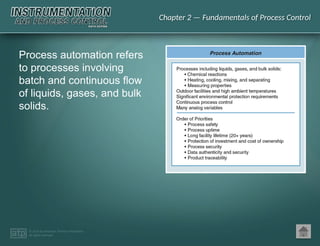
Process automation refers
to processes involving
batch and continuous flow
of liquids, gases, and bulk
solids.
Chapter 2 — Fundamentals of Process Control
© 2014 by American Technical Publishers
All rights reserved
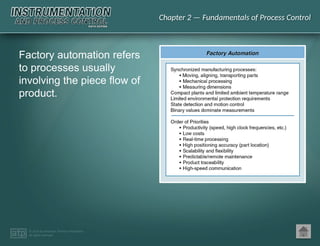
Factory automation refers
to processes usually
involving the piece flow of
product.
Chapter 2 — Fundamentals of Process Control
© 2014 by American Technical Publishers
All rights reserved
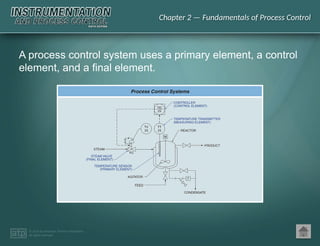
A process control system uses a primary element, a control
element, and a final element.
Chapter 2 — Fundamentals of Process Control
© 2014 by American Technical Publishers
All rights reserved
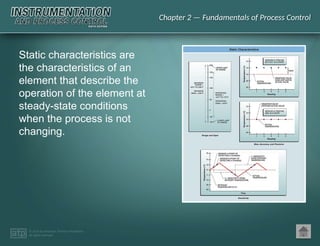
Static characteristics are
the characteristics of an
element that describe the
operation of the element at
steady-state conditions
when the process is not
changing.
Chapter 2 — Fundamentals of Process Control
© 2014 by American Technical Publishers
All rights reserved
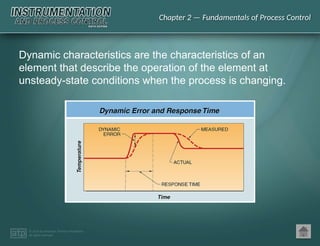
Dynamic characteristics are the characteristics of an
element that describe the operation of the element at
unsteady-state conditions when the process is changing.
Chapter 2 — Fundamentals of Process Control
© 2014 by American Technical Publishers
All rights reserved
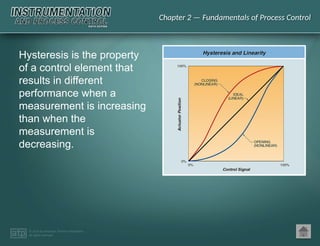
Hysteresis is the property
of a control element that
results in different
performance when a
measurement is increasing
than when the
measurement is
decreasing.
Chapter 2 — Fundamentals of Process Control
© 2014 by American Technical Publishers
All rights reserved
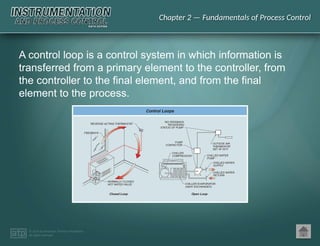
A control loop is a control system in which information is
transferred from a primary element to the controller, from
the controller to the final element, and from the final
element to the process.
Chapter 2 — Fundamentals of Process Control
© 2014 by American Technical Publishers
All rights reserved
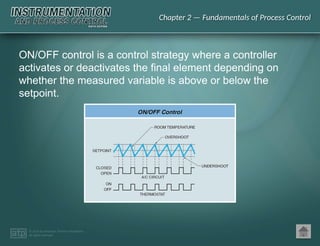
ON/OFF control is a control strategy where a controller
activates or deactivates the final element depending on
whether the measured variable is above or below the
setpoint.
Chapter 2 — Fundamentals of Process Control
© 2014 by American Technical Publishers
All rights reserved
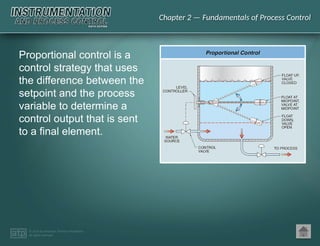
Proportional control is a
control strategy that uses
the difference between the
setpoint and the process
variable to determine a
control output that is sent
to a final element.
Chapter 2 — Fundamentals of Process Control
© 2014 by American Technical Publishers
All rights reserved
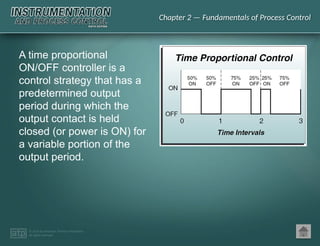
A time proportional
ON/OFF controller is a
control strategy that has a
predetermined output
period during which the
output contact is held
closed (or power is ON) for
a variable portion of the
output period.

introduction_to_process_control_from_instrumentation_process_control.pptx

  • 1.
    © 2014 byAmerican Technical Publishers All rights reserved Basic PowerPoint® Presentations Basic PowerPoint® Presentations offer instructors a no-cost option for providing a brief overview of content presented in Instrumentation Process and Control. Premium PowerPoint® Presentations allow instructors to minimize development time by taking advantage of prepopulated instructional content including the following: Premium PowerPoint® Presentations can be purchased from atplearning.com as part of the Instructor Resources or as a separate product. To purchase Premium PowerPoint® Presentations, visit atplearning.com • Chapter Objectives • Images of all Numbered Figures • Instructor Notes • Chapter Reviews
  • 2.
    Basic PowerPoint® Presentation © 2014by American Technical Publishers All rights reserved Chapter 2 Process Control • Variables • Automation • Control Elements • Performance Characteristics • Control Loops • Common Control Strategies • Instrument Calibration • Instrument Management Software Fundamentals of Process Control
  • 3.
    Chapter 2 —Fundamentals of Process Control © 2014 by American Technical Publishers All rights reserved Process automation refers to processes involving batch and continuous flow of liquids, gases, and bulk solids.
  • 4.
    Chapter 2 —Fundamentals of Process Control © 2014 by American Technical Publishers All rights reserved Factory automation refers to processes usually involving the piece flow of product.
  • 5.
    Chapter 2 —Fundamentals of Process Control © 2014 by American Technical Publishers All rights reserved A process control system uses a primary element, a control element, and a final element.
  • 6.
    Chapter 2 —Fundamentals of Process Control © 2014 by American Technical Publishers All rights reserved Static characteristics are the characteristics of an element that describe the operation of the element at steady-state conditions when the process is not changing.
  • 7.
    Chapter 2 —Fundamentals of Process Control © 2014 by American Technical Publishers All rights reserved Dynamic characteristics are the characteristics of an element that describe the operation of the element at unsteady-state conditions when the process is changing.
  • 8.
    Chapter 2 —Fundamentals of Process Control © 2014 by American Technical Publishers All rights reserved Hysteresis is the property of a control element that results in different performance when a measurement is increasing than when the measurement is decreasing.
  • 9.
    Chapter 2 —Fundamentals of Process Control © 2014 by American Technical Publishers All rights reserved A control loop is a control system in which information is transferred from a primary element to the controller, from the controller to the final element, and from the final element to the process.
  • 10.
    Chapter 2 —Fundamentals of Process Control © 2014 by American Technical Publishers All rights reserved ON/OFF control is a control strategy where a controller activates or deactivates the final element depending on whether the measured variable is above or below the setpoint.
  • 11.
    Chapter 2 —Fundamentals of Process Control © 2014 by American Technical Publishers All rights reserved Proportional control is a control strategy that uses the difference between the setpoint and the process variable to determine a control output that is sent to a final element.
  • 12.
    Chapter 2 —Fundamentals of Process Control © 2014 by American Technical Publishers All rights reserved A time proportional ON/OFF controller is a control strategy that has a predetermined output period during which the output contact is held closed (or power is ON) for a variable portion of the output period.