Introduction to the
Endocrine System
Hormonal Responses and Adaptation to Exercise
Coverage
 Nervous System and Endocrine System
 Structures of the Endocrine system
 Overview of Hormones
 Pathways of Hormone Action
Nervous System &
Endocrine System
Nervous
System
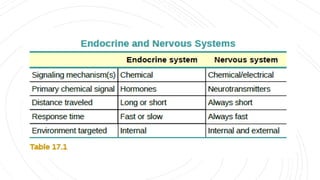
 The nervous system uses two types of intercellular
communication either by the direct action of an electrical
potential, or in the latter case, through the action of
chemical neurotransmitters such as serotonin or
norepinephrine.
 Neural communication enables body functions that
involve quick, brief actions, such as movement,
sensation, and cognition.
Endocrine
System
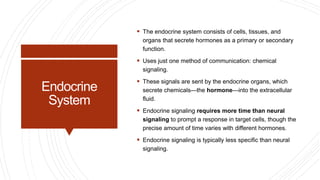
 The endocrine system consists of cells, tissues, and
organs that secrete hormones as a primary or secondary
function.
 Uses just one method of communication: chemical
signaling.
 These signals are sent by the endocrine organs, which
secrete chemicals—the hormone—into the extracellular
fluid.
 Endocrine signaling requires more time than neural
signaling to prompt a response in target cells, though the
precise amount of time varies with different hormones.
 Endocrine signaling is typically less specific than neural
signaling.
Structures of
the Endocrine
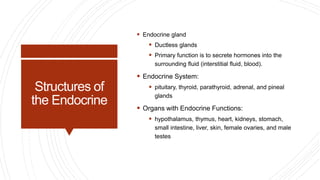
 Endocrine gland
 Ductless glands
 Primary function is to secrete hormones into the
surrounding fluid (interstitial fluid, blood).
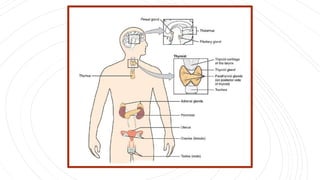
 Endocrine System:
 pituitary, thyroid, parathyroid, adrenal, and pineal
glands
 Organs with Endocrine Functions:
 hypothalamus, thymus, heart, kidneys, stomach,
small intestine, liver, skin, female ovaries, and male
testes
Autocrine &
Paracrine
Signaling
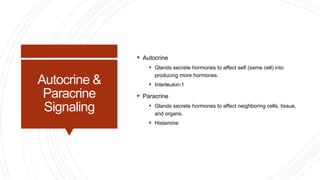
 Autocrine
 Glands secrete hormones to affect self (same cell) into
producing more hormones.
 Interleukin-1
 Paracrine
 Glands secrete hormones to affect neighboring cells, tissue,
and organs.
 Histamine
Overview of
Hormones
Types & Functions
General
Types/Classes
of Hormones
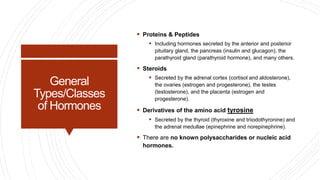
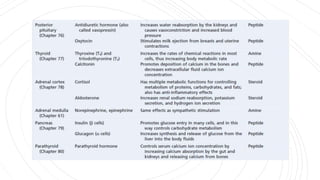
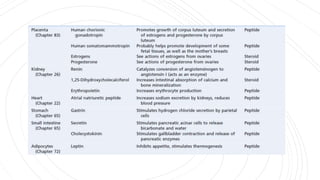
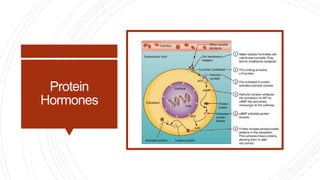
 Proteins & Peptides
 Including hormones secreted by the anterior and posterior
pituitary gland, the pancreas (insulin and glucagon), the
parathyroid gland (parathyroid hormone), and many others.
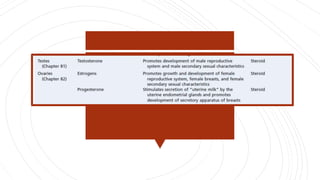
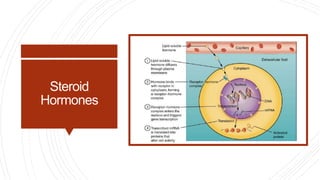
 Steroids
 Secreted by the adrenal cortex (cortisol and aldosterone),
the ovaries (estrogen and progesterone), the testes
(testosterone), and the placenta (estrogen and
progesterone).
 Derivatives of the amino acid tyrosine
 Secreted by the thyroid (thyroxine and triiodothyronine) and
the adrenal medullae (epinephrine and norepinephrine).
 There are no known polysaccharides or nucleic acid
hormones.
Pathways of
Hormone Action
Steroid and Protein Hormones
Steroid
Hormones
Protein
Hormones
References:
Rice University. Anatomy & Physiology. Openstax
Howley, E., & Powers, S. (2015). Exercise physiology: Theory and application to fitness and
performance (10th ed.). McGraw-Hill Education.
Hall, J. E., & Hall, M. E. (2015). Guyton and hall textbook of medical physiology E-book:
Guyton and hall textbook of medical physiology E-book (13th ed.). Elsevier Health Sciences.

Introduction to the Endocrine System.pptx

  • 1.
    Introduction to the EndocrineSystem Hormonal Responses and Adaptation to Exercise
  • 2.
    Coverage  Nervous Systemand Endocrine System  Structures of the Endocrine system  Overview of Hormones  Pathways of Hormone Action
  • 3.
  • 4.
    Nervous System  The nervoussystem uses two types of intercellular communication either by the direct action of an electrical potential, or in the latter case, through the action of chemical neurotransmitters such as serotonin or norepinephrine.  Neural communication enables body functions that involve quick, brief actions, such as movement, sensation, and cognition.
  • 5.
    Endocrine System  The endocrinesystem consists of cells, tissues, and organs that secrete hormones as a primary or secondary function.  Uses just one method of communication: chemical signaling.  These signals are sent by the endocrine organs, which secrete chemicals—the hormone—into the extracellular fluid.  Endocrine signaling requires more time than neural signaling to prompt a response in target cells, though the precise amount of time varies with different hormones.  Endocrine signaling is typically less specific than neural signaling.
  • 7.
    Structures of the Endocrine Endocrine gland  Ductless glands  Primary function is to secrete hormones into the surrounding fluid (interstitial fluid, blood).  Endocrine System:  pituitary, thyroid, parathyroid, adrenal, and pineal glands  Organs with Endocrine Functions:  hypothalamus, thymus, heart, kidneys, stomach, small intestine, liver, skin, female ovaries, and male testes
  • 9.
    Autocrine & Paracrine Signaling  Autocrine Glands secrete hormones to affect self (same cell) into producing more hormones.  Interleukin-1  Paracrine  Glands secrete hormones to affect neighboring cells, tissue, and organs.  Histamine
  • 10.
  • 11.
    General Types/Classes of Hormones  Proteins& Peptides  Including hormones secreted by the anterior and posterior pituitary gland, the pancreas (insulin and glucagon), the parathyroid gland (parathyroid hormone), and many others.  Steroids  Secreted by the adrenal cortex (cortisol and aldosterone), the ovaries (estrogen and progesterone), the testes (testosterone), and the placenta (estrogen and progesterone).  Derivatives of the amino acid tyrosine  Secreted by the thyroid (thyroxine and triiodothyronine) and the adrenal medullae (epinephrine and norepinephrine).  There are no known polysaccharides or nucleic acid hormones.
  • 16.
  • 17.
  • 18.
  • 19.
    References: Rice University. Anatomy& Physiology. Openstax Howley, E., & Powers, S. (2015). Exercise physiology: Theory and application to fitness and performance (10th ed.). McGraw-Hill Education. Hall, J. E., & Hall, M. E. (2015). Guyton and hall textbook of medical physiology E-book: Guyton and hall textbook of medical physiology E-book (13th ed.). Elsevier Health Sciences.

Editor's Notes

  • #5 The target cell responds within milliseconds of receiving the chemical “message”; this response then ceases very quickly once the neural signaling ends.
  • #6 For example, the hormones released when you are confronted with a dangerous or frightening situation, called the fight-or-flight response, occur by the release of adrenal hormones—epinephrine and norepinephrine—within seconds. In contrast, it may take up to 48 hours for target cells to respond to certain reproductive hormones. In general, the nervous system involves quick responses to rapid changes in the external environment, and the endocrine system is usually slower acting—taking care of the internal environment of the body, maintaining homeostasis, and controlling reproduction.
  • #10 example is the neurotransmitters of the nervous system, which act only locally within the synaptic cleft.