Introduction to Tata Trusts
2TATA TRUSTS
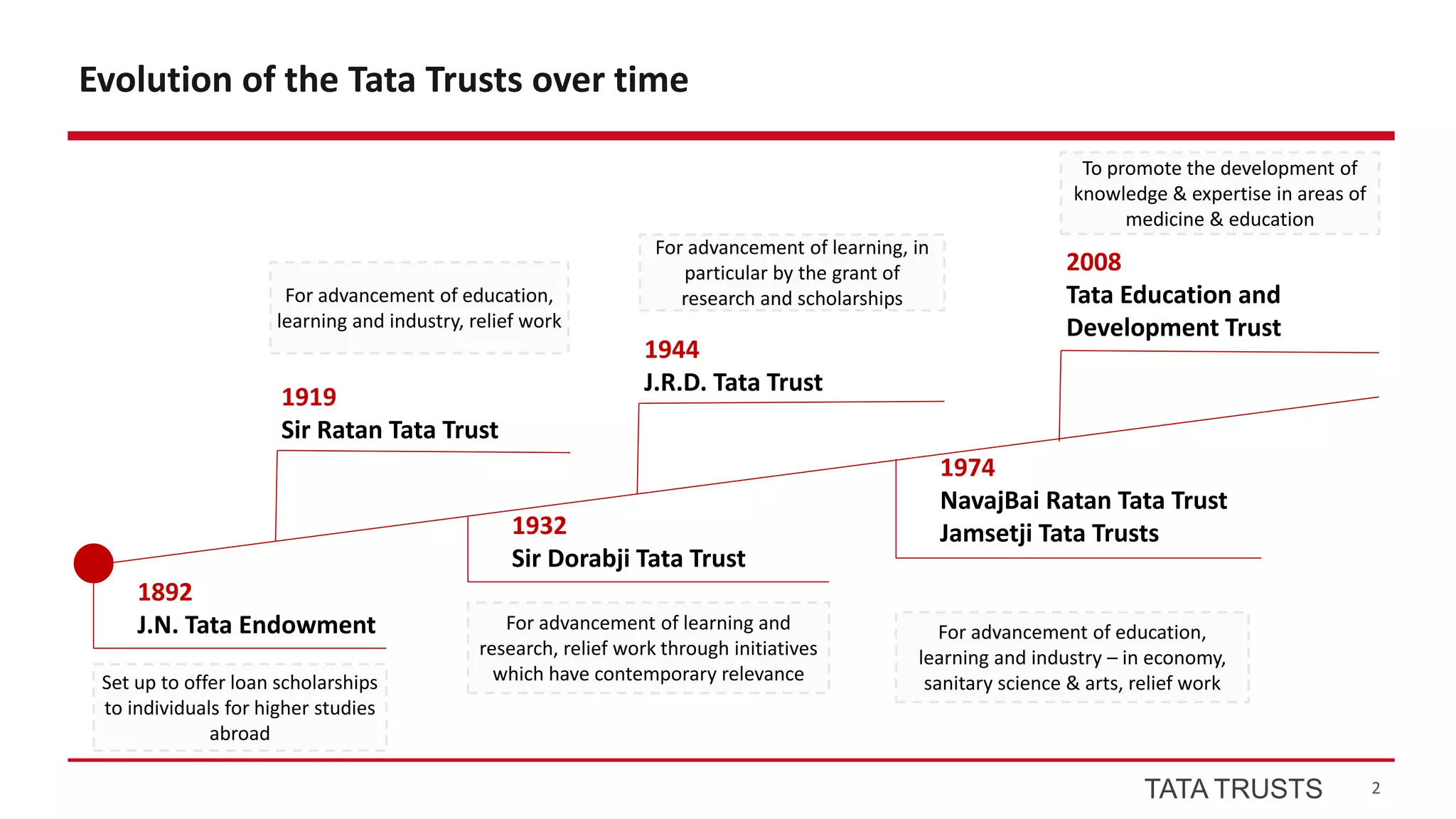
Evolution of the Tata Trusts over time
Set up to offer loan scholarships
to individuals for higher studies
abroad
For advancement of learning and
research, relief work through initiatives
which have contemporary relevance
For advancement of education,
learning and industry – in economy,
sanitary science & arts, relief work
For advancement of education,
learning and industry, relief work
For advancement of learning, in
particular by the grant of
research and scholarships
To promote the development of
knowledge & expertise in areas of
medicine & education
1892
J.N. Tata Endowment
1919
Sir Ratan Tata Trust
1932
Sir Dorabji Tata Trust
1944
J.R.D. Tata Trust
1974
NavajBai Ratan Tata Trust
Jamsetji Tata Trusts
2008
Tata Education and
Development Trust
3TATA TRUSTS
Legacy of Building World Class Institutions
1911
Indian Institute of
Science
Sir Ratan Tata
Department at LSE
1912
Tata Memorial
Centre
1941
1944
Tata Institute of
Social Sciences
1945
Tata Institute of
Fundamental Research
1969
National Centre for
the Performing Arts
1988
National Institute of
Advanced Studies
2011
Tata Medical
Center
2012
2016
Tata Centre for
Development,
National Cancer Grid
Tata Center for
Technology and Design
4TATA TRUSTS
7 Strategic Themes of Engagement..
• Agricultural Enhancement
• Natural Resource Management
• Sustainable Livelihood
• Affordable Finance
• Rural Electrification
• Low Cost Renewable
Energy & Storage
systems
1. Healthcare
• Primary Healthcare
• Non-Communicable diseases
• Communicable Diseases
• Maternal & Child Health
• Nutrition
• Medical Research
2.Energy AndClimateChange 3. Rural Upliftment
• Early Childhood Education
• Teacher Education
• Technology in Education
• Children’s Book Publication
4.Education 7. Water and Sanitation
• Water Harvesting and
Conservation
• Water Security
• Access to Safe water
through Innovative
Technologies
5.Media,Arts &Culture
• Affordable
Housing
• Migration
• Skill Building
• Sports
6. Urban Poverty Alleviation
IndividualGrantsInnovation Institution
• Preserve & Promote
Cultural Heritage
• Provide Platforms for
Performing Arts
5TATA TRUSTS
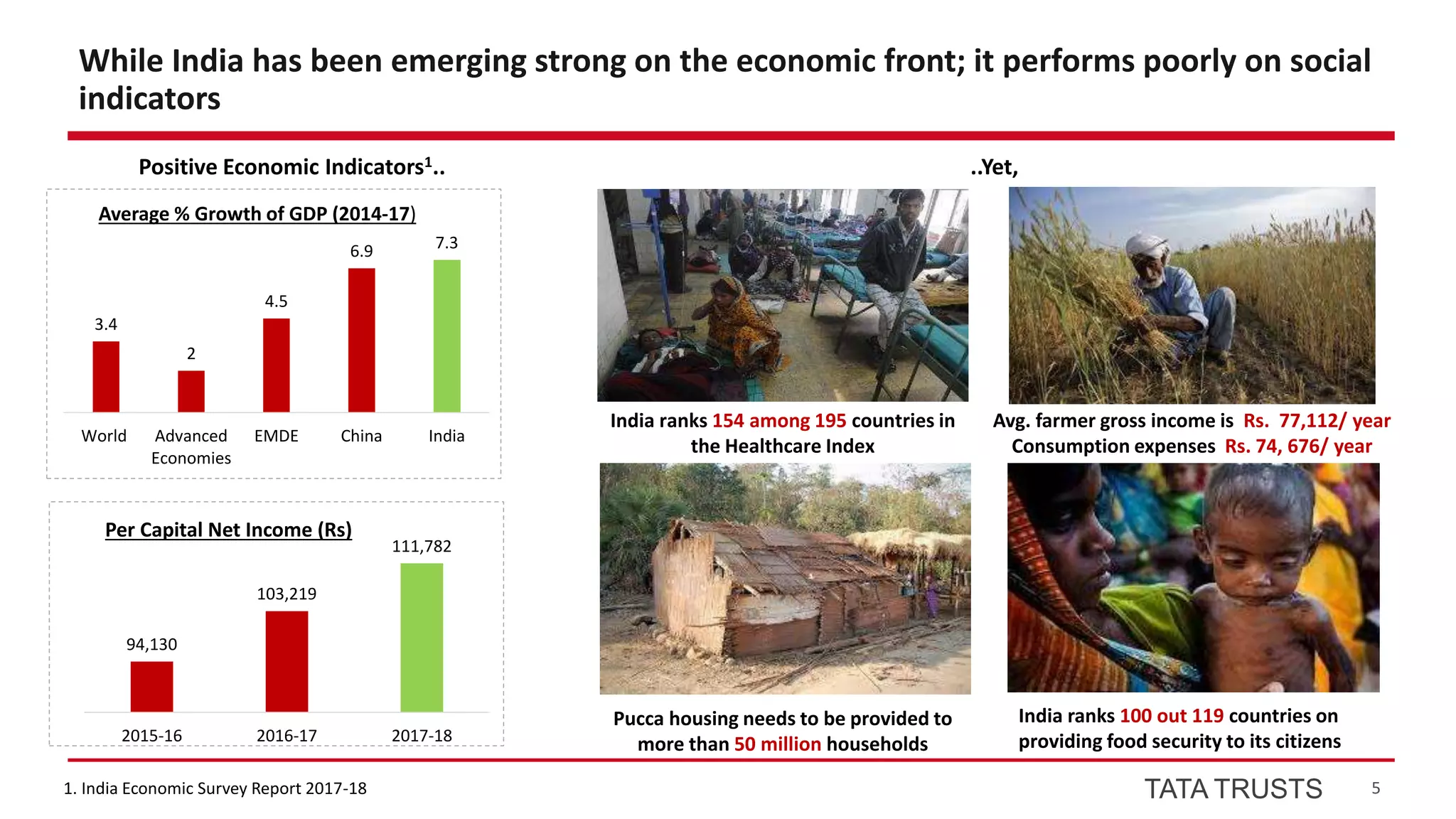
While India has been emerging strong on the economic front; it performs poorly on social
indicators
3.4
2
4.5
6.9 7.3
World Advanced
Economies
EMDE China India
Average % Growth of GDP (2014-17)
94,130
103,219
111,782
2015-16 2016-17 2017-18
Per Capital Net Income (Rs)
India ranks 154 among 195 countries in
the Healthcare Index
Avg. farmer gross income is Rs. 77,112/ year
Consumption expenses Rs. 74, 676/ year
Pucca housing needs to be provided to
more than 50 million households
India ranks 100 out 119 countries on
providing food security to its citizens
Positive Economic Indicators1.. ..Yet,
1. India Economic Survey Report 2017-18
6TATA TRUSTS
Major Portfolio of the Trusts: Healthcare and Rural Upliftment
Health & Nutrition
Rural Upliftment (Agriculture, Livelihoods,
Financial Inclusion, Digital Literacy)
GuidingPrinciples
Seek to achieve impact at scale on the most pressing issues facing vulnerable populations, irrespective of creed,
caste or religion
Aim for sustainable positive change and improvement in the quality of life of end beneficiaries
Seek and demonstrate measurable outcomes
Focus where the Trusts can innovate and play a distinctive role in supporting change
1
2
3
4
7TATA TRUSTS
It takes a
(bio)village…
and a family…
to raise a child
8TATA TRUSTS
• A farming system approach for nutrition to address the
challenge of malnutrition in the country
• The index of success: It works if young children are growing
and healthy
The principles
9TATA TRUSTS
The reality of early child growth in India
Fed at home Supported at anganwadi
10TATA TRUSTS
The existing system for feeding young children
• The <3y child is fed at home: that is when maximum growth faltering
occurs
• Supported by ‘take-home rations’ from the ICDS
• But food and health should start with the family, and the village
• How can the ICDS/anganwadi be supported by technology?
11TATA TRUSTS
What innovations sustain small holder farmer livelihood
and nutrition & health security?
• Investing in existing self-help groups for young child feeding
• Creating local supply and demand – the food the village grows should have a demand in the
family and in the village
o Procurement of local foods by the ICDS at a local level
o Procurement and sales for money
• Decrease in the water footprint of what is grown – resilience in the face of drought
• Storage of food
• Value addition by simple processing
o Innovative methods for raw food quality preservation
• Creating awareness and outreach – money generated does not always go into better nutrition
o Technology is not just engineering – social engineering is required
12TATA TRUSTS
Example: Working with the Govt of Karnataka
• Evaluating the supply and demand for the THR for <3y children
• Working with SHG’s to improve the THR
• Evaluating local supply chains and local procurement for SHG’s: co-
operative for raw rations and fresh vegetables
• Ensuring diversity in cropping and intake: Setting up an intercropping
database to assist farmers
13TATA TRUSTS
Technology: solar drier to preserve vegetables
Dangoria Trust and Dr Mahtab Bamji - Narsapur
14TATA TRUSTS
Example: Social Alpha
• The Social Alpha Quest for Agritech Innovations has the aim
of enabling an ecosystem for innovators and entrepreneurs
to develop farmer-focused technology solutions.
• The objective would be to empower small and marginal
farmers towards increasing productivity and profitability.
15TATA TRUSTS
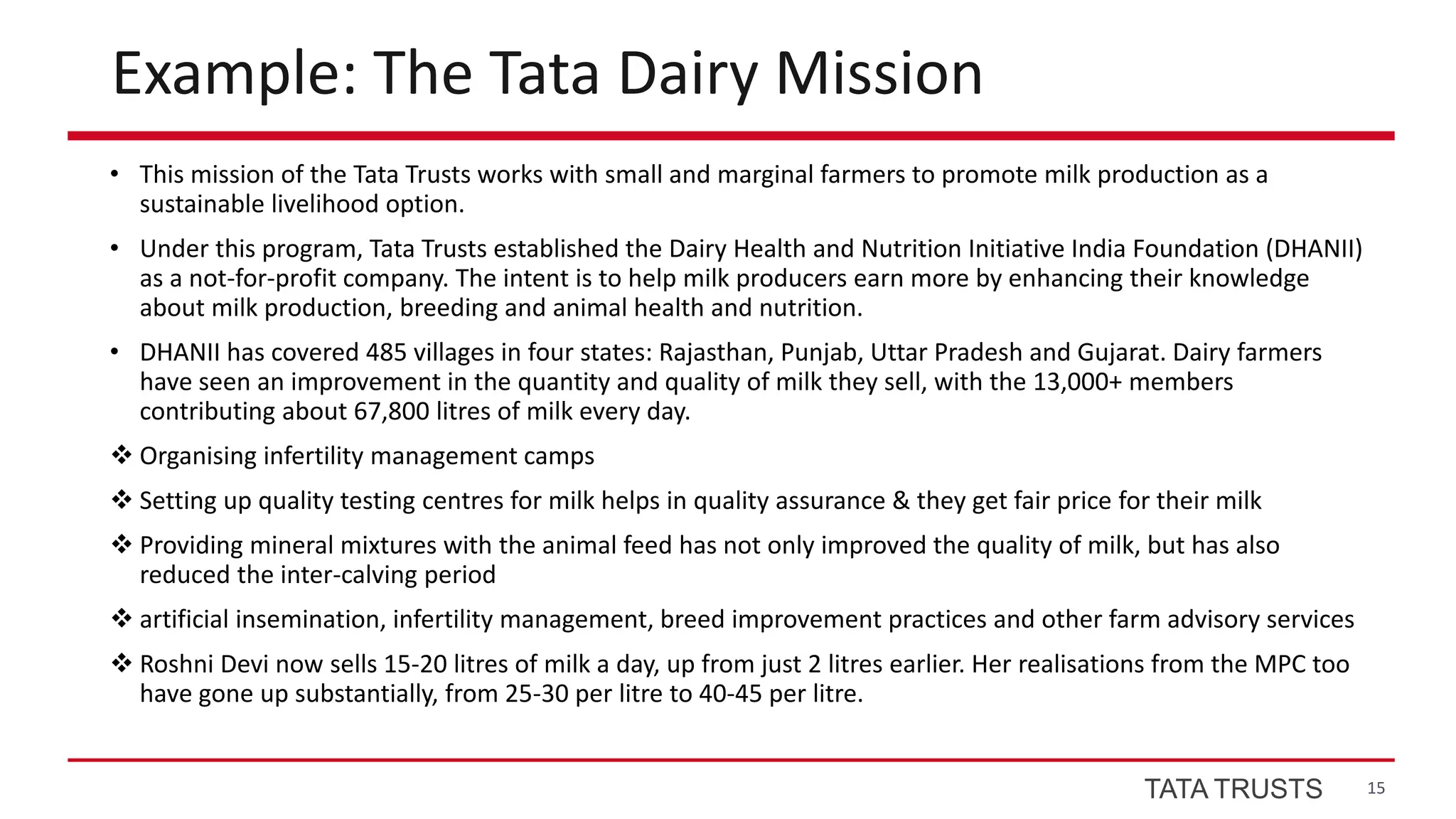
Example: The Tata Dairy Mission
• This mission of the Tata Trusts works with small and marginal farmers to promote milk production as a
sustainable livelihood option.
• Under this program, Tata Trusts established the Dairy Health and Nutrition Initiative India Foundation (DHANII)
as a not-for-profit company. The intent is to help milk producers earn more by enhancing their knowledge
about milk production, breeding and animal health and nutrition.
• DHANII has covered 485 villages in four states: Rajasthan, Punjab, Uttar Pradesh and Gujarat. Dairy farmers
have seen an improvement in the quantity and quality of milk they sell, with the 13,000+ members
contributing about 67,800 litres of milk every day.
 Organising infertility management camps
 Setting up quality testing centres for milk helps in quality assurance & they get fair price for their milk
 Providing mineral mixtures with the animal feed has not only improved the quality of milk, but has also
reduced the inter-calving period
 artificial insemination, infertility management, breed improvement practices and other farm advisory services
 Roshni Devi now sells 15-20 litres of milk a day, up from just 2 litres earlier. Her realisations from the MPC too
have gone up substantially, from 25-30 per litre to 40-45 per litre.
16TATA TRUSTS
Example: Reviving the Green Revolution
• The Sir Ratan Tata Trust and Navajbai Ratan Tata Trust launched the Reviving the Green Revolution (RGR)
programme in 2002.
• The programme encourages agricultural diversification by shifting to economically viable water saving crops.
• It focuses on improving soil health, arresting environmental degradation through judicious use of
agrochemicals, reducing cost of cultivation and making agriculture sustainable and economically viable.
• The initiative covers 1,300 villages in 40 blocks of 9 districts in Punjab.
• A regional centre of the RGR Cell was set up in Coimbatore in 2010 at the Tamil Nadu Agricultural University
(TNAU) and covers approximately 10,000 households across Perambalur, Coimbatore, Erode, Salem,
Dharmapuri and Thiruvannamalai districts.
• Its work focusses on agriculture and allied livelihood building activities, specifically in rainfed and drought-
prone areas, with a focus to increase profitability and productivity for small and marginal farmers.
17TATA TRUSTS
Example: Lakhpati Kisans (Multi cropping)
• Collectives for Integrated Livelihood Initiatives (CInI), a nodal agency of the Trusts, initiated work in
Janumpiri, Jharkhand through the introduction of improved cultivation practices of paddy for food security,
black gram for nutrition and tomato as a commercial crop.
• The farmers undertook cultivation of tomato, paddy and pulses during the kharif, and cabbage and garden
pea in the rabi season. They also experimented by cultivating watermelon in summer.
• The successes created a ripple effect, making neighbouring villages to join & form a part of the three vibrant
community institutions (SHGs) through which the programme is being rolled out. The villagers are now
annually earning an average of Rs65,000 from agriculture and Rs40,000 from lac.
• In the many stories of Janumpiri, that of Kuwanri Hassa and her husband Dola Hassa stands out. They have
earned Rs94,000 from agricultural activities and Rs35,000 from lac cultivation in a year and are now listed as
‘Lakhpati Kisans’.
• Expressing her joy, Kuwanri says, “With the increased income, we have managed to purchase a two-wheeler
and a portable pumpset for irrigation." Kuwanri and Dola are two of the change catalysts who have inspired
others in their village.
TATA EDUCATION AND DEVELOPMENT TRUST
THANKS

Introduction to Tata Trusts

  • 1.
  • 2.
    2TATA TRUSTS Evolution ofthe Tata Trusts over time Set up to offer loan scholarships to individuals for higher studies abroad For advancement of learning and research, relief work through initiatives which have contemporary relevance For advancement of education, learning and industry – in economy, sanitary science & arts, relief work For advancement of education, learning and industry, relief work For advancement of learning, in particular by the grant of research and scholarships To promote the development of knowledge & expertise in areas of medicine & education 1892 J.N. Tata Endowment 1919 Sir Ratan Tata Trust 1932 Sir Dorabji Tata Trust 1944 J.R.D. Tata Trust 1974 NavajBai Ratan Tata Trust Jamsetji Tata Trusts 2008 Tata Education and Development Trust
  • 3.
    3TATA TRUSTS Legacy ofBuilding World Class Institutions 1911 Indian Institute of Science Sir Ratan Tata Department at LSE 1912 Tata Memorial Centre 1941 1944 Tata Institute of Social Sciences 1945 Tata Institute of Fundamental Research 1969 National Centre for the Performing Arts 1988 National Institute of Advanced Studies 2011 Tata Medical Center 2012 2016 Tata Centre for Development, National Cancer Grid Tata Center for Technology and Design
  • 4.
    4TATA TRUSTS 7 StrategicThemes of Engagement.. • Agricultural Enhancement • Natural Resource Management • Sustainable Livelihood • Affordable Finance • Rural Electrification • Low Cost Renewable Energy & Storage systems 1. Healthcare • Primary Healthcare • Non-Communicable diseases • Communicable Diseases • Maternal & Child Health • Nutrition • Medical Research 2.Energy AndClimateChange 3. Rural Upliftment • Early Childhood Education • Teacher Education • Technology in Education • Children’s Book Publication 4.Education 7. Water and Sanitation • Water Harvesting and Conservation • Water Security • Access to Safe water through Innovative Technologies 5.Media,Arts &Culture • Affordable Housing • Migration • Skill Building • Sports 6. Urban Poverty Alleviation IndividualGrantsInnovation Institution • Preserve & Promote Cultural Heritage • Provide Platforms for Performing Arts
  • 5.
    5TATA TRUSTS While Indiahas been emerging strong on the economic front; it performs poorly on social indicators 3.4 2 4.5 6.9 7.3 World Advanced Economies EMDE China India Average % Growth of GDP (2014-17) 94,130 103,219 111,782 2015-16 2016-17 2017-18 Per Capital Net Income (Rs) India ranks 154 among 195 countries in the Healthcare Index Avg. farmer gross income is Rs. 77,112/ year Consumption expenses Rs. 74, 676/ year Pucca housing needs to be provided to more than 50 million households India ranks 100 out 119 countries on providing food security to its citizens Positive Economic Indicators1.. ..Yet, 1. India Economic Survey Report 2017-18
  • 6.
    6TATA TRUSTS Major Portfolioof the Trusts: Healthcare and Rural Upliftment Health & Nutrition Rural Upliftment (Agriculture, Livelihoods, Financial Inclusion, Digital Literacy) GuidingPrinciples Seek to achieve impact at scale on the most pressing issues facing vulnerable populations, irrespective of creed, caste or religion Aim for sustainable positive change and improvement in the quality of life of end beneficiaries Seek and demonstrate measurable outcomes Focus where the Trusts can innovate and play a distinctive role in supporting change 1 2 3 4
  • 7.
    7TATA TRUSTS It takesa (bio)village… and a family… to raise a child
  • 8.
    8TATA TRUSTS • Afarming system approach for nutrition to address the challenge of malnutrition in the country • The index of success: It works if young children are growing and healthy The principles
  • 9.
    9TATA TRUSTS The realityof early child growth in India Fed at home Supported at anganwadi
  • 10.
    10TATA TRUSTS The existingsystem for feeding young children • The <3y child is fed at home: that is when maximum growth faltering occurs • Supported by ‘take-home rations’ from the ICDS • But food and health should start with the family, and the village • How can the ICDS/anganwadi be supported by technology?
  • 11.
    11TATA TRUSTS What innovationssustain small holder farmer livelihood and nutrition & health security? • Investing in existing self-help groups for young child feeding • Creating local supply and demand – the food the village grows should have a demand in the family and in the village o Procurement of local foods by the ICDS at a local level o Procurement and sales for money • Decrease in the water footprint of what is grown – resilience in the face of drought • Storage of food • Value addition by simple processing o Innovative methods for raw food quality preservation • Creating awareness and outreach – money generated does not always go into better nutrition o Technology is not just engineering – social engineering is required
  • 12.
    12TATA TRUSTS Example: Workingwith the Govt of Karnataka • Evaluating the supply and demand for the THR for <3y children • Working with SHG’s to improve the THR • Evaluating local supply chains and local procurement for SHG’s: co- operative for raw rations and fresh vegetables • Ensuring diversity in cropping and intake: Setting up an intercropping database to assist farmers
  • 13.
    13TATA TRUSTS Technology: solardrier to preserve vegetables Dangoria Trust and Dr Mahtab Bamji - Narsapur
  • 14.
    14TATA TRUSTS Example: SocialAlpha • The Social Alpha Quest for Agritech Innovations has the aim of enabling an ecosystem for innovators and entrepreneurs to develop farmer-focused technology solutions. • The objective would be to empower small and marginal farmers towards increasing productivity and profitability.
  • 15.
    15TATA TRUSTS Example: TheTata Dairy Mission • This mission of the Tata Trusts works with small and marginal farmers to promote milk production as a sustainable livelihood option. • Under this program, Tata Trusts established the Dairy Health and Nutrition Initiative India Foundation (DHANII) as a not-for-profit company. The intent is to help milk producers earn more by enhancing their knowledge about milk production, breeding and animal health and nutrition. • DHANII has covered 485 villages in four states: Rajasthan, Punjab, Uttar Pradesh and Gujarat. Dairy farmers have seen an improvement in the quantity and quality of milk they sell, with the 13,000+ members contributing about 67,800 litres of milk every day.  Organising infertility management camps  Setting up quality testing centres for milk helps in quality assurance & they get fair price for their milk  Providing mineral mixtures with the animal feed has not only improved the quality of milk, but has also reduced the inter-calving period  artificial insemination, infertility management, breed improvement practices and other farm advisory services  Roshni Devi now sells 15-20 litres of milk a day, up from just 2 litres earlier. Her realisations from the MPC too have gone up substantially, from 25-30 per litre to 40-45 per litre.
  • 16.
    16TATA TRUSTS Example: Revivingthe Green Revolution • The Sir Ratan Tata Trust and Navajbai Ratan Tata Trust launched the Reviving the Green Revolution (RGR) programme in 2002. • The programme encourages agricultural diversification by shifting to economically viable water saving crops. • It focuses on improving soil health, arresting environmental degradation through judicious use of agrochemicals, reducing cost of cultivation and making agriculture sustainable and economically viable. • The initiative covers 1,300 villages in 40 blocks of 9 districts in Punjab. • A regional centre of the RGR Cell was set up in Coimbatore in 2010 at the Tamil Nadu Agricultural University (TNAU) and covers approximately 10,000 households across Perambalur, Coimbatore, Erode, Salem, Dharmapuri and Thiruvannamalai districts. • Its work focusses on agriculture and allied livelihood building activities, specifically in rainfed and drought- prone areas, with a focus to increase profitability and productivity for small and marginal farmers.
  • 17.
    17TATA TRUSTS Example: LakhpatiKisans (Multi cropping) • Collectives for Integrated Livelihood Initiatives (CInI), a nodal agency of the Trusts, initiated work in Janumpiri, Jharkhand through the introduction of improved cultivation practices of paddy for food security, black gram for nutrition and tomato as a commercial crop. • The farmers undertook cultivation of tomato, paddy and pulses during the kharif, and cabbage and garden pea in the rabi season. They also experimented by cultivating watermelon in summer. • The successes created a ripple effect, making neighbouring villages to join & form a part of the three vibrant community institutions (SHGs) through which the programme is being rolled out. The villagers are now annually earning an average of Rs65,000 from agriculture and Rs40,000 from lac. • In the many stories of Janumpiri, that of Kuwanri Hassa and her husband Dola Hassa stands out. They have earned Rs94,000 from agricultural activities and Rs35,000 from lac cultivation in a year and are now listed as ‘Lakhpati Kisans’. • Expressing her joy, Kuwanri says, “With the increased income, we have managed to purchase a two-wheeler and a portable pumpset for irrigation." Kuwanri and Dola are two of the change catalysts who have inspired others in their village.
  • 18.
    TATA EDUCATION ANDDEVELOPMENT TRUST THANKS