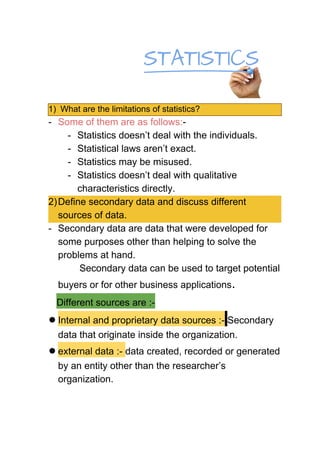
1) What are the limitations of statistics?
- Some of them are as follows:​-
- Statistics doesn’t deal with the individuals.
- Statistical laws aren’t exact.
- Statistics may be misused.
- Statistics doesn’t deal with qualitative
characteristics directly.
2)Define secondary data and discuss different
sources of data.
- Secondary data are data that were developed for
some purposes other than helping to solve the
problems at hand.
Secondary data can be used to target potential
buyers or for other business applications​.
​Different sources are :-
●Internal and proprietary data sources :-​ ​Secondary
data that originate inside the organization.
●external data :- ​data created, recorded or generated
by an entity other than the researcher’s
organization.
●Information as a product and its distribution :-
libraries,the internet,vendors,producers,books &
periodicals,government sources,trade associations
sources,commercial sources.
3) What is data? What statistical methods
are appropriate to describe the nominal
data ?
-The individual pieces of factual information collected
through censuses and surveys or in routine manner or
other sources is called data.
It is the raw information from which statistics are
created.
NOMINALDATA is “labelled” or “named” data which
can be divided into various groups that do not overlap.
Chi-square test (x2) is used to determine whether an
association (relationship) between two categorical
variables in a sample is likely to reflect a real association
between these two variables in the population.
4)Discuss the importance of statistics in
the field of management?
-Statistics is considered an important field of study and
it’s importance in management can never be ignored.
Statistics models are used by companies in making
significant decisions. All forms of data available in the
company can be organized by using statistical formulas
or statistical tools
5)What are the limitations of primary
sources of data ?
-Primary data is the data collected by particular persons
or organizations for his own use from the primary
sources.
* ​Limitations
1)Paperwork
2)Expensive
3)Sampling errors
4)Time consuming
5)Respondents bias
6)Interviewer bias etc..
6)​Define descriptive statistics.
- Descriptive statistics is used to analyze and
represent the data that have been previously
collected. It includes frequency counts,range(high
and low scoresor values),mean, modes,median
scores,and standard deviation.The important
concepts to understand descriptive statistics are :-
variables,distribution.
7)Define inferential statistics.
- The sample is a set of data taken from the
population to represent the population. Probability
distribution,hypothesis testing,correlation testing
and regression analysis all fall under the category of
inferential statistics.
8)Methods of collecting primary data.
In order to collect primary data,the following
sources may be used
-Direct personal interview method
-Indirect oral interview method
-Information through correspondence.
- Mail questionnaire method
-Schedule sent through enumerators.
9)Sources of primary data.
- Designed experiment
- Survey research
- Observational study etc.
10)Define statistics and function of
statistics?
-Statistics is the combination of the numerical
statements of facts capable of analysis and
interpretation and study of the principles, the method
applied in collecting,presenting,analysis,& interpreting
the numerical data in any field of investigation.
​Functions of statistics
- To help classification of data.
- To help in formulating policies.
- To determine the relationship between different
phenomena.
- To formulate & test the hypothesis.
- To help in predicting future trends.
- To provide methods for making comparisons.
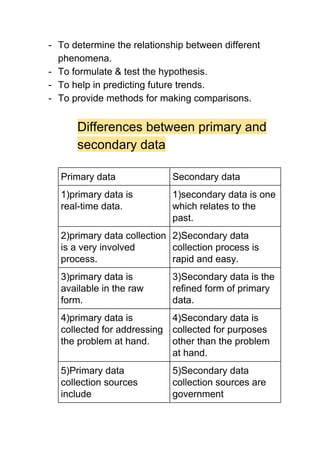
Differences between primary and
secondary data
Primary data Secondary data
1)primary data is
real-time data.
1)secondary data is one
which relates to the
past.
2)primary data collection
is a very involved
process.
2)Secondary data
collection process is
rapid and easy.
3)primary data is
available in the raw
form.
3)Secondary data is the
refined form of primary
data.
4)primary data is
collected for addressing
the problem at hand.
4)Secondary data is
collected for purposes
other than the problem
at hand.
5)Primary data
collection sources
include
5)Secondary data
collection sources are
government
surveys,observations,
experiments,questionnai
re,personal interview
etc.
publications, websites,
books, journal
articles,internal records
etc.
6)It is more accurate
and reliable.
6) It is relatively less
accurate and reliable.
7) Primary data may be
influenced by personal
prejudice of the
investigator etc.
7) Secondary data may
not be influenced by
personal prejudice of
the investigator etc.
8) Primary data are
collected as per the
requirement of the
investigator .
8)Secondary data might
have been collected
with different objectives.
9) Primary data
collection is more
expensive and
exhaustic.
9) Secondary data are
readily available at less
expense.

Statistics

  • 1.
    1) What arethe limitations of statistics? - Some of them are as follows:​- - Statistics doesn’t deal with the individuals. - Statistical laws aren’t exact. - Statistics may be misused. - Statistics doesn’t deal with qualitative characteristics directly. 2)Define secondary data and discuss different sources of data. - Secondary data are data that were developed for some purposes other than helping to solve the problems at hand. Secondary data can be used to target potential buyers or for other business applications​. ​Different sources are :- ●Internal and proprietary data sources :-​ ​Secondary data that originate inside the organization. ●external data :- ​data created, recorded or generated by an entity other than the researcher’s organization.
  • 2.
    ●Information as aproduct and its distribution :- libraries,the internet,vendors,producers,books & periodicals,government sources,trade associations sources,commercial sources. 3) What is data? What statistical methods are appropriate to describe the nominal data ? -The individual pieces of factual information collected through censuses and surveys or in routine manner or other sources is called data. It is the raw information from which statistics are created. NOMINALDATA is “labelled” or “named” data which can be divided into various groups that do not overlap. Chi-square test (x2) is used to determine whether an association (relationship) between two categorical variables in a sample is likely to reflect a real association between these two variables in the population. 4)Discuss the importance of statistics in the field of management? -Statistics is considered an important field of study and it’s importance in management can never be ignored. Statistics models are used by companies in making significant decisions. All forms of data available in the
  • 3.
    company can beorganized by using statistical formulas or statistical tools 5)What are the limitations of primary sources of data ? -Primary data is the data collected by particular persons or organizations for his own use from the primary sources. * ​Limitations 1)Paperwork 2)Expensive 3)Sampling errors 4)Time consuming 5)Respondents bias 6)Interviewer bias etc.. 6)​Define descriptive statistics. - Descriptive statistics is used to analyze and represent the data that have been previously collected. It includes frequency counts,range(high and low scoresor values),mean, modes,median scores,and standard deviation.The important concepts to understand descriptive statistics are :- variables,distribution. 7)Define inferential statistics. - The sample is a set of data taken from the population to represent the population. Probability
  • 4.
    distribution,hypothesis testing,correlation testing andregression analysis all fall under the category of inferential statistics. 8)Methods of collecting primary data. In order to collect primary data,the following sources may be used -Direct personal interview method -Indirect oral interview method -Information through correspondence. - Mail questionnaire method -Schedule sent through enumerators. 9)Sources of primary data. - Designed experiment - Survey research - Observational study etc. 10)Define statistics and function of statistics? -Statistics is the combination of the numerical statements of facts capable of analysis and interpretation and study of the principles, the method applied in collecting,presenting,analysis,& interpreting the numerical data in any field of investigation. ​Functions of statistics - To help classification of data. - To help in formulating policies.
  • 5.
    - To determinethe relationship between different phenomena. - To formulate & test the hypothesis. - To help in predicting future trends. - To provide methods for making comparisons. Differences between primary and secondary data Primary data Secondary data 1)primary data is real-time data. 1)secondary data is one which relates to the past. 2)primary data collection is a very involved process. 2)Secondary data collection process is rapid and easy. 3)primary data is available in the raw form. 3)Secondary data is the refined form of primary data. 4)primary data is collected for addressing the problem at hand. 4)Secondary data is collected for purposes other than the problem at hand. 5)Primary data collection sources include 5)Secondary data collection sources are government
  • 6.
    surveys,observations, experiments,questionnai re,personal interview etc. publications, websites, books,journal articles,internal records etc. 6)It is more accurate and reliable. 6) It is relatively less accurate and reliable. 7) Primary data may be influenced by personal prejudice of the investigator etc. 7) Secondary data may not be influenced by personal prejudice of the investigator etc. 8) Primary data are collected as per the requirement of the investigator . 8)Secondary data might have been collected with different objectives. 9) Primary data collection is more expensive and exhaustic. 9) Secondary data are readily available at less expense.