Department of ComputerScience and Engineering
School of Engineering
Shiv Nadar University Chennai
Sundharakumar KB
SPARK SQL
2.
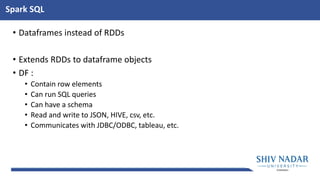
• Dataframes insteadof RDDs
• Extends RDDs to dataframe objects
• DF :
• Contain row elements
• Can run SQL queries
• Can have a schema
• Read and write to JSON, HIVE, csv, etc.
• Communicates with JDBC/ODBC, tableau, etc.
Spark SQL
3.
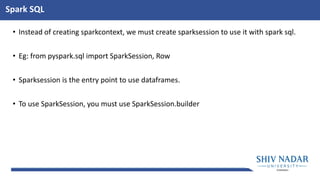
• Instead ofcreating sparkcontext, we must create sparksession to use it with spark sql.
• Eg: from pyspark.sql import SparkSession, Row
• Sparksession is the entry point to use dataframes.
• To use SparkSession, you must use SparkSession.builder
Spark SQL
4.
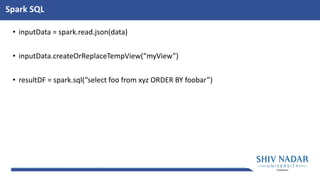
• inputData =spark.read.json(data)
• inputData.createOrReplaceTempView(“myView”)
• resultDF = spark.sql(“select foo from xyz ORDER BY foobar”)
Spark SQL
5.
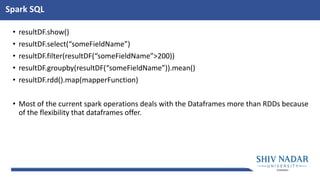
• resultDF.show()
• resultDF.select(“someFieldName”)
•resultDF.filter(resultDF(“someFieldName”>200))
• resultDF.groupby(resultDF(“someFieldName”)).mean()
• resultDF.rdd().map(mapperFunction)
• Most of the current spark operations deals with the Dataframes more than RDDs because
of the flexibility that dataframes offer.
Spark SQL
6.
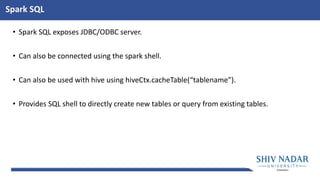
• Spark SQLexposes JDBC/ODBC server.
• Can also be connected using the spark shell.
• Can also be used with hive using hiveCtx.cacheTable(“tablename”).
• Provides SQL shell to directly create new tables or query from existing tables.
Spark SQL
7.
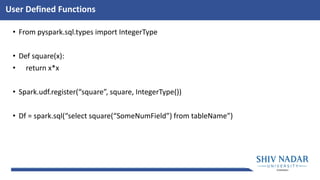
• From pyspark.sql.typesimport IntegerType
• Def square(x):
• return x*x
• Spark.udf.register(“square”, square, IntegerType())
• Df = spark.sql(“select square(“SomeNumField”) from tableName”)
User Defined Functions