Software engineering blendsengineering principles with software
development processes, focusing on delivering high-quality software
that meets user needs. It encompasses methodologies, tools, and best
practices to facilitate effective software creation and management.
Introduction to
Software
Engineering
2.
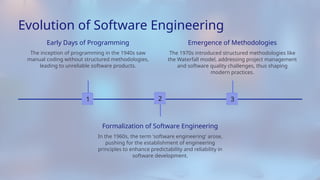
The 1970s introducedstructured methodologies like
the Waterfall model, addressing project management
and software quality challenges, thus shaping
modern practices.
1
Formalization of Software Engineering
3
The inception of programming in the 1940s saw
manual coding without structured methodologies,
leading to unreliable software products.
Emergence of Methodologies
Evolution of Software Engineering
In the 1960s, the term 'software engineering' arose,
pushing for the establishment of engineering
principles to enhance predictability and reliability in
software development.
2
Early Days of Programming
3.
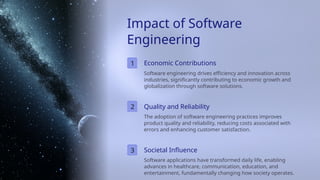
Software engineering drivesefficiency and innovation across
industries, significantly contributing to economic growth and
globalization through software solutions.
1
The adoption of software engineering practices improves
product quality and reliability, reducing costs associated with
errors and enhancing customer satisfaction.
Quality and Reliability
Societal Influence
2
Economic Contributions
Software applications have transformed daily life, enabling
advances in healthcare, communication, education, and
entertainment, fundamentally changing how society operates.
3
Impact of Software
Engineering
4.
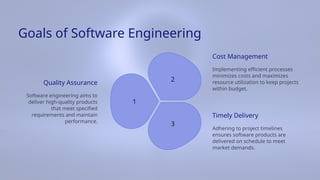
Quality Assurance
Timely Delivery
Softwareengineering aims to
deliver high-quality products
that meet specified
requirements and maintain
performance.
Adhering to project timelines
ensures software products are
delivered on schedule to meet
market demands.
Implementing efficient processes
minimizes costs and maximizes
resource utilization to keep projects
within budget.
Cost Management
Goals of Software Engineering
1
2
3
5.
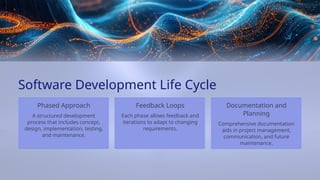
Comprehensive documentation
aids inproject management,
communication, and future
maintenance.
Each phase allows feedback and
iterations to adapt to changing
requirements.
Documentation and
Planning
Software Development Life Cycle
Feedback Loops
Phased Approach
A structured development
process that includes concept,
design, implementation, testing,
and maintenance.
6.
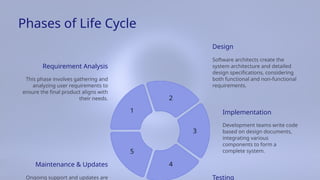
Design
Testing
Maintenance & Updates
Developmentteams write code
based on design documents,
integrating various
components to form a
complete system.
Software architects create the
system architecture and detailed
design specifications, considering
both functional and non-functional
requirements.
Implementation
Phases of Life Cycle
Ongoing support and updates are
This phase involves gathering and
analyzing user requirements to
ensure the final product aligns with
their needs.
Requirement Analysis
5
1
3
4
2
7.
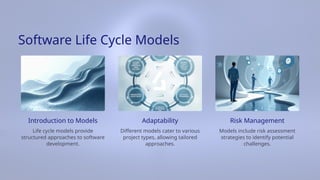
Life cycle modelsprovide
structured approaches to software
development.
Adaptability
Software Life Cycle Models
Different models cater to various
project types, allowing tailored
approaches.
Risk Management
Introduction to Models
Models include risk assessment
strategies to identify potential
challenges.
8.
Limitations
Clear Milestones
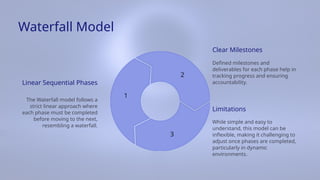
Waterfall Model
LinearSequential Phases
Defined milestones and
deliverables for each phase help in
tracking progress and ensuring
accountability.
While simple and easy to
understand, this model can be
inflexible, making it challenging to
adjust once phases are completed,
particularly in dynamic
environments.
The Waterfall model follows a
strict linear approach where
each phase must be completed
before moving to the next,
resembling a waterfall.
3
2
1
9.
A preliminary versionof the
software is built to understand
user requirements better.
User Engagement
Identifying potential issues early
reduces the risk of delivering an
unsatisfactory product.
Prototype Model
Iterative Development Reduction of Risk
Active user feedback throughout
the prototyping phases helps
clarify requirements.
10.
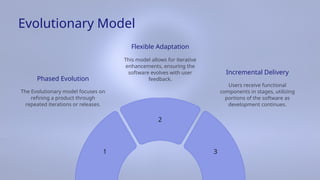
The Evolutionary modelfocuses on
refining a product through
repeated iterations or releases.
Evolutionary Model
This model allows for iterative
enhancements, ensuring the
software evolves with user
feedback.
Phased Evolution
Users receive functional
components in stages, utilizing
portions of the software as
development continues.
Flexible Adaptation
Incremental Delivery
3
2
1
11.
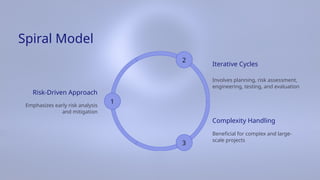
Beneficial for complexand large-
scale projects
Complexity Handling
Spiral Model
Involves planning, risk assessment,
engineering, testing, and evaluation
Emphasizes early risk analysis
and mitigation
Risk-Driven Approach
Iterative Cycles
3
1
2
12.
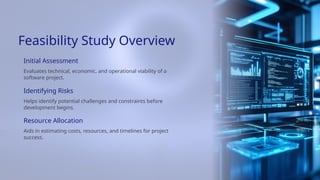
Aids in estimatingcosts, resources, and timelines for project
success.
Identifying Risks
Feasibility Study Overview
Initial Assessment
Resource Allocation
Evaluates technical, economic, and operational viability of a
software project.
Helps identify potential challenges and constraints before
development begins.
13.
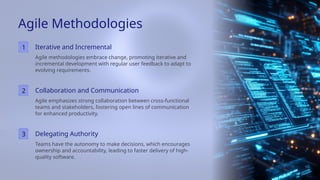
2
Delegating Authority
Agile methodologiesembrace change, promoting iterative and
incremental development with regular user feedback to adapt to
evolving requirements.
Agile emphasizes strong collaboration between cross-functional
teams and stakeholders, fostering open lines of communication
for enhanced productivity.
Collaboration and Communication
Teams have the autonomy to make decisions, which encourages
ownership and accountability, leading to faster delivery of high-
quality software.
Iterative and Incremental
3
Agile Methodologies
1


![SOFTWARE ENGINEERING SEM 4 [Read-Only] [Read-Only] (3).pptx](https://cdn.slidesharecdn.com/ss_thumbnails/softwareengineeringsem4read-onlyread-only3-251216044811-dd17b10d-thumbnail.jpg?width=640&height=640&fit=bounds)


