SOFTWARE ENGINEERING 1.0
SOFTWARE ENGINEERING
• Software Engineering is the science and art of
building significant software systems that are:
1) on time
2) on budget
3) with acceptable performance
4) with correct operation.
SOFTWARE ENGINEERING
The economies of all developed nations are
dependent on software.
More and more systems are software controlled.
Software engineering is concerned with theories, methods and tools
for professional software development.
Software engineering expenditure represents a
significant fraction of the GNP of developed countries.
SOFTWARE COSTS
Software costs often dominate system costs. The costs of software on a
PC are often greater than the hardware cost.
Software costs more to maintain than it does to develop.
Software engineering is concerned with cost-effective software
development.
SOFTWARE PRODUCTS
Generic products:
 Stand-alone systems which are produced by a development organization and sold on
the open market to any customer.
Customized products:
 Systems which are commissioned by a specific customer and developed specially by
some contractor.
SOFTWARE PRODUCT ATTRIBUTES
Maintainability
Dependability
Efficiency
Usability
IMPORTANCE OF PRODUCT CHARACTERISTICS
The relative importance of these characteristics depends on the
product and the environment in which it is to be used.
In some cases, some attributes may dominate
 In safety-critical real-time systems, key attributes may be dependability and
efficiency.
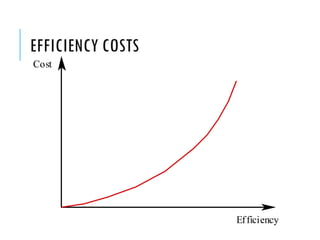
Costs tend to rise exponentially if very high levels of any one
attribute are required.
EFFICIENCY COSTS
Cost
Efficiency
THE SOFTWARE PROCESS
Structured set of activities required to develop a
software system
 Specification
 Design
 Validation
 Evolution
Activities vary depending on the organization
and the type of system being developed.
Must be explicitly modeled if it is to be
managed.
ENGINEERING PROCESS MODEL
Specification: Set out the requirements and
constraints on the system.
Design: Produce a model of the system.
Manufacture: Build the system.
Test: Check the system meets the required
specifications.
Install: Deliver the system to the customer and
ensure it is operational.
Maintain: Repair faults in the system as they
are discovered.
SOFTWARE ENGINEERING IS DIFFERENT
Normally, specifications are incomplete.
Very blurred distinction between specification,
design and manufacture.
No physical realization of the system for testing.
Software does not wear out - maintenance
does not mean component replacement.
GENERIC SOFTWARE PROCESS MODELS
Waterfall
 Separate and distinct phases of specification and development
Evolutionary
 Specification and development are interleaved
Formal Transformation
 A mathematical system model is formally transformed to an implementation
Reuse-based
 The system is assembled from existing components
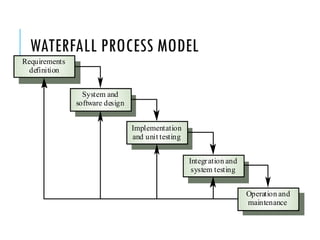
WATERFALL PROCESS MODEL
Requirements
definition
System and
software design
Implementation
and unit testing
Integration and
system testing
Operation and
maintenance
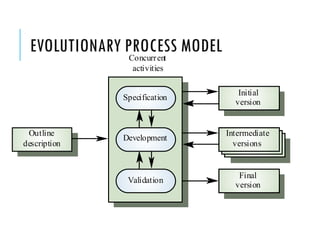
EVOLUTIONARY PROCESS MODEL
Validation
Final
version
Development
Intermediate
versions
Specification
Initial
version
Outline
description
Concurrent
activities
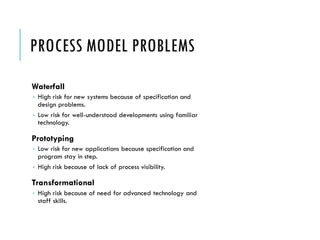
PROCESS MODEL PROBLEMS
Waterfall
 High risk for new systems because of specification and
design problems.
 Low risk for well-understood developments using familiar
technology.
Prototyping
 Low risk for new applications because specification and
program stay in step.
 High risk because of lack of process visibility.
Transformational
 High risk because of need for advanced technology and
staff skills.
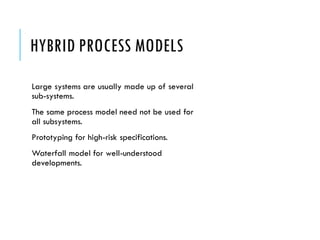
HYBRID PROCESS MODELS
Large systems are usually made up of several
sub-systems.
The same process model need not be used for
all subsystems.
Prototyping for high-risk specifications.
Waterfall model for well-understood
developments.
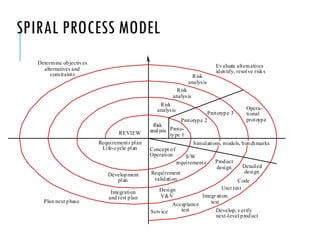
SPIRAL PROCESS MODEL
Risk
analysis
Risk
analysis
Risk
analysis
Risk
analysis Proto-
type 1
Prototype 2
Prototype 3
Opera-
tional
protoype
Concept of
Operation
Simulations, models, benchmarks
S/W
requirements
Requirement
validation
Design
V&V
Product
design Detailed
design
Code
Unit test
Integr ation
test
Acceptance
test
Service Develop, verify
next-level product
Evaluate alternatives
identify, resolve risks
Determine objectives
alternatives and
constraints
Plan next phase
Integration
and test plan
Development
plan
Requirements plan
Life-cycle plan
REVIEW
SPIRAL MODEL ADVANTAGES
Focuses attention on reuse options.
Focuses attention on early error elimination.
Puts quality objectives up front.
Integrates development and maintenance.
Provides a framework for hardware/software
development.
SPIRAL MODEL PROBLEMS
Contractual development often specifies
process model and deliverables in advance.
Requires risk assessment expertise.
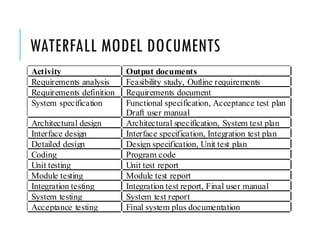
PROCESS VISIBILITY
Software systems are intangible so managers need documents to
assess progress.
Waterfall model is still the most widely used model.
WATERFALL MODEL DOCUMENTS
Activity Output documents
Requirements analysis Feasibility study, Outline requirements
Requirements definition Requirements document
System specification Functional specification, Acceptance test plan
Draft user manual
Architectural design Architectural specification, System test plan
Interface design Interface specification, Integration test plan
Detailed design Design specification, Unit test plan
Coding Program code
Unit testing Unit test report
Module testing Module test report
Integration testing Integration test report, Final user manual
System testing System test report
Acceptance testing Final system plus documentation
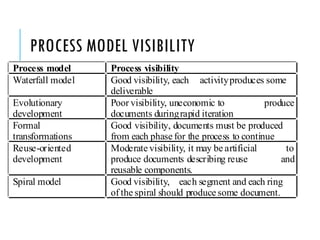
PROCESS MODEL VISIBILITY
Process model Process visibility
Waterfall model Good visibility, each activityproduces some
deliverable
Evolutionary
development
Poor visibility, uneconomic to produce
documents duringrapid iteration
Formal
transformations
Good visibility, documents must be produced
from each phase for the process to continue
Reuse-oriented
development
Moderate visibility, it may be artificial to
produce documents describing reuse and
reusable components.
Spiral model Good visibility, each segment and each ring
of the spiral should produce some document.
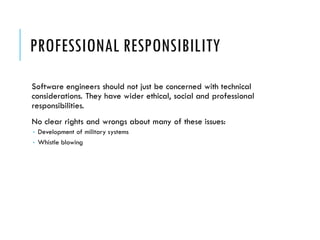
PROFESSIONAL RESPONSIBILITY
Software engineers should not just be concerned with technical
considerations. They have wider ethical, social and professional
responsibilities.
No clear rights and wrongs about many of these issues:
 Development of military systems
 Whistle blowing
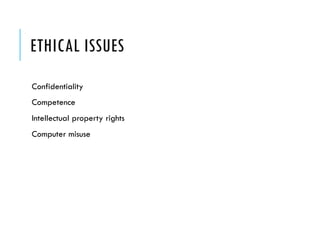
ETHICAL ISSUES
Confidentiality
Competence
Intellectual property rights
Computer misuse

Introduction to Software Engineering - What is Software Engineering?

  • 1.
  • 2.
    SOFTWARE ENGINEERING • SoftwareEngineering is the science and art of building significant software systems that are: 1) on time 2) on budget 3) with acceptable performance 4) with correct operation.
  • 3.
    SOFTWARE ENGINEERING The economiesof all developed nations are dependent on software. More and more systems are software controlled. Software engineering is concerned with theories, methods and tools for professional software development. Software engineering expenditure represents a significant fraction of the GNP of developed countries.
  • 4.
    SOFTWARE COSTS Software costsoften dominate system costs. The costs of software on a PC are often greater than the hardware cost. Software costs more to maintain than it does to develop. Software engineering is concerned with cost-effective software development.
  • 5.
    SOFTWARE PRODUCTS Generic products: Stand-alone systems which are produced by a development organization and sold on the open market to any customer. Customized products:  Systems which are commissioned by a specific customer and developed specially by some contractor.
  • 6.
  • 7.
    IMPORTANCE OF PRODUCTCHARACTERISTICS The relative importance of these characteristics depends on the product and the environment in which it is to be used. In some cases, some attributes may dominate  In safety-critical real-time systems, key attributes may be dependability and efficiency. Costs tend to rise exponentially if very high levels of any one attribute are required.
  • 8.
  • 9.
    THE SOFTWARE PROCESS Structuredset of activities required to develop a software system  Specification  Design  Validation  Evolution Activities vary depending on the organization and the type of system being developed. Must be explicitly modeled if it is to be managed.
  • 10.
    ENGINEERING PROCESS MODEL Specification:Set out the requirements and constraints on the system. Design: Produce a model of the system. Manufacture: Build the system. Test: Check the system meets the required specifications. Install: Deliver the system to the customer and ensure it is operational. Maintain: Repair faults in the system as they are discovered.
  • 11.
    SOFTWARE ENGINEERING ISDIFFERENT Normally, specifications are incomplete. Very blurred distinction between specification, design and manufacture. No physical realization of the system for testing. Software does not wear out - maintenance does not mean component replacement.
  • 12.
    GENERIC SOFTWARE PROCESSMODELS Waterfall  Separate and distinct phases of specification and development Evolutionary  Specification and development are interleaved Formal Transformation  A mathematical system model is formally transformed to an implementation Reuse-based  The system is assembled from existing components
  • 13.
    WATERFALL PROCESS MODEL Requirements definition Systemand software design Implementation and unit testing Integration and system testing Operation and maintenance
  • 14.
  • 15.
    PROCESS MODEL PROBLEMS Waterfall High risk for new systems because of specification and design problems.  Low risk for well-understood developments using familiar technology. Prototyping  Low risk for new applications because specification and program stay in step.  High risk because of lack of process visibility. Transformational  High risk because of need for advanced technology and staff skills.
  • 16.
    HYBRID PROCESS MODELS Largesystems are usually made up of several sub-systems. The same process model need not be used for all subsystems. Prototyping for high-risk specifications. Waterfall model for well-understood developments.
  • 17.
    SPIRAL PROCESS MODEL Risk analysis Risk analysis Risk analysis Risk analysisProto- type 1 Prototype 2 Prototype 3 Opera- tional protoype Concept of Operation Simulations, models, benchmarks S/W requirements Requirement validation Design V&V Product design Detailed design Code Unit test Integr ation test Acceptance test Service Develop, verify next-level product Evaluate alternatives identify, resolve risks Determine objectives alternatives and constraints Plan next phase Integration and test plan Development plan Requirements plan Life-cycle plan REVIEW
  • 18.
    SPIRAL MODEL ADVANTAGES Focusesattention on reuse options. Focuses attention on early error elimination. Puts quality objectives up front. Integrates development and maintenance. Provides a framework for hardware/software development.
  • 19.
    SPIRAL MODEL PROBLEMS Contractualdevelopment often specifies process model and deliverables in advance. Requires risk assessment expertise.
  • 20.
    PROCESS VISIBILITY Software systemsare intangible so managers need documents to assess progress. Waterfall model is still the most widely used model.
  • 21.
    WATERFALL MODEL DOCUMENTS ActivityOutput documents Requirements analysis Feasibility study, Outline requirements Requirements definition Requirements document System specification Functional specification, Acceptance test plan Draft user manual Architectural design Architectural specification, System test plan Interface design Interface specification, Integration test plan Detailed design Design specification, Unit test plan Coding Program code Unit testing Unit test report Module testing Module test report Integration testing Integration test report, Final user manual System testing System test report Acceptance testing Final system plus documentation
  • 22.
    PROCESS MODEL VISIBILITY Processmodel Process visibility Waterfall model Good visibility, each activityproduces some deliverable Evolutionary development Poor visibility, uneconomic to produce documents duringrapid iteration Formal transformations Good visibility, documents must be produced from each phase for the process to continue Reuse-oriented development Moderate visibility, it may be artificial to produce documents describing reuse and reusable components. Spiral model Good visibility, each segment and each ring of the spiral should produce some document.
  • 23.
    PROFESSIONAL RESPONSIBILITY Software engineersshould not just be concerned with technical considerations. They have wider ethical, social and professional responsibilities. No clear rights and wrongs about many of these issues:  Development of military systems  Whistle blowing
  • 24.