Software
Engineering
Overview
This presentation coversfundamentals of software engineering, tracing
its evolution and impact throughout the software development process.
It delves into life cycles, models, and methodologies such as Agile and
the Waterfall model, providing insights into how software is developed
efficiently in modern environments.
2.
Introduction to Software
Engineering
Providesstructured solutions to complex projects, reducing risks.
Significance
Evolution
A disciplined approach to software development using engineering
principles.
Driven by technology and agile methodologies, improving flexibility.
Definition
3.
1
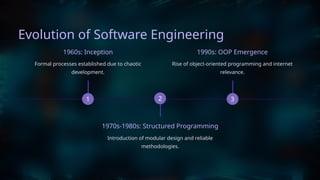
Evolution of SoftwareEngineering
1960s: Inception
Introduction of modular design and reliable
methodologies.
Rise of object-oriented programming and internet
relevance.
3
1970s-1980s: Structured Programming
1990s: OOP Emergence
2
Formal processes established due to chaotic
development.
4.
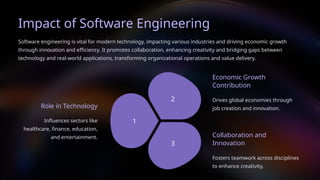
Economic Growth
Contribution
Impact ofSoftware Engineering
Influences sectors like
healthcare, finance, education,
and entertainment. Collaboration and
Innovation
Drives global economies through
job creation and innovation.
Software engineering is vital for modern technology, impacting various industries and driving economic growth
through innovation and efficiency. It promotes collaboration, enhancing creativity and bridging gaps between
technology and real-world applications, transforming organizational operations and value delivery.
Fosters teamwork across disciplines
to enhance creativity.
Role in Technology
1
2
3
5.
Producing
reliable,
maintainable, and
efficient software
throughrigorous
testing.
Facilitating
Communicati
on
Goals of Software
Engineering
Enhancing
productivity and
reducing risks by
adopting
methodologies
like Agile.
Encouraging
collaboration
among
stakeholders
through
documentation
and feedback.
High-Quality
Software
Effective
Process
Management