1
Advanced Functional Sandwich
Composites for Structural
Applications
Prof. Padmanabhan Krishnan
School of Mechanical Engineering,
VIT University-Vellore.
SLIET Lecture, 8th
August, 2024
Introduction
 Sandwich composites are familiar for their inherent tailor
ability, which enables them to meet specific design
objectives for a given application.
 Low density of these materials makes them especially
suitable for use in aeronautical, space and marine
applications.
 Engineers and researchers have several factors to consider
in their design. Here the structural factors are considered
for applications.
2
Definition- Sandwich composites
 Sandwich composites comprise of two thin but stiff face
sheets attached to lightweight materials known as the
Core.
 The function of the core is to reduce density and increase
shear strength and flexural rigidity where as the skins
must have good bonding to the core and possess excellent
axial stiffness and strength.
 Honey comb panels, rigid and flexible foam core panels,
Shape memory panels, filled and syntactic foam core
panels, all constitute sandwich composites.
3
Applications
4
Sandwich composites are multifunctional.
Some of their applications are:
• Automotive applications.
• Aerospace applications.
• Marine applications.
• Sports goods.
• Bio medical applications.
• Thermal insulations for buildings.
• Vibration dampers and isolators.
• Acoustic insulations.( sound proof rooms ).and acoustic fatigue.
• Wind mill blades and flywheels.
Applications of Polymer
Sandwich Composites
5
John Montagu
In 1762, John Montagu, the 4th
Earl of Sandwich, England,
invented the meal that changed
dining forever. As the story
goes, he was playing cards and
did not want to leave the gaming
table to eat. He asked for a
serving of roasted beef to be
placed between two slices of
bread so he could eat with his
one hand and play with the
other. This Sandwich design
was later named after him.
Sandwich Composites
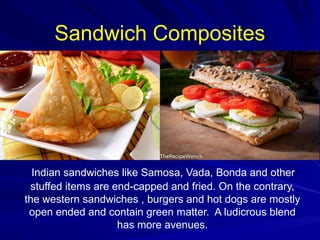
Indian sandwiches like Samosa, Vada, Bonda and other
stuffed items are end-capped and fried. On the contrary,
the western sandwiches , burgers and hot dogs are mostly
open ended and contain green matter. A ludicrous blend
has more avenues.
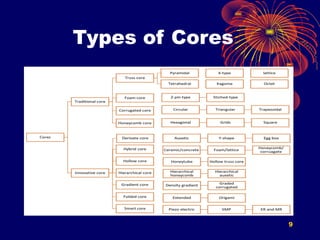
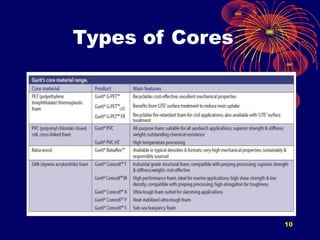
The core
Foams and Honeycomb
Types of Cores
9
Types of Cores
10
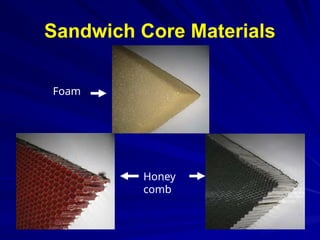
Sandwich Core Materials
Foam
Honey
comb
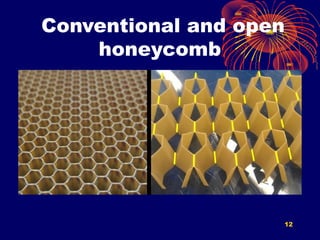
Conventional and open
honeycomb
12
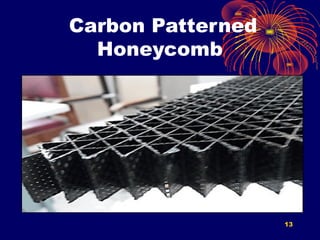
Carbon Patterned
Honeycomb
13
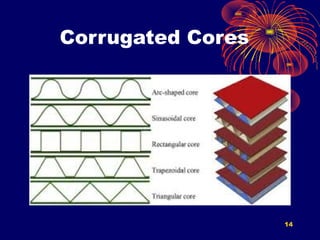
Corrugated Cores
14
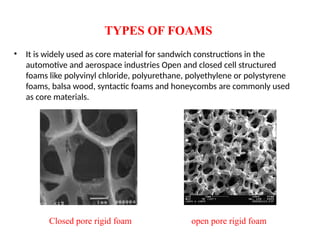
TYPES OF FOAMS
• It is widely used as core material for sandwich constructions in the
automotive and aerospace industries Open and closed cell structured
foams like polyvinyl chloride, polyurethane, polyethylene or polystyrene
foams, balsa wood, syntactic foams and honeycombs are commonly used
as core materials.
Closed pore rigid foam open pore rigid foam
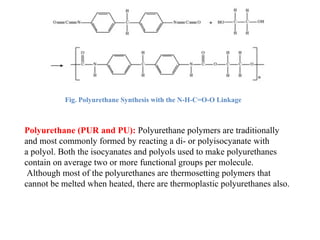
Fig. Polyurethane Synthesis with the N-H-C=O-O Linkage
Polyurethane (PUR and PU): Polyurethane polymers are traditionally
and most commonly formed by reacting a di- or polyisocyanate with
a polyol. Both the isocyanates and polyols used to make polyurethanes
contain on average two or more functional groups per molecule.
Although most of the polyurethanes are thermosetting polymers that
cannot be melted when heated, there are thermoplastic polyurethanes also.
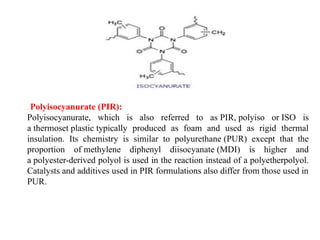
. Polyisocyanurate (PIR):
Polyisocyanurate, which is also referred to as PIR, polyiso or ISO is
a thermoset plastic typically produced as foam and used as rigid thermal
insulation. Its chemistry is similar to polyurethane (PUR) except that the
proportion of methylene diphenyl diisocyanate (MDI) is higher and
a polyester-derived polyol is used in the reaction instead of a polyetherpolyol.
Catalysts and additives used in PIR formulations also differ from those used in
PUR.
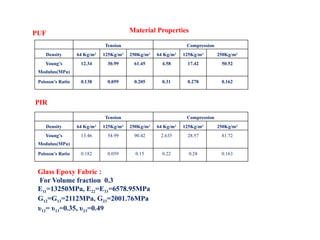
Material Properties
Tension Compression
Density 64 Kg/m3
125Kg/m3
250Kg/m3
64 Kg/m3
125Kg/m3
250Kg/m3
Young’s
Modulus(MPa)
12.34 30.99 61.45 4.58 17.42 50.52
Poisson’s Ratio 0.138 0.059 0.205 0.31 0.278 0.162
PUF
PIR
Tension Compression
Density 64 Kg/m3
125Kg/m3
250Kg/m3
64 Kg/m3
125Kg/m3
250Kg/m3
Young’s
Modulus(MPa)
13.46 54.99 90.42 2.635 28.57 81.72
Poisson’s Ratio 0.182 0.059 0.15 0.22 0.28 0.163
Glass Epoxy Fabric :
For Volume fraction 0.3
E11=13250MPa, E22=E33=6578.95MPa
G12=G13=2112MPa, G23=2001.76MPa
υ12= υ13=0.35, υ23=0.49
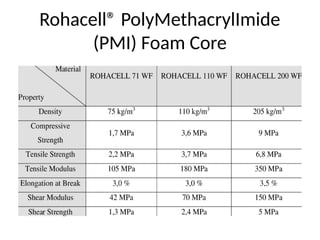
Rohacell® PolyMethacrylImide
(PMI) Foam Core
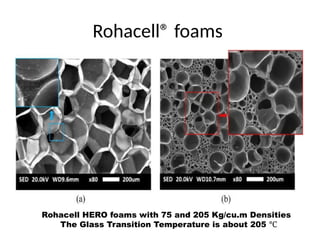
Rohacell® foams
Rohacell HERO foams with 75 and 205 Kg/cu.m Densities
The Glass Transition Temperature is about 205 ℃
Thermoplastic Core materials
Core materials made of other thermoplastics are light in weight, offering
some useful properties and possibly also making for easier recycling.
• ABS - for rigidity, impact strength, toughness, surface hardness and
dimensional stability
• Polycarbonate - for UV-stability, excellent light transmission, good heat
resistance & self-extinguishing properties
• Polypropylene - for good chemical resistance
• Polyethylene - a general-purpose low-cost core material
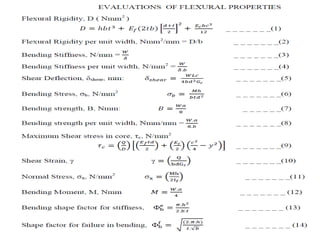
• Flexural rigidity = E B X I { Bending modulus X second moment of
area)
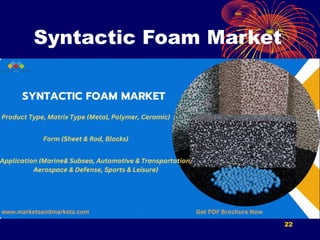
Syntactic Foam Market
22
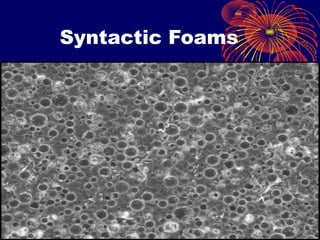
Syntactic Foams
23
24
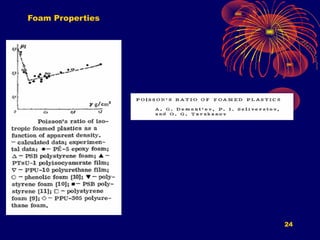
Foam Properties
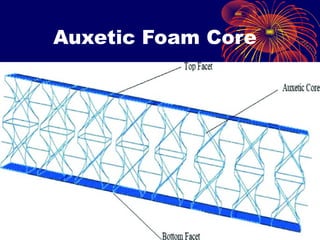
Auxetic Foam Core
25
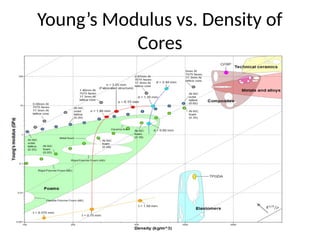
Ashby Maps for Materials
Selection
Young’s Modulus vs. Density of
Cores
Strength vs Cost Chart
28
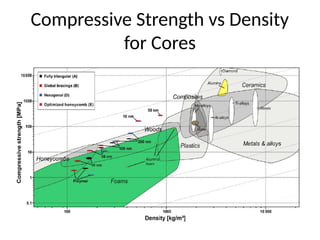
Compressive Strength vs Density
for Cores
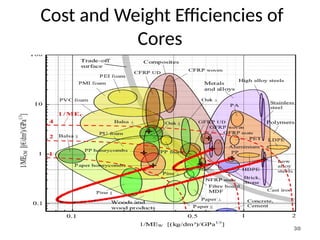
Cost and Weight Efficiencies of
Cores
30
Sandwich Composites and Panels
A typical Sandwich
Composite
32
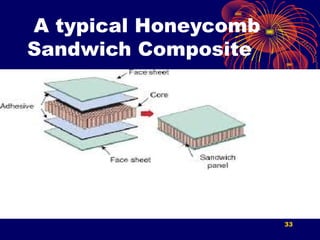
A typical Honeycomb
Sandwich Composite
33
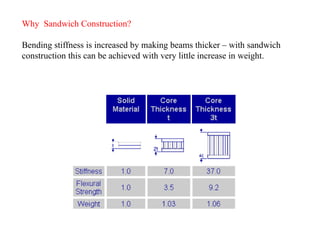
Why Sandwich Construction?
Bending stiffness is increased by making beams thicker – with sandwich
construction this can be achieved with very little increase in weight.
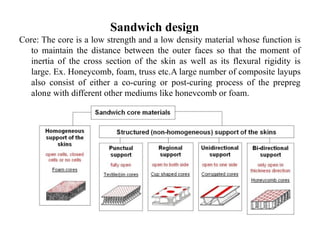
Sandwich design
Core: The core is a low strength and a low density material whose function is
to maintain the distance between the outer faces so that the moment of
inertia of the cross section of the skin as well as its flexural rigidity is
large. Ex. Honeycomb, foam, truss etc.A large number of composite layups
also consist of either a co-curing or post-curing process of the prepreg
along with different other mediums like honeycomb or foam.
Design optimization of rigid foam core
sandwich composites for strength & stiffness
ARDB Structures Panel
Project Number 1650
37
Aim and Objectives
• Optimization of design was done for the
polymer foam FRP face sheet sandwich
beams using beam equations so as to
obtain maximum strength and/or stiffness
in bending.
• Parameters like deflection, flexural rigidity,
bending and shear stress, normal stress,
shear strain, bending strength and bending
stiffness to be determined for the
sandwich composites and due
comparisons made with the results
evaluated for samples without design
optimization.
• It was proposed to design optimize for
minimum weight while maintaining the
desired properties .
38
Parameters for DO of Foam Sandwich
Composites
• Foam material, Rigid, Unfilled, Thermoset, Closed
pores, processing
• Weight ratios of skin and core
• Span to depth ratio, static tests
• Foam cell size, wall thickness, density, other
properties
• Shape Factors for Sandwich Composites.
• Sandwich composite thickness and shear flow
• Skin-core interfacial properties
• Feedback from failure features and modes,
priority, ranking, damage and mechanisms
• Modelling using FEM, Algorithms, DOE.
39
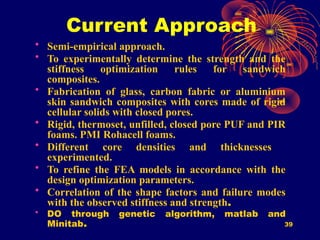
Current Approach
• Semi-empirical approach.
• To experimentally determine the strength and the
stiffness optimization rules for sandwich
composites.
• Fabrication of glass, carbon fabric or aluminium
skin sandwich composites with cores made of rigid
cellular solids with closed pores.
• Rigid, thermoset, unfilled, closed pore PUF and PIR
foams. PMI Rohacell foams.
• Different core densities and thicknesses
experimented.
• To refine the FEA models in accordance with the
design optimization parameters.
• Correlation of the shape factors and failure modes
with the observed stiffness and strength.
• DO through genetic algorithm, matlab and
Minitab.
40
Experimental Approach
• Hand Wet Lay Up followed by
Vacuum Bagging fabrication of
sandwich composites.
• Hot Vacuum Bagging, Dual and Triple
Hot Bagging Techniques.
• Conventional machining of test
specimens
• Tensile, Compressive, Shear , and
Flexural Testing in Instron 8801 and
Structural UTM.
• Failure analyses and feedback
Existing Theories for Design Optimization
• L.J. Gibson et al developed an analytical method for finding the values of
core thickness, face thickness and core density which minimize the weight
of a foam core (polyurethane) sandwich beam of given stiffness and span
length.
Maximum stiffness occurs when skin weight is one fourth of core weight
( Metal skin rigid polymeric foam core
• G.R. Froud, on his article on the mechanical properties in bending
applications of sandwich constructions, has suggested
The maximum flexural rigidity occurs when,
Core weight = 2/3*total weight
If it is assumed that the failure of a sandwich structure occurs due to tensile
failure in the skin, the core must not fail in shear before tensile failure in
the skins is attained.
The maximum bending strength is obtained when
Core weight = total weight of skins .
42
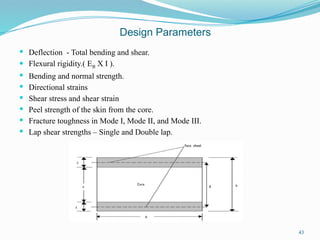
Design Parameters
Design Parameters
 Deflection - Total bending and shear.
 Flexural rigidity.( EB X I ).
 Bending and normal strength.
 Directional strains
 Shear stress and shear strain
 Peel strength of the skin from the core.
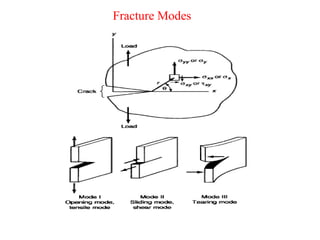
 Fracture toughness in Mode I, Mode II, and Mode III.
 Lap shear strengths – Single and Double lap.
43
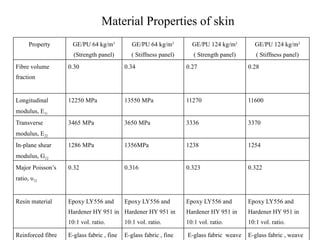
Material Properties of skin
Property GE/PU 64 kg/m3
(Strength panel)
GE/PU 64 kg/m3
( Stiffness panel)
GE/PU 124 kg/m3
( Strength panel)
GE/PU 124 kg/m3
( Stiffness panel)
Fibre volume
fraction
0.30 0.34 0.27 0.28
Longitudinal
modulus, E11
12250 MPa 13550 MPa 11270 11600
Transverse
modulus, E22
3465 MPa 3650 MPa 3336 3370
In-plane shear
modulus, G12
1286 MPa 1356MPa 1238 1254
Major Poisson’s
ratio, υ12
0.32 0.316 0.323 0.322
Resin material Epoxy LY556 and
Hardener HY 951 in
10:1 vol. ratio.
Epoxy LY556 and
Hardener HY 951 in
10:1 vol. ratio.
Epoxy LY556 and
Hardener HY 951 in
10:1 vol. ratio.
Epoxy LY556 and
Hardener HY 951 in
10:1 vol. ratio.
Reinforced fibre E-glass fabric , fine E-glass fabric , fine E-glass fabric weave E-glass fabric , weave
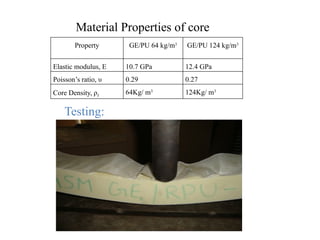
Material Properties of core
Property GE/PU 64 kg/m3
GE/PU 124 kg/m3
Elastic modulus, E 10.7 GPa 12.4 GPa
Poisson’s ratio, υ 0.29 0.27
Core Density, ρf
64Kg/ m3
124Kg/ m3
Testing:
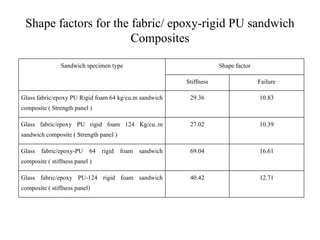
Shape factors for the fabric/ epoxy-rigid PU sandwich
Composites
Sandwich specimen type Shape factor
Stiffness Failure
Glass fabric/epoxy PU Rigid foam 64 kg/cu.m sandwich
composite ( Strength panel )
29.36 10.83
Glass fabric/epoxy PU rigid foam 124 Kg/cu..m
sandwich composite ( Strength panel )
27.02 10.39
Glass fabric/epoxy-PU 64 rigid foam sandwich
composite ( stiffness panel )
69.04 16.61
Glass fabric/epoxy PU-124 rigid foam sandwich
composite ( stiffness panel)
40.42 12.71
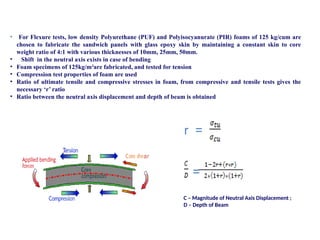
• For Flexure tests, low density Polyurethane (PUF) and Polyisocyanurate (PIR) foams of 125 kg/cum are
chosen to fabricate the sandwich panels with glass epoxy skin by maintaining a constant skin to core
weight ratio of 4:1 with various thicknesses of 10mm, 25mm, 50mm.
• Shift in the neutral axis exists in case of bending
• Foam specimens of 125kg/m3
are fabricated, and tested for tension
• Compression test properties of foam are used
• Ratio of ultimate tensile and compressive stresses in foam, from compressive and tensile tests gives the
necessary ‘r’ ratio
• Ratio between the neutral axis displacement and depth of beam is obtained
r =
=
C – Magnitude of Neutral Axis Displacement ;
D – Depth of Beam
Fracture Modes
Testing of Sandwich Panels
• Tensile Test on Foam to evaluate Tensile Properties of Foam
• Compression Test on Foam to evaluate Compression properties on
foam
• Single Lap Shear test to evaluate Shear strength of Foams in Adhesive
joints.
• Double Lap shear test to evaluate Shear strength of Foams in
Adhesive joints.
• Three Point Bending test to evaluate Flexural Properties of Sandwich
Panel.
• Fatigue and Creep Testing
• Impact and Vibrations Testing
• Hygrothermal Conditioning and Testing
ASTM – Standards.
 ASTM D 790M-93 , Standard Test Methods for Flexural Properties of
Unreinforced and Reinforced Plastics and Electrical Insulating Materials
[Metric]
 ASTM C273/C273M-11, Shear Properties of Sandwich Core Materials ,
ASTM International, PA, USA.
 ASTM C393 / C393 M-06, Standard test method for core shear properties
of sandwich constructions by beam flexure.
 ASTM D 7249 / D7249 M-06, Standard test method for facing properties
of sandwich constructions by long beam flexure.
 ASTM D7250 / D7250 M-06, Standard practice for determining sandwich
beam flexural and shear stiffness.
51
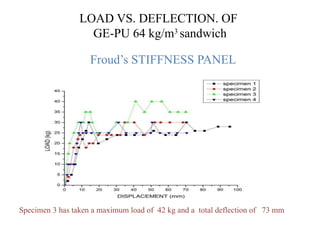
LOAD VS. DEFLECTION. OF
GE-PU 64 kg/m3
sandwich
Specimen 3 has taken a maximum load of 42 kg and a total deflection of 73 mm
Froud’s STIFFNESS PANEL
FEM Simulation of Sandwich Tests
FEM of sandwich composites in flexure
The project aim is to compare the stress distribution on the sandwich
panels while testing in flexure.
• Perform Finite element modeling and analysis for ASTM standard test
specimen under experimental conditions.
• Comparing the results obtained by the analysis and experiments.
• By using the available statistical, analytical methods and FEA failure
criteria design optimization was done for optimum strength, stiffness.
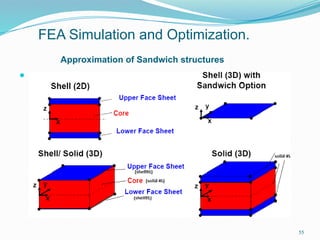
FEA Simulation and Optimization.
Approximation of Sandwich structures
 a
55
56
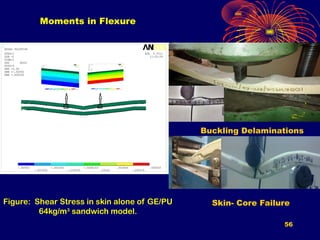
Moments in Flexure
Figure: Shear Stress in skin alone of GE/PU
64kg/m3
sandwich model.
Buckling Delaminations
Skin- Core Failure
57
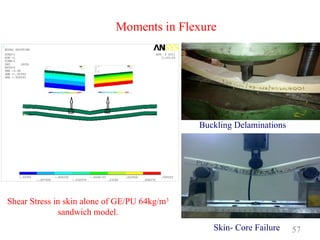
Moments in Flexure
Shear Stress in skin alone of GE/PU 64kg/m3
sandwich model.
Buckling Delaminations
Skin- Core Failure
Experimental Results and
Discussion
Studies On Shear Flow Of Foam Core -Glass /
Epoxy Skin Sandwich Composites In Flexure
The current study focuses on understanding the shear flow patterns in
failure by comparing the flexural, compressive and tensile properties.
Foams of low density are chosen to fabricate the sandwich panels with
glass epoxy skin by maintaining a constant skin to core weight ratio of
4:1with various thickness 10mm, 25mm, 50mm for PUF and PIR foams
of 125kg/cum density. Foam tensile test specimens are fabricated, and
tested, compression test properties are used, and, the shift in neutral axes
understood by a new novel design approach for the flexural specimens .
Analytical calculations can be done to find ‘r’ ratio and shift in neutral
axes.
SHEAR FLOW: If the shearing stress fv is multiplied by thickness t, we
obtain a quantity q known as the shear flow, which represents the
longitudinal force per unit length transmitted across a section at a level y1
from the neutral axis.
Q = fv*t
The shear flow values is calculated based on max shear stress in core
multiplied by thickness.
The influence of foam density and span to depth
ratio in the flexure of glass fabric/epoxy skin
polyurethane foam sandwich composites
The sandwich panels were tested at different span to depth ratios. The flexural properties

like the bending strength, flexural rigidity, shear stress, shear deflection and shear strain
were evaluated and a detailed analysis made on the influence of foam densities and
different span to depth ratios on the fracture behaviour of these sandwich composites in
flexure.
Sandwich manufacturing parametres:
 Vacuum bagging technique.
 Glass fabric: 280 & 100 GSM, plain weave
 Epoxy: GY257
 Hardener: ARADUR 140
 Rigid PUF densities 125 kg/m3
and 250 kg/m3
 Span to depth ratios 15.4 : 1, 12: 1, & 6:1
61
Influence of Post Curing on the Flexural Properties of a Rigid
Polyurethane or Polyisocynurate Foam - Glass/Epoxy Face
It was observed that there is an appreciable increase in flexural
rigidity and a general decrease in the other flexural properties with
post curing. The reasons are due to an increased degree of cross-
linking of the epoxy resin, dimensional and mechanical property
changes in the foam due to post curing.
62
• As the weight ratio increased stress developed had reduced as we can see from
plots this is because the dimensions of specimens vary as the weight ratio
increases and the stresses developed mostly depends on thickness, width and
length of specimen which in turn depends on weight ratio
• In PIR -125 the max load taken by the specimen is 9025 N and in PIR 64 the max
load taken by specimen is 6850N at a weight ratio of 5:1
• In PUF-125 the max load taken by the specimen is 7425N and in PUF 64 the max
load taken by the specimen is 3116N at a weight ratio of 5:1
• This concludes that the shift in neutral axis from the centroidal axis is 0.048
percent of foam thickness and r ratio is 1.0645 which can be understood in case of
PIR 125
• The shift in neutral axis from the centriodal axis is 2.59 percent of foam thickness
and r ratio is 1.59 in PUF 125 samples
• In PUF 64 samples the shift is6.6 percent of foam thickness & r ratio is 2.15 and in
PIR 64 samples the shift is 6.6 percent of foam thickness & r ratio is 1.69
• From shear flow Vs shift in neutral axis plot we observed that by varying
thickness10mm, 25mm, 50mm. as shear flow increases the shift in neutral axis also
increases with different thickness in both PUF 64,125 & PIR 64,125 is observed. If
the thickness of sample is high shear flow is high
• It is observed that while testing sandwich specimens’ failure occurs mainly through
face sheet shear and compressive core crushing in 64&125 kg/m3
density foam
sandwich panels.
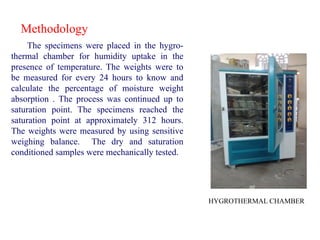
Methodology
The specimens were placed in the hygro-
thermal chamber for humidity uptake in the
presence of temperature. The weights were to
be measured for every 24 hours to know and
calculate the percentage of moisture weight
absorption . The process was continued up to
saturation point. The specimens reached the
saturation point at approximately 312 hours.
The weights were measured by using sensitive
weighing balance. The dry and saturation
conditioned samples were mechanically tested.
HYGROTHERMAL CHAMBER
Fractography and Failure analysis
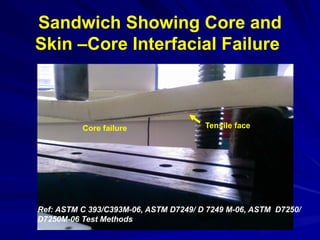
Sandwich Showing Core and
Skin –Core Interfacial Failure
Tensile face
Core failure
Ref: ASTM C 393/C393M-06, ASTM D7249/ D 7249 M-06, ASTM D7250/
D7250M-06 Test Methods
66
Functional Outcomes
• Optimized fabrication process selection for sandwich
structures at different temperatures and pressure levels
achieved through vacuum bagging, hot vacuum bagging
• Optimized material selection based on foam core, glass fabric/
epoxy and carbon-epoxy achieved for sandwich applications at
optimal strength and stiffness criteria
• Optimized weight ratios for different structural applications
based on maximum strength, stiffness and energy absorption
by foam core sandwich structures are achieved
End Use Applications
67
High performance structural foams are used for infusion
components in aerospace applications and in sports equipment
and automotive structures. The foam sandwich composites
fabricated in the above investigation can be used in
1. Empennage elevator and rudder of aircrafts.
2. Light and very light AIRCRAFT wing profiles.
3. Light aircraft primary structures in Cirrus (USA) like aircrafts.
4. Missile primary structures and bay wings.
5. Secondary structures of larger civil aircrafts like Interiors ,
hulls and decks.
6. Fighter aircraft radomes.
Alumina Paint Coated Flame
Retardant Balsa Wood Core
Sandwich Composites
68
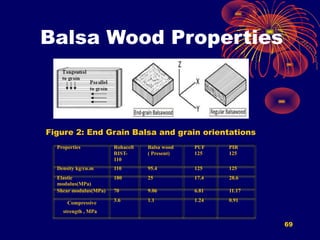
Balsa Wood Properties
69
Figure 2: End Grain Balsa and grain orientations
Properties Rohacell
RIST-
110
Balsa wood
( Present)
PUF
125
PIR
125
Density kg/cu.m 110 95.4 125 125
Elastic
modulus(MPa)
180 25 17.4 28.6
Shear modulus(MPa) 70 9.06 6.81 11.17
Compressive
strength , MPa
3.6 1.1 1.24 0.91
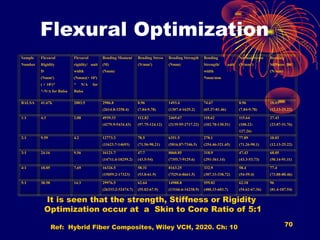
Flexural Optimization
70
Sample
Number
Flexural
Rigidity
D
(Nmm2
)
( × 106
)*
*-N/A for Balsa
Flexural
rigidity/ unit
width
(Nmm)(× 105
)
* N/A for
Balsa
Bending Moment
(M)
(Nmm)
Bending Stress
(N/mm2
)
Bending Strength
(Nmm)
Bending
Strength/ unit
width
Nmm/mm
Normal Stress
(N/mm2
)
Bending
Stiffness
(N/mm)
BALSA 41.67k 2083.5 2986.8
(2614.8-3258.4)
8.96
(7.84-9.78)
1493.4
(1307.4-1629.2)
74.67
(65.37-81.46)
8.96
(7.84-9.78)
18.03
(12.13-25.22)
1:1 4.3 2.08 4939.33
(4279.9-5434.43)
112.82
(97.75-124.12)
2469.67
(2139.95-2717.22)
118.62
(102.78-130.51)
115.64
(100.22-
127.26)
27.43
(23.87-31.76)
2:1 9.59 4.2 12773.3
(11623.7-14693)
78.5
(71.56-90.21)
6351.5
(5816.87-7346.5)
278.1
(254.46-321.65)
77.89
(71.26-90.1)
18.03
(12.13-25.22)
3:1 24.16 9.56 16121.7
(14711.4-18259.2)
47.7
(43.5-54)
8060.85
(7355.7-9129.6)
318.9
(291-361.14)
47.43
(43.3-53.73)
68.05
(50.14-91.11)
4:1 18.85 7.69 16326.5
(15059.2-17323)
58.31
(53.8-61.9)
8163.25
(7529.6-8661.5)
332.9
(307.33-338.72)
58.4
(54-59.4)
77.4
(73.88-80.46)
5:1 38.58 14.3 29976.5
(26333.2-32474.7)
62.64
(55.02-67.9)
14988.8
(13166.6-16238.9)
559.82
(488.33-603.7)
62.18
(54.62-67.36)
96
(81.4-107.54)
It is seen that the strength, Stiffness or Rigidity
Optimization occur at a Skin to Core Ratio of 5:1
Ref: Hybrid Fiber Composites, Wiley VCH, 2020. Ch: 10
Applications
71
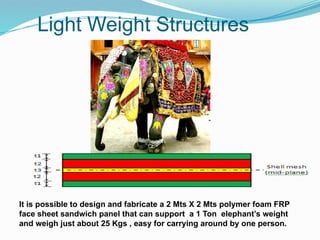
Light Weight Structures
It is possible to design and fabricate a 2 Mts X 2 Mts polymer foam FRP
face sheet sandwich panel that can support a 1 Ton elephant’s weight
and weigh just about 25 Kgs , easy for carrying around by one person.
Wind Turbine Blades
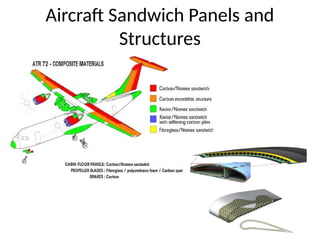
Aircraft Sandwich Panels and
Structures
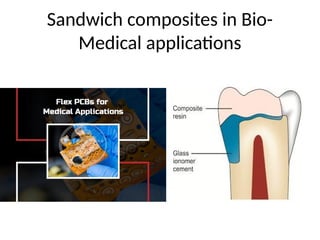
Sandwich composites in Bio-
Medical applications
Sandwich Composites in Marine
Applications
Aluminium
Honeycomb
Panels
Balsa Wood
Core Panels
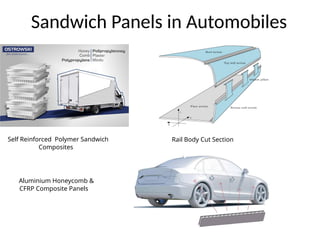
Sandwich Panels in Automobiles
Rail Body Cut Section
Aluminium Honeycomb &
CFRP Composite Panels
Self Reinforced Polymer Sandwich
Composites
78
Smart Cores and Sandwich Composites
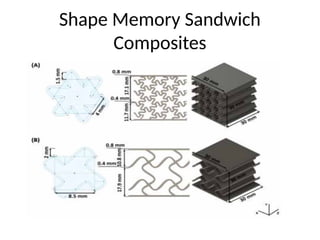
Shape Memory Sandwich
Composites
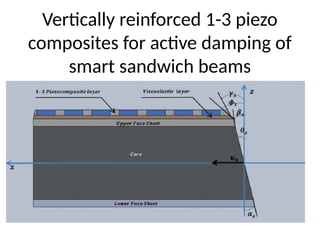
Vertically reinforced 1-3 piezo
composites for active damping of
smart sandwich beams
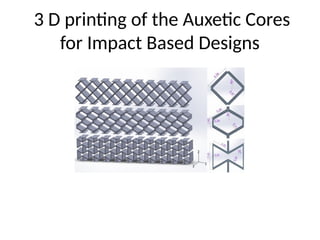
3 D printing of the Auxetic Cores
for Impact Based Designs
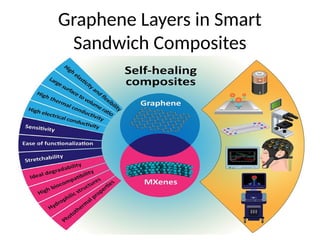
Graphene Layers in Smart
Sandwich Composites
References
• Froud.G.R., “Your Sandwich Order, Sir?”, Composites, July (1980), Vol.11(3), pp.133-138
• GIBSON.L..J.,“Optimization of Stiffness in Sandwich Beams with Rigid Foam Cores”, Mat Sci Engg, 1984,67,pp. 125-
135.
• Borsellino.C, Calabrese.L.,"Experimental And Numerical Evaluation Of Sandwich Composite Structures", Comp Sci
Tech , 2004, Vol.64 , pp. 1709–1715.
• Barbero.E.J.,''Finite Element Analysis of Composite Materials using Ansys”,Florida, CRC Press,2008.
• Zhu.H.X. N.J.Mills and J.F.Knott, "Analysis of High strain Compression in Open-cell Foams”, J.Mech. Phys.Solids,
1997,Vol.45, pp-1875-1904.
• Ines Ivanez, Carlos Santiuste, Sonia Sanchez-Saez, "FE Analysis of Dynamic Flexural Behavior of Composite
Sandwich Beams with Foam and Core”, J of Comp Struct, 2010, Vol.92, pp- 2285-2291.
• Hemnath T., Padmanabhan K,"Finite Element Modelling, Analysis And Experimental Evaluation Of Design
Optimization For Flexural Strength In Rigid Foam Core Epoxy Skin Based Sandwich Composite”, IJCSET, Jan-Dec
2011, vol.2 no.1, pp.103-135.
• Fa Zhang, Ramadan Mohammed, Baozhong Sun, Bohong Hu,"Damage Behavior of Foam Sandwich Composite
Materials under Quasi-Static Three Point Bending”, App Comp Mas, Volume 2, pp. 1231-1246.
• Panigrahi.S.K, B.Pradhan, "Delamination Damage Analysis of Adhesively Bonded Lap Shear Joints in Laminated
FRP Sheets”, Int J Fract, 2007. Vol.148, pp 373-385.
• Swanson.R.Stephen, Jongman Kim, ”Design of Sandwich Structures under Sandwich Loading”, J Comp Struct,
2003,Vol.59, pp.- 403-413
• Vishakh V, Ramya M, Suresh E, Padmanabhan K”Influence of foam densities and span to depth ratios on the Flexural
properties of rigid polyisocyanurate foam-glass fabric/epoxy Sandwich Composite”,IJSAD, 2014, Vol.1(3), pp.31-35.
• Surya Teja Varma CH, Ramya M, Suresh E, Padmanabhan K, "The Flexural Properties of Glass Fabric/Epoxy-Rigid
Polyurethane Foam Core Sandwich Composites at Different Span to Depth Ratios and Densities”,IJSAD,2014, pp. 26-
30.
Papers presented
• “Flexural optimization of glass fabric-epoxy skin/rigid foam core sandwich composites” in ICMCT
2014 held at VIT – Vellore. Suresh E, Hemnath T, Padmanabhan K
• “The Flexural Properties of Glass Fabric/Epoxy -Rigid Polyurethane Foam Core Sandwich Composites
at Different Span to Depth Ratios and Densities” in ICAET 2014 held at RIT, Roorkee . Chekuri Surya Teja
Varma, M. Ramya, E. Suresh & K. Padmanabhan
• “Mode-2 double lap shear and peel strength of rigid foam core glass epoxy skin sandwich composites
with different densities” in ICAET 2014 held at RIT, Roorkee .
Chava Uday, M Ramya, E.Suresh & K. Padmanabhan
• “Influence of foam density and span to depth ratio on flexural properties of rigid polyisocyanurate foam
glass fabric epoxy sandwich composites” in ICAET 2014 held at RIT, Roorkee . Vishakh V, Ramya
M, Suresh E, Padmanabhan K
• “Studies On Shear Flow Of Foam Core -Glass /Epoxy Skin Sandwich Composites In Flexure”
in Fatigue Durability and Fracture Mechanics 2015. IISc Bangalore from 28th-30th May 2015. Venkata
Subba Reddy Dandu, Ramya Malladi, Akash Nimbalkar, Prathamesh Patne, Sankalp Shinde, Suresh Erannagari,, Padmanabhan
Krishnan.
Papers presented
( At 14th ISAMPE National Conference on Composites
(INCCOM-14), Hyderabad January 22-23, 2016 )
• Flexural Behaviour of Rohacell Foam Core Sandwich Composites
Ramya. M, Sagar Daga, Anuj Sobti, Suresh. E and Padmanabhan. K
School of Mechanical Engineering, VIT University , Vellore-632014.
• Finite Element Analysis of Axial, Shear and Flexural Behaviour of Rigid Foam
Core-Glass Fabric /Epoxy Face Sheet Sandwich Composites
M. Saraschandra, Ramya. M, Suresh. E, Padmanabhan. K
• Fracture Mode Correlation with Flexure Test Data for Rigid Foam Core Sandwich Composites
Prudvi Krishna Maladi, Ramya. M, Suresh. E and Padmanabhan. K
Composites Laboratory, School of Mechanical Engineering, VIT-University, Vellore- 632014, India.
• A Study on Shear Flow Patterns in Foam Core-Glass/ Epoxy Face sheet Sandwich Composites
Vishnu Vardhan Reddy. G, Ramya. M, Suresh. E and Padmanabhan. K
School of Mechanical Engineering, VIT University, Vellore - 632014
Published papers in journals
• “Flexural optimization of glass fabric-epoxy skin/rigid foam core sandwich composites” in International
Journal of ChemTech Research ,CODEN (USA): IJCRGG ISSN : 0974-4290
Vol.6, No.6, pp 3336-3338, Aug-Sep 2014. Suresh E, Hemnath T, Padmanabhan K
• “The Flexural Properties of Glass Fabric/Epoxy -Rigid Polyurethane Foam Core Sandwich Composites
at Different Span to Depth Ratios and Densities” in International Journal of Structural Analysis & Design –
IJSAD,Volume 1 : Issue 3 [ISSN : 2372-4102],Publication Date : 30 September,2014. Chekuri Surya Teja Varma, M.
Ramya, E. Suresh & K. Padmanabhan
• “Mode-2 double lap shear and peel strength of rigid foam core glass epoxy skin sandwich composites
with different densities” in International Journal of Structural Analysis & Design – IJSAD, Volume 1 : Issue 3 [ISSN
: 2372-4102], Publication Date : 30 September,2014. Chava Uday, M Ramya, E.Suresh & K. Padmanabhan
• “Influence of foam density and span to depth ratio on flexural properties of rigid polyisocyanurate foam
glass fabric epoxy sandwich composites” in International Journal of Structural Analysis & Design –
IJSAD,Volume 1 : Issue 3 [ISSN : 2372-4102],Publication Date : 30 September,2014. Vishakh V, Ramya M, Suresh E,
Padmanabhan K
87
Publications From the Project
• The Influence of Rigid Foam Density on the Flexural Properties of Glass
Fabric/Epoxy-Polyurethane Foam Sandwich Composites, International Journal of
ChemTech Research CODEN (USA), Vol.6, No.6, pp 3314-3317.
• Influence Of Post Curing On The Flexural Properties Of A Rigid Polyurethane Or
Polyisocynurate Foam-Glass/Epoxy Face Sheet Sandwich Composite, International
Journal of ChemTech Research, CODEN (USA): IJCRGG ISSN : 0974-4290, Vol.6,
No.6, pp 3339-3342.
• Influence Of Foam Densities And Span To Depth Ratios On The Flexural Properties
Of Rigid Polyisocyanurate Foam-Glass Fabric/Epoxy Sandwich Composites,
International Jrnl of Structural Analysis and Design - IJSAD, Vol 1 , Issue 3, 30th
Sep 2014 Publn, Pp - 31-34,http://seekdl.org/nm.php?id=4399
• The Flexural Properties of Glass Fabric/Epoxy -Rigid Polyurethane Foam Core
Sandwich Composites at Different Span to Depth Ratios and Densities,
International Jrnl of Structural Analysis and Design - IJSAD, Vol 1 , Issue 3, 30th
Sep 2014 Publn, Pp 26-30, http://seekdl.org/nm.php?id=4398
• Fixed – Free Vibration Characteristics Of Rigid FoamGlass/Epoxy Sandwich
Composite Beams , (a)International conference on computational intelligence and
advanced manufacturing research-ICCIAMR 2014,VELS University (b) International
Jrnl of Structural Analysis and Design - IJSAD, Vol 1 , Issue 3, 30th Sep 2014
Publn, Pp 35-39 ; http://seekdl.org/nm.php?id=4400
• Double Lap Shear and Peel Properties of Rigid Foam Core Glass/Epoxy Skin
Sandwich Composites with Different Foam Densities, International Jrnl of
Structural Analysis and Design - IJSAD, Vol 1 , Issue 3, 30th Sep 2014 Publn, Pp
21-25; http://seekdl.org/nm.php?id=4397
88
Publications contd…
• A novel microbond bundle pullout technique to evaluate the interfacial
properties of fibre reinforced plastic composites,Padmanabhan Krishnan,
ISAMPE INCCOM 13 Proceedings, Trivandrum Chapter, 2014
• Design And Mechanical Property Evaluation Of A High Temperature Vacuum
Bagged Metal/Plastic Rigid Foam Sandwich Composite, ISAMPE INCCOM 13
Proceedings, Trivandrum Chapter, 2014
• Dynamic Analysis of Sandwich Composites, Proceedings of ISET2015
International Conference on Design, Manufacturing and Mechatronics ,
ICDMM2015.
• Suresh E, Hemnath T, Padmanabhan K , Studies On Flexural Optimization Of
Glass Fabric-Epoxy Skin/Rigid Foam Core Sandwich Composites,
International Journal of ChemTech Research CODEN (USA), Vol.6, No.6, pp
3336-3338
• Venkata Subba Reddy Dandu, Ramya Malladi, Akash Nimbalkar, Prathamesh
Patne, Sankalp Shinde, Suresh Erannagari , Padmanabhan Krishnan, Studies
On Shear Flow Of Foam Core -Glass /Epoxy Skin Sandwich Composites In
Flexure, Accepted for 2015 Fatigue Durability Conference at IISc to be hel on
28th & 29th May 2015.
• Hemanth G, Ramya M & Padmanabhan K, Flexural Behaviour of Sandwich
Composite Panels Fabricated Through Different Vacuum Bagging
Techniques, Accepted for 2015 Fatigue Durability Conference at IISc to be
hel on 28th & 29th May 2015.
• Sagar Daga, Anuj Sobti, Ramya M, Padmanabhan K,Flexural Behaviour of
Rohacell Foam Core Sandwich Composites , Inccom-14-ISAMPE,21-23 Jan
2016
• Vishnuvardhan Reddy, Suresh E, Ramya M, Padmanabhan K,A Study on Shear
Flow Patterns in Foam Core-Glass/ Epoxy Face sheet Sandwich
Composites,Inccom-14-ISAMPE,21-23 Jan 2016
89
Publications contd…
• Saraschandra M, Suresh E, Ramya M, Padmanabhan K, Finite Element Analysis of Axial,
Shear and Flexural Behaviour of Rigid Foam Core - Glass Fabric/ Epoxy Face sheet
Sandwich Composites, Inccom-14-ISAMPE,21-23 Jan 2016
• Prudvi Krishna M, Suresh E, Ramya M, Padmanabhan K, Fracture Mode Correlation with
Flexure Test Data forRigid Foam Core Sandwich Composites,Inccom-14-ISAMPE,21-23
Jan 2016
• Shabaz Mastan, Vishnuvardhan Reddy, Maruthi Mahesh, Ramya M, Padmanabhan K,
Design, Development and Flexural Characterization of High Temperature Vacuum
Bagged MetalSkin/Plastic Rigid Foam Sandwich Composites, Proceedings of ISET 2016-
ICDMM, Feb 19-20 2016,Pune
• G.Vishnuvardhan Reddy, Suresh E, Ramya M, Padmanabhan K, Shear Flow Patterns in
Foam Core-Glass/ Epoxy Face sheet Sandwich Composites, Proceedings – Materials
Today, ICAAMM-July 2016, Hyderabad
• D.Vishnuvardhan Reddy, Suresh E, Ramya M, Padmanabhan K,Influence of
Hygrothermal Effects on Strength and Stiffness of Rigid Foam Core Glass/Epoxy Skin
Sandwich Composites, Proceedings – Materials Today, ICAAMM-July 2016, Hyderabad
• Saraschandra M, Ramya M, Padmanabhan K, A Fracture Mode Based Algorithm for
Design Optimization of Strength Stiffness of Foam Core Sandwich Composites,
Proceedings – Materials Today, ICAAMM-July 2016, Hyderabad
• Prudvi Krishna Maladi, Ramya M, Padmanabhan K, Finite Element Analysis of
Glass/Epoxy Skin and Rigid Foam Core Sandwich Composites-Simulation of Shear
Modes and Flexural Modes of Failure, Proceedings – Materials Today, ICAAMM-July
2016, Hyderabad
90
Acknowledgements
• AR and DB for the financial and technical
support.
• VIT management for the equipment
purchase and support.
• CAMPT DST-FIST facility and Structures
labs, VIT, for mechanical testing.
• Anna University and SBST, VIT for the
Electron Microscopy.
• Mr. Ramaswamy K of Lloyds Insulations
and Dr. Ramesh Sundaram , NAL ,
Bangalore, for the foams.
• My project associate and students.
Introduction to Sandwich composites.pptx

Introduction to Sandwich composites.pptx

  • 1.
    1 Advanced Functional Sandwich Compositesfor Structural Applications Prof. Padmanabhan Krishnan School of Mechanical Engineering, VIT University-Vellore. SLIET Lecture, 8th August, 2024
  • 2.
    Introduction  Sandwich compositesare familiar for their inherent tailor ability, which enables them to meet specific design objectives for a given application.  Low density of these materials makes them especially suitable for use in aeronautical, space and marine applications.  Engineers and researchers have several factors to consider in their design. Here the structural factors are considered for applications. 2
  • 3.
    Definition- Sandwich composites Sandwich composites comprise of two thin but stiff face sheets attached to lightweight materials known as the Core.  The function of the core is to reduce density and increase shear strength and flexural rigidity where as the skins must have good bonding to the core and possess excellent axial stiffness and strength.  Honey comb panels, rigid and flexible foam core panels, Shape memory panels, filled and syntactic foam core panels, all constitute sandwich composites. 3
  • 4.
    Applications 4 Sandwich composites aremultifunctional. Some of their applications are: • Automotive applications. • Aerospace applications. • Marine applications. • Sports goods. • Bio medical applications. • Thermal insulations for buildings. • Vibration dampers and isolators. • Acoustic insulations.( sound proof rooms ).and acoustic fatigue. • Wind mill blades and flywheels.
  • 5.
  • 6.
    John Montagu In 1762,John Montagu, the 4th Earl of Sandwich, England, invented the meal that changed dining forever. As the story goes, he was playing cards and did not want to leave the gaming table to eat. He asked for a serving of roasted beef to be placed between two slices of bread so he could eat with his one hand and play with the other. This Sandwich design was later named after him.
  • 7.
    Sandwich Composites Indian sandwicheslike Samosa, Vada, Bonda and other stuffed items are end-capped and fried. On the contrary, the western sandwiches , burgers and hot dogs are mostly open ended and contain green matter. A ludicrous blend has more avenues.
  • 8.
  • 9.
  • 10.
  • 11.
  • 12.
  • 13.
  • 14.
  • 15.
    TYPES OF FOAMS •It is widely used as core material for sandwich constructions in the automotive and aerospace industries Open and closed cell structured foams like polyvinyl chloride, polyurethane, polyethylene or polystyrene foams, balsa wood, syntactic foams and honeycombs are commonly used as core materials. Closed pore rigid foam open pore rigid foam
  • 16.
    Fig. Polyurethane Synthesiswith the N-H-C=O-O Linkage Polyurethane (PUR and PU): Polyurethane polymers are traditionally and most commonly formed by reacting a di- or polyisocyanate with a polyol. Both the isocyanates and polyols used to make polyurethanes contain on average two or more functional groups per molecule. Although most of the polyurethanes are thermosetting polymers that cannot be melted when heated, there are thermoplastic polyurethanes also.
  • 17.
    . Polyisocyanurate (PIR): Polyisocyanurate,which is also referred to as PIR, polyiso or ISO is a thermoset plastic typically produced as foam and used as rigid thermal insulation. Its chemistry is similar to polyurethane (PUR) except that the proportion of methylene diphenyl diisocyanate (MDI) is higher and a polyester-derived polyol is used in the reaction instead of a polyetherpolyol. Catalysts and additives used in PIR formulations also differ from those used in PUR.
  • 18.
    Material Properties Tension Compression Density64 Kg/m3 125Kg/m3 250Kg/m3 64 Kg/m3 125Kg/m3 250Kg/m3 Young’s Modulus(MPa) 12.34 30.99 61.45 4.58 17.42 50.52 Poisson’s Ratio 0.138 0.059 0.205 0.31 0.278 0.162 PUF PIR Tension Compression Density 64 Kg/m3 125Kg/m3 250Kg/m3 64 Kg/m3 125Kg/m3 250Kg/m3 Young’s Modulus(MPa) 13.46 54.99 90.42 2.635 28.57 81.72 Poisson’s Ratio 0.182 0.059 0.15 0.22 0.28 0.163 Glass Epoxy Fabric : For Volume fraction 0.3 E11=13250MPa, E22=E33=6578.95MPa G12=G13=2112MPa, G23=2001.76MPa υ12= υ13=0.35, υ23=0.49
  • 19.
  • 20.
    Rohacell® foams Rohacell HEROfoams with 75 and 205 Kg/cu.m Densities The Glass Transition Temperature is about 205 ℃
  • 21.
    Thermoplastic Core materials Corematerials made of other thermoplastics are light in weight, offering some useful properties and possibly also making for easier recycling. • ABS - for rigidity, impact strength, toughness, surface hardness and dimensional stability • Polycarbonate - for UV-stability, excellent light transmission, good heat resistance & self-extinguishing properties • Polypropylene - for good chemical resistance • Polyethylene - a general-purpose low-cost core material • Flexural rigidity = E B X I { Bending modulus X second moment of area)
  • 22.
  • 23.
  • 24.
  • 25.
  • 26.
    Ashby Maps forMaterials Selection
  • 27.
    Young’s Modulus vs.Density of Cores
  • 28.
  • 29.
    Compressive Strength vsDensity for Cores
  • 30.
    Cost and WeightEfficiencies of Cores 30
  • 31.
  • 32.
  • 33.
  • 34.
    Why Sandwich Construction? Bendingstiffness is increased by making beams thicker – with sandwich construction this can be achieved with very little increase in weight.
  • 35.
    Sandwich design Core: Thecore is a low strength and a low density material whose function is to maintain the distance between the outer faces so that the moment of inertia of the cross section of the skin as well as its flexural rigidity is large. Ex. Honeycomb, foam, truss etc.A large number of composite layups also consist of either a co-curing or post-curing process of the prepreg along with different other mediums like honeycomb or foam.
  • 36.
    Design optimization ofrigid foam core sandwich composites for strength & stiffness ARDB Structures Panel Project Number 1650
  • 37.
    37 Aim and Objectives •Optimization of design was done for the polymer foam FRP face sheet sandwich beams using beam equations so as to obtain maximum strength and/or stiffness in bending. • Parameters like deflection, flexural rigidity, bending and shear stress, normal stress, shear strain, bending strength and bending stiffness to be determined for the sandwich composites and due comparisons made with the results evaluated for samples without design optimization. • It was proposed to design optimize for minimum weight while maintaining the desired properties .
  • 38.
    38 Parameters for DOof Foam Sandwich Composites • Foam material, Rigid, Unfilled, Thermoset, Closed pores, processing • Weight ratios of skin and core • Span to depth ratio, static tests • Foam cell size, wall thickness, density, other properties • Shape Factors for Sandwich Composites. • Sandwich composite thickness and shear flow • Skin-core interfacial properties • Feedback from failure features and modes, priority, ranking, damage and mechanisms • Modelling using FEM, Algorithms, DOE.
  • 39.
    39 Current Approach • Semi-empiricalapproach. • To experimentally determine the strength and the stiffness optimization rules for sandwich composites. • Fabrication of glass, carbon fabric or aluminium skin sandwich composites with cores made of rigid cellular solids with closed pores. • Rigid, thermoset, unfilled, closed pore PUF and PIR foams. PMI Rohacell foams. • Different core densities and thicknesses experimented. • To refine the FEA models in accordance with the design optimization parameters. • Correlation of the shape factors and failure modes with the observed stiffness and strength. • DO through genetic algorithm, matlab and Minitab.
  • 40.
    40 Experimental Approach • HandWet Lay Up followed by Vacuum Bagging fabrication of sandwich composites. • Hot Vacuum Bagging, Dual and Triple Hot Bagging Techniques. • Conventional machining of test specimens • Tensile, Compressive, Shear , and Flexural Testing in Instron 8801 and Structural UTM. • Failure analyses and feedback
  • 41.
    Existing Theories forDesign Optimization • L.J. Gibson et al developed an analytical method for finding the values of core thickness, face thickness and core density which minimize the weight of a foam core (polyurethane) sandwich beam of given stiffness and span length. Maximum stiffness occurs when skin weight is one fourth of core weight ( Metal skin rigid polymeric foam core • G.R. Froud, on his article on the mechanical properties in bending applications of sandwich constructions, has suggested The maximum flexural rigidity occurs when, Core weight = 2/3*total weight If it is assumed that the failure of a sandwich structure occurs due to tensile failure in the skin, the core must not fail in shear before tensile failure in the skins is attained. The maximum bending strength is obtained when Core weight = total weight of skins .
  • 42.
  • 43.
    Design Parameters  Deflection- Total bending and shear.  Flexural rigidity.( EB X I ).  Bending and normal strength.  Directional strains  Shear stress and shear strain  Peel strength of the skin from the core.  Fracture toughness in Mode I, Mode II, and Mode III.  Lap shear strengths – Single and Double lap. 43
  • 45.
    Material Properties ofskin Property GE/PU 64 kg/m3 (Strength panel) GE/PU 64 kg/m3 ( Stiffness panel) GE/PU 124 kg/m3 ( Strength panel) GE/PU 124 kg/m3 ( Stiffness panel) Fibre volume fraction 0.30 0.34 0.27 0.28 Longitudinal modulus, E11 12250 MPa 13550 MPa 11270 11600 Transverse modulus, E22 3465 MPa 3650 MPa 3336 3370 In-plane shear modulus, G12 1286 MPa 1356MPa 1238 1254 Major Poisson’s ratio, υ12 0.32 0.316 0.323 0.322 Resin material Epoxy LY556 and Hardener HY 951 in 10:1 vol. ratio. Epoxy LY556 and Hardener HY 951 in 10:1 vol. ratio. Epoxy LY556 and Hardener HY 951 in 10:1 vol. ratio. Epoxy LY556 and Hardener HY 951 in 10:1 vol. ratio. Reinforced fibre E-glass fabric , fine E-glass fabric , fine E-glass fabric weave E-glass fabric , weave
  • 46.
    Material Properties ofcore Property GE/PU 64 kg/m3 GE/PU 124 kg/m3 Elastic modulus, E 10.7 GPa 12.4 GPa Poisson’s ratio, υ 0.29 0.27 Core Density, ρf 64Kg/ m3 124Kg/ m3 Testing:
  • 47.
    Shape factors forthe fabric/ epoxy-rigid PU sandwich Composites Sandwich specimen type Shape factor Stiffness Failure Glass fabric/epoxy PU Rigid foam 64 kg/cu.m sandwich composite ( Strength panel ) 29.36 10.83 Glass fabric/epoxy PU rigid foam 124 Kg/cu..m sandwich composite ( Strength panel ) 27.02 10.39 Glass fabric/epoxy-PU 64 rigid foam sandwich composite ( stiffness panel ) 69.04 16.61 Glass fabric/epoxy PU-124 rigid foam sandwich composite ( stiffness panel) 40.42 12.71
  • 48.
    • For Flexuretests, low density Polyurethane (PUF) and Polyisocyanurate (PIR) foams of 125 kg/cum are chosen to fabricate the sandwich panels with glass epoxy skin by maintaining a constant skin to core weight ratio of 4:1 with various thicknesses of 10mm, 25mm, 50mm. • Shift in the neutral axis exists in case of bending • Foam specimens of 125kg/m3 are fabricated, and tested for tension • Compression test properties of foam are used • Ratio of ultimate tensile and compressive stresses in foam, from compressive and tensile tests gives the necessary ‘r’ ratio • Ratio between the neutral axis displacement and depth of beam is obtained r = = C – Magnitude of Neutral Axis Displacement ; D – Depth of Beam
  • 49.
  • 50.
    Testing of SandwichPanels • Tensile Test on Foam to evaluate Tensile Properties of Foam • Compression Test on Foam to evaluate Compression properties on foam • Single Lap Shear test to evaluate Shear strength of Foams in Adhesive joints. • Double Lap shear test to evaluate Shear strength of Foams in Adhesive joints. • Three Point Bending test to evaluate Flexural Properties of Sandwich Panel. • Fatigue and Creep Testing • Impact and Vibrations Testing • Hygrothermal Conditioning and Testing
  • 51.
    ASTM – Standards. ASTM D 790M-93 , Standard Test Methods for Flexural Properties of Unreinforced and Reinforced Plastics and Electrical Insulating Materials [Metric]  ASTM C273/C273M-11, Shear Properties of Sandwich Core Materials , ASTM International, PA, USA.  ASTM C393 / C393 M-06, Standard test method for core shear properties of sandwich constructions by beam flexure.  ASTM D 7249 / D7249 M-06, Standard test method for facing properties of sandwich constructions by long beam flexure.  ASTM D7250 / D7250 M-06, Standard practice for determining sandwich beam flexural and shear stiffness. 51
  • 52.
    LOAD VS. DEFLECTION.OF GE-PU 64 kg/m3 sandwich Specimen 3 has taken a maximum load of 42 kg and a total deflection of 73 mm Froud’s STIFFNESS PANEL
  • 53.
    FEM Simulation ofSandwich Tests
  • 54.
    FEM of sandwichcomposites in flexure The project aim is to compare the stress distribution on the sandwich panels while testing in flexure. • Perform Finite element modeling and analysis for ASTM standard test specimen under experimental conditions. • Comparing the results obtained by the analysis and experiments. • By using the available statistical, analytical methods and FEA failure criteria design optimization was done for optimum strength, stiffness.
  • 55.
    FEA Simulation andOptimization. Approximation of Sandwich structures  a 55
  • 56.
    56 Moments in Flexure Figure:Shear Stress in skin alone of GE/PU 64kg/m3 sandwich model. Buckling Delaminations Skin- Core Failure
  • 57.
    57 Moments in Flexure ShearStress in skin alone of GE/PU 64kg/m3 sandwich model. Buckling Delaminations Skin- Core Failure
  • 58.
  • 59.
    Studies On ShearFlow Of Foam Core -Glass / Epoxy Skin Sandwich Composites In Flexure The current study focuses on understanding the shear flow patterns in failure by comparing the flexural, compressive and tensile properties. Foams of low density are chosen to fabricate the sandwich panels with glass epoxy skin by maintaining a constant skin to core weight ratio of 4:1with various thickness 10mm, 25mm, 50mm for PUF and PIR foams of 125kg/cum density. Foam tensile test specimens are fabricated, and tested, compression test properties are used, and, the shift in neutral axes understood by a new novel design approach for the flexural specimens . Analytical calculations can be done to find ‘r’ ratio and shift in neutral axes. SHEAR FLOW: If the shearing stress fv is multiplied by thickness t, we obtain a quantity q known as the shear flow, which represents the longitudinal force per unit length transmitted across a section at a level y1 from the neutral axis. Q = fv*t The shear flow values is calculated based on max shear stress in core multiplied by thickness.
  • 60.
    The influence offoam density and span to depth ratio in the flexure of glass fabric/epoxy skin polyurethane foam sandwich composites The sandwich panels were tested at different span to depth ratios. The flexural properties like the bending strength, flexural rigidity, shear stress, shear deflection and shear strain were evaluated and a detailed analysis made on the influence of foam densities and different span to depth ratios on the fracture behaviour of these sandwich composites in flexure. Sandwich manufacturing parametres:  Vacuum bagging technique.  Glass fabric: 280 & 100 GSM, plain weave  Epoxy: GY257  Hardener: ARADUR 140  Rigid PUF densities 125 kg/m3 and 250 kg/m3  Span to depth ratios 15.4 : 1, 12: 1, & 6:1
  • 61.
    61 Influence of PostCuring on the Flexural Properties of a Rigid Polyurethane or Polyisocynurate Foam - Glass/Epoxy Face It was observed that there is an appreciable increase in flexural rigidity and a general decrease in the other flexural properties with post curing. The reasons are due to an increased degree of cross- linking of the epoxy resin, dimensional and mechanical property changes in the foam due to post curing.
  • 62.
    62 • As theweight ratio increased stress developed had reduced as we can see from plots this is because the dimensions of specimens vary as the weight ratio increases and the stresses developed mostly depends on thickness, width and length of specimen which in turn depends on weight ratio • In PIR -125 the max load taken by the specimen is 9025 N and in PIR 64 the max load taken by specimen is 6850N at a weight ratio of 5:1 • In PUF-125 the max load taken by the specimen is 7425N and in PUF 64 the max load taken by the specimen is 3116N at a weight ratio of 5:1 • This concludes that the shift in neutral axis from the centroidal axis is 0.048 percent of foam thickness and r ratio is 1.0645 which can be understood in case of PIR 125 • The shift in neutral axis from the centriodal axis is 2.59 percent of foam thickness and r ratio is 1.59 in PUF 125 samples • In PUF 64 samples the shift is6.6 percent of foam thickness & r ratio is 2.15 and in PIR 64 samples the shift is 6.6 percent of foam thickness & r ratio is 1.69 • From shear flow Vs shift in neutral axis plot we observed that by varying thickness10mm, 25mm, 50mm. as shear flow increases the shift in neutral axis also increases with different thickness in both PUF 64,125 & PIR 64,125 is observed. If the thickness of sample is high shear flow is high • It is observed that while testing sandwich specimens’ failure occurs mainly through face sheet shear and compressive core crushing in 64&125 kg/m3 density foam sandwich panels.
  • 63.
    Methodology The specimens wereplaced in the hygro- thermal chamber for humidity uptake in the presence of temperature. The weights were to be measured for every 24 hours to know and calculate the percentage of moisture weight absorption . The process was continued up to saturation point. The specimens reached the saturation point at approximately 312 hours. The weights were measured by using sensitive weighing balance. The dry and saturation conditioned samples were mechanically tested. HYGROTHERMAL CHAMBER
  • 64.
  • 65.
    Sandwich Showing Coreand Skin –Core Interfacial Failure Tensile face Core failure Ref: ASTM C 393/C393M-06, ASTM D7249/ D 7249 M-06, ASTM D7250/ D7250M-06 Test Methods
  • 66.
    66 Functional Outcomes • Optimizedfabrication process selection for sandwich structures at different temperatures and pressure levels achieved through vacuum bagging, hot vacuum bagging • Optimized material selection based on foam core, glass fabric/ epoxy and carbon-epoxy achieved for sandwich applications at optimal strength and stiffness criteria • Optimized weight ratios for different structural applications based on maximum strength, stiffness and energy absorption by foam core sandwich structures are achieved
  • 67.
    End Use Applications 67 Highperformance structural foams are used for infusion components in aerospace applications and in sports equipment and automotive structures. The foam sandwich composites fabricated in the above investigation can be used in 1. Empennage elevator and rudder of aircrafts. 2. Light and very light AIRCRAFT wing profiles. 3. Light aircraft primary structures in Cirrus (USA) like aircrafts. 4. Missile primary structures and bay wings. 5. Secondary structures of larger civil aircrafts like Interiors , hulls and decks. 6. Fighter aircraft radomes.
  • 68.
    Alumina Paint CoatedFlame Retardant Balsa Wood Core Sandwich Composites 68
  • 69.
    Balsa Wood Properties 69 Figure2: End Grain Balsa and grain orientations Properties Rohacell RIST- 110 Balsa wood ( Present) PUF 125 PIR 125 Density kg/cu.m 110 95.4 125 125 Elastic modulus(MPa) 180 25 17.4 28.6 Shear modulus(MPa) 70 9.06 6.81 11.17 Compressive strength , MPa 3.6 1.1 1.24 0.91
  • 70.
    Flexural Optimization 70 Sample Number Flexural Rigidity D (Nmm2 ) ( ×106 )* *-N/A for Balsa Flexural rigidity/ unit width (Nmm)(× 105 ) * N/A for Balsa Bending Moment (M) (Nmm) Bending Stress (N/mm2 ) Bending Strength (Nmm) Bending Strength/ unit width Nmm/mm Normal Stress (N/mm2 ) Bending Stiffness (N/mm) BALSA 41.67k 2083.5 2986.8 (2614.8-3258.4) 8.96 (7.84-9.78) 1493.4 (1307.4-1629.2) 74.67 (65.37-81.46) 8.96 (7.84-9.78) 18.03 (12.13-25.22) 1:1 4.3 2.08 4939.33 (4279.9-5434.43) 112.82 (97.75-124.12) 2469.67 (2139.95-2717.22) 118.62 (102.78-130.51) 115.64 (100.22- 127.26) 27.43 (23.87-31.76) 2:1 9.59 4.2 12773.3 (11623.7-14693) 78.5 (71.56-90.21) 6351.5 (5816.87-7346.5) 278.1 (254.46-321.65) 77.89 (71.26-90.1) 18.03 (12.13-25.22) 3:1 24.16 9.56 16121.7 (14711.4-18259.2) 47.7 (43.5-54) 8060.85 (7355.7-9129.6) 318.9 (291-361.14) 47.43 (43.3-53.73) 68.05 (50.14-91.11) 4:1 18.85 7.69 16326.5 (15059.2-17323) 58.31 (53.8-61.9) 8163.25 (7529.6-8661.5) 332.9 (307.33-338.72) 58.4 (54-59.4) 77.4 (73.88-80.46) 5:1 38.58 14.3 29976.5 (26333.2-32474.7) 62.64 (55.02-67.9) 14988.8 (13166.6-16238.9) 559.82 (488.33-603.7) 62.18 (54.62-67.36) 96 (81.4-107.54) It is seen that the strength, Stiffness or Rigidity Optimization occur at a Skin to Core Ratio of 5:1 Ref: Hybrid Fiber Composites, Wiley VCH, 2020. Ch: 10
  • 71.
  • 72.
    Light Weight Structures Itis possible to design and fabricate a 2 Mts X 2 Mts polymer foam FRP face sheet sandwich panel that can support a 1 Ton elephant’s weight and weigh just about 25 Kgs , easy for carrying around by one person.
  • 73.
  • 74.
  • 75.
    Sandwich composites inBio- Medical applications
  • 76.
    Sandwich Composites inMarine Applications Aluminium Honeycomb Panels Balsa Wood Core Panels
  • 77.
    Sandwich Panels inAutomobiles Rail Body Cut Section Aluminium Honeycomb & CFRP Composite Panels Self Reinforced Polymer Sandwich Composites
  • 78.
    78 Smart Cores andSandwich Composites
  • 79.
  • 80.
    Vertically reinforced 1-3piezo composites for active damping of smart sandwich beams
  • 81.
    3 D printingof the Auxetic Cores for Impact Based Designs
  • 82.
    Graphene Layers inSmart Sandwich Composites
  • 83.
    References • Froud.G.R., “YourSandwich Order, Sir?”, Composites, July (1980), Vol.11(3), pp.133-138 • GIBSON.L..J.,“Optimization of Stiffness in Sandwich Beams with Rigid Foam Cores”, Mat Sci Engg, 1984,67,pp. 125- 135. • Borsellino.C, Calabrese.L.,"Experimental And Numerical Evaluation Of Sandwich Composite Structures", Comp Sci Tech , 2004, Vol.64 , pp. 1709–1715. • Barbero.E.J.,''Finite Element Analysis of Composite Materials using Ansys”,Florida, CRC Press,2008. • Zhu.H.X. N.J.Mills and J.F.Knott, "Analysis of High strain Compression in Open-cell Foams”, J.Mech. Phys.Solids, 1997,Vol.45, pp-1875-1904. • Ines Ivanez, Carlos Santiuste, Sonia Sanchez-Saez, "FE Analysis of Dynamic Flexural Behavior of Composite Sandwich Beams with Foam and Core”, J of Comp Struct, 2010, Vol.92, pp- 2285-2291. • Hemnath T., Padmanabhan K,"Finite Element Modelling, Analysis And Experimental Evaluation Of Design Optimization For Flexural Strength In Rigid Foam Core Epoxy Skin Based Sandwich Composite”, IJCSET, Jan-Dec 2011, vol.2 no.1, pp.103-135. • Fa Zhang, Ramadan Mohammed, Baozhong Sun, Bohong Hu,"Damage Behavior of Foam Sandwich Composite Materials under Quasi-Static Three Point Bending”, App Comp Mas, Volume 2, pp. 1231-1246. • Panigrahi.S.K, B.Pradhan, "Delamination Damage Analysis of Adhesively Bonded Lap Shear Joints in Laminated FRP Sheets”, Int J Fract, 2007. Vol.148, pp 373-385. • Swanson.R.Stephen, Jongman Kim, ”Design of Sandwich Structures under Sandwich Loading”, J Comp Struct, 2003,Vol.59, pp.- 403-413 • Vishakh V, Ramya M, Suresh E, Padmanabhan K”Influence of foam densities and span to depth ratios on the Flexural properties of rigid polyisocyanurate foam-glass fabric/epoxy Sandwich Composite”,IJSAD, 2014, Vol.1(3), pp.31-35. • Surya Teja Varma CH, Ramya M, Suresh E, Padmanabhan K, "The Flexural Properties of Glass Fabric/Epoxy-Rigid Polyurethane Foam Core Sandwich Composites at Different Span to Depth Ratios and Densities”,IJSAD,2014, pp. 26- 30.
  • 84.
    Papers presented • “Flexuraloptimization of glass fabric-epoxy skin/rigid foam core sandwich composites” in ICMCT 2014 held at VIT – Vellore. Suresh E, Hemnath T, Padmanabhan K • “The Flexural Properties of Glass Fabric/Epoxy -Rigid Polyurethane Foam Core Sandwich Composites at Different Span to Depth Ratios and Densities” in ICAET 2014 held at RIT, Roorkee . Chekuri Surya Teja Varma, M. Ramya, E. Suresh & K. Padmanabhan • “Mode-2 double lap shear and peel strength of rigid foam core glass epoxy skin sandwich composites with different densities” in ICAET 2014 held at RIT, Roorkee . Chava Uday, M Ramya, E.Suresh & K. Padmanabhan • “Influence of foam density and span to depth ratio on flexural properties of rigid polyisocyanurate foam glass fabric epoxy sandwich composites” in ICAET 2014 held at RIT, Roorkee . Vishakh V, Ramya M, Suresh E, Padmanabhan K • “Studies On Shear Flow Of Foam Core -Glass /Epoxy Skin Sandwich Composites In Flexure” in Fatigue Durability and Fracture Mechanics 2015. IISc Bangalore from 28th-30th May 2015. Venkata Subba Reddy Dandu, Ramya Malladi, Akash Nimbalkar, Prathamesh Patne, Sankalp Shinde, Suresh Erannagari,, Padmanabhan Krishnan.
  • 85.
    Papers presented ( At14th ISAMPE National Conference on Composites (INCCOM-14), Hyderabad January 22-23, 2016 ) • Flexural Behaviour of Rohacell Foam Core Sandwich Composites Ramya. M, Sagar Daga, Anuj Sobti, Suresh. E and Padmanabhan. K School of Mechanical Engineering, VIT University , Vellore-632014. • Finite Element Analysis of Axial, Shear and Flexural Behaviour of Rigid Foam Core-Glass Fabric /Epoxy Face Sheet Sandwich Composites M. Saraschandra, Ramya. M, Suresh. E, Padmanabhan. K • Fracture Mode Correlation with Flexure Test Data for Rigid Foam Core Sandwich Composites Prudvi Krishna Maladi, Ramya. M, Suresh. E and Padmanabhan. K Composites Laboratory, School of Mechanical Engineering, VIT-University, Vellore- 632014, India. • A Study on Shear Flow Patterns in Foam Core-Glass/ Epoxy Face sheet Sandwich Composites Vishnu Vardhan Reddy. G, Ramya. M, Suresh. E and Padmanabhan. K School of Mechanical Engineering, VIT University, Vellore - 632014
  • 86.
    Published papers injournals • “Flexural optimization of glass fabric-epoxy skin/rigid foam core sandwich composites” in International Journal of ChemTech Research ,CODEN (USA): IJCRGG ISSN : 0974-4290 Vol.6, No.6, pp 3336-3338, Aug-Sep 2014. Suresh E, Hemnath T, Padmanabhan K • “The Flexural Properties of Glass Fabric/Epoxy -Rigid Polyurethane Foam Core Sandwich Composites at Different Span to Depth Ratios and Densities” in International Journal of Structural Analysis & Design – IJSAD,Volume 1 : Issue 3 [ISSN : 2372-4102],Publication Date : 30 September,2014. Chekuri Surya Teja Varma, M. Ramya, E. Suresh & K. Padmanabhan • “Mode-2 double lap shear and peel strength of rigid foam core glass epoxy skin sandwich composites with different densities” in International Journal of Structural Analysis & Design – IJSAD, Volume 1 : Issue 3 [ISSN : 2372-4102], Publication Date : 30 September,2014. Chava Uday, M Ramya, E.Suresh & K. Padmanabhan • “Influence of foam density and span to depth ratio on flexural properties of rigid polyisocyanurate foam glass fabric epoxy sandwich composites” in International Journal of Structural Analysis & Design – IJSAD,Volume 1 : Issue 3 [ISSN : 2372-4102],Publication Date : 30 September,2014. Vishakh V, Ramya M, Suresh E, Padmanabhan K
  • 87.
    87 Publications From theProject • The Influence of Rigid Foam Density on the Flexural Properties of Glass Fabric/Epoxy-Polyurethane Foam Sandwich Composites, International Journal of ChemTech Research CODEN (USA), Vol.6, No.6, pp 3314-3317. • Influence Of Post Curing On The Flexural Properties Of A Rigid Polyurethane Or Polyisocynurate Foam-Glass/Epoxy Face Sheet Sandwich Composite, International Journal of ChemTech Research, CODEN (USA): IJCRGG ISSN : 0974-4290, Vol.6, No.6, pp 3339-3342. • Influence Of Foam Densities And Span To Depth Ratios On The Flexural Properties Of Rigid Polyisocyanurate Foam-Glass Fabric/Epoxy Sandwich Composites, International Jrnl of Structural Analysis and Design - IJSAD, Vol 1 , Issue 3, 30th Sep 2014 Publn, Pp - 31-34,http://seekdl.org/nm.php?id=4399 • The Flexural Properties of Glass Fabric/Epoxy -Rigid Polyurethane Foam Core Sandwich Composites at Different Span to Depth Ratios and Densities, International Jrnl of Structural Analysis and Design - IJSAD, Vol 1 , Issue 3, 30th Sep 2014 Publn, Pp 26-30, http://seekdl.org/nm.php?id=4398 • Fixed – Free Vibration Characteristics Of Rigid FoamGlass/Epoxy Sandwich Composite Beams , (a)International conference on computational intelligence and advanced manufacturing research-ICCIAMR 2014,VELS University (b) International Jrnl of Structural Analysis and Design - IJSAD, Vol 1 , Issue 3, 30th Sep 2014 Publn, Pp 35-39 ; http://seekdl.org/nm.php?id=4400 • Double Lap Shear and Peel Properties of Rigid Foam Core Glass/Epoxy Skin Sandwich Composites with Different Foam Densities, International Jrnl of Structural Analysis and Design - IJSAD, Vol 1 , Issue 3, 30th Sep 2014 Publn, Pp 21-25; http://seekdl.org/nm.php?id=4397
  • 88.
    88 Publications contd… • Anovel microbond bundle pullout technique to evaluate the interfacial properties of fibre reinforced plastic composites,Padmanabhan Krishnan, ISAMPE INCCOM 13 Proceedings, Trivandrum Chapter, 2014 • Design And Mechanical Property Evaluation Of A High Temperature Vacuum Bagged Metal/Plastic Rigid Foam Sandwich Composite, ISAMPE INCCOM 13 Proceedings, Trivandrum Chapter, 2014 • Dynamic Analysis of Sandwich Composites, Proceedings of ISET2015 International Conference on Design, Manufacturing and Mechatronics , ICDMM2015. • Suresh E, Hemnath T, Padmanabhan K , Studies On Flexural Optimization Of Glass Fabric-Epoxy Skin/Rigid Foam Core Sandwich Composites, International Journal of ChemTech Research CODEN (USA), Vol.6, No.6, pp 3336-3338 • Venkata Subba Reddy Dandu, Ramya Malladi, Akash Nimbalkar, Prathamesh Patne, Sankalp Shinde, Suresh Erannagari , Padmanabhan Krishnan, Studies On Shear Flow Of Foam Core -Glass /Epoxy Skin Sandwich Composites In Flexure, Accepted for 2015 Fatigue Durability Conference at IISc to be hel on 28th & 29th May 2015. • Hemanth G, Ramya M & Padmanabhan K, Flexural Behaviour of Sandwich Composite Panels Fabricated Through Different Vacuum Bagging Techniques, Accepted for 2015 Fatigue Durability Conference at IISc to be hel on 28th & 29th May 2015. • Sagar Daga, Anuj Sobti, Ramya M, Padmanabhan K,Flexural Behaviour of Rohacell Foam Core Sandwich Composites , Inccom-14-ISAMPE,21-23 Jan 2016 • Vishnuvardhan Reddy, Suresh E, Ramya M, Padmanabhan K,A Study on Shear Flow Patterns in Foam Core-Glass/ Epoxy Face sheet Sandwich Composites,Inccom-14-ISAMPE,21-23 Jan 2016
  • 89.
    89 Publications contd… • SaraschandraM, Suresh E, Ramya M, Padmanabhan K, Finite Element Analysis of Axial, Shear and Flexural Behaviour of Rigid Foam Core - Glass Fabric/ Epoxy Face sheet Sandwich Composites, Inccom-14-ISAMPE,21-23 Jan 2016 • Prudvi Krishna M, Suresh E, Ramya M, Padmanabhan K, Fracture Mode Correlation with Flexure Test Data forRigid Foam Core Sandwich Composites,Inccom-14-ISAMPE,21-23 Jan 2016 • Shabaz Mastan, Vishnuvardhan Reddy, Maruthi Mahesh, Ramya M, Padmanabhan K, Design, Development and Flexural Characterization of High Temperature Vacuum Bagged MetalSkin/Plastic Rigid Foam Sandwich Composites, Proceedings of ISET 2016- ICDMM, Feb 19-20 2016,Pune • G.Vishnuvardhan Reddy, Suresh E, Ramya M, Padmanabhan K, Shear Flow Patterns in Foam Core-Glass/ Epoxy Face sheet Sandwich Composites, Proceedings – Materials Today, ICAAMM-July 2016, Hyderabad • D.Vishnuvardhan Reddy, Suresh E, Ramya M, Padmanabhan K,Influence of Hygrothermal Effects on Strength and Stiffness of Rigid Foam Core Glass/Epoxy Skin Sandwich Composites, Proceedings – Materials Today, ICAAMM-July 2016, Hyderabad • Saraschandra M, Ramya M, Padmanabhan K, A Fracture Mode Based Algorithm for Design Optimization of Strength Stiffness of Foam Core Sandwich Composites, Proceedings – Materials Today, ICAAMM-July 2016, Hyderabad • Prudvi Krishna Maladi, Ramya M, Padmanabhan K, Finite Element Analysis of Glass/Epoxy Skin and Rigid Foam Core Sandwich Composites-Simulation of Shear Modes and Flexural Modes of Failure, Proceedings – Materials Today, ICAAMM-July 2016, Hyderabad
  • 90.
    90 Acknowledgements • AR andDB for the financial and technical support. • VIT management for the equipment purchase and support. • CAMPT DST-FIST facility and Structures labs, VIT, for mechanical testing. • Anna University and SBST, VIT for the Electron Microscopy. • Mr. Ramaswamy K of Lloyds Insulations and Dr. Ramesh Sundaram , NAL , Bangalore, for the foams. • My project associate and students.