Introduction to Russian Law
Soili Nysten-Haarala
University of Lapland
Marcelo Gomes Freire
Autumn 2013
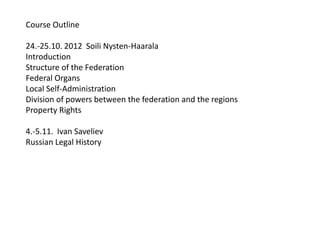
Course Outline
24.-25.10. 2012 Soili Nysten-Haarala
Introduction
Structure of the Federation
Federal Organs
Local Self-Administration
Division of powers between the federation and the regions
Property Rights
4.-5.11. Ivan Saveliev
Russian Legal History
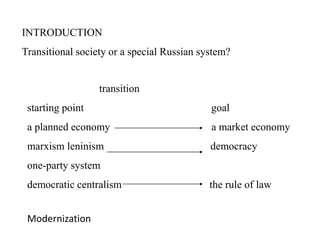
INTRODUCTION
Transitional society or a special Russian system?
transition
starting point goal
a planned economy a market economy
marxism leninism democracy
one-party system
democratic centralism the rule of law
Modernization
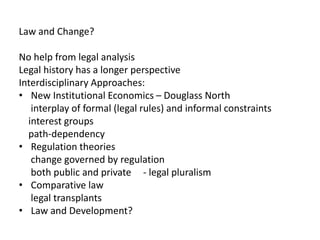
Law and Change?
No help from legal analysis
Legal history has a longer perspective
Interdisciplinary Approaches:
• New Institutional Economics – Douglass North
interplay of formal (legal rules) and informal constraints
interest groups
path-dependency
• Regulation theories
change governed by regulation
both public and private - legal pluralism
• Comparative law
legal transplants
• Law and Development?
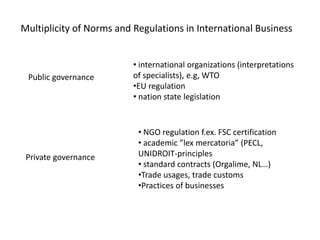
Multiplicity of Norms and Regulations in International Business
• international organizations (interpretations
of specialists), e.g, WTO
•EU regulation
• nation state legislation
• NGO regulation f.ex. FSC certification
• academic ”lex mercatoria” (PECL,
UNIDROIT-principles
• standard contracts (Orgalime, NL…)
•Trade usages, trade customs
•Practices of businesses
Public governance
Private governance
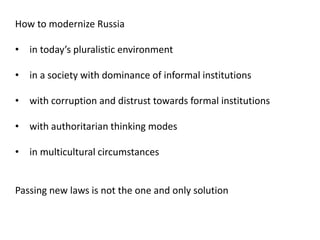
How to modernize Russia
• in today’s pluralistic environment
• in a society with dominance of informal institutions
• with corruption and distrust towards formal institutions
• with authoritarian thinking modes
• in multicultural circumstances
Passing new laws is not the one and only solution
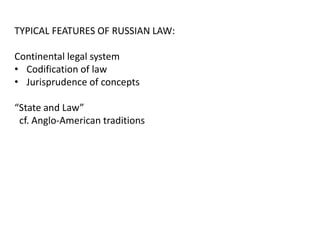
TYPICAL FEATURES OF RUSSIAN LAW:
Continental legal system
• Codification of law
• Jurisprudence of concepts
“State and Law”
cf. Anglo-American traditions
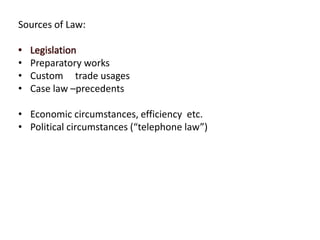
Sources of Law:
• Legislation
• Preparatory works
• Custom trade usages
• Case law –precedents
• Economic circumstances, efficiency etc.
• Political circumstances (“telephone law”)
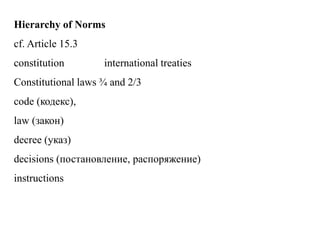
Hierarchy of Norms
cf. Article 15.3
constitution international treaties
Constitutional laws ¾ and 2/3
code (кодекс),
law (закон)
decree (указ)
decisions (постановление, распоряжение)
instructions
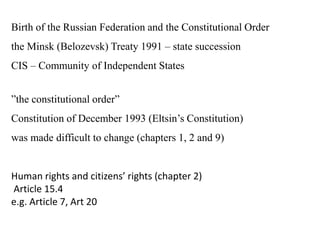
Birth of the Russian Federation and the Constitutional Order
the Minsk (Belozevsk) Treaty 1991 – state succession
CIS – Community of Independent States
”the constitutional order”
Constitution of December 1993 (Eltsin’s Constitution)
was made difficult to change (chapters 1, 2 and 9)
Human rights and citizens’ rights (chapter 2)
Article 15.4
e.g. Article 7, Art 20
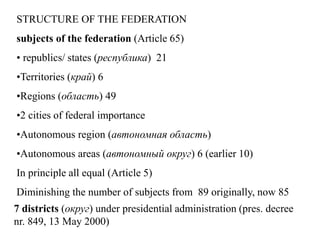
STRUCTURE OF THE FEDERATION
subjects of the federation (Article 65)
• republics/ states (республика) 21
•Territories (край) 6
•Regions (область) 49
•2 cities of federal importance
•Autonomous region (автономная область)
•Autonomous areas (автономный округ) 6 (earlier 10)
In principle all equal (Article 5)
Diminishing the number of subjects from 89 originally, now 85
7 districts (округ) under presidential administration (pres. decree
nr. 849, 13 May 2000)
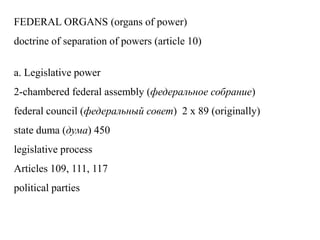
FEDERAL ORGANS (organs of power)
doctrine of separation of powers (article 10)
a. Legislative power
2-chambered federal assembly (федеральное собрание)
federal council (федеральный совет) 2 x 89 (originally)
state duma (дума) 450
legislative process
Articles 109, 111, 117
political parties
b. Executive power (and more?)
president of the federation
-legislative initiative power
-Power to give decrees
-Promulgation of laws (veto power)
Nomination powers
Can dissolve the duma (109, 111)
government
nomination of prime minister (111)
practice v. constitution
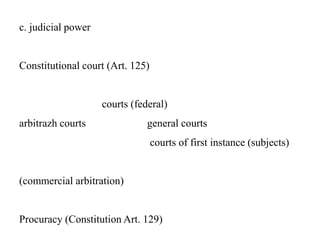
c. judicial power
Constitutional court (Art. 125)
courts (federal)
arbitrazh courts general courts
courts of first instance (subjects)
(commercial arbitration)
Procuracy (Constitution Art. 129)
division of powers between the federation and its subjects
Constitution Articles 71-73
division of legislative powers
division of executive powers
division of juridicial powers
Centralization and the Executive Power:
• From elections to nomination of governors
and back again?
• Governors not allowed to be members of the Federal Council
(senators)
• Federal districts under presidential administration
Centralization with federal legislation
e.g.
Forest Code 2006
Act on Subsoil (Geological) Rersouces (о недрах) 1999,
changes 2000, 2002, 2004
Water Code 2006
Centralization of the Judicial System
• From regional elections of judges to nomination of the
president
• Federal courts
courts of first instance (mirovye sudy) as an exception
LOCAL SELF-ADMINISTRATION = municipalities
(Constitution articles 130-133)
reform going on (Law on Local Self-Administration 2006)
Lack of tax revenues
municipal services
Authoritarian informal institutions

Introduction to russian law

  • 1.
    Introduction to RussianLaw Soili Nysten-Haarala University of Lapland Marcelo Gomes Freire Autumn 2013
  • 2.
    Course Outline 24.-25.10. 2012Soili Nysten-Haarala Introduction Structure of the Federation Federal Organs Local Self-Administration Division of powers between the federation and the regions Property Rights 4.-5.11. Ivan Saveliev Russian Legal History
  • 3.
    INTRODUCTION Transitional society ora special Russian system? transition starting point goal a planned economy a market economy marxism leninism democracy one-party system democratic centralism the rule of law Modernization
  • 4.
    Law and Change? Nohelp from legal analysis Legal history has a longer perspective Interdisciplinary Approaches: • New Institutional Economics – Douglass North interplay of formal (legal rules) and informal constraints interest groups path-dependency • Regulation theories change governed by regulation both public and private - legal pluralism • Comparative law legal transplants • Law and Development?
  • 5.
    Multiplicity of Normsand Regulations in International Business • international organizations (interpretations of specialists), e.g, WTO •EU regulation • nation state legislation • NGO regulation f.ex. FSC certification • academic ”lex mercatoria” (PECL, UNIDROIT-principles • standard contracts (Orgalime, NL…) •Trade usages, trade customs •Practices of businesses Public governance Private governance
  • 6.
    How to modernizeRussia • in today’s pluralistic environment • in a society with dominance of informal institutions • with corruption and distrust towards formal institutions • with authoritarian thinking modes • in multicultural circumstances Passing new laws is not the one and only solution
  • 7.
    TYPICAL FEATURES OFRUSSIAN LAW: Continental legal system • Codification of law • Jurisprudence of concepts “State and Law” cf. Anglo-American traditions
  • 8.
    Sources of Law: •Legislation • Preparatory works • Custom trade usages • Case law –precedents • Economic circumstances, efficiency etc. • Political circumstances (“telephone law”)
  • 9.
    Hierarchy of Norms cf.Article 15.3 constitution international treaties Constitutional laws ¾ and 2/3 code (кодекс), law (закон) decree (указ) decisions (постановление, распоряжение) instructions
  • 10.
    Birth of theRussian Federation and the Constitutional Order the Minsk (Belozevsk) Treaty 1991 – state succession CIS – Community of Independent States ”the constitutional order” Constitution of December 1993 (Eltsin’s Constitution) was made difficult to change (chapters 1, 2 and 9) Human rights and citizens’ rights (chapter 2) Article 15.4 e.g. Article 7, Art 20
  • 11.
    STRUCTURE OF THEFEDERATION subjects of the federation (Article 65) • republics/ states (республика) 21 •Territories (край) 6 •Regions (область) 49 •2 cities of federal importance •Autonomous region (автономная область) •Autonomous areas (автономный округ) 6 (earlier 10) In principle all equal (Article 5) Diminishing the number of subjects from 89 originally, now 85 7 districts (округ) under presidential administration (pres. decree nr. 849, 13 May 2000)
  • 12.
    FEDERAL ORGANS (organsof power) doctrine of separation of powers (article 10) a. Legislative power 2-chambered federal assembly (федеральное собрание) federal council (федеральный совет) 2 x 89 (originally) state duma (дума) 450 legislative process Articles 109, 111, 117 political parties
  • 13.
    b. Executive power(and more?) president of the federation -legislative initiative power -Power to give decrees -Promulgation of laws (veto power) Nomination powers Can dissolve the duma (109, 111)
  • 14.
    government nomination of primeminister (111) practice v. constitution
  • 15.
    c. judicial power Constitutionalcourt (Art. 125) courts (federal) arbitrazh courts general courts courts of first instance (subjects) (commercial arbitration) Procuracy (Constitution Art. 129)
  • 16.
    division of powersbetween the federation and its subjects Constitution Articles 71-73 division of legislative powers division of executive powers division of juridicial powers
  • 17.
    Centralization and theExecutive Power: • From elections to nomination of governors and back again? • Governors not allowed to be members of the Federal Council (senators) • Federal districts under presidential administration
  • 18.
    Centralization with federallegislation e.g. Forest Code 2006 Act on Subsoil (Geological) Rersouces (о недрах) 1999, changes 2000, 2002, 2004 Water Code 2006
  • 19.
    Centralization of theJudicial System • From regional elections of judges to nomination of the president • Federal courts courts of first instance (mirovye sudy) as an exception
  • 20.
    LOCAL SELF-ADMINISTRATION =municipalities (Constitution articles 130-133) reform going on (Law on Local Self-Administration 2006) Lack of tax revenues municipal services Authoritarian informal institutions

Editor's Notes

  • #19 Constitution Article?
  • #20 Already by Yeltsyn