topic = ‘Introduction to Ruby eval’
           eval(“p topic”)
                          - Niranjan Sarade
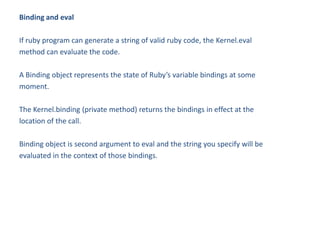
Binding and eval

If ruby program can generate a string of valid ruby code, the Kernel.eval
method can evaluate the code.

A Binding object represents the state of Ruby’s variable bindings at some
moment.

The Kernel.binding (private method) returns the bindings in effect at the
location of the call.

Binding object is second argument to eval and the string you specify will be
evaluated in the context of those bindings.
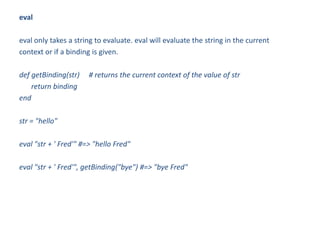
eval

eval only takes a string to evaluate. eval will evaluate the string in the current
context or if a binding is given.

def getBinding(str)    # returns the current context of the value of str
    return binding
end

str = "hello"

eval "str + ' Fred'" #=> "hello Fred"

eval "str + ' Fred'", getBinding("bye") #=> "bye Fred"
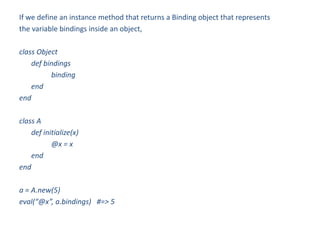
If we define an instance method that returns a Binding object that represents
the variable bindings inside an object,

class Object
    def bindings
          binding
    end
end

class A
    def initialize(x)
           @x = x
    end
end

a = A.new(5)
eval(“@x”, a.bindings) #=> 5
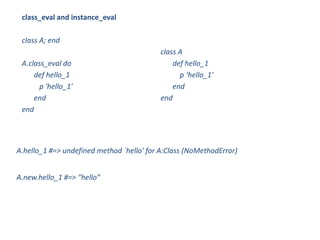
class_eval and instance_eval

 class A; end
                                           class A
 A.class_eval do                               def hello_1
     def hello_1                                 p ‘hello_1’
      p 'hello_1'                              end
     end                                   end
 end


A.hello_1 #=> undefined method `hello' for A:Class (NoMethodError)


A.new.hello_1 #=> “hello”
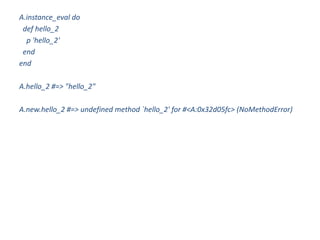
A.instance_eval do
 def hello_2
  p 'hello_2'
 end
end

A.hello_2 #=> "hello_2"

A.new.hello_2 #=> undefined method `hello_2' for #<A:0x32d05fc> (NoMethodError)
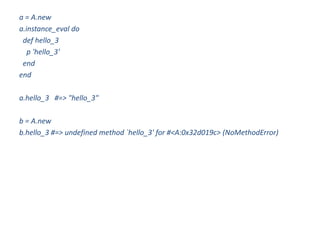
a = A.new
a.instance_eval do
 def hello_3
   p 'hello_3'
 end
end

a.hello_3 #=> "hello_3"

b = A.new
b.hello_3 #=> undefined method `hello_3' for #<A:0x32d019c> (NoMethodError)
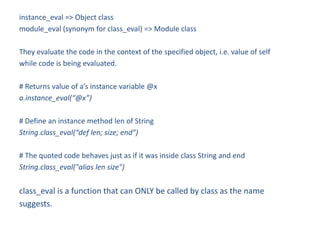
instance_eval => Object class
module_eval (synonym for class_eval) => Module class

They evaluate the code in the context of the specified object, i.e. value of self
while code is being evaluated.

# Returns value of a’s instance variable @x
a.instance_eval(“@x”)

# Define an instance method len of String
String.class_eval(“def len; size; end”)

# The quoted code behaves just as if it was inside class String and end
String.class_eval("alias len size")


class_eval is a function that can ONLY be called by class as the name
suggests.
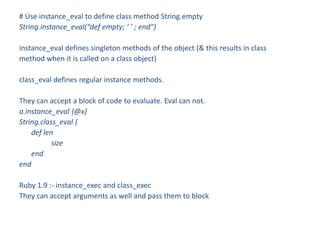
# Use instance_eval to define class method String.empty
String.instance_eval(“def empty; ‘ ’ ; end”)

instance_eval defines singleton methods of the object (& this results in class
method when it is called on a class object)

class_eval defines regular instance methods.

They can accept a block of code to evaluate. Eval can not.
a.instance_eval {@x}
String.class_eval {
    def len
           size
    end
end

Ruby 1.9 :- instance_exec and class_exec
They can accept arguments as well and pass them to block
class A
  has_attribute :my_attribute, :another_attribute
end

a = A.new

puts a.methods - Object.methods
# => ["my_attribute", my_attribute=", "another_attribute", "another_attribute="]

a.my_attribute = 1
a.my_attribute # => 1

a.another_attribute = "A String"
a.another_attribute # => "A String"
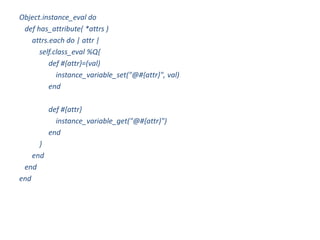
Object.instance_eval do
 def has_attribute( *attrs )
   attrs.each do | attr |
      self.class_eval %Q{
         def #{attr}=(val)
            instance_variable_set("@#{attr}", val)
         end

          def #{attr}
            instance_variable_get("@#{attr}")
          end
      }
    end
 end
end
Thank you !

Introduction to ruby eval

  • 1.
    topic = ‘Introductionto Ruby eval’ eval(“p topic”) - Niranjan Sarade
  • 2.
    Binding and eval Ifruby program can generate a string of valid ruby code, the Kernel.eval method can evaluate the code. A Binding object represents the state of Ruby’s variable bindings at some moment. The Kernel.binding (private method) returns the bindings in effect at the location of the call. Binding object is second argument to eval and the string you specify will be evaluated in the context of those bindings.
  • 3.
    eval eval only takesa string to evaluate. eval will evaluate the string in the current context or if a binding is given. def getBinding(str) # returns the current context of the value of str return binding end str = "hello" eval "str + ' Fred'" #=> "hello Fred" eval "str + ' Fred'", getBinding("bye") #=> "bye Fred"
  • 4.
    If we definean instance method that returns a Binding object that represents the variable bindings inside an object, class Object def bindings binding end end class A def initialize(x) @x = x end end a = A.new(5) eval(“@x”, a.bindings) #=> 5
  • 5.
    class_eval and instance_eval class A; end class A A.class_eval do def hello_1 def hello_1 p ‘hello_1’ p 'hello_1' end end end end A.hello_1 #=> undefined method `hello' for A:Class (NoMethodError) A.new.hello_1 #=> “hello”
  • 6.
    A.instance_eval do defhello_2 p 'hello_2' end end A.hello_2 #=> "hello_2" A.new.hello_2 #=> undefined method `hello_2' for #<A:0x32d05fc> (NoMethodError)
  • 7.
    a = A.new a.instance_evaldo def hello_3 p 'hello_3' end end a.hello_3 #=> "hello_3" b = A.new b.hello_3 #=> undefined method `hello_3' for #<A:0x32d019c> (NoMethodError)
  • 8.
    instance_eval => Objectclass module_eval (synonym for class_eval) => Module class They evaluate the code in the context of the specified object, i.e. value of self while code is being evaluated. # Returns value of a’s instance variable @x a.instance_eval(“@x”) # Define an instance method len of String String.class_eval(“def len; size; end”) # The quoted code behaves just as if it was inside class String and end String.class_eval("alias len size") class_eval is a function that can ONLY be called by class as the name suggests.
  • 9.
    # Use instance_evalto define class method String.empty String.instance_eval(“def empty; ‘ ’ ; end”) instance_eval defines singleton methods of the object (& this results in class method when it is called on a class object) class_eval defines regular instance methods. They can accept a block of code to evaluate. Eval can not. a.instance_eval {@x} String.class_eval { def len size end end Ruby 1.9 :- instance_exec and class_exec They can accept arguments as well and pass them to block
  • 10.
    class A has_attribute :my_attribute, :another_attribute end a = A.new puts a.methods - Object.methods # => ["my_attribute", my_attribute=", "another_attribute", "another_attribute="] a.my_attribute = 1 a.my_attribute # => 1 a.another_attribute = "A String" a.another_attribute # => "A String"
  • 11.
    Object.instance_eval do defhas_attribute( *attrs ) attrs.each do | attr | self.class_eval %Q{ def #{attr}=(val) instance_variable_set("@#{attr}", val) end def #{attr} instance_variable_get("@#{attr}") end } end end end
  • 12.