QUEUING THEORY
B.MAMATHA
MBA
Introduction to Queuing Models
 Queuing models analyze how customers (including people, objects,
and information) receive a service.
 Queueing theory is the mathematical study of waiting lines, or
queues.
 Queuing models are also called “Waiting line models” was done by
A.K. Erlang.
 The evolution of queuing theory was done after second world war2.
 The field of telephone traffic was further developed by Molins(1927)
& Thornton D-fry(1928).
Mostly ques are found in Hospitals ,Industries ,schools ,Book stores, Post offices
,Petrol pumps ,Theatres etc..
Waiting line problem arise because ,there is a too much demand on the facilities
so that there is an excess of waiting time (or) insufficient number of service
facilities.
There is too less demand, in which there is too much idle facility time (or) too
many facilities.
QUEUING MODELS
• Queuing theory is the analysis of waiting lines.
• It can be used for-
Determine the type of line to have at a bank.
Determine the seating procedures at a restaurant.
Determine the scheduling of patients at a clinic.
Landing procedures at an airport.
Determine the toll booths to have open on a bridge.
Examples
• These all queuing models represents common feature. Customers arrive at a
service centre and wait for service.
• The arrival of customers is not necessarily regular and so is the time taken for
service not uniform.
• Queues build up during hours of demand and disappear during the idle period.
Applications of Queuing Models
• Scheduling of mechanical transport flute.
• Scheduling of jobs in production control.
• Minimization of congestion(state of being very full of people)due to traffic delay at
toll booths.
• Solution of inventory control problems.
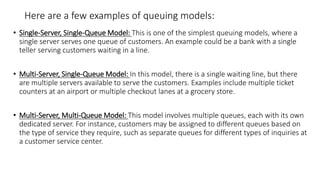
Here are a few examples of queuing models:
• Single-Server, Single-Queue Model: This is one of the simplest queuing models, where a
single server serves one queue of customers. An example could be a bank with a single
teller serving customers waiting in a line.
• Multi-Server, Single-Queue Model: In this model, there is a single waiting line, but there
are multiple servers available to serve the customers. Examples include multiple ticket
counters at an airport or multiple checkout lanes at a grocery store.
• Multi-Server, Multi-Queue Model: This model involves multiple queues, each with its own
dedicated server. For instance, customers may be assigned to different queues based on
the type of service they require, such as separate queues for different types of inquiries at
a customer service center.
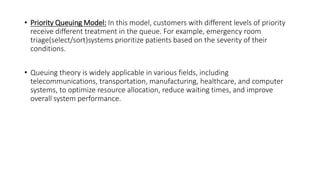
• Priority Queuing Model: In this model, customers with different levels of priority
receive different treatment in the queue. For example, emergency room
triage(select/sort)systems prioritize patients based on the severity of their
conditions.
• Queuing theory is widely applicable in various fields, including
telecommunications, transportation, manufacturing, healthcare, and computer
systems, to optimize resource allocation, reduce waiting times, and improve
overall system performance.
THANK YOU

Introduction to Queuing Models ..pptx

  • 1.
  • 2.
    Introduction to QueuingModels  Queuing models analyze how customers (including people, objects, and information) receive a service.  Queueing theory is the mathematical study of waiting lines, or queues.  Queuing models are also called “Waiting line models” was done by A.K. Erlang.  The evolution of queuing theory was done after second world war2.  The field of telephone traffic was further developed by Molins(1927) & Thornton D-fry(1928).
  • 3.
    Mostly ques arefound in Hospitals ,Industries ,schools ,Book stores, Post offices ,Petrol pumps ,Theatres etc.. Waiting line problem arise because ,there is a too much demand on the facilities so that there is an excess of waiting time (or) insufficient number of service facilities. There is too less demand, in which there is too much idle facility time (or) too many facilities.
  • 4.
    QUEUING MODELS • Queuingtheory is the analysis of waiting lines. • It can be used for- Determine the type of line to have at a bank. Determine the seating procedures at a restaurant. Determine the scheduling of patients at a clinic. Landing procedures at an airport. Determine the toll booths to have open on a bridge.
  • 5.
    Examples • These allqueuing models represents common feature. Customers arrive at a service centre and wait for service. • The arrival of customers is not necessarily regular and so is the time taken for service not uniform. • Queues build up during hours of demand and disappear during the idle period.
  • 6.
    Applications of QueuingModels • Scheduling of mechanical transport flute. • Scheduling of jobs in production control. • Minimization of congestion(state of being very full of people)due to traffic delay at toll booths. • Solution of inventory control problems.
  • 7.
    Here are afew examples of queuing models: • Single-Server, Single-Queue Model: This is one of the simplest queuing models, where a single server serves one queue of customers. An example could be a bank with a single teller serving customers waiting in a line. • Multi-Server, Single-Queue Model: In this model, there is a single waiting line, but there are multiple servers available to serve the customers. Examples include multiple ticket counters at an airport or multiple checkout lanes at a grocery store. • Multi-Server, Multi-Queue Model: This model involves multiple queues, each with its own dedicated server. For instance, customers may be assigned to different queues based on the type of service they require, such as separate queues for different types of inquiries at a customer service center.
  • 8.
    • Priority QueuingModel: In this model, customers with different levels of priority receive different treatment in the queue. For example, emergency room triage(select/sort)systems prioritize patients based on the severity of their conditions. • Queuing theory is widely applicable in various fields, including telecommunications, transportation, manufacturing, healthcare, and computer systems, to optimize resource allocation, reduce waiting times, and improve overall system performance.
  • 9.