Introduction to Project Management 2nd Edition Schwalbe Test Bank
Introduction to Project Management 2nd Edition Schwalbe Test Bank
Introduction to Project Management 2nd Edition Schwalbe Test Bank
Introduction to Project Management 2nd Edition Schwalbe Test Bank
Introduction to Project Management 2nd Edition Schwalbe Test Bank
1.
Introduction to ProjectManagement 2nd Edition
Schwalbe Test Bank pdf download
https://testbankfan.com/product/introduction-to-project-
management-2nd-edition-schwalbe-test-bank/
2.
We believe theseproducts will be a great fit for you. Click
the link to download now, or visit testbankfan.com
to discover even more!
Information Technology Project Management 9th Edition
Schwalbe Test Bank
https://testbankfan.com/product/information-technology-project-
management-9th-edition-schwalbe-test-bank/
Information Technology Project Management 7th Edition
Kathy Schwalbe Test Bank
https://testbankfan.com/product/information-technology-project-
management-7th-edition-kathy-schwalbe-test-bank/
Information Technology Project Management Revised 6th
Edition Schwalbe Test Bank
https://testbankfan.com/product/information-technology-project-
management-revised-6th-edition-schwalbe-test-bank/
Advanced Accounting 12th Edition Hoyle Test Bank
https://testbankfan.com/product/advanced-accounting-12th-edition-
hoyle-test-bank/
3.
Accounting Tools ForBusiness Decision Making 4th
Edition Kimmel Solutions Manual
https://testbankfan.com/product/accounting-tools-for-business-
decision-making-4th-edition-kimmel-solutions-manual/
Concise Introduction to Logic 11th Edition Hurley
Solutions Manual
https://testbankfan.com/product/concise-introduction-to-
logic-11th-edition-hurley-solutions-manual/
Biocalculus Calculus Probability and Statistics for the
Life Sciences 1st Edition Stewart Solutions Manual
https://testbankfan.com/product/biocalculus-calculus-probability-
and-statistics-for-the-life-sciences-1st-edition-stewart-
solutions-manual/
Micro Economy Today 13th Edition Hill Test Bank
https://testbankfan.com/product/micro-economy-today-13th-edition-
hill-test-bank/
Starting Out with Visual Basic 7th Edition Gaddis Test
Bank
https://testbankfan.com/product/starting-out-with-visual-
basic-7th-edition-gaddis-test-bank/
4.
Essentials of StrategicManagement The Quest for
Competitive Advantage 4th Edition Gamble Test Bank
https://testbankfan.com/product/essentials-of-strategic-
management-the-quest-for-competitive-advantage-4th-edition-
gamble-test-bank/
5.
Chapter 5: PlanningProjects, Part 2 (Project Quality, Human Resource,
Communications, Risk, And Procurement Management)
TRUE/FALSE
1. Quality, human resource, communications, risk, and procurement management are incidental to project
success.
ANS: F PTS: 1 REF: 162
2. Project plans provide the basis for executing tasks.
ANS: T PTS: 1 REF: 162
3. Project management involves meeting or exceeding stakeholder needs and expectations.
ANS: T PTS: 1 REF: 164
4. The project manager ultimately decides what level of quality is acceptable.
ANS: F PTS: 1 REF: 164
5. Quality must be considered on an equal level of importance with project scope, time, and cost.
ANS: T PTS: 1 REF: 164
6. A single project should have only one checklist.
ANS: F PTS: 1 REF: 167
7. People determine the success and failure of organizations and projects.
ANS: T PTS: 1 REF: 169
8. The size and complexity of the project determines how simple or complex the organizational chart is.
ANS: T PTS: 1 REF: 169
9. Having a plan guarantees that all communications will flow smoothly.
ANS: F PTS: 1 REF: 173
10. The communications management plan for any project should always be expressed in written form.
ANS: T PTS: 1 REF: 174
11. Project Web sites provide a centralized way of delivering project documents and other
communications.
ANS: T PTS: 1 REF: 176
12. Risk management contributes very little to the chance of a project succeeding.
6.
ANS: F PTS:1 REF: 177
13. A risk management plan summarizes how risk management will be performed on a particular project.
ANS: T PTS: 1 REF: 178
14. Project teams should initially focus on risk events that fall in the low sections of the probability/impact
matrix.
ANS: F PTS: 1 REF: 181
15. There can be one or more potential responses to each risk event.
ANS: T PTS: 1 REF: 183
16. Many people should be responsible for monitoring each risk event.
ANS: F PTS: 1 REF: 183
17. Project managers should include clauses in contracts to help manage project risks.
ANS: T PTS: 1 REF: 183
18. By having suppliers visibly compete against each other, the buyers reduce their risks and benefit from
competition.
ANS: T PTS: 1 REF: 185
19. Good procurement management typically involves buyers and sellers in a zero-sum game.
ANS: F PTS: 1 REF: 186
20. In the context of choosing whether to make or buy goods and services, the members of the
Just-In-Time Training project would be exercising the “make” option if they conducted basic
management training in-house.
ANS: T PTS: 1 REF: 188
21. Unlike other project plans, the contents of the procurement management plan do not vary with project
needs.
ANS: F PTS: 1 REF: 190
22. Contract type is a key consideration in a procurement management plan.
ANS: T PTS: 1 REF: 190
23. The salaries for people working directly on a project and materials purchased for a specific project are
indirect costs.
ANS: F PTS: 1 REF: 191
24. Indirect costs are often calculated as a percentage of direct costs.
7.
ANS: T PTS:1 REF: 191
25. A bid is a document prepared by buyers providing pricing for standard items that have been clearly
defined by the seller.
ANS: F PTS: 1 REF: 193
26. A weighted scoring model provides a systematic process for selection based on numerous criteria.
ANS: T PTS: 1 REF: 195
MULTIPLE CHOICE
1. Project ____ management ensures that the project will satisfy the stated or implied needs for which it
was undertaken.
a. integration c. portfolio
b. quality d. performance
ANS: B PTS: 1 REF: 163
2. ____ to requirements means that the project’s processes and products meet written specifications.
a. Voluntary adherence c. Conformance
b. Management d. Fidelity
ANS: C PTS: 1 REF: 163
3. If a project’s stakeholders are not satisfied with the quality of the project management or the resulting
products or services, the project team will need to adjust ____, time, and cost to satisfy stakeholder
needs and expectations.
a. range c. vision
b. breadth d. scope
ANS: D PTS: 1 REF: 164
4. Examples of common ____ used by organizations include failure rates of products produced,
availability of goods and services, and customer satisfaction ratings.
a. metrics c. requirements
b. analytics d. guidelines
ANS: A PTS: 1 REF: 166
5. Two important metrics related to the Just-In-Time Training project include the ____ and course
evaluation ratings.
a. rate of attrition c. overall attendance
b. survey response rate d. quantity of lesson modules
ANS: B PTS: 1 REF: 167
6. A project ____ chart is a graphic representation of how authority and responsibility is distributed
within the project.
a. organizational c. stakeholder
b. planning d. management
ANS: A PTS: 1 REF: 169
8.
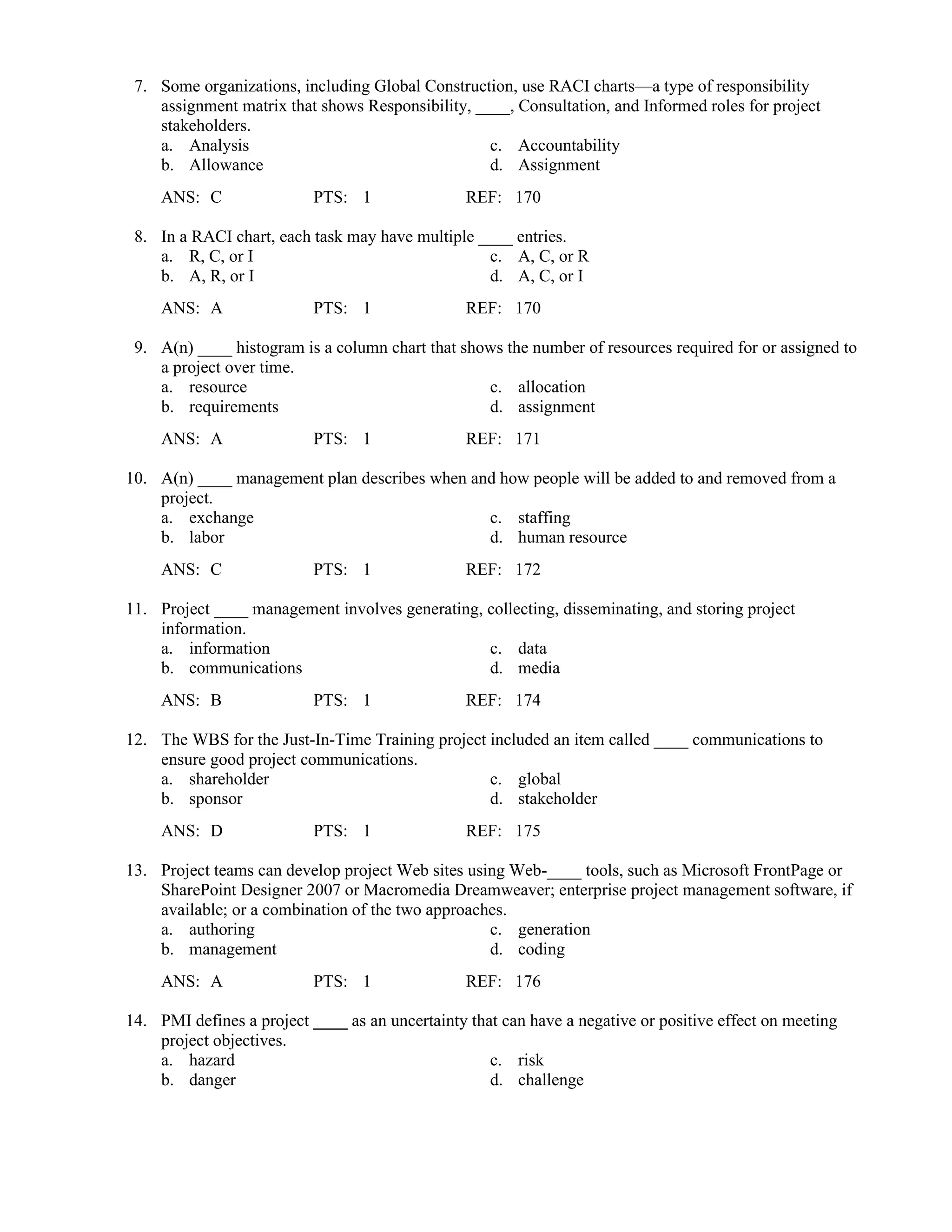
7. Some organizations,including Global Construction, use RACI charts—a type of responsibility
assignment matrix that shows Responsibility, ____, Consultation, and Informed roles for project
stakeholders.
a. Analysis c. Accountability
b. Allowance d. Assignment
ANS: C PTS: 1 REF: 170
8. In a RACI chart, each task may have multiple ____ entries.
a. R, C, or I c. A, C, or R
b. A, R, or I d. A, C, or I
ANS: A PTS: 1 REF: 170
9. A(n) ____ histogram is a column chart that shows the number of resources required for or assigned to
a project over time.
a. resource c. allocation
b. requirements d. assignment
ANS: A PTS: 1 REF: 171
10. A(n) ____ management plan describes when and how people will be added to and removed from a
project.
a. exchange c. staffing
b. labor d. human resource
ANS: C PTS: 1 REF: 172
11. Project ____ management involves generating, collecting, disseminating, and storing project
information.
a. information c. data
b. communications d. media
ANS: B PTS: 1 REF: 174
12. The WBS for the Just-In-Time Training project included an item called ____ communications to
ensure good project communications.
a. shareholder c. global
b. sponsor d. stakeholder
ANS: D PTS: 1 REF: 175
13. Project teams can develop project Web sites using Web-____ tools, such as Microsoft FrontPage or
SharePoint Designer 2007 or Macromedia Dreamweaver; enterprise project management software, if
available; or a combination of the two approaches.
a. authoring c. generation
b. management d. coding
ANS: A PTS: 1 REF: 176
14. PMI defines a project ____ as an uncertainty that can have a negative or positive effect on meeting
project objectives.
a. hazard c. risk
b. danger d. challenge
9.
ANS: C PTS:1 REF: 177
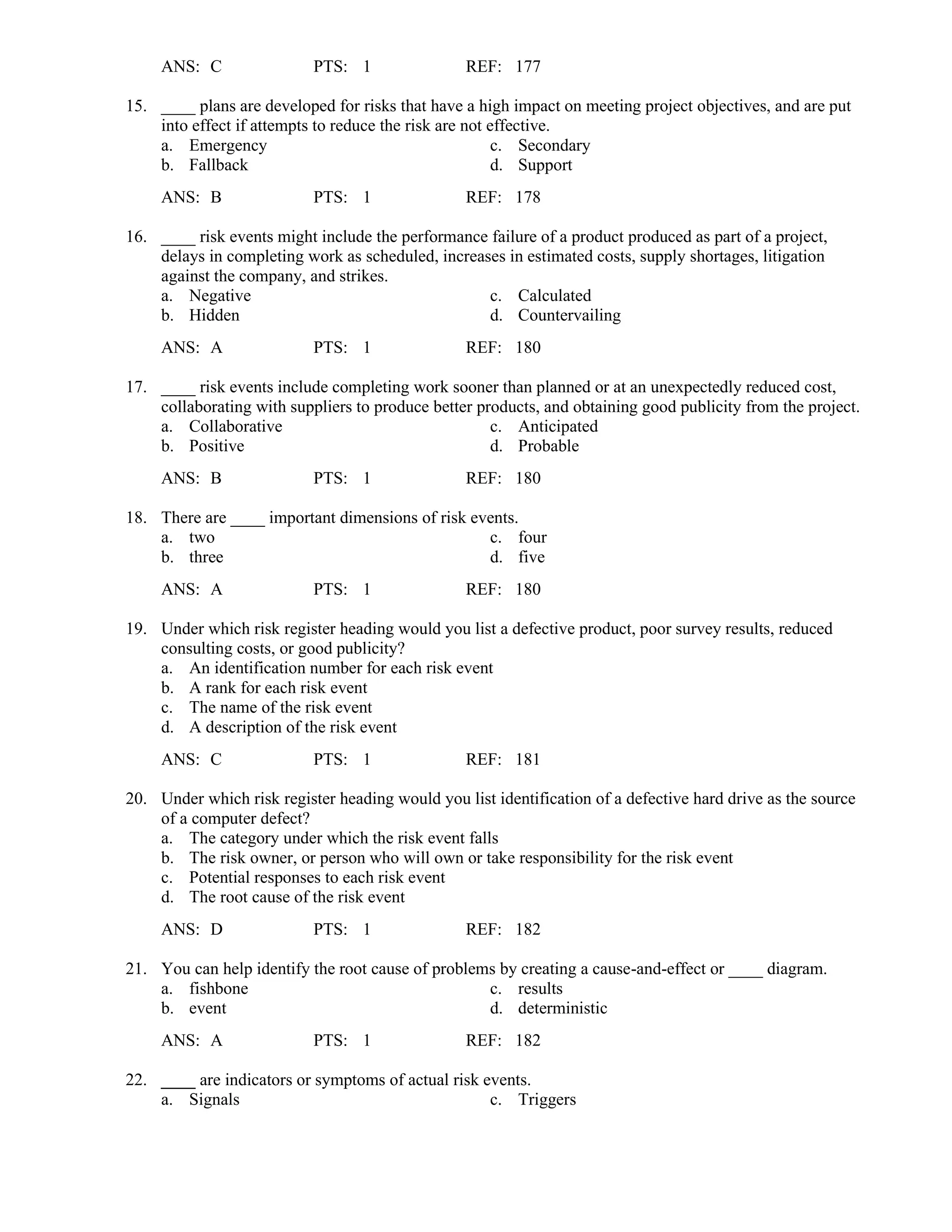
15. ____ plans are developed for risks that have a high impact on meeting project objectives, and are put
into effect if attempts to reduce the risk are not effective.
a. Emergency c. Secondary
b. Fallback d. Support
ANS: B PTS: 1 REF: 178
16. ____ risk events might include the performance failure of a product produced as part of a project,
delays in completing work as scheduled, increases in estimated costs, supply shortages, litigation
against the company, and strikes.
a. Negative c. Calculated
b. Hidden d. Countervailing
ANS: A PTS: 1 REF: 180
17. ____ risk events include completing work sooner than planned or at an unexpectedly reduced cost,
collaborating with suppliers to produce better products, and obtaining good publicity from the project.
a. Collaborative c. Anticipated
b. Positive d. Probable
ANS: B PTS: 1 REF: 180
18. There are ____ important dimensions of risk events.
a. two c. four
b. three d. five
ANS: A PTS: 1 REF: 180
19. Under which risk register heading would you list a defective product, poor survey results, reduced
consulting costs, or good publicity?
a. An identification number for each risk event
b. A rank for each risk event
c. The name of the risk event
d. A description of the risk event
ANS: C PTS: 1 REF: 181
20. Under which risk register heading would you list identification of a defective hard drive as the source
of a computer defect?
a. The category under which the risk event falls
b. The risk owner, or person who will own or take responsibility for the risk event
c. Potential responses to each risk event
d. The root cause of the risk event
ANS: D PTS: 1 REF: 182
21. You can help identify the root cause of problems by creating a cause-and-effect or ____ diagram.
a. fishbone c. results
b. event d. deterministic
ANS: A PTS: 1 REF: 182
22. ____ are indicators or symptoms of actual risk events.
a. Signals c. Triggers
10.
b. Flags d.Monitors
ANS: C PTS: 1 REF: 183
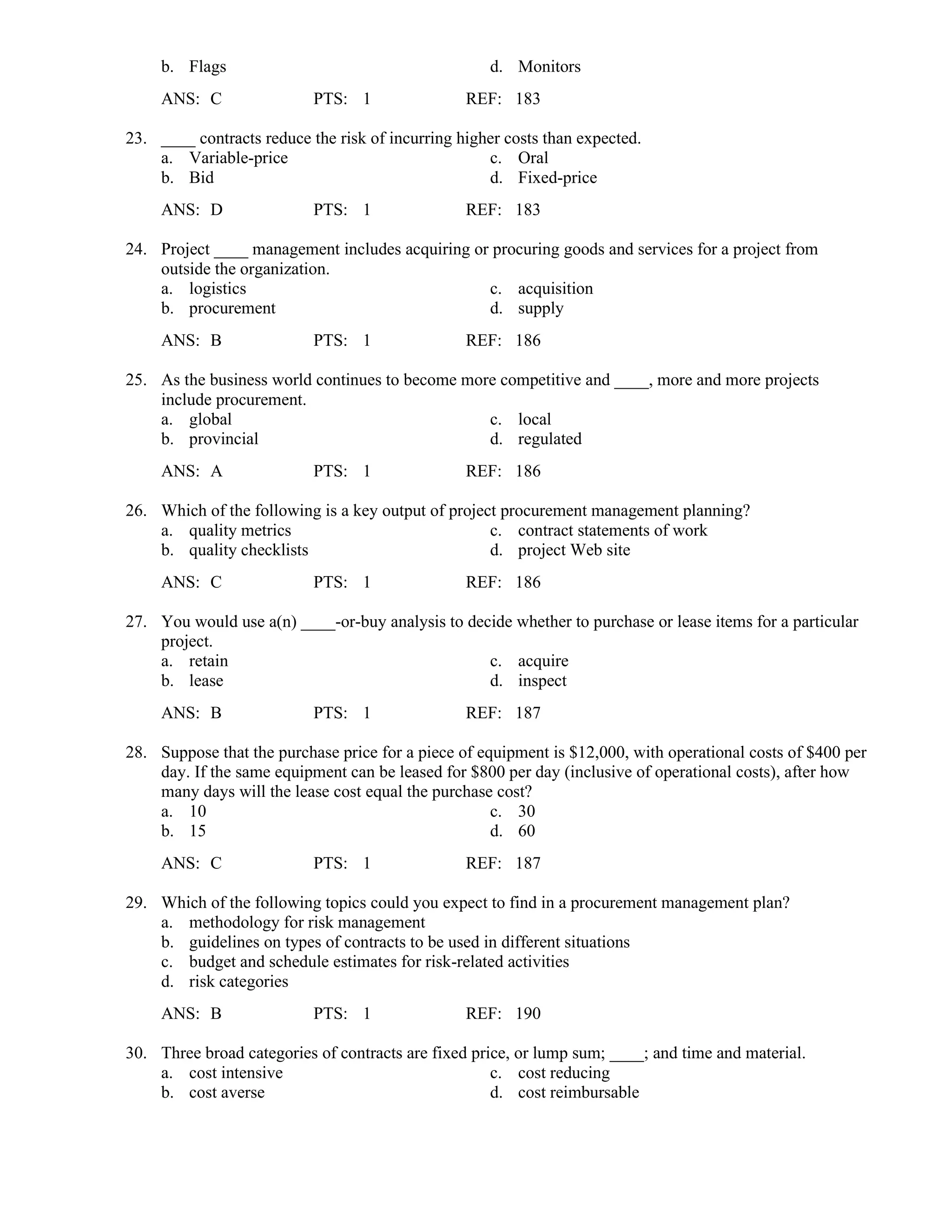
23. ____ contracts reduce the risk of incurring higher costs than expected.
a. Variable-price c. Oral
b. Bid d. Fixed-price
ANS: D PTS: 1 REF: 183
24. Project ____ management includes acquiring or procuring goods and services for a project from
outside the organization.
a. logistics c. acquisition
b. procurement d. supply
ANS: B PTS: 1 REF: 186
25. As the business world continues to become more competitive and ____, more and more projects
include procurement.
a. global c. local
b. provincial d. regulated
ANS: A PTS: 1 REF: 186
26. Which of the following is a key output of project procurement management planning?
a. quality metrics c. contract statements of work
b. quality checklists d. project Web site
ANS: C PTS: 1 REF: 186
27. You would use a(n) ____-or-buy analysis to decide whether to purchase or lease items for a particular
project.
a. retain c. acquire
b. lease d. inspect
ANS: B PTS: 1 REF: 187
28. Suppose that the purchase price for a piece of equipment is $12,000, with operational costs of $400 per
day. If the same equipment can be leased for $800 per day (inclusive of operational costs), after how
many days will the lease cost equal the purchase cost?
a. 10 c. 30
b. 15 d. 60
ANS: C PTS: 1 REF: 187
29. Which of the following topics could you expect to find in a procurement management plan?
a. methodology for risk management
b. guidelines on types of contracts to be used in different situations
c. budget and schedule estimates for risk-related activities
d. risk categories
ANS: B PTS: 1 REF: 190
30. Three broad categories of contracts are fixed price, or lump sum; ____; and time and material.
a. cost intensive c. cost reducing
b. cost averse d. cost reimbursable
11.
ANS: D PTS:1 REF: 190
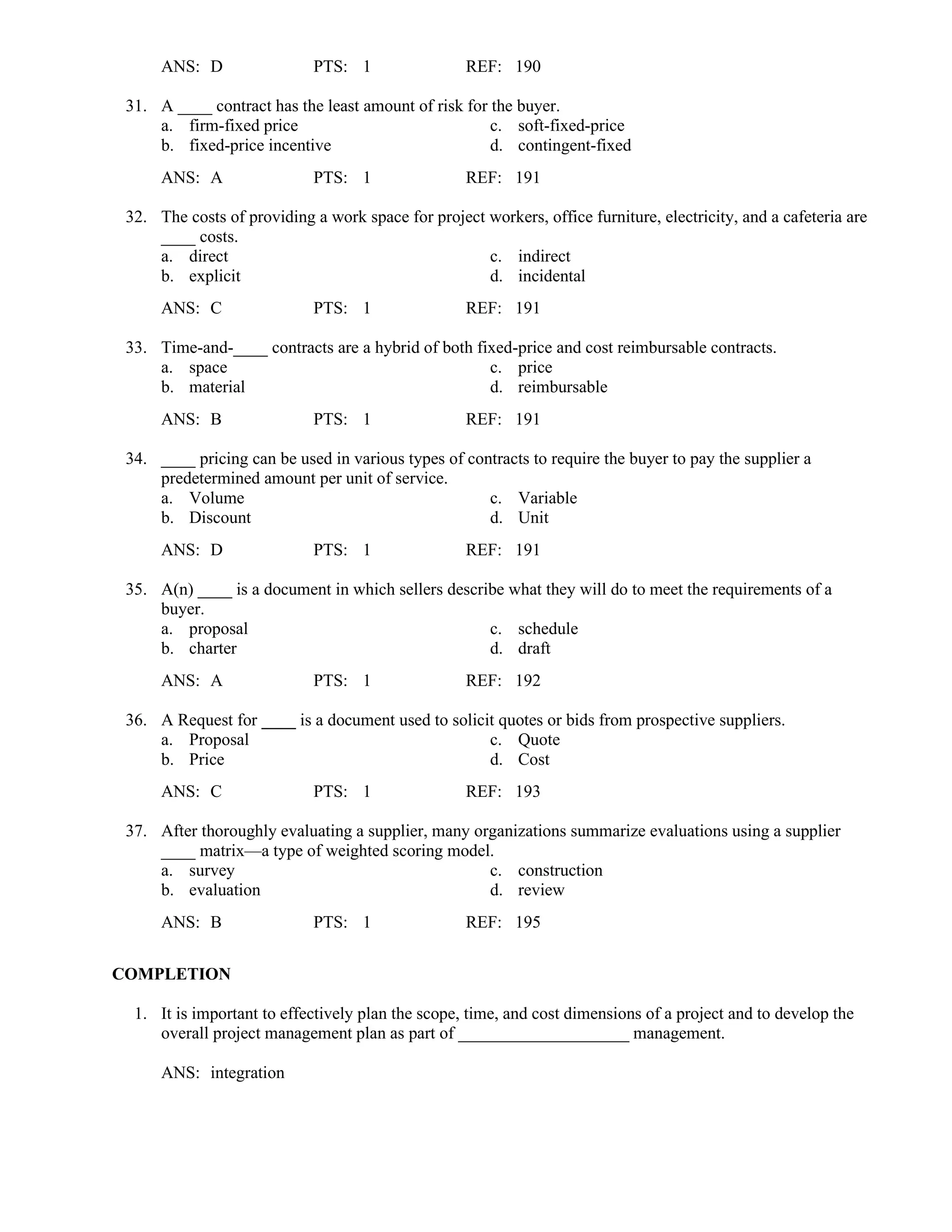
31. A ____ contract has the least amount of risk for the buyer.
a. firm-fixed price c. soft-fixed-price
b. fixed-price incentive d. contingent-fixed
ANS: A PTS: 1 REF: 191
32. The costs of providing a work space for project workers, office furniture, electricity, and a cafeteria are
____ costs.
a. direct c. indirect
b. explicit d. incidental
ANS: C PTS: 1 REF: 191
33. Time-and-____ contracts are a hybrid of both fixed-price and cost reimbursable contracts.
a. space c. price
b. material d. reimbursable
ANS: B PTS: 1 REF: 191
34. ____ pricing can be used in various types of contracts to require the buyer to pay the supplier a
predetermined amount per unit of service.
a. Volume c. Variable
b. Discount d. Unit
ANS: D PTS: 1 REF: 191
35. A(n) ____ is a document in which sellers describe what they will do to meet the requirements of a
buyer.
a. proposal c. schedule
b. charter d. draft
ANS: A PTS: 1 REF: 192
36. A Request for ____ is a document used to solicit quotes or bids from prospective suppliers.
a. Proposal c. Quote
b. Price d. Cost
ANS: C PTS: 1 REF: 193
37. After thoroughly evaluating a supplier, many organizations summarize evaluations using a supplier
____ matrix—a type of weighted scoring model.
a. survey c. construction
b. evaluation d. review
ANS: B PTS: 1 REF: 195
COMPLETION
1. It is important to effectively plan the scope, time, and cost dimensions of a project and to develop the
overall project management plan as part of ____________________ management.
ANS: integration
12.
PTS: 1 REF:162
2. The International Organization for Standardization (ISO) defines ____________________ as “the
degree to which a set of inherent characteristics fulfill requirements” (ISO9000:2000).
ANS: quality
PTS: 1 REF: 163
3. ____________________ for use means that a product can be used as it was intended.
ANS: Fitness
PTS: 1 REF: 164
4. A(n) ____________________ is a standard of measurement.
ANS: metric
PTS: 1 REF: 166
5. A(n) ____________________ is a list of items to be noted or consulted.
ANS: checklist
PTS: 1 REF: 167
6. Project human ____________________ management is concerned with making effective use of the
people involved with a project.
ANS: resource
PTS: 1 REF: 169
7. A(n) ____________________ is a matrix that maps the work of the project as described in the work
breakdown structure (WBS) to the people responsible for performing the work.
ANS:
responsibility assignment matrix
RAM
responsibility assignment matrix (RAM)
RAM (responsibility assignment matrix)
PTS: 1 REF: 169
8. A(n) ____________________ management plan is a document that guides project communications.
ANS: communication
PTS: 1 REF: 174
9. ____________________ are easy-to-use journals on the Web that allow users to write entries, create
links, and upload pictures, while allowing readers to post comments to particular journal entries.
13.
ANS: Blogs
PTS: 1REF: 176
10. Key outputs of project ____________________ management planning include a risk management
plan, a probability/impact matrix, a risk register, and risk-related contractual agreements.
ANS: risk
PTS: 1 REF: 177
11. ____________________ plans are predefined actions that the project team will take if an identified
risk event occurs.
ANS: Contingency
PTS: 1 REF: 178
12. Contingency reserves or contingency ____________________ are funds held by the project sponsor
that can be used to mitigate cost or schedule overruns if unknown risks occur.
ANS: allowances
PTS: 1 REF: 178
13. Risk ____________________ refer to specific, uncertain events that may occur to the detriment or
enhancement of the project.
ANS: events
PTS: 1 REF: 180
14. One side (axis) of a(n) ____________________/impact matrix or chart lists the relative probability of
a risk event occurring, and the other side (axis) of the chart shows the relative impact of the risk event
occurring.
ANS: probability
PTS: 1 REF: 181
15. A risk ____________________ is a document that contains results of various risk management
processes, often displayed in a table or spreadsheet format.
ANS: register
PTS: 1 REF: 181
16. The ____________________ cause of a problem is the real or underlying reason a problem occurs.
ANS: root
PTS: 1 REF: 182
14.
17. Work doneby outside suppliers or sellers should be well documented in ____________________,
which are mutually binding agreements that obligate the seller to provide the specified products or
services, and obligate the buyer to pay for them.
ANS: contracts
PTS: 1 REF: 183
18. Competition for supplying goods and services can also help reduce ____________________ risks and
enhance positive risks on projects.
ANS: negative
PTS: 1 REF: 183
19. Risk management planning addresses procurement-related topics, such as preparing risk-related
____________________ agreements.
ANS: contractual
PTS: 1 REF: 186
20. ____________________ analysis involves estimating the internal costs of providing a product or
service, and comparing that estimate to the cost of outsourcing.
ANS: Make-or-buy
PTS: 1 REF: 187
21. A(n) ____________________ management plan is a document that describes how the procurement
processes will be managed, from developing documentation for making outside purchases or
acquisitions to contract closure.
ANS: procurement
PTS: 1 REF: 190
22. Fixed-price or ____________________ contracts involve a fixed total price for a well defined product
or service.
ANS: lump sum
PTS: 1 REF: 190
23. ____________________ contracts involve payment to the seller for direct and indirect actual costs.
ANS: Cost reimbursable
PTS: 1 REF: 191
24. A(n) ____________________ is a document used to solicit proposals from prospective suppliers.
ANS:
Request for Proposal
15.
RFP
Request for Proposal(RFP)
RFP (Request for Proposal)
PTS: 1 REF: 192
ESSAY
1. Describe quality planning and the quality management plan.
ANS:
Quality planning includes identifying which quality standards are relevant to the project and how best
to satisfy those standards. It also involves designing quality into the products and services of the
project as well as the processes involved in managing the project. It is important to describe important
factors that directly contribute to meeting customer requirements. Organizational policies related to
quality, the scope statement, product descriptions, and related standards and regulations are all
important inputs to the quality planning process.
The quality management plan describes how the project management team will implement quality
policies. Like other project plans, its format and contents vary based on the particular project and
organizational needs. It can be a long, formal document or short and informal.
PTS: 1 REF: 164
2. Describe several functions that may be performed using a RAM (responsibility assignment matrix).
ANS:
A RAM allocates work to responsible and performing organizations, teams, or individuals, depending
on the desired level of detail. For smaller projects, it is best to assign WBS activities to individuals.
For larger projects, it is more effective to assign the work to organizational units or teams. In addition
to using a RAM to assign detailed work activities, you can use a RAM to define general roles and
responsibilities on projects. This type of RAM can include the stakeholders in the project. The project
team should decide what to use as categories in the RAM and include a key to explain those
categories. For example, a RAM can show whether stakeholders are accountable for (A) or just
participants (P) in part of a project, and whether they are required to provide input (I), review (R), or
sign off (S) on parts of a project. This simple tool enables the project manager to efficiently
communicate the roles of project team members and expectations of important project stakeholders.
PTS: 1 REF: 169
3. Identify eight items that should be addressed by a communications management plan.
ANS:
The communications management plan should address the following items:
Stakeholder communications requirements
Information to be communicated, including format, content, and level of detail
Identification of who will receive the information and who will produce it
Suggested methods or guidelines for conveying the information
Description of the frequency of communication
Escalation procedures for resolving issues
Revision procedures for updating the communications management plan
A glossary of common terminology used on the project.
PTS: 1 REF: 174
16.
4. What isthe main purpose of the risk management plan? How should the document be constructed?
ANS:
A risk management plan documents the procedures for managing risk throughout the life of a project.
Project teams should hold several planning meetings early in the project’s life cycle to help develop
the risk management plan. The project team should review project documents as well as corporate risk
management policies, risk categories, lessons learned from past projects, and templates for creating a
risk management plan. It is also important to review the risk tolerances of various stakeholders. For
example, if the project sponsor is risk-averse, the project might require a different approach to risk
management than if the project sponsor were a risk seeker.
PTS: 1 REF: 178
5. What is a contract statement of work (SOW) and how should it be specified?
ANS:
A contract statement of work (SOW) is a description of the work that is to be purchased. The SOW
should be included with the RFP to clarify the work that needs to be performed. The contract SOW is a
type of scope statement that describes the work in sufficient detail to allow prospective suppliers to
both determine if they are capable of providing the goods and services required, and determine an
appropriate price for the work. A contract SOW should be clear, concise, and as complete as possible.
It should describe all services required and include performance information, such as the location and
timing of the work. It is important to use appropriate words in a contract SOW—for example, must
instead of may. Must implies that something has to be done; may implies that there is a choice
involved. The contract SOW should specify the products and services required for the project, use
industry terms, and refer to industry standards.
PTS: 1 REF: 195
Somewhat calmed bythese reflections, she finally, just as day began to
dawn, dropped into a profound slumber, from which she did not awaken
until nearly ten in the morning.
Fortunately it was Saturday; she had no pupils for that day, and her time
was her own. But she was far from happy as she tried to busy herself with
some light duties about the house. Her thoughts constantly reverted to her
interview with John, and a sense of self-condemnation began to fasten itself
upon her, in view of the attitude she had maintained toward him.
She knew that she had not been kind to him; she had flung scorn and
taunts at him when he was already crushed beneath a heartrending load of
misery and shame. She had manifested antagonism, bitterness, and
resentment toward him. These, summed up, meant hate, and hate meant—
what? "He that hateth his brother is a murderer," was the text that came to
her again with a revolting shock, in reply. John had implied that perhaps she
had wished him dead. She knew, now, that she had, and involuntarily she
passed her hand across her forehead as she thought of that old-time brand
upon the brow of Cain. Had she fallen so low as that? Had she been simply
a whited sepulcher all these years, showing an attractive, gracious,
irreproachable surface to the world, while in her heart she had been nursing
this deadly viper, hate? John had deeply wronged her, but he had wronged
himself far more, and now his sins had brought their own punishment—had
stripped and left him wounded by the wayside; while she, instead of binding
up his wounds, pouring in the oil of kindness and the wine of cheer and
good will, had smitten him afresh. Surely she would not have treated the
veriest stranger like that! True, she had given him money, but how had she
given it—what had been the motive? She knew it had been merely to get rid
of him and to save herself the pain of thinking of him as a starving man.
All this was something similar to, though more effective than, the sifting
she had experienced that never-to-be-forgotten Sunday in church, so long
ago. She realized now that she had not rooted out, but simply buried a little
deeper, for the time being, the corroding bitterness within her heart. Her
interest in Marie Duncan, the kindness and sympathy she had shown her
during her last hours, the change in her own and in the woman's mental
attitude toward each other, together with Marie's surrender of the menacing
19.
newspapers and photographs,which had eliminated all fear of exposure,
had brought to her a deceptive peace, which she had believed to be a
purified conscience. But the test that had come to her now proved to her
that the serpent had only been sleeping, that she still had her battle to fight,
her victory to win, or the evil would recoil upon herself, warp her nature,
and poison her whole future.
It was a season of sackcloth and ashes for Helen, but the searching
introspection to which she subjected herself had uncovered the appalling
effects which long years of secret brooding, self-pity, and self-righteousness
had produced upon her, and awakened a wholesome sense of self-
condemnation and repentance, thus opening the way for a more healthful
mental condition and growth.
She realized all this, in a way; but she did not know how to begin to
tread down the conflicting forces that were rampant within her; how to
silence the mental arguments that were continually affirming that she had
been deeply wronged—that she might, perhaps, forgive, but could never
forget; that John had made his own bed and must lie in it—he had no legal
or moral right to expect either aid or sympathy from her—and so on to the
end of the chapter—or, rather, the chapter seemed to have no end.
"What shall I do?" she finally exclaimed, with a feeling of exhaustion.
"The evil talks to me incessantly, and I do not know how to get the better of
it."
Suddenly she started from her chair, and, going to her desk, opened a
drawer and found a card.
"Mrs. Raymond B. Everleigh, number —— Riverside Drive, New
York," she read aloud, and then stood gravely thinking for a minute or two.
Then she opened her telephone book, found the name and address she
wanted, and called the number opposite over the phone.
"Is this Mrs. Raymond B. Everleigh?" she inquired, when the connection
had been made.
20.
The answer cameback: "Yes, I am Mrs. Everleigh."
"Does Mrs. Everleigh remember the lady who sat with her in church the
third Sunday in May, and to whom she gave her card, asking her to come
again?" Helen questioned.
"Yes, indeed; and I have hoped to see her again—wondered why I have
not."
"It is she who is talking with you now. May I come to see you to-day? I
know it is asking a great favor from a stranger, but——"
Helen's appealing voice ceased while she listened to something that
came from the other end.
"At two o'clock? Oh, thank you! I will be there," she gratefully returned,
as she hung up her receiver and hastened to her room to dress for the street.
CHAPTER XVII.
AS WHEAT IS SIFTED.
At two o'clock Helen rang the bell of Mrs. Everleigh's palatial home on
Riverside Drive. A man in livery admitted her, swept herself and her card
with a comprehensive glance as she laid the bit of pasteboard upon his tray,
obsequiously bowed her into an elegantly appointed reception room, and
disappeared.
Five minutes later Mrs. Everleigh came to her. Helen had thought her a
rarely beautiful woman when she had seen her in church, more than four
months previous; but she seemed a hundredfold more lovely now, dressed
all in simple white, her abundant snowy hair coiled becomingly about her
head, her only ornament an exquisite chain of turquoise set in silver and
21.
almost the colorof her peaceful eyes, and her lips wreathed in sunny,
welcoming smiles.
"Mrs. Ford, I am more than glad to see you," she said, as she cordially
clasped Helen's hand. "And now, if you will allow me to waive the
formalities of a first call, I am going to ask you to come up to my private
sitting room, where we can be wholly by ourselves."
Helen thanked her, and followed her up the grand stairway, noting the
costly furnishings of the great hall, the rare paintings, statuary, bric-a-brac,
et cetera, on every hand; and almost gave vent to an exclamation of childish
delight as she was ushered into an exquisite boudoir on the second floor,
and which was furnished throughout in blue and white; the great chandelier
in the center of the ceiling, and other appliances for lighting, together with
many beautiful vases, being all of crystal or expensive cut glass.
"What an ideal setting for an ideal woman!" she said to herself, as she
entered the room.
"Come and sit here, Mrs. Ford," said Mrs. Everleigh, as she preceded her
to a great bow window, where there were two inviting rockers, with
hassocks to match, a pretty onyx table on which rested a small easel
supporting the photograph of a beautiful young girl, and, standing beside it,
a costly cut-glass vase filled with fresh forget-me-nots.
"What a lovely nook!" was Helen's involuntary tribute, as she sank into
the luxurious chair offered her. "And, oh, that view!" she added, with a
quick indrawn breath, as her glance fell upon the scene without, where,
between splendid great trees, all glorious in their brilliant fall attire of red,
yellow, and green, glimpses of the river, flashing in the sunlight, with the
darker hills beyond, made a picture that one could never forget.
"Yes, it is a scene of which I never tire," returned her hostess, as she took
the other rocker, and thoughtfully pushed a hassock nearer her guest.
"I hope, Mrs. Everleigh, I have not seemed intrusive in asking to come to
you?" Helen observed, after a moment or two, during which she sat silently
22.
drinking in thebeauty before her. "But your kindness to me that day in
church emboldened me to beg the favor."
"My dear, I am happy to have you come—I am glad to be helpful to any
one, as opportunity offers," the elder lady graciously replied.
Helen lifted a glance of surprise to her. She had not hinted that she was
unhappy, or needed help of any kind.
Mrs. Everleigh met her look with her winning smile.
"Your voice told me over the phone, dear, that you were in trouble," she
said. "Now, open your heart to me. What can I do for you?"
Her tone was so kind, her smile and manner so loving, Helen's forced
composure melted like wax in the sun, and a sudden flood of tears rendered
her utterly helpless to respond for the moment.
The strain and excitement of the last forty-eight hours had been very
great, and the loss of two nights' sleep, together with the relentless mental
vivisection to which she had since subjected herself, had robbed her of both
strength and self-control.
"Dear heart," gently entreated her companion, "let the bitterness all out;
then there will be room to pour in the balm and oil."
She leaned back in her chair, and sat silent, with bowed head and averted
eyes, until Helen's weeping ceased, and she began to regain something of
her customary self-possession.
"Dear Mrs. Everleigh," she at length said, as she lifted her tear-stained
face to her, "you have not attempted to question or comfort me, and yet it
seems to me you have been pouring peace into my heart every moment
since I came into this room; my trouble is the old puzzle regarding love and
hate."
"How is it a puzzle?"
23.
"All my life,"Helen explained, "I have believed myself to be a good
woman, a devoted wife and mother, faithful to my duties, charitable,
conscientious, God-fearing, self-sacrificing to a fault, and absolutely loyal
to my friends. I believed all this to be love. When trouble came, I bore it
patiently, taking up my burdens with courage, and setting my face
steadfastly toward the work of regaining for myself and my child that of
which we had been cruelly robbed—home, position, and an honorable
name. I thought I had won, that the goal had been attained, that I had so
firmly established myself no taint of the past could touch me; and I believed
I was happy in what I had achieved, until I suddenly awoke to the fact that
all the fair fabric I had constructed and believed unassailable was only an
outward show, built upon pride and self-righteousness; until I began to
realize that I had all the time been possessed of a subconscious hate, the
hate that wishes people dead and powerless to cross your path again! Does
the picture appall you?"
Helen paused, almost breathless from inward emotion and rapid
speaking.
"My dear, you have uncovered all this in connection with yourself?"
gravely queried Mrs. Everleigh.
"Something has uncovered it," said Helen, with a bitter sigh.
"And what is the result of such searching introspection?"
"I feel like a whited sepulcher. I am appalled, shocked beyond measure
at myself," said Helen, with a gesture of repugnance.
"Do you think it was your real self who was nursing all the evil you have
portrayed?" gently inquired her companion.
Helen lifted a look of surprise to her.
"My real self?" she repeated, in perplexity.
"The real self is the purity—the innate consciousness that shrinks from
evil, and would be clothed upon with the garment of righteousness, of right
24.
thinking and rightliving," said Mrs. Everleigh.
"Then the evil-thinking is the unreal self, and every one possesses a dual
nature? I recognize that—it is the old story of Doctor Jekyll and Mr. Hyde
—but when one wakes up to find that even the good he thinks he has done
is evil, because of the worm at the core, it becomes a mocking paradox,"
said Helen bitterly.
"No, dear; not the good he thinks and has done," opposed her companion
gently, "for every good thought that has taken form in your consciousness,
every good deed that has been the outgrowth of that thought, belongs to
your true self, and nothing can rob you of it. Your efforts to conquer adverse
circumstances, your determination to achieve success in your profession—I
have recently heard Madam Ford sing, and have learned something of her
career," the lady smilingly interposed—"and an honorable name and
position for yourself and your child are all justifiable and praiseworthy. We
have a right to set our standards high and do our utmost, with right motives,
to attain them. But the undercurrent of bitterness, the sense of resentment,
self-pity, self-righteousness—the thinking that is continually arguing about
the faults and sins of the wrongdoer—everything that tends to self-
justification by the condemnation of another is all wrong, and must be put
out, if we hope ever to attain to our ideals, and know real peace of mind. It
matters not how fair our outward living may seem, if the thinking is
wrong."
"I began to realize something of this, that Sunday in church," said Helen.
"It seemed as if a wonderful searchlight had been turned upon my inner
self, revealing lurking demons I never dreamed I was harboring."
"Every one, sooner or later, must be sifted as wheat is sifted—must be
refined as gold is refined; the dross and the chaff must be cast out," said her
companion.
"Oh, tell me how!" Helen exclaimed. "One yearns to be pure in thought
as well as in deed, but the wrong-thinking seems to go on and on of itself.
How can it be conquered?"
"By putting self out of sight and giving loving service to others."
25.
"To those whohave done us desperate wrong?" panted Helen, with an
inward shock.
"Even to those," said Mrs. Everleigh gently. "They need it most of all."
"Oh, you cannot mean that we should take them back into our hearts and
lives, and nourish and serve them again as if no wrong had been done, when
every law of God and man had been violated, every tendril of affection
ruthlessly trampled upon!" Helen's voice was almost inaudible as she
concluded.
Mrs. Everleigh did not immediately reply; she sat gravely thinking for
several minutes.
"Dear Mrs. Ford," she at length began, "we each have different problems
in life to solve, and it is difficult and perhaps unwise for one to say to
another what he or she would do under certain circumstances which had
never come into one's own experience. Loving service is that which best
promotes the welfare of the one served. What might be loving service and
helpful for one might be just the reverse for another. The wrongdoer must
suffer for his wrongdoing, else he would never recognize or repent his sin;
it would be doing irreparable injury to remove his punishment, restoring
joys he had forfeited, privileges he had trampled upon. That would be
encouraging sin. We are commanded to 'cast not our pearls before swine.'
We must not continue to shower blessings and favors indiscriminately upon
those who have shown themselves unappreciative and unworthy of past
benefits. Having cut themselves adrift, it is theirs to work out their own
salvation, and it is not our duty to again put ourselves in contact with the
error that has deliberately wronged and wounded us. And yet, there is
loving service that we can still render even these; we can think and speak
kindly of them, giving honor where honor is due, compassion instead of
condemnation for the errors that hold them in bondage. Such an attitude
cannot fail to crowd out and conquer the bitterness, self-pity, self-
righteousness, condemnation—everything that robs us of our peace. When
we attain to this we shall know that we have no partnership with hate."
"I begin to understand something of what love means," Helen said, in a
tone of awe. "I feel as if I were just beginning to see how to live. You surely
26.
have helped meto empty myself of much of the evil that seemed to be
surging within me when I came here this afternoon. You have indeed
'poured in balm and oil,' and given me much food for thought."
She arose to leave as she spoke, holding out her hand, a look of grateful
appreciation in her eyes.
"Oh, I am not going to let you go yet! I have not said half I wish," cried
her hostess, clasping her extended hand, but forcing her gently back into her
chair; and Helen, eager to learn more from the wisdom that fell from her
lips, sank restfully down among her cushions again, and they talked on for
an hour longer.
"How glad I am you came to me, Mrs. Ford!" Mrs. Everleigh observed,
when she finally said she must go. "I hope to see you often after this—I
shall make it my way to do so, if you will allow me. I heard you sing at the
Wardsworths' shortly after we met in church, and I intended to be
introduced to you at that time, but you had left when I asked to be
presented. You have a great gift, and I am going to beg you to use it for me
some time."
"It will give me great pleasure to do so, Mrs. Everleigh. I would love to
show some appreciation of the good you have done me to-day," Helen
heartily responded, adding, as her eyes sought those of her companion: "It
is a privilege just to look into your peaceful face—one would think that no
blight or sorrow had ever touched you in——"
Mrs. Everleigh's hand closed over Helen's almost spasmodically, and her
lips whitened suddenly, as her glance sought the beautiful photograph
resting on the onyx table beside the vase of forget-me-nots.
"No blight—no sorrow!" she repeated, as she gently drew her visitor a
step nearer the likeness. "Oh, no one escapes the tragedies of this mortal
life, my dear—they pass none of us by. This is a likeness of my daughter. Is
she not beautiful? She was swept from my sight almost before I realized she
was in danger. It seemed as if a whirlwind caught her away, and—she was
all I had—the apple of my eye, the one darling of my heart. The blow left
me with this crown of snow," she went on, touching with tremulous fingers
27.
the hair uponher forehead. "It broke my heart, crushed me to earth for the
time being, and the battle I had to fight was much the same that you are
fighting now. It is only step by step that we conquer in such experiences,
but if we are sincere—'honest in mind and intention'—if we keep our armor
on, and wield a merciless sword upon our secret foes, we must win in the
end."
Helen was very near weeping again as she listened to her. Surely, she
thought, the tragedies of earth pass no one by! Those in palace and hovel
meet on common ground in these great heart sorrows. She lifted the hand
she held, and softly laid her lips against it—she was powerless to speak one
word.
But Mrs. Everleigh quickly quelled her momentary emotion, and her
peaceful smile seemed like a benediction as she turned again to Helen.
"But she made my life very bright while she was here. I have beautiful
things to remember of her; I have very much to be grateful for," she said
bravely. "We must not forget to number our blessings, dear Mrs. Ford," she
continued gravely, "lest we drift back into the former bitterness and
darkness. You still have your lovely daughter, if you have had other trials—
I saw her also at the Wardsworths'—be thankful, and, in the light of that and
other blessings, forget the wrong and blight of the past."
They went downstairs together, Mrs. Everleigh accompanying her visitor
to the door and exacting a promise that she would come again in the near
future, for there was more she wished to say to her when the world seemed
brighter to her.
Helen went home with a sense of peace in her heart such as she had not
known for many weeks. She felt like a different person from what she had
been during the last forty-eight hours. She reviewed every step of her
interview with Mrs. Everleigh, analyzing her arguments, making a personal
application of them, and seeking to attain to a higher understanding of
them.
"Loving service for even those who have wronged us most!" This had
impressed her more deeply than anything else she had said, and as she
28.
conned it o'erand o'er she came to see that to purify her own consciousness
of evil-thinking against John—he who had wronged her most, who had put
the worst possible humiliation and suffering upon her—would not only
release her from the intolerable bondage of mental discord which she had
suffered for years whenever he had come into her thought, but would also
be obeying the divine command: "Do unto others as ye would they should
do unto you."
She might never see or hear from John again—she hoped she would not;
he had said he would trouble her no more; but whether he did or not, she
knew that the bitterness of hate was past, and in its place there was dawning
a peace that comes to all those who realize and practice the greatest of all
virtues—"Charity, the love that thinketh no evil."
CHAPTER XVIII.
LOVING SERVICE.
When Helen entered the vestibule to the Grenoble, where she lived, on
her return from her visit to Mrs. Everleigh, she found Mrs. Harding, to
whom she had sent John the night before, in the vestibule, just about to ring
her bell, and knew instantly, from the woman's face, that something had
gone wrong.
"What is it?" she inquired, with quickened pulses.
"You sent a man—Mr. Williams—to me last night?"
"Yes." Helen was touched by the fact that John had taken pains to
conceal his identity by giving his middle name to the woman.
He had been taken ill in the night, Mrs. Harding told her, and she had
found him delirious in the morning. She had sent for a physician—Doctor
29.
Wing—who seemed tothink the case critical, and wanted him taken to
some hospital, where he could have better air, and a constant attendant; but,
Mrs. Harding explained, she felt she ought to come and talk with madam
before consenting to the move.
"That was right," observed Helen, who had been thinking rapidly while
the woman was talking. "I knew Mr.—Williams years ago in San Francisco,
and I am sure his friends would not wish him sent to a hospital. He told me
he intended to start for California to-day—he had his ticket—so his friends
will be looking for him next week."
"Well, marm, it is my opinion that he'll never see San Francisco again,"
said the woman, with a grave shake of her head.
"Oh!" cried Helen sharply; "is he as ill as that?"
Was John going to die, after all? She was shocked through and through
at the thought. No, he must not—he should not! She could never forgive
herself for the dreadful things she had thought and said the night before, if
he did.
Had her repentance come too late? Was she to have no opportunity to
prove the sincerity of her desire to put into practice the higher interpretation
of love to which she was beginning to awake?
"He's an awful sick man, marm," her companion replied.
"When will Doctor Wing go to see him again?"
"He said he'd drop in about six o'clock."
"Then I will be there at six, also; I wish to talk with Doctor Wing,"
Helen observed, and Mrs. Harding, anxious to get back to her charge, but
evidently relieved to have her responsibility shared, went her way.
When Helen had leased her apartment at the Grenoble, she had hired
another smaller suite of two rooms and bath, adjoining, and running at right
angles with it. These she had fitted up attractively as a studio, where she
30.
gave her lessonsand prepared for her social engagements, thus leaving her
apartment free for Dorrie to entertain her friends whenever she wished. At
her request, her landlord had cut a door between the suites, and this
arrangement had enabled her to go back and forth without being obliged to
pass through the public hall.
While talking with Mrs. Harding she had conceived a plan to meet
Doctor Wing's desire for better air and good care for his patient. She would
put a bed and other comforts in the larger room of the studio. Mrs. Harding
was a good, sensible, reliable woman, capable in every way—and she
would engage her and a trained nurse, if necessary, to take care of the
invalid. John should have every possible chance for his life that she could
give him, and perhaps this would blot out that dreadful suspicion he had
voiced that she had wished him out of the way.
She unfolded this plan to Doctor Wing when she went to Mrs. Harding's
to meet him, at six o'clock, and, the physician cordially approving it, in less
than three hours the sick man was transferred to Helen's cheerful, well-
ventilated rooms, with good Mrs. Harding as nurse and attendant.
The woman said she would prefer to take care of him alone; she believed
she could do it, and it would be much easier for her than to be subjected to
the red tape and rigid rules of a trained nurse. Helen seconded this
proposition, saying she, too, would do whatever she was able, and would
stand ready to provide a trained nurse at any moment, if the plan did not
work to Doctor Wing's entire satisfaction.
The physician gave his consent somewhat reluctantly, but said they
would try it for a day or two. He was somewhat at a loss to understand
Madam Ford's interest in the man, even though she had frankly explained
that she had known both him and his family when, years ago, she also had
lived in San Francisco.
However, it was no affair of his, only so far as it made better conditions
for his patient; the rooms she offered were certainly more desirable than a
cot in the public ward of a hospital would be, and madam, if she were doing
this simply because of a friendly interest in him and his far-off family, was a
rare woman, indeed.
31.
For two weeksit seemed a doubtful battle for the sick man, who was
delirious and entirely unconscious of his condition and surroundings; but at
the end of that time he began slowly to mend, although he manifested very
little interest in the fact, obediently submitting to whatever was done or
prescribed for him, but with a feeble air of protest that was discouraging to
those interested in him.
"He doesn't want to get well," Mrs. Harding told the physician, when he
came one morning and found his patient very weak and unresponsive to his
cheerful greeting.
"I know it, poor fellow!" he gravely replied. "But we will do the best we
can for him, although it looks as if that 'best' will not keep him here very
long."
"Where am I?" John asked his nurse a few days later. "Is this a hospital?"
"No, it is a small suite," she told him. "Some one who was not going to
occupy it for a while offered the use of it to Doctor Wing, so he brought you
here and engaged me to take care of you."
Helen had insisted that her agency in the matter was not to be known—at
least, not at present, and when John came to himself she withdrew from the
rooms altogether.
"A man does not like to be under obligations to a woman," she had said,
"and doubtless we shall soon hear from his friends, who will then assume
the care of him."
But John, as he slowly improved, in spite of his indifference to life,
appeared intuitively to realize that he was not wholly indebted to the good
doctor for the comforts he was enjoying. The rooms were handsomely
furnished; there were dainty and womanly touches all around him that
somehow suggested a familiar atmosphere; the bed linen and towels were
fine and heavy; a rich, warm-hued dressing robe and nice underwear had
been provided for him, and, with the artistic tray on which his food was
served, the pretty hand-painted china, and bright flowers in unique vases,
besides many luxuries to tempt his appetite, all betrayed a thoughtful
32.
interest that strangers,or a strange doctor, would hardly bestow upon one so
destitute as himself.
He talked very little with either his physician or Mrs. Harding; asked no
questions, yet was always appreciative of any service rendered him. By the
end of four weeks he was able to sit up in a great easy-chair by a sunny
window, where he would remain as long as was permitted, sometimes
sitting with closed eyes, apparently thinking; at others manifesting a trifle
more interest than heretofore by studying the surrounding buildings and his
rooms.
He was now allowed to have a daily paper to look over, and Doctor
Wing tried to draw him out on current events and other subjects, now and
then telling a pleasant story or a piquant joke; but while John was always
most courteous in his bearing and conversation he could hardly be said to
be responsive to these efforts in his behalf.
One day there came a tap on the door leading into Helen's apartment.
John caught the sound, although the door of the room he was in was
partially closed. Mrs. Harding answered the summons, there followed a few
low-spoken words, and presently the woman returned, bearing in her hands
a basket of luscious fruit, a few fragrant flowers carelessly scattered over it.
"Where did you get it?" the man inquired, his face lighting with pleasure
at the attractive offering. It was the first really spontaneous sign of interest
he had manifested.
"A lady who lives in the next suite sent it in to you," Mrs. Harding
explained, as she laid a tempting peach, with a bunch of grapes, upon a
plate and passed it to him.
John sat suddenly erect, exhibiting an energy which betrayed to Mrs.
Harding that he possessed more strength than she had supposed. He flushed
a hot crimson, glanced alertly out of the window near him, then at the door
leading into the hall, through which the doctor usually entered. He next set
his plate upon a small table beside him, arose, and went to another window,
where he stood for several minutes, studying the surroundings outside.
33.
Presently he returnedto his chair and his fruit, a wan smile curling his
lips, for between certain suspicions that had beset him of late and a rather
accurate bump of location he had gotten his bearings at last, and thought he
knew where he was.
"Mrs. Harding, this house is the Grenoble, is it not?" he quietly inquired,
as he began to pare his peach, but with hands that trembled in spite of his
efforts to conceal his excitement.
"Um—yes," she replied, with some reluctance.
"And Madam Ford lives in the adjoining suite, does she not? It was she
who sent me the fruit?"
"You know, Mrs. Harding, it was Madam Ford who sent me to you the
night I was taken ill," John resumed, in a matter-of-fact tone, without
appearing to observe her confusion. "I would be glad to see her again; will
you ask her if she will spare me a few moments?"
On receiving this message, Helen knew that she could no longer keep
out of sight; she had realized from the first that the truth would have to be
revealed sooner or later, and she went to him at once, greeting him
courteously, as if he had been simply an old acquaintance.
"Helen, you are responsible for my being here. Why did you do this?" he
exclaimed huskily, as the nurse left the room, closing the door after her.
"If this is what you wished to see me about I am not going to stay, for
you are not to get excited," Helen returned reprovingly; then she added
kindly: "There was simply nothing else to do."
"Yes, there was; you could have let them take me to some hospital,
where they would have put me to die, like any other beggar. Why didn't
you?" he demanded bitterly.
"Because, for one reason, Doctor Wing thought this the better plan for
you——"
34.
"But the expenseof it!" he interposed, flushing hotly. "To say nothing
about the imposition on you."
"Oh, don't let that trouble you," said Helen calmly. "Of course, I wrote to
your uncle, telling him of your illness. I thought he would be wondering,
after sending you the ticket, why you did not put in an appearance at San
Francisco."
"Well, what did he say?"
"He wrote me to see that you were made comfortable, and sent me some
money."
"How much?"
"Fifty dollars," Helen confessed, rather reluctantly.
A cynical smile curled John Hungerford's lips.
"Fifty dollars! It has cost you many times that to provide for my needs,
and the care I have had, to say nothing about the doctor's bill," he faltered.
"Well"—with a reckless air—"I shall soon be where I will trouble no one,
and—I am glad of it."
"Why should you be glad of it?" Helen gravely asked.
"Because I do not wish to be a burden to any one. I've been a failure
from beginning to end, and I am weary of the race. Even if I were not, I
know my fate is settled, and it would be useless to try to change it."
"How do you know your fate is settled, as you express it?"
He held up a trembling, transparent hand.
"I have no blood; I have no strength, no courage, nothing to look
forward to," he said, in a hopeless tone.
"Don't you think it would be more brave if, instead of yielding to such
gloomy thoughts, you made an effort to get well?" Helen gently suggested.
35.
"What for? Whathave I to live for?" he cried, lifting agonized eyes to
her.
"For the sake of trying to live—right for a while," she gravely but very
kindly replied.
A wave of scarlet shot over his wan face, and his head fell upon his
breast.
"By Heaven, I wish I could!" he exclaimed, looking up, after a moment,
a ring of sincerity in his voice that Helen had never heard before.
"Then, John, why not make an honest effort for it?" And Helen's tone
was full of strength and encouragement.
"It is too late—I am not going to get well. I am sure the doctor thinks I
cannot," he wearily returned.
"Simply because you have no wish to, and will not try; your own attitude
is what is sending you to your doom. Don't let this inertia conquer you,
John; buckle on your courage, take a fresh grip on hope, and rise above this
weakness. There is hardly any situation in life so adverse that it cannot be
overcome if one will go to work the right way. Then, think of your talent—
it was a divine gift. Can you bear the thought of making no return for it—of
leaving absolutely nothing behind you to show that John Hungerford, who
was born with the soul of a great artist—you know, Monsieur Jacques told
you that—ever lived? Oh, rouse yourself; start out anew, and make your
mark in the world!"
Helen had spoken very earnestly, and it was evident that her words had
made a deep impression upon her listener, for it was with difficulty that he
preserved his composure.
"Do you think I can—now, after all the best of my life has been wasted?"
he breathed eagerly, but swallowing hard to keep back a sob that almost got
the better of him.
36.
"I am sureyou can," she cheerily responded. "Make up your mind, first
of all, that you are going to get well; that will be half of the battle won; and,
with health and strength regained, the rest will be comparatively easy. I
wish——"
She paused suddenly, as if in doubt of the wisdom of what she had been
about to say.
"What do you wish?" he inquired, as he keenly searched her thoughtful
face.
"I wish you would allow me to bring a dear friend to see you—some one
whom I feel sure would be a great help to you."
"Who is this friend?" John demanded, almost sharply, and with suddenly
averted face.
"A Mrs. Everleigh—the purest, sweetest woman I have ever known."
"Oh!" A great fear seemed to vanish as the man breathed the one word;
but Helen, busy with her own thoughts, did not appear to heed him.
"Does she know——" he began again, after a moment, and then faltered,
a hot flush mounting to his forehead.
"She knows nothing, except that a Mr. Williams, whom I once knew in
California, has been very ill here at the Grenoble, and I, as a neighbor, have
been interested in him," Helen assured him.
During the four weeks of John's illness she had seen Mrs. Everleigh
three times; once her new friend had come to see her, and twice she had
been to her, and a strong affection had sprung up between them. Helen had
been so benefited and uplifted by the woman's higher thought and its
practical application to daily living, it had occurred to her that if she could
bring John under her influence he might be inspired to desire a new lease of
life, and to try to redeem his past.
37.
She had toldher new friend of John, and of his sickness—had intimated,
as she said, that she had known him years ago in her old home, San
Francisco. She gave her some idea of his great talent, and how he had
wasted it; but she had not mentioned the fact that he had once been her
husband, and the author of her own troubles, or that he was under any
obligation to her for the care and comforts he had received during his
illness.
"Why do you wish me to meet this Mrs. Everleigh?" John inquired, after
silently considering the proposition for several moments.
"I want you to know this grand woman. She will do you good; she will
inspire you to take a different view—to have a better understanding—of life
and its obligations," was Helen's earnest response. "She will not preach to
you," she hastened to add, as she saw an uneasy look flit over his face. "She
is no officious missionary, going about trying to reform the world at large,
and I shall simply introduce her to you as a friend whom I thought it would
be pleasant for you to meet after being shut up here for so long, and——
Well, I am sure you will find her irresistible."
A smile, half of amusement, half of skepticism, curled her listener's pale
lips.
"You have certainly aroused my curiosity, and you may bring your friend
whenever you see fit," he observed, but more to please Helen than because
he felt any special desire to meet her paragon of excellence.
"Let me say you have a rare treat in store," she returned, adding, as he
manifested signs of weariness: "But you must not talk more now; try to rest
and think cheerful thoughts, and you will be stronger to-morrow."
She arose as she concluded, and, with a kindly good-by, quietly left the
room.
38.
CHAPTER XIX.
JOHN HUNGERFORDBEGINS LIFE ANEW.
John was not as well the following day, and the new impulse with which
Helen's visit of the previous day had inspired him seemed to have lost its
grip upon him, while all his former listlessness and indifference to life
returned.
Previous to her call, Helen had interviewed Doctor Wing regarding the
condition of his patient, and he had told her that, while the crisis appeared
to have been well passed, and there were indications that he might rally for
a time, he had grave doubts regarding his ultimate recovery; for, aside from
certain threatening conditions, the man was laboring under great mental
depression, and appeared to have no desire to live, which, of itself, was by
no means an encouraging phase. Consequently she had not been wholly
unprepared for John's own admission that he was glad he was not going to
get well.
But since her acquaintance with Mrs. Everleigh, Helen's views regarding
many things pertaining to life had radically changed. She did not believe
that John's case was hopeless, notwithstanding the unfavorable outlook, and
she resolved that he should be saved—he should have another chance to
prove himself a man, and a great artist, if there was any power that could
save him; and she felt assured there was.
She went immediately to her friend, to whom she explained the situation,
and Mrs. Everleigh promised to go to see "Mr. Williams" the following day.
She came late in the morning, when, refreshed by a good night's rest, he
was feeling much brighter and stronger than on the previous day. And the
moment he heard her speak, and looked into her eyes, he knew that all
Helen had said of her was true.
She was a brilliant as well as a beautiful woman, for, aside from having
been finely educated, she had always enjoyed rare social advantages. There
was also a merry vein in her nature, and she had not been many minutes in
39.
his presence beforeJohn found himself laughing out spontaneously over her
vivid description of a ludicrous incident that had occurred on her way to the
Grenoble to see him. This set him immediately at his ease with her, and
they dropped into a free and interesting discussion of various topics that
lasted for nearly an hour.
When Mrs. Everleigh finally arose to go she observed, with charming
cordiality:
"I have enjoyed my call so much, Mr. Williams, I am coming again soon,
if you will allow me."
"You are very kind, Mrs. Everleigh, and I assure you it will give me
great pleasure to have you do so," he replied, with all the old-time courtesy
of the once elegant John Hungerford.
"And I will send my car around for you as soon as you feel strong
enough for a drive," the lady continued brightly. "You need to get out into
this crisp fall air, and before long you will feel like a new man; the world
will seem like a different place to you."
John's face fell suddenly. Until this moment he had not once thought of
himself since her coming.
"I fear that will never be," he said, in a spiritless tone. "There are strong
indications that before very long I may be in a different world from this."
"Who has dared to pass such sentence upon you, Mr. Williams?" gravely
questioned his companion. "Put that thought away from you at once; it is
your rightful heritage to be a strong, well man, and—you still have work to
do here." Then she smiled cheerily into his face as she held out her hand to
take leave of him, adding: "But we will talk more of that when I come
again." And she went away, leaving John with a sense of something new
having been born into his consciousness.
He walked to a window, and stood looking thoughtfully out over the
roofs and chimney pots, while a voice within him, that seemed almost
40.
audible, repeated overand over: "It is your rightful heritage to be a strong,
well man; and you still have work to do here."
That same evening, the duties of the day being over, Helen went in to see
him again, and to inform him that she had received a second letter from his
uncle, Mr. Young, who had sent her another check for fifty dollars, which
she laid before him as she spoke.
He pushed it almost rudely from him.
"Keep it," he said, flushing sensitively; "I cannot take it."
She appeared to heed neither his act nor his words, but casually inquired,
while she observed that he looked better and brighter than when she last
saw him:
"Where is your painting outfit, John?"
"Sold at auction, I imagine," he replied; then continued, with painful
embarrassment: "I may as well tell you exactly how matters stand with me.
Marie left me—that is, we had a final falling out—more than three years
ago. She immediately broke camp, sold off everything—even my kit—and
cleared out; went West and got her bill from me, and I've drifted about ever
since. We didn't have a very happy time together, and I——"
"You need not tell me any more," Helen here abruptly interposed.
"Forget it, if you can."
"Oh, Helen," he burst forth, with exceeding bitterness, "I wish I could
forget it! I wish I could wake up to find these last ten years only a miserable
nightmare!"
"I think you are waking up from a very bad dream, John," she returned,
in a friendly tone. "You are looking decidedly better, and it rests a good deal
with yourself whether you continue to improve."
"Marie is dead—was killed, or, rather, fatally injured, and died in the
Mercy Hospital a few months ago," resumed John, not to be diverted from
41.
what he hadbeen saying. "I did not learn of it until it was all over, or I
would have gone to——"
"Yes, I know; I read of the accident," Helen again broke in upon him,
and somewhat startled to learn that he had been in New York at that time.
But she felt that she could not discuss that chapter of his life with him.
Her chief desire now was to start him upon the right road to redeem his
past, if that were possible; then leave him to work his own way to a more
prosperous future.
"Now, let there be no more looking back," she hastened to add; "do not
waste time in vain regrets over what is behind you, but keep your face
steadfastly toward the light of the new day that is dawning upon you. You
are really better—you are going to get well; you will take up your art again,
and you will do something worth while."
"Upon my soul, I wish I might!" he said, in a low, eager tone, and
secretly encouraged by her positive assertions.
"Then if you really wish it, suppose you begin at once," Helen proposed,
with inspiring energy. "Take some of this money your uncle has sent, get
what materials you need, and go to work, doing a little—what you are able
—every day. Make out a list of what you require, and I will place the order
for you; here are pencil and paper. I will come for the memorandum directly
after breakfast to-morrow morning, take it to Bronson's, have the things sent
up immediately, and you can make a beginning before the day is out."
She pushed some writing materials across the cable to him, and then
arose to go.
The man lifted a wondering glance to her.
"Helen, you are a marvel to me! You have put new life into me," he said,
with deep emotion. "I am simply overwhelmed by your goodness—I
wonder that your heart is not filled with bitter hatred for me."
42.
Helen flushed consciouslyat his words, and moved away to the mantel,
where she stood musing for a few minutes as she gazed down upon the
glowing logs in the fireplace below.
How she had struggled with the demon of hate no one save herself
would ever know. But she had finally conquered her foe. She knew she had,
from the simple fact that she experienced only the feeling of satisfaction in
knowing that John would get well—that she wanted him to get well; while
she firmly believed that he would be a better man in the future for the
helping hand she had given him and the interest she had manifested in him.
No, she no longer bore him the slightest ill will; instead of cherishing
antagonism and resentment, she had come to regard him as her "neighbor,"
a brother man, for whom she would do only as she would be done by; and,
having once attained this attitude, a great burden of self-condemnation had
rolled from her heart and left her at peace with him and the world.
"No, John, I have no hatred for you," she at length gravely observed, but
without turning toward him. "Once I—I could not have said this, but I have
learned, through bitter experience, that hate harms the hater rather than the
object of his hatred; that it corrodes, corrupts, and destroys him mentally,
morally, and spiritually; and to-day I can truly say that I only wish you well
—wish that you may grow strong, not only physically, but in every other
higher and better sense of the word, and make for yourself a name and place
in the world, that will compel all men to respect you. I know you can do it,
if you will."
As she ceased she turned abruptly, and, with a low-voiced good night,
slipped from the room before he could detain her.
The man sat motionless and absorbed in thought for a long time after she
had gone. Every word she had spoken had sunk deep into his
consciousness, and had shown him, directly and indirectly, not only what
she had overcome and suffered in her struggles with adverse circumstances,
but how she had won the greatest battle of all—the conquest over self. At
last he lifted his bowed head, and revealed a face all aglow with a new and
inspiring purpose; at the same time there was a look of keenest pain in his
eyes.
43.
"I will doit!" he breathed hoarsely. "But, good God, what a royal heart I
have trampled beneath my feet!"
* * * * * * *
Three weeks later John Hungerford left the Grenoble apartments, a
comparatively well man.
Meantime, having, through Helen's energetic efforts, obtained the
necessary materials, he had labored industriously, and with a constantly
growing interest, at his easel, gaining flesh and strength each day, while
something seemed to be burning within him that he had never been
conscious of before.
What was it? he wondered, with almost a feeling of awe—this ever-
increasing energy of purpose, this resistless zeal, that was pushing him
forward and lifting him above anything he had ever aspired to in the years
long gone by?
Was it the soul of the great artist, in embryo, that at last was really
beginning to expand in its effort to burst its long-imprisoning shackles and
plume its wings for a lofty flight?
Mrs. Everleigh came to see him every few days, and her talks with him
opened up broader vistas of life and its obligations, and imbued him with
higher ideals and desires. She insisted upon his going out every day, and
frequently sent her car to take him out of the city for an invigorating drive
in the country.
All this—the cheerful thought, the better purpose and outlook, together
with the kind attentions of those interested in him—could not fail to
develop faith and hope, with better physical conditions, also, and his
improvement was rapid.
During this time he had completed two very attractive paintings, which,
through the influence of his physician, were placed in a leading art store,
and sold at a fair valuation—enough to enable him to begin business for