Introduction to Project Management 2nd Edition Schwalbe Test Bank
Introduction to Project Management 2nd Edition Schwalbe Test Bank
Introduction to Project Management 2nd Edition Schwalbe Test Bank
Introduction to Project Management 2nd Edition Schwalbe Test Bank
Introduction to Project Management 2nd Edition Schwalbe Test Bank
1.
Introduction to ProjectManagement 2nd Edition
Schwalbe Test Bank install download
https://testbankfan.com/product/introduction-to-project-
management-2nd-edition-schwalbe-test-bank/
Download more testbank from https://testbankfan.com
2.
We believe theseproducts will be a great fit for you. Click
the link to download now, or visit testbankfan.com
to discover even more!
Information Technology Project Management 9th Edition
Schwalbe Test Bank
https://testbankfan.com/product/information-technology-project-
management-9th-edition-schwalbe-test-bank/
Information Technology Project Management 7th Edition
Kathy Schwalbe Test Bank
https://testbankfan.com/product/information-technology-project-
management-7th-edition-kathy-schwalbe-test-bank/
Information Technology Project Management Revised 6th
Edition Schwalbe Test Bank
https://testbankfan.com/product/information-technology-project-
management-revised-6th-edition-schwalbe-test-bank/
Information Technology Project Management 8th Edition
Kathy Schwalbe Test Bank
https://testbankfan.com/product/information-technology-project-
management-8th-edition-kathy-schwalbe-test-bank/
3.
Information Technology ProjectManagement 9th Edition
Schwalbe Solutions Manual
https://testbankfan.com/product/information-technology-project-
management-9th-edition-schwalbe-solutions-manual/
Information Technology Project Management 8th Edition
Kathy Schwalbe Solutions Manual
https://testbankfan.com/product/information-technology-project-
management-8th-edition-kathy-schwalbe-solutions-manual/
Information Technology Project Management 7th Edition
Kathy Schwalbe Solutions Manual
https://testbankfan.com/product/information-technology-project-
management-7th-edition-kathy-schwalbe-solutions-manual/
Contemporary Project Management 2nd Edition Kloppenborg
Test Bank
https://testbankfan.com/product/contemporary-project-
management-2nd-edition-kloppenborg-test-bank/
Methods of IT Project Management 2nd Edition Brewer
Test Bank
https://testbankfan.com/product/methods-of-it-project-
management-2nd-edition-brewer-test-bank/
4.
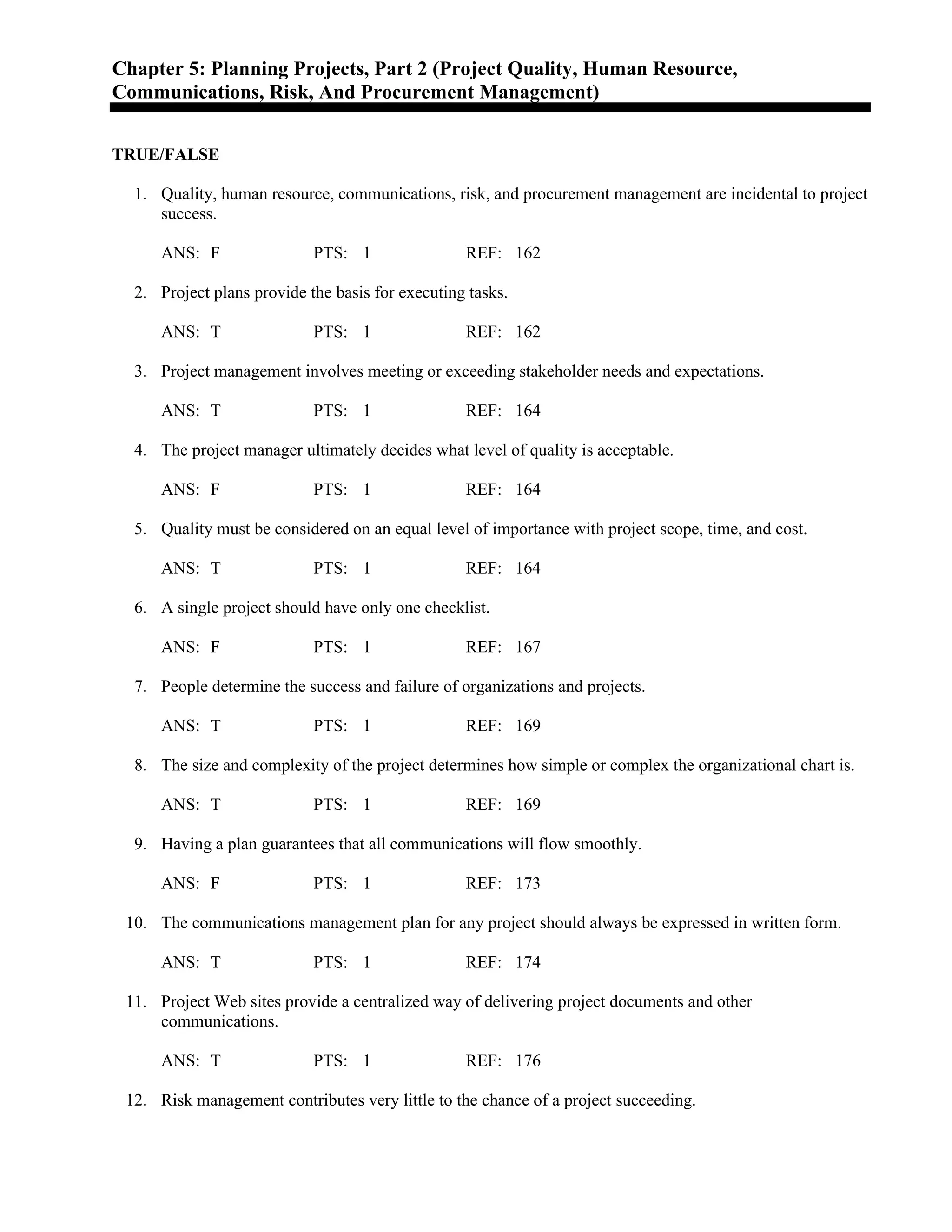
Chapter 5: PlanningProjects, Part 2 (Project Quality, Human Resource,
Communications, Risk, And Procurement Management)
TRUE/FALSE
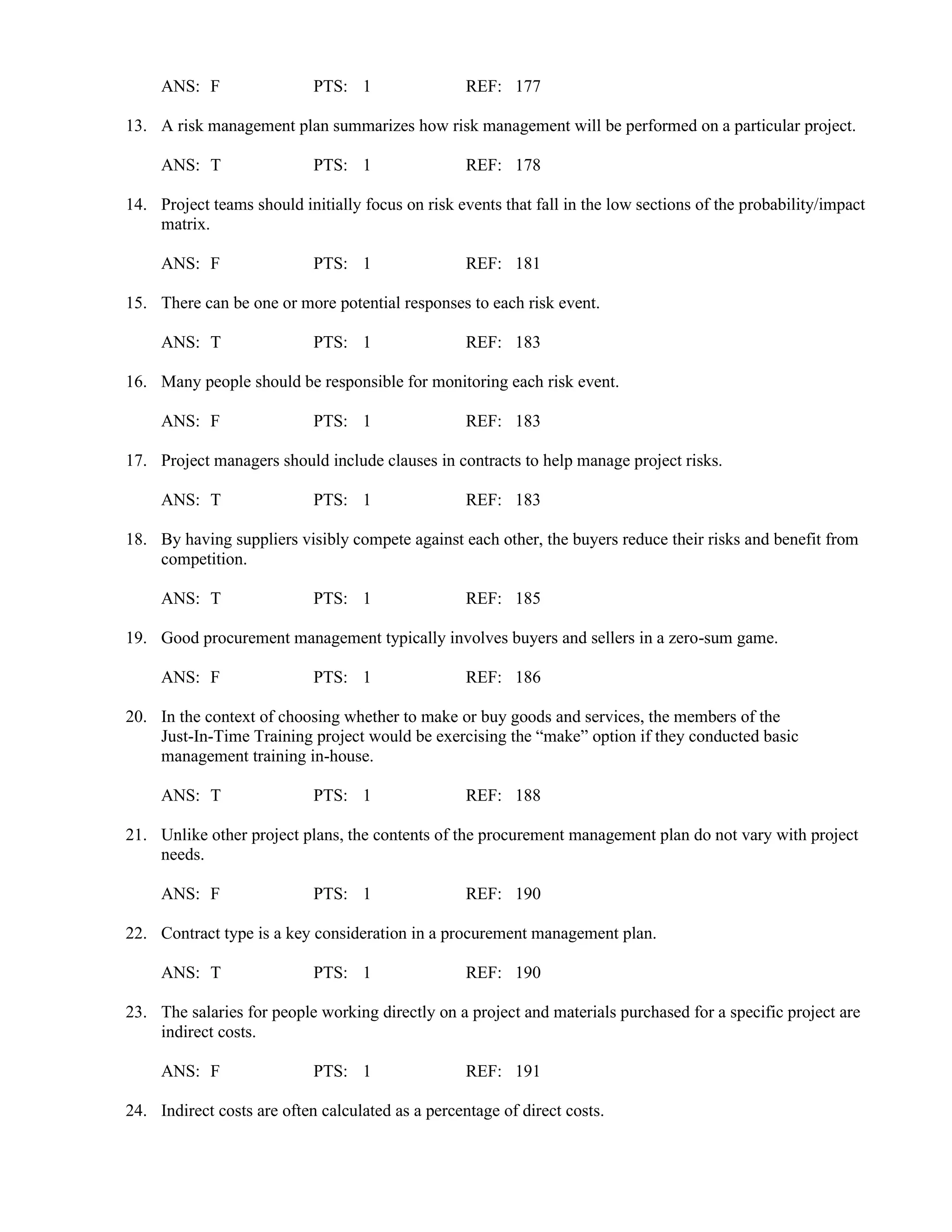
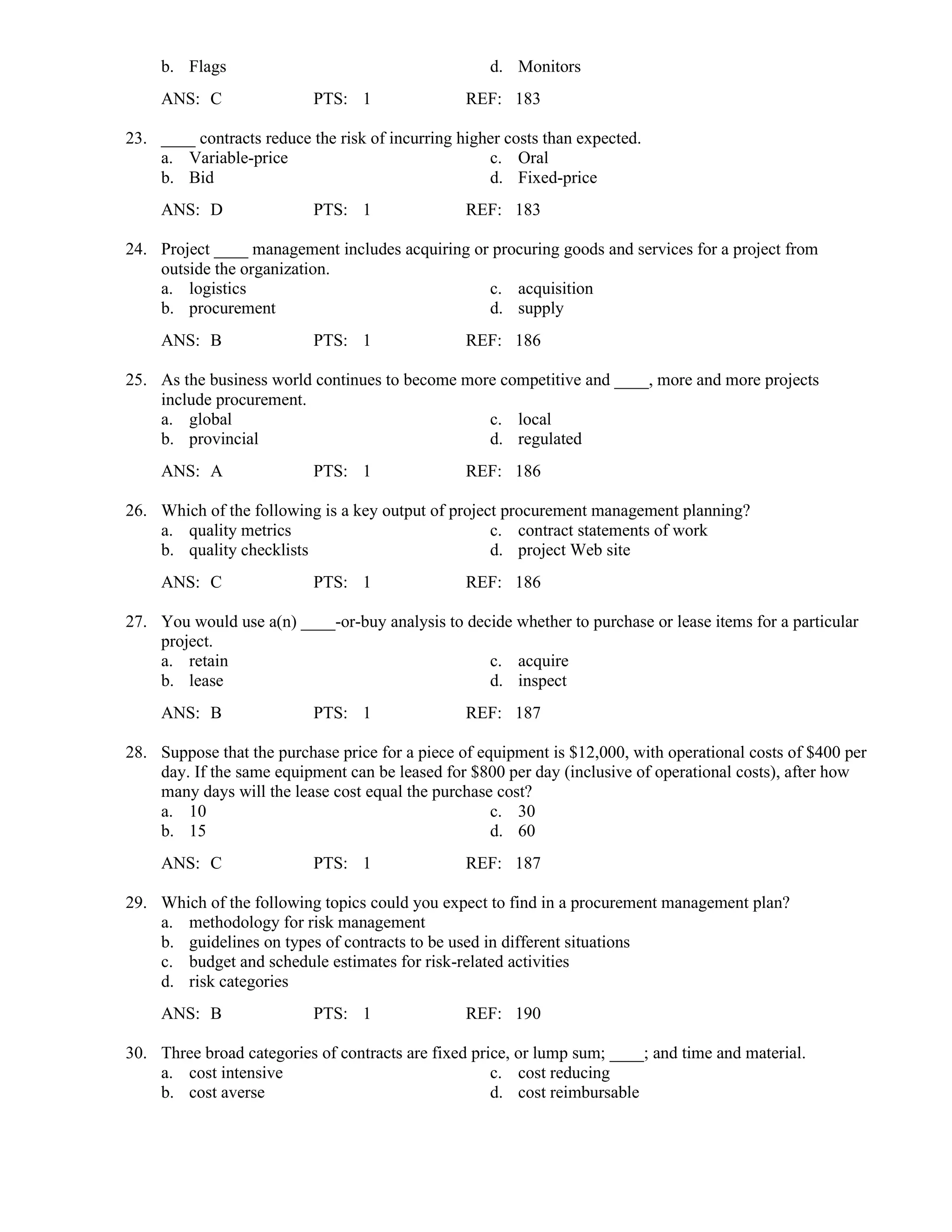
1. Quality, human resource, communications, risk, and procurement management are incidental to project
success.
ANS: F PTS: 1 REF: 162
2. Project plans provide the basis for executing tasks.
ANS: T PTS: 1 REF: 162
3. Project management involves meeting or exceeding stakeholder needs and expectations.
ANS: T PTS: 1 REF: 164
4. The project manager ultimately decides what level of quality is acceptable.
ANS: F PTS: 1 REF: 164
5. Quality must be considered on an equal level of importance with project scope, time, and cost.
ANS: T PTS: 1 REF: 164
6. A single project should have only one checklist.
ANS: F PTS: 1 REF: 167
7. People determine the success and failure of organizations and projects.
ANS: T PTS: 1 REF: 169
8. The size and complexity of the project determines how simple or complex the organizational chart is.
ANS: T PTS: 1 REF: 169
9. Having a plan guarantees that all communications will flow smoothly.
ANS: F PTS: 1 REF: 173
10. The communications management plan for any project should always be expressed in written form.
ANS: T PTS: 1 REF: 174
11. Project Web sites provide a centralized way of delivering project documents and other
communications.
ANS: T PTS: 1 REF: 176
12. Risk management contributes very little to the chance of a project succeeding.
5.
ANS: F PTS:1 REF: 177
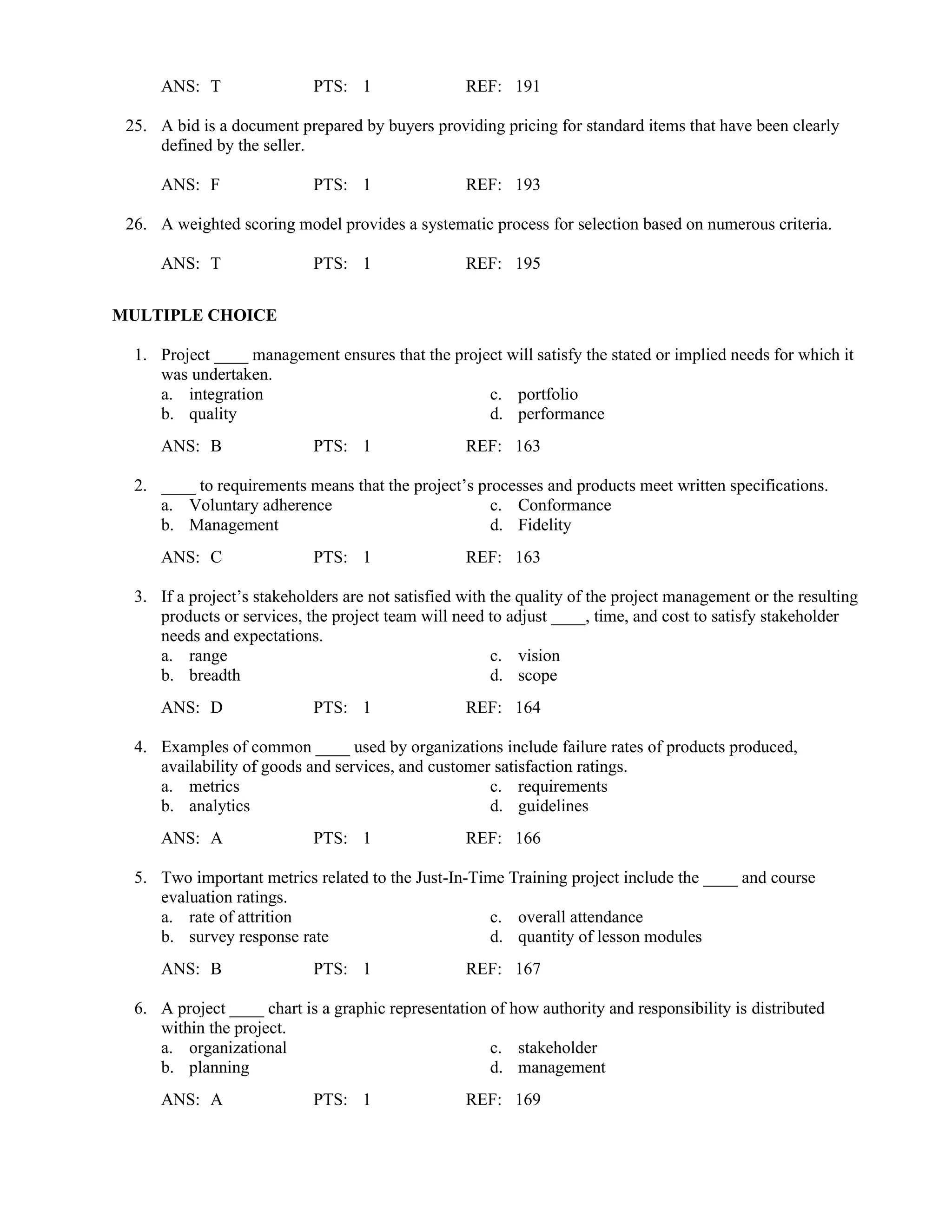
13. A risk management plan summarizes how risk management will be performed on a particular project.
ANS: T PTS: 1 REF: 178
14. Project teams should initially focus on risk events that fall in the low sections of the probability/impact
matrix.
ANS: F PTS: 1 REF: 181
15. There can be one or more potential responses to each risk event.
ANS: T PTS: 1 REF: 183
16. Many people should be responsible for monitoring each risk event.
ANS: F PTS: 1 REF: 183
17. Project managers should include clauses in contracts to help manage project risks.
ANS: T PTS: 1 REF: 183
18. By having suppliers visibly compete against each other, the buyers reduce their risks and benefit from
competition.
ANS: T PTS: 1 REF: 185
19. Good procurement management typically involves buyers and sellers in a zero-sum game.
ANS: F PTS: 1 REF: 186
20. In the context of choosing whether to make or buy goods and services, the members of the
Just-In-Time Training project would be exercising the “make” option if they conducted basic
management training in-house.
ANS: T PTS: 1 REF: 188
21. Unlike other project plans, the contents of the procurement management plan do not vary with project
needs.
ANS: F PTS: 1 REF: 190
22. Contract type is a key consideration in a procurement management plan.
ANS: T PTS: 1 REF: 190
23. The salaries for people working directly on a project and materials purchased for a specific project are
indirect costs.
ANS: F PTS: 1 REF: 191
24. Indirect costs are often calculated as a percentage of direct costs.
6.
ANS: T PTS:1 REF: 191
25. A bid is a document prepared by buyers providing pricing for standard items that have been clearly
defined by the seller.
ANS: F PTS: 1 REF: 193
26. A weighted scoring model provides a systematic process for selection based on numerous criteria.
ANS: T PTS: 1 REF: 195
MULTIPLE CHOICE
1. Project ____ management ensures that the project will satisfy the stated or implied needs for which it
was undertaken.
a. integration c. portfolio
b. quality d. performance
ANS: B PTS: 1 REF: 163
2. ____ to requirements means that the project’s processes and products meet written specifications.
a. Voluntary adherence c. Conformance
b. Management d. Fidelity
ANS: C PTS: 1 REF: 163
3. If a project’s stakeholders are not satisfied with the quality of the project management or the resulting
products or services, the project team will need to adjust ____, time, and cost to satisfy stakeholder
needs and expectations.
a. range c. vision
b. breadth d. scope
ANS: D PTS: 1 REF: 164
4. Examples of common ____ used by organizations include failure rates of products produced,
availability of goods and services, and customer satisfaction ratings.
a. metrics c. requirements
b. analytics d. guidelines
ANS: A PTS: 1 REF: 166
5. Two important metrics related to the Just-In-Time Training project include the ____ and course
evaluation ratings.
a. rate of attrition c. overall attendance
b. survey response rate d. quantity of lesson modules
ANS: B PTS: 1 REF: 167
6. A project ____ chart is a graphic representation of how authority and responsibility is distributed
within the project.
a. organizational c. stakeholder
b. planning d. management
ANS: A PTS: 1 REF: 169
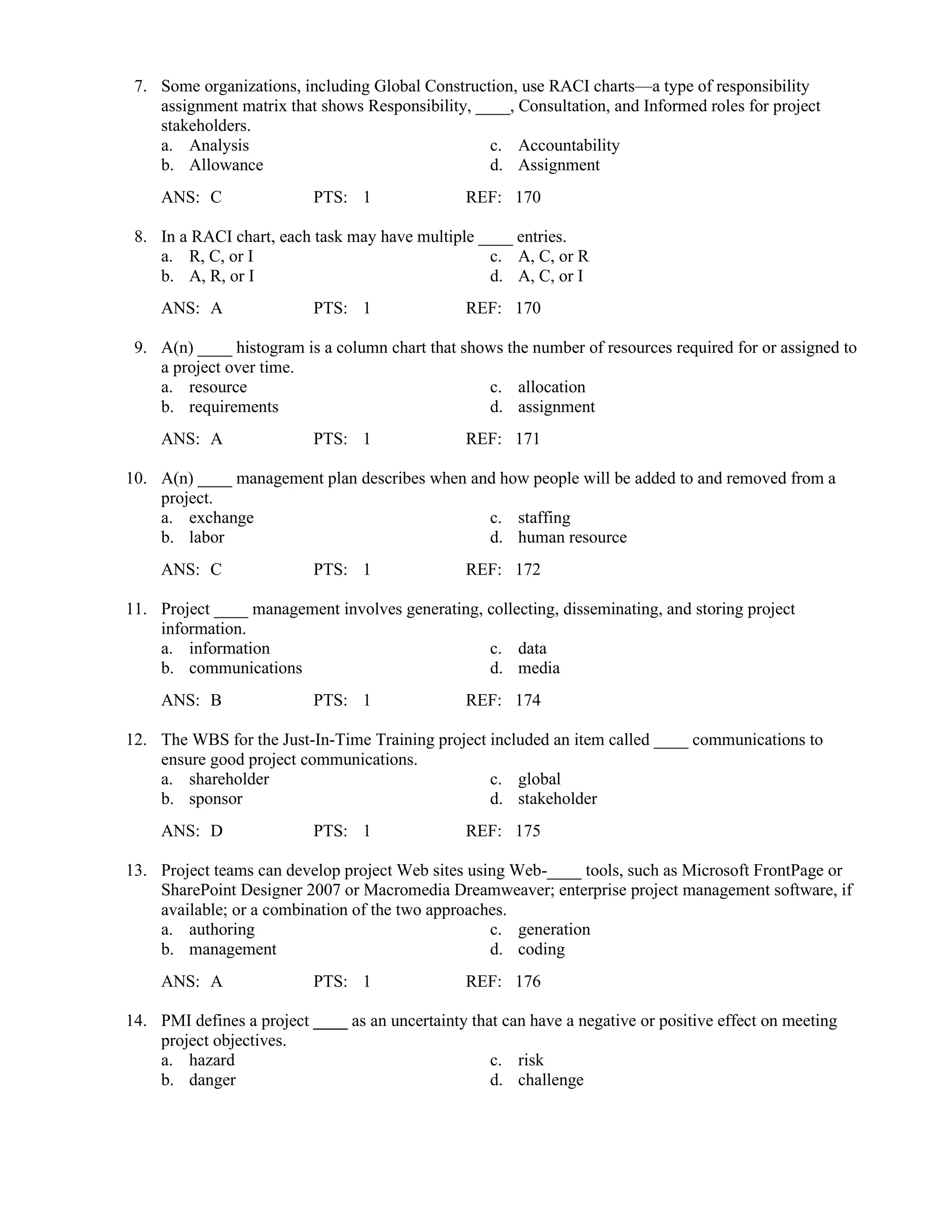
7.
7. Some organizations,including Global Construction, use RACI charts—a type of responsibility
assignment matrix that shows Responsibility, ____, Consultation, and Informed roles for project
stakeholders.
a. Analysis c. Accountability
b. Allowance d. Assignment
ANS: C PTS: 1 REF: 170
8. In a RACI chart, each task may have multiple ____ entries.
a. R, C, or I c. A, C, or R
b. A, R, or I d. A, C, or I
ANS: A PTS: 1 REF: 170
9. A(n) ____ histogram is a column chart that shows the number of resources required for or assigned to
a project over time.
a. resource c. allocation
b. requirements d. assignment
ANS: A PTS: 1 REF: 171
10. A(n) ____ management plan describes when and how people will be added to and removed from a
project.
a. exchange c. staffing
b. labor d. human resource
ANS: C PTS: 1 REF: 172
11. Project ____ management involves generating, collecting, disseminating, and storing project
information.
a. information c. data
b. communications d. media
ANS: B PTS: 1 REF: 174
12. The WBS for the Just-In-Time Training project included an item called ____ communications to
ensure good project communications.
a. shareholder c. global
b. sponsor d. stakeholder
ANS: D PTS: 1 REF: 175
13. Project teams can develop project Web sites using Web-____ tools, such as Microsoft FrontPage or
SharePoint Designer 2007 or Macromedia Dreamweaver; enterprise project management software, if
available; or a combination of the two approaches.
a. authoring c. generation
b. management d. coding
ANS: A PTS: 1 REF: 176
14. PMI defines a project ____ as an uncertainty that can have a negative or positive effect on meeting
project objectives.
a. hazard c. risk
b. danger d. challenge
8.
ANS: C PTS:1 REF: 177
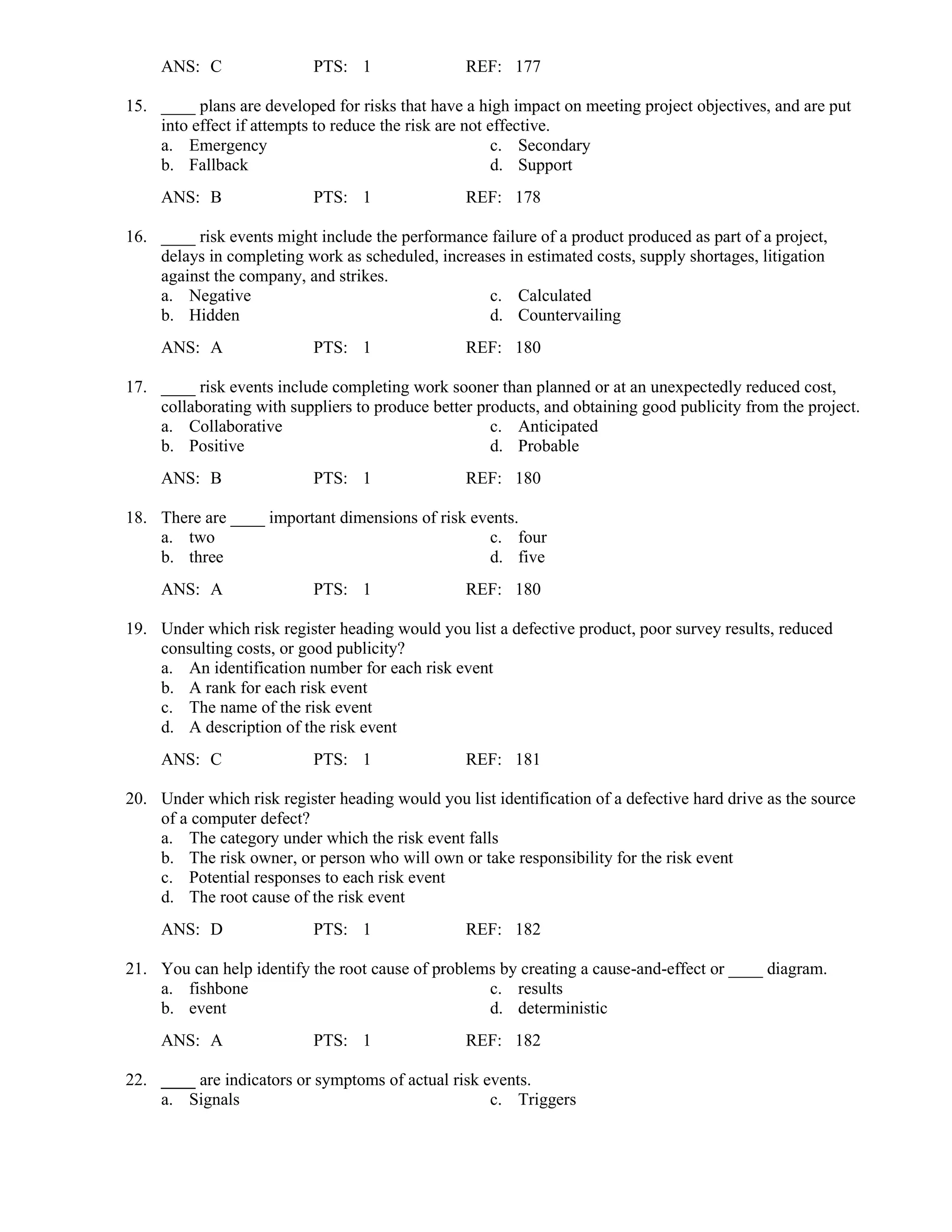
15. ____ plans are developed for risks that have a high impact on meeting project objectives, and are put
into effect if attempts to reduce the risk are not effective.
a. Emergency c. Secondary
b. Fallback d. Support
ANS: B PTS: 1 REF: 178
16. ____ risk events might include the performance failure of a product produced as part of a project,
delays in completing work as scheduled, increases in estimated costs, supply shortages, litigation
against the company, and strikes.
a. Negative c. Calculated
b. Hidden d. Countervailing
ANS: A PTS: 1 REF: 180
17. ____ risk events include completing work sooner than planned or at an unexpectedly reduced cost,
collaborating with suppliers to produce better products, and obtaining good publicity from the project.
a. Collaborative c. Anticipated
b. Positive d. Probable
ANS: B PTS: 1 REF: 180
18. There are ____ important dimensions of risk events.
a. two c. four
b. three d. five
ANS: A PTS: 1 REF: 180
19. Under which risk register heading would you list a defective product, poor survey results, reduced
consulting costs, or good publicity?
a. An identification number for each risk event
b. A rank for each risk event
c. The name of the risk event
d. A description of the risk event
ANS: C PTS: 1 REF: 181
20. Under which risk register heading would you list identification of a defective hard drive as the source
of a computer defect?
a. The category under which the risk event falls
b. The risk owner, or person who will own or take responsibility for the risk event
c. Potential responses to each risk event
d. The root cause of the risk event
ANS: D PTS: 1 REF: 182
21. You can help identify the root cause of problems by creating a cause-and-effect or ____ diagram.
a. fishbone c. results
b. event d. deterministic
ANS: A PTS: 1 REF: 182
22. ____ are indicators or symptoms of actual risk events.
a. Signals c. Triggers
9.
b. Flags d.Monitors
ANS: C PTS: 1 REF: 183
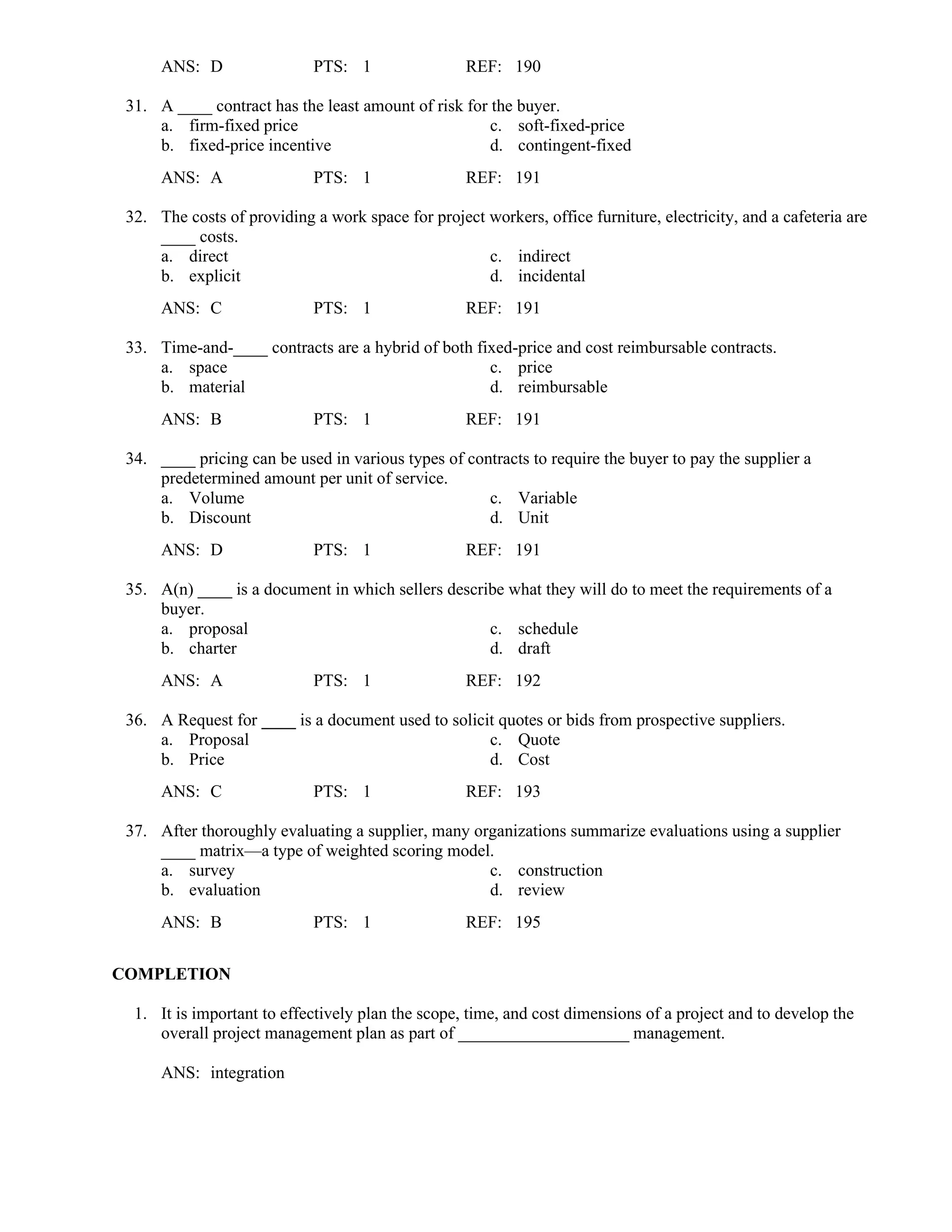
23. ____ contracts reduce the risk of incurring higher costs than expected.
a. Variable-price c. Oral
b. Bid d. Fixed-price
ANS: D PTS: 1 REF: 183
24. Project ____ management includes acquiring or procuring goods and services for a project from
outside the organization.
a. logistics c. acquisition
b. procurement d. supply
ANS: B PTS: 1 REF: 186
25. As the business world continues to become more competitive and ____, more and more projects
include procurement.
a. global c. local
b. provincial d. regulated
ANS: A PTS: 1 REF: 186
26. Which of the following is a key output of project procurement management planning?
a. quality metrics c. contract statements of work
b. quality checklists d. project Web site
ANS: C PTS: 1 REF: 186
27. You would use a(n) ____-or-buy analysis to decide whether to purchase or lease items for a particular
project.
a. retain c. acquire
b. lease d. inspect
ANS: B PTS: 1 REF: 187
28. Suppose that the purchase price for a piece of equipment is $12,000, with operational costs of $400 per
day. If the same equipment can be leased for $800 per day (inclusive of operational costs), after how
many days will the lease cost equal the purchase cost?
a. 10 c. 30
b. 15 d. 60
ANS: C PTS: 1 REF: 187
29. Which of the following topics could you expect to find in a procurement management plan?
a. methodology for risk management
b. guidelines on types of contracts to be used in different situations
c. budget and schedule estimates for risk-related activities
d. risk categories
ANS: B PTS: 1 REF: 190
30. Three broad categories of contracts are fixed price, or lump sum; ____; and time and material.
a. cost intensive c. cost reducing
b. cost averse d. cost reimbursable
10.
ANS: D PTS:1 REF: 190
31. A ____ contract has the least amount of risk for the buyer.
a. firm-fixed price c. soft-fixed-price
b. fixed-price incentive d. contingent-fixed
ANS: A PTS: 1 REF: 191
32. The costs of providing a work space for project workers, office furniture, electricity, and a cafeteria are
____ costs.
a. direct c. indirect
b. explicit d. incidental
ANS: C PTS: 1 REF: 191
33. Time-and-____ contracts are a hybrid of both fixed-price and cost reimbursable contracts.
a. space c. price
b. material d. reimbursable
ANS: B PTS: 1 REF: 191
34. ____ pricing can be used in various types of contracts to require the buyer to pay the supplier a
predetermined amount per unit of service.
a. Volume c. Variable
b. Discount d. Unit
ANS: D PTS: 1 REF: 191
35. A(n) ____ is a document in which sellers describe what they will do to meet the requirements of a
buyer.
a. proposal c. schedule
b. charter d. draft
ANS: A PTS: 1 REF: 192
36. A Request for ____ is a document used to solicit quotes or bids from prospective suppliers.
a. Proposal c. Quote
b. Price d. Cost
ANS: C PTS: 1 REF: 193
37. After thoroughly evaluating a supplier, many organizations summarize evaluations using a supplier
____ matrix—a type of weighted scoring model.
a. survey c. construction
b. evaluation d. review
ANS: B PTS: 1 REF: 195
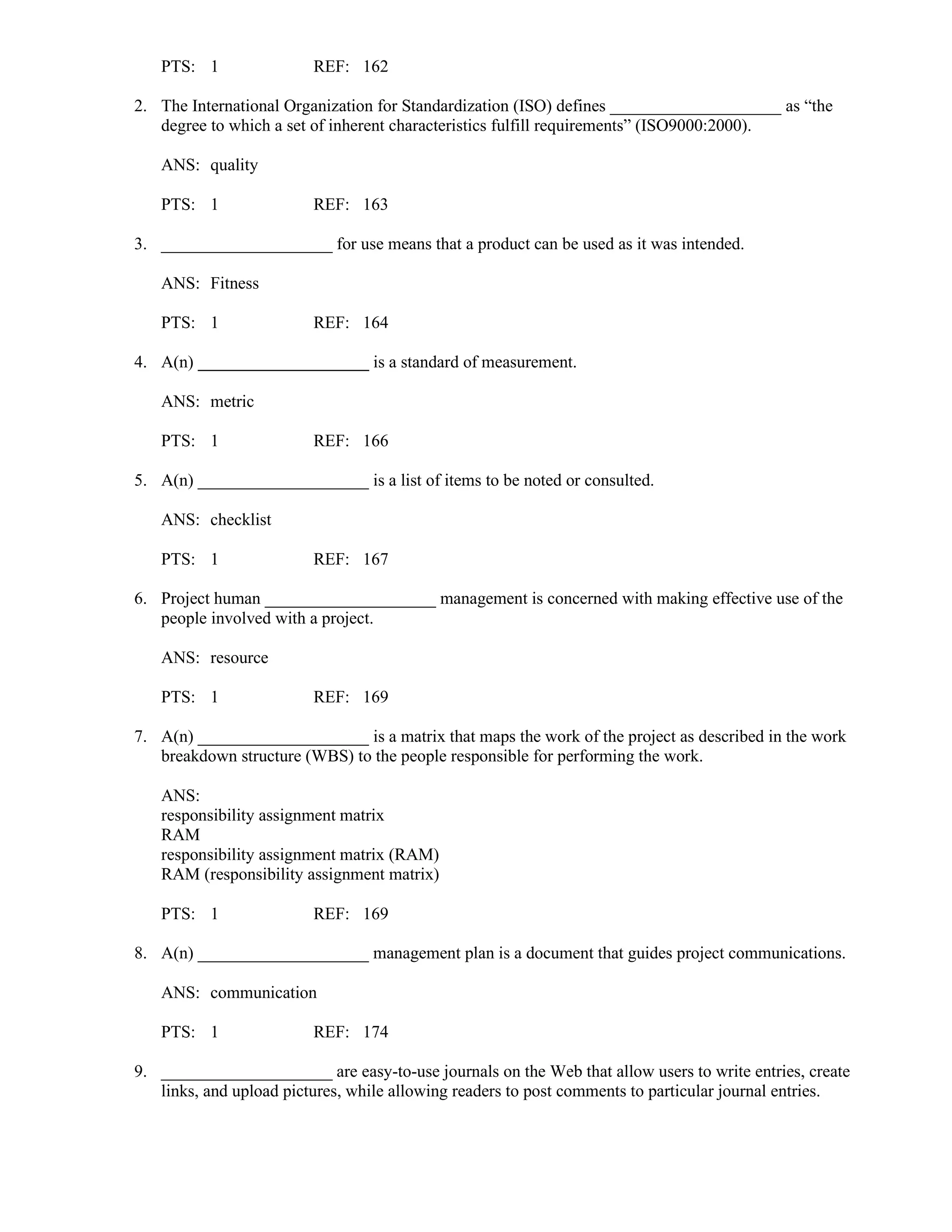
COMPLETION
1. It is important to effectively plan the scope, time, and cost dimensions of a project and to develop the
overall project management plan as part of ____________________ management.
ANS: integration
11.
PTS: 1 REF:162
2. The International Organization for Standardization (ISO) defines ____________________ as “the
degree to which a set of inherent characteristics fulfill requirements” (ISO9000:2000).
ANS: quality
PTS: 1 REF: 163
3. ____________________ for use means that a product can be used as it was intended.
ANS: Fitness
PTS: 1 REF: 164
4. A(n) ____________________ is a standard of measurement.
ANS: metric
PTS: 1 REF: 166
5. A(n) ____________________ is a list of items to be noted or consulted.
ANS: checklist
PTS: 1 REF: 167
6. Project human ____________________ management is concerned with making effective use of the
people involved with a project.
ANS: resource
PTS: 1 REF: 169
7. A(n) ____________________ is a matrix that maps the work of the project as described in the work
breakdown structure (WBS) to the people responsible for performing the work.
ANS:
responsibility assignment matrix
RAM
responsibility assignment matrix (RAM)
RAM (responsibility assignment matrix)
PTS: 1 REF: 169
8. A(n) ____________________ management plan is a document that guides project communications.
ANS: communication
PTS: 1 REF: 174
9. ____________________ are easy-to-use journals on the Web that allow users to write entries, create
links, and upload pictures, while allowing readers to post comments to particular journal entries.
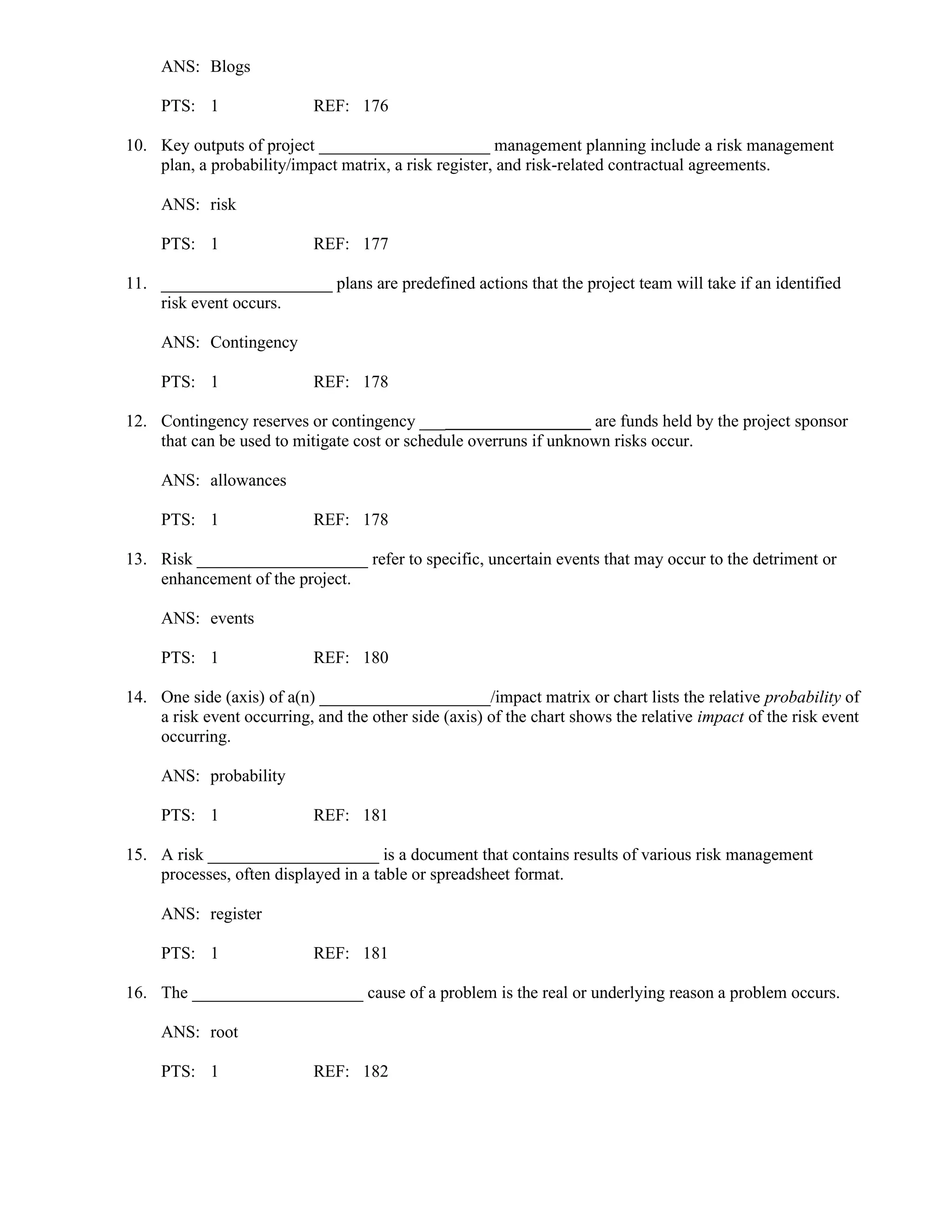
12.
ANS: Blogs
PTS: 1REF: 176
10. Key outputs of project ____________________ management planning include a risk management
plan, a probability/impact matrix, a risk register, and risk-related contractual agreements.
ANS: risk
PTS: 1 REF: 177
11. ____________________ plans are predefined actions that the project team will take if an identified
risk event occurs.
ANS: Contingency
PTS: 1 REF: 178
12. Contingency reserves or contingency ____________________ are funds held by the project sponsor
that can be used to mitigate cost or schedule overruns if unknown risks occur.
ANS: allowances
PTS: 1 REF: 178
13. Risk ____________________ refer to specific, uncertain events that may occur to the detriment or
enhancement of the project.
ANS: events
PTS: 1 REF: 180
14. One side (axis) of a(n) ____________________/impact matrix or chart lists the relative probability of
a risk event occurring, and the other side (axis) of the chart shows the relative impact of the risk event
occurring.
ANS: probability
PTS: 1 REF: 181
15. A risk ____________________ is a document that contains results of various risk management
processes, often displayed in a table or spreadsheet format.
ANS: register
PTS: 1 REF: 181
16. The ____________________ cause of a problem is the real or underlying reason a problem occurs.
ANS: root
PTS: 1 REF: 182
13.
17. Work doneby outside suppliers or sellers should be well documented in ____________________,
which are mutually binding agreements that obligate the seller to provide the specified products or
services, and obligate the buyer to pay for them.
ANS: contracts
PTS: 1 REF: 183
18. Competition for supplying goods and services can also help reduce ____________________ risks and
enhance positive risks on projects.
ANS: negative
PTS: 1 REF: 183
19. Risk management planning addresses procurement-related topics, such as preparing risk-related
____________________ agreements.
ANS: contractual
PTS: 1 REF: 186
20. ____________________ analysis involves estimating the internal costs of providing a product or
service, and comparing that estimate to the cost of outsourcing.
ANS: Make-or-buy
PTS: 1 REF: 187
21. A(n) ____________________ management plan is a document that describes how the procurement
processes will be managed, from developing documentation for making outside purchases or
acquisitions to contract closure.
ANS: procurement
PTS: 1 REF: 190
22. Fixed-price or ____________________ contracts involve a fixed total price for a well defined product
or service.
ANS: lump sum
PTS: 1 REF: 190
23. ____________________ contracts involve payment to the seller for direct and indirect actual costs.
ANS: Cost reimbursable
PTS: 1 REF: 191
24. A(n) ____________________ is a document used to solicit proposals from prospective suppliers.
ANS:
Request for Proposal
14.
RFP
Request for Proposal(RFP)
RFP (Request for Proposal)
PTS: 1 REF: 192
ESSAY
1. Describe quality planning and the quality management plan.
ANS:
Quality planning includes identifying which quality standards are relevant to the project and how best
to satisfy those standards. It also involves designing quality into the products and services of the
project as well as the processes involved in managing the project. It is important to describe important
factors that directly contribute to meeting customer requirements. Organizational policies related to
quality, the scope statement, product descriptions, and related standards and regulations are all
important inputs to the quality planning process.
The quality management plan describes how the project management team will implement quality
policies. Like other project plans, its format and contents vary based on the particular project and
organizational needs. It can be a long, formal document or short and informal.
PTS: 1 REF: 164
2. Describe several functions that may be performed using a RAM (responsibility assignment matrix).
ANS:
A RAM allocates work to responsible and performing organizations, teams, or individuals, depending
on the desired level of detail. For smaller projects, it is best to assign WBS activities to individuals.
For larger projects, it is more effective to assign the work to organizational units or teams. In addition
to using a RAM to assign detailed work activities, you can use a RAM to define general roles and
responsibilities on projects. This type of RAM can include the stakeholders in the project. The project
team should decide what to use as categories in the RAM and include a key to explain those
categories. For example, a RAM can show whether stakeholders are accountable for (A) or just
participants (P) in part of a project, and whether they are required to provide input (I), review (R), or
sign off (S) on parts of a project. This simple tool enables the project manager to efficiently
communicate the roles of project team members and expectations of important project stakeholders.
PTS: 1 REF: 169
3. Identify eight items that should be addressed by a communications management plan.
ANS:
The communications management plan should address the following items:
Stakeholder communications requirements
Information to be communicated, including format, content, and level of detail
Identification of who will receive the information and who will produce it
Suggested methods or guidelines for conveying the information
Description of the frequency of communication
Escalation procedures for resolving issues
Revision procedures for updating the communications management plan
A glossary of common terminology used on the project.
PTS: 1 REF: 174
15.
4. What isthe main purpose of the risk management plan? How should the document be constructed?
ANS:
A risk management plan documents the procedures for managing risk throughout the life of a project.
Project teams should hold several planning meetings early in the project’s life cycle to help develop
the risk management plan. The project team should review project documents as well as corporate risk
management policies, risk categories, lessons learned from past projects, and templates for creating a
risk management plan. It is also important to review the risk tolerances of various stakeholders. For
example, if the project sponsor is risk-averse, the project might require a different approach to risk
management than if the project sponsor were a risk seeker.
PTS: 1 REF: 178
5. What is a contract statement of work (SOW) and how should it be specified?
ANS:
A contract statement of work (SOW) is a description of the work that is to be purchased. The SOW
should be included with the RFP to clarify the work that needs to be performed. The contract SOW is a
type of scope statement that describes the work in sufficient detail to allow prospective suppliers to
both determine if they are capable of providing the goods and services required, and determine an
appropriate price for the work. A contract SOW should be clear, concise, and as complete as possible.
It should describe all services required and include performance information, such as the location and
timing of the work. It is important to use appropriate words in a contract SOW—for example, must
instead of may. Must implies that something has to be done; may implies that there is a choice
involved. The contract SOW should specify the products and services required for the project, use
industry terms, and refer to industry standards.
PTS: 1 REF: 195