1.DEFINITION OF PATHOLOGY
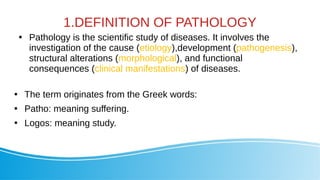
Pathologyis the scientific study of diseases. It involves the
investigation of the cause (etiology),development (pathogenesis),
structural alterations (morphological), and functional
consequences (clinical manifestations) of diseases.
The term originates from the Greek words:
Patho: meaning suffering.
Logos: meaning study.
3.
2.SCOPE OF PATHOLOGY
●
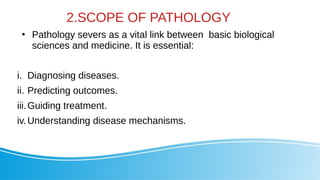
Pathologysevers as a vital link between basic biological
sciences and medicine. It is essential:
i. Diagnosing diseases.
ii. Predicting outcomes.
iii.Guiding treatment.
iv.Understanding disease mechanisms.
4.
3. BRANCHES OFPATHOLOGY
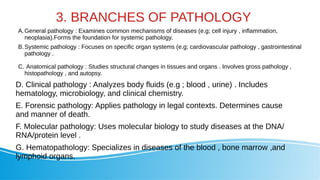
A.General pathology : Examines common mechanisms of diseases (e.g; cell injury , inflammation,
neoplasia).Forms the foundation for systemic pathology.
B.Systemic pathology : Focuses on specific organ systems (e.g; cardiovascular pathology , gastrointestinal
pathology .
C. Anatomical pathology : Studies structural changes in tissues and organs . Involves gross pathology ,
histopathology , and autopsy.
D. Clinical pathology : Analyzes body fluids (e.g ; blood , urine) . Includes
hematology, microbiology, and clinical chemistry.
E. Forensic pathology: Applies pathology in legal contexts. Determines cause
and manner of death.
F. Molecular pathology: Uses molecular biology to study diseases at the DNA/
RNA/protein level .
G. Hematopathology: Specializes in diseases of the blood , bone marrow ,and
lymphoid organs.
5.
4. IMPORTANCE INMEDICINE
●
Pathology is crucial for:
i. Accurate diagnosis.
ii. Monitoring disease progression.
iii.Determining prognosis.
iv.Selecting appropriate treatment.
v. Conducting medical research and innovations.
6.
Definition of Disease….
Diseaseis defined as:
an abnormality in structure or function of any part
of the body. (a physiology or psychological
dysfunction.)
7.
Parts of pathology.
●
The following are the 5major aspects studied as part of
pathology of any disease:
a) Epidemiology.
b) Etiology.
c) Pathogenesis.
d) Morphologic changes.
e) Clinical features ( signs and symptoms).