Introduction to National
Cancer Control Program
The National Cancer Control Program is a comprehensive, evidence-based approach to reducing the
burden of cancer in a population. Its primary goal is to improve the health of the population by
preventing new cancer cases, detecting existing cases early, and ensuring access to high-quality,
equitable cancer care and support services. This program takes a holistic view of cancer, addressing not
just clinical treatment but also prevention, screening, rehabilitation, and palliative care.
By coordinating efforts across multiple sectors, including healthcare, public health, research, and
community organizations, the National Cancer Control Program aims to reduce the incidence,
morbidity, and mortality of cancer. It focuses on implementing effective, affordable, and sustainable
interventions that are tailored to the specific needs and resources of the country or region. This
includes promoting healthy lifestyle choices, expanding access to cancer screening and early detection
services, improving the quality of cancer treatment and care, and supporting those affected by cancer
throughout their journey.
Sa by Sumit Chakranarayan
Objectives of the Program
Cancer Prevention
The primary objective of the National Cancer
Control Program is to implement
comprehensive strategies for cancer
prevention. This includes promoting healthy
lifestyle choices, such as encouraging
smoking cessation, healthy eating, and
physical activity, to reduce the overall risk of
cancer in the population. The program also
aims to address environmental and
occupational risk factors that may contribute
to cancer development.
Early Detection and Screening
Early detection and screening are crucial for
improving cancer outcomes. The program's
objectives include increasing access to and
utilization of evidence-based screening
services, such as mammograms, Pap tests,
and colorectal cancer screening. By
detecting cancers at an early, more treatable
stage, the program aims to reduce cancer-
related mortality and improve the quality of
life for those affected.
Equitable Access to Care
The program's objectives also include
ensuring equitable access to high-quality
cancer care, regardless of an individual's
socioeconomic status, geographic location,
or other demographic factors. This involves
addressing barriers to care, such as financial
constraints, lack of transportation, or
cultural/linguistic differences, and
developing strategies to reach underserved
populations.
Comprehensive Cancer Control
The National Cancer Control Program takes a
holistic approach to cancer control,
addressing the entire continuum of care,
from prevention and early detection to
treatment, palliative care, and survivorship.
The program's objectives include integrating
these various components to provide
seamless, patient-centered care and improve
overall cancer outcomes for the population.
Comprehensive Cancer Control
Approach
Multidimensio
nal Strategy
The National
Cancer Control
Program (NCCP)
employs a
comprehensive,
multidimensional
approach to
addressing the
cancer burden. This
strategy
encompasses a
range of
complementary
initiatives that work
in tandem to
reduce the impact
of cancer on
individuals, families,
and communities.
By integrating
prevention, early
detection,
treatment, palliative
Coordinated
Efforts
At the core of the
NCCP's
comprehensive
approach is a focus
on coordinating
efforts across
various
stakeholders,
including
healthcare
providers, public
health agencies,
research
institutions, and
community
organizations. This
collaborative
approach ensures
that resources,
expertise, and best
practices are shared
effectively, creating
a robust and
Evidence-
Based
Interventions
The NCCP's
comprehensive
strategy is
grounded in
evidence-based
interventions that
have been
rigorously
evaluated and
proven effective in
reducing the cancer
burden. From
public health
campaigns
promoting healthy
lifestyles to
targeted screening
programs and
innovative
treatment
modalities, the
program's
initiatives are
Adaptability
and
Responsivenes
s
Recognizing the
dynamic and
evolving nature of
cancer, the NCCP's
comprehensive
approach is
designed to be
adaptable and
responsive to
emerging
challenges and new
scientific
advancements. The
program
continuously
monitors the cancer
landscape,
evaluates the
effectiveness of its
interventions, and
adjusts its
strategies to ensure
that it remains
Early Detection and Screening
1 Importance of Early Detection
Early detection of cancer is crucial for improving patient outcomes and survival rates.
When cancer is caught early, before it has had a chance to spread, treatment is often
more effective and less invasive. This can lead to better quality of life for patients and
reduced healthcare costs. National cancer control programs emphasize the importance
of routine cancer screening and early detection through various methods tailored to
different cancer types.
2 Screening Modalities
The national cancer control program offers a range of screening modalities to detect
cancer in its earliest stages. These include mammograms for breast cancer, Pap smears
and HPV testing for cervical cancer, colonoscopies for colorectal cancer, and low-dose CT
scans for lung cancer. The program also promotes prostate-specific antigen (PSA) testing
and clinical breast exams as part of a comprehensive early detection strategy.
3 Target Population and Access
The national cancer control program aims to make cancer screening accessible to all
eligible individuals within the target population. This includes providing free or low-cost
screening services, especially for underserved and high-risk communities. The program
also works to raise awareness about the importance of regular cancer screening and
overcome barriers to access, such as lack of knowledge, transportation, or insurance
coverage.
Cancer Treatment and Palliative Care
Comprehensive cancer care encompasses not only curative treatment, but also the provision of
palliative services to improve the quality of life for patients and their families. The national cancer
control program focuses on ensuring access to high-quality cancer treatment options, including surgery,
radiation therapy, chemotherapy, and targeted therapies. These treatments are tailored to the individual
patient's needs and stage of cancer, with the goal of achieving the best possible outcomes.
Alongside curative treatments, the program also emphasizes the importance of palliative care. Palliative
care aims to alleviate symptoms, manage pain, and provide emotional and spiritual support for patients
facing advanced or terminal cancer. This holistic approach helps to address the physical, psychological,
and social needs of patients and their loved ones, improving their overall quality of life and well-being
during a challenging time.
The national cancer control program works to integrate palliative care services into the broader cancer
care continuum, ensuring that patients have access to this crucial support system from the time of
diagnosis through the end of life. By prioritizing both curative and palliative care, the program strives to
provide comprehensive, patient-centered cancer management that addresses the diverse needs of
those affected by this devastating disease.
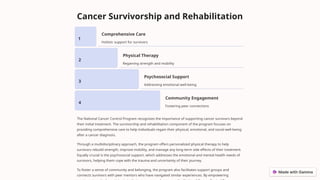
Cancer Survivorship and Rehabilitation
1
Comprehensive Care
Holistic support for survivors
2
Physical Therapy
Regaining strength and mobility
3
Psychosocial Support
Addressing emotional well-being
4
Community Engagement
Fostering peer connections
The National Cancer Control Program recognizes the importance of supporting cancer survivors beyond
their initial treatment. The survivorship and rehabilitation component of the program focuses on
providing comprehensive care to help individuals regain their physical, emotional, and social well-being
after a cancer diagnosis.
Through a multidisciplinary approach, the program offers personalized physical therapy to help
survivors rebuild strength, improve mobility, and manage any long-term side effects of their treatment.
Equally crucial is the psychosocial support, which addresses the emotional and mental health needs of
survivors, helping them cope with the trauma and uncertainty of their journey.
To foster a sense of community and belonging, the program also facilitates support groups and
connects survivors with peer mentors who have navigated similar experiences. By empowering
Cancer Surveillance and Monitoring
1 Comprehensive Cancer Registries
A robust cancer surveillance system relies
on comprehensive cancer registries that
collect detailed information on cancer
incidence, prevalence, mortality, and other
key indicators. These registries play a
crucial role in understanding the cancer
burden, identifying trends, and informing
cancer control strategies. They gather
data from various sources, including
hospitals, clinics, pathology laboratories,
and death certificates, to create a
comprehensive picture of the cancer
landscape.
2 Population-based Surveys and
Surveillance
In addition to cancer registries, the
national cancer control program also
conducts population-based surveys and
surveillance to gather information on
cancer-related risk factors, screening
practices, and quality of life among cancer
patients and survivors. These surveys
provide valuable insights into the wider
social and behavioral aspects of cancer,
which can help tailor interventions and
allocate resources more effectively.
3 Monitoring and Evaluation
Ongoing monitoring and evaluation of the
national cancer control program's
activities and outcomes are essential for
ensuring its effectiveness and identifying
areas for improvement. This includes
tracking the implementation of various
strategies, measuring their impact on
cancer outcomes, and using the data to
refine and optimize the program's
activities. Regular review and adjustment
4 Data-driven Decision Making
The vast amount of data collected through
the cancer surveillance and monitoring
system is a valuable resource for
informing evidence-based decision-
making at all levels of the national cancer
control program. Policymakers, healthcare
providers, and researchers can use this
data to identify high-risk populations,
allocate resources, develop targeted
interventions, and monitor the progress
Cancer Research and Innovation
Basic Research
Fundamental
research is crucial for
advancing our
understanding of
cancer biology and
driving new
breakthroughs. This
includes studying the
genetic, molecular,
and cellular
mechanisms that
underlie the
development and
progression of
different cancer
types. By uncovering
new insights, basic
research lays the
groundwork for the
development of
innovative diagnostic
tools, targeted
therapies, and more
effective prevention
Translational
Research
Translational
research bridges the
gap between
laboratory
discoveries and
clinical applications.
This involves taking
promising findings
from basic science
and developing them
into real-world
solutions, such as
new drugs, medical
devices, or treatment
approaches.
Translational
research is essential
for transforming
scientific knowledge
into meaningful
improvements in
cancer care and
patient outcomes.
Clinical Trials
Rigorous clinical trials
are the gold standard
for evaluating the
safety and efficacy of
new cancer
interventions. These
studies enroll
patients to test
experimental
treatments,
diagnostic tools, or
prevention strategies
in a controlled and
scientific manner.
Clinical trials are
critical for generating
high-quality evidence
to guide the
development and
adoption of
innovative cancer
care solutions.
Interdisciplinar
y Collaboration
Advancing cancer
research and
innovation requires
the collective efforts
of diverse experts
and stakeholders.
Fostering
interdisciplinary
collaboration among
researchers,
clinicians, public
health professionals,
data scientists, and
patient advocates
helps to generate a
more comprehensive
and holistic
understanding of
cancer. This
collaborative
approach facilitates
the exchange of
ideas, the sharing of
Stakeholder Engagement and
Partnerships
Collaborative Approach
The National Cancer Control
Program recognizes the
importance of engaging a
diverse range of stakeholders
to effectively address the
multifaceted challenges of
cancer. By bringing together
government officials,
healthcare professionals,
research scientists, patient
advocates, and community
leaders, the program fosters a
collaborative approach that
ensures all perspectives and
concerns are taken into
account. This inclusive
dialogue helps to identify the
Leveraging Partnerships
The National Cancer Control
Program actively seeks to
build and strengthen
partnerships with a wide
range of organizations, both
within the healthcare sector
and beyond. By collaborating
with non-profit organizations,
academic institutions,
pharmaceutical companies,
and international agencies,
the program is able to
leverage additional resources,
expertise, and innovative
approaches to enhance its
overall effectiveness. These
partnerships not only expand
Community
Engagement
Recognizing that cancer
prevention and control efforts
must be rooted in the needs
and perspectives of local
communities, the National
Cancer Control Program
places a strong emphasis on
community engagement. The
program collaborates with
grassroots organizations,
community leaders, and local
healthcare providers to ensure
that interventions are tailored
to the specific cultural, social,
and economic factors that
influence cancer outcomes. By
Conclusion and Future Directions
As we conclude our discussion of the National Cancer Control Program, it's clear that this
comprehensive approach to cancer management has made significant strides in improving outcomes
for individuals and communities affected by this disease. By focusing on early detection, effective
treatment, palliative care, and empowering cancer survivors, the program has demonstrated its ability
to positively impact the lives of those touched by cancer.
Looking to the future, there are exciting opportunities to build upon the program's successes.
Advancements in cancer research and innovation hold the promise of even more effective therapies,
earlier diagnoses, and personalized approaches to care. Strengthening stakeholder engagement and
partnerships will be crucial to ensure the program remains responsive to the evolving needs of
patients, providers, and the broader community.
Continued investment in cancer surveillance and monitoring will provide the data-driven insights
needed to refine and optimize the program's strategies. Equally important will be the ongoing
commitment to cancer survivorship and rehabilitation, empowering individuals to reclaim their lives
and thrive beyond their diagnosis.
As we look ahead, the National Cancer Control Program stands poised to make even greater strides in
its mission to reduce the burden of cancer and improve the well-being of all those affected. By
maintaining a steadfast focus on these key priorities, we can envision a future where cancer is
increasingly prevented, detected early, and managed with compassion and effectiveness, ultimately
leading to better outcomes and a higher quality of life for all.

Introduction-to-National-Cancer-Control-Program.pptx

  • 1.
    Introduction to National CancerControl Program The National Cancer Control Program is a comprehensive, evidence-based approach to reducing the burden of cancer in a population. Its primary goal is to improve the health of the population by preventing new cancer cases, detecting existing cases early, and ensuring access to high-quality, equitable cancer care and support services. This program takes a holistic view of cancer, addressing not just clinical treatment but also prevention, screening, rehabilitation, and palliative care. By coordinating efforts across multiple sectors, including healthcare, public health, research, and community organizations, the National Cancer Control Program aims to reduce the incidence, morbidity, and mortality of cancer. It focuses on implementing effective, affordable, and sustainable interventions that are tailored to the specific needs and resources of the country or region. This includes promoting healthy lifestyle choices, expanding access to cancer screening and early detection services, improving the quality of cancer treatment and care, and supporting those affected by cancer throughout their journey. Sa by Sumit Chakranarayan
  • 2.
    Objectives of theProgram Cancer Prevention The primary objective of the National Cancer Control Program is to implement comprehensive strategies for cancer prevention. This includes promoting healthy lifestyle choices, such as encouraging smoking cessation, healthy eating, and physical activity, to reduce the overall risk of cancer in the population. The program also aims to address environmental and occupational risk factors that may contribute to cancer development. Early Detection and Screening Early detection and screening are crucial for improving cancer outcomes. The program's objectives include increasing access to and utilization of evidence-based screening services, such as mammograms, Pap tests, and colorectal cancer screening. By detecting cancers at an early, more treatable stage, the program aims to reduce cancer- related mortality and improve the quality of life for those affected. Equitable Access to Care The program's objectives also include ensuring equitable access to high-quality cancer care, regardless of an individual's socioeconomic status, geographic location, or other demographic factors. This involves addressing barriers to care, such as financial constraints, lack of transportation, or cultural/linguistic differences, and developing strategies to reach underserved populations. Comprehensive Cancer Control The National Cancer Control Program takes a holistic approach to cancer control, addressing the entire continuum of care, from prevention and early detection to treatment, palliative care, and survivorship. The program's objectives include integrating these various components to provide seamless, patient-centered care and improve overall cancer outcomes for the population.
  • 3.
    Comprehensive Cancer Control Approach Multidimensio nalStrategy The National Cancer Control Program (NCCP) employs a comprehensive, multidimensional approach to addressing the cancer burden. This strategy encompasses a range of complementary initiatives that work in tandem to reduce the impact of cancer on individuals, families, and communities. By integrating prevention, early detection, treatment, palliative Coordinated Efforts At the core of the NCCP's comprehensive approach is a focus on coordinating efforts across various stakeholders, including healthcare providers, public health agencies, research institutions, and community organizations. This collaborative approach ensures that resources, expertise, and best practices are shared effectively, creating a robust and Evidence- Based Interventions The NCCP's comprehensive strategy is grounded in evidence-based interventions that have been rigorously evaluated and proven effective in reducing the cancer burden. From public health campaigns promoting healthy lifestyles to targeted screening programs and innovative treatment modalities, the program's initiatives are Adaptability and Responsivenes s Recognizing the dynamic and evolving nature of cancer, the NCCP's comprehensive approach is designed to be adaptable and responsive to emerging challenges and new scientific advancements. The program continuously monitors the cancer landscape, evaluates the effectiveness of its interventions, and adjusts its strategies to ensure that it remains
  • 4.
    Early Detection andScreening 1 Importance of Early Detection Early detection of cancer is crucial for improving patient outcomes and survival rates. When cancer is caught early, before it has had a chance to spread, treatment is often more effective and less invasive. This can lead to better quality of life for patients and reduced healthcare costs. National cancer control programs emphasize the importance of routine cancer screening and early detection through various methods tailored to different cancer types. 2 Screening Modalities The national cancer control program offers a range of screening modalities to detect cancer in its earliest stages. These include mammograms for breast cancer, Pap smears and HPV testing for cervical cancer, colonoscopies for colorectal cancer, and low-dose CT scans for lung cancer. The program also promotes prostate-specific antigen (PSA) testing and clinical breast exams as part of a comprehensive early detection strategy. 3 Target Population and Access The national cancer control program aims to make cancer screening accessible to all eligible individuals within the target population. This includes providing free or low-cost screening services, especially for underserved and high-risk communities. The program also works to raise awareness about the importance of regular cancer screening and overcome barriers to access, such as lack of knowledge, transportation, or insurance coverage.
  • 5.
    Cancer Treatment andPalliative Care Comprehensive cancer care encompasses not only curative treatment, but also the provision of palliative services to improve the quality of life for patients and their families. The national cancer control program focuses on ensuring access to high-quality cancer treatment options, including surgery, radiation therapy, chemotherapy, and targeted therapies. These treatments are tailored to the individual patient's needs and stage of cancer, with the goal of achieving the best possible outcomes. Alongside curative treatments, the program also emphasizes the importance of palliative care. Palliative care aims to alleviate symptoms, manage pain, and provide emotional and spiritual support for patients facing advanced or terminal cancer. This holistic approach helps to address the physical, psychological, and social needs of patients and their loved ones, improving their overall quality of life and well-being during a challenging time. The national cancer control program works to integrate palliative care services into the broader cancer care continuum, ensuring that patients have access to this crucial support system from the time of diagnosis through the end of life. By prioritizing both curative and palliative care, the program strives to provide comprehensive, patient-centered cancer management that addresses the diverse needs of those affected by this devastating disease.
  • 6.
    Cancer Survivorship andRehabilitation 1 Comprehensive Care Holistic support for survivors 2 Physical Therapy Regaining strength and mobility 3 Psychosocial Support Addressing emotional well-being 4 Community Engagement Fostering peer connections The National Cancer Control Program recognizes the importance of supporting cancer survivors beyond their initial treatment. The survivorship and rehabilitation component of the program focuses on providing comprehensive care to help individuals regain their physical, emotional, and social well-being after a cancer diagnosis. Through a multidisciplinary approach, the program offers personalized physical therapy to help survivors rebuild strength, improve mobility, and manage any long-term side effects of their treatment. Equally crucial is the psychosocial support, which addresses the emotional and mental health needs of survivors, helping them cope with the trauma and uncertainty of their journey. To foster a sense of community and belonging, the program also facilitates support groups and connects survivors with peer mentors who have navigated similar experiences. By empowering
  • 7.
    Cancer Surveillance andMonitoring 1 Comprehensive Cancer Registries A robust cancer surveillance system relies on comprehensive cancer registries that collect detailed information on cancer incidence, prevalence, mortality, and other key indicators. These registries play a crucial role in understanding the cancer burden, identifying trends, and informing cancer control strategies. They gather data from various sources, including hospitals, clinics, pathology laboratories, and death certificates, to create a comprehensive picture of the cancer landscape. 2 Population-based Surveys and Surveillance In addition to cancer registries, the national cancer control program also conducts population-based surveys and surveillance to gather information on cancer-related risk factors, screening practices, and quality of life among cancer patients and survivors. These surveys provide valuable insights into the wider social and behavioral aspects of cancer, which can help tailor interventions and allocate resources more effectively. 3 Monitoring and Evaluation Ongoing monitoring and evaluation of the national cancer control program's activities and outcomes are essential for ensuring its effectiveness and identifying areas for improvement. This includes tracking the implementation of various strategies, measuring their impact on cancer outcomes, and using the data to refine and optimize the program's activities. Regular review and adjustment 4 Data-driven Decision Making The vast amount of data collected through the cancer surveillance and monitoring system is a valuable resource for informing evidence-based decision- making at all levels of the national cancer control program. Policymakers, healthcare providers, and researchers can use this data to identify high-risk populations, allocate resources, develop targeted interventions, and monitor the progress
  • 8.
    Cancer Research andInnovation Basic Research Fundamental research is crucial for advancing our understanding of cancer biology and driving new breakthroughs. This includes studying the genetic, molecular, and cellular mechanisms that underlie the development and progression of different cancer types. By uncovering new insights, basic research lays the groundwork for the development of innovative diagnostic tools, targeted therapies, and more effective prevention Translational Research Translational research bridges the gap between laboratory discoveries and clinical applications. This involves taking promising findings from basic science and developing them into real-world solutions, such as new drugs, medical devices, or treatment approaches. Translational research is essential for transforming scientific knowledge into meaningful improvements in cancer care and patient outcomes. Clinical Trials Rigorous clinical trials are the gold standard for evaluating the safety and efficacy of new cancer interventions. These studies enroll patients to test experimental treatments, diagnostic tools, or prevention strategies in a controlled and scientific manner. Clinical trials are critical for generating high-quality evidence to guide the development and adoption of innovative cancer care solutions. Interdisciplinar y Collaboration Advancing cancer research and innovation requires the collective efforts of diverse experts and stakeholders. Fostering interdisciplinary collaboration among researchers, clinicians, public health professionals, data scientists, and patient advocates helps to generate a more comprehensive and holistic understanding of cancer. This collaborative approach facilitates the exchange of ideas, the sharing of
  • 9.
    Stakeholder Engagement and Partnerships CollaborativeApproach The National Cancer Control Program recognizes the importance of engaging a diverse range of stakeholders to effectively address the multifaceted challenges of cancer. By bringing together government officials, healthcare professionals, research scientists, patient advocates, and community leaders, the program fosters a collaborative approach that ensures all perspectives and concerns are taken into account. This inclusive dialogue helps to identify the Leveraging Partnerships The National Cancer Control Program actively seeks to build and strengthen partnerships with a wide range of organizations, both within the healthcare sector and beyond. By collaborating with non-profit organizations, academic institutions, pharmaceutical companies, and international agencies, the program is able to leverage additional resources, expertise, and innovative approaches to enhance its overall effectiveness. These partnerships not only expand Community Engagement Recognizing that cancer prevention and control efforts must be rooted in the needs and perspectives of local communities, the National Cancer Control Program places a strong emphasis on community engagement. The program collaborates with grassroots organizations, community leaders, and local healthcare providers to ensure that interventions are tailored to the specific cultural, social, and economic factors that influence cancer outcomes. By
  • 10.
    Conclusion and FutureDirections As we conclude our discussion of the National Cancer Control Program, it's clear that this comprehensive approach to cancer management has made significant strides in improving outcomes for individuals and communities affected by this disease. By focusing on early detection, effective treatment, palliative care, and empowering cancer survivors, the program has demonstrated its ability to positively impact the lives of those touched by cancer. Looking to the future, there are exciting opportunities to build upon the program's successes. Advancements in cancer research and innovation hold the promise of even more effective therapies, earlier diagnoses, and personalized approaches to care. Strengthening stakeholder engagement and partnerships will be crucial to ensure the program remains responsive to the evolving needs of patients, providers, and the broader community. Continued investment in cancer surveillance and monitoring will provide the data-driven insights needed to refine and optimize the program's strategies. Equally important will be the ongoing commitment to cancer survivorship and rehabilitation, empowering individuals to reclaim their lives and thrive beyond their diagnosis. As we look ahead, the National Cancer Control Program stands poised to make even greater strides in its mission to reduce the burden of cancer and improve the well-being of all those affected. By maintaining a steadfast focus on these key priorities, we can envision a future where cancer is increasingly prevented, detected early, and managed with compassion and effectiveness, ultimately leading to better outcomes and a higher quality of life for all.