MACHINE
INTRODUCTION
TO
WHAT IS MACHINE
LEARNING ?
• A branch of artificial intelligence and
computer science which focuses on the
use of data and algorithms to imitate the
way that humans learn, gradually
improving its accuracy.
• The term “Machine Learning”
was coined by Arthur Samuel, a
computer scientist at IBM .
• A type of artificial intelligence (AI)
focused on building computer systems
that can learn from data.
APPLICATIONS OF MACHINE LEARNING -
Facial recognition
Product recommendations
Email automation and spam filtering
Financial accuracy
Social media optimization
Healthcare advancement
Mobile voice to text and predictive text
Predictive analytics
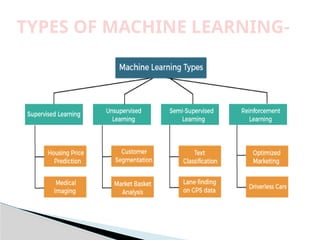
TYPES OF MACHINE LEARNING-
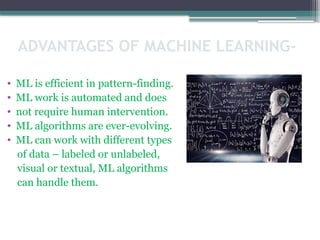
ADVANTAGES OF MACHINE LEARNING-
• ML is efficient in pattern-finding.
• ML work is automated and does
• not require human intervention.
• ML algorithms are ever-evolving.
• ML can work with different types
of data – labeled or unlabeled,
visual or textual, ML algorithms
can handle them.
DISADVANTAGES OF MACHINE LEARNING -
 Time and Resources
 Results Interpretations
 High Error Chances
 Social Changes
 Elimination of Human
Interface
 Changing Nature of
Jobs
 Highly Expensive
MAIN BRANCHES OF MACHINE LEARNING -
PROGRAMMING LANGUAGE
FOR MACHINE LEARNING -
 Python
 Java
 C
 C++
 JavaScript
 C#
 GO
 Julia
 Scala
FUTURE OF MACHINE LEARNING
IN ROBOTICS -
• Computer Vision: Robots can identify and recognize
objects they meet, discern details, and learn how to
navigate or avoid specific items.
• Manipulation: AI helps robots gain the fine motor skills
needed to grasp objects without destroying the item.
• Motion Control and Navigation: Robots no longer need
humans to guide them along paths and process flows. AI
enables robots to analyze their environment and self-
navigate. This capability even applies to the virtual world
of software. AI helps robot software processes avoid flow
bottlenecks or process exceptions.
MACHINE LEARNING ROBOT
• Machine Learning is a sub-discipline within
Artificial Intelligence that allows a computer to
identify behaviour patterns within a massive
amount of data and develop predictive
analytics, improving the experience.
• A machine learning robot is a type of robot
that includes these machine learning
techniques to acquire knowledge and improve
its responsiveness, based on what it learns.
• The machine learning process allows robots to
recognize patterns that help them understand
their environment and perform specific tasks
more efficiently by applying what they learn.
BENEFITS OF MACHINE LEARNING IN
ROBOTICS
• Adaptability: ML enables robots to adapt to changing
environments and handle unforeseen circumstances. They
can learn from experience, detect patterns, and make
adjustments to optimize performance.
• Efficiency: ML algorithms empower robots to acquire efficient
strategies for task execution, enabling them to optimize
energy utilization, reduce wastage, and enhance overall
operational efficiency.
• Safety: ML enhances robot safety by enabling them to detect
and avoid obstacles, predict potential risks, and make real-
time decisions to ensure the safety of humans and the robot
itself.
• Precision: ML algorithms enable robots to perform tasks with
high precision and accuracy. They can learn from data,
improve their motor skills, and execute delicate operations.
FUTURE OF MACHINE LEARNING -
 Fine – tuned personalization
 Better search engine experiences
 Evolution of data teams
 No-code environment
 Rise of quantum computing
MACHINE LEARNING AND ROBOTICS
 The intersection of robotics and machine learning
introduces new possibilities for the autonomy of
mobile robots and for the intelligence of their task
execution.
 Machine learning robots are being used in a wide
range of applications, from inspection and
maintenance or surveillance to manufacturing and
healthcare.
 In the manufacturing industry, machine learning
robots can improve the efficiency and accuracy of
production processes by learning to perform
complex tasks more quickly and accurately.
THANK YOU
SUBMITTED BY:- ARYAN PANWAR
CLASS ROLL NO:- 20
STUDENT ID:- 23151325
BCA ( AI & DS )

Introduction to Machine Learning theory .pptx

  • 1.
  • 2.
    WHAT IS MACHINE LEARNING? • A branch of artificial intelligence and computer science which focuses on the use of data and algorithms to imitate the way that humans learn, gradually improving its accuracy. • The term “Machine Learning” was coined by Arthur Samuel, a computer scientist at IBM . • A type of artificial intelligence (AI) focused on building computer systems that can learn from data.
  • 3.
    APPLICATIONS OF MACHINELEARNING - Facial recognition Product recommendations Email automation and spam filtering Financial accuracy Social media optimization Healthcare advancement Mobile voice to text and predictive text Predictive analytics
  • 4.
  • 5.
    ADVANTAGES OF MACHINELEARNING- • ML is efficient in pattern-finding. • ML work is automated and does • not require human intervention. • ML algorithms are ever-evolving. • ML can work with different types of data – labeled or unlabeled, visual or textual, ML algorithms can handle them.
  • 6.
    DISADVANTAGES OF MACHINELEARNING -  Time and Resources  Results Interpretations  High Error Chances  Social Changes  Elimination of Human Interface  Changing Nature of Jobs  Highly Expensive
  • 7.
    MAIN BRANCHES OFMACHINE LEARNING -
  • 8.
    PROGRAMMING LANGUAGE FOR MACHINELEARNING -  Python  Java  C  C++  JavaScript  C#  GO  Julia  Scala
  • 9.
    FUTURE OF MACHINELEARNING IN ROBOTICS - • Computer Vision: Robots can identify and recognize objects they meet, discern details, and learn how to navigate or avoid specific items. • Manipulation: AI helps robots gain the fine motor skills needed to grasp objects without destroying the item. • Motion Control and Navigation: Robots no longer need humans to guide them along paths and process flows. AI enables robots to analyze their environment and self- navigate. This capability even applies to the virtual world of software. AI helps robot software processes avoid flow bottlenecks or process exceptions.
  • 10.
    MACHINE LEARNING ROBOT •Machine Learning is a sub-discipline within Artificial Intelligence that allows a computer to identify behaviour patterns within a massive amount of data and develop predictive analytics, improving the experience. • A machine learning robot is a type of robot that includes these machine learning techniques to acquire knowledge and improve its responsiveness, based on what it learns. • The machine learning process allows robots to recognize patterns that help them understand their environment and perform specific tasks more efficiently by applying what they learn.
  • 11.
    BENEFITS OF MACHINELEARNING IN ROBOTICS • Adaptability: ML enables robots to adapt to changing environments and handle unforeseen circumstances. They can learn from experience, detect patterns, and make adjustments to optimize performance. • Efficiency: ML algorithms empower robots to acquire efficient strategies for task execution, enabling them to optimize energy utilization, reduce wastage, and enhance overall operational efficiency. • Safety: ML enhances robot safety by enabling them to detect and avoid obstacles, predict potential risks, and make real- time decisions to ensure the safety of humans and the robot itself. • Precision: ML algorithms enable robots to perform tasks with high precision and accuracy. They can learn from data, improve their motor skills, and execute delicate operations.
  • 12.
    FUTURE OF MACHINELEARNING -  Fine – tuned personalization  Better search engine experiences  Evolution of data teams  No-code environment  Rise of quantum computing
  • 13.
    MACHINE LEARNING ANDROBOTICS  The intersection of robotics and machine learning introduces new possibilities for the autonomy of mobile robots and for the intelligence of their task execution.  Machine learning robots are being used in a wide range of applications, from inspection and maintenance or surveillance to manufacturing and healthcare.  In the manufacturing industry, machine learning robots can improve the efficiency and accuracy of production processes by learning to perform complex tasks more quickly and accurately.
  • 14.
    THANK YOU SUBMITTED BY:-ARYAN PANWAR CLASS ROLL NO:- 20 STUDENT ID:- 23151325 BCA ( AI & DS )