Introduction to Machine learning
Name : Deepesh Yadav
Roll no. : 17ECTEC005
Branch : ECE
Subject : Industrial training
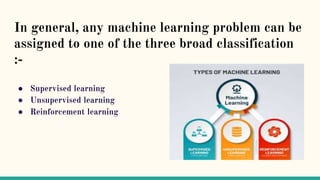
In general, any machine learning problem can be
assigned to one of the three broad classification
:-
● Supervised learning
● Unsupervised learning
● Reinforcement learning
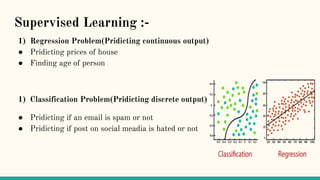
Supervised Learning :-
1) Regression Problem(Pridicting continuous output)
● Pridicting prices of house
● Finding age of person
1) Classification Problem(Pridicting discrete output)
● Pridicting if an email is spam or not
● Pridicting if post on social meadia is hated or not
Unsupervised learning :-
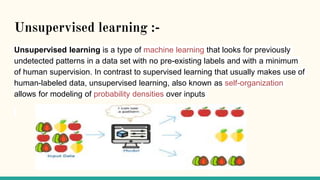
Unsupervised learning is a type of machine learning that looks for previously
undetected patterns in a data set with no pre-existing labels and with a minimum
of human supervision. In contrast to supervised learning that usually makes use of
human-labeled data, unsupervised learning, also known as self-organization
allows for modeling of probability densities over inputs
Reinforcement learning:-
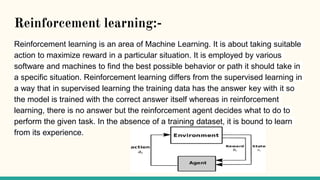
Reinforcement learning is an area of Machine Learning. It is about taking suitable
action to maximize reward in a particular situation. It is employed by various
software and machines to find the best possible behavior or path it should take in
a specific situation. Reinforcement learning differs from the supervised learning in
a way that in supervised learning the training data has the answer key with it so
the model is trained with the correct answer itself whereas in reinforcement
learning, there is no answer but the reinforcement agent decides what to do to
perform the given task. In the absence of a training dataset, it is bound to learn
from its experience.
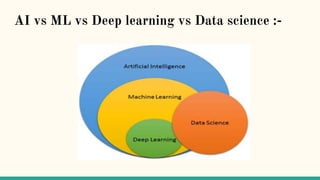
AI vs ML vs Deep learning vs Data science :-
Deep learning/neural network :-
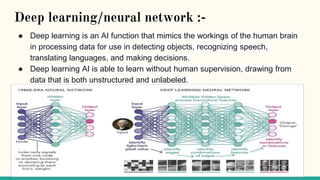
● Deep learning is an AI function that mimics the workings of the human brain
in processing data for use in detecting objects, recognizing speech,
translating languages, and making decisions.
● Deep learning AI is able to learn without human supervision, drawing from
data that is both unstructured and unlabeled.
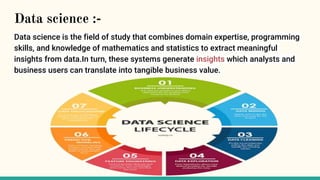
Data science :-
Data science is the field of study that combines domain expertise, programming
skills, and knowledge of mathematics and statistics to extract meaningful
insights from data.In turn, these systems generate insights which analysts and
business users can translate into tangible business value.
Thank you

Introduction to machine learning

  • 1.
    Introduction to Machinelearning Name : Deepesh Yadav Roll no. : 17ECTEC005 Branch : ECE Subject : Industrial training
  • 2.
    In general, anymachine learning problem can be assigned to one of the three broad classification :- ● Supervised learning ● Unsupervised learning ● Reinforcement learning
  • 3.
    Supervised Learning :- 1)Regression Problem(Pridicting continuous output) ● Pridicting prices of house ● Finding age of person 1) Classification Problem(Pridicting discrete output) ● Pridicting if an email is spam or not ● Pridicting if post on social meadia is hated or not
  • 4.
    Unsupervised learning :- Unsupervisedlearning is a type of machine learning that looks for previously undetected patterns in a data set with no pre-existing labels and with a minimum of human supervision. In contrast to supervised learning that usually makes use of human-labeled data, unsupervised learning, also known as self-organization allows for modeling of probability densities over inputs
  • 5.
    Reinforcement learning:- Reinforcement learningis an area of Machine Learning. It is about taking suitable action to maximize reward in a particular situation. It is employed by various software and machines to find the best possible behavior or path it should take in a specific situation. Reinforcement learning differs from the supervised learning in a way that in supervised learning the training data has the answer key with it so the model is trained with the correct answer itself whereas in reinforcement learning, there is no answer but the reinforcement agent decides what to do to perform the given task. In the absence of a training dataset, it is bound to learn from its experience.
  • 6.
    AI vs MLvs Deep learning vs Data science :-
  • 7.
    Deep learning/neural network:- ● Deep learning is an AI function that mimics the workings of the human brain in processing data for use in detecting objects, recognizing speech, translating languages, and making decisions. ● Deep learning AI is able to learn without human supervision, drawing from data that is both unstructured and unlabeled.
  • 8.
    Data science :- Datascience is the field of study that combines domain expertise, programming skills, and knowledge of mathematics and statistics to extract meaningful insights from data.In turn, these systems generate insights which analysts and business users can translate into tangible business value.
  • 9.