Introduction to JRubME

 Roy Ben Hayun
 Engineering Services
 CSG

                         1
Topics
• Requirements for mobile Ruby
• Port of the native Ruby VM (MRI)
• Porting JRuby to Java ME
  > CLDC
  > CDC
• More things to do..


                        Sun Confidential: Internal Only   2
Requirements for mobile Ruby


          Sun Confidential: Internal Only   3
Possible usages for mobile Ruby
•   Simple application development
•   Prototyping
•   Development tools
•   Education
•   Not Ruby on Rails.

• Not much usage today.
• Possibly in few years when/if scripting languages
  gain more traction in mobile space
                       Sun Confidential: Internal Only   4
Requirements from JRubyME
• What do we actually want to get?
  > The power of Ruby language
  > JRuby's Java bindings
  > An acceptable working subset


• What can we keep for later?
  > Ruby to JVM bytecode compilation
  > Threading
  > Any advanced feature


                       Sun Confidential: Internal Only   5
Port of the native Ruby VM (MRI)


            Sun Confidential: Internal Only   6
Porting the native Ruby MRI
• See
  http://developer.symbian.com/main/tools/opensrc/ruby
• Native porting effort is lengthy
• Need to port per OS
• Requires additional effort for API access
  > Mobile APIs
  > GUI
• MRI port gives only barebones Ruby language
  > No mobile APIs

                     Sun Confidential: Internal Only     7
Comparing native MRI vs JRuby port
• Porting involved:
  > Hybrid of C, K&R C, Symbian C++ vs Java only


• Porting time:
  > Weeks vs Days


• Value achieved in those ports:
  >   Interpreter – approximately same in both
  >   No OS APIs vs Java APIs via JRuby Java binding
  >   Required customization vs platform independent
  >   JRubME is easier to extend and enhance
                          Sun Confidential: Internal Only   8
Porting JRuby to Java ME


        Sun Confidential: Internal Only   9
Choosing the Java ME plaform
• CLDC based solution
  >   The current Java ME de-facto standard
  >   MIDP provides rich mobile APIs
  >   Requires build-time modifications to replace reflection
  >   Requires source modifications to JRuby

• CDC based solution
  > e.g., Sony Ericsson P990, M600
  > Closer to a desktop Java environment
  > Requires source modifications to JRuby

                           Sun Confidential: Internal Only      10
Choosing the JRuby baseline
• Newer versions (v0.9.8 from 2007)
  > Closer to the main JRuby branch for easy integration
  > Has more advanced features


• Taking an older version (v0.8.2 from 2006)
  > Has less advanced features
  > Minimize the porting effort to get a working subset
     – Less code, fewer dependencies, fewer libraries
  > Provides the interpreter and Java bindings
     – Which is what we need for now


                         Sun Confidential: Internal Only   11
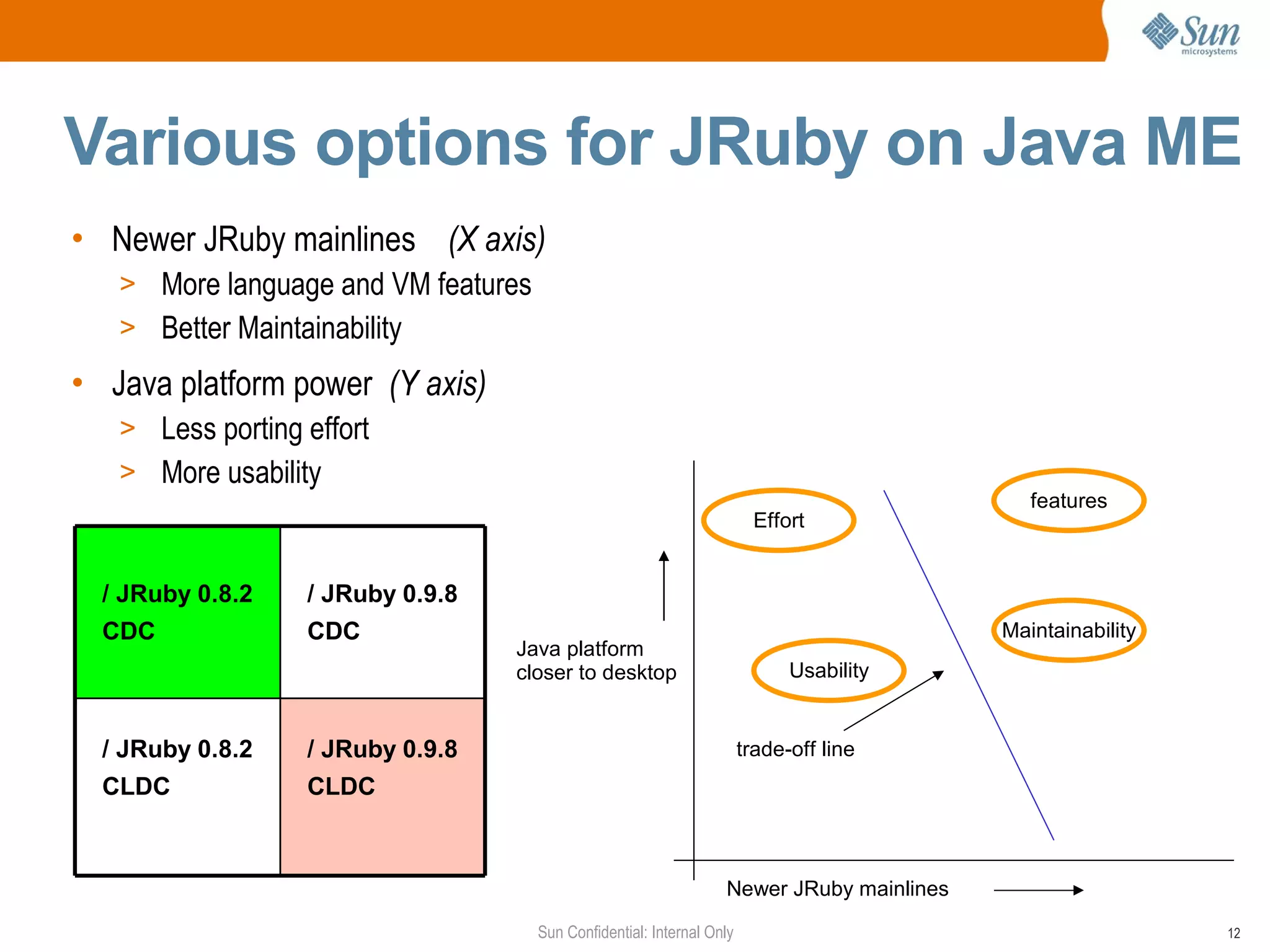
Various options for JRuby on Java ME
• Newer JRuby mainlines (X axis)
   > More language and VM features
   > Better Maintainability

• Java platform power (Y axis)
   > Less porting effort
   > More usability
                                                                                             features
                                                                         Effort


  / JRuby 0.8.2   / JRuby 0.9.8
  CDC             CDC                                                                     Maintainability
                                  Java platform
                                  closer to desktop                          Usability


  / JRuby 0.8.2   / JRuby 0.9.8                                        trade-off line
  CLDC            CLDC


                                                                  Newer JRuby mainlines

                                     Sun Confidential: Internal Only                                        12
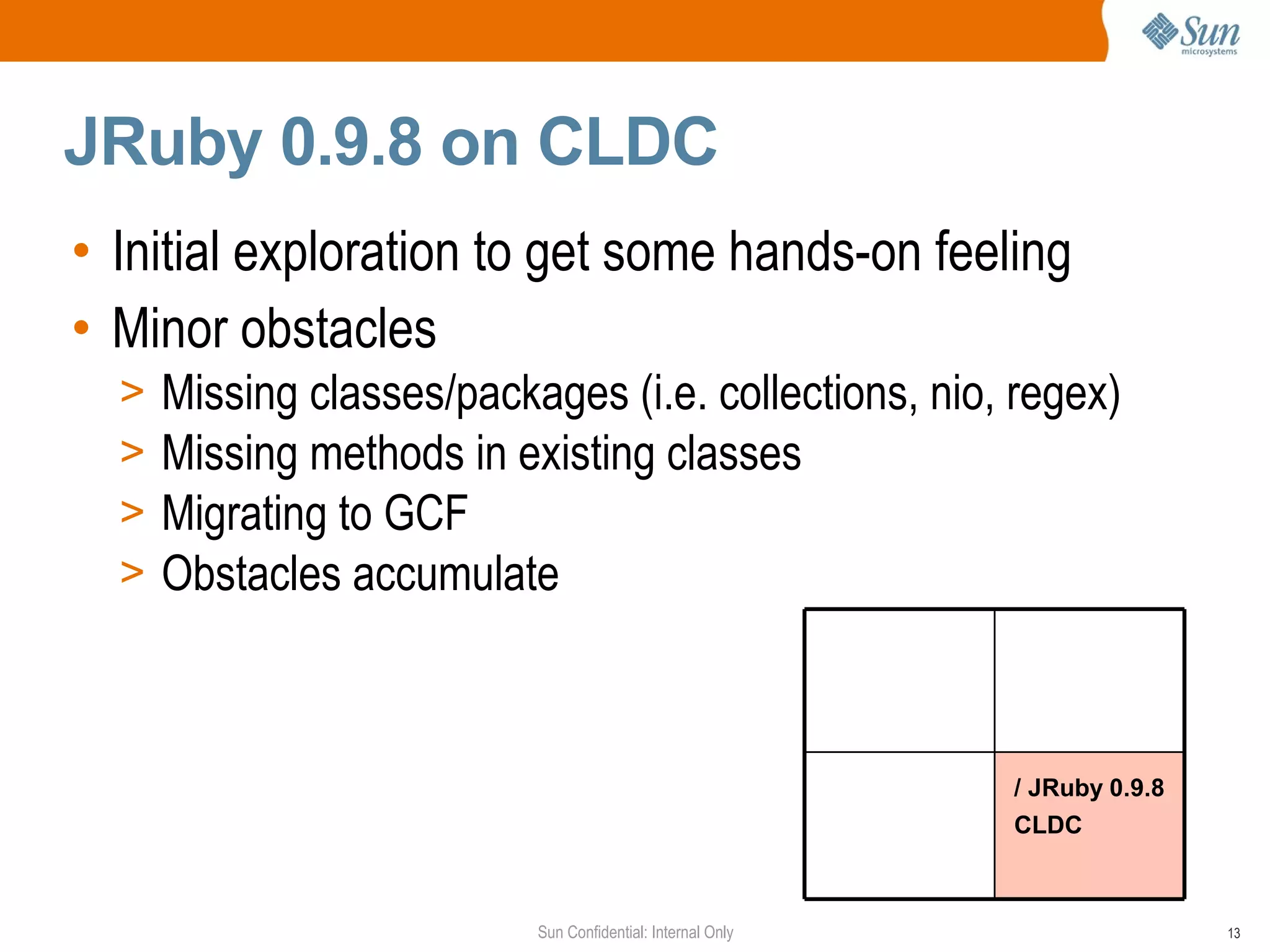
JRuby 0.9.8 on CLDC
• Initial exploration to get some hands-on feeling
• Minor obstacles
  >   Missing classes/packages (i.e. collections, nio, regex)
  >   Missing methods in existing classes
  >   Migrating to GCF
  >   Obstacles accumulate


                                                             / JRuby 0.9.8
                                                             CLDC


                           Sun Confidential: Internal Only                   13
JRuby 0.9.8 on CLDC main obstacles
• Obstacles accumulate

• Java bindings require reflection capability
• Possible solutions:
  > Pseudo reflection mechanism
  > Hard wired code support for specific classes
     – LCDUI, PIM, connectivity, persistance etc.
  > Same process as using the C API for the native Ruby
    VM


                        Sun Confidential: Internal Only   14
Usability obstacle on CLDC
• Sandboxing limits the usage of JRuby on mobiles
  > Limits usage to MIDP APIs
  > Can not jump out of the sandbox
  > Limits options of development tools
     – i.e. Limits dynamic extensions of testing frameworks


                            Sun Confidential: Internal Only   15
Summary of obstacles on CLDC
• CLDC porting effort becomes a handcrafted port
  > Although, it’s not a full rewrite
  > But big enough to diverge from the mainline JRuby


• Need to have a CLDC version.

• A more powerful JRuby on CDC should come first
  > Provide a proof of concept
  > Prototype for mobile usage
  > Attract developers
                        Sun Confidential: Internal Only   16
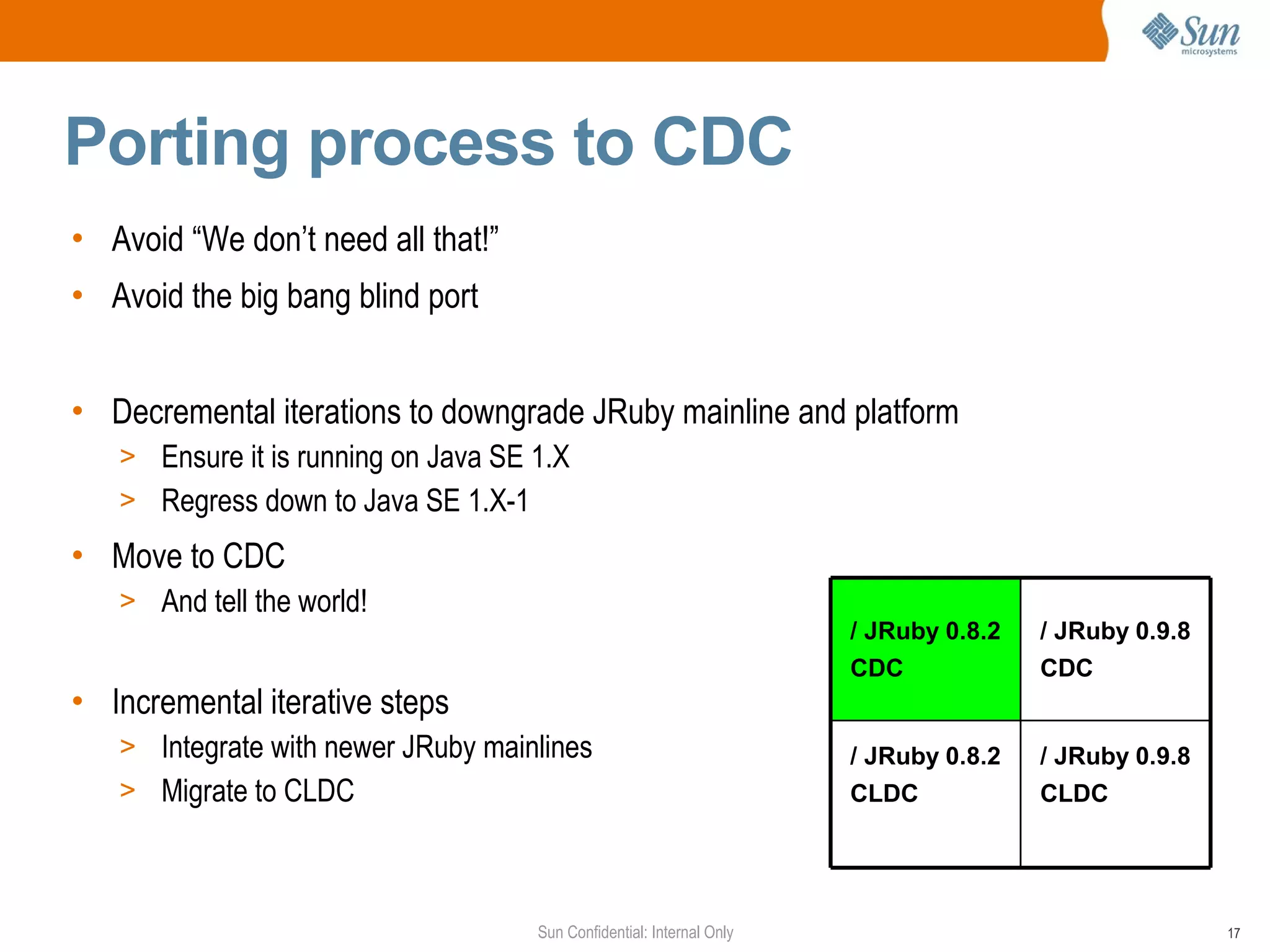
Porting process to CDC
• Avoid “We don’t need all that!”
• Avoid the big bang blind port


• Decremental iterations to downgrade JRuby mainline and platform
   > Ensure it is running on Java SE 1.X
   > Regress down to Java SE 1.X-1

• Move to CDC
   > And tell the world!
                                                                       / JRuby 0.8.2   / JRuby 0.9.8
                                                                       CDC             CDC
• Incremental iterative steps
   > Integrate with newer JRuby mainlines                              / JRuby 0.8.2   / JRuby 0.9.8
   > Migrate to CLDC                                                   CLDC            CLDC


                                     Sun Confidential: Internal Only                                   17
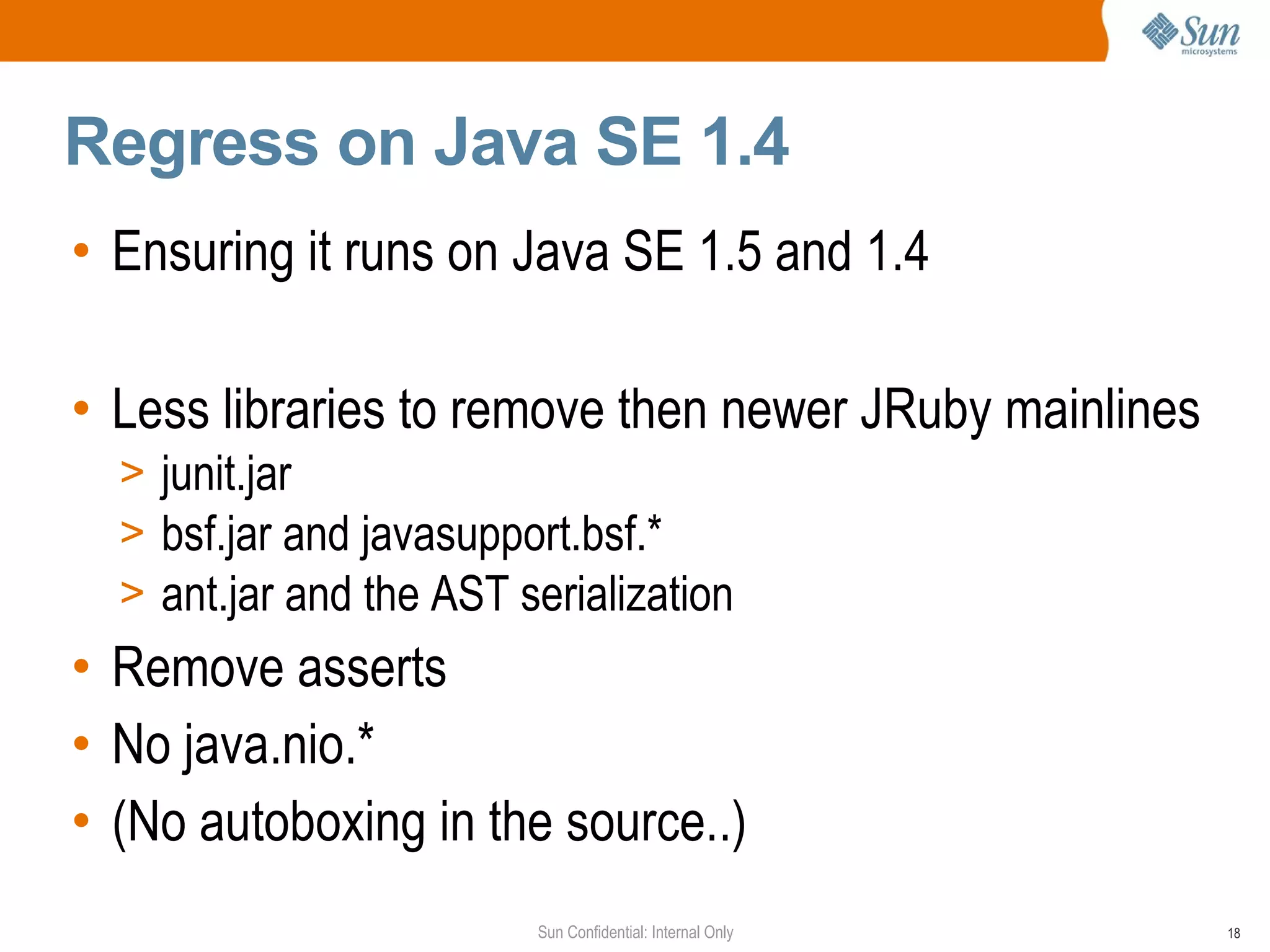
Regress on Java SE 1.4
• Ensuring it runs on Java SE 1.5 and 1.4

• Less libraries to remove then newer JRuby mainlines
  > junit.jar
  > bsf.jar and javasupport.bsf.*
  > ant.jar and the AST serialization
• Remove asserts
• No java.nio.*
• (No autoboxing in the source..)
                         Sun Confidential: Internal Only   18
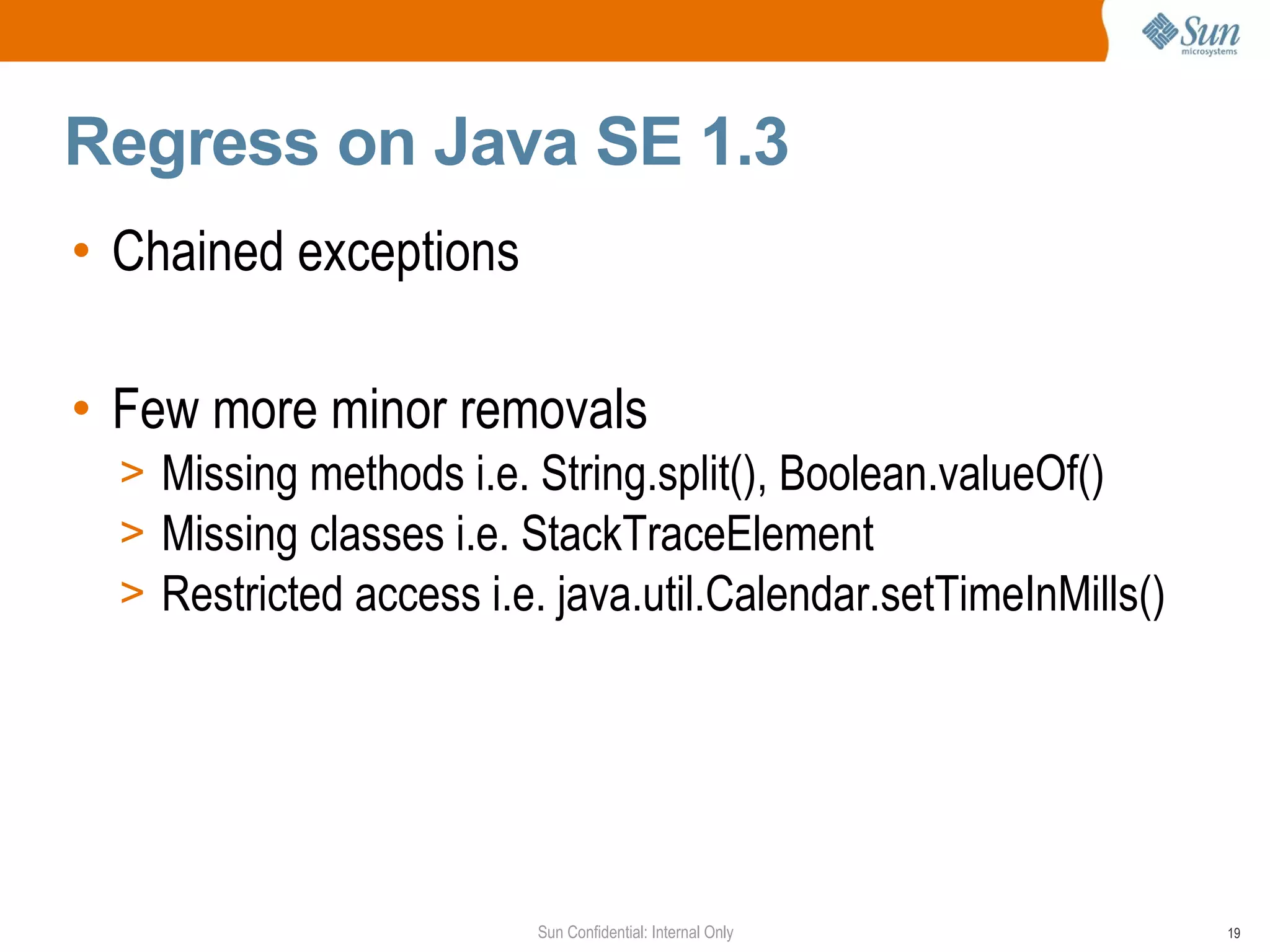
Regress on Java SE 1.3
• Chained exceptions

• Few more minor removals
  > Missing methods i.e. String.split(), Boolean.valueOf()
  > Missing classes i.e. StackTraceElement
  > Restricted access i.e. java.util.Calendar.setTimeInMills()


                         Sun Confidential: Internal Only         19
Regress on Java SE 1.3
• Bigger obstacle is that there is no java.util.regex.*
• Solution
  > Find a replacement package e.g.,Java 1.4
  > Paste into a new package jrubyme.poc.[package]
  > Modifications as required to package and client code
     – e.g., sun.text.Normalizer silently commented out.


• And do the same for other dependencies


                        Sun Confidential: Internal Only    20
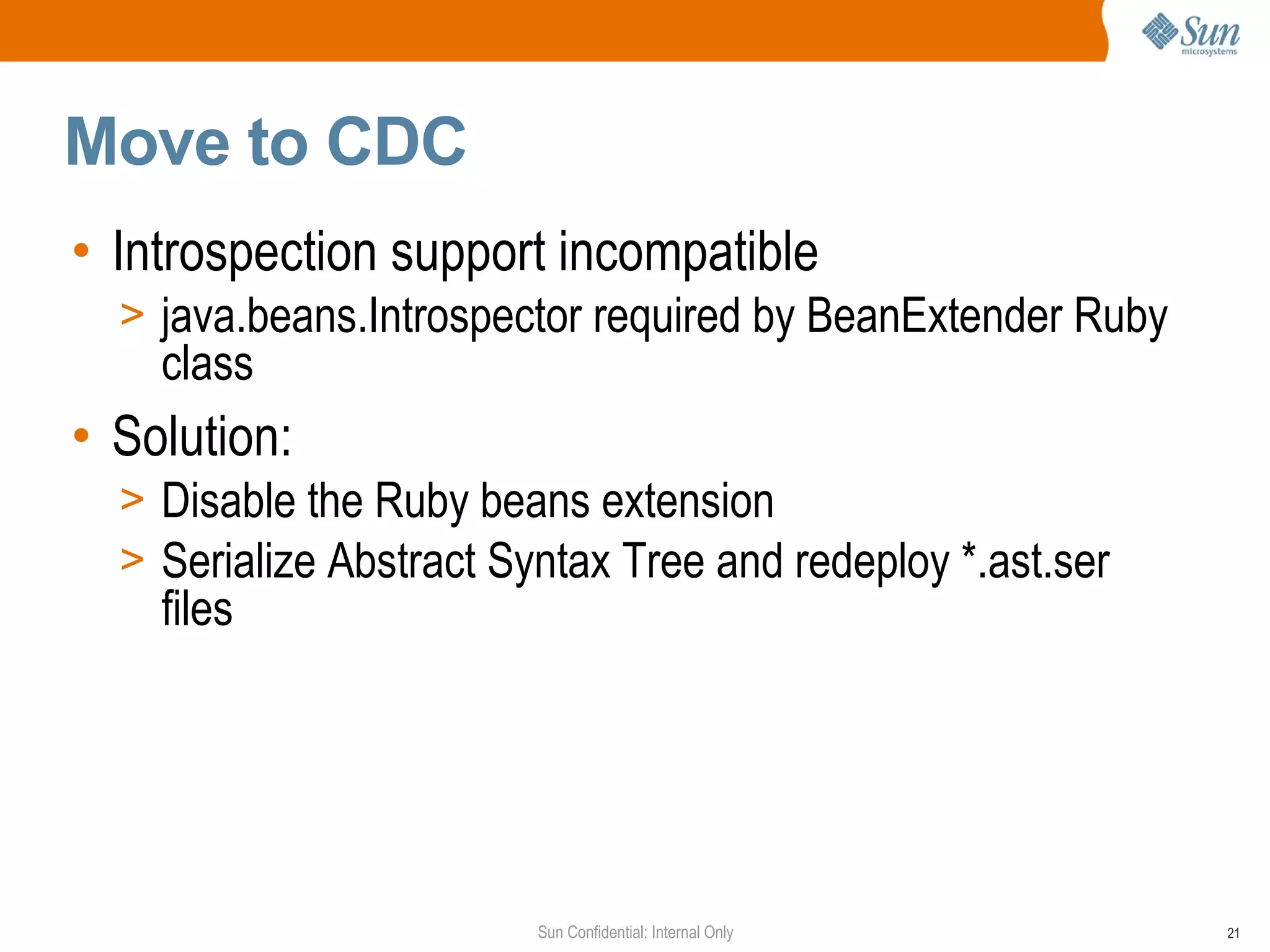
Move to CDC
• Introspection support incompatible
  > java.beans.Introspector required by BeanExtender Ruby
    class
• Solution:
  > Disable the Ruby beans extension
  > Serialize Abstract Syntax Tree and redeploy *.ast.ser
    files


                         Sun Confidential: Internal Only    21
Evaluating the CDC port
• How does downgrading JRuby to 0.8.2 simplify things?
  > i.e. Less than 40 locations of java.util.Regex package usage
  > Less code e.g., 318 source files compared to 574 in 0.9.8


• How does porting to CDC via Java SE simplify things?
  > Moving closer to CDC gradually
  > Much fewer new APIs or API differences
    – No need for handcrafted porting


• Remember: we’re trying to get to a working subset
                         Sun Confidential: Internal Only       22
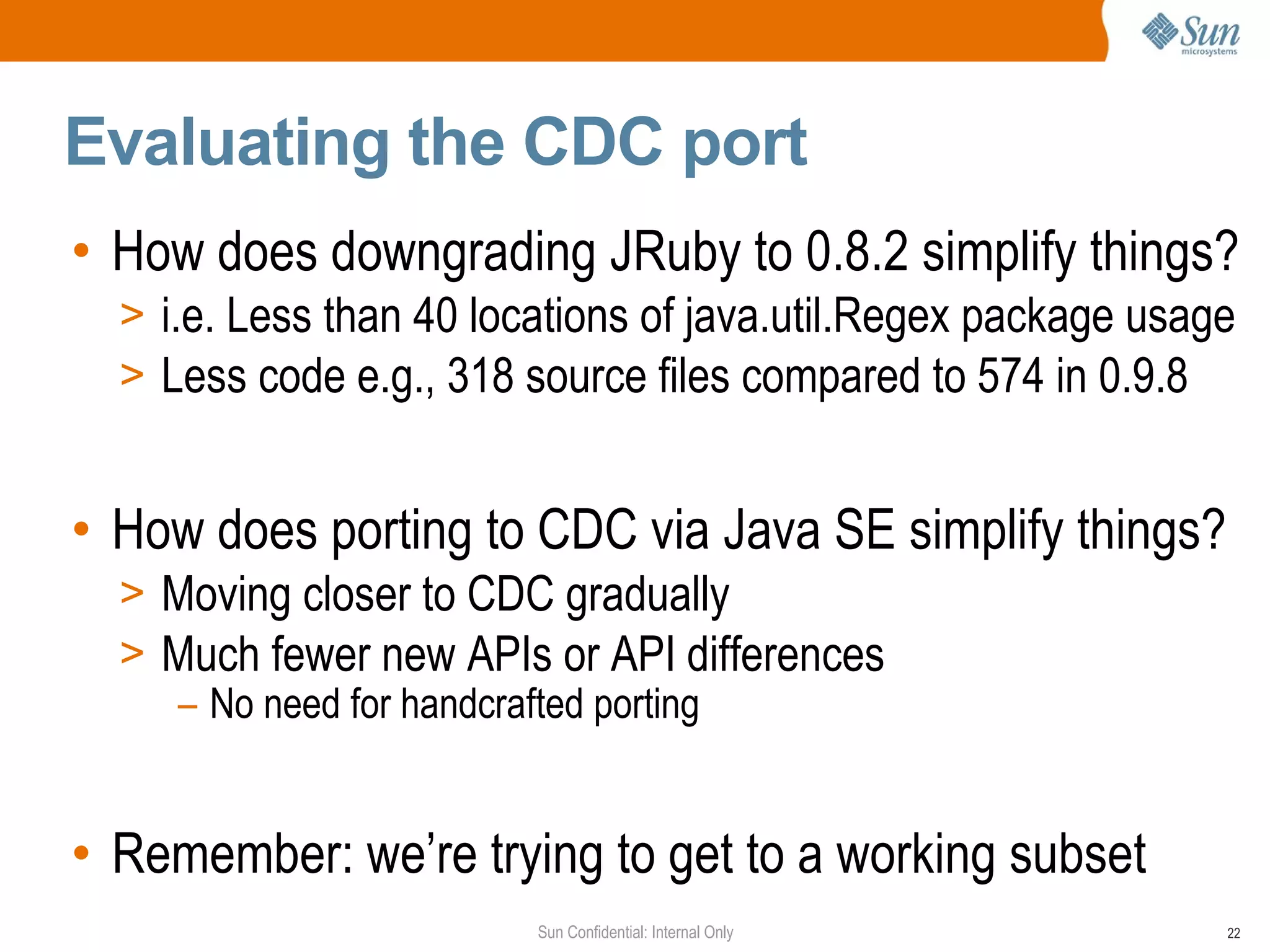
Demo on a real device
• AWT UI
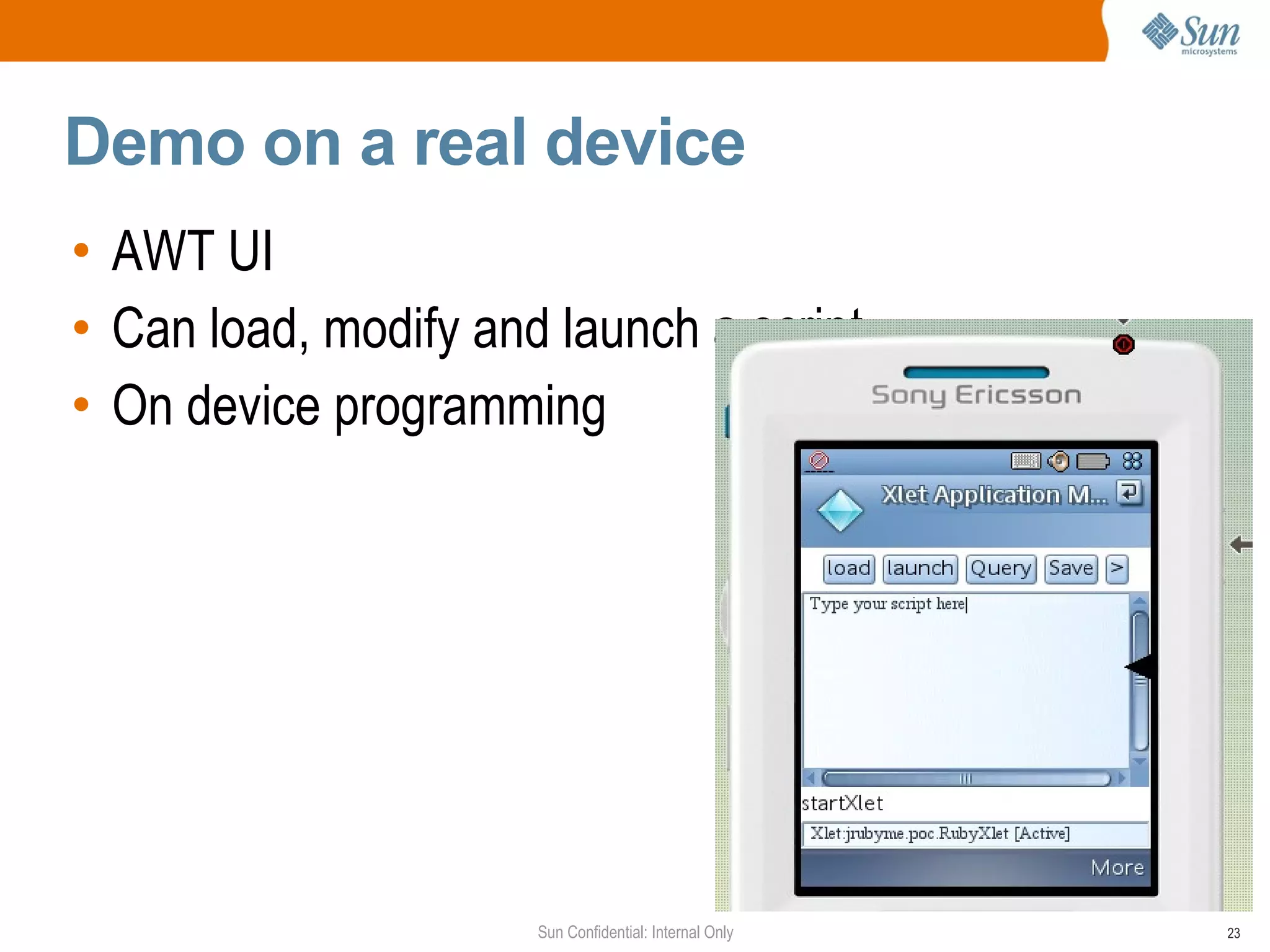
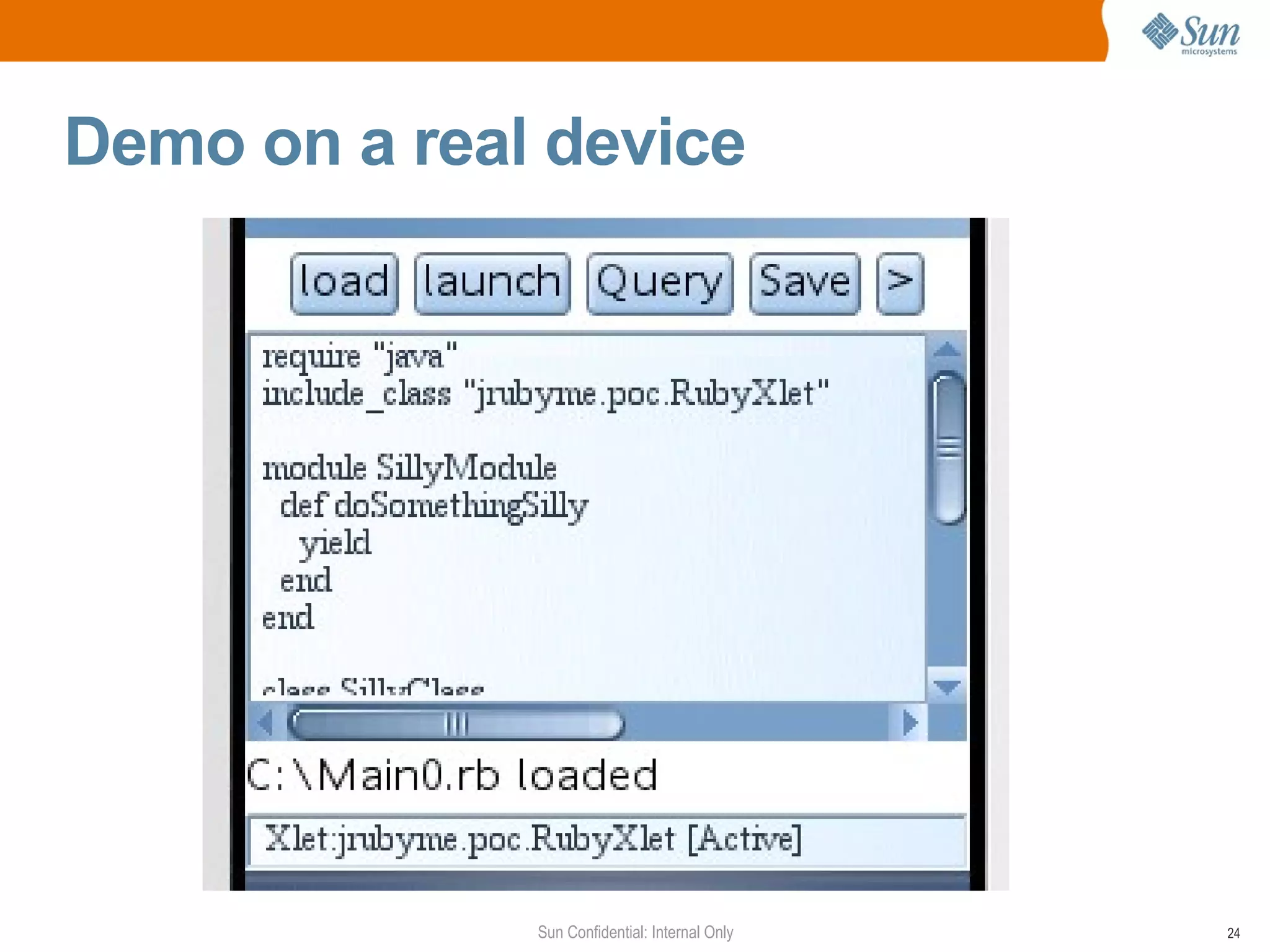
• Can load, modify and launch a script
• On device programming


                      Sun Confidential: Internal Only   23
Demo on a real device


              Sun Confidential: Internal Only   24
Demo on a real device


              Sun Confidential: Internal Only   25
There's a lot to do from here..


           Sun Confidential: Internal Only   26
Bringing JRuby to the mobile space
• Co-existence of the native and Java options
  > Attracts developers from different backgrounds
  > No reason to limit the hosting platform options


• Anatomy of free open source success
  > Governance and decision making capability
  > Tools for collaboration
  > Strong community values and commitment


                         Sun Confidential: Internal Only   27
Bringing JRuby to the mobile space
• JRubME ‘TODO’ list
  >   Create a mobile spec (desktop too)
  >   Adapt to mobile constraints (ROM, performance, ..)
  >   Rectify the initial porting
  >   Move upwards in the JRuby versions
  >   Migrate to CLDC as well


                          Sun Confidential: Internal Only   28
Bringing JRuby to the mobile space
• JRubME ‘Wish-list’
  > Scripting languages gain more traction in the mobile
    space
  > CDC (or embedded Java SE flavour) to become the
    mobile Java de-facto standard
  > Dual compilation and JSR-292 (invokedynamic)
     – Moore’s law will take care of speed


                            Sun Confidential: Internal Only   29
Thank you


 Roy Ben Hayun
 Engineering Services
 CSG

                        30

Introduction to JRubMe

  • 1.
    Introduction to JRubME Roy Ben Hayun Engineering Services CSG 1
  • 2.
    Topics • Requirements formobile Ruby • Port of the native Ruby VM (MRI) • Porting JRuby to Java ME > CLDC > CDC • More things to do.. Sun Confidential: Internal Only 2
  • 3.
    Requirements for mobileRuby Sun Confidential: Internal Only 3
  • 4.
    Possible usages formobile Ruby • Simple application development • Prototyping • Development tools • Education • Not Ruby on Rails. • Not much usage today. • Possibly in few years when/if scripting languages gain more traction in mobile space Sun Confidential: Internal Only 4
  • 5.
    Requirements from JRubyME •What do we actually want to get? > The power of Ruby language > JRuby's Java bindings > An acceptable working subset • What can we keep for later? > Ruby to JVM bytecode compilation > Threading > Any advanced feature Sun Confidential: Internal Only 5
  • 6.
    Port of thenative Ruby VM (MRI) Sun Confidential: Internal Only 6
  • 7.
    Porting the nativeRuby MRI • See http://developer.symbian.com/main/tools/opensrc/ruby • Native porting effort is lengthy • Need to port per OS • Requires additional effort for API access > Mobile APIs > GUI • MRI port gives only barebones Ruby language > No mobile APIs Sun Confidential: Internal Only 7
  • 8.
    Comparing native MRIvs JRuby port • Porting involved: > Hybrid of C, K&R C, Symbian C++ vs Java only • Porting time: > Weeks vs Days • Value achieved in those ports: > Interpreter – approximately same in both > No OS APIs vs Java APIs via JRuby Java binding > Required customization vs platform independent > JRubME is easier to extend and enhance Sun Confidential: Internal Only 8
  • 9.
    Porting JRuby toJava ME Sun Confidential: Internal Only 9
  • 10.
    Choosing the JavaME plaform • CLDC based solution > The current Java ME de-facto standard > MIDP provides rich mobile APIs > Requires build-time modifications to replace reflection > Requires source modifications to JRuby • CDC based solution > e.g., Sony Ericsson P990, M600 > Closer to a desktop Java environment > Requires source modifications to JRuby Sun Confidential: Internal Only 10
  • 11.
    Choosing the JRubybaseline • Newer versions (v0.9.8 from 2007) > Closer to the main JRuby branch for easy integration > Has more advanced features • Taking an older version (v0.8.2 from 2006) > Has less advanced features > Minimize the porting effort to get a working subset – Less code, fewer dependencies, fewer libraries > Provides the interpreter and Java bindings – Which is what we need for now Sun Confidential: Internal Only 11
  • 12.
    Various options forJRuby on Java ME • Newer JRuby mainlines (X axis) > More language and VM features > Better Maintainability • Java platform power (Y axis) > Less porting effort > More usability features Effort / JRuby 0.8.2 / JRuby 0.9.8 CDC CDC Maintainability Java platform closer to desktop Usability / JRuby 0.8.2 / JRuby 0.9.8 trade-off line CLDC CLDC Newer JRuby mainlines Sun Confidential: Internal Only 12
  • 13.
    JRuby 0.9.8 onCLDC • Initial exploration to get some hands-on feeling • Minor obstacles > Missing classes/packages (i.e. collections, nio, regex) > Missing methods in existing classes > Migrating to GCF > Obstacles accumulate / JRuby 0.9.8 CLDC Sun Confidential: Internal Only 13
  • 14.
    JRuby 0.9.8 onCLDC main obstacles • Obstacles accumulate • Java bindings require reflection capability • Possible solutions: > Pseudo reflection mechanism > Hard wired code support for specific classes – LCDUI, PIM, connectivity, persistance etc. > Same process as using the C API for the native Ruby VM Sun Confidential: Internal Only 14
  • 15.
    Usability obstacle onCLDC • Sandboxing limits the usage of JRuby on mobiles > Limits usage to MIDP APIs > Can not jump out of the sandbox > Limits options of development tools – i.e. Limits dynamic extensions of testing frameworks Sun Confidential: Internal Only 15
  • 16.
    Summary of obstacleson CLDC • CLDC porting effort becomes a handcrafted port > Although, it’s not a full rewrite > But big enough to diverge from the mainline JRuby • Need to have a CLDC version. • A more powerful JRuby on CDC should come first > Provide a proof of concept > Prototype for mobile usage > Attract developers Sun Confidential: Internal Only 16
  • 17.
    Porting process toCDC • Avoid “We don’t need all that!” • Avoid the big bang blind port • Decremental iterations to downgrade JRuby mainline and platform > Ensure it is running on Java SE 1.X > Regress down to Java SE 1.X-1 • Move to CDC > And tell the world! / JRuby 0.8.2 / JRuby 0.9.8 CDC CDC • Incremental iterative steps > Integrate with newer JRuby mainlines / JRuby 0.8.2 / JRuby 0.9.8 > Migrate to CLDC CLDC CLDC Sun Confidential: Internal Only 17
  • 18.
    Regress on JavaSE 1.4 • Ensuring it runs on Java SE 1.5 and 1.4 • Less libraries to remove then newer JRuby mainlines > junit.jar > bsf.jar and javasupport.bsf.* > ant.jar and the AST serialization • Remove asserts • No java.nio.* • (No autoboxing in the source..) Sun Confidential: Internal Only 18
  • 19.
    Regress on JavaSE 1.3 • Chained exceptions • Few more minor removals > Missing methods i.e. String.split(), Boolean.valueOf() > Missing classes i.e. StackTraceElement > Restricted access i.e. java.util.Calendar.setTimeInMills() Sun Confidential: Internal Only 19
  • 20.
    Regress on JavaSE 1.3 • Bigger obstacle is that there is no java.util.regex.* • Solution > Find a replacement package e.g.,Java 1.4 > Paste into a new package jrubyme.poc.[package] > Modifications as required to package and client code – e.g., sun.text.Normalizer silently commented out. • And do the same for other dependencies Sun Confidential: Internal Only 20
  • 21.
    Move to CDC •Introspection support incompatible > java.beans.Introspector required by BeanExtender Ruby class • Solution: > Disable the Ruby beans extension > Serialize Abstract Syntax Tree and redeploy *.ast.ser files Sun Confidential: Internal Only 21
  • 22.
    Evaluating the CDCport • How does downgrading JRuby to 0.8.2 simplify things? > i.e. Less than 40 locations of java.util.Regex package usage > Less code e.g., 318 source files compared to 574 in 0.9.8 • How does porting to CDC via Java SE simplify things? > Moving closer to CDC gradually > Much fewer new APIs or API differences – No need for handcrafted porting • Remember: we’re trying to get to a working subset Sun Confidential: Internal Only 22
  • 23.
    Demo on areal device • AWT UI • Can load, modify and launch a script • On device programming Sun Confidential: Internal Only 23
  • 24.
    Demo on areal device Sun Confidential: Internal Only 24
  • 25.
    Demo on areal device Sun Confidential: Internal Only 25
  • 26.
    There's a lotto do from here.. Sun Confidential: Internal Only 26
  • 27.
    Bringing JRuby tothe mobile space • Co-existence of the native and Java options > Attracts developers from different backgrounds > No reason to limit the hosting platform options • Anatomy of free open source success > Governance and decision making capability > Tools for collaboration > Strong community values and commitment Sun Confidential: Internal Only 27
  • 28.
    Bringing JRuby tothe mobile space • JRubME ‘TODO’ list > Create a mobile spec (desktop too) > Adapt to mobile constraints (ROM, performance, ..) > Rectify the initial porting > Move upwards in the JRuby versions > Migrate to CLDC as well Sun Confidential: Internal Only 28
  • 29.
    Bringing JRuby tothe mobile space • JRubME ‘Wish-list’ > Scripting languages gain more traction in the mobile space > CDC (or embedded Java SE flavour) to become the mobile Java de-facto standard > Dual compilation and JSR-292 (invokedynamic) – Moore’s law will take care of speed Sun Confidential: Internal Only 29
  • 30.
    Thank you RoyBen Hayun Engineering Services CSG 30