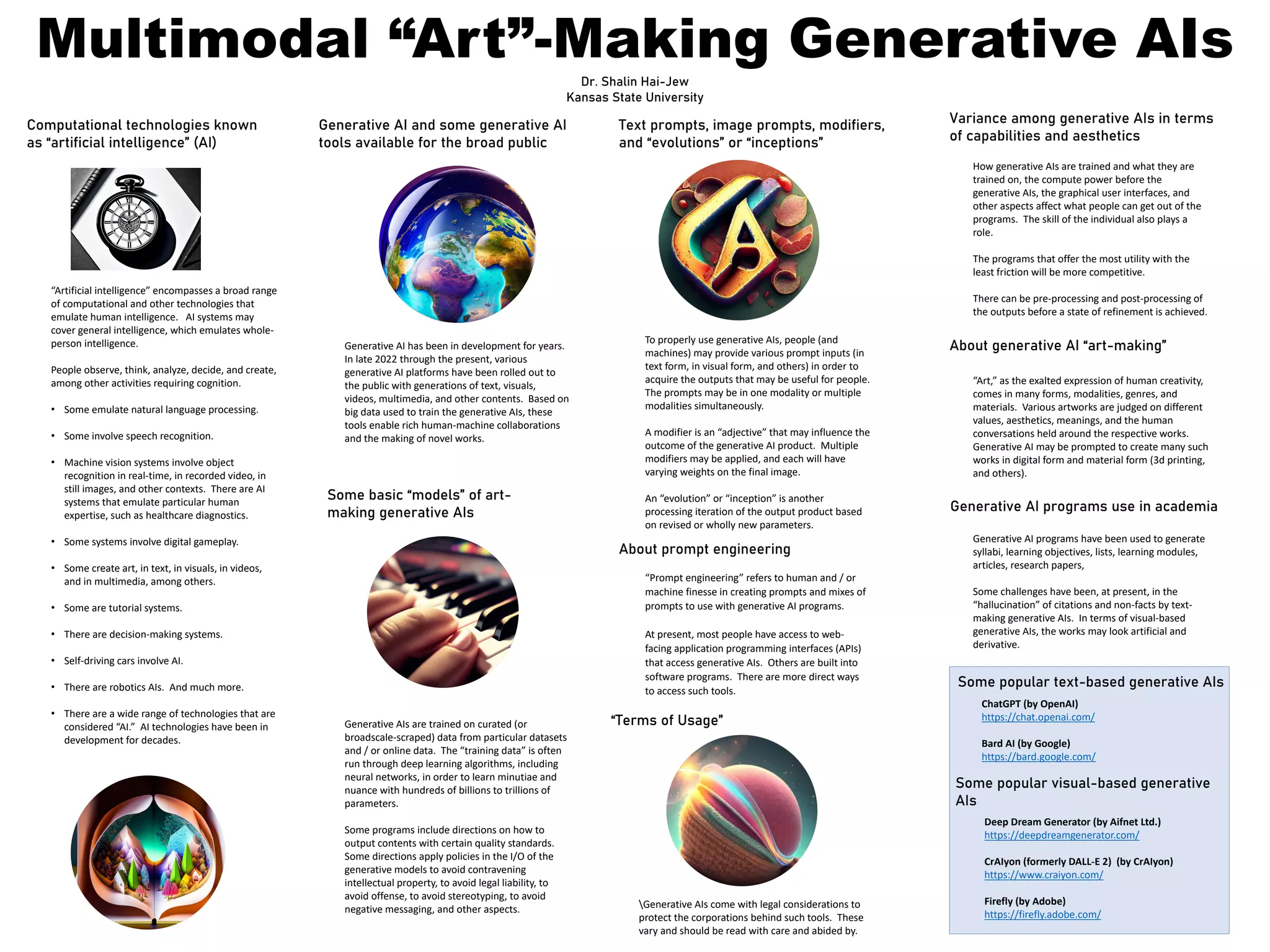
Multimodal “Art”-Making Generative AIs
Computational technologies known
as “artificial intelligence” (AI)
“Terms of Usage”
Dr. Shalin Hai-Jew
Kansas State University
“Artificial intelligence” encompasses a broad range
of computational and other technologies that
emulate human intelligence. AI systems may
cover general intelligence, which emulates whole-
person intelligence.
People observe, think, analyze, decide, and create,
among other activities requiring cognition.
• Some emulate natural language processing.
• Some involve speech recognition.
• Machine vision systems involve object
recognition in real-time, in recorded video, in
still images, and other contexts. There are AI
systems that emulate particular human
expertise, such as healthcare diagnostics.
• Some systems involve digital gameplay.
• Some create art, in text, in visuals, in videos,
and in multimedia, among others.
• Some are tutorial systems.
• There are decision-making systems.
• Self-driving cars involve AI.
• There are robotics AIs. And much more.
• There are a wide range of technologies that are
considered “AI.” AI technologies have been in
development for decades.
To properly use generative AIs, people (and
machines) may provide various prompt inputs (in
text form, in visual form, and others) in order to
acquire the outputs that may be useful for people.
The prompts may be in one modality or multiple
modalities simultaneously.
A modifier is an “adjective” that may influence the
outcome of the generative AI product. Multiple
modifiers may be applied, and each will have
varying weights on the final image.
An “evolution” or “inception” is another
processing iteration of the output product based
on revised or wholly new parameters.
Generative AIs come with legal considerations to
protect the corporations behind such tools. These
vary and should be read with care and abided by.
Text prompts, image prompts, modifiers,
and “evolutions” or “inceptions”
Some popular text-based generative AIs
Generative AI and some generative AI
tools available for the broad public
About prompt engineering
Generative AI has been in development for years.
In late 2022 through the present, various
generative AI platforms have been rolled out to
the public with generations of text, visuals,
videos, multimedia, and other contents. Based on
big data used to train the generative AIs, these
tools enable rich human-machine collaborations
and the making of novel works.
About generative AI “art-making”
Some basic “models” of art-
making generative AIs
Variance among generative AIs in terms
of capabilities and aesthetics
Generative AIs are trained on curated (or
broadscale-scraped) data from particular datasets
and / or online data. The “training data” is often
run through deep learning algorithms, including
neural networks, in order to learn minutiae and
nuance with hundreds of billions to trillions of
parameters.
Some programs include directions on how to
output contents with certain quality standards.
Some directions apply policies in the I/O of the
generative models to avoid contravening
intellectual property, to avoid legal liability, to
avoid offense, to avoid stereotyping, to avoid
negative messaging, and other aspects.
“Prompt engineering” refers to human and / or
machine finesse in creating prompts and mixes of
prompts to use with generative AI programs.
At present, most people have access to web-
facing application programming interfaces (APIs)
that access generative AIs. Others are built into
software programs. There are more direct ways
to access such tools.
How generative AIs are trained and what they are
trained on, the compute power before the
generative AIs, the graphical user interfaces, and
other aspects affect what people can get out of the
programs. The skill of the individual also plays a
role.
The programs that offer the most utility with the
least friction will be more competitive.
There can be pre-processing and post-processing of
the outputs before a state of refinement is achieved.
“Art,” as the exalted expression of human creativity,
comes in many forms, modalities, genres, and
materials. Various artworks are judged on different
values, aesthetics, meanings, and the human
conversations held around the respective works.
Generative AI may be prompted to create many such
works in digital form and material form (3d printing,
and others).
Generative AI programs have been used to generate
syllabi, learning objectives, lists, learning modules,
articles, research papers,
Some challenges have been, at present, in the
“hallucination” of citations and non-facts by text-
making generative AIs. In terms of visual-based
generative AIs, the works may look artificial and
derivative.
Generative AI programs use in academia
ChatGPT (by OpenAI)
https://chat.openai.com/
Bard AI (by Google)
https://bard.google.com/
Some popular visual-based generative
AIs
Deep Dream Generator (by Aifnet Ltd.)
https://deepdreamgenerator.com/
CrAIyon (formerly DALL-E 2) (by CrAIyon)
https://www.craiyon.com/
Firefly (by Adobe)
https://firefly.adobe.com/

Poster: Multimodal "Art"-Making Generative AIs

  • 1.
    Multimodal “Art”-Making GenerativeAIs Computational technologies known as “artificial intelligence” (AI) “Terms of Usage” Dr. Shalin Hai-Jew Kansas State University “Artificial intelligence” encompasses a broad range of computational and other technologies that emulate human intelligence. AI systems may cover general intelligence, which emulates whole- person intelligence. People observe, think, analyze, decide, and create, among other activities requiring cognition. • Some emulate natural language processing. • Some involve speech recognition. • Machine vision systems involve object recognition in real-time, in recorded video, in still images, and other contexts. There are AI systems that emulate particular human expertise, such as healthcare diagnostics. • Some systems involve digital gameplay. • Some create art, in text, in visuals, in videos, and in multimedia, among others. • Some are tutorial systems. • There are decision-making systems. • Self-driving cars involve AI. • There are robotics AIs. And much more. • There are a wide range of technologies that are considered “AI.” AI technologies have been in development for decades. To properly use generative AIs, people (and machines) may provide various prompt inputs (in text form, in visual form, and others) in order to acquire the outputs that may be useful for people. The prompts may be in one modality or multiple modalities simultaneously. A modifier is an “adjective” that may influence the outcome of the generative AI product. Multiple modifiers may be applied, and each will have varying weights on the final image. An “evolution” or “inception” is another processing iteration of the output product based on revised or wholly new parameters. Generative AIs come with legal considerations to protect the corporations behind such tools. These vary and should be read with care and abided by. Text prompts, image prompts, modifiers, and “evolutions” or “inceptions” Some popular text-based generative AIs Generative AI and some generative AI tools available for the broad public About prompt engineering Generative AI has been in development for years. In late 2022 through the present, various generative AI platforms have been rolled out to the public with generations of text, visuals, videos, multimedia, and other contents. Based on big data used to train the generative AIs, these tools enable rich human-machine collaborations and the making of novel works. About generative AI “art-making” Some basic “models” of art- making generative AIs Variance among generative AIs in terms of capabilities and aesthetics Generative AIs are trained on curated (or broadscale-scraped) data from particular datasets and / or online data. The “training data” is often run through deep learning algorithms, including neural networks, in order to learn minutiae and nuance with hundreds of billions to trillions of parameters. Some programs include directions on how to output contents with certain quality standards. Some directions apply policies in the I/O of the generative models to avoid contravening intellectual property, to avoid legal liability, to avoid offense, to avoid stereotyping, to avoid negative messaging, and other aspects. “Prompt engineering” refers to human and / or machine finesse in creating prompts and mixes of prompts to use with generative AI programs. At present, most people have access to web- facing application programming interfaces (APIs) that access generative AIs. Others are built into software programs. There are more direct ways to access such tools. How generative AIs are trained and what they are trained on, the compute power before the generative AIs, the graphical user interfaces, and other aspects affect what people can get out of the programs. The skill of the individual also plays a role. The programs that offer the most utility with the least friction will be more competitive. There can be pre-processing and post-processing of the outputs before a state of refinement is achieved. “Art,” as the exalted expression of human creativity, comes in many forms, modalities, genres, and materials. Various artworks are judged on different values, aesthetics, meanings, and the human conversations held around the respective works. Generative AI may be prompted to create many such works in digital form and material form (3d printing, and others). Generative AI programs have been used to generate syllabi, learning objectives, lists, learning modules, articles, research papers, Some challenges have been, at present, in the “hallucination” of citations and non-facts by text- making generative AIs. In terms of visual-based generative AIs, the works may look artificial and derivative. Generative AI programs use in academia ChatGPT (by OpenAI) https://chat.openai.com/ Bard AI (by Google) https://bard.google.com/ Some popular visual-based generative AIs Deep Dream Generator (by Aifnet Ltd.) https://deepdreamgenerator.com/ CrAIyon (formerly DALL-E 2) (by CrAIyon) https://www.craiyon.com/ Firefly (by Adobe) https://firefly.adobe.com/