Introduction to
Falco
Presenter Name: Mohd Shahenvaz Khan
Lack of etiquette and manners is a huge turn off.
KnolX Etiquettes
 Punctuality
Join the session 5 minutes prior to the session start time. We start on
time and conclude on time!
 Feedback
Make sure to submit a constructive feedback for all sessions as it is very
helpful for the presenter.
 Silent Mode
Keep your mobile devices in silent mode, feel free to move out of session
in case you need to attend an urgent call.
 Avoid Disturbance
Avoid unwanted chit chat during the session.
1. Introduction
 What does Falco do?
 Importance of Falco
 What does Falco checks for?
2. Falco Architecture
3. Falco Components
4. Demo
Introduction to Falco
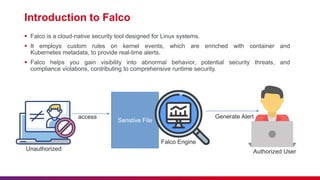
 Falco is a cloud-native security tool designed for Linux systems.
 It employs custom rules on kernel events, which are enriched with container and
Kubernetes metadata, to provide real-time alerts.
 Falco helps you gain visibility into abnormal behavior, potential security threats, and
compliance violations, contributing to comprehensive runtime security.
Senstive File
Unauthorized user
Falco Engine
Generate alert
Authorized User
access Generate Alert
Unauthorized user Authorized User
Falco Engine
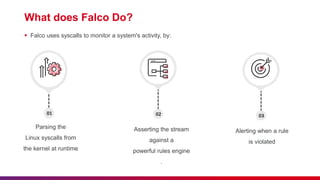
What does Falco Do?
 Falco uses syscalls to monitor a system's activity, by:
01 02
Parsing the
Linux syscalls from
the kernel at runtime
Asserting the stream
against a
powerful rules engine
.
Alerting when a rule
is violated
03
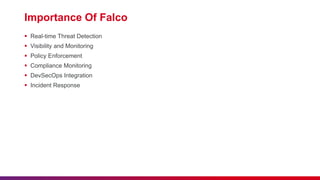
Importance Of Falco
 Real-time Threat Detection
 Visibility and Monitoring
 Policy Enforcement
 Compliance Monitoring
 DevSecOps Integration
 Incident Response
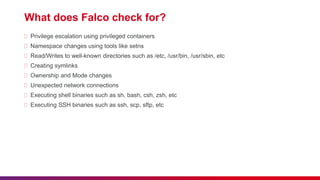
What does Falco check for?
 Privilege escalation using privileged containers
 Namespace changes using tools like setns
 Read/Writes to well-known directories such as /etc, /usr/bin, /usr/sbin, etc
 Creating symlinks
 Ownership and Mode changes
 Unexpected network connections
 Executing shell binaries such as sh, bash, csh, zsh, etc
 Executing SSH binaries such as ssh, scp, sftp, etc
02
Falco Architecture
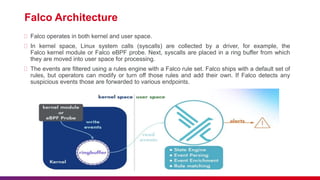
 Falco operates in both kernel and user space.
 In kernel space, Linux system calls (syscalls) are collected by a driver, for example, the
Falco kernel module or Falco eBPF probe. Next, syscalls are placed in a ring buffer from which
they are moved into user space for processing.
 The events are filtered using a rules engine with a Falco rule set. Falco ships with a default set of
rules, but operators can modify or turn off those rules and add their own. If Falco detects any
suspicious events those are forwarded to various endpoints.
03
Basic Components of Falco
1) Events: Events are activity that are generated when we change something in the system.
For example: modifying a file , running new process etc.
2) Rules: Rules are set of conditions that instruct Falco when to generate alerts. A Falco rule file is
a yaml file.
3) Output: It tells what message will be send by Falco to an endpoint.
4) Endpoint: The endpoint is a place where Falco send the alerts.
5) Priority: Every Falco rule has a priority which indicates how serious a violation of the rule is.
 For Eg:
 EMERGENCY
 ALERT, etc.
DEMO
Introduction to Falco presentation.pptxx

Introduction to Falco presentation.pptxx

  • 1.
  • 2.
    Lack of etiquetteand manners is a huge turn off. KnolX Etiquettes  Punctuality Join the session 5 minutes prior to the session start time. We start on time and conclude on time!  Feedback Make sure to submit a constructive feedback for all sessions as it is very helpful for the presenter.  Silent Mode Keep your mobile devices in silent mode, feel free to move out of session in case you need to attend an urgent call.  Avoid Disturbance Avoid unwanted chit chat during the session.
  • 3.
    1. Introduction  Whatdoes Falco do?  Importance of Falco  What does Falco checks for? 2. Falco Architecture 3. Falco Components 4. Demo
  • 5.
    Introduction to Falco Falco is a cloud-native security tool designed for Linux systems.  It employs custom rules on kernel events, which are enriched with container and Kubernetes metadata, to provide real-time alerts.  Falco helps you gain visibility into abnormal behavior, potential security threats, and compliance violations, contributing to comprehensive runtime security. Senstive File Unauthorized user Falco Engine Generate alert Authorized User access Generate Alert Unauthorized user Authorized User Falco Engine
  • 6.
    What does FalcoDo?  Falco uses syscalls to monitor a system's activity, by: 01 02 Parsing the Linux syscalls from the kernel at runtime Asserting the stream against a powerful rules engine . Alerting when a rule is violated 03
  • 7.
    Importance Of Falco Real-time Threat Detection  Visibility and Monitoring  Policy Enforcement  Compliance Monitoring  DevSecOps Integration  Incident Response
  • 8.
    What does Falcocheck for?  Privilege escalation using privileged containers  Namespace changes using tools like setns  Read/Writes to well-known directories such as /etc, /usr/bin, /usr/sbin, etc  Creating symlinks  Ownership and Mode changes  Unexpected network connections  Executing shell binaries such as sh, bash, csh, zsh, etc  Executing SSH binaries such as ssh, scp, sftp, etc
  • 9.
  • 10.
    Falco Architecture  Falcooperates in both kernel and user space.  In kernel space, Linux system calls (syscalls) are collected by a driver, for example, the Falco kernel module or Falco eBPF probe. Next, syscalls are placed in a ring buffer from which they are moved into user space for processing.  The events are filtered using a rules engine with a Falco rule set. Falco ships with a default set of rules, but operators can modify or turn off those rules and add their own. If Falco detects any suspicious events those are forwarded to various endpoints.
  • 11.
  • 12.
    Basic Components ofFalco 1) Events: Events are activity that are generated when we change something in the system. For example: modifying a file , running new process etc. 2) Rules: Rules are set of conditions that instruct Falco when to generate alerts. A Falco rule file is a yaml file. 3) Output: It tells what message will be send by Falco to an endpoint. 4) Endpoint: The endpoint is a place where Falco send the alerts. 5) Priority: Every Falco rule has a priority which indicates how serious a violation of the rule is.  For Eg:  EMERGENCY  ALERT, etc.
  • 13.