Linear resistors
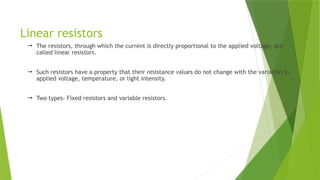
Theresistors, through which the current is directly proportional to the applied voltage, are
called linear resistors.
Such resistors have a property that their resistance values do not change with the variation in
applied voltage, temperature, or light intensity.
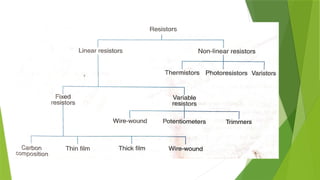
Two types- Fixed resistors and variable resistors.
4.
Non-linear resistors
Theresistors, through which the current is not directly proportional to the
applied voltage, are called non-linear resistors.
Such resistors have a property that their resistance values change with the
variation in applied voltage, temperature, or light intensity.
Three types- thermistor, photo-resistor and varistor.
5.
Fixed Resistors
Thefixed resistors are those, whose value do not change the variation in applied voltage,
temperature and light intensity.
Such resistors are available in various shapes and sizes, with both axial and radial leads.
The fixed resistors are the following types:
Carbon composition resistors
Thin film resistors
Thick film resistors
Wire-wound resistors
6.
Carbon composition resistors
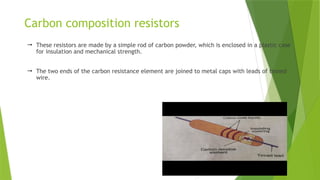
These resistors are made by a simple rod of carbon powder, which is enclosed in a plastic case
for insulation and mechanical strength.
The two ends of the carbon resistance element are joined to metal caps with leads of tinned
wire.
7.
Thin film resistors
These resistors are made by depositing a very thin layer of conducting
material on an insulated rod, tube or plate of ceramic or glass.
Two types:
Carbon film resistors
Metal film resistors
8.
Carbon filmresistors:
these resistors are cheaper than carbon composition resistors. They have good stability, wide
operating frequency range and low noise.
Metal film resistors:
these resistors are made by depositing a very thin layer of metal on ceramic or glass rod.
These resistors have tolerance ranging from +_ 0.025% and 2%.
9.
Thick film resistors
It is the resistor which is characterized by a thick film resistive layer over a
ceramic base.
As compared to the thin-film resistor, this resistor’s appearance is similar but
their manufacturing procedure and properties are not the same.
The thickness of the thick film resistor is 1000 times thicker than the thin-
film resistor.
10.
Thick filmresistors are produced by firing a special paste onto the substrate.
The paste is a mixture of glass and metal oxides.
Thin film is more accurate, has a better temperature coefficient and is more
stable. On the other hand, thick film is preferred for applications where
these high requirements are not critical since prices are much lower.
Metal oxidefilm resistors:
These are made by oxidizing tin chloride on a heated glass tube.
These resistors have low noise and good temperature stability.
13.
Cermet filmresistors:
These are made by placing a coating of metal alloy along with insulating
materials on a ceramic substrate.
The cermet material provides the highest resistance than any other
resistance material.
The cermet resistors are available with values up to 500MΩ and tolerances
ranging from +- 0.5% to 2%.
14.
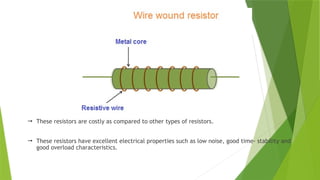
Wire- wound resistors
The wire wound resistor is made by winding the metal wire around on a plastic, fiberglass, or
ceramic. A Nichrome or manganin is commonly used as the metal wires
These resistors are costly as compared to other types of resistors.
These resistors have excellent electrical properties such as low noise, good time- stability and
good overload characteristics.
15.
These resistorsare costly as compared to other types of resistors.
These resistors have excellent electrical properties such as low noise, good time- stability and
good overload characteristics.
16.
Variable Linear Resistors
The resistance values of variable linear resistors can be varied from 0 to a
specified amount.
Three types:
Variable wire-wound
Potentiometer
Trimmer
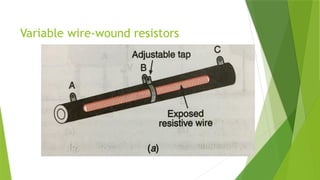
Variable wire-wound resistors
These resistors are made of nichrome wire on a ceramic core and covered
with an insulative coating.
A window is left in the insulating cover,which exposes the resistive wire.
An adjustable tap B rides along the exposed wire, which makes electrical
contact with the wire.
The points A and C represent the end points, and B indicates the adjustable
point.
20.
Variable Resistor
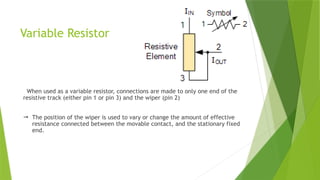
When usedas a variable resistor, connections are made to only one end of the
resistive track (either pin 1 or pin 3) and the wiper (pin 2)
The position of the wiper is used to vary or change the amount of effective
resistance connected between the movable contact, and the stationary fixed
end.
21.
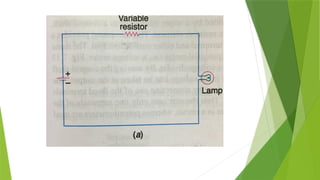
Then avariable resistor is a two-wire resistive device .
A variable resistor used to control very high circuit currents found in lamp or
motor loads are called Rheostats.
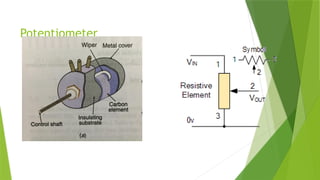
Potentiometer Itis a three terminal variable resistor.
Its outer terminals are fixed and the middle terminal is variable.
The variation is provided by a wiper connected to a control shaft.
When a control shaft is moved, the wiper moves over a resistive element. This movement
provides a continuous variation in resistance between—the middle terminal and either outside
terminal.
24.
The namepotentiometer comes from the use of this device as a potential meter i.e., a voltage
meter.
By moving the control shaft on either side of the middle terminal, any part of the input
voltage can be taken at the output.
The potentiometer can be used as a rheostat. This can be done by connecting one of the fixed
terminals with the variable terminal.
The rheostats are used to control current in a circuit, whereas potentiometers are used to
control voltage.
26.
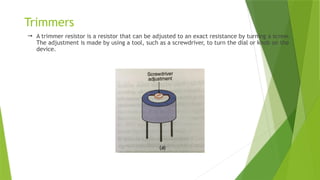
Trimmers
A trimmerresistor is a resistor that can be adjusted to an exact resistance by turning a screw.
The adjustment is made by using a tool, such as a screwdriver, to turn the dial or knob on the
device.
27.
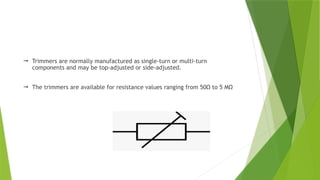
Trimmers arenormally manufactured as single-turn or multi-turn
components and may be top-adjusted or side-adjusted.
The trimmers are available for resistance values ranging from 50Ω to 5 MΩ