Introduction to Economics
In 1776,Adam Smith defined the definition of
economics.According to him,Economics is the study of process
that deals with the mechanism of satisfying unlimited wants
with limited resources.Sometimes,economics is defined as the
science of scarcity or,science of wealth.But it’s the interesting
part that,wealth & scarcity are opposite in nature.
▶ Scarcity:- Refers the lackings of resources.
▶ Wealth:- Refers to the prosperity.
▶ Want:- Desires to have something.
▶ Resources:- Which produces goods & services. Or,
Factors of production.
Economics:
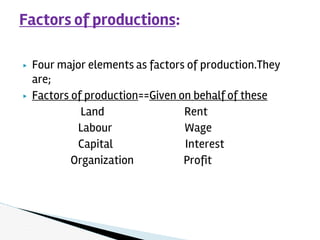
▶ Four major elements as factors of production.They
are;
▶ Factors of production==Given on behalf of these
Land Rent
Labour Wage
Capital Interest
Organization Profit
Factors of productions:
Two/Duel basic problems of economy is:
i. Scarcity. &
ii. Choice.
Basic problems of economy:
i) Limited amount of resources is known as Scarcity.
ii) Choosing a great varities from a vast,is known as
Choice.Due to the limited amount of
resources,neither the individual nor,the state can
produce all the goods & services at a
time.So,choosing a limited amount of goods to
produce from a great varities is known as Choice
problem.
Scarcity & Choice:
Three interrelated problems of economy:
❑ What to produce?
❑ How to produce?
❑ For whom to produce?
They are discussed here;
Interrelated problems of economy:
This problem directly indicates the problem of
scarcity.We know,society creates a lot of demands
but,due to limited resources only a few of them can be
produced.Creating the list of goods on priority basis
for production and,alter for not to produce which is
less important,is indicating the problem what to
produce?.
What to produce?
This problem refers that,due to limited resources and
unlimited wants,doing the production technically
within limited resources.There are two techniques:-
➢ Capital intensive technology.
➢ Labour intensive technology.
How to produce:
This technique means that,using higher amount of capital
than labour in production.This technique is
appropriate for affluent nations who have capital
abundance.They setup huge industries for productions
and,able to produce huge amount of goods or
services.These industries plays an important role in
economy’s welfare.
Capital intensive technique:
This technique refers that,in production,using higher
amounts of labour than capial.Generally,densly
populated countries uses this method in production
because,labour is comparatively lower than capital
there.This technique requires,lower amount of cost in
production.
Labour intensive technique:
Every goods & services are not consumed equally in every
nations & in every time.Consumption may vary due to
religion,taste,weather etc.So,it should be focused
that,what we are producing,wheather they will be used
by the consumers or not.
For whom to produce:
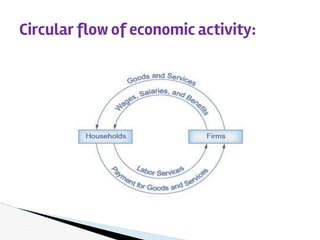
Circular flow of economic activity:
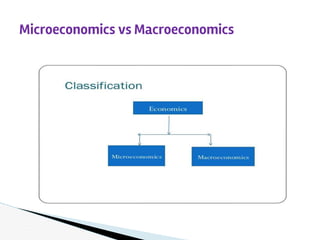
Microeconomics vs Macroeconomics
The subject matters of Microeconomics is;
Demand & Supply theory,Price elasticity,Theory of
production,Theory of costs,Theory of farms,Theory of
Market structures,General equilibrium etc.
Microeconomics:
The subject matters of Macroeconomics is;
Aggregate demand,Aggregate supply,Price
level,Employment & unemployment,Inflation &
deflation,Growth theory etc.
Macroeconomics:
Opportunity cost is the next best alternative forgone to
perform an economic acivity.It’s also called as implicit
cost or invisible cost.If a producer gives up the
production of 6kg wheat in order to produce 5kg
paddy then,the opportunity cost of producing 5kg
paddy is 6kg wheat.This is happened in some uncertain
conditon of economy or sometimes to get higher
profits.
Opportunity cost:
The combinations of two goods or services
that can be produced under a given
technology by efficiently utilising all of
the resources of an economy is known as
Production Possibility Curve (PPC).
Production Possibility Curve(PPC):
Production Possibility Curve(PPC) [Continued from previous]:
If technology improves,PPC will be
shifted upwards.Shifted PPC shows
the components which increases
PPC.Concavity of PPC shows
increasing Opportunity cost.
Production Possibility Curve(PPC) [Continued from previous]:

Introduction to economics.ppsx

  • 1.
  • 2.
    In 1776,Adam Smithdefined the definition of economics.According to him,Economics is the study of process that deals with the mechanism of satisfying unlimited wants with limited resources.Sometimes,economics is defined as the science of scarcity or,science of wealth.But it’s the interesting part that,wealth & scarcity are opposite in nature. ▶ Scarcity:- Refers the lackings of resources. ▶ Wealth:- Refers to the prosperity. ▶ Want:- Desires to have something. ▶ Resources:- Which produces goods & services. Or, Factors of production. Economics:
  • 3.
    ▶ Four majorelements as factors of production.They are; ▶ Factors of production==Given on behalf of these Land Rent Labour Wage Capital Interest Organization Profit Factors of productions:
  • 4.
    Two/Duel basic problemsof economy is: i. Scarcity. & ii. Choice. Basic problems of economy:
  • 5.
    i) Limited amountof resources is known as Scarcity. ii) Choosing a great varities from a vast,is known as Choice.Due to the limited amount of resources,neither the individual nor,the state can produce all the goods & services at a time.So,choosing a limited amount of goods to produce from a great varities is known as Choice problem. Scarcity & Choice:
  • 6.
    Three interrelated problemsof economy: ❑ What to produce? ❑ How to produce? ❑ For whom to produce? They are discussed here; Interrelated problems of economy:
  • 7.
    This problem directlyindicates the problem of scarcity.We know,society creates a lot of demands but,due to limited resources only a few of them can be produced.Creating the list of goods on priority basis for production and,alter for not to produce which is less important,is indicating the problem what to produce?. What to produce?
  • 8.
    This problem refersthat,due to limited resources and unlimited wants,doing the production technically within limited resources.There are two techniques:- ➢ Capital intensive technology. ➢ Labour intensive technology. How to produce:
  • 9.
    This technique meansthat,using higher amount of capital than labour in production.This technique is appropriate for affluent nations who have capital abundance.They setup huge industries for productions and,able to produce huge amount of goods or services.These industries plays an important role in economy’s welfare. Capital intensive technique:
  • 10.
    This technique refersthat,in production,using higher amounts of labour than capial.Generally,densly populated countries uses this method in production because,labour is comparatively lower than capital there.This technique requires,lower amount of cost in production. Labour intensive technique:
  • 11.
    Every goods &services are not consumed equally in every nations & in every time.Consumption may vary due to religion,taste,weather etc.So,it should be focused that,what we are producing,wheather they will be used by the consumers or not. For whom to produce:
  • 12.
    Circular flow ofeconomic activity:
  • 13.
  • 14.
    The subject mattersof Microeconomics is; Demand & Supply theory,Price elasticity,Theory of production,Theory of costs,Theory of farms,Theory of Market structures,General equilibrium etc. Microeconomics:
  • 15.
    The subject mattersof Macroeconomics is; Aggregate demand,Aggregate supply,Price level,Employment & unemployment,Inflation & deflation,Growth theory etc. Macroeconomics:
  • 16.
    Opportunity cost isthe next best alternative forgone to perform an economic acivity.It’s also called as implicit cost or invisible cost.If a producer gives up the production of 6kg wheat in order to produce 5kg paddy then,the opportunity cost of producing 5kg paddy is 6kg wheat.This is happened in some uncertain conditon of economy or sometimes to get higher profits. Opportunity cost:
  • 17.
    The combinations oftwo goods or services that can be produced under a given technology by efficiently utilising all of the resources of an economy is known as Production Possibility Curve (PPC). Production Possibility Curve(PPC):
  • 18.
    Production Possibility Curve(PPC)[Continued from previous]:
  • 19.
    If technology improves,PPCwill be shifted upwards.Shifted PPC shows the components which increases PPC.Concavity of PPC shows increasing Opportunity cost. Production Possibility Curve(PPC) [Continued from previous]: