Introduction to
Divide and
Conquer
Divide and conquer is a powerful problem-solving technique
used in computer science and mathematics. It involves
breaking down a complex problem into smaller, more
manageable subproblems that are easier to solve.
by Prithvi
Singh
Definition and
Principles
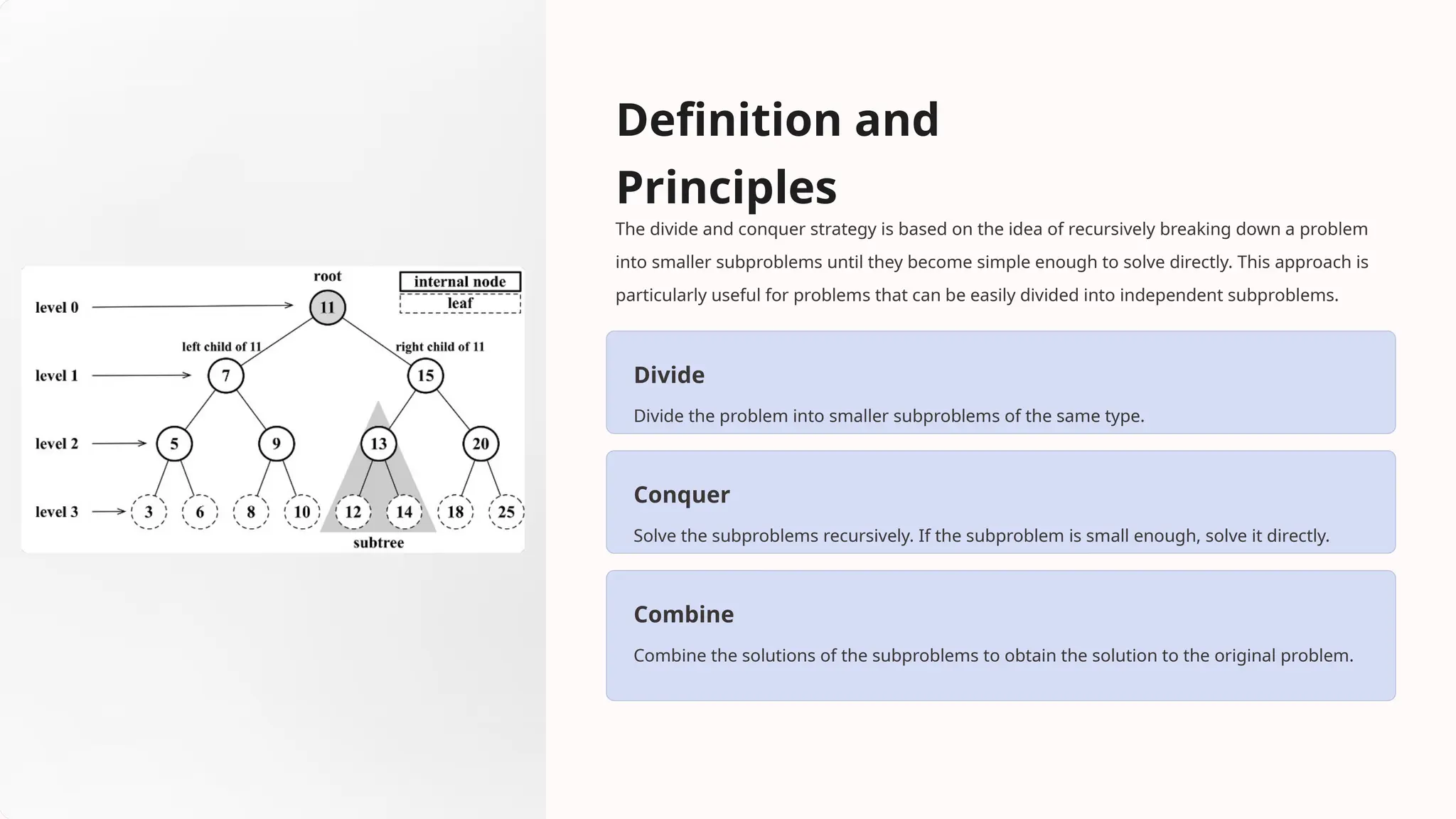
The divide and conquer strategy is based on the idea of recursively breaking down a problem
into smaller subproblems until they become simple enough to solve directly. This approach is
particularly useful for problems that can be easily divided into independent subproblems.
Divide
Divide the problem into smaller subproblems of the same type.
Conquer
Solve the subproblems recursively. If the subproblem is small enough, solve it directly.
Combine
Combine the solutions of the subproblems to obtain the solution to the original problem.
Advantages of Divide and
Conquer
Divide and conquer offers several benefits, making it a popular technique in
algorithm design.
1 Efficiency
It often leads to efficient algorithms, especially for problems that can be
broken down into independent subproblems.
2 Parallelism
Divide and conquer algorithms are well-suited for parallel processing, as
subproblems can be solved concurrently.
3 Simplicity
The recursive nature of divide and conquer can make algorithms easier to
understand and implement.
Disadvantages of Divide and Conquer
While highly effective, divide and conquer has certain drawbacks that need to be considered.
Overhead
The overhead of dividing and combining solutions
can sometimes outweigh the benefits, especially
for small problems.
Memory Usage
Recursive algorithms can use significant memory,
as they store the state of each subproblem.
Applications of Divide
and Conquer
Divide and conquer finds extensive use in various areas of
computer science, showcasing its versatility.
Sorting Algorithms Merge Sort, Quick Sort
Searching Algorithms Binary Search
Matrix Multiplication Strassen's Algorithm
Closest Pair Problem Divide and Conquer
Algorithm
Divide and Conquer
Algorithms
Several well-known algorithms are based on the divide and conquer principle, demonstrating its
effectiveness in solving a wide range of problems.
Merge Sort
A sorting algorithm that divides the input list into two halves, recursively sorts
each half, and then merges the sorted halves.
Quick Sort
Another efficient sorting algorithm that partitions the input list around a pivot
element, recursively sorts the partitions, and then combines the sorted partitions.
Binary Search
A search algorithm that repeatedly divides the search space in half, effectively
finding the desired element in a sorted list.
Implementing Divide and
Conquer
The implementation of divide and conquer algorithms typically involves recursion, allowing for
a concise and elegant representation of the solution.
Recursive
Functions
Recursive functions play a crucial role in implementing divide and conquer algorithms, breaking
down the problem into smaller subproblems.
Base Cases
Base cases are essential for preventing infinite recursion, ensuring that the algorithm
terminates correctly.
Combine
Solutions
After recursively solving subproblems, the solutions are combined to obtain the final solution.
Conclusion and Key
Takeaways
Divide and conquer is a powerful and versatile problem-
solving technique with broad applications in computer
science. By recursively breaking down problems into smaller
subproblems, divide and conquer often leads to efficient and
elegant algorithms.

Introduction-to-Divide-and-Conquer_(1).pptx

  • 1.
    Introduction to Divide and Conquer Divideand conquer is a powerful problem-solving technique used in computer science and mathematics. It involves breaking down a complex problem into smaller, more manageable subproblems that are easier to solve. by Prithvi Singh
  • 2.
    Definition and Principles The divideand conquer strategy is based on the idea of recursively breaking down a problem into smaller subproblems until they become simple enough to solve directly. This approach is particularly useful for problems that can be easily divided into independent subproblems. Divide Divide the problem into smaller subproblems of the same type. Conquer Solve the subproblems recursively. If the subproblem is small enough, solve it directly. Combine Combine the solutions of the subproblems to obtain the solution to the original problem.
  • 3.
    Advantages of Divideand Conquer Divide and conquer offers several benefits, making it a popular technique in algorithm design. 1 Efficiency It often leads to efficient algorithms, especially for problems that can be broken down into independent subproblems. 2 Parallelism Divide and conquer algorithms are well-suited for parallel processing, as subproblems can be solved concurrently. 3 Simplicity The recursive nature of divide and conquer can make algorithms easier to understand and implement.
  • 4.
    Disadvantages of Divideand Conquer While highly effective, divide and conquer has certain drawbacks that need to be considered. Overhead The overhead of dividing and combining solutions can sometimes outweigh the benefits, especially for small problems. Memory Usage Recursive algorithms can use significant memory, as they store the state of each subproblem.
  • 5.
    Applications of Divide andConquer Divide and conquer finds extensive use in various areas of computer science, showcasing its versatility. Sorting Algorithms Merge Sort, Quick Sort Searching Algorithms Binary Search Matrix Multiplication Strassen's Algorithm Closest Pair Problem Divide and Conquer Algorithm
  • 6.
    Divide and Conquer Algorithms Severalwell-known algorithms are based on the divide and conquer principle, demonstrating its effectiveness in solving a wide range of problems. Merge Sort A sorting algorithm that divides the input list into two halves, recursively sorts each half, and then merges the sorted halves. Quick Sort Another efficient sorting algorithm that partitions the input list around a pivot element, recursively sorts the partitions, and then combines the sorted partitions. Binary Search A search algorithm that repeatedly divides the search space in half, effectively finding the desired element in a sorted list.
  • 7.
    Implementing Divide and Conquer Theimplementation of divide and conquer algorithms typically involves recursion, allowing for a concise and elegant representation of the solution. Recursive Functions Recursive functions play a crucial role in implementing divide and conquer algorithms, breaking down the problem into smaller subproblems. Base Cases Base cases are essential for preventing infinite recursion, ensuring that the algorithm terminates correctly. Combine Solutions After recursively solving subproblems, the solutions are combined to obtain the final solution.
  • 8.
    Conclusion and Key Takeaways Divideand conquer is a powerful and versatile problem- solving technique with broad applications in computer science. By recursively breaking down problems into smaller subproblems, divide and conquer often leads to efficient and elegant algorithms.