Submitted by
T.Mounika
R190286
Dept of ECE
DATA SCIENCE AND
MACHINE LEARNING
Introduction to
Data Science and
Machine Learning
Data science and machine learning are rapidly evolving fields that
are transforming the way we understand and interact with the world
around us. Through the power of data collection, statistical analysis,
and advanced algorithms, data scientists and machine learning
experts are uncovering insights, making predictions, and driving
innovation in a wide range of industries. From predicting customer
behavior to optimizing complex systems, these cutting-edge
techniques are reshaping the landscape of problem-solving and
decision-making.
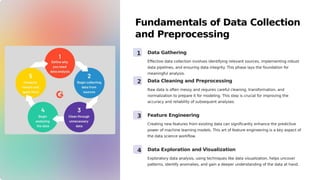
Fundamentals of Data Collection
and Preprocessing
1 Data Gathering
Effective data collection involves identifying relevant sources, implementing robust
data pipelines, and ensuring data integrity. This phase lays the foundation for
meaningful analysis.
2 Data Cleaning and Preprocessing
Raw data is often messy and requires careful cleaning, transformation, and
normalization to prepare it for modeling. This step is crucial for improving the
accuracy and reliability of subsequent analyses.
3 Feature Engineering
Creating new features from existing data can significantly enhance the predictive
power of machine learning models. This art of feature engineering is a key aspect of
the data science workflow.
4 Data Exploration and Visualization
Exploratory data analysis, using techniques like data visualization, helps uncover
patterns, identify anomalies, and gain a deeper understanding of the data at hand.
Exploratory Data Analysis and
Visualization
Data Exploration
Exploratory data analysis
(EDA) is the foundation of any
data science project. It
involves examining the data
from multiple perspectives,
identifying patterns, and
uncovering insights that can
inform the subsequent
modeling and decision-making
processes.
Visualization Techniques
Effective data visualization is a
crucial skill for data scientists.
Tools like scatter plots,
histograms, heatmaps, and
line charts help communicate
complex information in a clear
and intuitive manner, enabling
stakeholders to quickly grasp
the key insights.
Storytelling with Data
Beyond mere data
presentation, the art of data
storytelling involves crafting a
compelling narrative that
connects insights to business
objectives. Skilled data
scientists can transform raw
data into actionable
intelligence that informs
strategic decision-making.
Supervised Learning Techniques
1 Regression
Regression models are used to predict numerical outcomes, such as sales
forecasts or stock prices. Techniques like linear regression, logistic regression,
and decision trees fall under this category.
2 Classification
Classification models are designed to predict categorical outcomes, like
whether a customer will churn or which email is spam. Popular algorithms
include k-nearest neighbors, support vector machines, and random forests.
3 Ensemble Methods
Ensemble techniques, such as bagging and boosting, combine multiple
models to improve the overall predictive performance. These methods often
outperform individual models, making them a powerful tool in the data
scientist's arsenal.
Unsupervised Learning Techniques
Clustering
Clustering algorithms, like k-
means and hierarchical
clustering, group data points
based on their similarities,
revealing natural patterns and
segmentations within the
data. These techniques are
valuable for market
segmentation, anomaly
detection, and customer
profiling.
Dimensionality Reduction
When dealing with high-
dimensional data,
dimensionality reduction
techniques like principal
component analysis (PCA) and
t-SNE can help identify the
most significant features and
visualize complex data in a
lower-dimensional space,
facilitating better
understanding and modeling.
Association Rule Mining
Association rule learning
algorithms, such as the Apriori
algorithm, uncover hidden
relationships and patterns
within data, enabling the
identification of co-occurring
items or events. This
technique is widely used in
market basket analysis and
recommendation systems.
Deep Learning and Neural Networks
1 Artificial Neural Networks
At the core of deep learning are artificial neural networks, inspired by the
human brain's neural structure. These multilayered models can learn to
recognize complex patterns in data, making them highly effective for tasks
like image recognition, natural language processing, and speech generation.
2 Convolutional Neural Networks
Convolutional neural networks (CNNs) are particularly well-suited for
processing and understanding visual data, such as images and videos. By
leveraging the spatial relationships within the data, CNNs can extract features
and learn representations that enable accurate classification and object
detection.
3 Recurrent Neural Networks
Recurrent neural networks (RNNs) are designed to handle sequential data,
such as text and time series. By maintaining an internal state, RNNs can learn
to model dependencies and make predictions based on the context, making
them invaluable for tasks like language modeling, machine translation, and
time series forecasting.
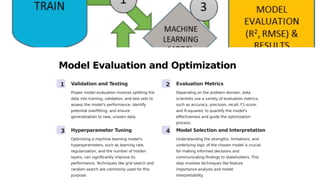
Model Evaluation and Optimization
1 Validation and Testing
Proper model evaluation involves splitting the
data into training, validation, and test sets to
assess the model's performance, identify
potential overfitting, and ensure
generalization to new, unseen data.
2 Evaluation Metrics
Depending on the problem domain, data
scientists use a variety of evaluation metrics,
such as accuracy, precision, recall, F1-score,
and R-squared, to quantify the model's
effectiveness and guide the optimization
process.
3 Hyperparameter Tuning
Optimizing a machine learning model's
hyperparameters, such as learning rate,
regularization, and the number of hidden
layers, can significantly improve its
performance. Techniques like grid search and
random search are commonly used for this
purpose.
4 Model Selection and Interpretation
Understanding the strengths, limitations, and
underlying logic of the chosen model is crucial
for making informed decisions and
communicating findings to stakeholders. This
step involves techniques like feature
importance analysis and model
interpretability.
Real-World Applications and
Case Studies
Healthcare
Data science and machine learning are transforming the healthcare industry, from
predicting disease outbreaks to optimizing clinical workflows and personalized medicine.
Finance
In the financial sector, data science techniques are used for portfolio optimization, fraud
detection, credit risk assessment, and algorithmic trading.
Smart Cities
Data-driven solutions are revolutionizing urban planning, traffic management, and public
service delivery in the pursuit of more sustainable and livable cities.

Introduction-to-Data-Science-and-Machine-Learning.pdf

  • 1.
    Submitted by T.Mounika R190286 Dept ofECE DATA SCIENCE AND MACHINE LEARNING
  • 2.
    Introduction to Data Scienceand Machine Learning Data science and machine learning are rapidly evolving fields that are transforming the way we understand and interact with the world around us. Through the power of data collection, statistical analysis, and advanced algorithms, data scientists and machine learning experts are uncovering insights, making predictions, and driving innovation in a wide range of industries. From predicting customer behavior to optimizing complex systems, these cutting-edge techniques are reshaping the landscape of problem-solving and decision-making.
  • 3.
    Fundamentals of DataCollection and Preprocessing 1 Data Gathering Effective data collection involves identifying relevant sources, implementing robust data pipelines, and ensuring data integrity. This phase lays the foundation for meaningful analysis. 2 Data Cleaning and Preprocessing Raw data is often messy and requires careful cleaning, transformation, and normalization to prepare it for modeling. This step is crucial for improving the accuracy and reliability of subsequent analyses. 3 Feature Engineering Creating new features from existing data can significantly enhance the predictive power of machine learning models. This art of feature engineering is a key aspect of the data science workflow. 4 Data Exploration and Visualization Exploratory data analysis, using techniques like data visualization, helps uncover patterns, identify anomalies, and gain a deeper understanding of the data at hand.
  • 4.
    Exploratory Data Analysisand Visualization Data Exploration Exploratory data analysis (EDA) is the foundation of any data science project. It involves examining the data from multiple perspectives, identifying patterns, and uncovering insights that can inform the subsequent modeling and decision-making processes. Visualization Techniques Effective data visualization is a crucial skill for data scientists. Tools like scatter plots, histograms, heatmaps, and line charts help communicate complex information in a clear and intuitive manner, enabling stakeholders to quickly grasp the key insights. Storytelling with Data Beyond mere data presentation, the art of data storytelling involves crafting a compelling narrative that connects insights to business objectives. Skilled data scientists can transform raw data into actionable intelligence that informs strategic decision-making.
  • 5.
    Supervised Learning Techniques 1Regression Regression models are used to predict numerical outcomes, such as sales forecasts or stock prices. Techniques like linear regression, logistic regression, and decision trees fall under this category. 2 Classification Classification models are designed to predict categorical outcomes, like whether a customer will churn or which email is spam. Popular algorithms include k-nearest neighbors, support vector machines, and random forests. 3 Ensemble Methods Ensemble techniques, such as bagging and boosting, combine multiple models to improve the overall predictive performance. These methods often outperform individual models, making them a powerful tool in the data scientist's arsenal.
  • 6.
    Unsupervised Learning Techniques Clustering Clusteringalgorithms, like k- means and hierarchical clustering, group data points based on their similarities, revealing natural patterns and segmentations within the data. These techniques are valuable for market segmentation, anomaly detection, and customer profiling. Dimensionality Reduction When dealing with high- dimensional data, dimensionality reduction techniques like principal component analysis (PCA) and t-SNE can help identify the most significant features and visualize complex data in a lower-dimensional space, facilitating better understanding and modeling. Association Rule Mining Association rule learning algorithms, such as the Apriori algorithm, uncover hidden relationships and patterns within data, enabling the identification of co-occurring items or events. This technique is widely used in market basket analysis and recommendation systems.
  • 7.
    Deep Learning andNeural Networks 1 Artificial Neural Networks At the core of deep learning are artificial neural networks, inspired by the human brain's neural structure. These multilayered models can learn to recognize complex patterns in data, making them highly effective for tasks like image recognition, natural language processing, and speech generation. 2 Convolutional Neural Networks Convolutional neural networks (CNNs) are particularly well-suited for processing and understanding visual data, such as images and videos. By leveraging the spatial relationships within the data, CNNs can extract features and learn representations that enable accurate classification and object detection. 3 Recurrent Neural Networks Recurrent neural networks (RNNs) are designed to handle sequential data, such as text and time series. By maintaining an internal state, RNNs can learn to model dependencies and make predictions based on the context, making them invaluable for tasks like language modeling, machine translation, and time series forecasting.
  • 8.
    Model Evaluation andOptimization 1 Validation and Testing Proper model evaluation involves splitting the data into training, validation, and test sets to assess the model's performance, identify potential overfitting, and ensure generalization to new, unseen data. 2 Evaluation Metrics Depending on the problem domain, data scientists use a variety of evaluation metrics, such as accuracy, precision, recall, F1-score, and R-squared, to quantify the model's effectiveness and guide the optimization process. 3 Hyperparameter Tuning Optimizing a machine learning model's hyperparameters, such as learning rate, regularization, and the number of hidden layers, can significantly improve its performance. Techniques like grid search and random search are commonly used for this purpose. 4 Model Selection and Interpretation Understanding the strengths, limitations, and underlying logic of the chosen model is crucial for making informed decisions and communicating findings to stakeholders. This step involves techniques like feature importance analysis and model interpretability.
  • 9.
    Real-World Applications and CaseStudies Healthcare Data science and machine learning are transforming the healthcare industry, from predicting disease outbreaks to optimizing clinical workflows and personalized medicine. Finance In the financial sector, data science techniques are used for portfolio optimization, fraud detection, credit risk assessment, and algorithmic trading. Smart Cities Data-driven solutions are revolutionizing urban planning, traffic management, and public service delivery in the pursuit of more sustainable and livable cities.