Introduction to Data
Science
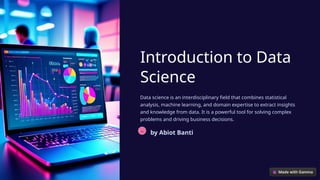
Data science is an interdisciplinary field that combines statistical
analysis, machine learning, and domain expertise to extract insights
and knowledge from data. It is a powerful tool for solving complex
problems and driving business decisions.
AB
by Abiot Banti
Data Collection and Preprocessing
Data Collection
Gathering data from
various sources, such as
databases, sensors, and
web APIs, is a crucial first
step in the data science
process.
Data Preprocessing
Cleaning, transforming,
and preparing the raw
data for analysis is
essential to ensure data
quality and reliability.
Feature Engineering
Creating new features
from the raw data can
help improve the
performance of machine
learning models.
Exploratory Data Analysis
1 Data Visualization
Using various charts, graphs, and
plots to understand the patterns,
trends, and relationships within the
data.
2 Statistical Analysis
Applying statistical techniques to
identify the distribution, central
tendency, and variability of the data.
3 Anomaly Detection
Identifying outliers and unusual data
points that may require further
investigation or special handling.
4 Hypothesis Testing
Formulating and testing hypotheses
to gain insights into the data and
uncover potential relationships.
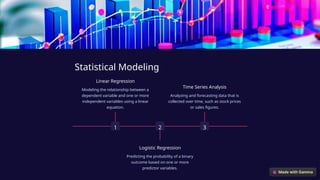
Statistical Modeling
1
Linear Regression
Modeling the relationship between a
dependent variable and one or more
independent variables using a linear
equation.
2
Logistic Regression
Predicting the probability of a binary
outcome based on one or more
predictor variables.
3
Time Series Analysis
Analyzing and forecasting data that is
collected over time, such as stock prices
or sales figures.
Machine Learning Algorithms
Supervised Learning
Algorithms that learn from labeled data
to make predictions or classify new
data, such as linear regression and
decision trees.
Unsupervised Learning
Algorithms that discover patterns and
insights from unlabeled data, such as
clustering and dimensionality reduction.
Deep Learning
A powerful subset of machine learning
that uses neural networks to learn
complex patterns in data, such as image
recognition and natural language
processing.
Reinforcement Learning
Algorithms that learn by interacting
with an environment and receiving
feedback, such as game-playing agents
and robotic control systems.
Model Evaluation and Validation
Testing
Evaluating the
performance of the
model on a held-
out test set to
ensure it
generalizes well to
new data.
Validation
Tuning the model's
hyperparameters
and checking for
overfitting or
underfitting using
a validation set.
Iteration
Iterating on the
model design and
feature
engineering to
improve its
performance and
accuracy.
Deployment
Deploying the final
model to
production and
monitoring its
performance in
real-world
applications.
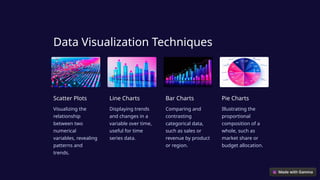
Data Visualization Techniques
Scatter Plots
Visualizing the
relationship
between two
numerical
variables, revealing
patterns and
trends.
Line Charts
Displaying trends
and changes in a
variable over time,
useful for time
series data.
Bar Charts
Comparing and
contrasting
categorical data,
such as sales or
revenue by product
or region.
Pie Charts
Illustrating the
proportional
composition of a
whole, such as
market share or
budget allocation.
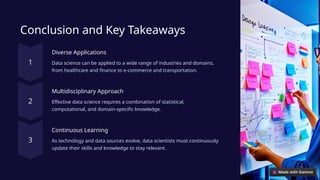
Conclusion and Key Takeaways
Diverse Applications
Data science can be applied to a wide range of industries and domains,
from healthcare and finance to e-commerce and transportation.
Multidisciplinary Approach
Effective data science requires a combination of statistical,
computational, and domain-specific knowledge.
Continuous Learning
As technology and data sources evolve, data scientists must continuously
update their skills and knowledge to stay relevant.

Introduction-to-Data-Science_Abiot_.pptx

  • 1.
    Introduction to Data Science Datascience is an interdisciplinary field that combines statistical analysis, machine learning, and domain expertise to extract insights and knowledge from data. It is a powerful tool for solving complex problems and driving business decisions. AB by Abiot Banti
  • 2.
    Data Collection andPreprocessing Data Collection Gathering data from various sources, such as databases, sensors, and web APIs, is a crucial first step in the data science process. Data Preprocessing Cleaning, transforming, and preparing the raw data for analysis is essential to ensure data quality and reliability. Feature Engineering Creating new features from the raw data can help improve the performance of machine learning models.
  • 3.
    Exploratory Data Analysis 1Data Visualization Using various charts, graphs, and plots to understand the patterns, trends, and relationships within the data. 2 Statistical Analysis Applying statistical techniques to identify the distribution, central tendency, and variability of the data. 3 Anomaly Detection Identifying outliers and unusual data points that may require further investigation or special handling. 4 Hypothesis Testing Formulating and testing hypotheses to gain insights into the data and uncover potential relationships.
  • 4.
    Statistical Modeling 1 Linear Regression Modelingthe relationship between a dependent variable and one or more independent variables using a linear equation. 2 Logistic Regression Predicting the probability of a binary outcome based on one or more predictor variables. 3 Time Series Analysis Analyzing and forecasting data that is collected over time, such as stock prices or sales figures.
  • 5.
    Machine Learning Algorithms SupervisedLearning Algorithms that learn from labeled data to make predictions or classify new data, such as linear regression and decision trees. Unsupervised Learning Algorithms that discover patterns and insights from unlabeled data, such as clustering and dimensionality reduction. Deep Learning A powerful subset of machine learning that uses neural networks to learn complex patterns in data, such as image recognition and natural language processing. Reinforcement Learning Algorithms that learn by interacting with an environment and receiving feedback, such as game-playing agents and robotic control systems.
  • 6.
    Model Evaluation andValidation Testing Evaluating the performance of the model on a held- out test set to ensure it generalizes well to new data. Validation Tuning the model's hyperparameters and checking for overfitting or underfitting using a validation set. Iteration Iterating on the model design and feature engineering to improve its performance and accuracy. Deployment Deploying the final model to production and monitoring its performance in real-world applications.
  • 7.
    Data Visualization Techniques ScatterPlots Visualizing the relationship between two numerical variables, revealing patterns and trends. Line Charts Displaying trends and changes in a variable over time, useful for time series data. Bar Charts Comparing and contrasting categorical data, such as sales or revenue by product or region. Pie Charts Illustrating the proportional composition of a whole, such as market share or budget allocation.
  • 8.
    Conclusion and KeyTakeaways Diverse Applications Data science can be applied to a wide range of industries and domains, from healthcare and finance to e-commerce and transportation. Multidisciplinary Approach Effective data science requires a combination of statistical, computational, and domain-specific knowledge. Continuous Learning As technology and data sources evolve, data scientists must continuously update their skills and knowledge to stay relevant.