Lecture – 1
Department of CSE, DIU
INTRODUCTION TO
BIOINFORMATICS
CONTENTS
1. Basics
- Cell
- Nucleus
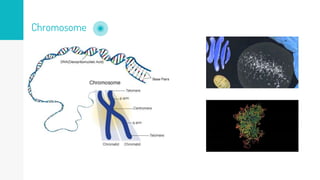
- Chromosome
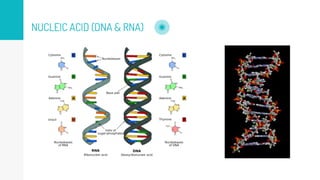
- DNA
- RNA
- Gene
- Genome
2. Brief History
3. Present and Future Scopes
1. Begin With Basics
Let’s start with the very basics and learn step by step,
TOGETHER!
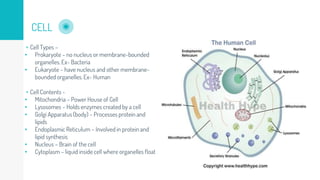
CELL
▹Cell Types –
• Prokaryote – no nucleus or membrane-bounded
organelles. Ex- Bacteria
• Eukaryote – have nucleus and other membrane-
bounded organelles. Ex- Human
▹Cell Contents -
• Mitochondria – Power House of Cell
• Lysosomes – Holds enzymes created by a cell
• Golgi Apparatus (body) – Processes protein and
lipids
• Endoplasmic Reticulum – Involved in protein and
lipid synthesis
• Nucleus – Brain of the cell
• Cytoplasm – liquid inside cell where organelles float
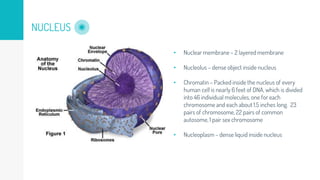
NUCLEUS
• Nuclear membrane – 2 layered membrane
• Nucleolus – dense object inside nucleus
• Chromatin – Packed inside the nucleus of every
human cell is nearly 6 feet of DNA, which is divided
into 46 individual molecules, one for each
chromosome and each about 1.5 inches long. 23
pairs of chromosome, 22 pairs of common
autosome, 1 pair sex chromosome
• Nucleoplasm – dense liquid inside nucleus
Chromosome
NUCLEIC ACID (DNA & RNA)
GENE
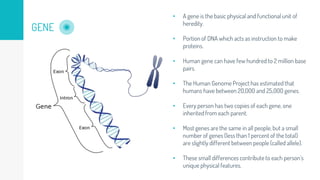
• A gene is the basic physical and functional unit of
heredity.
• Portion of DNA which acts as instruction to make
proteins.
• Human gene can have few hundred to 2 million base
pairs.
• The Human Genome Project has estimated that
humans have between 20,000 and 25,000 genes.
• Every person has two copies of each gene, one
inherited from each parent.
• Most genes are the same in all people, but a small
number of genes (less than 1 percent of the total)
are slightly different between people (called allele).
• These small differences contribute to each person’s
unique physical features.
GENOME
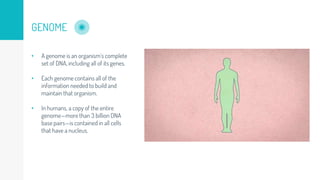
• A genome is an organism’s complete
set of DNA, including all of its genes.
• Each genome contains all of the
information needed to build and
maintain that organism.
• In humans, a copy of the entire
genome—more than 3 billion DNA
base pairs—is contained in all cells
that have a nucleus.
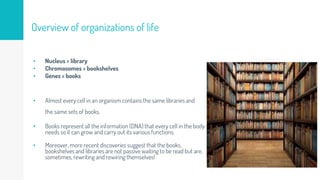
• Nucleus = library
• Chromosomes = bookshelves
• Genes = books
• Almost every cell in an organism contains the same libraries and
the same sets of books.
• Books represent all the information (DNA) that every cell in the body
needs so it can grow and carry out its various functions.
• Moreover, more recent discoveries suggest that the books,
bookshelves and libraries are not passive waiting to be read but are,
sometimes, rewriting and rewiring themselves!
Overview of organizations of life
2. HISTORY
A Journey from Biology to Bioinformatics
WHAT IS
BIOINFORMATICS?
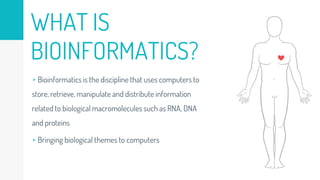
▹Bioinformatics is the discipline that uses computers to
store, retrieve, manipulate and distribute information
related to biological macromolecules such as RNA, DNA
and proteins
▹Bringing biological themes to computers
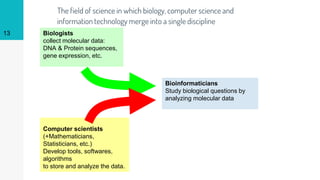
Biologists
collect molecular data:
DNA & Protein sequences,
gene expression, etc.
Computer scientists
(+Mathematicians,
Statisticians, etc.)
Develop tools, softwares,
algorithms
to store and analyze the data.
Bioinformaticians
Study biological questions by
analyzing molecular data
The field of science in which biology, computer science and
information technology merge into a single discipline
13
”
SYNONYMS
Molecular Bioinformatics, Computational Biology,
Biocomputing
FROM BIOLOGY TO BIOINFORMATICS
▹From Academic Interest to Commercial Interest
▹From Knowledge Discovery to Industrial Development
▹Added Pursuit for Longer Life and Cure for Diseases
▹Tremendous recent progress in Biology and Engineering
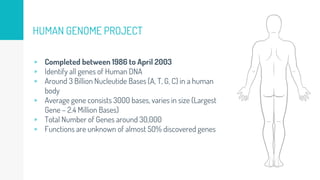
▹ Completed between 1986 to April 2003
▹ Identify all genes of Human DNA
▹ Around 3 Billion Nucleutide Bases (A, T, G, C) in a human
body
▹ Average gene consists 3000 bases, varies in size (Largest
Gene – 2.4 Million Bases)
▹ Total Number of Genes around 30,000
▹ Functions are unknown of almost 50% discovered genes
HUMAN GENOME PROJECT
3. BIOINFORMATICS – PRESENT & FUTURE SCOPES
What’s happening now and what might happen in the upcoming years?
SCOPE OF RESEARCH
Sequence Alignment
Arranging DNA/RNA/Protein
Sequences to identify regions of
similarity.
Genome Assembly
Merging long/short reads by
aligning and produce original
ancestral gene.
Read Mapping
Mapping generated long/short
reads to a reference sequence.
Evolution
Phylogenetics
Studying evolutionary
relationships among bilogical
entities.
Statistical
Phylogenetics
Performing statistical analysis for
finding evolutionary relationships
between biological entities.
Population Genetics
Study of genetic variation within
populations.
SCOPE OF RESEARCH (CONT.)
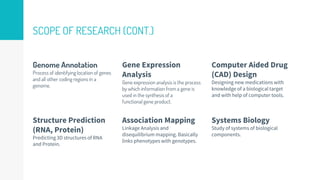
Genome Annotation
Process of identifying location of genes
and all other coding regions in a
genome.
Gene Expression
Analysis
Gene expression analysis is the process
by which information from a gene is
used in the synthesis of a
functional gene product.
Computer Aided Drug
(CAD) Design
Designing new medications with
knowledge of a biological target
and with help of computer tools.
Structure Prediction
(RNA, Protein)
Predicting 3D structures of RNA
and Protein.
Association Mapping
Linkage Analysis and
disequilibrium mapping. Basically
links phenotypes with genotypes.
Systems Biology
Study of systems of biological
components.
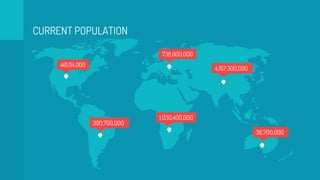
CURRENT POPULATION
390,700,000
461,114,000
1,030,400,000
738,600,000
4,157,300,000
36,700,000
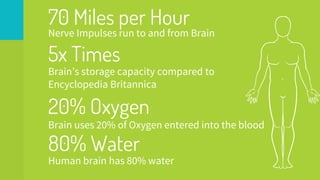
70 Miles per Hour
Nerve Impulses run to and from Brain
20% Oxygen
Brain uses 20% of Oxygen entered into the blood
5x Times
Brain’s storage capacity compared to
Encyclopedia Britannica
80% Water
Human brain has 80% water

Introduction to Bioinformatics (1).pptx

  • 1.
    Lecture – 1 Departmentof CSE, DIU INTRODUCTION TO BIOINFORMATICS
  • 2.
    CONTENTS 1. Basics - Cell -Nucleus - Chromosome - DNA - RNA - Gene - Genome 2. Brief History 3. Present and Future Scopes
  • 3.
    1. Begin WithBasics Let’s start with the very basics and learn step by step, TOGETHER!
  • 4.
    CELL ▹Cell Types – •Prokaryote – no nucleus or membrane-bounded organelles. Ex- Bacteria • Eukaryote – have nucleus and other membrane- bounded organelles. Ex- Human ▹Cell Contents - • Mitochondria – Power House of Cell • Lysosomes – Holds enzymes created by a cell • Golgi Apparatus (body) – Processes protein and lipids • Endoplasmic Reticulum – Involved in protein and lipid synthesis • Nucleus – Brain of the cell • Cytoplasm – liquid inside cell where organelles float
  • 5.
    NUCLEUS • Nuclear membrane– 2 layered membrane • Nucleolus – dense object inside nucleus • Chromatin – Packed inside the nucleus of every human cell is nearly 6 feet of DNA, which is divided into 46 individual molecules, one for each chromosome and each about 1.5 inches long. 23 pairs of chromosome, 22 pairs of common autosome, 1 pair sex chromosome • Nucleoplasm – dense liquid inside nucleus
  • 6.
  • 7.
  • 8.
    GENE • A geneis the basic physical and functional unit of heredity. • Portion of DNA which acts as instruction to make proteins. • Human gene can have few hundred to 2 million base pairs. • The Human Genome Project has estimated that humans have between 20,000 and 25,000 genes. • Every person has two copies of each gene, one inherited from each parent. • Most genes are the same in all people, but a small number of genes (less than 1 percent of the total) are slightly different between people (called allele). • These small differences contribute to each person’s unique physical features.
  • 9.
    GENOME • A genomeis an organism’s complete set of DNA, including all of its genes. • Each genome contains all of the information needed to build and maintain that organism. • In humans, a copy of the entire genome—more than 3 billion DNA base pairs—is contained in all cells that have a nucleus.
  • 10.
    • Nucleus =library • Chromosomes = bookshelves • Genes = books • Almost every cell in an organism contains the same libraries and the same sets of books. • Books represent all the information (DNA) that every cell in the body needs so it can grow and carry out its various functions. • Moreover, more recent discoveries suggest that the books, bookshelves and libraries are not passive waiting to be read but are, sometimes, rewriting and rewiring themselves! Overview of organizations of life
  • 11.
    2. HISTORY A Journeyfrom Biology to Bioinformatics
  • 12.
    WHAT IS BIOINFORMATICS? ▹Bioinformatics isthe discipline that uses computers to store, retrieve, manipulate and distribute information related to biological macromolecules such as RNA, DNA and proteins ▹Bringing biological themes to computers
  • 13.
    Biologists collect molecular data: DNA& Protein sequences, gene expression, etc. Computer scientists (+Mathematicians, Statisticians, etc.) Develop tools, softwares, algorithms to store and analyze the data. Bioinformaticians Study biological questions by analyzing molecular data The field of science in which biology, computer science and information technology merge into a single discipline 13
  • 14.
  • 15.
    FROM BIOLOGY TOBIOINFORMATICS ▹From Academic Interest to Commercial Interest ▹From Knowledge Discovery to Industrial Development ▹Added Pursuit for Longer Life and Cure for Diseases ▹Tremendous recent progress in Biology and Engineering
  • 16.
    ▹ Completed between1986 to April 2003 ▹ Identify all genes of Human DNA ▹ Around 3 Billion Nucleutide Bases (A, T, G, C) in a human body ▹ Average gene consists 3000 bases, varies in size (Largest Gene – 2.4 Million Bases) ▹ Total Number of Genes around 30,000 ▹ Functions are unknown of almost 50% discovered genes HUMAN GENOME PROJECT
  • 17.
    3. BIOINFORMATICS –PRESENT & FUTURE SCOPES What’s happening now and what might happen in the upcoming years?
  • 18.
    SCOPE OF RESEARCH SequenceAlignment Arranging DNA/RNA/Protein Sequences to identify regions of similarity. Genome Assembly Merging long/short reads by aligning and produce original ancestral gene. Read Mapping Mapping generated long/short reads to a reference sequence. Evolution Phylogenetics Studying evolutionary relationships among bilogical entities. Statistical Phylogenetics Performing statistical analysis for finding evolutionary relationships between biological entities. Population Genetics Study of genetic variation within populations.
  • 19.
    SCOPE OF RESEARCH(CONT.) Genome Annotation Process of identifying location of genes and all other coding regions in a genome. Gene Expression Analysis Gene expression analysis is the process by which information from a gene is used in the synthesis of a functional gene product. Computer Aided Drug (CAD) Design Designing new medications with knowledge of a biological target and with help of computer tools. Structure Prediction (RNA, Protein) Predicting 3D structures of RNA and Protein. Association Mapping Linkage Analysis and disequilibrium mapping. Basically links phenotypes with genotypes. Systems Biology Study of systems of biological components.
  • 20.
  • 21.
    70 Miles perHour Nerve Impulses run to and from Brain 20% Oxygen Brain uses 20% of Oxygen entered into the blood 5x Times Brain’s storage capacity compared to Encyclopedia Britannica 80% Water Human brain has 80% water