Introduction to
Augmented Reality
Augmented reality (AR) is a cutting-edge technology that integrates digital
information and immersive experiences with the user's real-world
environment. With the rise of AR applications, users can interact with virtual
objects, images, and information in real time, enhancing their perception of
reality. This innovative technology has diverse applications, from
entertainment and gaming to education, healthcare, and industrial settings.
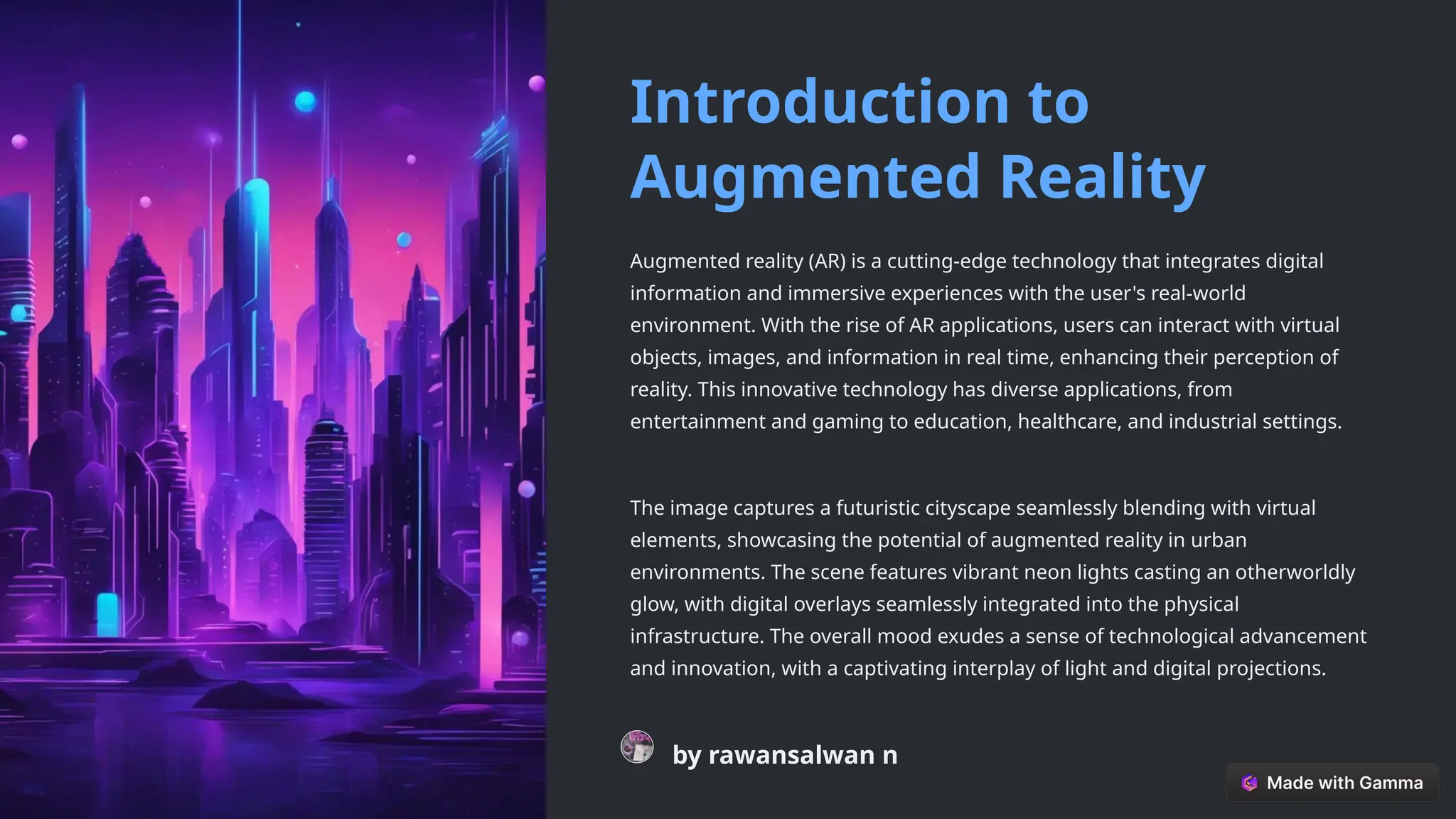
The image captures a futuristic cityscape seamlessly blending with virtual
elements, showcasing the potential of augmented reality in urban
environments. The scene features vibrant neon lights casting an otherworldly
glow, with digital overlays seamlessly integrated into the physical
infrastructure. The overall mood exudes a sense of technological advancement
and innovation, with a captivating interplay of light and digital projections.
by rawansalwan n
What is augmented reality?
Augmented reality (AR) is a revolutionary technology that overlays digital information, such as images,
videos, or 3D models, onto the real world. Unlike virtual reality, which immerses the user in a completely
artificial environment, AR enhances the existing environment and adds virtual elements to it.
AR applications are diverse, ranging from gaming and entertainment to education, healthcare, retail,
and industrial uses. This technology has the potential to transform various industries and enhance the
way we interact with the world around us. With the use of devices like smartphones, tablets, or AR
glasses, users can experience an enriched version of reality, blurring the lines between the physical and
digital realms.
Furthermore, AR is not limited to visual experiences only; it can also incorporate auditory and haptic
elements, providing a truly immersive and multisensory experience. As AR continues to evolve, it
presents exciting opportunities for innovation and integration into everyday life.
This section will delve deeper into the applications and implications of augmented reality, exploring its
potential impact on society and its future trends.
Applications in Gaming
and Entertainment
Augmented reality (AR) has revolutionized the gaming and
entertainment industry by seamlessly integrating virtual elements
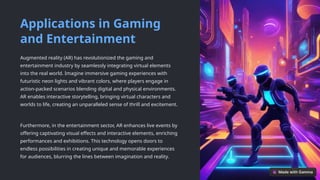
into the real world. Imagine immersive gaming experiences with
futuristic neon lights and vibrant colors, where players engage in
action-packed scenarios blending digital and physical environments.
AR enables interactive storytelling, bringing virtual characters and
worlds to life, creating an unparalleled sense of thrill and excitement.
Furthermore, in the entertainment sector, AR enhances live events by
offering captivating visual effects and interactive elements, enriching
performances and exhibitions. This technology opens doors to
endless possibilities in creating unique and memorable experiences
for audiences, blurring the lines between imagination and reality.
Augmented reality in education and training
1
Interactive Learning
Augmented reality introduces
interactive learning experiences where
students can engage with virtual
models and simulations. This
facilitates a deeper understanding of
complex concepts and enhances the
overall learning process. Visualizing
abstract theories in a tangible way
helps students grasp the subject
matter effectively.
2 Skill Development
AR systems provide a platform for
practical skill development, allowing
learners to practice real-life scenarios
in a simulated environment. This
hands-on approach greatly benefits
professions such as medicine,
engineering, and architecture, where
practical training is essential.
3
Personalized Education
With AR, personalized education
becomes achievable as learners can
access customized content tailored to
their individual learning styles and
pace. This adaptability fosters a more
inclusive and engaging learning
environment, catering to diverse
educational needs.
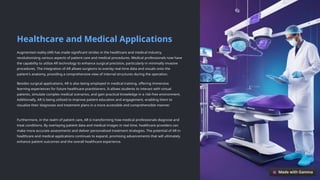
Healthcare and Medical Applications
Augmented reality (AR) has made significant strides in the healthcare and medical industry,
revolutionizing various aspects of patient care and medical procedures. Medical professionals now have
the capability to utilize AR technology to enhance surgical precision, particularly in minimally invasive
procedures. The integration of AR allows surgeons to overlay real-time data and visuals onto the
patient's anatomy, providing a comprehensive view of internal structures during the operation.
Besides surgical applications, AR is also being employed in medical training, offering immersive
learning experiences for future healthcare practitioners. It allows students to interact with virtual
patients, simulate complex medical scenarios, and gain practical knowledge in a risk-free environment.
Additionally, AR is being utilized to improve patient education and engagement, enabling them to
visualize their diagnoses and treatment plans in a more accessible and comprehensible manner.
Furthermore, in the realm of patient care, AR is transforming how medical professionals diagnose and
treat conditions. By overlaying patient data and medical images in real time, healthcare providers can
make more accurate assessments and deliver personalized treatment strategies. The potential of AR in
healthcare and medical applications continues to expand, promising advancements that will ultimately
enhance patient outcomes and the overall healthcare experience.
Augmented Reality in Retail
and E-commerce
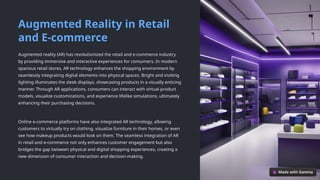
Augmented reality (AR) has revolutionized the retail and e-commerce industry
by providing immersive and interactive experiences for consumers. In modern
spacious retail stores, AR technology enhances the shopping environment by
seamlessly integrating digital elements into physical spaces. Bright and inviting
lighting illuminates the sleek displays, showcasing products in a visually enticing
manner. Through AR applications, consumers can interact with virtual product
models, visualize customizations, and experience lifelike simulations, ultimately
enhancing their purchasing decisions.
Online e-commerce platforms have also integrated AR technology, allowing
customers to virtually try on clothing, visualize furniture in their homes, or even
see how makeup products would look on them. The seamless integration of AR
in retail and e-commerce not only enhances customer engagement but also
bridges the gap between physical and digital shopping experiences, creating a
new dimension of consumer interaction and decision-making.
Industrial and Manufacturing
Uses of Augmented Reality
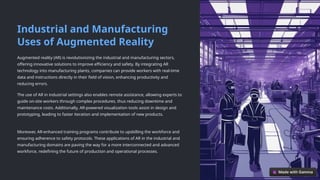
Augmented reality (AR) is revolutionizing the industrial and manufacturing sectors,
offering innovative solutions to improve efficiency and safety. By integrating AR
technology into manufacturing plants, companies can provide workers with real-time
data and instructions directly in their field of vision, enhancing productivity and
reducing errors.
The use of AR in industrial settings also enables remote assistance, allowing experts to
guide on-site workers through complex procedures, thus reducing downtime and
maintenance costs. Additionally, AR-powered visualization tools assist in design and
prototyping, leading to faster iteration and implementation of new products.
Moreover, AR-enhanced training programs contribute to upskilling the workforce and
ensuring adherence to safety protocols. These applications of AR in the industrial and
manufacturing domains are paving the way for a more interconnected and advanced
workforce, redefining the future of production and operational processes.
Augmented Reality for
Navigation and Tourism
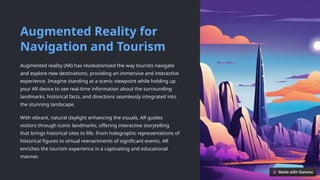
Augmented reality (AR) has revolutionized the way tourists navigate
and explore new destinations, providing an immersive and interactive
experience. Imagine standing at a scenic viewpoint while holding up
your AR device to see real-time information about the surrounding
landmarks, historical facts, and directions seamlessly integrated into
the stunning landscape.
With vibrant, natural daylight enhancing the visuals, AR guides
visitors through iconic landmarks, offering interactive storytelling
that brings historical sites to life. From holographic representations of
historical figures to virtual reenactments of significant events, AR
enriches the tourism experience in a captivating and educational
manner.
Future trends in augmented reality
Integration with IoT: One of the future trends in augmented reality involves its
seamless integration with the Internet of Things (IoT). This convergence will enable AR
to interact with connected devices in real time, creating immersive and interactive
experiences for users.
Advancements in spatial computing: As technology progresses, we anticipate
significant advancements in spatial computing, allowing AR to better understand and
interact with the physical space around us. This will open up possibilities for more
accurate and sophisticated AR applications.
AR in everyday life: The future of AR will likely see its widespread integration into our
daily routines, from shopping experiences to home maintenance. This will revolutionize
how we perceive and interact with the world, enhancing our daily tasks and activities.
Emphasis on privacy and security: With the increasing use of AR, there will be a
heightened focus on maintaining privacy and security. Future trends will likely include
advancements in AR technologies that prioritize user data protection and secure AR
interactions.
The Impact of Augmented
Reality on Society
As augmented reality continues to evolve and integrate into various sectors, its potential
impact on society is profound. This innovative technology has the power to redefine our
interactions with the digital world, blurring the lines between the virtual and the
physical. With the ability to enhance experiences in education, healthcare, retail,
entertainment, and more, augmented reality holds the promise of transforming how we
perceive and engage with our surroundings.
From revolutionizing the way we learn and explore, to improving medical diagnostics
and treatment, to enhancing shopping experiences and industrial processes, the
widespread adoption of augmented reality has the potential to reshape societal norms
and behaviors. Furthermore, as AR becomes more ubiquitous, it is poised to influence
consumer habits, workforce dynamics, and even cultural practices, ushering in a new
era of technological immersion.

Introduction-to-Augmented-Reality new.pptx

  • 1.
    Introduction to Augmented Reality Augmentedreality (AR) is a cutting-edge technology that integrates digital information and immersive experiences with the user's real-world environment. With the rise of AR applications, users can interact with virtual objects, images, and information in real time, enhancing their perception of reality. This innovative technology has diverse applications, from entertainment and gaming to education, healthcare, and industrial settings. The image captures a futuristic cityscape seamlessly blending with virtual elements, showcasing the potential of augmented reality in urban environments. The scene features vibrant neon lights casting an otherworldly glow, with digital overlays seamlessly integrated into the physical infrastructure. The overall mood exudes a sense of technological advancement and innovation, with a captivating interplay of light and digital projections. by rawansalwan n
  • 2.
    What is augmentedreality? Augmented reality (AR) is a revolutionary technology that overlays digital information, such as images, videos, or 3D models, onto the real world. Unlike virtual reality, which immerses the user in a completely artificial environment, AR enhances the existing environment and adds virtual elements to it. AR applications are diverse, ranging from gaming and entertainment to education, healthcare, retail, and industrial uses. This technology has the potential to transform various industries and enhance the way we interact with the world around us. With the use of devices like smartphones, tablets, or AR glasses, users can experience an enriched version of reality, blurring the lines between the physical and digital realms. Furthermore, AR is not limited to visual experiences only; it can also incorporate auditory and haptic elements, providing a truly immersive and multisensory experience. As AR continues to evolve, it presents exciting opportunities for innovation and integration into everyday life. This section will delve deeper into the applications and implications of augmented reality, exploring its potential impact on society and its future trends.
  • 3.
    Applications in Gaming andEntertainment Augmented reality (AR) has revolutionized the gaming and entertainment industry by seamlessly integrating virtual elements into the real world. Imagine immersive gaming experiences with futuristic neon lights and vibrant colors, where players engage in action-packed scenarios blending digital and physical environments. AR enables interactive storytelling, bringing virtual characters and worlds to life, creating an unparalleled sense of thrill and excitement. Furthermore, in the entertainment sector, AR enhances live events by offering captivating visual effects and interactive elements, enriching performances and exhibitions. This technology opens doors to endless possibilities in creating unique and memorable experiences for audiences, blurring the lines between imagination and reality.
  • 4.
    Augmented reality ineducation and training 1 Interactive Learning Augmented reality introduces interactive learning experiences where students can engage with virtual models and simulations. This facilitates a deeper understanding of complex concepts and enhances the overall learning process. Visualizing abstract theories in a tangible way helps students grasp the subject matter effectively. 2 Skill Development AR systems provide a platform for practical skill development, allowing learners to practice real-life scenarios in a simulated environment. This hands-on approach greatly benefits professions such as medicine, engineering, and architecture, where practical training is essential. 3 Personalized Education With AR, personalized education becomes achievable as learners can access customized content tailored to their individual learning styles and pace. This adaptability fosters a more inclusive and engaging learning environment, catering to diverse educational needs.
  • 5.
    Healthcare and MedicalApplications Augmented reality (AR) has made significant strides in the healthcare and medical industry, revolutionizing various aspects of patient care and medical procedures. Medical professionals now have the capability to utilize AR technology to enhance surgical precision, particularly in minimally invasive procedures. The integration of AR allows surgeons to overlay real-time data and visuals onto the patient's anatomy, providing a comprehensive view of internal structures during the operation. Besides surgical applications, AR is also being employed in medical training, offering immersive learning experiences for future healthcare practitioners. It allows students to interact with virtual patients, simulate complex medical scenarios, and gain practical knowledge in a risk-free environment. Additionally, AR is being utilized to improve patient education and engagement, enabling them to visualize their diagnoses and treatment plans in a more accessible and comprehensible manner. Furthermore, in the realm of patient care, AR is transforming how medical professionals diagnose and treat conditions. By overlaying patient data and medical images in real time, healthcare providers can make more accurate assessments and deliver personalized treatment strategies. The potential of AR in healthcare and medical applications continues to expand, promising advancements that will ultimately enhance patient outcomes and the overall healthcare experience.
  • 6.
    Augmented Reality inRetail and E-commerce Augmented reality (AR) has revolutionized the retail and e-commerce industry by providing immersive and interactive experiences for consumers. In modern spacious retail stores, AR technology enhances the shopping environment by seamlessly integrating digital elements into physical spaces. Bright and inviting lighting illuminates the sleek displays, showcasing products in a visually enticing manner. Through AR applications, consumers can interact with virtual product models, visualize customizations, and experience lifelike simulations, ultimately enhancing their purchasing decisions. Online e-commerce platforms have also integrated AR technology, allowing customers to virtually try on clothing, visualize furniture in their homes, or even see how makeup products would look on them. The seamless integration of AR in retail and e-commerce not only enhances customer engagement but also bridges the gap between physical and digital shopping experiences, creating a new dimension of consumer interaction and decision-making.
  • 7.
    Industrial and Manufacturing Usesof Augmented Reality Augmented reality (AR) is revolutionizing the industrial and manufacturing sectors, offering innovative solutions to improve efficiency and safety. By integrating AR technology into manufacturing plants, companies can provide workers with real-time data and instructions directly in their field of vision, enhancing productivity and reducing errors. The use of AR in industrial settings also enables remote assistance, allowing experts to guide on-site workers through complex procedures, thus reducing downtime and maintenance costs. Additionally, AR-powered visualization tools assist in design and prototyping, leading to faster iteration and implementation of new products. Moreover, AR-enhanced training programs contribute to upskilling the workforce and ensuring adherence to safety protocols. These applications of AR in the industrial and manufacturing domains are paving the way for a more interconnected and advanced workforce, redefining the future of production and operational processes.
  • 8.
    Augmented Reality for Navigationand Tourism Augmented reality (AR) has revolutionized the way tourists navigate and explore new destinations, providing an immersive and interactive experience. Imagine standing at a scenic viewpoint while holding up your AR device to see real-time information about the surrounding landmarks, historical facts, and directions seamlessly integrated into the stunning landscape. With vibrant, natural daylight enhancing the visuals, AR guides visitors through iconic landmarks, offering interactive storytelling that brings historical sites to life. From holographic representations of historical figures to virtual reenactments of significant events, AR enriches the tourism experience in a captivating and educational manner.
  • 9.
    Future trends inaugmented reality Integration with IoT: One of the future trends in augmented reality involves its seamless integration with the Internet of Things (IoT). This convergence will enable AR to interact with connected devices in real time, creating immersive and interactive experiences for users. Advancements in spatial computing: As technology progresses, we anticipate significant advancements in spatial computing, allowing AR to better understand and interact with the physical space around us. This will open up possibilities for more accurate and sophisticated AR applications. AR in everyday life: The future of AR will likely see its widespread integration into our daily routines, from shopping experiences to home maintenance. This will revolutionize how we perceive and interact with the world, enhancing our daily tasks and activities. Emphasis on privacy and security: With the increasing use of AR, there will be a heightened focus on maintaining privacy and security. Future trends will likely include advancements in AR technologies that prioritize user data protection and secure AR interactions.
  • 10.
    The Impact ofAugmented Reality on Society As augmented reality continues to evolve and integrate into various sectors, its potential impact on society is profound. This innovative technology has the power to redefine our interactions with the digital world, blurring the lines between the virtual and the physical. With the ability to enhance experiences in education, healthcare, retail, entertainment, and more, augmented reality holds the promise of transforming how we perceive and engage with our surroundings. From revolutionizing the way we learn and explore, to improving medical diagnostics and treatment, to enhancing shopping experiences and industrial processes, the widespread adoption of augmented reality has the potential to reshape societal norms and behaviors. Furthermore, as AR becomes more ubiquitous, it is poised to influence consumer habits, workforce dynamics, and even cultural practices, ushering in a new era of technological immersion.