Nova Architecture
Technology and architecture magazine
June22,2020–1stedition
Learn about the latest trends
in architecture
Staff
Teacher: Pedro Beltran
Student: Rafael Aponte
CI: 27226785
Career: Architecture
Semester: VI
Subject: Computing
Editorial
Demonstrating that architecture
and technology go hand in hand in
their advancement process, in this
edition of Architecture Nova we will
see how architecture and
technology merge to improve the
experience of architects, favoring
faster designs and elaboration of
works, through 3D surveys,
simulations in Virtual Reality, terrain
surveys thanks to drones that scan
the area. Thanks to all this we get
better jobs, better finishes and
everything is obtained by the
technology of architecture.
We will see: avant-garde
innovations that are changing the
architectural scene of today such
as, 3D prints in architecture that
creates objects and elements for
models of different sectors, drones
applied to the building that recreate
the terrain with 3D infographics,
robotic architecture that has already
been in use before but you can see
it
will be used for other purposes of
greater responsibility, BIM
methodology that was in use by the
engineers but now the architects
are also implementing it as an
advantage for the design and
maintenance phase of buildings,
virtual reality that allows both
architects and clients or other
agents of the project to interact with
the created environment and
sustainable architecture that seeks
to achieve environmental care
through simulation tools to avoid
any type of error during
construction. A new style of tree-
based structural parts and canopies
will also be seen that are planned to
replace concrete and steel
structures with their high
carbon. Water in architecture was
only used for pools and fountains,
but on certain occasions architects
manage to create new ways to use
it as a filter to create blue light with
fluctuating changes.
Technological advances that will take over
architecture
A new type of construction is yet to
overcome steel and concrete constructions.
Water seen from a decorative point for
architecture
Index
"The purpose of a house is to
provide a good and comfortable life,
and it would be a mistake to
overestimate an exclusively
decorative result“
Lina Bo Bardi (1914-1992)
4
7
8
5. Virtual Reality applied to
Architecture
The multiple applications of Virtual
Reality have turned this technology
into a new architectural niche. And
among all of them, it should be noted
that this new form of real-time 3D
design allows architects, clients or
other project agents to interact with
the environment created: from
modifying the textures or the color of
the walls to changing an exterior,
consulting the measures or update
expenses.
Technological advances that
will take over architecture
We have great advances in the
world of architecture that make
surprising innovations for the
realization of buildings, such as the
following:
1. 3D Printing in
Architecture
The potential of three-dimensional
printing is not a science fiction
thing, but has come to stay and
revolutionize the architecture
sector. This technology creates
objects and elements for models
from different sectors. However, in
the world of Construction and
Building, it is already part of
projects that do not need molds and
that combine different materials to
complete the different parts of a
structure. Thus, through a macro-
printer and a model introduced by
computer, the resulting material can
be placed in layers until it is
achieved.
3. Robotic Architecture
At the moment robots are already used
to mechanize dangerous tasks such as
demolition, insulation projection, or
those that are heavier (placement of
materials, adaptation of spaces to
different sizes, inspection tasks,
cleaning ...) with the objective to
streamline and optimize
times. However, the development that
robotics is undergoing makes us think
that in the not so long time it will also
allow it to carry out other tasks of
greater architectural responsibility.
4. BIM methodology
Not only is it a revolution in itself for
engineers, but architects are also
experiencing its benefits in the design
and maintenance phases of
buildings. Keep in mind that this
methodology allows you to carry out
immersive projects in which you can
walk through its interior before they are
even carried out or detect and combat
errors in your planning.
2.Drones applied to the
building
The professional use of drones
has also caught up with
architectural tasks. Recreation of
the terrain with 3D infographics,
taking aerial images to monitor
the evolution of buildings
accurately or modifying
structures built with state-of-the-
art architectural elements are just
some of its applications within
this field..
4 5
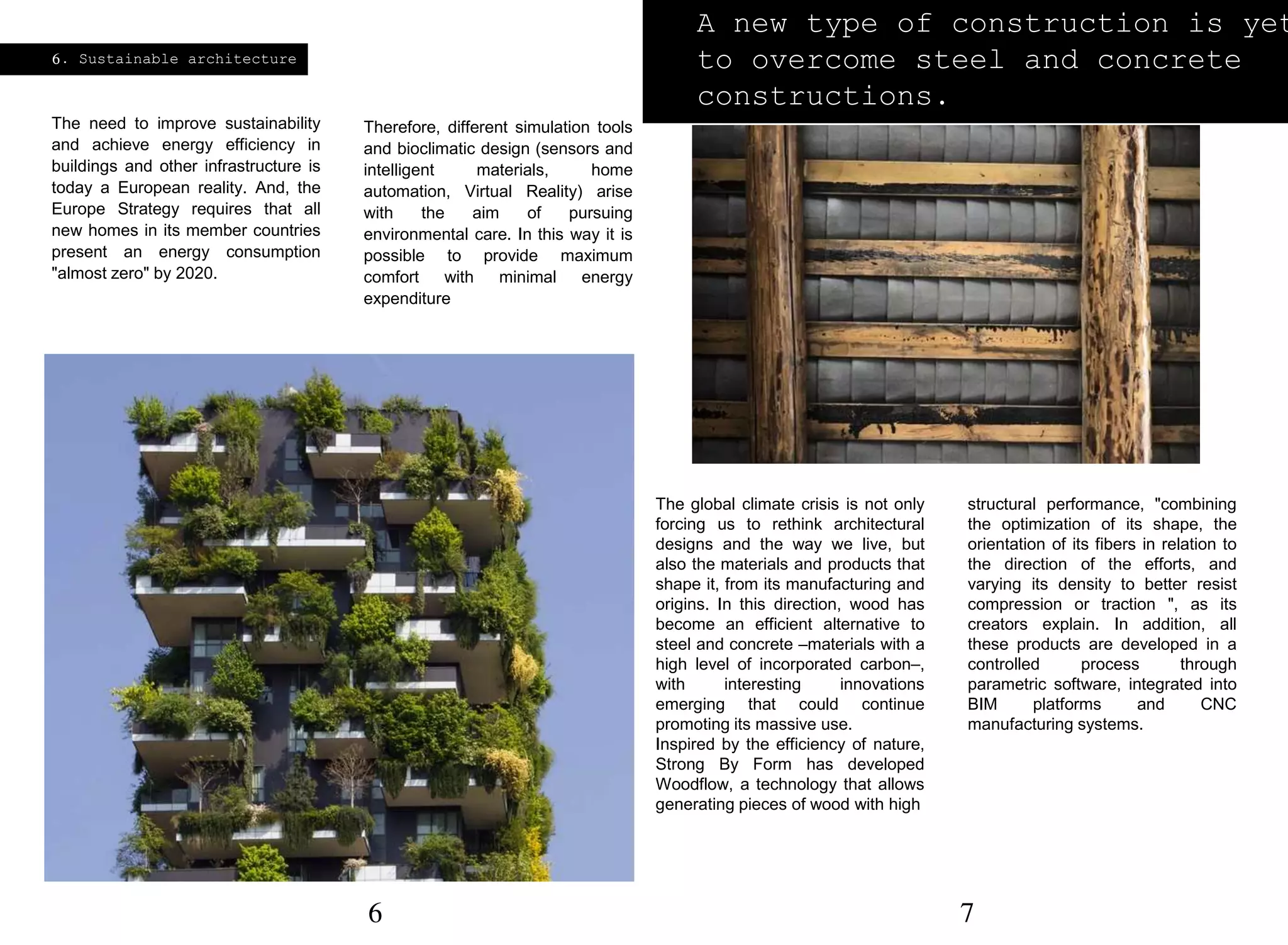
6. Sustainable architecture
The need to improve sustainability
and achieve energy efficiency in
buildings and other infrastructure is
today a European reality. And, the
Europe Strategy requires that all
new homes in its member countries
present an energy consumption
"almost zero" by 2020.
Therefore, different simulation tools
and bioclimatic design (sensors and
intelligent materials, home
automation, Virtual Reality) arise
with the aim of pursuing
environmental care. In this way it is
possible to provide maximum
comfort with minimal energy
expenditure
A new type of construction is yet
to overcome steel and concrete
constructions.
The global climate crisis is not only
forcing us to rethink architectural
designs and the way we live, but
also the materials and products that
shape it, from its manufacturing and
origins. In this direction, wood has
become an efficient alternative to
steel and concrete –materials with a
high level of incorporated carbon–,
with interesting innovations
emerging that could continue
promoting its massive use.
Inspired by the efficiency of nature,
Strong By Form has developed
Woodflow, a technology that allows
generating pieces of wood with high
structural performance, "combining
the optimization of its shape, the
orientation of its fibers in relation to
the direction of the efforts, and
varying its density to better resist
compression or traction ", as its
creators explain. In addition, all
these products are developed in a
controlled process through
parametric software, integrated into
BIM platforms and CNC
manufacturing systems.
6 7
Water seen from a decorative
point for architecture
From indoor pools to tranquil
outdoor fountains, tall waterfalls,
and oversized lagoons, architecture
has incorporated water over the
centuries in infinitely innovative
ways. Whether fulfilling aesthetic
purposes or giving rise to
sustainable activities or systems,
water and its different states allow it
to take innumerable forms and thus
serve multiple purposes. Below, we
synthesize different uses of water in
contemporary architectural projects,
ranging from single-family homes to
large commercial and public
complexes.
Although the pool is a common
element in homes located in hot
climates, some architects have
exceeded the limits of its
conventional format. ”SPBR
Arquitectos” weekend home in
downtown Sao Paulo elevates its
pool to maximize sunlight, ensuring
that neighboring homes don't
overshadow its essential
feature. On the ground floor, a
series of additional pools make up a
beautiful interior garden, installing
the main living room in the midst of
this natural environment. Wiel Arets
Architects' 'House of the Jellyfish'
also features a raised, cantilevered
pool with an infinity edge. Using a
glass floor and a panoramic window
on its attached edge, the pool filters
sunlight into the home, creating
fluctuating reflections of blue
light. These designs challenge the
traditional concept of the
underground pool and uniquely
interact with light and nature.
“The place as a result of nature and time:
this is the most important aspect. I think
my architecture is a kind of frame of
nature. With him, we can experience
nature in a deeper and more intimate way“
Kengo Kuma
8

Nova architecture

  • 1.
    Nova Architecture Technology andarchitecture magazine June22,2020–1stedition Learn about the latest trends in architecture
  • 2.
    Staff Teacher: Pedro Beltran Student:Rafael Aponte CI: 27226785 Career: Architecture Semester: VI Subject: Computing Editorial Demonstrating that architecture and technology go hand in hand in their advancement process, in this edition of Architecture Nova we will see how architecture and technology merge to improve the experience of architects, favoring faster designs and elaboration of works, through 3D surveys, simulations in Virtual Reality, terrain surveys thanks to drones that scan the area. Thanks to all this we get better jobs, better finishes and everything is obtained by the technology of architecture. We will see: avant-garde innovations that are changing the architectural scene of today such as, 3D prints in architecture that creates objects and elements for models of different sectors, drones applied to the building that recreate the terrain with 3D infographics, robotic architecture that has already been in use before but you can see it will be used for other purposes of greater responsibility, BIM methodology that was in use by the engineers but now the architects are also implementing it as an advantage for the design and maintenance phase of buildings, virtual reality that allows both architects and clients or other agents of the project to interact with the created environment and sustainable architecture that seeks to achieve environmental care through simulation tools to avoid any type of error during construction. A new style of tree- based structural parts and canopies will also be seen that are planned to replace concrete and steel structures with their high carbon. Water in architecture was only used for pools and fountains, but on certain occasions architects manage to create new ways to use it as a filter to create blue light with fluctuating changes.
  • 3.
    Technological advances thatwill take over architecture A new type of construction is yet to overcome steel and concrete constructions. Water seen from a decorative point for architecture Index "The purpose of a house is to provide a good and comfortable life, and it would be a mistake to overestimate an exclusively decorative result“ Lina Bo Bardi (1914-1992) 4 7 8
  • 4.
    5. Virtual Realityapplied to Architecture The multiple applications of Virtual Reality have turned this technology into a new architectural niche. And among all of them, it should be noted that this new form of real-time 3D design allows architects, clients or other project agents to interact with the environment created: from modifying the textures or the color of the walls to changing an exterior, consulting the measures or update expenses. Technological advances that will take over architecture We have great advances in the world of architecture that make surprising innovations for the realization of buildings, such as the following: 1. 3D Printing in Architecture The potential of three-dimensional printing is not a science fiction thing, but has come to stay and revolutionize the architecture sector. This technology creates objects and elements for models from different sectors. However, in the world of Construction and Building, it is already part of projects that do not need molds and that combine different materials to complete the different parts of a structure. Thus, through a macro- printer and a model introduced by computer, the resulting material can be placed in layers until it is achieved. 3. Robotic Architecture At the moment robots are already used to mechanize dangerous tasks such as demolition, insulation projection, or those that are heavier (placement of materials, adaptation of spaces to different sizes, inspection tasks, cleaning ...) with the objective to streamline and optimize times. However, the development that robotics is undergoing makes us think that in the not so long time it will also allow it to carry out other tasks of greater architectural responsibility. 4. BIM methodology Not only is it a revolution in itself for engineers, but architects are also experiencing its benefits in the design and maintenance phases of buildings. Keep in mind that this methodology allows you to carry out immersive projects in which you can walk through its interior before they are even carried out or detect and combat errors in your planning. 2.Drones applied to the building The professional use of drones has also caught up with architectural tasks. Recreation of the terrain with 3D infographics, taking aerial images to monitor the evolution of buildings accurately or modifying structures built with state-of-the- art architectural elements are just some of its applications within this field.. 4 5
  • 5.
    6. Sustainable architecture Theneed to improve sustainability and achieve energy efficiency in buildings and other infrastructure is today a European reality. And, the Europe Strategy requires that all new homes in its member countries present an energy consumption "almost zero" by 2020. Therefore, different simulation tools and bioclimatic design (sensors and intelligent materials, home automation, Virtual Reality) arise with the aim of pursuing environmental care. In this way it is possible to provide maximum comfort with minimal energy expenditure A new type of construction is yet to overcome steel and concrete constructions. The global climate crisis is not only forcing us to rethink architectural designs and the way we live, but also the materials and products that shape it, from its manufacturing and origins. In this direction, wood has become an efficient alternative to steel and concrete –materials with a high level of incorporated carbon–, with interesting innovations emerging that could continue promoting its massive use. Inspired by the efficiency of nature, Strong By Form has developed Woodflow, a technology that allows generating pieces of wood with high structural performance, "combining the optimization of its shape, the orientation of its fibers in relation to the direction of the efforts, and varying its density to better resist compression or traction ", as its creators explain. In addition, all these products are developed in a controlled process through parametric software, integrated into BIM platforms and CNC manufacturing systems. 6 7
  • 6.
    Water seen froma decorative point for architecture From indoor pools to tranquil outdoor fountains, tall waterfalls, and oversized lagoons, architecture has incorporated water over the centuries in infinitely innovative ways. Whether fulfilling aesthetic purposes or giving rise to sustainable activities or systems, water and its different states allow it to take innumerable forms and thus serve multiple purposes. Below, we synthesize different uses of water in contemporary architectural projects, ranging from single-family homes to large commercial and public complexes. Although the pool is a common element in homes located in hot climates, some architects have exceeded the limits of its conventional format. ”SPBR Arquitectos” weekend home in downtown Sao Paulo elevates its pool to maximize sunlight, ensuring that neighboring homes don't overshadow its essential feature. On the ground floor, a series of additional pools make up a beautiful interior garden, installing the main living room in the midst of this natural environment. Wiel Arets Architects' 'House of the Jellyfish' also features a raised, cantilevered pool with an infinity edge. Using a glass floor and a panoramic window on its attached edge, the pool filters sunlight into the home, creating fluctuating reflections of blue light. These designs challenge the traditional concept of the underground pool and uniquely interact with light and nature. “The place as a result of nature and time: this is the most important aspect. I think my architecture is a kind of frame of nature. With him, we can experience nature in a deeper and more intimate way“ Kengo Kuma 8