GLOBAL
DISTRIBUTION
SYSTEM
Topic1 - Introduction of Computer
Reservation System
Lessons:
1. Functions and Evolution of Computer
Reservation System
2. Overview and History of Global
Distribution System
Lesson1 - Functions and Evolution of
Computer Reservation System
Computer Reservation System was originally designed and used by
airlines but was then extended to travel agents and hotels for more
convenience in transacting with various guests and travelers. It is an
information system that promotes sales and provides fast and accurate
information about availability, price and bookings of tourism products and
services.
Computer Reservation System or a Central Reservation System (CRS) -
is a computer – based reservation system in the travel and tourism industry
which is used to store and retrieve information and eventually conduct
transaction related to travel.
Typical CRS Functions
Flight schedule information:
Days and times for flights operated by the airline
Availability information
Seat availability on a flight by service class (i.e. Economy, business, first class)
Fare quote
A consolidated fare for an itinerary based on flight, day, time, service class and
passenger types chosen
Reservation information
Seat bookings
Ticketing information
Generating and storing tickets
Refunds and cancellations
Cancellation of existing reservations and tickets
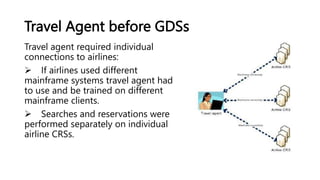
Travel Agent before GDSs
Travel agent required individual
connections to airlines:
 If airlines used different
mainframe systems travel agent had
to use and be trained on different
mainframe clients.
 Searches and reservations were
performed separately on individual
airline CRSs.
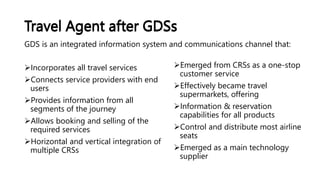
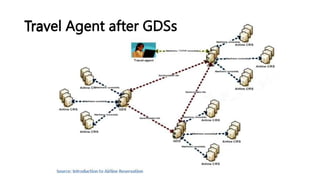
Travel Agent after GDSs
Incorporates all travel services
Connects service providers with end
users
Provides information from all
segments of the journey
Allows booking and selling of the
required services
Horizontal and vertical integration of
multiple CRSs
Emerged from CRSs as a one-stop
customer service
Effectively became travel
supermarkets, offering
Information & reservation
capabilities for all products
Control and distribute most airline
seats
Emerged as a main technology
supplier
Travel Agent after GDSs
GDS is an integrated information system and communications channel that:
Travel Agent after GDSs
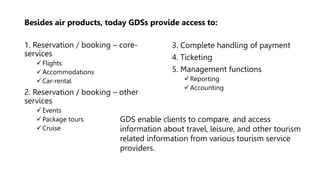
1. Reservation / booking – core-
services
Flights
Accommodations
Car-rental
2. Reservation / booking – other
services
Events
Package tours
Cruise
3. Complete handling of payment
4. Ticketing
5. Management functions
Reporting
Accounting
Besides air products, today GDSs provide access to:
GDS enable clients to compare, and access
information about travel, leisure, and other tourism
related information from various tourism service
providers.
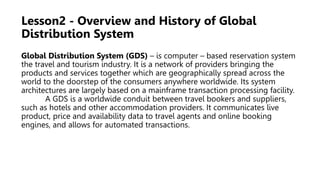
Global Distribution System (GDS) – is computer – based reservation system
the travel and tourism industry. It is a network of providers bringing the
products and services together which are geographically spread across the
world to the doorstep of the consumers anywhere worldwide. Its system
architectures are largely based on a mainframe transaction processing facility.
A GDS is a worldwide conduit between travel bookers and suppliers,
such as hotels and other accommodation providers. It communicates live
product, price and availability data to travel agents and online booking
engines, and allows for automated transactions.
Lesson2 - Overview and History of Global
Distribution System
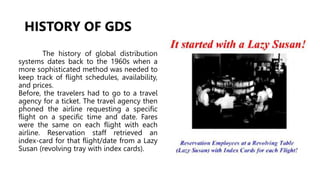
The history of global distribution
systems dates back to the 1960s when a
more sophisticated method was needed to
keep track of flight schedules, availability,
and prices.
Before, the travelers had to go to a travel
agency for a ticket. The travel agency then
phoned the airline requesting a specific
flight on a specific time and date. Fares
were the same on each flight with each
airline. Reservation staff retrieved an
index-card for that flight/date from a Lazy
Susan (revolving tray with index cards).
HISTORY OF GDS
Then travel agency’s request could
be answered. Travel agency issued the
ticket, collected payment and received a
commission from the airline.
In 1953, two people met by
chance, Mr. Smith from American Airlines
(AA) and Mr. Smith from International
Business Management (IBM). They plan to
automate the AA reservation process with
the help of IBM hard and software. The
result of the plan is the introduction of
SABRE (Semi-Automatic Business
Research Environment) by American
Airlines in 1960.
HISTORY OF GDS
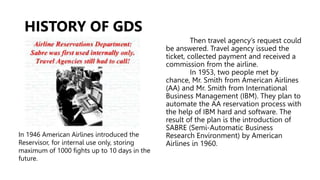
In 1946 American Airlines introduced the
Reservisor, for internal use only, storing
maximum of 1000 fights up to 10 days in the
future.
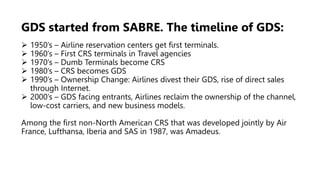
 1950’s – Airline reservation centers get first terminals.
 1960’s – First CRS terminals in Travel agencies
 1970’s – Dumb Terminals become CRS
 1980’s – CRS becomes GDS
 1990’s – Ownership Change: Airlines divest their GDS, rise of direct sales
through Internet.
 2000’s – GDS facing entrants, Airlines reclaim the ownership of the channel,
low-cost carriers, and new business models.
Among the first non-North American CRS that was developed jointly by Air
France, Lufthansa, Iberia and SAS in 1987, was Amadeus.
GDS started from SABRE. The timeline of GDS:
Topic2 - Importance of Global
Distribution System
Lessons:
1. Role of the GDS in Global Travel Industry
and Destination
2. Types of GDS
3. Online Travel Agency
GDS ON TOURISM SECTORS.
Lesson1 – Role of the GDS in Global Travel
Industry and Destination
 Cruise Industry - The cruise market is expanding with global revenue now at $40 billion. travelers
are finding them a more accessible form of holiday. It appears travel agents are driving most of this
success, with 70% of cruise bookings made via this channel. Travel agents offer expertise, advice,
and personal service; which are needed for cruise passengers.
 Airlines - GDS continue to represent most of air travel. Amadeus, Galileo, Sabre Travel Network
and Worldspan were set up by competing airlines distribute their fares electronically to business
travel agents. All are still used by business travel agents who will select one of the GDS s rather than
use all four.
 Hotel & Car Rental - The GDSs play a far smaller but still considerable role in hotel and car rental
distribution segments of the travel industry in which most of the bookings are handled over the
phone or in person, usually directly with the local hotel property or car rental location.
GDS on Travel Supplier.
Lesson1 – Role of the GDS in Global Travel
Industry and Destination
The GDSs enable suppliers to make their products available to consumers globally through travel
agencies in markets
 Matrix display - First introduced by Orbitz (based upon technology from ITA Software) and
now standard throughout online travel, the matrix display allows consumers to click on
any cell within the matrix to sort airfare search results by price, airline and number of
stops.
 Opaque fares - Initially made famous by Priceline’s Name Your Own Price airfare bidding
model, opaque fares allow travellers to get deeply discounted plane tickets.
 Dynamic packaging - Debuted by Expedia and now standard throughout online travel, this
“book together and save” option allows travellers to shop for multiple components in a
single search, such as “Flight + Hotel.” This feature generally provides a lower overall price
than if the two components are purchased independently.
 Travel agency is a private retailer or public service that provides travel and
tourism –related services to the public on behalf of accommodation or
travel suppliers. The main function of a travel agency is to act as an agent,
selling travel products and services on behalf of a supplier.
 Tour operator typically combines tour and travel components to create a
package holiday. They advertise and produce brochures to promote their
product, holidays and itineraries.
 Airline consolidator is a wholesaler of airline tickets, sometimes described as
a broker. Consolidators most commonly operate in international markets.
 Online Travel Agency (OTA) - An entity who’s branding is oriented online
and that principally conducts business online.
Examples of Travel suppliers:
GDS on Travel Supplier.
Lesson1 – Role of the GDS in Global Travel
Industry and Destination
 Flexible and alternative date search - This feature allows travelers to compare flight
options across multiple departures and return dates to find the lowest possible fare.
 Alternative airport search - Travelers can search across multiple departure and arrival
airports within an acceptable distance to find the lowest possible fare or most convenient
schedule.
 Low-fare notifications - OTAs introduced a feature that would email customers when there
were specific deals on particular O&D (origin and destination) pairs.
 Hotel search, results display and sorting - OTAs have made significant contributions to
hotel search result displays and sorting options to make it easier for travelers to compare
options from hundreds of possible results.
GDS is used as a single point of access for checking status & make booking for
flights, hotel rooms, rental cars, packages and other travel related items. Global
Distribution System is accessed as B2C and B2B model, such as by travel agents, online
reservation sites, end customers and corporations. Therefore, GDS providers also with
Travel APIs which can be integrated to any Travel House’s web portal for booking
through online.
Lesson2 – Types of GDS
 API provider - is an organization that exposes data and/or capabilities through a programmatically
consumable service or an Application Programming Interface (API)
 Business-to-Business (B2B) - also called B-to-B, is a form of transaction between businesses, such
as one involving a manufacturer and wholesaler, or a wholesaler and a retailer. Business-to-
business refers to business that is conducted between companies, rather than between a company
and individual consumer. Business-to-business stands in contrast to business-to-consumer (B2C)
and business-to-government (B2G) transactions.
 Business-to-Consumer (B2C) - refers to the process of selling products and services directly
between a business and consumers who are the end-users of its products or services. Most
companies that sell directly to consumers can be referred to as B2C companies.
1. Sabre
Since more than 4 decades, Sabre has been
offering innovations, research and development
transformation to the Travel Industry business. Started
originally as Sabre computer reservations system in
the 1960s and then to advanced airline yield
management systems in the 1980s and finally
transformed into one of the leading travel websites
today. Sabre technology is into this industry since a
long time and served around the world touching all
points of the travel industry.
In July of 1996, Sabre became a separate legal
entity of AMR (parent company of American Airlines),
followed by a successful initial public offering in
October in which AMR released 18% of its shares for
public trading.
Sabre is present in 45 countries and one of the
leading providers of technology & API for the
travel industry and provides innovative products
that enable travel commerce, services, and
enhance airline/supplier operations. Recently
Sabre has acquired Abacus International, which is
one of the leading Travel API, Application, and
Technology providers in Asia.
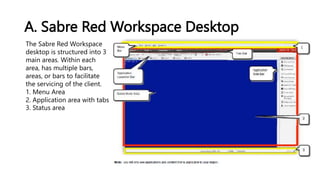
A. Sabre Red Workspace Desktop
The Sabre Red Workspace
desktop is structured into 3
main areas. Within each
area, has multiple bars,
areas, or bars to facilitate
the servicing of the client.
1. Menu Area
2. Application area with tabs
3. Status area
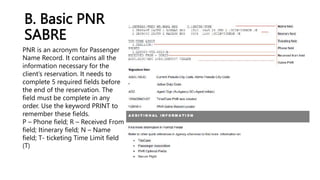
B. Basic PNR
SABRE
PNR is an acronym for Passenger
Name Record. It contains all the
information necessary for the
client’s reservation. It needs to
complete 5 required fields before
the end of the reservation. The
field must be complete in any
order. Use the keyword PRINT to
remember these fields.
P – Phone field; R – Received From
field; Itinerary field; N – Name
field; T- ticketing Time Limit field
(T)
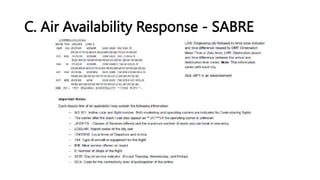
C. Air Availability Response - SABRE
2. Travelport
(Travelport
Galileo,
Travelport
Worldspan)
Travelport is one of the biggest travel
ecommerce & travel solution providers
worldwide. It provides distribution,
technology, application, API, payment
method and other solutions for the travel
and tourism industry. In 2014, the company
completed an initial public offering on the
New York Stock Exchange and trades under
the symbol “TVPT”.
Acquiring Galileo
Travel Distribution Services (TDS) which is Travelport’s
predecessor, came into picture in 2001 through the acquisition of
one of the leading Travel GDS providers Galileo International.
Travelport was formed in August 2006, when TDS parent
company Cendant sold Orbitz and Galileo to The Blackstone
Group in a deal valued at $4.3 billion.
2. Travelport (Travelport
Galileo, Travelport
Worldspan)
• Acquiring Worldspan
• After the Blackstone buyout, in December
2006, Travelport also bought one of its rivals,
Worldspan, for $1.4 billion. Moreover in 2007
Travelport completed the Worldspan deal,
integrating Worldspan with Galileo. has more
than 3,500 employees with revenue of more
than 2.1 billion USD. Subsidiaries: Travelport
includes Travelport Apollo, Travelport Galileo
and Travelport Worldspan, Travelport Digital.
A. Checking Flight Availability and Selling Flights - Sample
of Galileo system
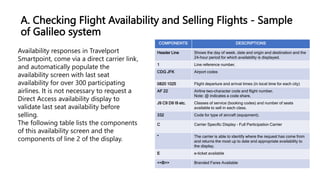
Availability responses in Travelport
Smartpoint, come via a direct carrier link,
and automatically populate the
availability screen with last seat
availability for over 300 participating
airlines. It is not necessary to request a
Direct Access availability display to
validate last seat availability before
selling.
The following table lists the components
of this availability screen and the
components of line 2 of the display.
COMPONENTS DESCRIPTIONS
Header Line Shows the day of week, date and origin and destination and the
24-hour period for which availability is displayed.
1 Line reference number.
CDG JFK Airport codes
0820 1025 Flight departure and arrival times (in local time for each city)
AF 22 Airline two-character code and flight number.
Note: @ indicates a code share.
J9 C9 D9 I9 etc. Classes of service (booking codes) and number of seats
available to sell in each class.
332 Code for type of aircraft (equipment).
C Carrier Specific Display – Full Participation Carrier
* The carrier is able to identify where the request has come from
and returns the most up to date and appropriate availability to
the display.
E e-ticket available
<<B>> Branded Fares Available
A. Checking Flight Availability and Selling
Flights
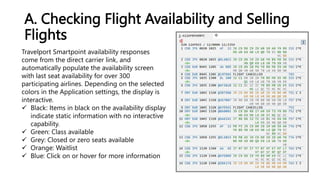
Travelport Smartpoint availability responses
come from the direct carrier link, and
automatically populate the availability screen
with last seat availability for over 300
participating airlines. Depending on the selected
colors in the Application settings, the display is
interactive.
 Black: Items in black on the availability display
indicate static information with no interactive
capability.
 Green: Class available
 Grey: Closed or zero seats available
 Orange: Waitlist
 Blue: Click on or hover for more information
3.
Amadeus
Amadeus is the topmost GDS Travel API provider around the
globe. It has a strong technical & sales team to take care of any
queries of customers. It is founded in 1987 by Air France, Iberia,
Lufthansa, and SAS, Amadeus is a leading Global Distribution
System API and technology provider serving the marketing,
sales, and distribution needs of the world’s travel and tourism
industries. Its inventory, data network and database are the
largest of their kind in Europe.
It serves more than 57,000 travel agency locations and more
than 10,500 airline sales offices in some 200 markets
worldwide. Amadeus has an inventory of approx. 58,000
hotels and 50 car rental companies from 24,000 different
locations and other provider groups, including ferry, rail, and
cruise, insurance, and tour operators. The most attractive
feature of Amadeus is it allows the user to book preferred seat
in a flight through online without calling.
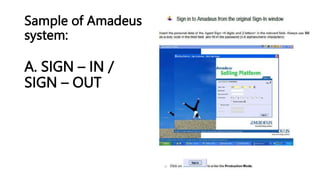
Sample of Amadeus
system:
A. SIGN – IN /
SIGN – OUT
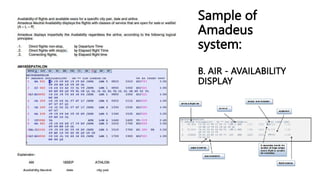
Sample of
Amadeus
system:
B. AIR - AVAILABILITY
DISPLAY
Lesson3 -
Online Travel
Agency (OTA)
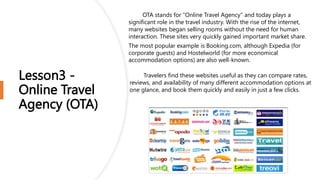
OTA stands for "Online Travel Agency" and today plays a
significant role in the travel industry. With the rise of the internet,
many websites began selling rooms without the need for human
interaction. These sites very quickly gained important market share.
The most popular example is Booking.com, although Expedia (for
corporate guests) and Hostelworld (for more economical
accommodation options) are also well-known.
Travelers find these websites useful as they can compare rates,
reviews, and availability of many different accommodation options at
one glance, and book them quickly and easily in just a few clicks.
1. Expedia, Inc. (Best
Package Deals)
 American online travel agency owned by
Expedia Group,
 founded as a division of Microsoft on October
22, 1996; "Expedia" is derived from a
combination of "exploration" and "speed"
 The website and mobile app can be used to
book airline tickets, hotel reservations, car
rentals, cruise ships, and vacation packages.
 Expedia Group, Inc. - owns and operates travel
fare aggregators and travel metasearch
engines, including Expedia.com, Hotels.com,
Vrbo, Travelocity, Hotwire.com, Orbitz,
Ebookers, CheapTickets, CarRentals.com,
Expedia Cruises, Wotif, and Trivago.
2. TripAdvisor, Inc.
(Best for Reviews)
 American company that operates online
travel agencies, comparison shopping
websites, and mobile apps with user-
generated content.
 operates in 40 countries and 20 languages;
 features approximately 1 billion reviews
and opinions on roughly 8 million
establishments.
 The company's other brands include
Bokun.io, Cruise Critic, FlipKey, TheFork,
Holiday Lettings, Housetrip, Jetsetter,
Singleplatform,Niumba, SeatGuru, and
Viator.
3. Agoda.com
(Best in Asia)
• Agoda.com is an online travel agency
catering primarily to consumers in the
Asia-Pacific region, with headquarters
in Singapore and operations in
Bangkok, Thailand.
• The hotel section of the website
functions as an independent OTA and
allows for direct bookings.
Simply enter your chosen destination, dates, and
room requirements to receive a list of results that
you can order according to Best Match, Lowest
Price, or Top Reviewed.
Agoda facilitates reservations for lodging, flights,
ground transportation, and activities.
4. Lastminute.com
(Best in Europe)
 lastminute.com is an online travel and
leisure retailer.
 geared towards European travel and
is one of the continent’s top three
travel companies.
 The company operates websites and
mobile apps in 17 languages and 40
countries and has 43 million monthly
unique users.
 In May 2015, LastMinute.com was acquired
from Sabre by the Bravofly Rumbo Group which
rebranded as Lastminute.com Group
 Lastminute.com Group owns several travel
brands including lastminute.com, Volagratis,
Rumbo, Bravofly, Jetcost, Crocierissime.it,
weg.de, and Hotelscan.
4. Booking.com
 Booking.com is one of the largest
online travel agencies. It is
headquartered in Amsterdam, and is
a subsidiary of Booking Holdings
 In 2022, the company's mobile app
was the most downloaded mobile
app in the travel agency category
 It also offers flights in 54 markets and
tours and activities in more than
1,200 cities
 As of December 31, 2022, Booking.com offered
lodging reservation services for approximately
2.7 million properties, including 400,000 hotels,
motels, and resorts and 2.3 million homes,
apartments in over 220 countries and in over 40
languages.
GDS-Midterm (2023-2024).pptx