Risk Studies I
Risk & Behavior, in the light of psychology
and sometimes, with behavioral economics
21st June 2015, TRIP laboratory seminar
K. Matsui
1. Risk & Behavior
2. Risk & Finance
3. Risk & Planning
4. Special lecture by Associate professor Murakami
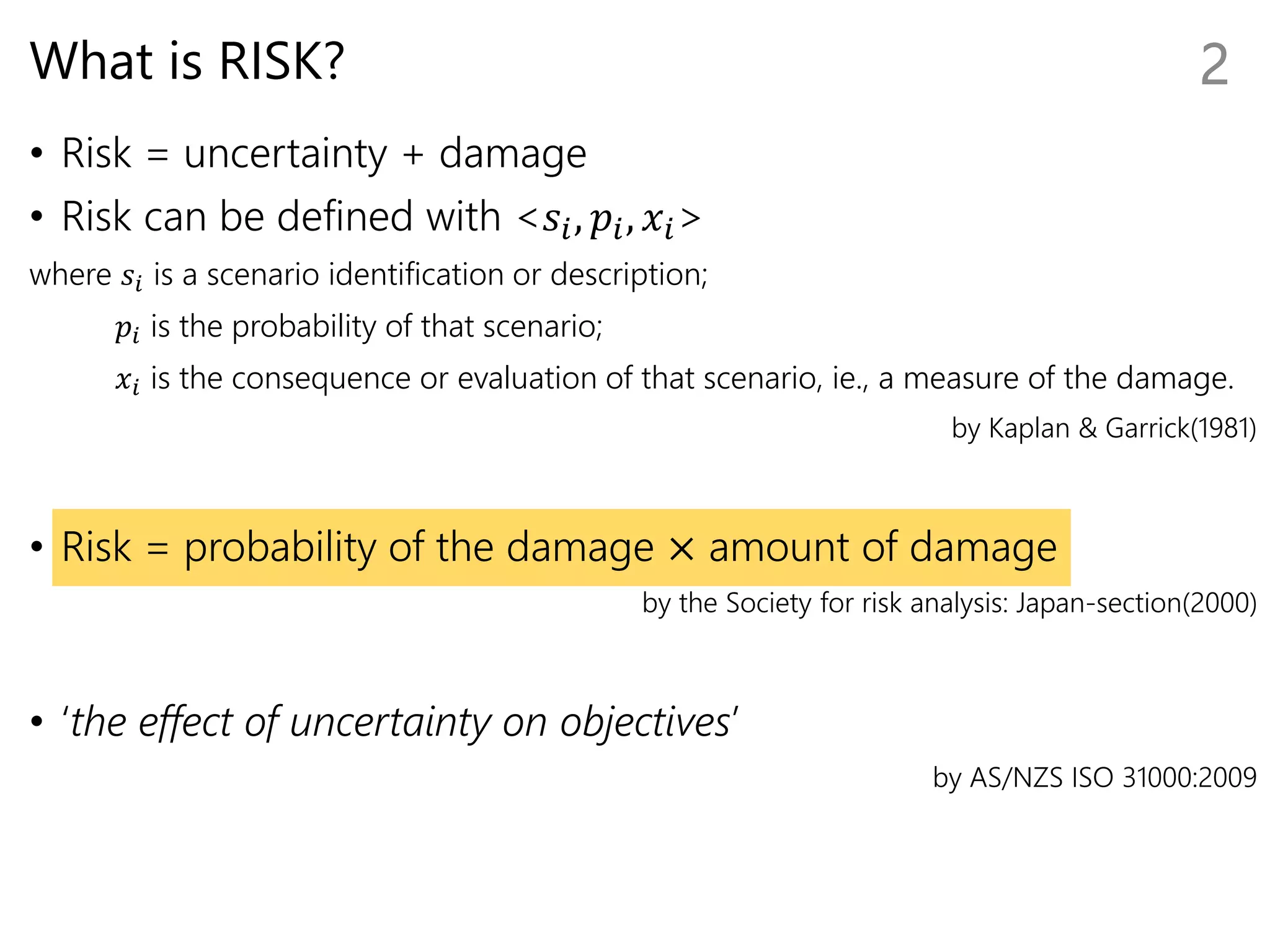
What is RISK?
• Risk = uncertainty + damage
• Risk can be defined with <𝑠𝑖, 𝑝𝑖, 𝑥𝑖>
where 𝑠𝑖 is a scenario identification or description;
𝑝𝑖 is the probability of that scenario;
𝑥𝑖 is the consequence or evaluation of that scenario, ie., a measure of the damage.
by Kaplan & Garrick(1981)
• Risk = probability of the damage × amount of damage
by the Society for risk analysis: Japan-section(2000)
• ‘the effect of uncertainty on objectives’
by AS/NZS ISO 31000:2009
2
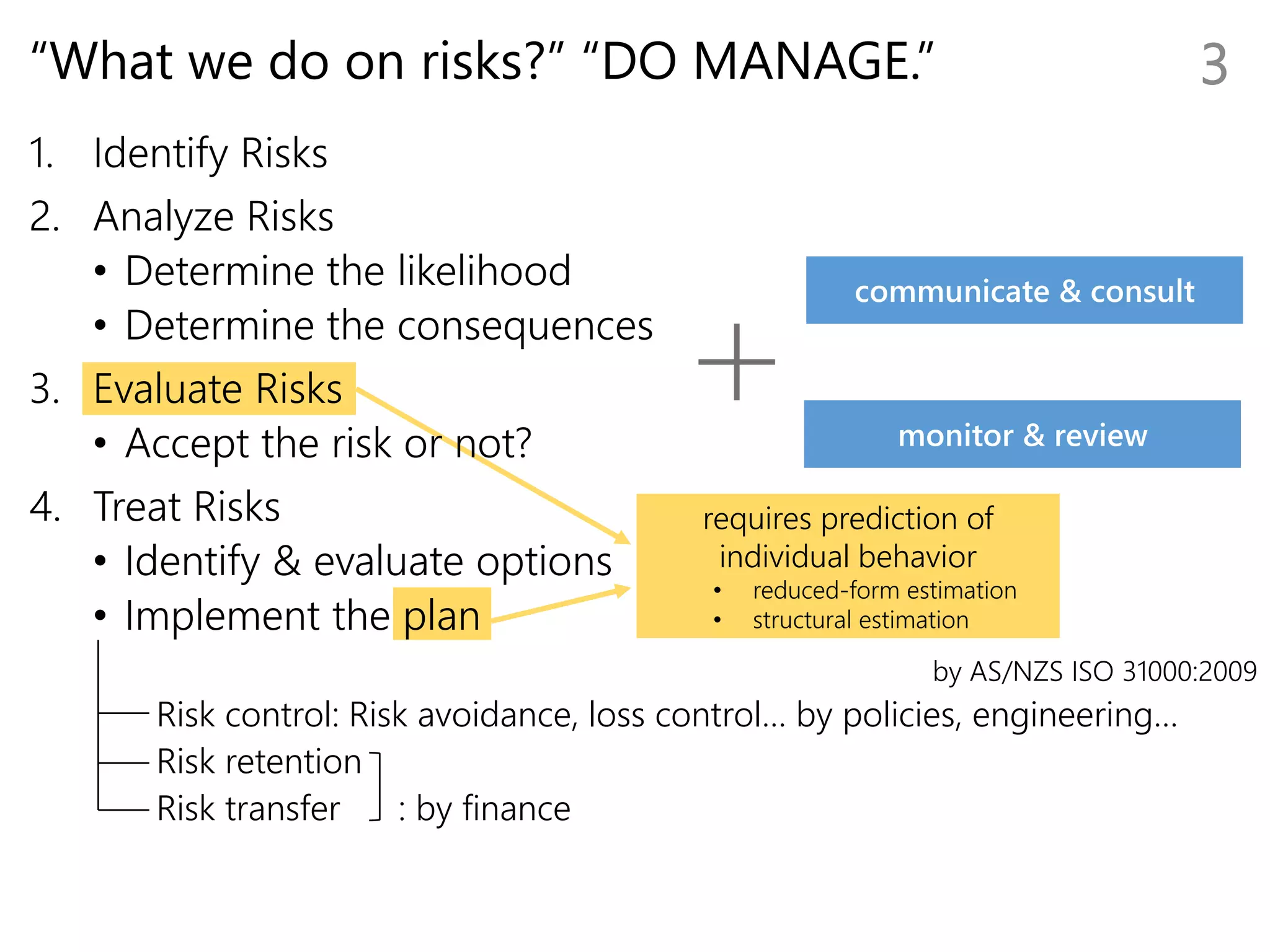
“What we do on risks?” “DO MANAGE.”
1. Identify Risks
2. Analyze Risks
• Determine the likelihood
• Determine the consequences
3. Evaluate Risks
• Accept the risk or not?
4. Treat Risks
• Identify & evaluate options
• Implement the plan
by AS/NZS ISO 31000:2009
Risk control: Risk avoidance, loss control… by policies, engineering…
Risk retention
Risk transfer : by finance
3
communicate & consult
monitor & review
requires prediction of
individual behavior
• reduced-form estimation
• structural estimation
Prediction of behavior
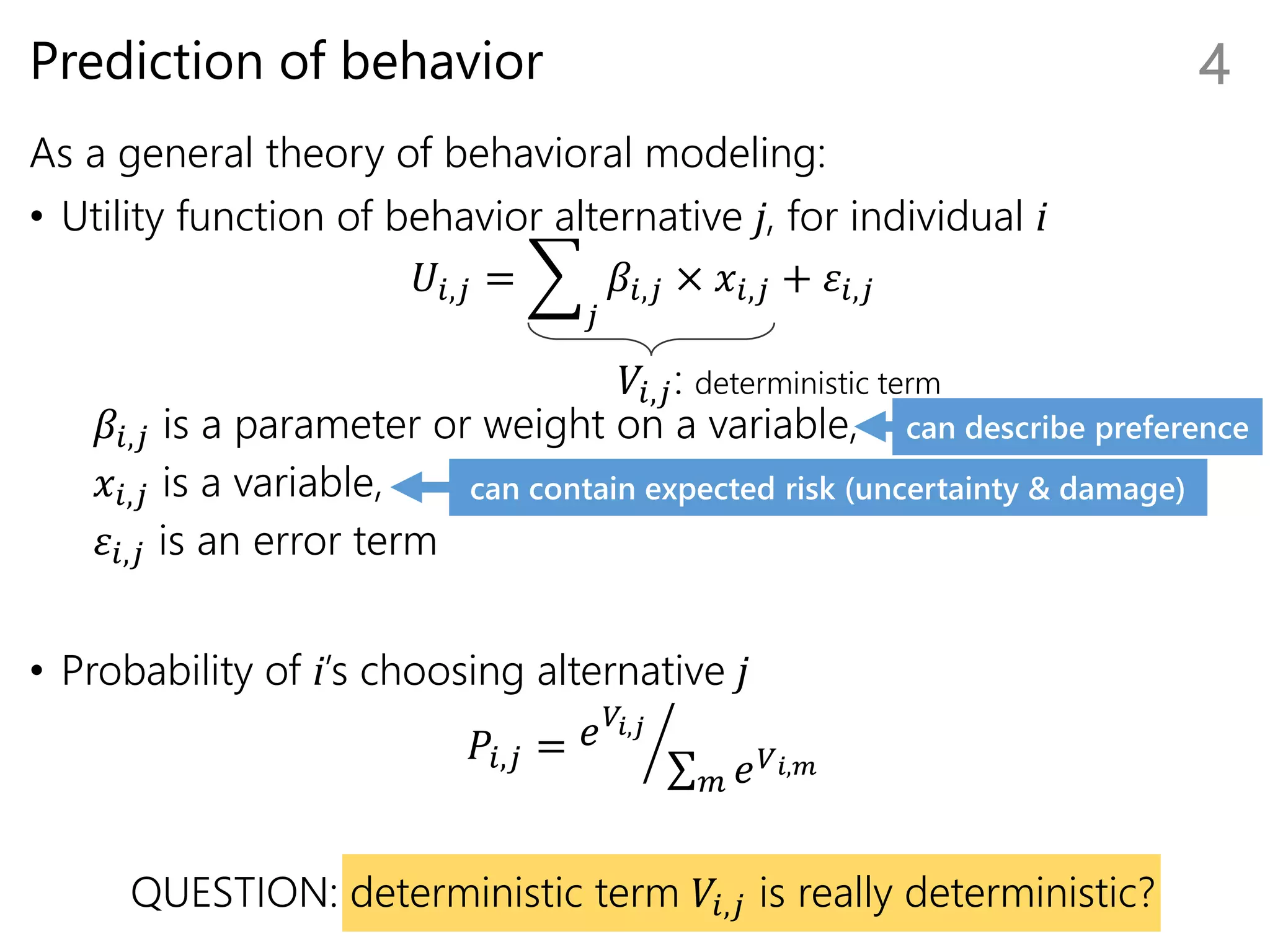
As a general theory of behavioral modeling:
• Utility function of behavior alternative j, for individual i
𝑈𝑖,𝑗 =
𝑗
𝛽𝑖,𝑗 × 𝑥𝑖,𝑗 + 𝜀𝑖,𝑗
𝛽𝑖,𝑗 is a parameter or weight on a variable,
𝑥𝑖,𝑗 is a variable,
𝜀𝑖,𝑗 is an error term
• Probability of i’s choosing alternative j
𝑃𝑖,𝑗 = 𝑒 𝑉𝑖,𝑗
𝑚 𝑒 𝑉 𝑖,𝑚
QUESTION: deterministic term 𝑉𝑖,𝑗 is really deterministic?
4
𝑉𝑖,𝑗: deterministic term
can contain expected risk (uncertainty & damage)
can describe preference
Perception of probability 1/2:
Risk perception
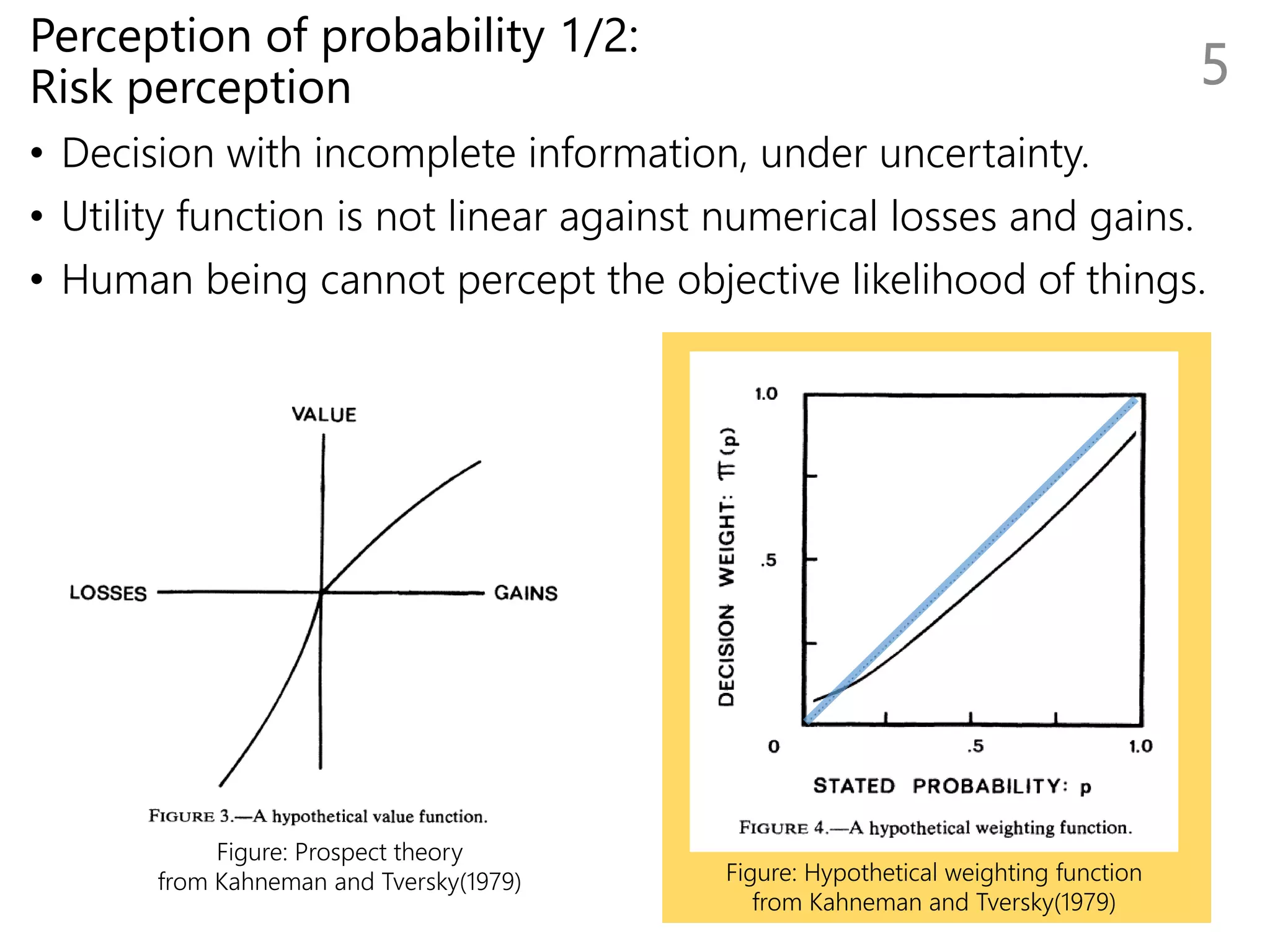
• Decision with incomplete information, under uncertainty.
• Utility function is not linear against numerical losses and gains.
• Human being cannot percept the objective likelihood of things.
5
Figure: Prospect theory
from Kahneman and Tversky(1979) Figure: Hypothetical weighting function
from Kahneman and Tversky(1979)
Perception of probability 2/2:
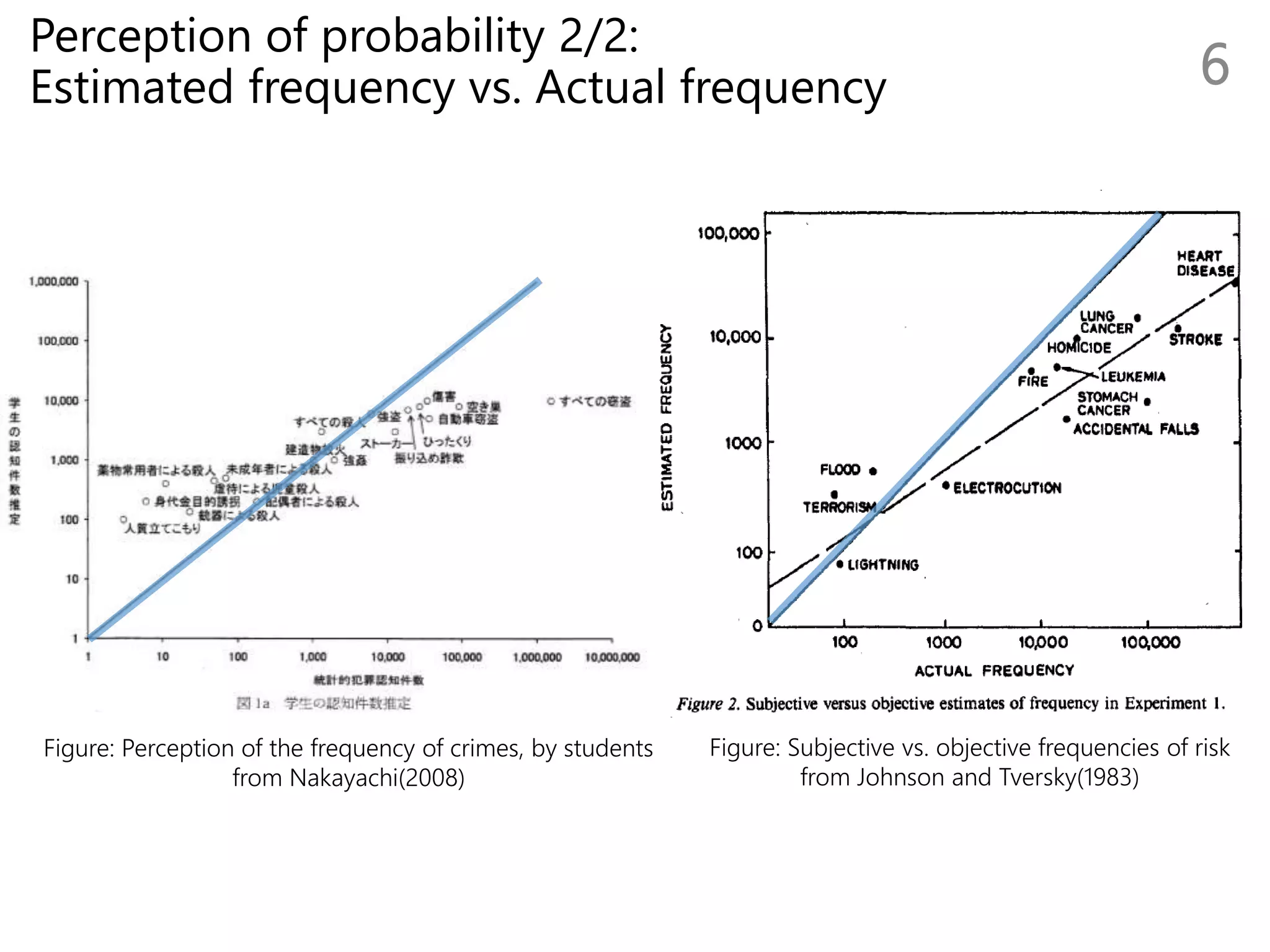
Estimated frequency vs. Actual frequency 6
Figure: Perception of the frequency of crimes, by students
from Nakayachi(2008)
Figure: Subjective vs. objective frequencies of risk
from Johnson and Tversky(1983)
Utility function in the face of risk:
Rationality on the verge of hazard
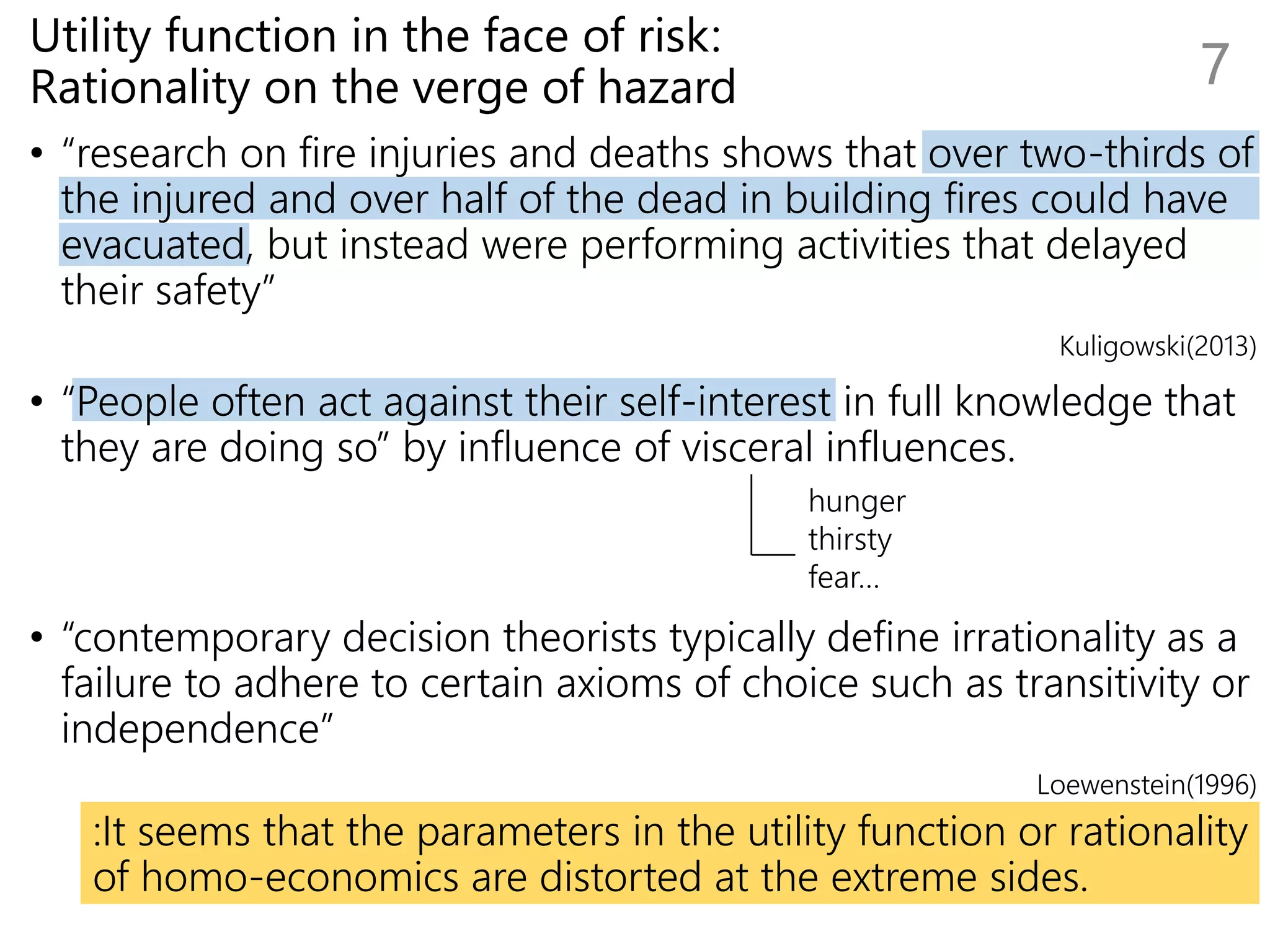
• “research on fire injuries and deaths shows that over two-thirds of
the injured and over half of the dead in building fires could have
evacuated, but instead were performing activities that delayed
their safety”
Kuligowski(2013)
• “People often act against their self-interest in full knowledge that
they are doing so” by influence of visceral influences.
• “contemporary decision theorists typically define irrationality as a
failure to adhere to certain axioms of choice such as transitivity or
independence”
Loewenstein(1996)
:It seems that the parameters in the utility function or rationality
of homo-economics are distorted at the extreme sides.
7
hunger
thirsty
fear…
REFERENCES
Johnson, Eric J., and Amos Tversky. "Affect, generalization, and the perception of risk." Journal of
personality and social psychology 45.1 (1983): 20.
Kahneman, Daniel, and Amos Tversky. "Prospect theory: An analysis of decision under
risk." Econometrica: Journal of the Econometric Society (1979): 263-291.
Kaplan, Stanley, and B. John Garrick. "On the quantitative definition of risk."Risk analysis 1.1
(1981): 11-27.
Kuligowski, Erica. "Predicting human behavior during fires." Fire Technology, 49.1 (2013): 101-120.
Loewenstein, George. "Out of control: Visceral influences on behavior."Organizational behavior
and human decision processes 65.3 (1996): 272-292.
※ Slovic, Paul. "Perception of risk." Science 236.4799 (1987): 280-285.
Standards New Zealand, AS/NZS ISO 31000:2009
Wogalter, Michael S., Douglas J. Brems, and Elaine G. Martin. "Risk perception of common
consumer products: Judgments of accident frequency and precautionary intent." Journal of
Safety Research 24.2 (1993): 97-106.
中谷内一也, and 島田貴仁. "犯罪リスク認知に関する一般人-専門家間比較: 学生と警察官の
犯罪発生頻度評価." 社会心理学研究 24.1 (2008): 34-44.
日本リスク研究学会編, 『リスク学事典』, TBSブリタニカ(2000).
8
Conclusion and other things
Behavioral modeling in the risks is DIFFICULT
• with incomplete variables in the utility functions
• with skew utility function
• in fact, human being also has biases, emotional heuristics and
everything
• in addition, collecting data in rare situation is difficult
• a lot of works to do!
9
Normalcy bias
Cooperation bias…

Introduction of Risk & Behavior, in the light of psychology

  • 1.
    Risk Studies I Risk& Behavior, in the light of psychology and sometimes, with behavioral economics 21st June 2015, TRIP laboratory seminar K. Matsui 1. Risk & Behavior 2. Risk & Finance 3. Risk & Planning 4. Special lecture by Associate professor Murakami
  • 2.
    What is RISK? •Risk = uncertainty + damage • Risk can be defined with <𝑠𝑖, 𝑝𝑖, 𝑥𝑖> where 𝑠𝑖 is a scenario identification or description; 𝑝𝑖 is the probability of that scenario; 𝑥𝑖 is the consequence or evaluation of that scenario, ie., a measure of the damage. by Kaplan & Garrick(1981) • Risk = probability of the damage × amount of damage by the Society for risk analysis: Japan-section(2000) • ‘the effect of uncertainty on objectives’ by AS/NZS ISO 31000:2009 2
  • 3.
    “What we doon risks?” “DO MANAGE.” 1. Identify Risks 2. Analyze Risks • Determine the likelihood • Determine the consequences 3. Evaluate Risks • Accept the risk or not? 4. Treat Risks • Identify & evaluate options • Implement the plan by AS/NZS ISO 31000:2009 Risk control: Risk avoidance, loss control… by policies, engineering… Risk retention Risk transfer : by finance 3 communicate & consult monitor & review requires prediction of individual behavior • reduced-form estimation • structural estimation
  • 4.
    Prediction of behavior Asa general theory of behavioral modeling: • Utility function of behavior alternative j, for individual i 𝑈𝑖,𝑗 = 𝑗 𝛽𝑖,𝑗 × 𝑥𝑖,𝑗 + 𝜀𝑖,𝑗 𝛽𝑖,𝑗 is a parameter or weight on a variable, 𝑥𝑖,𝑗 is a variable, 𝜀𝑖,𝑗 is an error term • Probability of i’s choosing alternative j 𝑃𝑖,𝑗 = 𝑒 𝑉𝑖,𝑗 𝑚 𝑒 𝑉 𝑖,𝑚 QUESTION: deterministic term 𝑉𝑖,𝑗 is really deterministic? 4 𝑉𝑖,𝑗: deterministic term can contain expected risk (uncertainty & damage) can describe preference
  • 5.
    Perception of probability1/2: Risk perception • Decision with incomplete information, under uncertainty. • Utility function is not linear against numerical losses and gains. • Human being cannot percept the objective likelihood of things. 5 Figure: Prospect theory from Kahneman and Tversky(1979) Figure: Hypothetical weighting function from Kahneman and Tversky(1979)
  • 6.
    Perception of probability2/2: Estimated frequency vs. Actual frequency 6 Figure: Perception of the frequency of crimes, by students from Nakayachi(2008) Figure: Subjective vs. objective frequencies of risk from Johnson and Tversky(1983)
  • 7.
    Utility function inthe face of risk: Rationality on the verge of hazard • “research on fire injuries and deaths shows that over two-thirds of the injured and over half of the dead in building fires could have evacuated, but instead were performing activities that delayed their safety” Kuligowski(2013) • “People often act against their self-interest in full knowledge that they are doing so” by influence of visceral influences. • “contemporary decision theorists typically define irrationality as a failure to adhere to certain axioms of choice such as transitivity or independence” Loewenstein(1996) :It seems that the parameters in the utility function or rationality of homo-economics are distorted at the extreme sides. 7 hunger thirsty fear…
  • 8.
    REFERENCES Johnson, Eric J.,and Amos Tversky. "Affect, generalization, and the perception of risk." Journal of personality and social psychology 45.1 (1983): 20. Kahneman, Daniel, and Amos Tversky. "Prospect theory: An analysis of decision under risk." Econometrica: Journal of the Econometric Society (1979): 263-291. Kaplan, Stanley, and B. John Garrick. "On the quantitative definition of risk."Risk analysis 1.1 (1981): 11-27. Kuligowski, Erica. "Predicting human behavior during fires." Fire Technology, 49.1 (2013): 101-120. Loewenstein, George. "Out of control: Visceral influences on behavior."Organizational behavior and human decision processes 65.3 (1996): 272-292. ※ Slovic, Paul. "Perception of risk." Science 236.4799 (1987): 280-285. Standards New Zealand, AS/NZS ISO 31000:2009 Wogalter, Michael S., Douglas J. Brems, and Elaine G. Martin. "Risk perception of common consumer products: Judgments of accident frequency and precautionary intent." Journal of Safety Research 24.2 (1993): 97-106. 中谷内一也, and 島田貴仁. "犯罪リスク認知に関する一般人-専門家間比較: 学生と警察官の 犯罪発生頻度評価." 社会心理学研究 24.1 (2008): 34-44. 日本リスク研究学会編, 『リスク学事典』, TBSブリタニカ(2000). 8
  • 9.
    Conclusion and otherthings Behavioral modeling in the risks is DIFFICULT • with incomplete variables in the utility functions • with skew utility function • in fact, human being also has biases, emotional heuristics and everything • in addition, collecting data in rare situation is difficult • a lot of works to do! 9 Normalcy bias Cooperation bias…