Introduction
Marijuana has long been a controversial issue in the United
States. Research has identified that marijuana has the purposes
of medical use, and in many states, medical marijuana is
promoted by the state government. The very first federal act
that is related to marijuana can be traced back to the Marijuana
Tax Act of 1937, and the act imposed an excise tax on the sale
and possession of marijuana. However, the legalization of
marijuana is never an easy act since it involves so many parties.
Literature has been developed for years to discuss the potential
problems that the legalization of marijuana might face. In many
ways, the legalization of marijuana in literature is mainly
focused on the possible social change and demographic groups
that be affected by further changes. Currently, literature reviews
associated with the legalization of marijuana are mainly
focusing on social, economic, cultural, as well as political
aspects, and are discussing influences to certain groups of the
society.
Existing literature usually considers specific demographic
groups of users such as youngsters and those who have
committed crimes. Current literature always talks about how the
legalization of marijuana would affect certain groups but lack of
evidence to support the effect on society as a whole. The
literature has not been fully established as a solution to the
legalization of marijuana since demographic groups in different
states have different experiences related to the use of marijuana.
Also, existing literature focuses on discussing whether
legalizing marijuana contributes to social stability and what
might go wrong if certain factors are not fully considered.
Reviewing existing literature allows the public to
understand the current phase of the legalization of marijuana. In
this paper, literature would be discussed to see what has been
covered and what has been not This would help assess the
problems that come with the legalization of marijuana, and find
out what happens to the society if the legalization of marijuana
is incompleted.
Small Business
Management, 18e
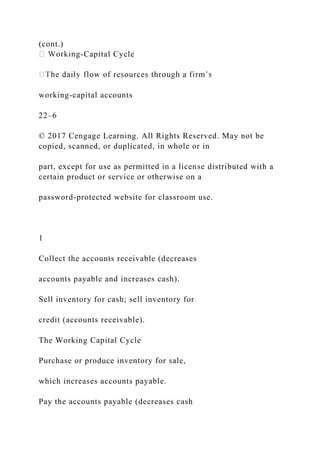
Longenecker/Petty/Palich/Hoy
© 2017 Cengage Learning. All Rights Reserved. May not be
copied, scanned, or duplicated, in whole or in part, except for
use as permitted in a license
distributed with a certain product or service or otherwise on a
password-protected website for classroom use.
Managing Risk in the Small
Business
Chapter 23
© 2017 Cengage Learning. All Rights Reserved. May not be
copied, scanned, or duplicated, in whole or in part, except for
use as permitted in a license distributed with a certain product
or
service or otherwise on a password-protected website for
classroom use.
Learning Goals:
dimensions.
of pure risk.
process, and explain how risk management
can be used in small companies.
an insurance program.
insurance coverage.
© 2017 Cengage Learning. All Rights Reserved. May not be
copied, scanned, or duplicated, in whole or in part, except for
use as permitted in a license distributed with a certain product
or
service or otherwise on a password-protected website for
classroom use.
What is Business Risk?
earnings potential of a firm.
or loss) associated with an investment
decision.
no loss can occur—there is no potential for gain (only
downside).
23–4
© 2017 Cengage Learning. All Rights Reserved. May not be
copied, scanned, or duplicated, in whole or in
part, except for use as permitted in a license distributed with a
certain product or service or otherwise on a
password-protected website for classroom use.
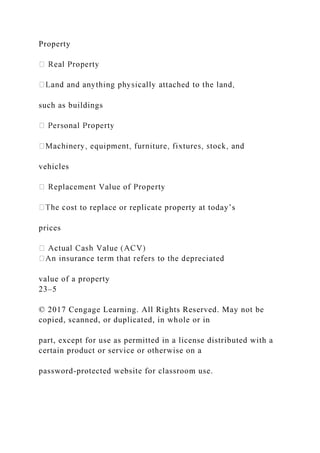
Basic Types of Pure Risk:
Property
such as buildings
vehicles
ost to replace or replicate property at today’s
prices
value of a property
23–5
© 2017 Cengage Learning. All Rights Reserved. May not be
copied, scanned, or duplicated, in whole or in
part, except for use as permitted in a license distributed with a
certain product or service or otherwise on a
password-protected website for classroom use.
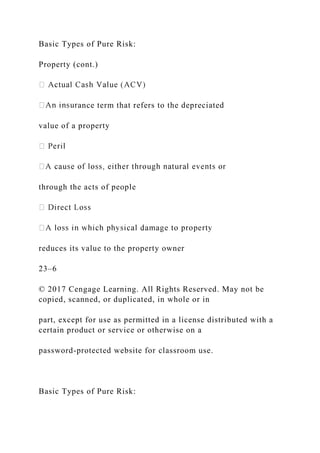
Basic Types of Pure Risk:
Property (cont.)
ance term that refers to the depreciated
value of a property
through the acts of people
reduces its value to the property owner
23–6
© 2017 Cengage Learning. All Rights Reserved. May not be
copied, scanned, or duplicated, in whole or in
part, except for use as permitted in a license distributed with a
certain product or service or otherwise on a
password-protected website for classroom use.
Basic Types of Pure Risk:
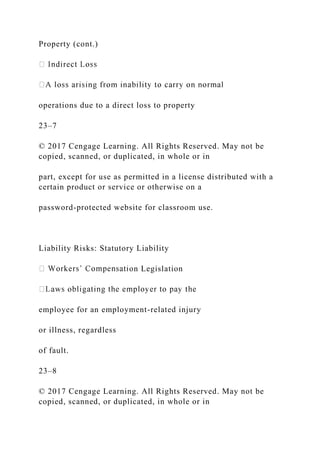
Property (cont.)
operations due to a direct loss to property
23–7
© 2017 Cengage Learning. All Rights Reserved. May not be
copied, scanned, or duplicated, in whole or in
part, except for use as permitted in a license distributed with a
certain product or service or otherwise on a
password-protected website for classroom use.
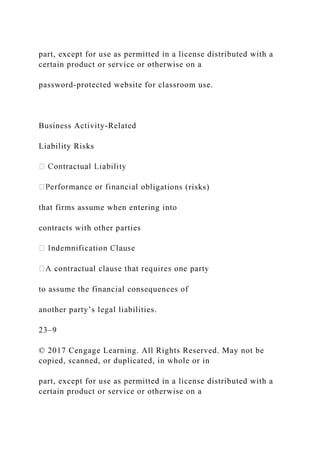
Liability Risks: Statutory Liability
on Legislation
employee for an employment-related injury
or illness, regardless
of fault.
23–8
© 2017 Cengage Learning. All Rights Reserved. May not be
copied, scanned, or duplicated, in whole or in
part, except for use as permitted in a license distributed with a
certain product or service or otherwise on a
password-protected website for classroom use.
Business Activity-Related
Liability Risks
igations (risks)
that firms assume when entering into
contracts with other parties
to assume the financial consequences of
another party’s legal liabilities.
23–9
© 2017 Cengage Learning. All Rights Reserved. May not be
copied, scanned, or duplicated, in whole or in
part, except for use as permitted in a license distributed with a
certain product or service or otherwise on a
password-protected website for classroom use.
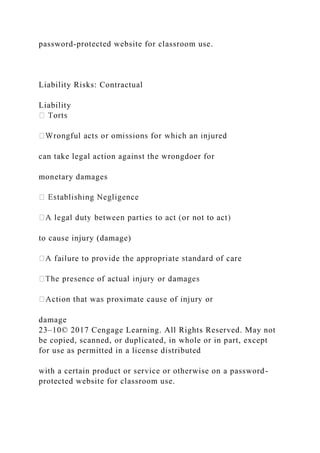
Liability Risks: Contractual
Liability
can take legal action against the wrongdoer for
monetary damages
to cause injury (damage)
damage
23–10© 2017 Cengage Learning. All Rights Reserved. May not
be copied, scanned, or duplicated, in whole or in part, except
for use as permitted in a license distributed
with a certain product or service or otherwise on a password-
protected website for classroom use.
Liability Risks: Contractual
Liability (cont.)
Prudent Person) Standard
reasonable or prudent person would do
under similar circumstances.
to make the claimant whole, by indemnifying
the claimant for any injuries or damage arising
from the negligent action
23–11
© 2017 Cengage Learning. All Rights Reserved. May not be
copied, scanned, or duplicated, in whole or in
part, except for use as permitted in a license distributed with a
certain product or service or otherwise on a
password-protected website for classroom use.
Torts: Types of Compensatory
Damages
economic loss, such as medical expense, loss
of income, or the cost of property
replacement/restoration
pain and suffering, mental anguish, and loss of
consortium
23–12
© 2017 Cengage Learning. All Rights Reserved. May not be
copied, scanned, or duplicated, in whole or in
part, except for use as permitted in a license distributed with a
certain product or service or otherwise on a
password-protected website for classroom use.
Torts: Types of Compensatory
Damages
gross negligence or a callous disregard for the
interests of others and to have a deterrent
effect
23–13
© 2017 Cengage Learning. All Rights Reserved. May not be
copied, scanned, or duplicated, in whole or in
part, except for use as permitted in a license distributed with a
certain product or service or otherwise on a
password-protected website for classroom use.
Product Liability
urs
during the manufacturing process causing the
product to subsequently not be made according
to specifications.
though the product was made according to
specifications.
23–14
© 2017 Cengage Learning. All Rights Reserved. May not be
copied, scanned, or duplicated, in whole or in
part, except for use as permitted in a license distributed with a
certain product or service or otherwise on a
password-protected website for classroom use.
Product Liability (cont.)
user that hazards are associated with a product
or to provide adequate instructions on safe
product use.
23–15
© 2017 Cengage Learning. All Rights Reserved. May not be
copied, scanned, or duplicated, in whole or in
part, except for use as permitted in a license distributed with a
certain product or service or otherwise on a
password-protected website for classroom use.
Sources of
Tort Liability
Automobile Liability
Product Liability
Completed
Operations Liability
Premises Liability
Operations Liability
Professional Liability
Employers’ Liability
Directors and
Officers Liability
© 2017 Cengage Learning. All Rights Reserved. May not be
copied, scanned, or duplicated, in whole or in part, except for
use as permitted in a license distributed with a certain product
or service or otherwise on a
password-protected website for classroom use.
Personnel Risks
s
but may have an indirect impact on a business
as well.
23–17
© 2017 Cengage Learning. All Rights Reserved. May not be
copied, scanned, or duplicated, in whole or in
part, except for use as permitted in a license distributed with a
certain product or service or otherwise on a
password-protected website for classroom use.
Risk Management
g with risk that are
designed to preserve assets and the earning
power of a firm.
reduce the cost of dealing with risk.
to minimizing the pure risks a firm is sure to
encounter.
23–18
© 2017 Cengage Learning. All Rights Reserved. May not be
copied, scanned, or duplicated, in whole or in
part, except for use as permitted in a license distributed with a
certain product or service or otherwise on a
password-protected website for classroom use.
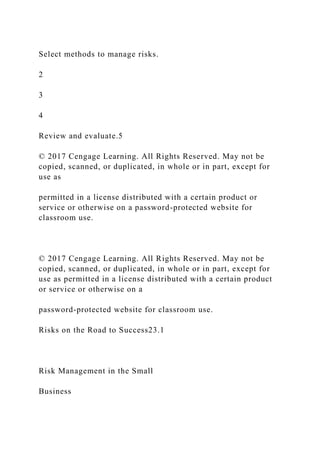
1
Implement the decision.
Evaluate risks.
The Process of Risk Management
Identify and understand risks.
Select methods to manage risks.
2
3
4
Review and evaluate.5
© 2017 Cengage Learning. All Rights Reserved. May not be
copied, scanned, or duplicated, in whole or in part, except for
use as
permitted in a license distributed with a certain product or
service or otherwise on a password-protected website for
classroom use.
© 2017 Cengage Learning. All Rights Reserved. May not be
copied, scanned, or duplicated, in whole or in part, except for
use as permitted in a license distributed with a certain product
or service or otherwise on a
password-protected website for classroom use.
Risks on the Road to Success23.1
Risk Management in the Small
Business
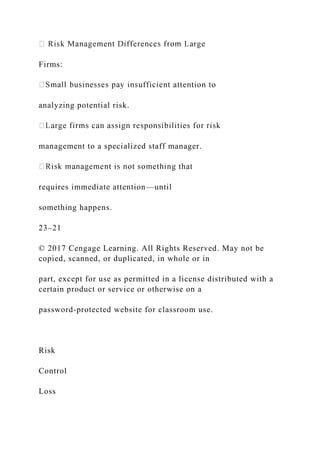
Firms:
analyzing potential risk.
management to a specialized staff manager.
requires immediate attention—until
something happens.
23–21
© 2017 Cengage Learning. All Rights Reserved. May not be
copied, scanned, or duplicated, in whole or in
part, except for use as permitted in a license distributed with a
certain product or service or otherwise on a
password-protected website for classroom use.
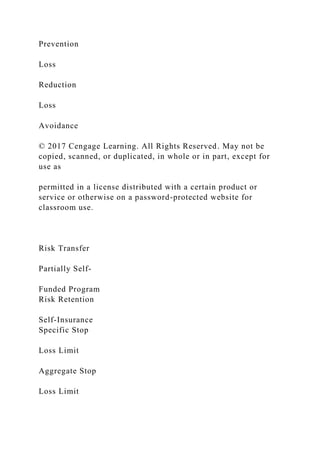
Risk
Control
Loss
Prevention
Loss
Reduction
Loss
Avoidance
© 2017 Cengage Learning. All Rights Reserved. May not be
copied, scanned, or duplicated, in whole or in part, except for
use as
permitted in a license distributed with a certain product or
service or otherwise on a password-protected website for
classroom use.
Risk Transfer
Partially Self-
Funded Program
Risk Retention
Self-Insurance
Specific Stop
Loss Limit
Aggregate Stop
Loss Limit
Risk
Financing
© 2017 Cengage Learning. All Rights Reserved. May not be
copied, scanned, or duplicated, in whole or in part, except for
use as
permitted in a license distributed with a certain product or
service or otherwise on a password-protected website for
classroom use.
Basic Principles of a Sound Insurance Program
© 2017 Cengage Learning. All Rights Reserved. May not be
copied, scanned, or duplicated, in whole or in part, except for
use as permitted in a license distributed with a certain product
or service or otherwise on a
password-protected website for classroom use.
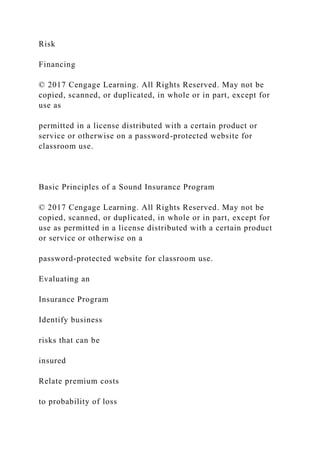
Evaluating an
Insurance Program
Identify business
risks that can be
insured
Relate premium costs
to probability of loss
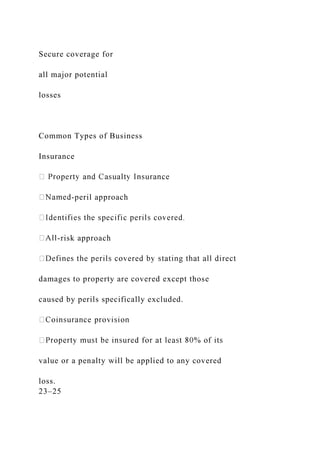
Secure coverage for
all major potential
losses
Common Types of Business
Insurance
-peril approach
-risk approach
damages to property are covered except those
caused by perils specifically excluded.
value or a penalty will be applied to any covered
loss.
23–25
© 2017 Cengage Learning. All Rights Reserved. May not be
copied, scanned, or duplicated, in whole or in
part, except for use as permitted in a license distributed with a
certain product or service or otherwise on a
password-protected website for classroom use.
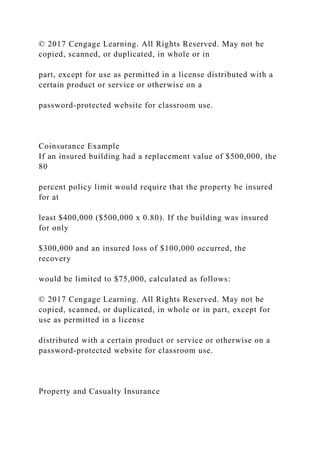
Coinsurance Example
If an insured building had a replacement value of $500,000, the
80
percent policy limit would require that the property be insured
for at
least $400,000 ($500,000 x 0.80). If the building was insured
for only
$300,000 and an insured loss of $100,000 occurred, the
recovery
would be limited to $75,000, calculated as follows:
© 2017 Cengage Learning. All Rights Reserved. May not be
copied, scanned, or duplicated, in whole or in part, except for
use as permitted in a license
distributed with a certain product or service or otherwise on a
password-protected website for classroom use.
Property and Casualty Insurance
(cont.)
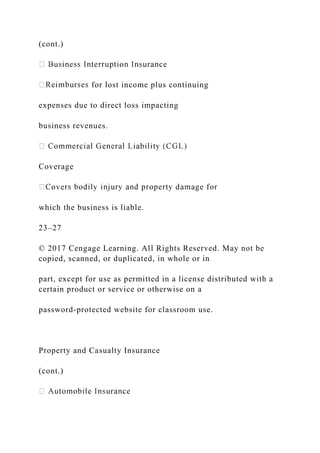
for lost income plus continuing
expenses due to direct loss impacting
business revenues.
Coverage
which the business is liable.
23–27
© 2017 Cengage Learning. All Rights Reserved. May not be
copied, scanned, or duplicated, in whole or in
part, except for use as permitted in a license distributed with a
certain product or service or otherwise on a
password-protected website for classroom use.
Property and Casualty Insurance
(cont.)
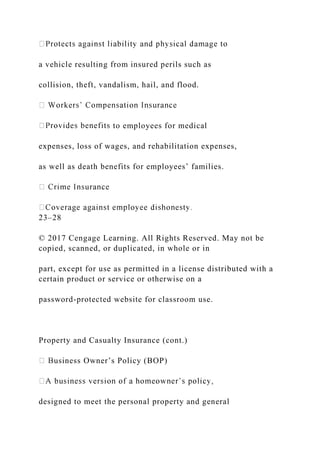
a vehicle resulting from insured perils such as
collision, theft, vandalism, hail, and flood.
to employees for medical
expenses, loss of wages, and rehabilitation expenses,
as well as death benefits for employees’ families.
23–28
© 2017 Cengage Learning. All Rights Reserved. May not be
copied, scanned, or duplicated, in whole or in
part, except for use as permitted in a license distributed with a
certain product or service or otherwise on a
password-protected website for classroom use.
Property and Casualty Insurance (cont.)
usiness Owner’s Policy (BOP)
designed to meet the personal property and general
liability insurance needs of small business owners
to purchase all coverages separately
insurance
to actual cash value protection
23–29
© 2017 Cengage Learning. All Rights Reserved. May not be
copied, scanned, or duplicated, in whole or in
part, except for use as permitted in a license distributed with a
certain product or service or otherwise on a
password-protected website for classroom use.
Property and Casualty Insurance (cont.)
icy
for a BOP that combines property insurance and
commercial general liability insurance.
to purchase all coverages separately
23–30
© 2017 Cengage Learning. All Rights Reserved. May not be
copied, scanned, or duplicated, in whole or in
part, except for use as permitted in a license distributed with a
certain product or service or otherwise on a
password-protected website for classroom use.
© 2017 Cengage Learning. All Rights Reserved. May not be
copied, scanned, or duplicated, in whole or in part, except for
use as permitted in a license distributed with a certain product
or service or otherwise on a
password-protected website for classroom use.
Miscellaneous
Policies
Umbrella
liability
policies
Professional
liability
policies
Inland
marine
policies
Cyber
liability
policies
Life and Health Insurance
doctors’ offices, and rehabilitation facilities,
that usually includes outpatient services and
prescription drugs.
-care network that is less
expensive than that of a PPO but limits
employees’ choices of medical care providers
more than a PPO does.
23–32
© 2017 Cengage Learning. All Rights Reserved. May not be
copied, scanned, or duplicated, in whole or in
part, except for use as permitted in a license distributed with a
certain product or service or otherwise on a
password-protected website for classroom use.
Life and Health Insurance (cont.)
-care network that provides health
insurance that is generally more expensive
than an HMO but offers a broader choice of
medical providers
-Person Insurance
pon the death
of a firm’s key personnel.
23–33
© 2017 Cengage Learning. All Rights Reserved. May not be
copied, scanned, or duplicated, in whole or in
part, except for use as permitted in a license distributed with a
certain product or service or otherwise on a
password-protected website for classroom use.
Life and Health Insurance (cont.)
firm’s partner or other key employee.
-person disability insurance
23–34
© 2017 Cengage Learning. All Rights Reserved. May not be
copied, scanned, or duplicated, in whole or in
part, except for use as permitted in a license distributed with a
certain product or service or otherwise on a
password-protected website for classroom use.
Key Terms
actual cash value (ACV)
aggregate stop loss limit
all-risk approach
automobile insurance
business interruption insurance
business owner’s policy (BOP)
business risk
coinsurance clause
commercial general liability (CGL)
insurance
compensatory damages
crime insurance
design defect
direct loss
disability buyout insurance
disability insurance
economic damages
funds transfer fraud
health maintenance organization
(HMO)
indemnification clause
indirect loss
key-person life insurance
loss avoidance
loss prevention
loss reduction
manufacturing defect
market risk
© 2017 Cengage Learning. All Rights Reserved. May not be
copied, scanned, or duplicated, in whole or in part, except for
use as
permitted in a license distributed with a certain product or
service or otherwise on a password-protected website for
classroom use.
Key Terms
market risk
marketing defect
named-peril approach
noneconomic damages
package policy
partially self-funded program
peril
personal property
personnel risks
preferred provider organization
(PPO)
proximate cause
punitive damages
pure risk
real property
reasonable (prudent person) standard
replacement value of property
risk control
risk financing
risk management
risk retention
risk transfer
self-insurance
specific stop loss limit
torts
workers’ compensation insurance
workers’ compensation legislation
© 2017 Cengage Learning. All Rights Reserved. May not be
copied, scanned, or duplicated, in whole or in part, except for
use as permitted in a license distributed with a certain product
or service or otherwise on a
password-protected website for classroom use.
Key Terms
commercial general liability (CGL) insurance
automobile insurance
crime insurance
business owner’s policy (BOP)
package policy
health insurance
health maintenance organization (HMO)
preferred provider organization (PPO)
key-person insurance
disability insurance
© 2017 Cengage Learning. All Rights Reserved. May not be
copied, scanned, or duplicated, in whole or in part, except for
use as permitted in a license distributed with a certain product
or service or otherwise on a
password-protected website for classroom use.
Small Business
Management, 18e
Longenecker/Petty/Palich/Hoy
© 2017 Cengage Learning. All Rights Reserved. May not be
copied, scanned, or duplicated, in whole or in part, except for
use as permitted in a license
distributed with a certain product or service or otherwise on a
password-protected website for classroom use.
Managing the Firm’s Assets
Chapter 22
© 2017 Cengage Learning. All Rights Reserved. May not be
copied, scanned, or duplicated, in whole or in part, except for
use as permitted in a license distributed with a certain product
or
service or otherwise on a password-protected website for
classroom use.
Learning Goals:
business.
cash flows.
in managing accounts
receivable.
inventory.
payable.
© 2017 Cengage Learning. All Rights Reserved. May not be
copied, scanned, or duplicated, in whole or in part, except for
use as permitted in a license distributed with a certain product
or
service or otherwise on a password-protected website for
classroom use.
Learning Goals (cont.):
conversion period.
capital budgeting decisions.
firms.
© 2017 Cengage Learning. All Rights Reserved. May not be
copied, scanned, or duplicated, in whole or in part, except for
use as permitted in a license distributed with a certain product
or
service or otherwise on a password-protected website for
classroom use.
The Working-Capital Cycle
-Capital Management
t
liabilities
receivable, and inventories) less current liabilities
(short-term notes, accounts payable, and
accruals)
22–5
© 2017 Cengage Learning. All Rights Reserved. May not be
copied, scanned, or duplicated, in whole or in
part, except for use as permitted in a license distributed with a
certain product or service or otherwise on a
password-protected website for classroom use.
The Working-Capital Cycle
(cont.)
-Capital Cycle
working-capital accounts
22–6
© 2017 Cengage Learning. All Rights Reserved. May not be
copied, scanned, or duplicated, in whole or in
part, except for use as permitted in a license distributed with a
certain product or service or otherwise on a
password-protected website for classroom use.
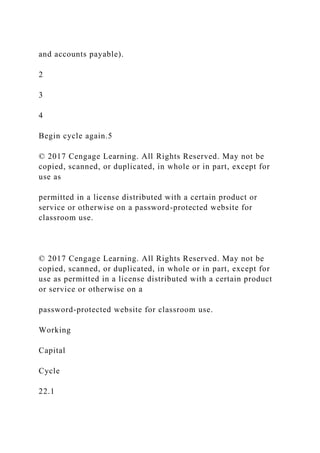
1
Collect the accounts receivable (decreases
accounts payable and increases cash).
Sell inventory for cash; sell inventory for
credit (accounts receivable).
The Working Capital Cycle
Purchase or produce inventory for sale,
which increases accounts payable.
Pay the accounts payable (decreases cash
and accounts payable).
2
3
4
Begin cycle again.5
© 2017 Cengage Learning. All Rights Reserved. May not be
copied, scanned, or duplicated, in whole or in part, except for
use as
permitted in a license distributed with a certain product or
service or otherwise on a password-protected website for
classroom use.
© 2017 Cengage Learning. All Rights Reserved. May not be
copied, scanned, or duplicated, in whole or in part, except for
use as permitted in a license distributed with a certain product
or service or otherwise on a
password-protected website for classroom use.
Working
Capital
Cycle
22.1
© 2017 Cengage Learning. All Rights Reserved. May not be
copied, scanned, or duplicated, in whole or in part, except for
use as permitted in a license distributed with a certain product
or service or otherwise on a
password-protected website for classroom use.
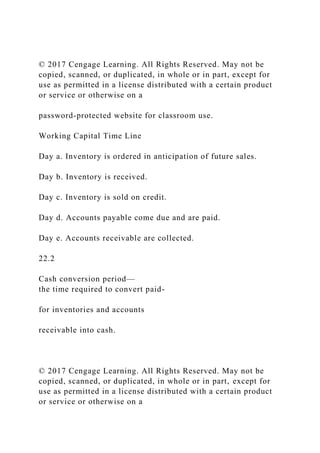
Working Capital Time Line
Day a. Inventory is ordered in anticipation of future sales.
Day b. Inventory is received.
Day c. Inventory is sold on credit.
Day d. Accounts payable come due and are paid.
Day e. Accounts receivable are collected.
22.2
Cash conversion period—
the time required to convert paid-
for inventories and accounts
receivable into cash.
© 2017 Cengage Learning. All Rights Reserved. May not be
copied, scanned, or duplicated, in whole or in part, except for
use as permitted in a license distributed with a certain product
or service or otherwise on a
password-protected website for classroom use.
Working Capital Time Lines for Pokey, Inc., and Quick Turn
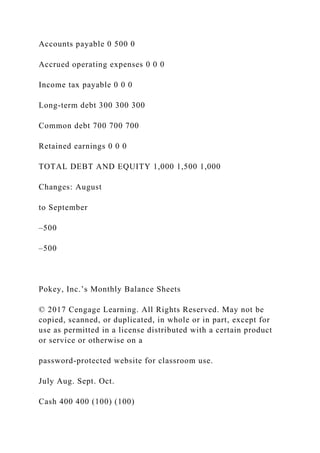
Company22.3
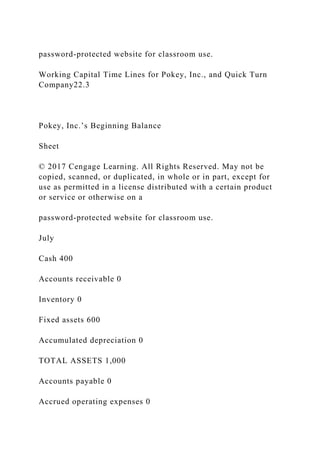
Pokey, Inc.’s Beginning Balance
Sheet
© 2017 Cengage Learning. All Rights Reserved. May not be
copied, scanned, or duplicated, in whole or in part, except for
use as permitted in a license distributed with a certain product
or service or otherwise on a
password-protected website for classroom use.
July
Cash 400
Accounts receivable 0
Inventory 0
Fixed assets 600
Accumulated depreciation 0
TOTAL ASSETS 1,000
Accounts payable 0
Accrued operating expenses 0
Income tax payable 0
Long-term debt 300
Common debt 700
Retained earnings 0
TOTAL DEBT AND EQUITY 1,000
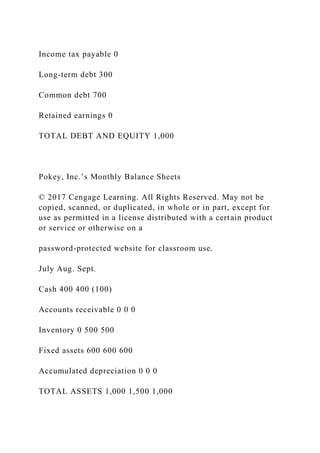
Pokey, Inc.’s Monthly Balance Sheets
© 2017 Cengage Learning. All Rights Reserved. May not be
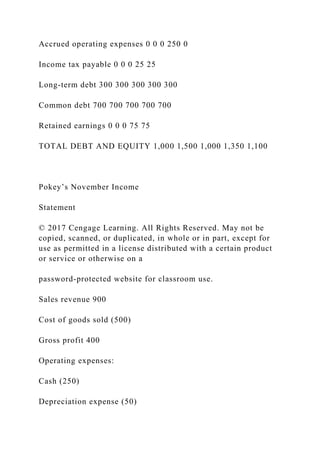
copied, scanned, or duplicated, in whole or in part, except for
use as permitted in a license distributed with a certain product
or service or otherwise on a
password-protected website for classroom use.
July Aug. Sept.
Cash 400 400 (100)
Accounts receivable 0 0 0
Inventory 0 500 500
Fixed assets 600 600 600
Accumulated depreciation 0 0 0
TOTAL ASSETS 1,000 1,500 1,000
Accounts payable 0 500 0
Accrued operating expenses 0 0 0
Income tax payable 0 0 0
Long-term debt 300 300 300
Common debt 700 700 700
Retained earnings 0 0 0
TOTAL DEBT AND EQUITY 1,000 1,500 1,000
Changes: August
to September
–500
–500
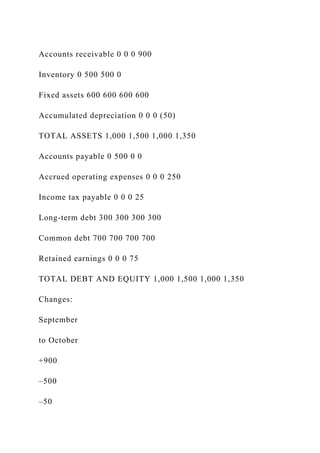
Pokey, Inc.’s Monthly Balance Sheets
© 2017 Cengage Learning. All Rights Reserved. May not be
copied, scanned, or duplicated, in whole or in part, except for
use as permitted in a license distributed with a certain product
or service or otherwise on a
password-protected website for classroom use.
July Aug. Sept. Oct.
Cash 400 400 (100) (100)
Accounts receivable 0 0 0 900
Inventory 0 500 500 0
Fixed assets 600 600 600 600
Accumulated depreciation 0 0 0 (50)
TOTAL ASSETS 1,000 1,500 1,000 1,350
Accounts payable 0 500 0 0
Accrued operating expenses 0 0 0 250
Income tax payable 0 0 0 25
Long-term debt 300 300 300 300
Common debt 700 700 700 700
Retained earnings 0 0 0 75
TOTAL DEBT AND EQUITY 1,000 1,500 1,000 1,350
Changes:
September
to October
+900
–500
–50
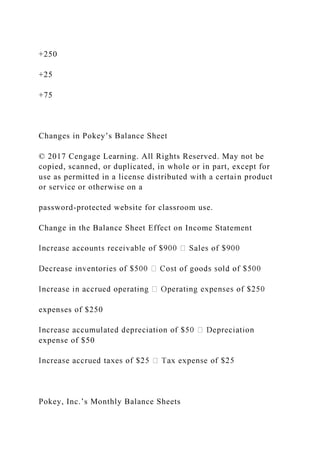
+250
+25
+75
Changes in Pokey’s Balance Sheet
© 2017 Cengage Learning. All Rights Reserved. May not be
copied, scanned, or duplicated, in whole or in part, except for
use as permitted in a license distributed with a certain product
or service or otherwise on a
password-protected website for classroom use.
Change in the Balance Sheet Effect on Income Statement
expenses of $250
expense of $50
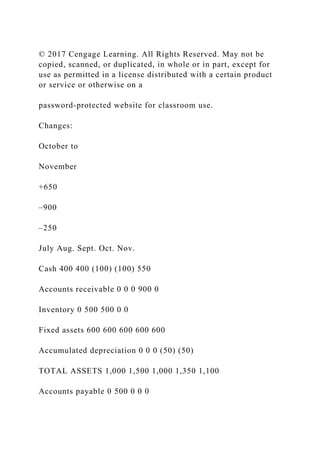
Pokey, Inc.’s Monthly Balance Sheets
© 2017 Cengage Learning. All Rights Reserved. May not be
copied, scanned, or duplicated, in whole or in part, except for
use as permitted in a license distributed with a certain product
or service or otherwise on a
password-protected website for classroom use.
Changes:
October to
November
+650
–900
–250
July Aug. Sept. Oct. Nov.
Cash 400 400 (100) (100) 550
Accounts receivable 0 0 0 900 0
Inventory 0 500 500 0 0
Fixed assets 600 600 600 600 600
Accumulated depreciation 0 0 0 (50) (50)
TOTAL ASSETS 1,000 1,500 1,000 1,350 1,100
Accounts payable 0 500 0 0 0
Accrued operating expenses 0 0 0 250 0
Income tax payable 0 0 0 25 25
Long-term debt 300 300 300 300 300
Common debt 700 700 700 700 700
Retained earnings 0 0 0 75 75
TOTAL DEBT AND EQUITY 1,000 1,500 1,000 1,350 1,100
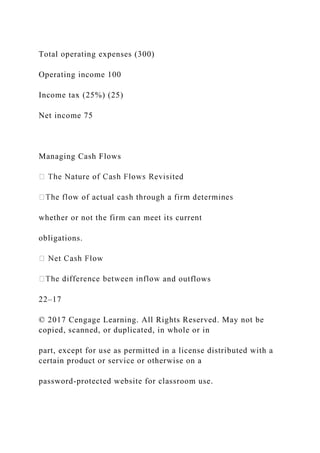
Pokey’s November Income
Statement
© 2017 Cengage Learning. All Rights Reserved. May not be
copied, scanned, or duplicated, in whole or in part, except for
use as permitted in a license distributed with a certain product
or service or otherwise on a
password-protected website for classroom use.
Sales revenue 900
Cost of goods sold (500)
Gross profit 400
Operating expenses:
Cash (250)
Depreciation expense (50)
Total operating expenses (300)
Operating income 100
Income tax (25%) (25)
Net income 75
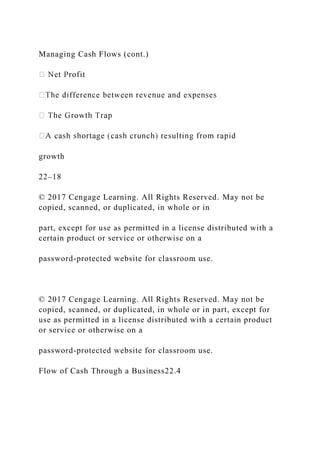
Managing Cash Flows
whether or not the firm can meet its current
obligations.
and outflows
22–17
© 2017 Cengage Learning. All Rights Reserved. May not be
copied, scanned, or duplicated, in whole or in
part, except for use as permitted in a license distributed with a
certain product or service or otherwise on a
password-protected website for classroom use.
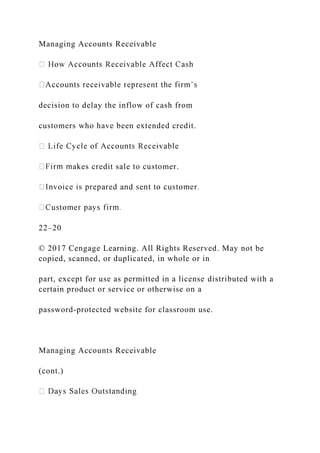
Managing Cash Flows (cont.)
growth
22–18
© 2017 Cengage Learning. All Rights Reserved. May not be
copied, scanned, or duplicated, in whole or in
part, except for use as permitted in a license distributed with a
certain product or service or otherwise on a
password-protected website for classroom use.
© 2017 Cengage Learning. All Rights Reserved. May not be
copied, scanned, or duplicated, in whole or in part, except for
use as permitted in a license distributed with a certain product
or service or otherwise on a
password-protected website for classroom use.
Flow of Cash Through a Business22.4
Managing Accounts Receivable
decision to delay the inflow of cash from
customers who have been extended credit.
akes credit sale to customer.
22–20
© 2017 Cengage Learning. All Rights Reserved. May not be
copied, scanned, or duplicated, in whole or in
part, except for use as permitted in a license distributed with a
certain product or service or otherwise on a
password-protected website for classroom use.
Managing Accounts Receivable
(cont.)
◦ Average collection period—number of days, on
average, a firm is extending credit to its customers.
22–21
© 2017 Cengage Learning. All Rights Reserved. May not be
copied, scanned, or duplicated, in whole or in
part, except for use as permitted in a license distributed with a
certain product or service or otherwise on a
password-protected website for classroom use.
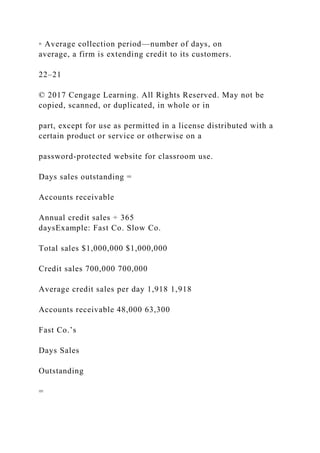
Days sales outstanding =
Accounts receivable
Annual credit sales ÷ 365
daysExample: Fast Co. Slow Co.
Total sales $1,000,000 $1,000,000
Credit sales 700,000 700,000
Average credit sales per day 1,918 1,918
Accounts receivable 48,000 63,300
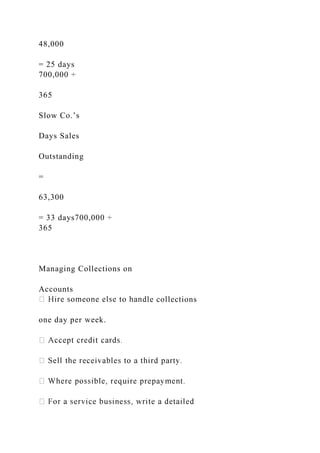
Fast Co.’s
Days Sales
Outstanding
=
48,000
= 25 days
700,000 ÷
365
Slow Co.’s
Days Sales
Outstanding
=
63,300
= 33 days700,000 ÷
365
Managing Collections on
Accounts
le collections
one day per week.
work plan and payment schedule and have
it signed by the customer.
22–22
© 2017 Cengage Learning. All Rights Reserved. May not be
copied, scanned, or duplicated, in whole or in
part, except for use as permitted in a license distributed with a
certain product or service or otherwise on a
password-protected website for classroom use.
Credit Management Practices
sending notices on billings.
impediments to cash flows.
Age accounts receivable on a monthly or even a weekly
basis to identify delinquent accounts.
accounts.
—a post office box for receiving
remittances.
22–23© 2017 Cengage Learning. All Rights Reserved. May not
be copied, scanned, or duplicated, in whole or in part, except
for use as permitted in a license
distributed with a certain product or service or otherwise on a
password-protected website for classroom use.
Managing Accounts Receivable
(cont.)
discount to another firm.
22–24
© 2017 Cengage Learning. All Rights Reserved. May not be
copied, scanned, or duplicated, in whole or in
part, except for use as permitted in a license distributed with a
certain product or service or otherwise on a
password-protected website for classroom use.
Managing Accounts Receivable
(cont.)
factored receivables
eral in borrowing
22–25
© 2017 Cengage Learning. All Rights Reserved. May not be
copied, scanned, or duplicated, in whole or in
part, except for use as permitted in a license distributed with a
certain product or service or otherwise on a
password-protected website for classroom use.
Managing Inventory
always match up.
te cash flow
problems.
—number of days, on average,
that a company is holding inventory.
22–26© 2017 Cengage Learning. All Rights Reserved. May not
be copied, scanned, or duplicated, in whole or in part, except
for use as permitted in a license distributed
with a certain product or service or otherwise on a password-
protected website for classroom use.
Days in inventory =
Inventory
Cost of goods sold ÷ 365
days
Managing Inventory (cont.)
Controlling stockpiles
-hand inventory with demand.
-customer
relationship.
cost for excess inventory may exceed any savings.
22–27
© 2017 Cengage Learning. All Rights Reserved. May not be
copied, scanned, or duplicated, in whole or in
part, except for use as permitted in a license distributed with a
certain product or service or otherwise on a
password-protected website for classroom use.
Managing Accounts Payable
time.
-term cash
needs until payment is demanded.
payment should be examined for their savings
potential.
22–28
© 2017 Cengage Learning. All Rights Reserved. May not be
copied, scanned, or duplicated, in whole or in
part, except for use as permitted in a license distributed with a
certain product or service or otherwise on a
password-protected website for classroom use.
Managing Accounts Payable
(cont.)
—pay early enough to
get cash discounts and timely enough to avoid
late-payment fees.
22–29
© 2017 Cengage Learning. All Rights Reserved. May not be
copied, scanned, or duplicated, in whole or in
part, except for use as permitted in a license distributed with a
certain product or service or otherwise on a
password-protected website for classroom use.
© 2017 Cengage Learning. All Rights Reserved. May not be
copied, scanned, or duplicated, in whole or in part, except for
use as permitted in a license distributed with a certain product
or service or otherwise on a
password-protected website for classroom use.
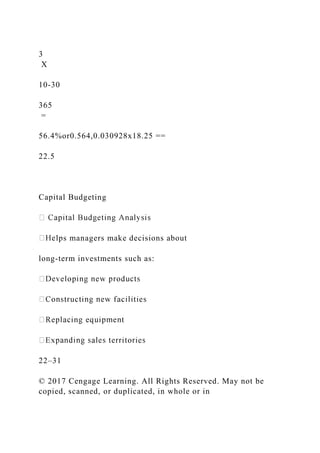
An Accounts Payable Timetable for Terms of 3/10, Net 30
Annualized
interest rate
discount%Cash-100
%discount Cash
x
perioddiscount Cash-periodNet
yearinDays
=
3-100
3
X
10-30
365
=
56.4%or0.564,0.030928x18.25 ==
22.5
Capital Budgeting
lps managers make decisions about
long-term investments such as:
22–31
© 2017 Cengage Learning. All Rights Reserved. May not be
copied, scanned, or duplicated, in whole or in
part, except for use as permitted in a license distributed with a
certain product or service or otherwise on a
password-protected website for classroom use.
Capital Budgeting (cont.)
.)
the cost of making the investment?”
decisions can put the firm out of business.
22–32
© 2017 Cengage Learning. All Rights Reserved. May not be
copied, scanned, or duplicated, in whole or in
part, except for use as permitted in a license distributed with a
certain product or service or otherwise on a
password-protected website for classroom use.
Capital Budgeting Techniques
per dollar of average investment?
h flows (net present value or
internal rate of return)
the investment compare to the investment outlay?
22–33
© 2017 Cengage Learning. All Rights Reserved. May not be
copied, scanned, or duplicated, in whole or in
part, except for use as permitted in a license distributed with a
certain product or service or otherwise on a
password-protected website for classroom use.
Three Rules of Capital Budgeting
of an investment prefer:
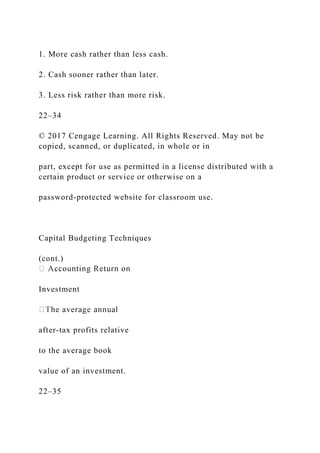
1. More cash rather than less cash.
2. Cash sooner rather than later.
3. Less risk rather than more risk.
22–34
© 2017 Cengage Learning. All Rights Reserved. May not be
copied, scanned, or duplicated, in whole or in
part, except for use as permitted in a license distributed with a
certain product or service or otherwise on a
password-protected website for classroom use.
Capital Budgeting Techniques
(cont.)
Investment
after-tax profits relative
to the average book
value of an investment.
22–35
© 2017 Cengage Learning. All Rights Reserved. May not be
copied, scanned, or duplicated, in whole or in
part, except for use as permitted in a license distributed with a
certain product or service or otherwise on a
password-protected website for classroom use.
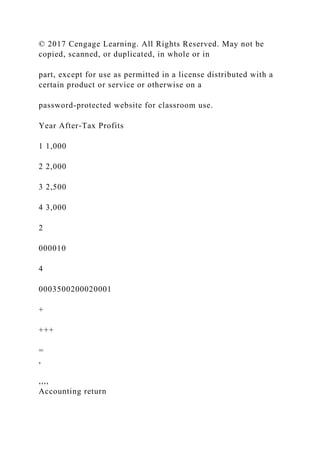
Year After-Tax Profits
1 1,000
2 2,000
3 2,500
4 3,000
2
000010
4
0003500200020001
+
+++
=
,
,,,,
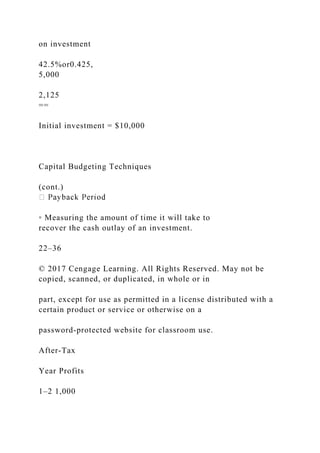
Accounting return
on investment
42.5%or0.425,
5,000
2,125
==
Initial investment = $10,000
Capital Budgeting Techniques
(cont.)
◦ Measuring the amount of time it will take to
recover the cash outlay of an investment.
22–36
© 2017 Cengage Learning. All Rights Reserved. May not be
copied, scanned, or duplicated, in whole or in
part, except for use as permitted in a license distributed with a
certain product or service or otherwise on a
password-protected website for classroom use.
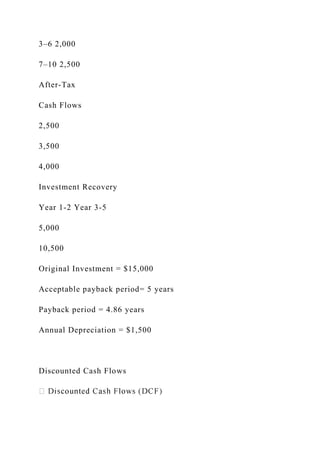
After-Tax
Year Profits
1–2 1,000
3–6 2,000
7–10 2,500
After-Tax
Cash Flows
2,500
3,500
4,000
Investment Recovery
Year 1-2 Year 3-5
5,000
10,500
Original Investment = $15,000
Acceptable payback period= 5 years
Payback period = 4.86 years
Annual Depreciation = $1,500
Discounted Cash Flows
flows with the cost of the initial investment.
received in the future—the time value of money.
V)
over time less the initial investment outlay.
22–37
© 2017 Cengage Learning. All Rights Reserved. May not be
copied, scanned, or duplicated, in whole or in
part, except for use as permitted in a license distributed with a
certain product or service or otherwise on a
password-protected website for classroom use.
Discounted Cash Flows (cont.)
xpects to earn on a
project; return rate must exceed cost of capital.
22–38
© 2017 Cengage Learning. All Rights Reserved. May not be
copied, scanned, or duplicated, in whole or in
part, except for use as permitted in a license distributed with a
certain product or service or otherwise on a
password-protected website for classroom use.
Capital Budgeting Analysis in
Small Firms
Analysis Process:
and liquidity problems
22–39
© 2017 Cengage Learning. All Rights Reserved. May not be
copied, scanned, or duplicated, in whole or in
part, except for use as permitted in a license distributed with a
certain product or service or otherwise on a
password-protected website for classroom use.
Key Terms
accounting return on
investment technique
capital budgeting analysis
cash conversion period
days in inventory
days in payables
days sales outstanding (average
collection period)
discounted cash flow (DCF)
techniques
internal rate of return (IRR)
lock box
net present value (NPV)
payback period technique
pledged accounts receivable
working capital cycle
working capital management
© 2017 Cengage Learning. All Rights Reserved. May not be
copied, scanned, or duplicated, in whole or in part, except for
use as
permitted in a license distributed with a certain product or
service or otherwise on a password-protected website for
classroom use.

Introduction Marijuana has long been a controversial issue in th.docx

  • 1.
    Introduction Marijuana has longbeen a controversial issue in the United States. Research has identified that marijuana has the purposes of medical use, and in many states, medical marijuana is promoted by the state government. The very first federal act that is related to marijuana can be traced back to the Marijuana Tax Act of 1937, and the act imposed an excise tax on the sale and possession of marijuana. However, the legalization of marijuana is never an easy act since it involves so many parties. Literature has been developed for years to discuss the potential problems that the legalization of marijuana might face. In many ways, the legalization of marijuana in literature is mainly focused on the possible social change and demographic groups that be affected by further changes. Currently, literature reviews associated with the legalization of marijuana are mainly focusing on social, economic, cultural, as well as political aspects, and are discussing influences to certain groups of the society. Existing literature usually considers specific demographic groups of users such as youngsters and those who have committed crimes. Current literature always talks about how the legalization of marijuana would affect certain groups but lack of evidence to support the effect on society as a whole. The literature has not been fully established as a solution to the legalization of marijuana since demographic groups in different states have different experiences related to the use of marijuana. Also, existing literature focuses on discussing whether legalizing marijuana contributes to social stability and what might go wrong if certain factors are not fully considered. Reviewing existing literature allows the public to understand the current phase of the legalization of marijuana. In this paper, literature would be discussed to see what has been covered and what has been not This would help assess the problems that come with the legalization of marijuana, and find
  • 2.
    out what happensto the society if the legalization of marijuana is incompleted. Small Business Management, 18e Longenecker/Petty/Palich/Hoy © 2017 Cengage Learning. All Rights Reserved. May not be copied, scanned, or duplicated, in whole or in part, except for use as permitted in a license distributed with a certain product or service or otherwise on a password-protected website for classroom use. Managing Risk in the Small Business Chapter 23 © 2017 Cengage Learning. All Rights Reserved. May not be copied, scanned, or duplicated, in whole or in part, except for use as permitted in a license distributed with a certain product or service or otherwise on a password-protected website for classroom use. Learning Goals:
  • 3.
    dimensions. of pure risk. process,and explain how risk management can be used in small companies. an insurance program. insurance coverage. © 2017 Cengage Learning. All Rights Reserved. May not be copied, scanned, or duplicated, in whole or in part, except for use as permitted in a license distributed with a certain product or service or otherwise on a password-protected website for classroom use. What is Business Risk?
  • 4.
    earnings potential ofa firm. or loss) associated with an investment decision. no loss can occur—there is no potential for gain (only downside). 23–4 © 2017 Cengage Learning. All Rights Reserved. May not be copied, scanned, or duplicated, in whole or in part, except for use as permitted in a license distributed with a certain product or service or otherwise on a password-protected website for classroom use. Basic Types of Pure Risk:
  • 5.
    Property such as buildings vehicles ostto replace or replicate property at today’s prices value of a property 23–5 © 2017 Cengage Learning. All Rights Reserved. May not be copied, scanned, or duplicated, in whole or in part, except for use as permitted in a license distributed with a certain product or service or otherwise on a password-protected website for classroom use.
  • 6.
    Basic Types ofPure Risk: Property (cont.) ance term that refers to the depreciated value of a property through the acts of people reduces its value to the property owner 23–6 © 2017 Cengage Learning. All Rights Reserved. May not be copied, scanned, or duplicated, in whole or in part, except for use as permitted in a license distributed with a certain product or service or otherwise on a password-protected website for classroom use. Basic Types of Pure Risk:
  • 7.
    Property (cont.) operations dueto a direct loss to property 23–7 © 2017 Cengage Learning. All Rights Reserved. May not be copied, scanned, or duplicated, in whole or in part, except for use as permitted in a license distributed with a certain product or service or otherwise on a password-protected website for classroom use. Liability Risks: Statutory Liability on Legislation employee for an employment-related injury or illness, regardless of fault. 23–8 © 2017 Cengage Learning. All Rights Reserved. May not be copied, scanned, or duplicated, in whole or in
  • 8.
    part, except foruse as permitted in a license distributed with a certain product or service or otherwise on a password-protected website for classroom use. Business Activity-Related Liability Risks igations (risks) that firms assume when entering into contracts with other parties to assume the financial consequences of another party’s legal liabilities. 23–9 © 2017 Cengage Learning. All Rights Reserved. May not be copied, scanned, or duplicated, in whole or in part, except for use as permitted in a license distributed with a certain product or service or otherwise on a
  • 9.
    password-protected website forclassroom use. Liability Risks: Contractual Liability can take legal action against the wrongdoer for monetary damages to cause injury (damage) damage 23–10© 2017 Cengage Learning. All Rights Reserved. May not be copied, scanned, or duplicated, in whole or in part, except for use as permitted in a license distributed with a certain product or service or otherwise on a password- protected website for classroom use.
  • 10.
    Liability Risks: Contractual Liability(cont.) Prudent Person) Standard reasonable or prudent person would do under similar circumstances. to make the claimant whole, by indemnifying the claimant for any injuries or damage arising from the negligent action 23–11 © 2017 Cengage Learning. All Rights Reserved. May not be copied, scanned, or duplicated, in whole or in part, except for use as permitted in a license distributed with a certain product or service or otherwise on a password-protected website for classroom use. Torts: Types of Compensatory
  • 11.
    Damages economic loss, suchas medical expense, loss of income, or the cost of property replacement/restoration pain and suffering, mental anguish, and loss of consortium 23–12 © 2017 Cengage Learning. All Rights Reserved. May not be copied, scanned, or duplicated, in whole or in part, except for use as permitted in a license distributed with a certain product or service or otherwise on a password-protected website for classroom use. Torts: Types of Compensatory Damages
  • 12.
    gross negligence ora callous disregard for the interests of others and to have a deterrent effect 23–13 © 2017 Cengage Learning. All Rights Reserved. May not be copied, scanned, or duplicated, in whole or in part, except for use as permitted in a license distributed with a certain product or service or otherwise on a password-protected website for classroom use. Product Liability urs during the manufacturing process causing the product to subsequently not be made according to specifications.
  • 13.
    though the productwas made according to specifications. 23–14 © 2017 Cengage Learning. All Rights Reserved. May not be copied, scanned, or duplicated, in whole or in part, except for use as permitted in a license distributed with a certain product or service or otherwise on a password-protected website for classroom use. Product Liability (cont.) user that hazards are associated with a product or to provide adequate instructions on safe product use. 23–15 © 2017 Cengage Learning. All Rights Reserved. May not be copied, scanned, or duplicated, in whole or in
  • 14.
    part, except foruse as permitted in a license distributed with a certain product or service or otherwise on a password-protected website for classroom use. Sources of Tort Liability Automobile Liability Product Liability Completed Operations Liability Premises Liability Operations Liability Professional Liability Employers’ Liability Directors and Officers Liability © 2017 Cengage Learning. All Rights Reserved. May not be copied, scanned, or duplicated, in whole or in part, except for use as permitted in a license distributed with a certain product or service or otherwise on a password-protected website for classroom use.
  • 15.
    Personnel Risks s but mayhave an indirect impact on a business as well. 23–17 © 2017 Cengage Learning. All Rights Reserved. May not be copied, scanned, or duplicated, in whole or in part, except for use as permitted in a license distributed with a certain product or service or otherwise on a password-protected website for classroom use. Risk Management g with risk that are
  • 16.
    designed to preserveassets and the earning power of a firm. reduce the cost of dealing with risk. to minimizing the pure risks a firm is sure to encounter. 23–18 © 2017 Cengage Learning. All Rights Reserved. May not be copied, scanned, or duplicated, in whole or in part, except for use as permitted in a license distributed with a certain product or service or otherwise on a password-protected website for classroom use. 1 Implement the decision. Evaluate risks. The Process of Risk Management Identify and understand risks.
  • 17.
    Select methods tomanage risks. 2 3 4 Review and evaluate.5 © 2017 Cengage Learning. All Rights Reserved. May not be copied, scanned, or duplicated, in whole or in part, except for use as permitted in a license distributed with a certain product or service or otherwise on a password-protected website for classroom use. © 2017 Cengage Learning. All Rights Reserved. May not be copied, scanned, or duplicated, in whole or in part, except for use as permitted in a license distributed with a certain product or service or otherwise on a password-protected website for classroom use. Risks on the Road to Success23.1 Risk Management in the Small Business
  • 18.
    Firms: analyzing potential risk. managementto a specialized staff manager. requires immediate attention—until something happens. 23–21 © 2017 Cengage Learning. All Rights Reserved. May not be copied, scanned, or duplicated, in whole or in part, except for use as permitted in a license distributed with a certain product or service or otherwise on a password-protected website for classroom use. Risk Control Loss
  • 19.
    Prevention Loss Reduction Loss Avoidance © 2017 CengageLearning. All Rights Reserved. May not be copied, scanned, or duplicated, in whole or in part, except for use as permitted in a license distributed with a certain product or service or otherwise on a password-protected website for classroom use. Risk Transfer Partially Self- Funded Program Risk Retention Self-Insurance Specific Stop Loss Limit Aggregate Stop Loss Limit
  • 20.
    Risk Financing © 2017 CengageLearning. All Rights Reserved. May not be copied, scanned, or duplicated, in whole or in part, except for use as permitted in a license distributed with a certain product or service or otherwise on a password-protected website for classroom use. Basic Principles of a Sound Insurance Program © 2017 Cengage Learning. All Rights Reserved. May not be copied, scanned, or duplicated, in whole or in part, except for use as permitted in a license distributed with a certain product or service or otherwise on a password-protected website for classroom use. Evaluating an Insurance Program Identify business risks that can be insured Relate premium costs to probability of loss
  • 21.
    Secure coverage for allmajor potential losses Common Types of Business Insurance -peril approach -risk approach damages to property are covered except those caused by perils specifically excluded. value or a penalty will be applied to any covered loss. 23–25
  • 22.
    © 2017 CengageLearning. All Rights Reserved. May not be copied, scanned, or duplicated, in whole or in part, except for use as permitted in a license distributed with a certain product or service or otherwise on a password-protected website for classroom use. Coinsurance Example If an insured building had a replacement value of $500,000, the 80 percent policy limit would require that the property be insured for at least $400,000 ($500,000 x 0.80). If the building was insured for only $300,000 and an insured loss of $100,000 occurred, the recovery would be limited to $75,000, calculated as follows: © 2017 Cengage Learning. All Rights Reserved. May not be copied, scanned, or duplicated, in whole or in part, except for use as permitted in a license distributed with a certain product or service or otherwise on a password-protected website for classroom use. Property and Casualty Insurance
  • 23.
    (cont.) for lost incomeplus continuing expenses due to direct loss impacting business revenues. Coverage which the business is liable. 23–27 © 2017 Cengage Learning. All Rights Reserved. May not be copied, scanned, or duplicated, in whole or in part, except for use as permitted in a license distributed with a certain product or service or otherwise on a password-protected website for classroom use. Property and Casualty Insurance (cont.)
  • 24.
    a vehicle resultingfrom insured perils such as collision, theft, vandalism, hail, and flood. to employees for medical expenses, loss of wages, and rehabilitation expenses, as well as death benefits for employees’ families. 23–28 © 2017 Cengage Learning. All Rights Reserved. May not be copied, scanned, or duplicated, in whole or in part, except for use as permitted in a license distributed with a certain product or service or otherwise on a password-protected website for classroom use. Property and Casualty Insurance (cont.) usiness Owner’s Policy (BOP) designed to meet the personal property and general
  • 25.
    liability insurance needsof small business owners to purchase all coverages separately insurance to actual cash value protection 23–29 © 2017 Cengage Learning. All Rights Reserved. May not be copied, scanned, or duplicated, in whole or in part, except for use as permitted in a license distributed with a certain product or service or otherwise on a password-protected website for classroom use. Property and Casualty Insurance (cont.) icy for a BOP that combines property insurance and
  • 26.
    commercial general liabilityinsurance. to purchase all coverages separately 23–30 © 2017 Cengage Learning. All Rights Reserved. May not be copied, scanned, or duplicated, in whole or in part, except for use as permitted in a license distributed with a certain product or service or otherwise on a password-protected website for classroom use. © 2017 Cengage Learning. All Rights Reserved. May not be copied, scanned, or duplicated, in whole or in part, except for use as permitted in a license distributed with a certain product or service or otherwise on a password-protected website for classroom use. Miscellaneous
  • 27.
  • 28.
    that usually includesoutpatient services and prescription drugs. -care network that is less expensive than that of a PPO but limits employees’ choices of medical care providers more than a PPO does. 23–32 © 2017 Cengage Learning. All Rights Reserved. May not be copied, scanned, or duplicated, in whole or in part, except for use as permitted in a license distributed with a certain product or service or otherwise on a password-protected website for classroom use. Life and Health Insurance (cont.) -care network that provides health insurance that is generally more expensive than an HMO but offers a broader choice of
  • 29.
    medical providers -Person Insurance ponthe death of a firm’s key personnel. 23–33 © 2017 Cengage Learning. All Rights Reserved. May not be copied, scanned, or duplicated, in whole or in part, except for use as permitted in a license distributed with a certain product or service or otherwise on a password-protected website for classroom use. Life and Health Insurance (cont.) firm’s partner or other key employee. -person disability insurance 23–34 © 2017 Cengage Learning. All Rights Reserved. May not be copied, scanned, or duplicated, in whole or in
  • 30.
    part, except foruse as permitted in a license distributed with a certain product or service or otherwise on a password-protected website for classroom use. Key Terms actual cash value (ACV) aggregate stop loss limit all-risk approach automobile insurance business interruption insurance business owner’s policy (BOP) business risk coinsurance clause commercial general liability (CGL) insurance compensatory damages crime insurance design defect
  • 31.
    direct loss disability buyoutinsurance disability insurance economic damages funds transfer fraud health maintenance organization (HMO) indemnification clause indirect loss key-person life insurance loss avoidance loss prevention loss reduction manufacturing defect market risk © 2017 Cengage Learning. All Rights Reserved. May not be copied, scanned, or duplicated, in whole or in part, except for use as permitted in a license distributed with a certain product or service or otherwise on a password-protected website for classroom use.
  • 32.
    Key Terms market risk marketingdefect named-peril approach noneconomic damages package policy partially self-funded program peril personal property personnel risks preferred provider organization (PPO) proximate cause punitive damages pure risk real property reasonable (prudent person) standard
  • 33.
    replacement value ofproperty risk control risk financing risk management risk retention risk transfer self-insurance specific stop loss limit torts workers’ compensation insurance workers’ compensation legislation © 2017 Cengage Learning. All Rights Reserved. May not be copied, scanned, or duplicated, in whole or in part, except for use as permitted in a license distributed with a certain product or service or otherwise on a password-protected website for classroom use. Key Terms commercial general liability (CGL) insurance
  • 34.
    automobile insurance crime insurance businessowner’s policy (BOP) package policy health insurance health maintenance organization (HMO) preferred provider organization (PPO) key-person insurance disability insurance © 2017 Cengage Learning. All Rights Reserved. May not be copied, scanned, or duplicated, in whole or in part, except for use as permitted in a license distributed with a certain product or service or otherwise on a password-protected website for classroom use. Small Business Management, 18e Longenecker/Petty/Palich/Hoy © 2017 Cengage Learning. All Rights Reserved. May not be copied, scanned, or duplicated, in whole or in part, except for use as permitted in a license
  • 35.
    distributed with acertain product or service or otherwise on a password-protected website for classroom use. Managing the Firm’s Assets Chapter 22 © 2017 Cengage Learning. All Rights Reserved. May not be copied, scanned, or duplicated, in whole or in part, except for use as permitted in a license distributed with a certain product or service or otherwise on a password-protected website for classroom use. Learning Goals: business. cash flows. in managing accounts receivable.
  • 36.
    inventory. payable. © 2017 CengageLearning. All Rights Reserved. May not be copied, scanned, or duplicated, in whole or in part, except for use as permitted in a license distributed with a certain product or service or otherwise on a password-protected website for classroom use. Learning Goals (cont.): conversion period. capital budgeting decisions. firms. © 2017 Cengage Learning. All Rights Reserved. May not be copied, scanned, or duplicated, in whole or in part, except for use as permitted in a license distributed with a certain product or service or otherwise on a password-protected website for
  • 37.
    classroom use. The Working-CapitalCycle -Capital Management t liabilities receivable, and inventories) less current liabilities (short-term notes, accounts payable, and accruals) 22–5 © 2017 Cengage Learning. All Rights Reserved. May not be copied, scanned, or duplicated, in whole or in part, except for use as permitted in a license distributed with a certain product or service or otherwise on a password-protected website for classroom use. The Working-Capital Cycle
  • 38.
    (cont.) -Capital Cycle working-capital accounts 22–6 ©2017 Cengage Learning. All Rights Reserved. May not be copied, scanned, or duplicated, in whole or in part, except for use as permitted in a license distributed with a certain product or service or otherwise on a password-protected website for classroom use. 1 Collect the accounts receivable (decreases accounts payable and increases cash). Sell inventory for cash; sell inventory for credit (accounts receivable). The Working Capital Cycle Purchase or produce inventory for sale, which increases accounts payable. Pay the accounts payable (decreases cash
  • 39.
    and accounts payable). 2 3 4 Begincycle again.5 © 2017 Cengage Learning. All Rights Reserved. May not be copied, scanned, or duplicated, in whole or in part, except for use as permitted in a license distributed with a certain product or service or otherwise on a password-protected website for classroom use. © 2017 Cengage Learning. All Rights Reserved. May not be copied, scanned, or duplicated, in whole or in part, except for use as permitted in a license distributed with a certain product or service or otherwise on a password-protected website for classroom use. Working Capital Cycle 22.1
  • 40.
    © 2017 CengageLearning. All Rights Reserved. May not be copied, scanned, or duplicated, in whole or in part, except for use as permitted in a license distributed with a certain product or service or otherwise on a password-protected website for classroom use. Working Capital Time Line Day a. Inventory is ordered in anticipation of future sales. Day b. Inventory is received. Day c. Inventory is sold on credit. Day d. Accounts payable come due and are paid. Day e. Accounts receivable are collected. 22.2 Cash conversion period— the time required to convert paid- for inventories and accounts receivable into cash. © 2017 Cengage Learning. All Rights Reserved. May not be copied, scanned, or duplicated, in whole or in part, except for use as permitted in a license distributed with a certain product or service or otherwise on a
  • 41.
    password-protected website forclassroom use. Working Capital Time Lines for Pokey, Inc., and Quick Turn Company22.3 Pokey, Inc.’s Beginning Balance Sheet © 2017 Cengage Learning. All Rights Reserved. May not be copied, scanned, or duplicated, in whole or in part, except for use as permitted in a license distributed with a certain product or service or otherwise on a password-protected website for classroom use. July Cash 400 Accounts receivable 0 Inventory 0 Fixed assets 600 Accumulated depreciation 0 TOTAL ASSETS 1,000 Accounts payable 0 Accrued operating expenses 0
  • 42.
    Income tax payable0 Long-term debt 300 Common debt 700 Retained earnings 0 TOTAL DEBT AND EQUITY 1,000 Pokey, Inc.’s Monthly Balance Sheets © 2017 Cengage Learning. All Rights Reserved. May not be copied, scanned, or duplicated, in whole or in part, except for use as permitted in a license distributed with a certain product or service or otherwise on a password-protected website for classroom use. July Aug. Sept. Cash 400 400 (100) Accounts receivable 0 0 0 Inventory 0 500 500 Fixed assets 600 600 600 Accumulated depreciation 0 0 0 TOTAL ASSETS 1,000 1,500 1,000
  • 43.
    Accounts payable 0500 0 Accrued operating expenses 0 0 0 Income tax payable 0 0 0 Long-term debt 300 300 300 Common debt 700 700 700 Retained earnings 0 0 0 TOTAL DEBT AND EQUITY 1,000 1,500 1,000 Changes: August to September –500 –500 Pokey, Inc.’s Monthly Balance Sheets © 2017 Cengage Learning. All Rights Reserved. May not be copied, scanned, or duplicated, in whole or in part, except for use as permitted in a license distributed with a certain product or service or otherwise on a password-protected website for classroom use. July Aug. Sept. Oct. Cash 400 400 (100) (100)
  • 44.
    Accounts receivable 00 0 900 Inventory 0 500 500 0 Fixed assets 600 600 600 600 Accumulated depreciation 0 0 0 (50) TOTAL ASSETS 1,000 1,500 1,000 1,350 Accounts payable 0 500 0 0 Accrued operating expenses 0 0 0 250 Income tax payable 0 0 0 25 Long-term debt 300 300 300 300 Common debt 700 700 700 700 Retained earnings 0 0 0 75 TOTAL DEBT AND EQUITY 1,000 1,500 1,000 1,350 Changes: September to October +900 –500 –50
  • 45.
    +250 +25 +75 Changes in Pokey’sBalance Sheet © 2017 Cengage Learning. All Rights Reserved. May not be copied, scanned, or duplicated, in whole or in part, except for use as permitted in a license distributed with a certain product or service or otherwise on a password-protected website for classroom use. Change in the Balance Sheet Effect on Income Statement expenses of $250 expense of $50 Pokey, Inc.’s Monthly Balance Sheets
  • 46.
    © 2017 CengageLearning. All Rights Reserved. May not be copied, scanned, or duplicated, in whole or in part, except for use as permitted in a license distributed with a certain product or service or otherwise on a password-protected website for classroom use. Changes: October to November +650 –900 –250 July Aug. Sept. Oct. Nov. Cash 400 400 (100) (100) 550 Accounts receivable 0 0 0 900 0 Inventory 0 500 500 0 0 Fixed assets 600 600 600 600 600 Accumulated depreciation 0 0 0 (50) (50) TOTAL ASSETS 1,000 1,500 1,000 1,350 1,100 Accounts payable 0 500 0 0 0
  • 47.
    Accrued operating expenses0 0 0 250 0 Income tax payable 0 0 0 25 25 Long-term debt 300 300 300 300 300 Common debt 700 700 700 700 700 Retained earnings 0 0 0 75 75 TOTAL DEBT AND EQUITY 1,000 1,500 1,000 1,350 1,100 Pokey’s November Income Statement © 2017 Cengage Learning. All Rights Reserved. May not be copied, scanned, or duplicated, in whole or in part, except for use as permitted in a license distributed with a certain product or service or otherwise on a password-protected website for classroom use. Sales revenue 900 Cost of goods sold (500) Gross profit 400 Operating expenses: Cash (250) Depreciation expense (50)
  • 48.
    Total operating expenses(300) Operating income 100 Income tax (25%) (25) Net income 75 Managing Cash Flows whether or not the firm can meet its current obligations. and outflows 22–17 © 2017 Cengage Learning. All Rights Reserved. May not be copied, scanned, or duplicated, in whole or in part, except for use as permitted in a license distributed with a certain product or service or otherwise on a password-protected website for classroom use.
  • 49.
    Managing Cash Flows(cont.) growth 22–18 © 2017 Cengage Learning. All Rights Reserved. May not be copied, scanned, or duplicated, in whole or in part, except for use as permitted in a license distributed with a certain product or service or otherwise on a password-protected website for classroom use. © 2017 Cengage Learning. All Rights Reserved. May not be copied, scanned, or duplicated, in whole or in part, except for use as permitted in a license distributed with a certain product or service or otherwise on a password-protected website for classroom use. Flow of Cash Through a Business22.4
  • 50.
    Managing Accounts Receivable decisionto delay the inflow of cash from customers who have been extended credit. akes credit sale to customer. 22–20 © 2017 Cengage Learning. All Rights Reserved. May not be copied, scanned, or duplicated, in whole or in part, except for use as permitted in a license distributed with a certain product or service or otherwise on a password-protected website for classroom use. Managing Accounts Receivable (cont.)
  • 51.
    ◦ Average collectionperiod—number of days, on average, a firm is extending credit to its customers. 22–21 © 2017 Cengage Learning. All Rights Reserved. May not be copied, scanned, or duplicated, in whole or in part, except for use as permitted in a license distributed with a certain product or service or otherwise on a password-protected website for classroom use. Days sales outstanding = Accounts receivable Annual credit sales ÷ 365 daysExample: Fast Co. Slow Co. Total sales $1,000,000 $1,000,000 Credit sales 700,000 700,000 Average credit sales per day 1,918 1,918 Accounts receivable 48,000 63,300 Fast Co.’s Days Sales Outstanding =
  • 52.
    48,000 = 25 days 700,000÷ 365 Slow Co.’s Days Sales Outstanding = 63,300 = 33 days700,000 ÷ 365 Managing Collections on Accounts le collections one day per week.
  • 53.
    work plan andpayment schedule and have it signed by the customer. 22–22 © 2017 Cengage Learning. All Rights Reserved. May not be copied, scanned, or duplicated, in whole or in part, except for use as permitted in a license distributed with a certain product or service or otherwise on a password-protected website for classroom use. Credit Management Practices sending notices on billings. impediments to cash flows. Age accounts receivable on a monthly or even a weekly basis to identify delinquent accounts. accounts.
  • 54.
    —a post officebox for receiving remittances. 22–23© 2017 Cengage Learning. All Rights Reserved. May not be copied, scanned, or duplicated, in whole or in part, except for use as permitted in a license distributed with a certain product or service or otherwise on a password-protected website for classroom use. Managing Accounts Receivable (cont.) discount to another firm. 22–24 © 2017 Cengage Learning. All Rights Reserved. May not be copied, scanned, or duplicated, in whole or in part, except for use as permitted in a license distributed with a certain product or service or otherwise on a
  • 55.
    password-protected website forclassroom use. Managing Accounts Receivable (cont.) factored receivables eral in borrowing 22–25 © 2017 Cengage Learning. All Rights Reserved. May not be copied, scanned, or duplicated, in whole or in part, except for use as permitted in a license distributed with a certain product or service or otherwise on a password-protected website for classroom use.
  • 56.
    Managing Inventory always matchup. te cash flow problems. —number of days, on average, that a company is holding inventory. 22–26© 2017 Cengage Learning. All Rights Reserved. May not be copied, scanned, or duplicated, in whole or in part, except for use as permitted in a license distributed with a certain product or service or otherwise on a password- protected website for classroom use. Days in inventory = Inventory Cost of goods sold ÷ 365 days
  • 57.
    Managing Inventory (cont.) Controllingstockpiles -hand inventory with demand. -customer relationship. cost for excess inventory may exceed any savings. 22–27 © 2017 Cengage Learning. All Rights Reserved. May not be copied, scanned, or duplicated, in whole or in part, except for use as permitted in a license distributed with a certain product or service or otherwise on a password-protected website for classroom use. Managing Accounts Payable time.
  • 58.
    -term cash needs untilpayment is demanded. payment should be examined for their savings potential. 22–28 © 2017 Cengage Learning. All Rights Reserved. May not be copied, scanned, or duplicated, in whole or in part, except for use as permitted in a license distributed with a certain product or service or otherwise on a password-protected website for classroom use. Managing Accounts Payable (cont.) —pay early enough to get cash discounts and timely enough to avoid late-payment fees.
  • 59.
    22–29 © 2017 CengageLearning. All Rights Reserved. May not be copied, scanned, or duplicated, in whole or in part, except for use as permitted in a license distributed with a certain product or service or otherwise on a password-protected website for classroom use. © 2017 Cengage Learning. All Rights Reserved. May not be copied, scanned, or duplicated, in whole or in part, except for use as permitted in a license distributed with a certain product or service or otherwise on a password-protected website for classroom use. An Accounts Payable Timetable for Terms of 3/10, Net 30 Annualized interest rate discount%Cash-100 %discount Cash x perioddiscount Cash-periodNet yearinDays = 3-100
  • 60.
    3 X 10-30 365 = 56.4%or0.564,0.030928x18.25 == 22.5 Capital Budgeting lpsmanagers make decisions about long-term investments such as: 22–31 © 2017 Cengage Learning. All Rights Reserved. May not be copied, scanned, or duplicated, in whole or in
  • 61.
    part, except foruse as permitted in a license distributed with a certain product or service or otherwise on a password-protected website for classroom use. Capital Budgeting (cont.) .) the cost of making the investment?” decisions can put the firm out of business. 22–32 © 2017 Cengage Learning. All Rights Reserved. May not be copied, scanned, or duplicated, in whole or in part, except for use as permitted in a license distributed with a certain product or service or otherwise on a password-protected website for classroom use. Capital Budgeting Techniques
  • 62.
    per dollar ofaverage investment? h flows (net present value or internal rate of return) the investment compare to the investment outlay? 22–33 © 2017 Cengage Learning. All Rights Reserved. May not be copied, scanned, or duplicated, in whole or in part, except for use as permitted in a license distributed with a certain product or service or otherwise on a password-protected website for classroom use. Three Rules of Capital Budgeting of an investment prefer:
  • 63.
    1. More cashrather than less cash. 2. Cash sooner rather than later. 3. Less risk rather than more risk. 22–34 © 2017 Cengage Learning. All Rights Reserved. May not be copied, scanned, or duplicated, in whole or in part, except for use as permitted in a license distributed with a certain product or service or otherwise on a password-protected website for classroom use. Capital Budgeting Techniques (cont.) Investment after-tax profits relative to the average book value of an investment. 22–35
  • 64.
    © 2017 CengageLearning. All Rights Reserved. May not be copied, scanned, or duplicated, in whole or in part, except for use as permitted in a license distributed with a certain product or service or otherwise on a password-protected website for classroom use. Year After-Tax Profits 1 1,000 2 2,000 3 2,500 4 3,000 2 000010 4 0003500200020001 + +++ = , ,,,, Accounting return
  • 65.
    on investment 42.5%or0.425, 5,000 2,125 == Initial investment= $10,000 Capital Budgeting Techniques (cont.) ◦ Measuring the amount of time it will take to recover the cash outlay of an investment. 22–36 © 2017 Cengage Learning. All Rights Reserved. May not be copied, scanned, or duplicated, in whole or in part, except for use as permitted in a license distributed with a certain product or service or otherwise on a password-protected website for classroom use. After-Tax Year Profits 1–2 1,000
  • 66.
    3–6 2,000 7–10 2,500 After-Tax CashFlows 2,500 3,500 4,000 Investment Recovery Year 1-2 Year 3-5 5,000 10,500 Original Investment = $15,000 Acceptable payback period= 5 years Payback period = 4.86 years Annual Depreciation = $1,500 Discounted Cash Flows
  • 67.
    flows with thecost of the initial investment. received in the future—the time value of money. V) over time less the initial investment outlay. 22–37 © 2017 Cengage Learning. All Rights Reserved. May not be copied, scanned, or duplicated, in whole or in part, except for use as permitted in a license distributed with a certain product or service or otherwise on a password-protected website for classroom use. Discounted Cash Flows (cont.) xpects to earn on a project; return rate must exceed cost of capital.
  • 68.
    22–38 © 2017 CengageLearning. All Rights Reserved. May not be copied, scanned, or duplicated, in whole or in part, except for use as permitted in a license distributed with a certain product or service or otherwise on a password-protected website for classroom use. Capital Budgeting Analysis in Small Firms Analysis Process: and liquidity problems 22–39 © 2017 Cengage Learning. All Rights Reserved. May not be copied, scanned, or duplicated, in whole or in
  • 69.
    part, except foruse as permitted in a license distributed with a certain product or service or otherwise on a password-protected website for classroom use. Key Terms accounting return on investment technique capital budgeting analysis cash conversion period days in inventory days in payables days sales outstanding (average collection period) discounted cash flow (DCF) techniques internal rate of return (IRR) lock box net present value (NPV) payback period technique
  • 70.
    pledged accounts receivable workingcapital cycle working capital management © 2017 Cengage Learning. All Rights Reserved. May not be copied, scanned, or duplicated, in whole or in part, except for use as permitted in a license distributed with a certain product or service or otherwise on a password-protected website for classroom use.