RESEARCH DESIGN AND
METHODOLOGY
Presenter: Dr. Edward Kofi Sutherland
Welcome Back From the Holidays!
Classes Have Began…………….
What is RESEARCH?
What is HEALTH RESEARCH?
Research - the systematic collection, description, analysis, and
interpretation of data to answer a certain question or solve a
problem.
Health research – the process for systematic collection,
description, analysis, and interpretation of data that can be
used to improve the health of individuals or groups.
The research process changes “information” into
“knowledge”, through critical assessment and relating it
to other existing human knowledge.
The health gains in the last century >>>>>> unprecedented.
Advances made in health research account for a significant
part of these health gains. New scientific frontiers, now
opening up, promise to transform medical practice in ways
never imagined before, and to contribute to further
improvements in health.
Health research is not only about the development of new
tools and advancing our understanding of health and disease.
Health research is important to inform policy and decision-
making in health systems.
Health research is not a luxury, to be conducted only by
countries with the resources to spare.
When India gained independence, the country faced the
problem of how to allocate its scarce resources to areas of
most need.
Jawahar Lal Nehru, in this context, made the following
statement: “Because we are a poor country, we cannot
afford not to do research”.
The participation and contribution of developing countries in
scientific research has been well expressed by the Pakistani Nobel
Laureate Abdul Salam, as follows:
“Science and technology are a shared heritage of all mankind; East
and West, South and North have all equally participated in their
creation in the past, as, we hope, they will in the future—the joint
endeavor in science becoming one of the unifying forces among the
diverse people on the globe.” (Salam, 1989.)
• Health research may be pursued as a career in a public or
private research organization.
• Research may be done in pursuit of prestige or under the
pressure of the threat of “publish or perish” when
climbing the ladder of a successful academic career.
A strong argument:
• All health professionals should do some research, or at least get
enough knowledge about the research process, even if they wish to
spend the rest of their lives dealing with patients or health
administration.
Do you agree??????????????????????
A scientific approach is essential for health professionals.
As the practice of medicine is advancing rapidly, the need
for critical evaluation of new developments becomes
more urgent.
The medical past is littered with examples of possible
major advances eventually being shown to be of no value,
or even to be harmful. Research helps to develop a
scientific critical attitude.
A clinician will find that the faculties developed by doing
research are those most needed in clinical diagnosis.
Health policy-makers, particularly in developing countries,
may not appreciate the contribution which research can
make.
• A divide between the universe of research and the
universe of policy-making.
• The stereotype of the researcher in her or his ivory
tower still prevails.
•Health managers and policy-makers may be doing
research without knowing it.
Why do you think this is so?
• A need to demystify the scientific process.
• Scientific inquiry is basically a potentiation of common
sense, which is probably one of the most equitably
distributed human gifts.
• Einstein said, “The whole of science is nothing more than a
refinement of everyday thinking.”
• In a sense, most of us may be conducting some research in our
daily life.
Can you give some general examples ???
• When we, for example, want to buy a car in a proper way, we
collect information about models and dealers, analyse it, then try
to reach a “scientific” conclusion on which car to buy. The use of
complex instrumentation is not a necessary requirement for good
research.
• Key attributes of good research are proper planning, accuracy in
data collection and proper unbiased interpretation.
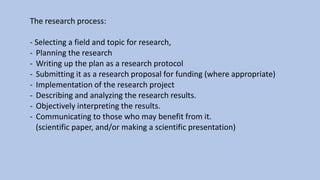
The research process:
- Selecting a field and topic for research,
- Planning the research
- Writing up the plan as a research protocol
- Submitting it as a research proposal for funding (where appropriate)
- Implementation of the research project
- Describing and analyzing the research results.
- Objectively interpreting the results.
- Communicating to those who may benefit from it.
(scientific paper, and/or making a scientific presentation)
The research process also involves assessing and evaluating research
done by others.
Throughout the research process, and particularly where the research
involves human subjects, rules of ethical conduct must be carefully
observed.
ETHICS IN RESEARCH
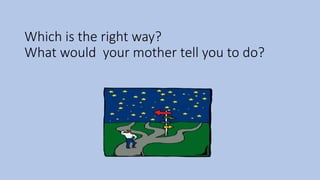
Which is the right way?
What would your mother tell you to do?
• Ethics are principles of right conduct.
• Generally no disagreements on the ethical principles in
themselves, since they represent basic human values.

• There can, however, be differences on how they are
interpreted and implemented in specific cases.

Basic principles include beneficence, non-maleficence, respect, and
justice.
Where research involves experimentation on human subjects, every
effort should be made to maximize the benefits to the subjects
(beneficence), and the subjects should suffer no harm (non-
maleficence).
The principle of respect –
Participation in the research should be completely voluntary
and based on informed consent. Where research involves
collection of data on individuals, privacy should be protected
by ensuring confidentiality. Respect to the community
means respecting its values and having its approval for the
research.
The principle of justice (distributive justice) –
Participation in the research should correlate with expected
benefits. No population group should carry an undue
burden of research for the benefit of another group.
VIDEO - BREAK
Apart from the basic principles of beneficence (non-maleficence),
respect and distributive justice, other principles also apply
• https://www.youtube.com/watch?app=desktop&v=VcbPqhwJzcg
- TRUE OR FALSE GAME
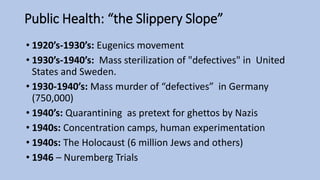
Public Health: “the Slippery Slope”
• 1920’s-1930’s: Eugenics movement
• 1930’s-1940’s: Mass sterilization of "defectives" in United
States and Sweden.
• 1930-1940’s: Mass murder of “defectives” in Germany
(750,000)
• 1940’s: Quarantining as pretext for ghettos by Nazis
• 1940s: Concentration camps, human experimentation
• 1940s: The Holocaust (6 million Jews and others)
• 1946 – Nuremberg Trials
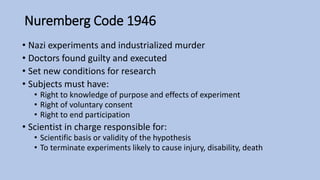
Nuremberg Code 1946
• Nazi experiments and industrialized murder
• Doctors found guilty and executed
• Set new conditions for research
• Subjects must have:
• Right to knowledge of purpose and effects of experiment
• Right of voluntary consent
• Right to end participation
• Scientist in charge responsible for:
• Scientific basis or validity of the hypothesis
• To terminate experiments likely to cause injury, disability, death
Universal Declaration of Human Rights, 1948
• Article 25.
Everyone has the right to a standard of living adequate for the health
and well-being of himself and of his family, including food, clothing,
housing and medical care and necessary social services etc.
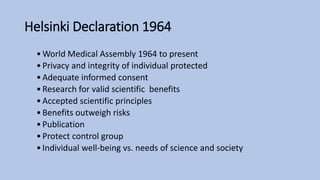
Helsinki Declaration 1964
•World Medical Assembly 1964 to present
•Privacy and integrity of individual protected
•Adequate informed consent
•Research for valid scientific benefits
•Accepted scientific principles
•Benefits outweigh risks
•Publication
•Protect control group
•Individual well-being vs. needs of science and society
Tuskegee Experiment
• Tuskegee, Mississippi
• Duration 1932-1972
• Conducted by US Public Health Service
• To observe the natural history of syphilis
• Group of black men
• Treatment with penicillin available (1942)
• Failed to provide information to subjects
• Unethical (possibly criminal) behavior
• New standards resulted
• Apology by President Clinton 1996
• Continues to influence sectors of US public in response to public health initiatives
Nuremberg Code
• https://www.youtube.com/watch?v=slLff2OigkE
Tuskegee experiment
• https://www.youtube.com/watch?v=ZV7RzS8QRXE
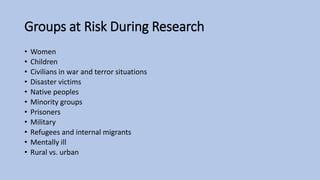
Groups at Risk During Research
• Women
• Children
• Civilians in war and terror situations
• Disaster victims
• Native peoples
• Minority groups
• Prisoners
• Military
• Refugees and internal migrants
• Mentally ill
• Rural vs. urban
References
• WHO Practical Guide for Researchers
THANK YOU

INTRODUCTION LECTURE_RESEARCH DESIGN AND METHODOLOGY.pptx

  • 1.
  • 2.
    Welcome Back Fromthe Holidays! Classes Have Began…………….
  • 3.
    What is RESEARCH? Whatis HEALTH RESEARCH?
  • 4.
    Research - thesystematic collection, description, analysis, and interpretation of data to answer a certain question or solve a problem. Health research – the process for systematic collection, description, analysis, and interpretation of data that can be used to improve the health of individuals or groups.
  • 5.
    The research processchanges “information” into “knowledge”, through critical assessment and relating it to other existing human knowledge.
  • 6.
    The health gainsin the last century >>>>>> unprecedented. Advances made in health research account for a significant part of these health gains. New scientific frontiers, now opening up, promise to transform medical practice in ways never imagined before, and to contribute to further improvements in health.
  • 7.
    Health research isnot only about the development of new tools and advancing our understanding of health and disease. Health research is important to inform policy and decision- making in health systems.
  • 8.
    Health research isnot a luxury, to be conducted only by countries with the resources to spare. When India gained independence, the country faced the problem of how to allocate its scarce resources to areas of most need. Jawahar Lal Nehru, in this context, made the following statement: “Because we are a poor country, we cannot afford not to do research”.
  • 9.
    The participation andcontribution of developing countries in scientific research has been well expressed by the Pakistani Nobel Laureate Abdul Salam, as follows: “Science and technology are a shared heritage of all mankind; East and West, South and North have all equally participated in their creation in the past, as, we hope, they will in the future—the joint endeavor in science becoming one of the unifying forces among the diverse people on the globe.” (Salam, 1989.)
  • 10.
    • Health researchmay be pursued as a career in a public or private research organization. • Research may be done in pursuit of prestige or under the pressure of the threat of “publish or perish” when climbing the ladder of a successful academic career.
  • 11.
    A strong argument: •All health professionals should do some research, or at least get enough knowledge about the research process, even if they wish to spend the rest of their lives dealing with patients or health administration. Do you agree??????????????????????
  • 12.
    A scientific approachis essential for health professionals. As the practice of medicine is advancing rapidly, the need for critical evaluation of new developments becomes more urgent. The medical past is littered with examples of possible major advances eventually being shown to be of no value, or even to be harmful. Research helps to develop a scientific critical attitude.
  • 13.
    A clinician willfind that the faculties developed by doing research are those most needed in clinical diagnosis. Health policy-makers, particularly in developing countries, may not appreciate the contribution which research can make.
  • 14.
    • A dividebetween the universe of research and the universe of policy-making. • The stereotype of the researcher in her or his ivory tower still prevails.
  • 15.
    •Health managers andpolicy-makers may be doing research without knowing it. Why do you think this is so?
  • 16.
    • A needto demystify the scientific process. • Scientific inquiry is basically a potentiation of common sense, which is probably one of the most equitably distributed human gifts.
  • 17.
    • Einstein said,“The whole of science is nothing more than a refinement of everyday thinking.” • In a sense, most of us may be conducting some research in our daily life. Can you give some general examples ???
  • 18.
    • When we,for example, want to buy a car in a proper way, we collect information about models and dealers, analyse it, then try to reach a “scientific” conclusion on which car to buy. The use of complex instrumentation is not a necessary requirement for good research. • Key attributes of good research are proper planning, accuracy in data collection and proper unbiased interpretation.
  • 19.
    The research process: -Selecting a field and topic for research, - Planning the research - Writing up the plan as a research protocol - Submitting it as a research proposal for funding (where appropriate) - Implementation of the research project - Describing and analyzing the research results. - Objectively interpreting the results. - Communicating to those who may benefit from it. (scientific paper, and/or making a scientific presentation)
  • 20.
    The research processalso involves assessing and evaluating research done by others. Throughout the research process, and particularly where the research involves human subjects, rules of ethical conduct must be carefully observed.
  • 21.
  • 22.
    Which is theright way? What would your mother tell you to do?
  • 23.
    • Ethics areprinciples of right conduct. • Generally no disagreements on the ethical principles in themselves, since they represent basic human values. • There can, however, be differences on how they are interpreted and implemented in specific cases.
  • 24.
    Basic principles includebeneficence, non-maleficence, respect, and justice. Where research involves experimentation on human subjects, every effort should be made to maximize the benefits to the subjects (beneficence), and the subjects should suffer no harm (non- maleficence).
  • 25.
    The principle ofrespect – Participation in the research should be completely voluntary and based on informed consent. Where research involves collection of data on individuals, privacy should be protected by ensuring confidentiality. Respect to the community means respecting its values and having its approval for the research.
  • 26.
    The principle ofjustice (distributive justice) – Participation in the research should correlate with expected benefits. No population group should carry an undue burden of research for the benefit of another group.
  • 27.
    VIDEO - BREAK Apartfrom the basic principles of beneficence (non-maleficence), respect and distributive justice, other principles also apply • https://www.youtube.com/watch?app=desktop&v=VcbPqhwJzcg
  • 28.
    - TRUE ORFALSE GAME
  • 29.
    Public Health: “theSlippery Slope” • 1920’s-1930’s: Eugenics movement • 1930’s-1940’s: Mass sterilization of "defectives" in United States and Sweden. • 1930-1940’s: Mass murder of “defectives” in Germany (750,000) • 1940’s: Quarantining as pretext for ghettos by Nazis • 1940s: Concentration camps, human experimentation • 1940s: The Holocaust (6 million Jews and others) • 1946 – Nuremberg Trials
  • 30.
    Nuremberg Code 1946 •Nazi experiments and industrialized murder • Doctors found guilty and executed • Set new conditions for research • Subjects must have: • Right to knowledge of purpose and effects of experiment • Right of voluntary consent • Right to end participation • Scientist in charge responsible for: • Scientific basis or validity of the hypothesis • To terminate experiments likely to cause injury, disability, death
  • 31.
    Universal Declaration ofHuman Rights, 1948 • Article 25. Everyone has the right to a standard of living adequate for the health and well-being of himself and of his family, including food, clothing, housing and medical care and necessary social services etc.
  • 32.
    Helsinki Declaration 1964 •WorldMedical Assembly 1964 to present •Privacy and integrity of individual protected •Adequate informed consent •Research for valid scientific benefits •Accepted scientific principles •Benefits outweigh risks •Publication •Protect control group •Individual well-being vs. needs of science and society
  • 33.
    Tuskegee Experiment • Tuskegee,Mississippi • Duration 1932-1972 • Conducted by US Public Health Service • To observe the natural history of syphilis • Group of black men • Treatment with penicillin available (1942) • Failed to provide information to subjects • Unethical (possibly criminal) behavior • New standards resulted • Apology by President Clinton 1996 • Continues to influence sectors of US public in response to public health initiatives
  • 34.
  • 35.
  • 36.
    Groups at RiskDuring Research • Women • Children • Civilians in war and terror situations • Disaster victims • Native peoples • Minority groups • Prisoners • Military • Refugees and internal migrants • Mentally ill • Rural vs. urban
  • 37.
    References • WHO PracticalGuide for Researchers
  • 38.