What’s new in .Net 4.0 ??
Mohan
Consultant
Certification
Mohan Arumugam
Technologies Specialist
E-mail : moohanan@gmail.com
Phone : +91 99406 53876
Profile
Blogger
Trainer
Who Am I ?
Agenda
• New Features in SharePoint
2013
• Development
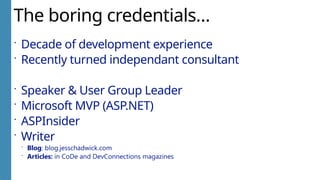
The boring credentials…
 Decade of development experience
 Recently turned independant consultant
 Speaker & User Group Leader
 Microsoft MVP (ASP.NET)
 ASPInsider
 Writer
 Blog: blog.jesschadwick.com
 Articles: in CoDe and DevConnections magazines
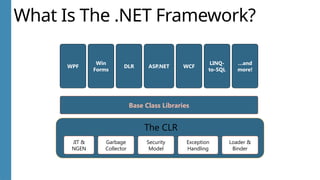
What Is The .NET Framework?
Base Class Libraries
The CLR
JIT &
NGEN
Garbage
Collector
Security
Model
Exception
Handling
Loader &
Binder
WPF
Win
Forms
DLR ASP.NET WCF
…and
more!
LINQ-
to-SQL
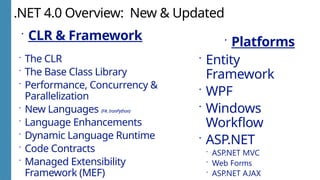
.NET 4.0 Overview: New & Updated
 CLR & Framework
 The CLR
 The Base Class Library
 Performance, Concurrency &
Parallelization
 New Languages (F#, IronPython)
 Language Enhancements
 Dynamic Language Runtime
 Code Contracts
 Managed Extensibility
Framework (MEF)
 Platforms
 Entity
Framework
 WPF
 Windows
Workflow
 ASP.NET
 ASP.NET MVC
 Web Forms
 ASP.NET AJAX
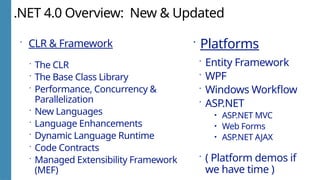
.NET 4.0 Overview: New & Updated
 CLR & Framework
 The CLR
 The Base Class Library
 Performance, Concurrency &
Parallelization
 New Languages
 Language Enhancements
 Dynamic Language Runtime
 Code Contracts
 Managed Extensibility Framework
(MEF)
 Platforms
 Entity Framework
 WPF
 Windows Workflow
 ASP.NET
• ASP.NET MVC
• Web Forms
• ASP.NET AJAX
 ( Platform demos if
we have time )
.NET Framework
Improvements
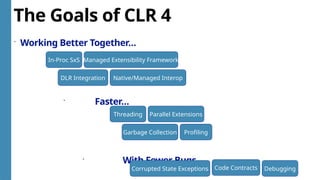
The Goals of CLR 4
 Working Better Together…
 Faster…
 With Fewer Bugs…
In-Proc SxS
Native/Managed Interop
DLR Integration
Managed Extensibility Framework
Threading Parallel Extensions
Garbage Collection Profiling
Code Contracts Debugging
Corrupted State Exceptions
Base Class Library Additions
Numerics
 BigInteger
Data Structures
 Tuple (new Tuple<int,int,string>(1,2,”Test”))
 ISet<T> (SortedSet<T> & HashSet<T>)
I/O
 Memory-Mapped File
Performance, Concurrency, and
Parallel Extensions
Thread-safe collections
(BlockingCollection<T>, ConcurrentDictionary<T>,
etc.)
Task Parallel Library (TPL)
PLINQ
Lazy Initialization
eg: Lazy<IEnumerable<Order>> Orders { get; set;}
Code Contracts
Design By Contract
 Code Contracts provide a
language-agnostic and declarative way to express coding
assumptions in .NET programs.
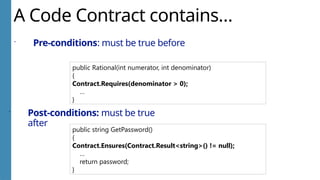
A Code Contract contains…
 Pre-conditions: must be true before
public Rational(int numerator, int denominator)
{
Contract.Requires(denominator > 0);
…
}
 Post-conditions: must be true
after
public string GetPassword()
{
Contract.Ensures(Contract.Result<string>() != null);
…
return password;
}
A Code Contract contains…
 Invariants - must always be true
[ContractInvariantMethod]
protected void ObjectInvariant()
{
Contract.Invariant(denominator > 0);
}
Code Contracts
Language Enhancements
 C#, Visual Basic, plus new Functional &
Dynamic Languages
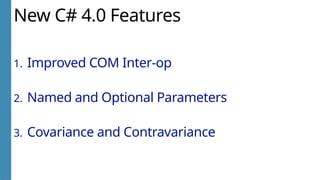
New C# 4.0 Features
1. Improved COM Inter-op
2. Named and Optional Parameters
3. Covariance and Contravariance
New VB10 Features
1. Auto-Implemented Properties
2. Collection Initializers
3. Statement Lambdas
4. Implicit Line Continuation
5. Covariance and Contravariance
New VB10 Features
1. Automatic Properties
2. Collection Initializers
3. Statement Lambdas
4. Implicit Line Continuation
5. Covariance and Contravariance
Covariance & Contravariance
“Fix” generics
Covariance
Describes the substitution of related types, such that the ordering
from the more restrictive type to the less restrictive type is preserved
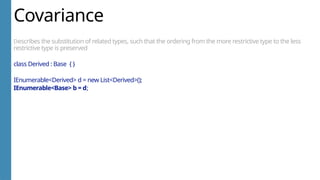
Covariance
Describes the substitution of related types, such that the ordering from the more restrictive type to the less
restrictive type is preserved
class Derived : Base { }
IEnumerable<Derived> d = new List<Derived>();
IEnumerable<Base> b = d;
Contravariance
Describes the substitution of related types,
such that the ordering from the more
restrictive type to the less restrictive type is
reversed.
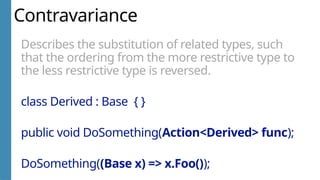
Contravariance
Describes the substitution of related types, such
that the ordering from the more restrictive type to
the less restrictive type is reversed.
class Derived : Base { }
public void DoSomething(Action<Derived> func);
DoSomething((Base x) => x.Foo());
New Language Features
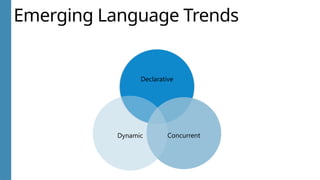
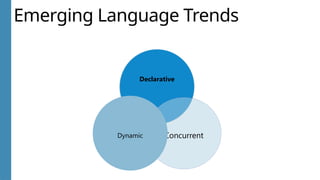
Emerging Language Trends
Declarative
Concurrent
Dynamic
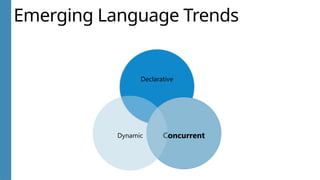
Emerging Language Trends
Declarative
Concurrent
Dynamic
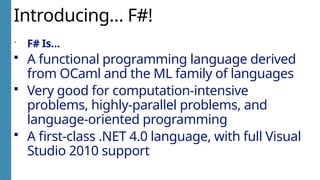
Introducing… F#!
 F# Is…
 A functional programming language derived
from OCaml and the ML family of languages
 Very good for computation-intensive
problems, highly-parallel problems, and
language-oriented programming
 A first-class .NET 4.0 language, with full Visual
Studio 2010 support
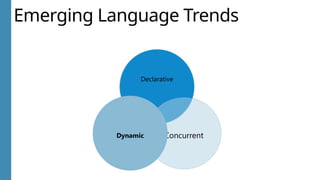
Emerging Language Trends
Declarative
Concurrent
Dynamic
New C# 4.0 Features
1. Improved COM Inter-op
2. Named and Optional Parameters
3. Covariance and Contravariance
4. Late-binding support (via dynamic keyword)
(Will show up in our demos coming up next!)
Dynamic Language Runtime
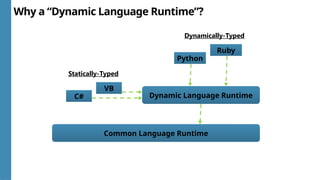
Why a “Dynamic Language Runtime”?
Common Language Runtime
Statically-Typed
C#
VB
Ruby
Python
Dynamically-Typed
Dynamic Language Runtime
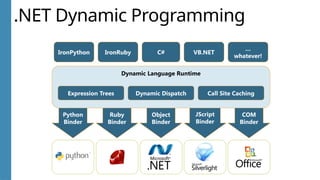
Python
Binder
Ruby
Binder
COM
Binder
JScript
Binder
Object
Binder
.NET Dynamic Programming
Dynamic Language Runtime
Expression Trees Dynamic Dispatch Call Site Caching
IronPython IronRuby C# VB.NET
…
whatever!
Emerging Language Trends
Declarative
Concurrent
Dynamic
Declarative Development
 ASP.NET Web Forms (ASPX)
 XAML (WPF & Silverlight)
 Code Contracts
 MEF!
Managed Extensibility Framework
(MEF)
What is MEF?
MEF is…
 A way to manage dependencies
 A way to provide extensibility in your apps
 A framework to encourage loose coupling and
reusability
 A new addition to the Base Class Library
 System.ComponentModel.Composition
What is MEF? (Simple Answer)
Imports and Exports
What is MEF? (Simple Answer)
Imports and Exports
of components (“parts”)
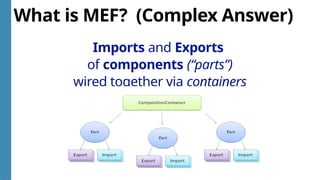
What is MEF? (Complex Answer)
Imports and Exports
of components (“parts”)
wired together via containers
What’s New in the Platforms?
 WPF, ASP.NET, Workflow, etc!
Windows
Presentation
Framework (WPF)
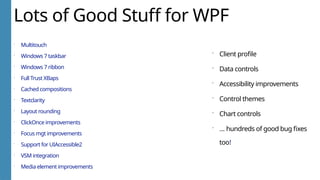
Lots of Good Stuff for WPF
 Multitouch
 Windows 7 taskbar
 Windows 7 ribbon
 Full Trust XBaps
 Cached compositions
 Textclarity
 Layout rounding
 ClickOnce improvements
 Focus mgt improvements
 Support for UIAccessible2
 VSM integration
 Media element improvements
 Client profile
 Data controls
 Accessibility improvements
 Control themes
 Chart controls
 … hundreds of good bug fixes
too!
Entity Framework
 It’s not just for databases anymore!
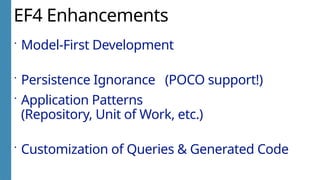
EF4 Enhancements
 Model-First Development
 Persistence Ignorance (POCO support!)
 Application Patterns
(Repository, Unit of Work, etc.)
 Customization of Queries & Generated Code
Windows Workflow
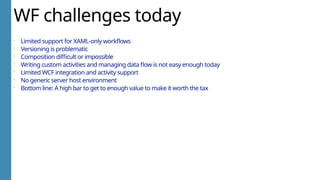
WF challenges today
 Limited support for XAML-only workflows
 Versioning is problematic
 Composition difficult or impossible
 Writing custom activities and managing data flow is not easy enough today
 Limited WCF integration and activity support
 No generic server host environment
 Bottom line: A high bar to get to enough value to make it worth the tax
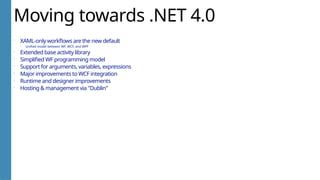
Moving towards .NET 4.0
 XAML-only workflows are the new default
 Unified model between WF, WCF, and WPF
 Extended base activity library
 Simplified WF programming model
 Support for arguments, variables, expressions
 Major improvements to WCF integration
 Runtime and designer improvements
 Hosting & management via "Dublin"
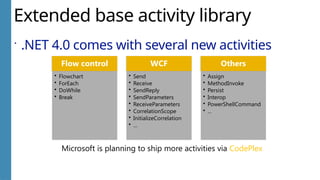
Extended base activity library
 .NET 4.0 comes with several new activities
Flow control
• Flowchart
• ForEach
• DoWhile
• Break
WCF
• Send
• Receive
• SendReply
• SendParameters
• ReceiveParameters
• CorrelationScope
• InitializeCorrelation
• …
Others
• Assign
• MethodInvoke
• Persist
• Interop
• PowerShellCommand
• ...
Microsoft is planning to ship more activities via CodePlex
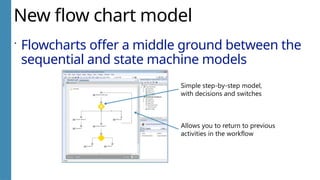
New flow chart model
 Flowcharts offer a middle ground between the
sequential and state machine models
Simple step-by-step model,
with decisions and switches
Allows you to return to previous
activities in the workflow
Improving the Web
 ASP.NET MVC, Web Forms, and ASP.NET AJAX
ASP.NET MVC
 v.2 “Officially” part of the framework
 New Features for v2:
 Areas
 Data Annotations support
 Templated Helpers
 Client-Side Validation
Web Forms
• Client ID manipulation
• Fine-Grained ViewState control
ASP.NET AJAX
• Client-SideTemplates
• Client-SideDataControls(DataView&DataContext)
• DeclarativeInstantiation
• CommandBubbling
• LiveBindings
Questions?
 Please complete the online evaluation form
Thank you!
Contact Info
Email: jesschadwick@gmail.com
Blog: blog.jesschadwick.com
Twitter: twitter.com/jchadwick
Resources
• Visual Studio 2010: msdn.microsoft.com/en-us/vstudio
• MEF Homepage: mef.codeplex.com
• DLR Homepage: dlr.codeplex.com
• IronPython Homepage: ironpython.codeplex.com
Mohan Arumugam
Technologies Specialist
E-mail : moohanan@gmail.com
Phone : +91 99406 53876
Profile
Thank You

Introduction - DotNet 4.0 Intro by Mohan

  • 1.
    What’s new in.Net 4.0 ?? Mohan
  • 2.
    Consultant Certification Mohan Arumugam Technologies Specialist E-mail: moohanan@gmail.com Phone : +91 99406 53876 Profile Blogger Trainer Who Am I ?
  • 3.
    Agenda • New Featuresin SharePoint 2013 • Development
  • 4.
    The boring credentials… Decade of development experience  Recently turned independant consultant  Speaker & User Group Leader  Microsoft MVP (ASP.NET)  ASPInsider  Writer  Blog: blog.jesschadwick.com  Articles: in CoDe and DevConnections magazines
  • 5.
    What Is The.NET Framework? Base Class Libraries The CLR JIT & NGEN Garbage Collector Security Model Exception Handling Loader & Binder WPF Win Forms DLR ASP.NET WCF …and more! LINQ- to-SQL
  • 6.
    .NET 4.0 Overview:New & Updated  CLR & Framework  The CLR  The Base Class Library  Performance, Concurrency & Parallelization  New Languages (F#, IronPython)  Language Enhancements  Dynamic Language Runtime  Code Contracts  Managed Extensibility Framework (MEF)  Platforms  Entity Framework  WPF  Windows Workflow  ASP.NET  ASP.NET MVC  Web Forms  ASP.NET AJAX
  • 7.
    .NET 4.0 Overview:New & Updated  CLR & Framework  The CLR  The Base Class Library  Performance, Concurrency & Parallelization  New Languages  Language Enhancements  Dynamic Language Runtime  Code Contracts  Managed Extensibility Framework (MEF)  Platforms  Entity Framework  WPF  Windows Workflow  ASP.NET • ASP.NET MVC • Web Forms • ASP.NET AJAX  ( Platform demos if we have time )
  • 8.
  • 9.
    The Goals ofCLR 4  Working Better Together…  Faster…  With Fewer Bugs… In-Proc SxS Native/Managed Interop DLR Integration Managed Extensibility Framework Threading Parallel Extensions Garbage Collection Profiling Code Contracts Debugging Corrupted State Exceptions
  • 10.
    Base Class LibraryAdditions Numerics  BigInteger Data Structures  Tuple (new Tuple<int,int,string>(1,2,”Test”))  ISet<T> (SortedSet<T> & HashSet<T>) I/O  Memory-Mapped File
  • 11.
    Performance, Concurrency, and ParallelExtensions Thread-safe collections (BlockingCollection<T>, ConcurrentDictionary<T>, etc.) Task Parallel Library (TPL) PLINQ Lazy Initialization eg: Lazy<IEnumerable<Order>> Orders { get; set;}
  • 12.
  • 13.
    Design By Contract Code Contracts provide a language-agnostic and declarative way to express coding assumptions in .NET programs.
  • 14.
    A Code Contractcontains…  Pre-conditions: must be true before public Rational(int numerator, int denominator) { Contract.Requires(denominator > 0); … }  Post-conditions: must be true after public string GetPassword() { Contract.Ensures(Contract.Result<string>() != null); … return password; }
  • 15.
    A Code Contractcontains…  Invariants - must always be true [ContractInvariantMethod] protected void ObjectInvariant() { Contract.Invariant(denominator > 0); }
  • 16.
  • 17.
    Language Enhancements  C#,Visual Basic, plus new Functional & Dynamic Languages
  • 18.
    New C# 4.0Features 1. Improved COM Inter-op 2. Named and Optional Parameters 3. Covariance and Contravariance
  • 19.
    New VB10 Features 1.Auto-Implemented Properties 2. Collection Initializers 3. Statement Lambdas 4. Implicit Line Continuation 5. Covariance and Contravariance
  • 20.
    New VB10 Features 1.Automatic Properties 2. Collection Initializers 3. Statement Lambdas 4. Implicit Line Continuation 5. Covariance and Contravariance
  • 21.
  • 22.
    Covariance Describes the substitutionof related types, such that the ordering from the more restrictive type to the less restrictive type is preserved
  • 23.
    Covariance Describes the substitutionof related types, such that the ordering from the more restrictive type to the less restrictive type is preserved class Derived : Base { } IEnumerable<Derived> d = new List<Derived>(); IEnumerable<Base> b = d;
  • 24.
    Contravariance Describes the substitutionof related types, such that the ordering from the more restrictive type to the less restrictive type is reversed.
  • 25.
    Contravariance Describes the substitutionof related types, such that the ordering from the more restrictive type to the less restrictive type is reversed. class Derived : Base { } public void DoSomething(Action<Derived> func); DoSomething((Base x) => x.Foo());
  • 26.
  • 27.
  • 28.
  • 29.
    Introducing… F#!  F#Is…  A functional programming language derived from OCaml and the ML family of languages  Very good for computation-intensive problems, highly-parallel problems, and language-oriented programming  A first-class .NET 4.0 language, with full Visual Studio 2010 support
  • 30.
  • 31.
    New C# 4.0Features 1. Improved COM Inter-op 2. Named and Optional Parameters 3. Covariance and Contravariance 4. Late-binding support (via dynamic keyword) (Will show up in our demos coming up next!)
  • 32.
  • 33.
    Why a “DynamicLanguage Runtime”? Common Language Runtime Statically-Typed C# VB Ruby Python Dynamically-Typed Dynamic Language Runtime
  • 34.
    Python Binder Ruby Binder COM Binder JScript Binder Object Binder .NET Dynamic Programming DynamicLanguage Runtime Expression Trees Dynamic Dispatch Call Site Caching IronPython IronRuby C# VB.NET … whatever!
  • 35.
  • 36.
    Declarative Development  ASP.NETWeb Forms (ASPX)  XAML (WPF & Silverlight)  Code Contracts  MEF!
  • 37.
  • 38.
    What is MEF? MEFis…  A way to manage dependencies  A way to provide extensibility in your apps  A framework to encourage loose coupling and reusability  A new addition to the Base Class Library  System.ComponentModel.Composition
  • 39.
    What is MEF?(Simple Answer) Imports and Exports
  • 40.
    What is MEF?(Simple Answer) Imports and Exports of components (“parts”)
  • 41.
    What is MEF?(Complex Answer) Imports and Exports of components (“parts”) wired together via containers
  • 42.
    What’s New inthe Platforms?  WPF, ASP.NET, Workflow, etc!
  • 43.
  • 44.
    Lots of GoodStuff for WPF  Multitouch  Windows 7 taskbar  Windows 7 ribbon  Full Trust XBaps  Cached compositions  Textclarity  Layout rounding  ClickOnce improvements  Focus mgt improvements  Support for UIAccessible2  VSM integration  Media element improvements  Client profile  Data controls  Accessibility improvements  Control themes  Chart controls  … hundreds of good bug fixes too!
  • 45.
    Entity Framework  It’snot just for databases anymore!
  • 46.
    EF4 Enhancements  Model-FirstDevelopment  Persistence Ignorance (POCO support!)  Application Patterns (Repository, Unit of Work, etc.)  Customization of Queries & Generated Code
  • 47.
  • 48.
    WF challenges today Limited support for XAML-only workflows  Versioning is problematic  Composition difficult or impossible  Writing custom activities and managing data flow is not easy enough today  Limited WCF integration and activity support  No generic server host environment  Bottom line: A high bar to get to enough value to make it worth the tax
  • 49.
    Moving towards .NET4.0  XAML-only workflows are the new default  Unified model between WF, WCF, and WPF  Extended base activity library  Simplified WF programming model  Support for arguments, variables, expressions  Major improvements to WCF integration  Runtime and designer improvements  Hosting & management via "Dublin"
  • 50.
    Extended base activitylibrary  .NET 4.0 comes with several new activities Flow control • Flowchart • ForEach • DoWhile • Break WCF • Send • Receive • SendReply • SendParameters • ReceiveParameters • CorrelationScope • InitializeCorrelation • … Others • Assign • MethodInvoke • Persist • Interop • PowerShellCommand • ... Microsoft is planning to ship more activities via CodePlex
  • 51.
    New flow chartmodel  Flowcharts offer a middle ground between the sequential and state machine models Simple step-by-step model, with decisions and switches Allows you to return to previous activities in the workflow
  • 52.
    Improving the Web ASP.NET MVC, Web Forms, and ASP.NET AJAX
  • 53.
    ASP.NET MVC  v.2“Officially” part of the framework  New Features for v2:  Areas  Data Annotations support  Templated Helpers  Client-Side Validation
  • 54.
    Web Forms • ClientID manipulation • Fine-Grained ViewState control
  • 55.
    ASP.NET AJAX • Client-SideTemplates •Client-SideDataControls(DataView&DataContext) • DeclarativeInstantiation • CommandBubbling • LiveBindings
  • 56.
    Questions?  Please completethe online evaluation form
  • 57.
    Thank you! Contact Info Email:jesschadwick@gmail.com Blog: blog.jesschadwick.com Twitter: twitter.com/jchadwick Resources • Visual Studio 2010: msdn.microsoft.com/en-us/vstudio • MEF Homepage: mef.codeplex.com • DLR Homepage: dlr.codeplex.com • IronPython Homepage: ironpython.codeplex.com
  • 58.
    Mohan Arumugam Technologies Specialist E-mail: moohanan@gmail.com Phone : +91 99406 53876 Profile Thank You

Editor's Notes

  • #10  BigInteger: an immutable type that represents an arbitrarily large integer whose value in theory has no upper or lower bounds Tuple: a small, finite list of objects; used to pass around multiple values in one object. Kind of like a dynamic struct. ISet<T>: collections that have unique elements and specific operations. Memory-Mapped File: gives you ability to work with files without loading them into memory and locking them from other processes
  • #18 MESSAGING: Late-Binding Support: The ability to do runtime call dispatch rather than being forced into compile-time verification. Named and Optional Parameters: This allows us to clean up our code as we can see. It also goes hand-in-hand with #3, Improved COM interop (bye-bye “ref MissingValue”) Improved COM Interop: Better interop with COM, along with easier deployment via Type Equivalent and embedding of types. Covariance and Contravariance: This is really about patching a problem in our generic type system as it exists today. Most developers won’t be using the generic variance features directly, they will simply be able to do stuff they couldn’t do before.
  • #19 MESSAGING: We show all these features in our demo.
  • #20 MESSAGING: We show all these features in our demo.
  • #27 MESSAGING: There are several trends in modern programming languages that we feel are important to address and capture with our programming language that we will continue to target. Declarative Imperative languages focus heavily on the how. Programming logic is achieved via if statements, for loops, while loops, etc. Declarative languages focus on the what Tell the computer “what” you want done, and let it focus on how to get it done (so the language decides whether to achieve the goal via a for loop, foreach loop, recursion, etc.) Focusing on the what instead of the “how” is an important part of “stepping away from the compiler” and better expressing your true intent in code. Dynamic Around dynamic languages, you often hear the comparison of dynamically-typed versus statically-typed languages. A better way to express this difference is thinking “late-bound” versus early-bound. Early-bound languages enforce calling conventions, matching contracts (method calls on specific types, for instance), at compile time. However, late-bound languages “punt” this decision until runtime. While early-bound languages gain me benefits like compile-time type-safety, they also enforce rigid constraints on the design of your code In this way, code written in early-bound languages becomes more difficult to change. For more information on this “flexibility”, check out Duck Typing in Ruby. Concurrent Concurrency is a topic that is very important to start addressing ASAP. The “concurrency problem” is already here, not 5 years from now, but today. Functional languages like F# are very powerful when it comes to addressing concurrency This power comes from the immutable-by-default approach when enables easier-to-parallelize code since assumptions can be made about the behavior of the code because of no shared-state F# introduces a very powerful mechanism for achieving concurrency called Asynchronous Workflows (has nothing to do with Workflow Foundation workflows) Async Workflows use Parallel Extensions to the .NET Framework under-the-hood For shared-stated languages like C# and Visual Basic, concurrency features are primarily coming from library features like Parallel Extensions Language teams are thinking hard about how to possibly integrate concurrency into the core language (this is a hard space).
  • #28 MESSAGING: There are several trends in modern programming languages that we feel are important to address and capture with our programming language that we will continue to target. Declarative Imperative languages focus heavily on the how. Programming logic is achieved via if statements, for loops, while loops, etc. Declarative languages focus on the what Tell the computer “what” you want done, and let it focus on how to get it done (so the language decides whether to achieve the goal via a for loop, foreach loop, recursion, etc.) Focusing on the what instead of the “how” is an important part of “stepping away from the compiler” and better expressing your true intent in code. Dynamic Around dynamic languages, you often hear the comparison of dynamically-typed versus statically-typed languages. A better way to express this difference is thinking “late-bound” versus early-bound. Early-bound languages enforce calling conventions, matching contracts (method calls on specific types, for instance), at compile time. However, late-bound languages “punt” this decision until runtime. While early-bound languages gain me benefits like compile-time type-safety, they also enforce rigid constraints on the design of your code In this way, code written in early-bound languages becomes more difficult to change. For more information on this “flexibility”, check out Duck Typing in Ruby. Concurrent Concurrency is a topic that is very important to start addressing ASAP. The “concurrency problem” is already here, not 5 years from now, but today. Functional languages like F# are very powerful when it comes to addressing concurrency This power comes from the immutable-by-default approach when enables easier-to-parallelize code since assumptions can be made about the behavior of the code because of no shared-state F# introduces a very powerful mechanism for achieving concurrency called Asynchronous Workflows (has nothing to do with Workflow Foundation workflows) Async Workflows use Parallel Extensions to the .NET Framework under-the-hood For shared-stated languages like C# and Visual Basic, concurrency features are primarily coming from library features like Parallel Extensions Language teams are thinking hard about how to possibly integrate concurrency into the core language (this is a hard space).
  • #29 MESSAGING: F# is a functional programming language for the .NET Framework. It combines the succinct, expressive, and compositional style of functional programming with the runtime, libraries, interoperability, and object model of .NET. F# is included in Visual Studio 2010 and is now a first-class language just like Visual Basic, C#, and C++. F# is very good for compute-intensive problems, highly parallel problems, and language-oriented programming. Since F# just generates normal MSIL and .NET assemblies, you can develop a library in F# that does your computations, and call your F# code from your C# application.
  • #30 MESSAGING: There are several trends in modern programming languages that we feel are important to address and capture with our programming language that we will continue to target. Declarative Imperative languages focus heavily on the how. Programming logic is achieved via if statements, for loops, while loops, etc. Declarative languages focus on the what Tell the computer “what” you want done, and let it focus on how to get it done (so the language decides whether to achieve the goal via a for loop, foreach loop, recursion, etc.) Focusing on the what instead of the “how” is an important part of “stepping away from the compiler” and better expressing your true intent in code. Dynamic Around dynamic languages, you often hear the comparison of dynamically-typed versus statically-typed languages. A better way to express this difference is thinking “late-bound” versus early-bound. Early-bound languages enforce calling conventions, matching contracts (method calls on specific types, for instance), at compile time. However, late-bound languages “punt” this decision until runtime. While early-bound languages gain me benefits like compile-time type-safety, they also enforce rigid constraints on the design of your code In this way, code written in early-bound languages becomes more difficult to change. For more information on this “flexibility”, check out Duck Typing in Ruby. Concurrent Concurrency is a topic that is very important to start addressing ASAP. The “concurrency problem” is already here, not 5 years from now, but today. Functional languages like F# are very powerful when it comes to addressing concurrency This power comes from the immutable-by-default approach when enables easier-to-parallelize code since assumptions can be made about the behavior of the code because of no shared-state F# introduces a very powerful mechanism for achieving concurrency called Asynchronous Workflows (has nothing to do with Workflow Foundation workflows) Async Workflows use Parallel Extensions to the .NET Framework under-the-hood For shared-stated languages like C# and Visual Basic, concurrency features are primarily coming from library features like Parallel Extensions Language teams are thinking hard about how to possibly integrate concurrency into the core language (this is a hard space).
  • #31 MESSAGING: Late-Binding Support: The ability to do runtime call dispatch rather than being forced into compile-time verification. Named and Optional Parameters: This allows us to clean up our code as we can see. It also goes hand-in-hand with #3, Improved COM interop (bye-bye “ref MissingValue”) Improved COM Interop: Better interop with COM, along with easier deployment via Type Equivalent and embedding of types. Covariance and Contravariance: This is really about patching a problem in our generic type system as it exists today. Most developers won’t be using the generic variance features directly, they will simply be able to do stuff they couldn’t do before.
  • #33 MESSAGING: The DLR provides core services that are necessary for dynamically-typed languages to work on the CLR The DLR also provides other services that can be used by statically-typed languages as well to achieve more dynamic behavior: Expression Trees (including Statements) Dynamic Dispatch Call Site Caching
  • #34 MESSAGING: The power of the DLR is that there are many binders for the DLR. Yes, we can interop with dynamic languages like Python and Ruby like we expect to. However, perhaps even more importantly, there are binders available for .NET, Silverlight, and Office. This allows us to interact between these platforms in very powerful ways that we were unable to currently.
  • #35 MESSAGING: There are several trends in modern programming languages that we feel are important to address and capture with our programming language that we will continue to target. Declarative Imperative languages focus heavily on the how. Programming logic is achieved via if statements, for loops, while loops, etc. Declarative languages focus on the what Tell the computer “what” you want done, and let it focus on how to get it done (so the language decides whether to achieve the goal via a for loop, foreach loop, recursion, etc.) Focusing on the what instead of the “how” is an important part of “stepping away from the compiler” and better expressing your true intent in code. Dynamic Around dynamic languages, you often hear the comparison of dynamically-typed versus statically-typed languages. A better way to express this difference is thinking “late-bound” versus early-bound. Early-bound languages enforce calling conventions, matching contracts (method calls on specific types, for instance), at compile time. However, late-bound languages “punt” this decision until runtime. While early-bound languages gain me benefits like compile-time type-safety, they also enforce rigid constraints on the design of your code In this way, code written in early-bound languages becomes more difficult to change. For more information on this “flexibility”, check out Duck Typing in Ruby. Concurrent Concurrency is a topic that is very important to start addressing ASAP. The “concurrency problem” is already here, not 5 years from now, but today. Functional languages like F# are very powerful when it comes to addressing concurrency This power comes from the immutable-by-default approach when enables easier-to-parallelize code since assumptions can be made about the behavior of the code because of no shared-state F# introduces a very powerful mechanism for achieving concurrency called Asynchronous Workflows (has nothing to do with Workflow Foundation workflows) Async Workflows use Parallel Extensions to the .NET Framework under-the-hood For shared-stated languages like C# and Visual Basic, concurrency features are primarily coming from library features like Parallel Extensions Language teams are thinking hard about how to possibly integrate concurrency into the core language (this is a hard space).