



Consultant
Certification
Mohan Arumugam
Technologies Specialist
E-mail : moohanan@gmail.com
Phone : +91 99406 53876
Profile
Blogger
Trainer
Who Am I ?
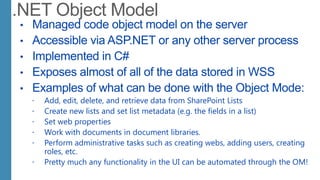
• Managed code object model on the server
• Accessible via ASP.NET or any other server process
• Implemented in C#
• Exposes almost of all of the data stored in WSS
• Examples of what can be done with the Object Mode:
 Add, edit, delete, and retrieve data from SharePoint Lists
 Create new lists and set list metadata (e.g. the fields in a list)
 Set web properties
 Work with documents in document libraries.
 Perform administrative tasks such as creating webs, adding users, creating
roles, etc.
 Pretty much any functionality in the UI can be automated through the OM!
• For content stored in WSS, only registered set of web custom
controls will run in pages
• Inline script in the page will not execute
 Code behind in pages can be made to work
• All Executable code (e.g. web custom controls, web parts, and
code-behind classes) needs to be installed on physical web server
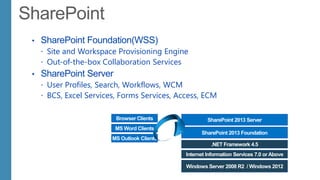
• SharePoint Foundation(WSS)
 Site and Workspace Provisioning Engine
 Out-of-the-box Collaboration Services
• SharePoint Server
 User Profiles, Search, Workflows, WCM
 BCS, Excel Services, Forms Services, Access, ECM
SharePoint 2013 Foundation
Browser Clients
MS Word Clients
MS Outlook Clients
SharePoint 2013 Server
Windows Server 2008 R2 / Windows 2012
Internet Information Services 7.0 or Above
.NET Framework 4.5
• Farm-Trust Solutions
 Introduced in SharePoint 2007
 Hosted in the same process as SharePoint
 Full server-side SharePoint API access
• Sandbox Solutions
 For existing SharePoint 2010 solutions only
• SharePoint App Model
 Introduced in SharePoint 2013
 Provides for highest level of app isolation
 Much cleaner & simpler install & upgrade process
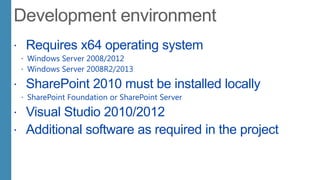
 Requires x64 operating system
 Windows Server 2008/2012
 Windows Server 2008R2/2013
 SharePoint 2010 must be installed locally
 SharePoint Foundation or SharePoint Server
 Visual Studio 2010/2012
 Additional software as required in the project
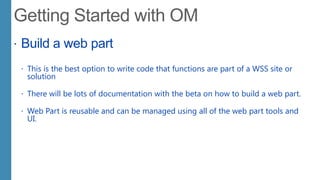
 Build a web part
 This is the best option to write code that functions are part of a WSS site or
solution
 There will be lots of documentation with the beta on how to build a web part.
 Web Part is reusable and can be managed using all of the web part tools and
UI.
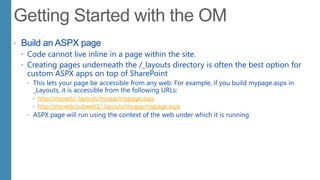
 Build an ASPX page
 Code cannot live inline in a page within the site.
 Creating pages underneath the /_layouts directory is often the best option for
custom ASPX apps on top of SharePoint
 This lets your page be accessible from any web. For example, if you build mypage.aspx in
_Layouts, it is accessible from the following URLs:
 http://myweb/_layouts/myapp/mypage.aspx
 http://myweb/subweb1/_layouts/myapp/mypage.aspx
 ASPX page will run using the context of the web under which it is running.
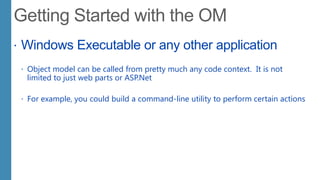
 Windows Executable or any other application
 Object model can be called from pretty much any code context. It is not
limited to just web parts or ASP.Net
 For example, you could build a command-line utility to perform certain actions
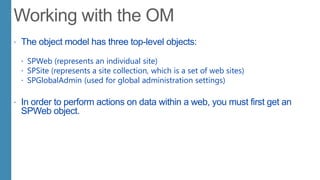
 The object model has three top-level objects:
 SPWeb (represents an individual site)
 SPSite (represents a site collection, which is a set of web sites)
 SPGlobalAdmin (used for global administration settings)
 In order to perform actions on data within a web, you must first get an
SPWeb object.
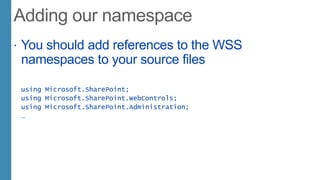
 You should add references to the WSS
namespaces to your source files
using Microsoft.SharePoint;
using Microsoft.SharePoint.WebControls;
using Microsoft.SharePoint.Administration;
…
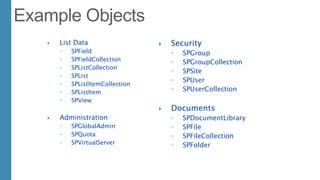
 List Data
◦ SPField
◦ SPFieldCollection
◦ SPListCollection
◦ SPList
◦ SPListItemCollection
◦ SPListItem
◦ SPView
 Administration
◦ SPGlobalAdmin
◦ SPQuota
◦ SPVirtualServer
 Security
◦ SPGroup
◦ SPGroupCollection
◦ SPSite
◦ SPUser
◦ SPUserCollection
 Documents
◦ SPDocumentLibrary
◦ SPFile
◦ SPFileCollection
◦ SPFolder
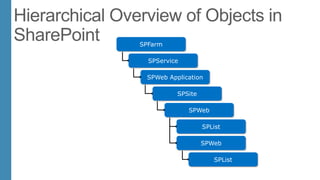
SPFarm
SPService
SPWeb Application
SPSite
SPWeb
SPList
SPWeb
SPList
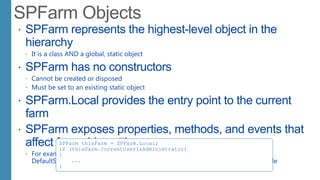
 SPFarm represents the highest-level object in the
hierarchy
 It is a class AND a global, static object
 SPFarm has no constructors
 Cannot be created or disposed
 Must be set to an existing static object
 SPFarm.Local provides the entry point to the current
farm
 SPFarm exposes properties, methods, and events that
affect farmwide settings
 For example:
DefaultServiceAccount, Servers, Services, Solutions, OnBackup, OnRestore, Upgrade
SPFarm thisFarm = SPFarm.Local;
if (thisFarm.CurrentUserIsAdministrator)
{
...
}
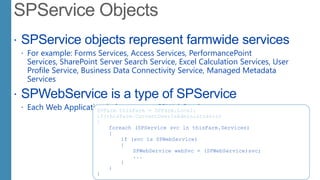
 SPService objects represent farmwide services
 For example: Forms Services, Access Services, PerformancePoint
Services, SharePoint Server Search Service, Excel Calculation Services, User
Profile Service, Business Data Connectivity Service, Managed Metadata
Services
 SPWebService is a type of SPService
 Each Web Application belongs to an SPWebServiceSPFarm thisFarm = SPFarm.Local;
if(thisFarm.CurrentUserIsAdministrator)
{
foreach (SPService svc in thisFarm.Services)
{
if (svc is SPWebService)
{
SPWebService webSvc = (SPWebService)svc;
...
}
}
}
 SPWebApplication objects map to IIS Web sites
 Not the same as a SharePoint Site or SharePoint Web
 Each SPWebApplication has its own Web.config
 Administrators typically create Web Applications
by using SharePoint Central Administration
 Developers can also create Web Applications by adding to the
WebApplications collection of a SPWebService object, but this is not a typical
action
 More typically, developers work with an existing SPWebApplication
 For example, to control Alert settings, create new site collections, or to
control maximum file size settings
 Developers can also delete Web Applications, but this is not a typical action
 Exercise caution
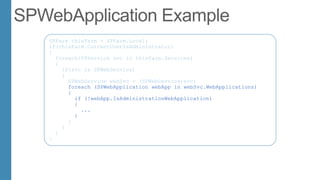
SPFarm thisFarm = SPFarm.Local;
if(thisFarm.CurrentUserIsAdministrator)
{
foreach(SPService svc in thisFarm.Services)
{
if(svc is SPWebService)
{
SPWebService webSvc = (SPWebService)svc;
foreach (SPWebApplication webApp in webSvc.WebApplications)
{
if (!webApp.IsAdministrationWebApplication)
{
...
}
}
}
}
}
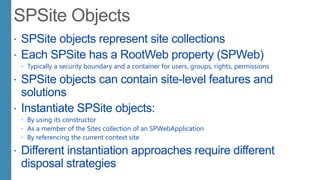
 SPSite objects represent site collections
 Each SPSite has a RootWeb property (SPWeb)
 Typically a security boundary and a container for users, groups, rights, permissions
 SPSite objects can contain site-level features and
solutions
 Instantiate SPSite objects:
 By using its constructor
 As a member of the Sites collection of an SPWebApplication
 By referencing the current context site
 Different instantiation approaches require different
disposal strategies
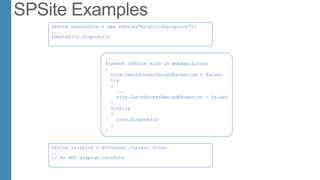
...
foreach (SPSite site in webApp.Sites)
{
site.CatchAccessDeniedException = false;
try
{
...
site.CatchAccessDeniedException = false;
}
finally
{
site.Dispose();
}
}
SPSite remoteSite = new SPSite("http://sharepoint");
...
remoteSite.Dispose();
SPSite thisSite = SPContext.Current.Site;
...
// Do NOT dispose thisSite
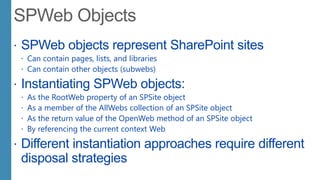
 SPWeb objects represent SharePoint sites
 Can contain pages, lists, and libraries
 Can contain other objects (subwebs)
 Instantiating SPWeb objects:
 As the RootWeb property of an SPSite object
 As a member of the AllWebs collection of an SPSite object
 As the return value of the OpenWeb method of an SPSite object
 By referencing the current context Web
 Different instantiation approaches require different
disposal strategies
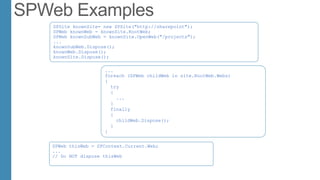
SPSite knownSite= new SPSite("http://sharepoint");
SPWeb knownWeb = knownSite.RootWeb;
SPWeb knownSubWeb = knownSite.OpenWeb("/projects");
...
knownSubWeb.Dispose();
knownWeb.Dispose();
knownSite.Dispose();
SPWeb thisWeb = SPContext.Current.Web;
...
// Do NOT dispose thisWeb
...
foreach (SPWeb childWeb in site.RootWeb.Webs)
{
try
{
...
}
finally
{
childWeb.Dispose();
}
}
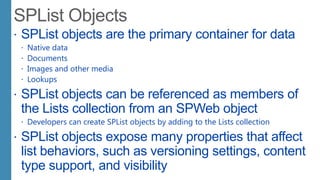
 SPList objects are the primary container for data
 Native data
 Documents
 Images and other media
 Lookups
 SPList objects can be referenced as members of
the Lists collection from an SPWeb object
 Developers can create SPList objects by adding to the Lists collection
 SPList objects expose many properties that affect
list behaviors, such as versioning settings, content
type support, and visibility
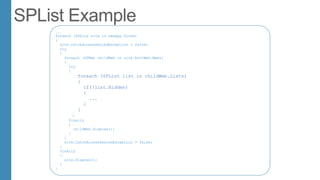
...
foreach (SPSite site in webApp.Sites)
{
site.CatchAccessDeniedException = false;
try
{
foreach (SPWeb childWeb in site.RootWeb.Webs)
{
try
{
foreach (SPList list in childWeb.Lists)
{
if(!list.Hidden)
{
...
}
}
}
finally
{
childWeb.Dispose();
}
}
site.CatchAccessDeniedException = false;
}
finally
{
site.Dispose();
}
}
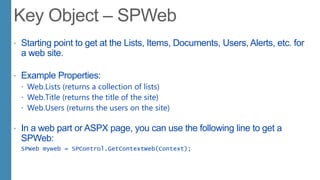
 Starting point to get at the Lists, Items, Documents, Users, Alerts, etc. for
a web site.
 Example Properties:
 Web.Lists (returns a collection of lists)
 Web.Title (returns the title of the site)
 Web.Users (returns the users on the site)
 In a web part or ASPX page, you can use the following line to get a
SPWeb:
SPWeb myweb = SPControl.GetContextWeb(Context);
 Get a SPList or SPDocumentLibrary object.
SPList mylist = web.Lists[“Events”];
 You can then call the .Items property to get all of the items:
SPListItemCollection items = mylist.Items;
 If you only want a subset of the items, call the GetItems method and
pass a SPQuery object
SPListItemCollection items = mylist.GetItems(query);
 To get data for a field, specify the field name in the
indexer for an SPListItem
foreach(SPListItem item in items)
{
Response.Write(item["Due Date"].ToString());
Response.Write(item["Status"].ToString());
Response.WRite(item["Title"].ToString());
}
SPWeb web = SPControl.GetContextWeb(Context);
SPList tasks = web.Lists["Tasks"];
SPListItemCollection items=tasks.Items;
foreach(SPListItem item in items)
{
output.Write(item["Title"].ToString() + item["Status"].ToString() +
"<br>");
}
 Most objects in WSS do not immediately update
data when you change a property
 You need to first call the Update() method on the
object
 This helps performance by minimizing SQL queries underneath the covers
 Example:
SPList mylist = web.Lists[“Tasks”];
mylist.Title=“Tasks!!!”;
mylist.Description=“Description!!”;
Mylist.Update();
 SPListItem is another example of an object where you need to
call update:
 Example:
SPListItem item = items[0];
item["Status"]="Not Started";
item["Title"]="Task Title";
item.Update();
 By default, the object model will not allow data updates if the form submitting the data
does not contain the „FormDigest‟ security key.
 FormDigest is based on username and site. It will time out after 30 minutes.
 Best solution is to include <FormDigest runat=“Server”/> web folder control in ASPX
page.
 If you do not need the security the FormDigest provides, you can set to
SPWeb.AllowUnsafeUpdates to bypass this check.
 Get the appropriate SPRole object:
SPRole admins = web.Roles["Administrator"];
 Call the AddUser method:
admins.AddUser("redmondgfoltz","Greg@hotmail.com","Greg Foltz","");
 If you create and destroy objects frequently, you may do extra SQL queries and have
code that is incorrect:
 Bad Example:
SPWeb web = SPControl.GetContextWeb(Context);
web.Lists["Tasks"].Title="mytitle";
web.Lists["Tasks"].Description="mydescription";
web.Lists["Tasks"].Update();
 Good Example:
SPWeb web = SPControl.GetContextWeb(Context);
SPList mylist = web.Lists["Tasks"];
mylist.Title="mytitle";
mylist.Description="mydescription";
mylist.Update();
 SharePoint will have web services APIs for accessing content. The
web services layer will be built on top of the server OM.
 Allows manipulation of Lists, Webs, Views, List Items, etc.
 Functionality will be similar to server object model, but with fewer
interfaces optimized to minimize transactions.
 Office11 (e.g. Excel, DataSheet, Work, Outlook, FrontPage, etc) use
web services to access data from WSS.
 GetListCollection
 GetListItems
 GetWebCollection
 UpdateList
 UpdateListItems
 GetWebInfo
 GetWebPart
 GetSmartPageDocument
 And more…
 Create a Windows Application
 In Visual Studio, choose „Add Web Reference‟
 Enter http://<server>/_vti_bin/lists.asmx to access the lists web service
 Other services include:
 UserGroups.asmx – users and groups
 Webs.asmx – Web information
 Views.asmx – View information
 Subscription.asmx – Subscriptions
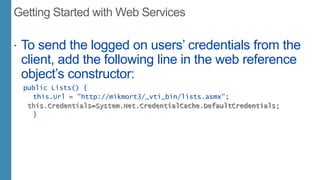
 To send the logged on users‟ credentials from the
client, add the following line in the web reference
object‟s constructor:
public Lists() {
this.Url = "http://mikmort3/_vti_bin/lists.asmx";
this.Credentials=System.Net.CredentialCache.DefaultCredentials;
}
 We support events on document libraries.
 Operations such as add, update, delete, check-in, check-out, etc.
 Events are asynchronous
 Events call IListEventSink managed interface.
 Documentation and Sample in the SDK
 The biggest goal is to minimize the number of SQL queries.
 It may be helpful to use the SQL profiler to monitor what the OM is doing
underneath the covers
 Minimizing managed/unmanaged transitions also a goal, though this is
mostly taken care within the OM.
 Page Execution will no longer be driven by
CAML (XML schema used in SharePoint)
 CAML is still used in several places
 Field Type Definitions
 Site and List Templates
 View definitions
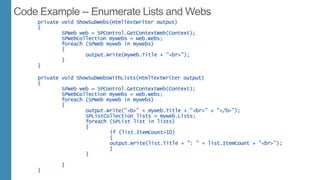
private void ShowSubWebs(HtmlTextWriter output)
{
SPWeb web = SPControl.GetContextWeb(Context);
SPWebCollection mywebs = web.Webs;
foreach (SPWeb myweb in mywebs)
{
output.Write(myweb.Title + "<br>");
}
}
private void ShowSubWebsWithLists(HtmlTextWriter output)
{
SPWeb web = SPControl.GetContextWeb(Context);
SPWebCollection mywebs = web.Webs;
foreach (SPWeb myweb in mywebs)
{
output.Write("<b>" + myweb.Title + "<br>" + "</b>");
SPListCollection lists = myweb.Lists;
foreach (SPList list in lists)
{
if (list.ItemCount>10)
{
output.Write(list.Title + ": " + list.ItemCount + "<br>");
}
}
}
}
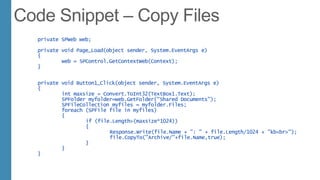
private SPWeb web;
private void Page_Load(object sender, System.EventArgs e)
{
web = SPControl.GetContextWeb(Context);
}
private void Button1_Click(object sender, System.EventArgs e)
{
int maxsize = Convert.ToInt32(TextBox1.Text);
SPFolder myfolder=web.GetFolder("Shared Documents");
SPFileCollection myfiles = myfolder.Files;
foreach (SPFile file in myfiles)
{
if (file.Length>(maxsize*1024))
{
Response.Write(file.Name + ": " + file.Length/1024 + "kb<br>");
file.CopyTo("Archive/"+file.Name,true);
}
}
}
private void Button1_Click(object sender, System.EventArgs e)
{
SPWeb web = SPControl.GetContextWeb(Context);
string username = TextBox1.Text;
string displayname = TextBox2.Text;
string email = TextBox3.Text;
SPRole admins = web.Roles["Administrator"];
try
{
admins.AddUser(username,email,displayname,"");
Label4.Text="Successfully added user";
}
catch(Exception ex)
{
Label4.Text=ex.ToString();
}
}
Mohan Arumugam
Technologies Specialist
E-mail : moohanan@gmail.com
Phone : +91 99406 53876
Profile
Thank You

SharePoint Object Model, Web Services and Events

  • 2.
    Consultant Certification Mohan Arumugam Technologies Specialist E-mail: moohanan@gmail.com Phone : +91 99406 53876 Profile Blogger Trainer Who Am I ?
  • 5.
    • Managed codeobject model on the server • Accessible via ASP.NET or any other server process • Implemented in C# • Exposes almost of all of the data stored in WSS • Examples of what can be done with the Object Mode:  Add, edit, delete, and retrieve data from SharePoint Lists  Create new lists and set list metadata (e.g. the fields in a list)  Set web properties  Work with documents in document libraries.  Perform administrative tasks such as creating webs, adding users, creating roles, etc.  Pretty much any functionality in the UI can be automated through the OM!
  • 6.
    • For contentstored in WSS, only registered set of web custom controls will run in pages • Inline script in the page will not execute  Code behind in pages can be made to work • All Executable code (e.g. web custom controls, web parts, and code-behind classes) needs to be installed on physical web server
  • 7.
    • SharePoint Foundation(WSS) Site and Workspace Provisioning Engine  Out-of-the-box Collaboration Services • SharePoint Server  User Profiles, Search, Workflows, WCM  BCS, Excel Services, Forms Services, Access, ECM SharePoint 2013 Foundation Browser Clients MS Word Clients MS Outlook Clients SharePoint 2013 Server Windows Server 2008 R2 / Windows 2012 Internet Information Services 7.0 or Above .NET Framework 4.5
  • 9.
    • Farm-Trust Solutions Introduced in SharePoint 2007  Hosted in the same process as SharePoint  Full server-side SharePoint API access • Sandbox Solutions  For existing SharePoint 2010 solutions only • SharePoint App Model  Introduced in SharePoint 2013  Provides for highest level of app isolation  Much cleaner & simpler install & upgrade process
  • 11.
     Requires x64operating system  Windows Server 2008/2012  Windows Server 2008R2/2013  SharePoint 2010 must be installed locally  SharePoint Foundation or SharePoint Server  Visual Studio 2010/2012  Additional software as required in the project
  • 12.
     Build aweb part  This is the best option to write code that functions are part of a WSS site or solution  There will be lots of documentation with the beta on how to build a web part.  Web Part is reusable and can be managed using all of the web part tools and UI.
  • 13.
     Build anASPX page  Code cannot live inline in a page within the site.  Creating pages underneath the /_layouts directory is often the best option for custom ASPX apps on top of SharePoint  This lets your page be accessible from any web. For example, if you build mypage.aspx in _Layouts, it is accessible from the following URLs:  http://myweb/_layouts/myapp/mypage.aspx  http://myweb/subweb1/_layouts/myapp/mypage.aspx  ASPX page will run using the context of the web under which it is running.
  • 14.
     Windows Executableor any other application  Object model can be called from pretty much any code context. It is not limited to just web parts or ASP.Net  For example, you could build a command-line utility to perform certain actions
  • 15.
     The objectmodel has three top-level objects:  SPWeb (represents an individual site)  SPSite (represents a site collection, which is a set of web sites)  SPGlobalAdmin (used for global administration settings)  In order to perform actions on data within a web, you must first get an SPWeb object.
  • 16.
     You shouldadd references to the WSS namespaces to your source files using Microsoft.SharePoint; using Microsoft.SharePoint.WebControls; using Microsoft.SharePoint.Administration; …
  • 17.
     List Data ◦SPField ◦ SPFieldCollection ◦ SPListCollection ◦ SPList ◦ SPListItemCollection ◦ SPListItem ◦ SPView  Administration ◦ SPGlobalAdmin ◦ SPQuota ◦ SPVirtualServer  Security ◦ SPGroup ◦ SPGroupCollection ◦ SPSite ◦ SPUser ◦ SPUserCollection  Documents ◦ SPDocumentLibrary ◦ SPFile ◦ SPFileCollection ◦ SPFolder
  • 18.
  • 19.
     SPFarm representsthe highest-level object in the hierarchy  It is a class AND a global, static object  SPFarm has no constructors  Cannot be created or disposed  Must be set to an existing static object  SPFarm.Local provides the entry point to the current farm  SPFarm exposes properties, methods, and events that affect farmwide settings  For example: DefaultServiceAccount, Servers, Services, Solutions, OnBackup, OnRestore, Upgrade SPFarm thisFarm = SPFarm.Local; if (thisFarm.CurrentUserIsAdministrator) { ... }
  • 20.
     SPService objectsrepresent farmwide services  For example: Forms Services, Access Services, PerformancePoint Services, SharePoint Server Search Service, Excel Calculation Services, User Profile Service, Business Data Connectivity Service, Managed Metadata Services  SPWebService is a type of SPService  Each Web Application belongs to an SPWebServiceSPFarm thisFarm = SPFarm.Local; if(thisFarm.CurrentUserIsAdministrator) { foreach (SPService svc in thisFarm.Services) { if (svc is SPWebService) { SPWebService webSvc = (SPWebService)svc; ... } } }
  • 21.
     SPWebApplication objectsmap to IIS Web sites  Not the same as a SharePoint Site or SharePoint Web  Each SPWebApplication has its own Web.config  Administrators typically create Web Applications by using SharePoint Central Administration  Developers can also create Web Applications by adding to the WebApplications collection of a SPWebService object, but this is not a typical action  More typically, developers work with an existing SPWebApplication  For example, to control Alert settings, create new site collections, or to control maximum file size settings  Developers can also delete Web Applications, but this is not a typical action  Exercise caution
  • 22.
    SPFarm thisFarm =SPFarm.Local; if(thisFarm.CurrentUserIsAdministrator) { foreach(SPService svc in thisFarm.Services) { if(svc is SPWebService) { SPWebService webSvc = (SPWebService)svc; foreach (SPWebApplication webApp in webSvc.WebApplications) { if (!webApp.IsAdministrationWebApplication) { ... } } } } }
  • 23.
     SPSite objectsrepresent site collections  Each SPSite has a RootWeb property (SPWeb)  Typically a security boundary and a container for users, groups, rights, permissions  SPSite objects can contain site-level features and solutions  Instantiate SPSite objects:  By using its constructor  As a member of the Sites collection of an SPWebApplication  By referencing the current context site  Different instantiation approaches require different disposal strategies
  • 24.
    ... foreach (SPSite sitein webApp.Sites) { site.CatchAccessDeniedException = false; try { ... site.CatchAccessDeniedException = false; } finally { site.Dispose(); } } SPSite remoteSite = new SPSite("http://sharepoint"); ... remoteSite.Dispose(); SPSite thisSite = SPContext.Current.Site; ... // Do NOT dispose thisSite
  • 25.
     SPWeb objectsrepresent SharePoint sites  Can contain pages, lists, and libraries  Can contain other objects (subwebs)  Instantiating SPWeb objects:  As the RootWeb property of an SPSite object  As a member of the AllWebs collection of an SPSite object  As the return value of the OpenWeb method of an SPSite object  By referencing the current context Web  Different instantiation approaches require different disposal strategies
  • 26.
    SPSite knownSite= newSPSite("http://sharepoint"); SPWeb knownWeb = knownSite.RootWeb; SPWeb knownSubWeb = knownSite.OpenWeb("/projects"); ... knownSubWeb.Dispose(); knownWeb.Dispose(); knownSite.Dispose(); SPWeb thisWeb = SPContext.Current.Web; ... // Do NOT dispose thisWeb ... foreach (SPWeb childWeb in site.RootWeb.Webs) { try { ... } finally { childWeb.Dispose(); } }
  • 27.
     SPList objectsare the primary container for data  Native data  Documents  Images and other media  Lookups  SPList objects can be referenced as members of the Lists collection from an SPWeb object  Developers can create SPList objects by adding to the Lists collection  SPList objects expose many properties that affect list behaviors, such as versioning settings, content type support, and visibility
  • 28.
    ... foreach (SPSite sitein webApp.Sites) { site.CatchAccessDeniedException = false; try { foreach (SPWeb childWeb in site.RootWeb.Webs) { try { foreach (SPList list in childWeb.Lists) { if(!list.Hidden) { ... } } } finally { childWeb.Dispose(); } } site.CatchAccessDeniedException = false; } finally { site.Dispose(); } }
  • 29.
     Starting pointto get at the Lists, Items, Documents, Users, Alerts, etc. for a web site.  Example Properties:  Web.Lists (returns a collection of lists)  Web.Title (returns the title of the site)  Web.Users (returns the users on the site)  In a web part or ASPX page, you can use the following line to get a SPWeb: SPWeb myweb = SPControl.GetContextWeb(Context);
  • 30.
     Get aSPList or SPDocumentLibrary object. SPList mylist = web.Lists[“Events”];  You can then call the .Items property to get all of the items: SPListItemCollection items = mylist.Items;  If you only want a subset of the items, call the GetItems method and pass a SPQuery object SPListItemCollection items = mylist.GetItems(query);
  • 31.
     To getdata for a field, specify the field name in the indexer for an SPListItem foreach(SPListItem item in items) { Response.Write(item["Due Date"].ToString()); Response.Write(item["Status"].ToString()); Response.WRite(item["Title"].ToString()); }
  • 32.
    SPWeb web =SPControl.GetContextWeb(Context); SPList tasks = web.Lists["Tasks"]; SPListItemCollection items=tasks.Items; foreach(SPListItem item in items) { output.Write(item["Title"].ToString() + item["Status"].ToString() + "<br>"); }
  • 33.
     Most objectsin WSS do not immediately update data when you change a property  You need to first call the Update() method on the object  This helps performance by minimizing SQL queries underneath the covers  Example: SPList mylist = web.Lists[“Tasks”]; mylist.Title=“Tasks!!!”; mylist.Description=“Description!!”; Mylist.Update();
  • 34.
     SPListItem isanother example of an object where you need to call update:  Example: SPListItem item = items[0]; item["Status"]="Not Started"; item["Title"]="Task Title"; item.Update();
  • 35.
     By default,the object model will not allow data updates if the form submitting the data does not contain the „FormDigest‟ security key.  FormDigest is based on username and site. It will time out after 30 minutes.  Best solution is to include <FormDigest runat=“Server”/> web folder control in ASPX page.  If you do not need the security the FormDigest provides, you can set to SPWeb.AllowUnsafeUpdates to bypass this check.
  • 36.
     Get theappropriate SPRole object: SPRole admins = web.Roles["Administrator"];  Call the AddUser method: admins.AddUser("redmondgfoltz","Greg@hotmail.com","Greg Foltz","");
  • 37.
     If youcreate and destroy objects frequently, you may do extra SQL queries and have code that is incorrect:  Bad Example: SPWeb web = SPControl.GetContextWeb(Context); web.Lists["Tasks"].Title="mytitle"; web.Lists["Tasks"].Description="mydescription"; web.Lists["Tasks"].Update();  Good Example: SPWeb web = SPControl.GetContextWeb(Context); SPList mylist = web.Lists["Tasks"]; mylist.Title="mytitle"; mylist.Description="mydescription"; mylist.Update();
  • 38.
     SharePoint willhave web services APIs for accessing content. The web services layer will be built on top of the server OM.  Allows manipulation of Lists, Webs, Views, List Items, etc.  Functionality will be similar to server object model, but with fewer interfaces optimized to minimize transactions.  Office11 (e.g. Excel, DataSheet, Work, Outlook, FrontPage, etc) use web services to access data from WSS.
  • 39.
     GetListCollection  GetListItems GetWebCollection  UpdateList  UpdateListItems  GetWebInfo  GetWebPart  GetSmartPageDocument  And more…
  • 40.
     Create aWindows Application  In Visual Studio, choose „Add Web Reference‟  Enter http://<server>/_vti_bin/lists.asmx to access the lists web service  Other services include:  UserGroups.asmx – users and groups  Webs.asmx – Web information  Views.asmx – View information  Subscription.asmx – Subscriptions
  • 41.
     To sendthe logged on users‟ credentials from the client, add the following line in the web reference object‟s constructor: public Lists() { this.Url = "http://mikmort3/_vti_bin/lists.asmx"; this.Credentials=System.Net.CredentialCache.DefaultCredentials; }
  • 42.
     We supportevents on document libraries.  Operations such as add, update, delete, check-in, check-out, etc.  Events are asynchronous  Events call IListEventSink managed interface.  Documentation and Sample in the SDK
  • 43.
     The biggestgoal is to minimize the number of SQL queries.  It may be helpful to use the SQL profiler to monitor what the OM is doing underneath the covers  Minimizing managed/unmanaged transitions also a goal, though this is mostly taken care within the OM.
  • 44.
     Page Executionwill no longer be driven by CAML (XML schema used in SharePoint)  CAML is still used in several places  Field Type Definitions  Site and List Templates  View definitions
  • 45.
    private void ShowSubWebs(HtmlTextWriteroutput) { SPWeb web = SPControl.GetContextWeb(Context); SPWebCollection mywebs = web.Webs; foreach (SPWeb myweb in mywebs) { output.Write(myweb.Title + "<br>"); } } private void ShowSubWebsWithLists(HtmlTextWriter output) { SPWeb web = SPControl.GetContextWeb(Context); SPWebCollection mywebs = web.Webs; foreach (SPWeb myweb in mywebs) { output.Write("<b>" + myweb.Title + "<br>" + "</b>"); SPListCollection lists = myweb.Lists; foreach (SPList list in lists) { if (list.ItemCount>10) { output.Write(list.Title + ": " + list.ItemCount + "<br>"); } } } }
  • 46.
    private SPWeb web; privatevoid Page_Load(object sender, System.EventArgs e) { web = SPControl.GetContextWeb(Context); } private void Button1_Click(object sender, System.EventArgs e) { int maxsize = Convert.ToInt32(TextBox1.Text); SPFolder myfolder=web.GetFolder("Shared Documents"); SPFileCollection myfiles = myfolder.Files; foreach (SPFile file in myfiles) { if (file.Length>(maxsize*1024)) { Response.Write(file.Name + ": " + file.Length/1024 + "kb<br>"); file.CopyTo("Archive/"+file.Name,true); } } }
  • 47.
    private void Button1_Click(objectsender, System.EventArgs e) { SPWeb web = SPControl.GetContextWeb(Context); string username = TextBox1.Text; string displayname = TextBox2.Text; string email = TextBox3.Text; SPRole admins = web.Roles["Administrator"]; try { admins.AddUser(username,email,displayname,""); Label4.Text="Successfully added user"; } catch(Exception ex) { Label4.Text=ex.ToString(); } }
  • 49.
    Mohan Arumugam Technologies Specialist E-mail: moohanan@gmail.com Phone : +91 99406 53876 Profile Thank You