Welcome and Intro
DPDK Summit India - Bangalore - 2018
5G + IOT requires NETWORK
transformation
5G
50 B 2 Connected Devices
Device Centric Network
50X Peak Data Rate
10X Latency Reduction
1000X Capacity
2 ZB Global
Data Traffic
Annually by 20191
Sources: 1. Cisco Virtual Networking Index, 2015. 2. IDC, IoT Market Forecast: Worldwide IoT Predictions, 2015.
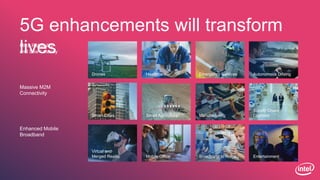
5G enhancements will transform
lives
Ultra Reliability
and Low Latency
Massive M2M
Connectivity
Enhanced Mobile
Broadband
Broadband to Home
Mobile Office
Healthcare Emergency Services Autonomous Driving
Manufacturing
Supply Chain/
Logistics
Virtual and
Merged Reality Entertainment
Smart Agriculture
Smart Cities
Drones
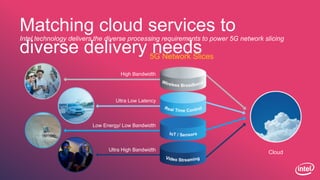
Intel technology delivers the diverse processing requirements to power 5G network slicing
High Bandwidth
Ultra Low Latency
Low Energy/ Low Bandwidth
Ultra High Bandwidth
Cloud
5G Network Slices
Matching cloud services to
diverse delivery needs
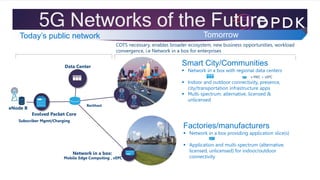
5G Networks of the Future
5
Today’s public network Tomorrow
Network in a box:
Mobile Edge Computing , vEPC
eNode B
Evolved Packet Core
Subscriber Mgmt/Charging
Backhaul
Data Center
Smart City/Communities
 Network in a box with regional data centers
 Indoor and outdoor connectivity, presence,
city/transportation infrastructure apps
 Multi-spectrum: alternative, licensed &
unlicensed
Factories/manufacturers
 Network in a box providing application slice(s)
 Application and multi-spectrum (alternative,
licensed, unlicensed) for indoor/outdoor
connectivity
RRH
RRH
v MEC + vEPC
COTS necessary, enables broader ecosystem, new business opportunities, workload
convergence, i.e Network in a box for enterprises
DEVICE/ MACHINE/ON-
SITE EDGE/FOG ACCESS TECHNOLOGY
ACCESS
NETWORK/FAR EDGE
CORE
NETWORK
INTERNET / CLOUD
Network function virtualization
Hypervisor
Operating System
C-RAN (Remote Radio Heads)
Small cells
Security
4G
3G/2G
5G
IOT
CCG/DCG
Wired
Sliceable Virtualized Network
Smart Device / Machines as Integral
Part of E2E Comms Network
5G + IOT E2E Communication Transformation
NB-IOT, CATM, LORA, SigFox
WiFi/WiGig
Edge
Compute
Edge Compute
Complex Packet Processing Pipeline with
QoS Support
7
Packet Look ups in an OpenFlow* switch.
8
Port Src
MAC
Dest
Mac
VLAN
ID
Priority Etherty
pe
Src IP Dest IP IP
TOS
Action
* * * * * * 192.168
.*.*
192.169
.*.*
32
Q1
* * 0A.C8.* 10
* * * * * Port1
* * * * * * 172.19.*
.*
172.19.*
.*
72
Q2
* * * * * * 172.19.*
.*
172.19.*
.*
96
Q3
* Third party Trademark, Other names and brands may be claimed as the property of others.
Questions?
5G + IOT requires NETWORK
transformation
2 ZB
Global
Data Traffic
Annually by 20191
50B Connected
Devices by 20202
Sources: 1. Cisco Virtual Networking Index, 2015. 2. IDC, IoT Market Forecast: Worldwide IoT Predictions, 2015.
Transfor
ming
Architecture
Value Chain
Business
Process
Workforce
Agility +
SCALE
VIRTUALI
ZED
SOFTWARE DE
CLOUD
ENABLED
with IA
1
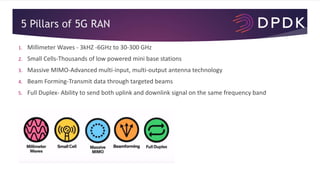
5 Pillars of 5G RAN
1
1. Millimeter Waves - 3kHZ -6GHz to 30-300 GHz
2. Small Cells-Thousands of low powered mini base stations
3. Massive MIMO-Advanced multi-input, multi-output antenna technology
4. Beam Forming-Transmit data through targeted beams
5. Full Duplex- Ability to send both uplink and downlink signal on the same frequency band

Introduction- 5g.pptx

  • 1.
    Welcome and Intro DPDKSummit India - Bangalore - 2018
  • 2.
    5G + IOTrequires NETWORK transformation 5G 50 B 2 Connected Devices Device Centric Network 50X Peak Data Rate 10X Latency Reduction 1000X Capacity 2 ZB Global Data Traffic Annually by 20191 Sources: 1. Cisco Virtual Networking Index, 2015. 2. IDC, IoT Market Forecast: Worldwide IoT Predictions, 2015.
  • 3.
    5G enhancements willtransform lives Ultra Reliability and Low Latency Massive M2M Connectivity Enhanced Mobile Broadband Broadband to Home Mobile Office Healthcare Emergency Services Autonomous Driving Manufacturing Supply Chain/ Logistics Virtual and Merged Reality Entertainment Smart Agriculture Smart Cities Drones
  • 4.
    Intel technology deliversthe diverse processing requirements to power 5G network slicing High Bandwidth Ultra Low Latency Low Energy/ Low Bandwidth Ultra High Bandwidth Cloud 5G Network Slices Matching cloud services to diverse delivery needs
  • 5.
    5G Networks ofthe Future 5 Today’s public network Tomorrow Network in a box: Mobile Edge Computing , vEPC eNode B Evolved Packet Core Subscriber Mgmt/Charging Backhaul Data Center Smart City/Communities  Network in a box with regional data centers  Indoor and outdoor connectivity, presence, city/transportation infrastructure apps  Multi-spectrum: alternative, licensed & unlicensed Factories/manufacturers  Network in a box providing application slice(s)  Application and multi-spectrum (alternative, licensed, unlicensed) for indoor/outdoor connectivity RRH RRH v MEC + vEPC COTS necessary, enables broader ecosystem, new business opportunities, workload convergence, i.e Network in a box for enterprises
  • 6.
    DEVICE/ MACHINE/ON- SITE EDGE/FOGACCESS TECHNOLOGY ACCESS NETWORK/FAR EDGE CORE NETWORK INTERNET / CLOUD Network function virtualization Hypervisor Operating System C-RAN (Remote Radio Heads) Small cells Security 4G 3G/2G 5G IOT CCG/DCG Wired Sliceable Virtualized Network Smart Device / Machines as Integral Part of E2E Comms Network 5G + IOT E2E Communication Transformation NB-IOT, CATM, LORA, SigFox WiFi/WiGig Edge Compute Edge Compute
  • 7.
    Complex Packet ProcessingPipeline with QoS Support 7
  • 8.
    Packet Look upsin an OpenFlow* switch. 8 Port Src MAC Dest Mac VLAN ID Priority Etherty pe Src IP Dest IP IP TOS Action * * * * * * 192.168 .*.* 192.169 .*.* 32 Q1 * * 0A.C8.* 10 * * * * * Port1 * * * * * * 172.19.* .* 172.19.* .* 72 Q2 * * * * * * 172.19.* .* 172.19.* .* 96 Q3 * Third party Trademark, Other names and brands may be claimed as the property of others.
  • 9.
  • 10.
    5G + IOTrequires NETWORK transformation 2 ZB Global Data Traffic Annually by 20191 50B Connected Devices by 20202 Sources: 1. Cisco Virtual Networking Index, 2015. 2. IDC, IoT Market Forecast: Worldwide IoT Predictions, 2015. Transfor ming Architecture Value Chain Business Process Workforce Agility + SCALE VIRTUALI ZED SOFTWARE DE CLOUD ENABLED with IA 1
  • 11.
    5 Pillars of5G RAN 1 1. Millimeter Waves - 3kHZ -6GHz to 30-300 GHz 2. Small Cells-Thousands of low powered mini base stations 3. Massive MIMO-Advanced multi-input, multi-output antenna technology 4. Beam Forming-Transmit data through targeted beams 5. Full Duplex- Ability to send both uplink and downlink signal on the same frequency band

Editor's Notes

  • #3 1.3EB per month @2017 and expected to grow to 14EB @2023. 3.9GB per smartphone to 18GB @2023 https://economictimes.indiatimes.com/tech/internet/data-usage-per-smartphone-in-india-to-grow-5-fold-by-2023-ericsson/articleshow/61838209.cms
  • #6 For instance, this is an example of what the future network could look like Smart cities with various connectivity for coverage and specific applications for public safety, health, transportation, and infrastructure could be a slice or multiple slices out of the network Factories and Manufacturers have different application and coverage needs, but the basic foundation is similar
  • #7 Here is a diagram of the future network. Provides an ample play for dpdk to meet the various requirements like higher throughput, lower latency, burst traffic handling, QoS etc.
  • #11 he massive influx of devices and use cases coming with 5G and IOT will drive tremendous pressure on next generation infrastructure. How do you cope with the volume and complexity of that data on the infrastructure? How do you enable the next gen services that have yet to be invented (the next Uber, next Airbnb, etc.)? The network must scale to support billions of devices, and a wide variety of use cases. The amount of annual global data traffic has been doubling since 2011. And by 2019, Cisco says that 2 zettabytes of traffic will traverse global networks annually. In case you don’t know what a zettabyte is, it’s 1021. Just to give you some sense for how BIG that number is, one zettabyte is equivalent to 20 billion dual-layer Blu Ray discs.   All of these factors leading to need to transform the network to cope with increasing capacity demands and accelerate delivery of new services and capabilities. What’s the technology shift behind this transformation? Today, the network is composed of purpose-built infrastructure with each device containing its own management software. You have separate pieces of equipment for functions like routing, virtual private networking, and firewall. This makes it very difficult for operators to deploy new services as each device is individually provisioned.   The network of tomorrow will be deployed using Network Functions Virtualization and Software Defined Networking, or NFV & SDN. Instead of running a separate router, VPN, and firewall on three different pieces of hardware, you can run all three on the same Intel architecture based infrastructure. This has obvious CAPEX benefits – consolidate 3 hardware purchases into one. Add to that Software Defined Networking. Now you’re adding intelligence to network. In SSN, the software -- let’s say firewall software – tells the networks the resources it needs through orchestration software. These resources are then automatically configured on the hardware – all the way through the network. SDN can greatly reduce OPEX by making it easier to provision services throughout the network. Additionally, you can swap out hardware without reconfiguring your orchestration software. This is providing tremendous value to service providers to terms of driving network scale and agility while reducing CAPEX and OPEX expenditures. But while this transformation includes architectural & technology transformation, it is also equally importantly about transforming the way network operators do business to make this architectural shift a reality. It means bringing new players into the value chain, redefining business processes, and retooling workforce skillsets away from purpose-built hardware to software-defined technologies. The result is cloud-ready networks. Networks that are scalable enough to cope with next-generation demands on the number of devices, amount of traffic, level of performance, and complexity and variety of use cases. Networks that are agile enough to develop and deploy new services with “push-button” ease; highly automated, secured, and managed. And these scalable, agile networks enable agile businesses – driving a quicker pace of business model innovation and revenue generation.