Introduction to Concept of Automata

                                       Abhineet Anand
                                      Assistant Professor

                              Dept. of Computer Science And Engineering,
                                     College of Engineering Studies.
                         University of Petroleum and Energy Studies, Dehradun.


                                        January 22, 2013


Abhineet Anand (UPES, Dehradun)        Introduction:Concept of Automata          January 22, 2013   1 / 12
Outline


1   Automata:The Methods and The Madness


2   Structural Representations


3   Automata and Complexity


4   The Central Concept of Automata Theory


 Abhineet Anand (UPES, Dehradun)   Introduction:Concept of Automata   January 22, 2013   2 / 12
Automata:The Methods and The Madness


      Automata Theory is the study of abstract computing devices, or
      ”machine”.
      Before there were computers, in 1930’s, A. Turing studded an abstract
      machine that had all the capabilities of today’s computers, at least as
      far as in what they could compute.


Abhineet Anand (UPES, Dehradun)   Introduction:Concept of Automata   January 22, 2013   3 / 12
Automata:The Methods and The Madness


      Automata, originally proposed to model brain function, turned out to
      be extremely useful for a variety of other purposes, like
             Software for designing and checking the behavior of digital circuits.
             The ”lexical Analyzer” of a typical complier.
             Software for scanning large bodies of text.
             Software for verifying system of all types that have a finite number of
             distinct states, such as communication protocol or protocols for secure
             exchange of information.


Abhineet Anand (UPES, Dehradun)   Introduction:Concept of Automata   January 22, 2013   4 / 12
Develop feeling about Automata


       There are system or component that may be viewed as being at all
       times in one of a finite number of ”states”.
       The purpose of a state is to remember the relevant portion of the
       system’s history.
       Since there are only a finite number of states, the entire history
       generally cannot be remembered, so the system must be designed
       carefully, to remember what is important and forget what is not.
       The advantage of having only a finite number of states is that we can
       implement the system with a fixed set of resources.


 Abhineet Anand (UPES, Dehradun)   Introduction:Concept of Automata   January 22, 2013   5 / 12
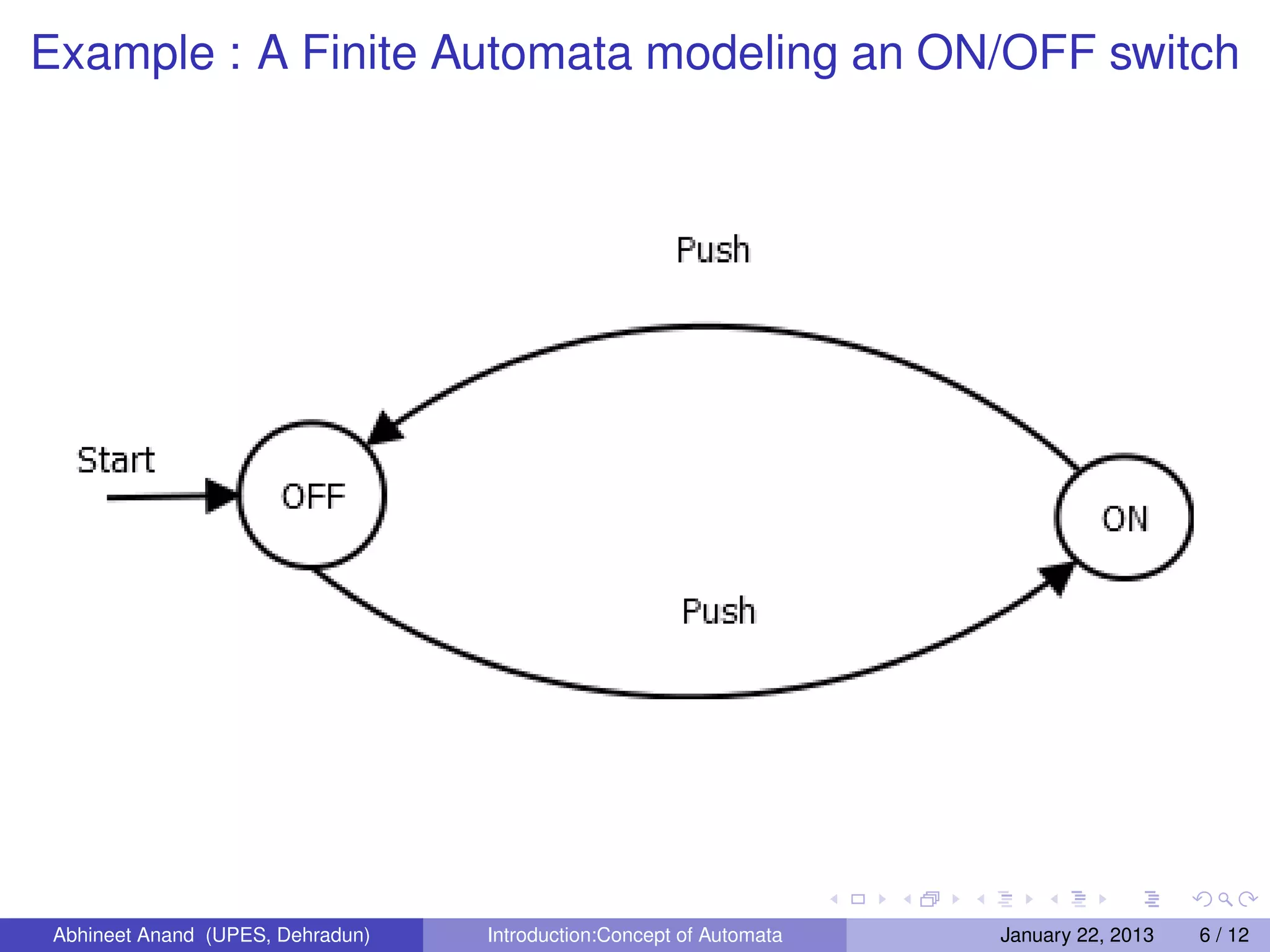
Example : A Finite Automata modeling an ON/OFF switch


 Abhineet Anand (UPES, Dehradun)   Introduction:Concept of Automata   January 22, 2013   6 / 12
Structural Representations


There are two important Notation that plays an important role in the study
of automata and their applications.
       Grammers: are useful models when designing software that
       processes data with a recursive structure.
       The best-known example is a ”parser”, the component of a complier
       that deals with the recursively nested features of a typical
       programming language, such as expression - arithmetic, conditional,
       and so on.
       Regular Expression: also denote the structure of data.
       The pattern of string they describe are exactly the same as what can
       be described by finite automata.


 Abhineet Anand (UPES, Dehradun)   Introduction:Concept of Automata   January 22, 2013   7 / 12
Automata and Complexity


Automata are essential for the study of the limits of computation. There
are two important issues:
      What can a computer do at all? - Decidability.
      What can a computer do efficiently? - Intractability.


Abhineet Anand (UPES, Dehradun)   Introduction:Concept of Automata   January 22, 2013   8 / 12
The Central Concept of Automata Theory


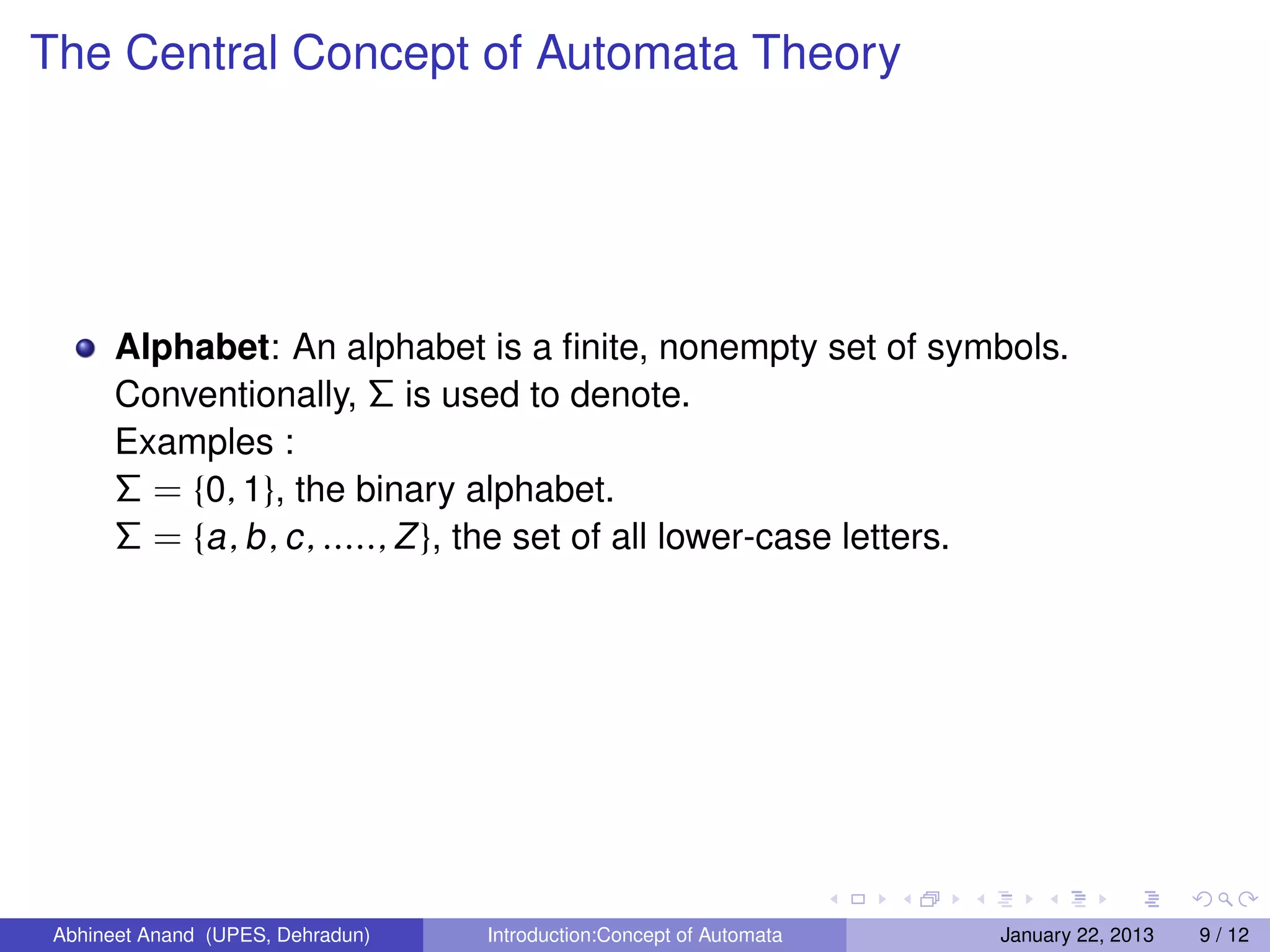
       Alphabet: An alphabet is a finite, nonempty set of symbols.
       Conventionally, Σ is used to denote.
       Examples :
       Σ = {0, 1}, the binary alphabet.
       Σ = {a , b , c , ....., Z }, the set of all lower-case letters.


 Abhineet Anand (UPES, Dehradun)   Introduction:Concept of Automata   January 22, 2013   9 / 12
The Central Concept of Automata Theory

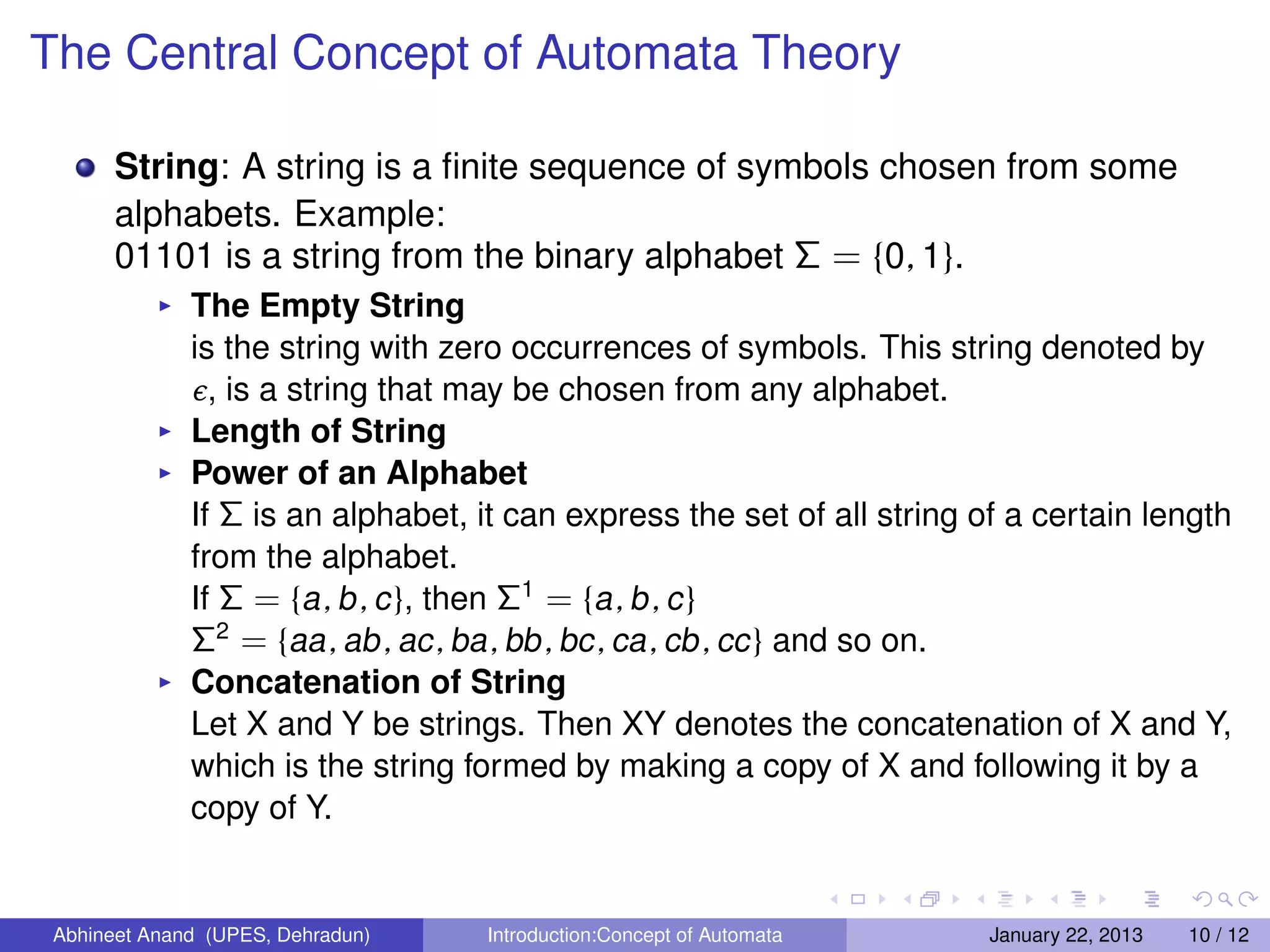
       String: A string is a finite sequence of symbols chosen from some
       alphabets. Example:
       01101 is a string from the binary alphabet Σ = {0, 1}.
              The Empty String
              is the string with zero occurrences of symbols. This string denoted by
              ϸ , is a string that may be chosen from any alphabet.
              Length of String
              Power of an Alphabet
              If Σ is an alphabet, it can express the set of all string of a certain length
              from the alphabet.
              If Σ = {a , b , c }, then Σ1 = {a , b , c }
              Σ2 = {aa , ab , ac , ba , bb , bc , ca , cb , cc } and so on.
              Concatenation of String
              Let X and Y be strings. Then XY denotes the concatenation of X and Y,
              which is the string formed by making a copy of X and following it by a
              copy of Y.


 Abhineet Anand (UPES, Dehradun)   Introduction:Concept of Automata      January 22, 2013   10 / 12
The Central Concept of Automata Theory


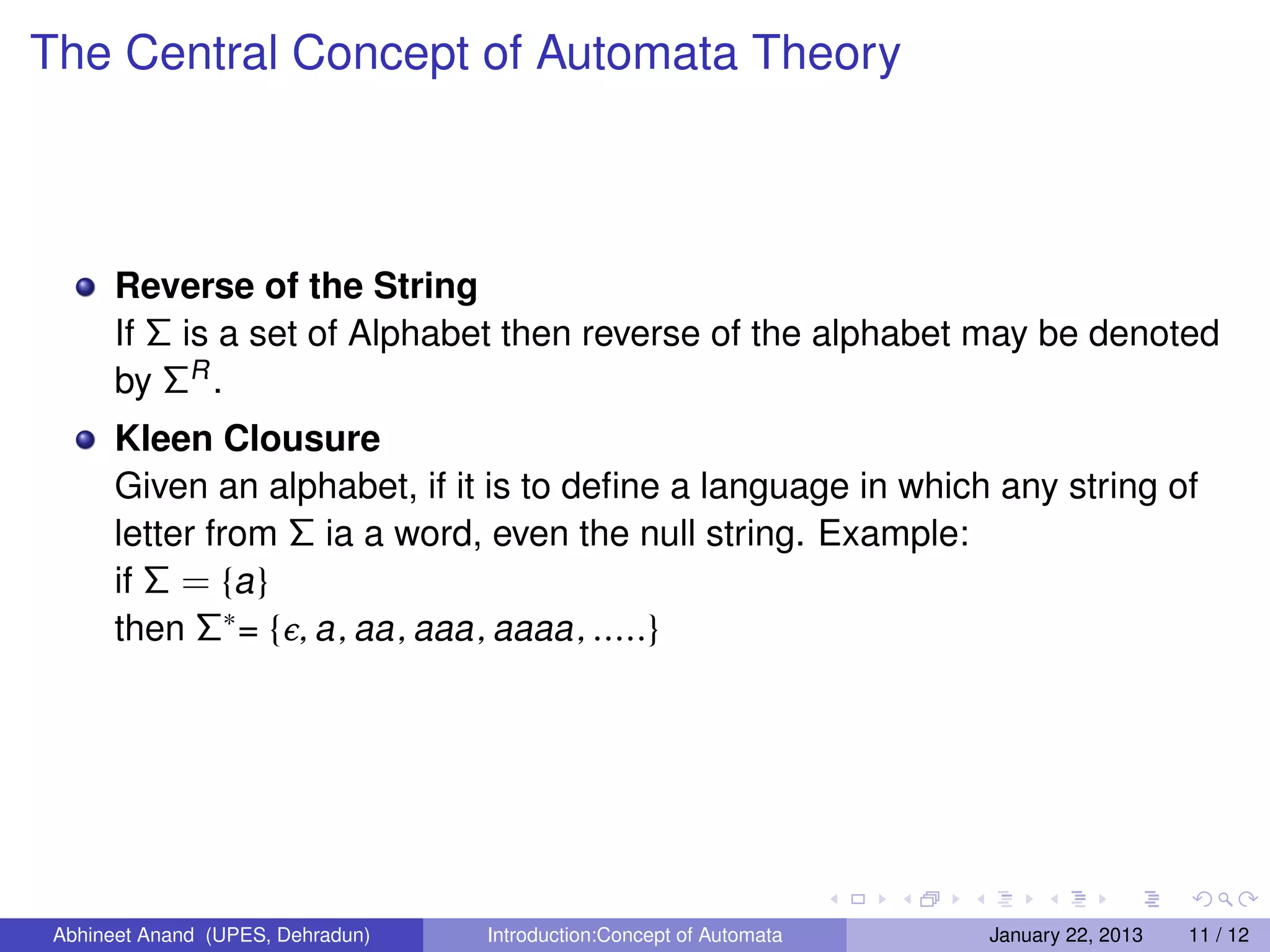
       Reverse of the String
       If Σ is a set of Alphabet then reverse of the alphabet may be denoted
       by ΣR .
       Kleen Clousure
       Given an alphabet, if it is to define a language in which any string of
       letter from Σ ia a word, even the null string. Example:
       if Σ = {a }
       then Σ∗ = {ϸ, a , aa , aaa , aaaa , .....}


 Abhineet Anand (UPES, Dehradun)   Introduction:Concept of Automata   January 22, 2013   11 / 12
THANK YOU


Abhineet Anand (UPES, Dehradun)   Introduction:Concept of Automata   January 22, 2013   12 / 12

Introduction

  • 1.
    Introduction to Conceptof Automata Abhineet Anand Assistant Professor Dept. of Computer Science And Engineering, College of Engineering Studies. University of Petroleum and Energy Studies, Dehradun. January 22, 2013 Abhineet Anand (UPES, Dehradun) Introduction:Concept of Automata January 22, 2013 1 / 12
  • 2.
    Outline 1 Automata:The Methods and The Madness 2 Structural Representations 3 Automata and Complexity 4 The Central Concept of Automata Theory Abhineet Anand (UPES, Dehradun) Introduction:Concept of Automata January 22, 2013 2 / 12
  • 3.
    Automata:The Methods andThe Madness Automata Theory is the study of abstract computing devices, or ”machine”. Before there were computers, in 1930’s, A. Turing studded an abstract machine that had all the capabilities of today’s computers, at least as far as in what they could compute. Abhineet Anand (UPES, Dehradun) Introduction:Concept of Automata January 22, 2013 3 / 12
  • 4.
    Automata:The Methods andThe Madness Automata, originally proposed to model brain function, turned out to be extremely useful for a variety of other purposes, like Software for designing and checking the behavior of digital circuits. The ”lexical Analyzer” of a typical complier. Software for scanning large bodies of text. Software for verifying system of all types that have a finite number of distinct states, such as communication protocol or protocols for secure exchange of information. Abhineet Anand (UPES, Dehradun) Introduction:Concept of Automata January 22, 2013 4 / 12
  • 5.
    Develop feeling aboutAutomata There are system or component that may be viewed as being at all times in one of a finite number of ”states”. The purpose of a state is to remember the relevant portion of the system’s history. Since there are only a finite number of states, the entire history generally cannot be remembered, so the system must be designed carefully, to remember what is important and forget what is not. The advantage of having only a finite number of states is that we can implement the system with a fixed set of resources. Abhineet Anand (UPES, Dehradun) Introduction:Concept of Automata January 22, 2013 5 / 12
  • 6.
    Example : AFinite Automata modeling an ON/OFF switch Abhineet Anand (UPES, Dehradun) Introduction:Concept of Automata January 22, 2013 6 / 12
  • 7.
    Structural Representations There aretwo important Notation that plays an important role in the study of automata and their applications. Grammers: are useful models when designing software that processes data with a recursive structure. The best-known example is a ”parser”, the component of a complier that deals with the recursively nested features of a typical programming language, such as expression - arithmetic, conditional, and so on. Regular Expression: also denote the structure of data. The pattern of string they describe are exactly the same as what can be described by finite automata. Abhineet Anand (UPES, Dehradun) Introduction:Concept of Automata January 22, 2013 7 / 12
  • 8.
    Automata and Complexity Automataare essential for the study of the limits of computation. There are two important issues: What can a computer do at all? - Decidability. What can a computer do efficiently? - Intractability. Abhineet Anand (UPES, Dehradun) Introduction:Concept of Automata January 22, 2013 8 / 12
  • 9.
    The Central Conceptof Automata Theory Alphabet: An alphabet is a finite, nonempty set of symbols. Conventionally, Σ is used to denote. Examples : Σ = {0, 1}, the binary alphabet. Σ = {a , b , c , ....., Z }, the set of all lower-case letters. Abhineet Anand (UPES, Dehradun) Introduction:Concept of Automata January 22, 2013 9 / 12
  • 10.
    The Central Conceptof Automata Theory String: A string is a finite sequence of symbols chosen from some alphabets. Example: 01101 is a string from the binary alphabet Σ = {0, 1}. The Empty String is the string with zero occurrences of symbols. This string denoted by ϸ , is a string that may be chosen from any alphabet. Length of String Power of an Alphabet If Σ is an alphabet, it can express the set of all string of a certain length from the alphabet. If Σ = {a , b , c }, then Σ1 = {a , b , c } Σ2 = {aa , ab , ac , ba , bb , bc , ca , cb , cc } and so on. Concatenation of String Let X and Y be strings. Then XY denotes the concatenation of X and Y, which is the string formed by making a copy of X and following it by a copy of Y. Abhineet Anand (UPES, Dehradun) Introduction:Concept of Automata January 22, 2013 10 / 12
  • 11.
    The Central Conceptof Automata Theory Reverse of the String If Σ is a set of Alphabet then reverse of the alphabet may be denoted by ΣR . Kleen Clousure Given an alphabet, if it is to define a language in which any string of letter from Σ ia a word, even the null string. Example: if Σ = {a } then Σ∗ = {ϸ, a , aa , aaa , aaaa , .....} Abhineet Anand (UPES, Dehradun) Introduction:Concept of Automata January 22, 2013 11 / 12
  • 12.
    THANK YOU Abhineet Anand(UPES, Dehradun) Introduction:Concept of Automata January 22, 2013 12 / 12