
Intro to the Alfresco Public
API
Jeff Potts
Chief Community Officer
Doesn’t Alfresco already have
an API?
Yes, but…
• Not really public (things change)
• Not versioned
• Not well documented
• Doesn’t work for cloud
The Alfresco Public API addresses these
limitations
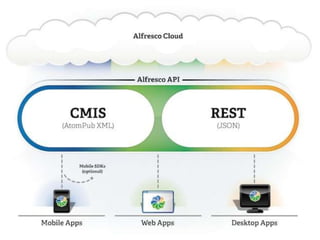
Vision is to have a single API that works
across cloud and on-premise
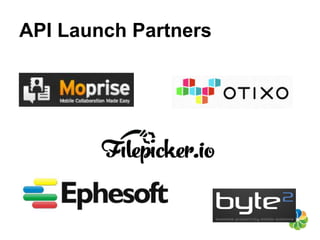
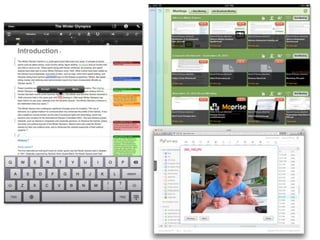
API Launch Partners
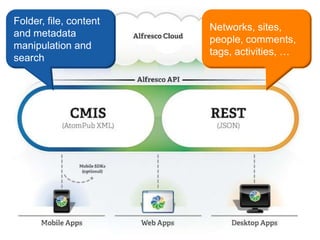
Folder, file, content
and metadata
manipulation and
search
Networks, sites,
people, comments,
tags, activities, …
Getting Started
1. Understand OAuth2
2. Register your app
3. Grab a client-side CMIS library
• Or an SDK if coding a mobile app
4. Start coding!
Step 1: Groking OAuth2
Defined in RFC-6749
Secure authentication
• 3rd party apps don’t ever see the user’s
password
Unambiguously identifies:
• API provider (e.g. Alfresco)
• Client application (e.g. your application)
• End-user (e.g. an Alfresco Cloud user)
OAuth2 & Alfresco
Used to secure the Alfresco API
Only authentication mechanism provided for
APIs in Alfresco Cloud
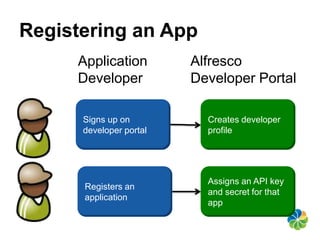
Registering an App
Application
Developer
Alfresco
Developer Portal
Creates developer
profile
Assigns an API key
and secret for that
app
Signs up on
developer portal
Registers an
application
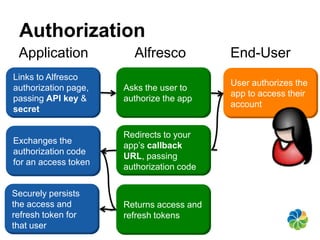
Authorization
Application Alfresco End-User
Links to Alfresco
authorization page,
passing API key &
secret
Asks the user to
authorize the app
User authorizes the
app to access their
account
Redirects to your
app’s callback
URL, passing
authorization code
Exchanges the
authorization code
for an access token
Returns access and
refresh tokens
Securely persists
the access and
refresh token for
that user
Making API Calls
Calls APIs, passing
the access token in
the Authorization
HTTP header
Identifies user from
access token,
executes API call
Application Alfresco
Refresh Flow
Calls APIs, passing
the access token in
the Authorization
HTTP header
Returns 401 error,
indicating access
token has expired
Refreshes access
token, passing
refresh token
Returns new access
token
Application Alfresco
OAuth2 library can hide
details
Spring Social
http://www.springsource.org/spring-social
Google OAuth2 Client
https://developers.google.com/accounts/doc
s/OAuth2#libraries
Step 2: Register Your App
http://www.alfresco.com/develop
• Alfresco Cloud Account
• Registered Developer Account
Add as many applications as you want
Key, secret, callback URL
Step 3: CMIS Library
Apache Chemistry is the umbrella project for
all CMIS related projects at the ASF
• OpenCMIS (Java, client and server)
• cmislib (Python, client)
• phpclient (PHP, client)
• DotCMIS (.NET, client)
• ObjectiveCMIS (Objective-C)
Other client libraries exist
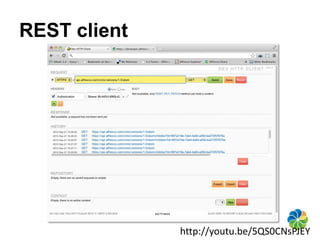
REST client
http://youtu.be/5QS0CNsPJEY
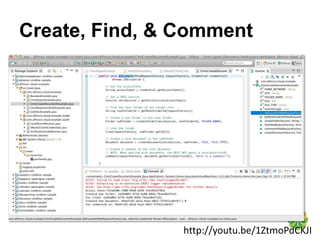
Create, Find, & Comment
http://youtu.be/1ZtmoPdCKJI
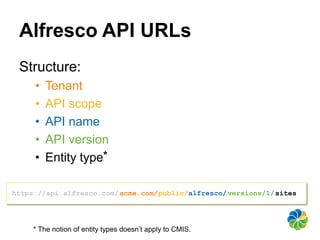
Alfresco API URLs
Structure:
• Tenant
• API scope
• API name
• API version
• Entity type
https://api.alfresco.com/
* The notion of entity types doesn’t apply to CMIS.
*
public/acme.com/ sitesalfresco/versions/1/
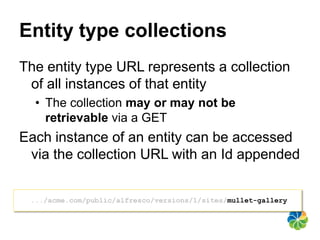
Entity type collections
The entity type URL represents a collection
of all instances of that entity
• The collection may or may not be
retrievable via a GET
Each instance of an entity can be accessed
via the collection URL with an Id appended
.../acme.com/public/alfresco/versions/1/sites/mullet-gallery
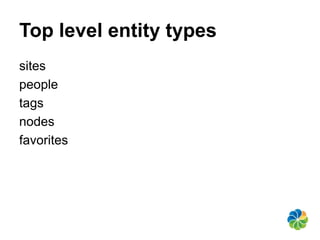
Top level entity types
sites
people
tags
nodes
favorites
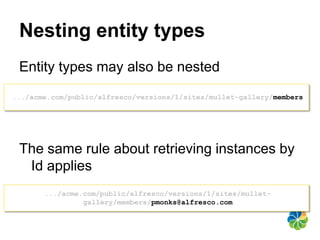
Nesting entity types
Entity types may also be nested
The same rule about retrieving instances by
Id applies
.../acme.com/public/alfresco/versions/1/sites/mullet-gallery/members
.../acme.com/public/alfresco/versions/1/sites/mullet-
gallery/members/pmonks@alfresco.com
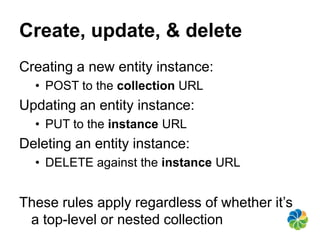
Create, update, & delete
Creating a new entity instance:
• POST to the collection URL
Updating an entity instance:
• PUT to the instance URL
Deleting an entity instance:
• DELETE against the instance URL
These rules apply regardless of whether it’s
a top-level or nested collection
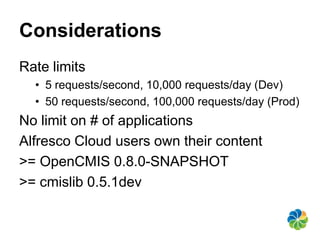
Considerations
Rate limits
• 5 requests/second, 10,000 requests/day (Dev)
• 50 requests/second, 100,000 requests/day (Prod)
No limit on # of applications
Alfresco Cloud users own their content
>= OpenCMIS 0.8.0-SNAPSHOT
>= cmislib 0.5.1dev
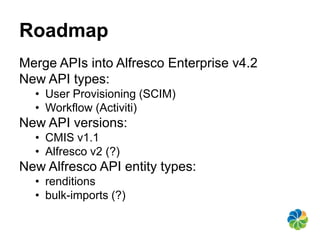
Roadmap
Merge APIs into Alfresco Enterprise v4.2
New API types:
• User Provisioning (SCIM)
• Workflow (Activiti)
New API versions:
• CMIS v1.1
• Alfresco v2 (?)
New Alfresco API entity types:
• renditions
• bulk-imports (?)
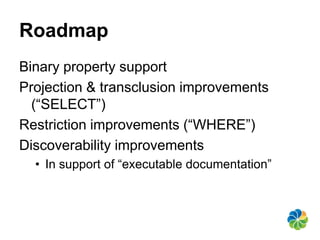
Roadmap
Binary property support
Projection & transclusion improvements
(“SELECT”)
Restriction improvements (“WHERE”)
Discoverability improvements
• In support of “executable documentation”
Getting Help
Docs: http://www.alfresco.com/develop
Resources:
• Alfresco API forum
• #alfresco on freenode IRC
• Alfresco Technical Discussion Google Group
Source Code:
• Code from DevCon Session
• Spring Social Alfresco Library
• Peter’s Grails Example
• Jeff’s Java Examples & Python Examples
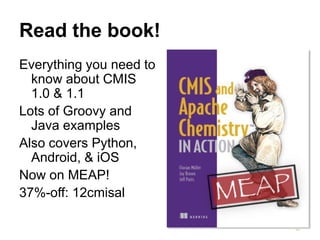
Read the book!
Everything you need to
know about CMIS
1.0 & 1.1
Lots of Groovy and
Java examples
Also covers Python,
Android, & iOS
Now on MEAP!
37%-off: 12cmisal
The keys to one badass ECM platform are yours for
the taking
http://www.alfresco.com/develop
http://www.flickr.com/photos/ph-stop/3101407532/

Intro to the Alfresco Public API

  • 1.
    Intro to theAlfresco Public API Jeff Potts Chief Community Officer
  • 2.
    Doesn’t Alfresco alreadyhave an API? Yes, but… • Not really public (things change) • Not versioned • Not well documented • Doesn’t work for cloud The Alfresco Public API addresses these limitations Vision is to have a single API that works across cloud and on-premise
  • 3.
  • 6.
    Folder, file, content andmetadata manipulation and search Networks, sites, people, comments, tags, activities, …
  • 7.
    Getting Started 1. UnderstandOAuth2 2. Register your app 3. Grab a client-side CMIS library • Or an SDK if coding a mobile app 4. Start coding!
  • 8.
    Step 1: GrokingOAuth2 Defined in RFC-6749 Secure authentication • 3rd party apps don’t ever see the user’s password Unambiguously identifies: • API provider (e.g. Alfresco) • Client application (e.g. your application) • End-user (e.g. an Alfresco Cloud user)
  • 9.
    OAuth2 & Alfresco Usedto secure the Alfresco API Only authentication mechanism provided for APIs in Alfresco Cloud
  • 10.
    Registering an App Application Developer Alfresco DeveloperPortal Creates developer profile Assigns an API key and secret for that app Signs up on developer portal Registers an application
  • 11.
    Authorization Application Alfresco End-User Linksto Alfresco authorization page, passing API key & secret Asks the user to authorize the app User authorizes the app to access their account Redirects to your app’s callback URL, passing authorization code Exchanges the authorization code for an access token Returns access and refresh tokens Securely persists the access and refresh token for that user
  • 12.
    Making API Calls CallsAPIs, passing the access token in the Authorization HTTP header Identifies user from access token, executes API call Application Alfresco
  • 13.
    Refresh Flow Calls APIs,passing the access token in the Authorization HTTP header Returns 401 error, indicating access token has expired Refreshes access token, passing refresh token Returns new access token Application Alfresco
  • 14.
    OAuth2 library canhide details Spring Social http://www.springsource.org/spring-social Google OAuth2 Client https://developers.google.com/accounts/doc s/OAuth2#libraries
  • 15.
    Step 2: RegisterYour App http://www.alfresco.com/develop • Alfresco Cloud Account • Registered Developer Account Add as many applications as you want Key, secret, callback URL
  • 16.
    Step 3: CMISLibrary Apache Chemistry is the umbrella project for all CMIS related projects at the ASF • OpenCMIS (Java, client and server) • cmislib (Python, client) • phpclient (PHP, client) • DotCMIS (.NET, client) • ObjectiveCMIS (Objective-C) Other client libraries exist
  • 17.
  • 18.
    Create, Find, &Comment http://youtu.be/1ZtmoPdCKJI
  • 19.
    Alfresco API URLs Structure: •Tenant • API scope • API name • API version • Entity type https://api.alfresco.com/ * The notion of entity types doesn’t apply to CMIS. * public/acme.com/ sitesalfresco/versions/1/
  • 20.
    Entity type collections Theentity type URL represents a collection of all instances of that entity • The collection may or may not be retrievable via a GET Each instance of an entity can be accessed via the collection URL with an Id appended .../acme.com/public/alfresco/versions/1/sites/mullet-gallery
  • 21.
    Top level entitytypes sites people tags nodes favorites
  • 22.
    Nesting entity types Entitytypes may also be nested The same rule about retrieving instances by Id applies .../acme.com/public/alfresco/versions/1/sites/mullet-gallery/members .../acme.com/public/alfresco/versions/1/sites/mullet- gallery/members/pmonks@alfresco.com
  • 23.
    Create, update, &delete Creating a new entity instance: • POST to the collection URL Updating an entity instance: • PUT to the instance URL Deleting an entity instance: • DELETE against the instance URL These rules apply regardless of whether it’s a top-level or nested collection
  • 24.
    Considerations Rate limits • 5requests/second, 10,000 requests/day (Dev) • 50 requests/second, 100,000 requests/day (Prod) No limit on # of applications Alfresco Cloud users own their content >= OpenCMIS 0.8.0-SNAPSHOT >= cmislib 0.5.1dev
  • 25.
    Roadmap Merge APIs intoAlfresco Enterprise v4.2 New API types: • User Provisioning (SCIM) • Workflow (Activiti) New API versions: • CMIS v1.1 • Alfresco v2 (?) New Alfresco API entity types: • renditions • bulk-imports (?)
  • 26.
    Roadmap Binary property support Projection& transclusion improvements (“SELECT”) Restriction improvements (“WHERE”) Discoverability improvements • In support of “executable documentation”
  • 27.
    Getting Help Docs: http://www.alfresco.com/develop Resources: •Alfresco API forum • #alfresco on freenode IRC • Alfresco Technical Discussion Google Group Source Code: • Code from DevCon Session • Spring Social Alfresco Library • Peter’s Grails Example • Jeff’s Java Examples & Python Examples
  • 28.
    Read the book! Everythingyou need to know about CMIS 1.0 & 1.1 Lots of Groovy and Java examples Also covers Python, Android, & iOS Now on MEAP! 37%-off: 12cmisal
  • 29.
    The keys toone badass ECM platform are yours for the taking http://www.alfresco.com/develop http://www.flickr.com/photos/ph-stop/3101407532/

Editor's Notes