AND DEVELOPMENT OF
HISTORY, THEORIES OF SOURCES
HUMAN RIGHTS EDUCATION IN SCHOOL SYSTEMS
LAGUNA STATE POLYTECHNIC UNIVERSITY
HUMAN RIGHTS
Jonathan Aranza
Marvin Canaria
Marynell Velasco
Kenneth Hernandez
Carla Aviles
Grace Lamano
INTRODUCTION
Human rights are as old as human
society. In this chapter, we will delve into
this compelling subject. Our discussion
will take us through the historical
origins and significant milestones that
have shaped the concept of human
rights internationally and in the
Philippines. We will also examine the
fundamental theories that underpin
these rights and explore their ongoing
development.
Page 02
TABLE OF
CONTENT
09 THEORIES OF SOURCES OF
RIGHTS
04 HISTORY
29
HUMAN RIGHTS AS
INTERNATIONAL CONCERN
33
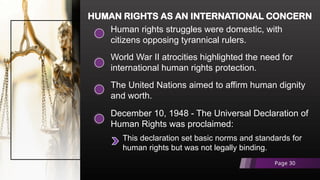
ORIGIN OF HUMAN RIGHTS
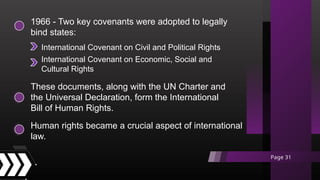
IN THE PHILIPPINES
39 NARROW CONCEPT OF HUMAN
RIGHTS IN THE PHILIPPINES
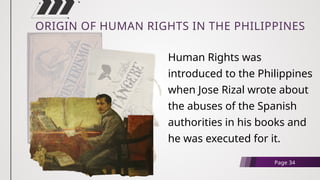
45 STATUS OF HUMAN RIGHTS IN
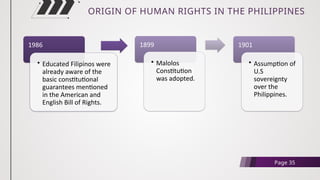
THE PHILIPPINES
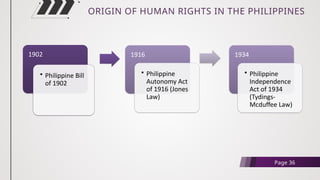
Page 03
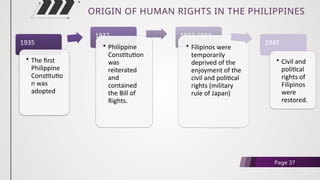
48 PHILIPPINE FOREIGN POLICY
ON HUMAN RIGHTS
HISTORY OF HUMAN
RIGHTS
Page 04
Jonathan Aranza
What is the origin of human rights?
These arose from the struggle of man against injustices of despotic
rulers. Men revolted against the concept of the "Divine Right of Kings." In
the Middle Ages, the Magna Carta was delivered by King John in 1215. It
is regarded as the first English Constitution that guaranteed the personal
liberties and civil rights. The Americans revolting against the English King
in 1776 declared their own Bill of Rights. The French in 1789 proclaimed
the Declaration of the Rights of Man where it was declared that all men
are born free and equal and affirmed the inalienable rights of man.
Eventually most democratic countries adopted in their respective
constitutions their own Bill of Rights.
HISTORY
Page 05
What are the circumstances that brought out the concept of
human rights in ancient history?
Rulers were despotic and tyrannical, and citizens rose against
the injustices that they have long suffered
HISTORY
Page 06
What famous documents in history that
contained concepts of human rights?
Magna Carta of 1215 – first English
Constitution delivered by King John on June
9, 1215, it guaranteed personal liberties and
civil rights.
HISTORY
Page 07
https://www.britannica.com/topic/Magna-Carta
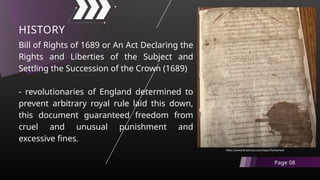
Bill of Rights of 1689 or An Act Declaring the
Rights and Liberties of the Subject and
Settling the Succession of the Crown (1689)
- revolutionaries of England determined to
prevent arbitrary royal rule laid this down,
this document guaranteed freedom from
cruel and unusual punishment and
excessive fines.
HISTORY
Page 08
https://www.britannica.com/topic/Parliament
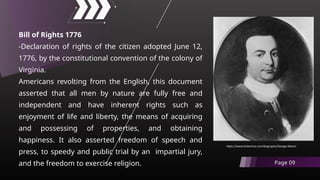
Bill of Rights 1776
-Declaration of rights of the citizen adopted June 12,
1776, by the constitutional convention of the colony of
Virginia.
Americans revolting from the English, this document
asserted that all men by nature are fully free and
independent and have inherent rights such as
enjoyment of life and liberty, the means of acquiring
and possessing of properties, and obtaining
happiness. It also asserted freedom of speech and
press, to speedy and public trial by an impartial jury,
and the freedom to exercise religion. Page 09
https://www.britannica.com/biography/George-Mason
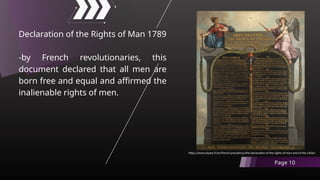
Declaration of the Rights of Man 1789
-by French revolutionaries, this
document declared that all men are
born free and equal and affirmed the
inalienable rights of men.
Page 10
https://www.elysee.fr/en/french-presidency/the-declaration-of-the-rights-of-man-and-of-the-citizen
THEORIES
OF SOURCES OF
RIGHTS
Page 05
John Marvin Canaria Marynell Velasco
RELIGIOUS OR THEOLOGICAL APPROACH
Page 10
• Doctrine of a Supreme Being, the creator, the
Father of all humanity.
• Central to the doctrines of all religions is the
concept of the dignity of man as a consequence
of human rights, and therefore the rights are
universal, inalienable and cannot be denied by
mortal beings (men).
RELIGIOUS OR THEOLOGICAL APPROACH
Page 11
• The theological approach means also the
brotherhood of men and equality in the eyes of
God. Theology, therefore, is a basis of human
rights theory stemming from a law higher than
the state and whose source as the Supreme
being. They are not concessions granted by
human institutions or states, or any
international organization as they are God-given
rights.
RELIGIOUS OR THEOLOGICAL APPROACH
Page 12
• The criticism of the theological approach is that
some religions impose so many restrictions on
individual freedom. Some religions even tolerate
slavery, discrimination against women and
imposition of death penalty. The theological
approach is valid as long as men believe that
God created them.
RELIGIOUS OR THEOLOGICAL APPROACH
Page 13
• It is the interpretation of man loving his
neighbor. The concept of brotherhood of men
means respecting the rights of a man. This also
illustrates the universal concept of human
rights. In short, the dignity of human person is
realized through the love of fellowmen.
THE NATURAL LAW THEORY
Page 14
• The natural law theory which originated from
the Stoics and elaborated by Greek philosophers
Plato an Aristotle and later by ancient Roman
law jurists perceives that the conduct of men
must always conform to the law of nature.
Philosophers, in their search for the truth, must
be in accordance with nature, which is eternal.
THE NATURAL LAW THEORY
Page 15
• The conduct of men must always conform to the
law of nature, and this theory is detached from
religion.
• The natural characteristics of human beings are
the social impulse to live peacefully and in
harmony with others, and whatever conformed
to the nature of men was right and just.
• Whatever is disturbing to social harmony is
wrong and unjust.
THE NATURAL LAW THEORY
Page 16
• The main characteristic of natural law is that
natural law leaves vague what is part of the law
of nations and therefore is inalienable.
HISTORICAL THEORY
Page 17
• It advocates that the human rights are not
deliberate creation or the effort of man but they
have already existed through the common
consciousness of the people of what is right and
just. Human rights developed through the
common consciousness of men.
HISTORICAL THEORY
Page 18
• Unlike the positivist theory, the historical theory
believes human rights exist through gradual,
spontaneous and evolutionary process without
any arbitrary will of any authority. The examples
are custom and traditions.

THE POSITIVIST THEORY
Page 19
• States that all rights and authority come from
the state and what officials have promulgated,
that rights are enjoyed if recognized and
protected by legislation promulgated by the
state.
• Under this theory, the only law is what it is
commanded by the sovereign. The source of
human rights is to be found only in the
enactment of law with sanctions attached.
THE MARXIST THEORY
Page 20
• It emphasizes the interest of society over am
individual man’s interest. Individual freedom is
recognized only after the interest of society is
served. It is concerned with economic and social
rights over civil or political rights of community.
THE MARXIST THEORY
Page 21
• The Communist system of rights has been
referred to as “parental” with the political body
providing the guidance in value choice. But the
true choice is the government set by the state.
The Functional or Sociological Approach
- human rights exist as a means of social control ( it
exist to serve the interest of society)
- emphasis of obtaining a just equilibrium of
multifarious interests among prevailing moral
sentiments and the social and economic conditions
of the time and place.
- The essence of law is simply to satisfy the needs of
the people.
Page 22
The Functional or Sociological Approach
-This approach is develop because there were
demands for a variety of wants occasioned by
the development of a society as help for the
unemployed, the handicapped, the
underprivileged, minorities and other
disadvantaged groups
-it focus on rights in terms of people’s
wants and concern Page 23
The Utilitarian Theory
- It seeks to define the notion of rights in terms of tendencies to
promote specified ends such as common good
- believes that every human decision was motivated by some
calculation of pleasure and pain
- The goal is to promote the greatest happiness of the greatest
number.
- Governments are to be judged on their tendencies to promote
the greatest happiness to the greatest number
- everyone is counted equally , but is not mean they are treated
equally.
- the principle requires governments to maximize
the total net Sum of citizens.
Page 24
The Utilitarian Theory
- emphasizes that an individual cannot be more
important than the entire group.
- Man cannot disregard his society. Similar to Aristotle
“the man is social animal”.
- The composite society of which the individual is a
unit has on its own wants, claims and demands.
- This act is good only when it takes into consideration
the interests of the society and tends to augment the
happiness of the entire community.
Page 25
The Theory Based on Justice
- The greatest interest of man Respect for human
rights serves the ends of justice Each person
possesses inviolability founded on justice.
- the first virtue of any social institution is justice,
that each person possesses in- violability founded
on justice, and when the liberties of equal
citizenship are settled, The rights secured for
justice are not subject to political bargaining or to
social interests. Page 26
The Theory Based on Justice
-no justice in a community where there are
social and economic inequalities because
Each person has equal rights to the whole
system of liberties.
-general conception of justice - one of fairness
and those social primary goods such as
opportunity, income and wealth and self-
respect are to be distributed equally. Page 27
The Theory Based on Equality and Respect
- Equality with respect to basic liberty
- The purpose is for the government to intervene in order
to advance general welfare.
- equality involves opportunities in the Av ailment of public
service and equal treatment before the law
- Specific liberties such as freedom of speech, freedom of
worship, right to join association and freedom of opinion
are part of equality and respect
- preferred liberties, where usually the government imposes
restrictions. Page 28
HUMAN RIGHTS AS
INTERNATIONAL CONCERN
Page 29
Kenneth B. Hernandez
Human rights struggles were domestic, with
citizens opposing tyrannical rulers.
HUMAN RIGHTS AS AN INTERNATIONAL CONCERN
World War II atrocities highlighted the need for
international human rights protection.
The United Nations aimed to affirm human dignity
and worth.
December 10, 1948 - The Universal Declaration of
Human Rights was proclaimed:
This declaration set basic norms and standards for
human rights but was not legally binding.
Page 30
1966 - Two key covenants were adopted to legally
bind states:
These documents, along with the UN Charter and
the Universal Declaration, form the International
Bill of Human Rights.
Human rights became a crucial aspect of international
law.
International Covenant on Civil and Political Rights
International Covenant on Economic, Social and
Cultural Rights
Page 31
Respect for human rights concerns
individuals regardless of nationality or
citizenship.
Human rights violations are recognized
as offenses that transcend national
boundaries.
Page 32
ORIGIN OF HUMAN RIGHTS
IN THE PHILIPPINES
Page 35
Carla Aviles
ORIGIN OF HUMAN RIGHTS IN THE PHILIPPINES
Human Rights was
introduced to the Philippines
when Jose Rizal wrote about
the abuses of the Spanish
authorities in his books and
he was executed for it.
Page 34
ORIGIN OF HUMAN RIGHTS IN THE PHILIPPINES
Page 35
1986
• Educated Filipinos were
already aware of the
basic constitutional
guarantees mentioned
in the American and
English Bill of Rights.
1899
• Malolos
Constitution
was adopted.
1901
• Assumption of
U.S
sovereignty
over the
Philippines.
ORIGIN OF HUMAN RIGHTS IN THE PHILIPPINES
Page 36
1902
• Philippine Bill
of 1902
1916
• Philippine
Autonomy Act
of 1916 (Jones
Law)
1934
• Philippine
Independence
Act of 1934
(Tydings-
Mcduffee Law)
ORIGIN OF HUMAN RIGHTS IN THE PHILIPPINES
Page 37
1935
• The first
Philippine
Constitutio
n was
adopted
1937
• Philippine
Constitution
was
reiterated
and
contained
the Bill of
Rights.
1942-1944
• Filipinos were
temporarily
deprived of the
enjoyment of the
civil and political
rights (military
rule of Japan)
1945
• Civil and
political
rights of
Filipinos
were
restored.
ORIGIN OF HUMAN RIGHTS IN THE PHILIPPINES
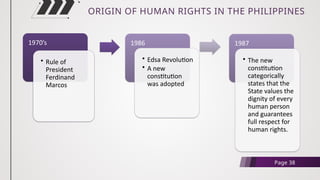
Page 38
1970’s
• Rule of
President
Ferdinand
Marcos
1986
• Edsa Revolution
• A new
constitution
was adopted
1987
• The new
constitution
categorically
states that the
State values the
dignity of every
human person
and guarantees
full respect for
human rights.
NARROW CONCEPT OF
HUMAN RIGHTS IN THE
PHILIPPINES
Human rights has been
originally understood as civil
and political rights which men
asserted against their
tyrannical ruler.
Page 39
NARROW CONCEPT OF HUMAN RIGHTS IN THE
PHILIPPINES
• The Magna Carta of 1215, the Bill of Rights of the
American revolutionists referred to the guarantees
of the enjoyment of individual liberties.
• As society has developed and progressed and with
the increase of diverse activities especially in the
field of economic development, the concept of
human rights have been broadened.
Page 40
• The 1986 Philippine Constitution has
mentioned only civil and political
rights. Under the Art. XIII, Sec. 18 (1) of
the Constitution, the Commission on
Human Rights is empowered to
investigate “all forms of human rights
violations involving civil and political
rights.
Page 41
• Cariño vs. Commission on Human
Rights, 204 SCRA 483 [1991]
ruled that the most that may be
conceded on the Commission on
Human Rights is the power to
investigate, i.e. receive evidence and
make findings of fact as regards
claimed human rights violations
involving civil and political rights.
Page 42
• Simon vs. Commission on Human
Rights, 229 SCRA 7 (1994)
when the court said that it was
apparent that the constitutional
delegates who drafted the constitution
have envisioned a Commission on
Human Rights that would focus its
attention to the more severe cases of
human rights violation.
Page 43
• It is not surprising therefore that the
commission on Human Rights in its
earlier resolutions have limited its
function only on civil and political
rights.
Resolution No. A89-109, July 19, 1989
Page 44
STATUS OF HUMAN RIGHTS
IN THE PHILIPPINES
Page 45
Grace Lamano
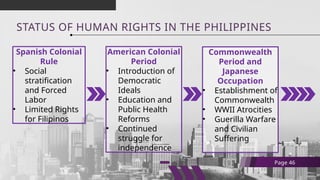
STATUS OF HUMAN RIGHTS IN THE PHILIPPINES
Spanish Colonial
Rule
• Social
stratification
and Forced
Labor
• Limited Rights
for Filipinos
Page 46
American Colonial
Period
• Introduction of
Democratic
Ideals
• Education and
Public Health
Reforms
• Continued
struggle for
independence
Commonwealth
Period and
Japanese
Occupation
• Establishment of
Commonwealth
• WWII Atrocities
• Guerilla Warfare
and Civilian
Suffering
STATUS OF HUMAN RIGHTS IN THE PHILIPPINES
Post-War Era and
the Marcos
Regime
• Post-War
reconstruction
• Declaration of
Martial Law
(1972)
• Human Rights
violation during
Martial Law
• People Power
Revolution
(1986)
Page 47
Post-Marcos Era to Present
• Restoration of democracy
• 1987 Constitution
• Human rights challenges
• Extrajudicial killings (War on Drugs)
• Freedom of Expression and Media
• Rights of Indigenous People
• Gender-Based Violence
• Human rights Institutions
• Commission on Human Rights
• Role of Judiciary
• Non-Government Organizations
PHILIPPINE FOREIGN POLICY
ON HUMAN RIGHTS
Page 48
PHILIPPINE FOREIGN POLICY ON HUMAN RIGHTS
Article II, Section 2: “The Philippines
renounces war as an instrument of
national policy, adopts the generally
accepted principles of international
law as part of the law of the land and
adheres to the policy of peace,
equality, justice.”
Page 49
1987
Philippine
Constitution
provisions on
Philippine
foreign
policy:
PHILIPPINE FOREIGN POLICY ON HUMAN RIGHTS
Article II, Section 7: “The State shall
pursue an independent foreign
policy. In its relations with other
states the paramount consideration
shall be national sovereignty,
territorial integrity, national interest,
and the right to self-determination.”
Page 50
1987
Philippine
Constitution
provisions on
Philippine
foreign
policy:
PHILIPPINE FOREIGN POLICY ON HUMAN RIGHTS
This gives mandate to the Department
of Foreign Affairs to implement the
three (3) pillars of the Philippine
Foreign Policy, as follows:
• Preservation and enhancement of
national security
• Promotion and attainment of
economic security
• Protection of the rights and
promotion of the welfare and
interest of Filipinos overseas.
Page 51
Republic Act
No. 7157
"Philippine
Foreign
Service Act
of 1991"
PHILIPPINE FOREIGN POLICY ON HUMAN RIGHTS
• Challenges
• Domestic vs
International Human
Rights Priorities
• Balancing National
Security and Human
rights priorities
• Enhancing Human Rights
Education
Page 52
• Commitments
• Adherence to
International Human
Rights Laws
• Participation in UN
Human Rights Council
• Bilateral Relations
Impacting Human Rights
THANK YOU
LAGUNA STATE POLYTECHNIC UNIVERSITY

Intro to HUMAN-RIGHTS-REPORT_Chapter-2.pptx

  • 1.
    AND DEVELOPMENT OF HISTORY,THEORIES OF SOURCES HUMAN RIGHTS EDUCATION IN SCHOOL SYSTEMS LAGUNA STATE POLYTECHNIC UNIVERSITY HUMAN RIGHTS Jonathan Aranza Marvin Canaria Marynell Velasco Kenneth Hernandez Carla Aviles Grace Lamano
  • 2.
    INTRODUCTION Human rights areas old as human society. In this chapter, we will delve into this compelling subject. Our discussion will take us through the historical origins and significant milestones that have shaped the concept of human rights internationally and in the Philippines. We will also examine the fundamental theories that underpin these rights and explore their ongoing development. Page 02
  • 3.
    TABLE OF CONTENT 09 THEORIESOF SOURCES OF RIGHTS 04 HISTORY 29 HUMAN RIGHTS AS INTERNATIONAL CONCERN 33 ORIGIN OF HUMAN RIGHTS IN THE PHILIPPINES 39 NARROW CONCEPT OF HUMAN RIGHTS IN THE PHILIPPINES 45 STATUS OF HUMAN RIGHTS IN THE PHILIPPINES Page 03 48 PHILIPPINE FOREIGN POLICY ON HUMAN RIGHTS
  • 4.
    HISTORY OF HUMAN RIGHTS Page04 Jonathan Aranza
  • 6.
    What is theorigin of human rights? These arose from the struggle of man against injustices of despotic rulers. Men revolted against the concept of the "Divine Right of Kings." In the Middle Ages, the Magna Carta was delivered by King John in 1215. It is regarded as the first English Constitution that guaranteed the personal liberties and civil rights. The Americans revolting against the English King in 1776 declared their own Bill of Rights. The French in 1789 proclaimed the Declaration of the Rights of Man where it was declared that all men are born free and equal and affirmed the inalienable rights of man. Eventually most democratic countries adopted in their respective constitutions their own Bill of Rights. HISTORY Page 05
  • 7.
    What are thecircumstances that brought out the concept of human rights in ancient history? Rulers were despotic and tyrannical, and citizens rose against the injustices that they have long suffered HISTORY Page 06
  • 8.
    What famous documentsin history that contained concepts of human rights? Magna Carta of 1215 – first English Constitution delivered by King John on June 9, 1215, it guaranteed personal liberties and civil rights. HISTORY Page 07 https://www.britannica.com/topic/Magna-Carta https://www.britannica.com/topic/Magna-Carta
  • 9.
    Bill of Rightsof 1689 or An Act Declaring the Rights and Liberties of the Subject and Settling the Succession of the Crown (1689) - revolutionaries of England determined to prevent arbitrary royal rule laid this down, this document guaranteed freedom from cruel and unusual punishment and excessive fines. HISTORY Page 08 https://www.britannica.com/topic/Parliament
  • 10.
    Bill of Rights1776 -Declaration of rights of the citizen adopted June 12, 1776, by the constitutional convention of the colony of Virginia. Americans revolting from the English, this document asserted that all men by nature are fully free and independent and have inherent rights such as enjoyment of life and liberty, the means of acquiring and possessing of properties, and obtaining happiness. It also asserted freedom of speech and press, to speedy and public trial by an impartial jury, and the freedom to exercise religion. Page 09 https://www.britannica.com/biography/George-Mason
  • 11.
    Declaration of theRights of Man 1789 -by French revolutionaries, this document declared that all men are born free and equal and affirmed the inalienable rights of men. Page 10 https://www.elysee.fr/en/french-presidency/the-declaration-of-the-rights-of-man-and-of-the-citizen
  • 12.
    THEORIES OF SOURCES OF RIGHTS Page05 John Marvin Canaria Marynell Velasco
  • 13.
    RELIGIOUS OR THEOLOGICALAPPROACH Page 10 • Doctrine of a Supreme Being, the creator, the Father of all humanity. • Central to the doctrines of all religions is the concept of the dignity of man as a consequence of human rights, and therefore the rights are universal, inalienable and cannot be denied by mortal beings (men).
  • 14.
    RELIGIOUS OR THEOLOGICALAPPROACH Page 11 • The theological approach means also the brotherhood of men and equality in the eyes of God. Theology, therefore, is a basis of human rights theory stemming from a law higher than the state and whose source as the Supreme being. They are not concessions granted by human institutions or states, or any international organization as they are God-given rights.
  • 15.
    RELIGIOUS OR THEOLOGICALAPPROACH Page 12 • The criticism of the theological approach is that some religions impose so many restrictions on individual freedom. Some religions even tolerate slavery, discrimination against women and imposition of death penalty. The theological approach is valid as long as men believe that God created them.
  • 16.
    RELIGIOUS OR THEOLOGICALAPPROACH Page 13 • It is the interpretation of man loving his neighbor. The concept of brotherhood of men means respecting the rights of a man. This also illustrates the universal concept of human rights. In short, the dignity of human person is realized through the love of fellowmen.
  • 17.
    THE NATURAL LAWTHEORY Page 14 • The natural law theory which originated from the Stoics and elaborated by Greek philosophers Plato an Aristotle and later by ancient Roman law jurists perceives that the conduct of men must always conform to the law of nature. Philosophers, in their search for the truth, must be in accordance with nature, which is eternal.
  • 18.
    THE NATURAL LAWTHEORY Page 15 • The conduct of men must always conform to the law of nature, and this theory is detached from religion. • The natural characteristics of human beings are the social impulse to live peacefully and in harmony with others, and whatever conformed to the nature of men was right and just. • Whatever is disturbing to social harmony is wrong and unjust.
  • 19.
    THE NATURAL LAWTHEORY Page 16 • The main characteristic of natural law is that natural law leaves vague what is part of the law of nations and therefore is inalienable.
  • 20.
    HISTORICAL THEORY Page 17 •It advocates that the human rights are not deliberate creation or the effort of man but they have already existed through the common consciousness of the people of what is right and just. Human rights developed through the common consciousness of men.
  • 21.
    HISTORICAL THEORY Page 18 •Unlike the positivist theory, the historical theory believes human rights exist through gradual, spontaneous and evolutionary process without any arbitrary will of any authority. The examples are custom and traditions.
  • 22.
    THE POSITIVIST THEORY Page19 • States that all rights and authority come from the state and what officials have promulgated, that rights are enjoyed if recognized and protected by legislation promulgated by the state. • Under this theory, the only law is what it is commanded by the sovereign. The source of human rights is to be found only in the enactment of law with sanctions attached.
  • 23.
    THE MARXIST THEORY Page20 • It emphasizes the interest of society over am individual man’s interest. Individual freedom is recognized only after the interest of society is served. It is concerned with economic and social rights over civil or political rights of community.
  • 24.
    THE MARXIST THEORY Page21 • The Communist system of rights has been referred to as “parental” with the political body providing the guidance in value choice. But the true choice is the government set by the state.
  • 25.
    The Functional orSociological Approach - human rights exist as a means of social control ( it exist to serve the interest of society) - emphasis of obtaining a just equilibrium of multifarious interests among prevailing moral sentiments and the social and economic conditions of the time and place. - The essence of law is simply to satisfy the needs of the people. Page 22
  • 26.
    The Functional orSociological Approach -This approach is develop because there were demands for a variety of wants occasioned by the development of a society as help for the unemployed, the handicapped, the underprivileged, minorities and other disadvantaged groups -it focus on rights in terms of people’s wants and concern Page 23
  • 27.
    The Utilitarian Theory -It seeks to define the notion of rights in terms of tendencies to promote specified ends such as common good - believes that every human decision was motivated by some calculation of pleasure and pain - The goal is to promote the greatest happiness of the greatest number. - Governments are to be judged on their tendencies to promote the greatest happiness to the greatest number - everyone is counted equally , but is not mean they are treated equally. - the principle requires governments to maximize the total net Sum of citizens. Page 24
  • 28.
    The Utilitarian Theory -emphasizes that an individual cannot be more important than the entire group. - Man cannot disregard his society. Similar to Aristotle “the man is social animal”. - The composite society of which the individual is a unit has on its own wants, claims and demands. - This act is good only when it takes into consideration the interests of the society and tends to augment the happiness of the entire community. Page 25
  • 29.
    The Theory Basedon Justice - The greatest interest of man Respect for human rights serves the ends of justice Each person possesses inviolability founded on justice. - the first virtue of any social institution is justice, that each person possesses in- violability founded on justice, and when the liberties of equal citizenship are settled, The rights secured for justice are not subject to political bargaining or to social interests. Page 26
  • 30.
    The Theory Basedon Justice -no justice in a community where there are social and economic inequalities because Each person has equal rights to the whole system of liberties. -general conception of justice - one of fairness and those social primary goods such as opportunity, income and wealth and self- respect are to be distributed equally. Page 27
  • 31.
    The Theory Basedon Equality and Respect - Equality with respect to basic liberty - The purpose is for the government to intervene in order to advance general welfare. - equality involves opportunities in the Av ailment of public service and equal treatment before the law - Specific liberties such as freedom of speech, freedom of worship, right to join association and freedom of opinion are part of equality and respect - preferred liberties, where usually the government imposes restrictions. Page 28
  • 32.
    HUMAN RIGHTS AS INTERNATIONALCONCERN Page 29 Kenneth B. Hernandez
  • 33.
    Human rights struggleswere domestic, with citizens opposing tyrannical rulers. HUMAN RIGHTS AS AN INTERNATIONAL CONCERN World War II atrocities highlighted the need for international human rights protection. The United Nations aimed to affirm human dignity and worth. December 10, 1948 - The Universal Declaration of Human Rights was proclaimed: This declaration set basic norms and standards for human rights but was not legally binding. Page 30
  • 34.
    1966 - Twokey covenants were adopted to legally bind states: These documents, along with the UN Charter and the Universal Declaration, form the International Bill of Human Rights. Human rights became a crucial aspect of international law. International Covenant on Civil and Political Rights International Covenant on Economic, Social and Cultural Rights Page 31
  • 35.
    Respect for humanrights concerns individuals regardless of nationality or citizenship. Human rights violations are recognized as offenses that transcend national boundaries. Page 32
  • 36.
    ORIGIN OF HUMANRIGHTS IN THE PHILIPPINES Page 35 Carla Aviles
  • 37.
    ORIGIN OF HUMANRIGHTS IN THE PHILIPPINES Human Rights was introduced to the Philippines when Jose Rizal wrote about the abuses of the Spanish authorities in his books and he was executed for it. Page 34
  • 38.
    ORIGIN OF HUMANRIGHTS IN THE PHILIPPINES Page 35 1986 • Educated Filipinos were already aware of the basic constitutional guarantees mentioned in the American and English Bill of Rights. 1899 • Malolos Constitution was adopted. 1901 • Assumption of U.S sovereignty over the Philippines.
  • 39.
    ORIGIN OF HUMANRIGHTS IN THE PHILIPPINES Page 36 1902 • Philippine Bill of 1902 1916 • Philippine Autonomy Act of 1916 (Jones Law) 1934 • Philippine Independence Act of 1934 (Tydings- Mcduffee Law)
  • 40.
    ORIGIN OF HUMANRIGHTS IN THE PHILIPPINES Page 37 1935 • The first Philippine Constitutio n was adopted 1937 • Philippine Constitution was reiterated and contained the Bill of Rights. 1942-1944 • Filipinos were temporarily deprived of the enjoyment of the civil and political rights (military rule of Japan) 1945 • Civil and political rights of Filipinos were restored.
  • 41.
    ORIGIN OF HUMANRIGHTS IN THE PHILIPPINES Page 38 1970’s • Rule of President Ferdinand Marcos 1986 • Edsa Revolution • A new constitution was adopted 1987 • The new constitution categorically states that the State values the dignity of every human person and guarantees full respect for human rights.
  • 42.
    NARROW CONCEPT OF HUMANRIGHTS IN THE PHILIPPINES Human rights has been originally understood as civil and political rights which men asserted against their tyrannical ruler. Page 39
  • 43.
    NARROW CONCEPT OFHUMAN RIGHTS IN THE PHILIPPINES • The Magna Carta of 1215, the Bill of Rights of the American revolutionists referred to the guarantees of the enjoyment of individual liberties. • As society has developed and progressed and with the increase of diverse activities especially in the field of economic development, the concept of human rights have been broadened. Page 40
  • 44.
    • The 1986Philippine Constitution has mentioned only civil and political rights. Under the Art. XIII, Sec. 18 (1) of the Constitution, the Commission on Human Rights is empowered to investigate “all forms of human rights violations involving civil and political rights. Page 41
  • 45.
    • Cariño vs.Commission on Human Rights, 204 SCRA 483 [1991] ruled that the most that may be conceded on the Commission on Human Rights is the power to investigate, i.e. receive evidence and make findings of fact as regards claimed human rights violations involving civil and political rights. Page 42
  • 46.
    • Simon vs.Commission on Human Rights, 229 SCRA 7 (1994) when the court said that it was apparent that the constitutional delegates who drafted the constitution have envisioned a Commission on Human Rights that would focus its attention to the more severe cases of human rights violation. Page 43
  • 47.
    • It isnot surprising therefore that the commission on Human Rights in its earlier resolutions have limited its function only on civil and political rights. Resolution No. A89-109, July 19, 1989 Page 44
  • 48.
    STATUS OF HUMANRIGHTS IN THE PHILIPPINES Page 45 Grace Lamano
  • 49.
    STATUS OF HUMANRIGHTS IN THE PHILIPPINES Spanish Colonial Rule • Social stratification and Forced Labor • Limited Rights for Filipinos Page 46 American Colonial Period • Introduction of Democratic Ideals • Education and Public Health Reforms • Continued struggle for independence Commonwealth Period and Japanese Occupation • Establishment of Commonwealth • WWII Atrocities • Guerilla Warfare and Civilian Suffering
  • 50.
    STATUS OF HUMANRIGHTS IN THE PHILIPPINES Post-War Era and the Marcos Regime • Post-War reconstruction • Declaration of Martial Law (1972) • Human Rights violation during Martial Law • People Power Revolution (1986) Page 47 Post-Marcos Era to Present • Restoration of democracy • 1987 Constitution • Human rights challenges • Extrajudicial killings (War on Drugs) • Freedom of Expression and Media • Rights of Indigenous People • Gender-Based Violence • Human rights Institutions • Commission on Human Rights • Role of Judiciary • Non-Government Organizations
  • 51.
    PHILIPPINE FOREIGN POLICY ONHUMAN RIGHTS Page 48
  • 52.
    PHILIPPINE FOREIGN POLICYON HUMAN RIGHTS Article II, Section 2: “The Philippines renounces war as an instrument of national policy, adopts the generally accepted principles of international law as part of the law of the land and adheres to the policy of peace, equality, justice.” Page 49 1987 Philippine Constitution provisions on Philippine foreign policy:
  • 53.
    PHILIPPINE FOREIGN POLICYON HUMAN RIGHTS Article II, Section 7: “The State shall pursue an independent foreign policy. In its relations with other states the paramount consideration shall be national sovereignty, territorial integrity, national interest, and the right to self-determination.” Page 50 1987 Philippine Constitution provisions on Philippine foreign policy:
  • 54.
    PHILIPPINE FOREIGN POLICYON HUMAN RIGHTS This gives mandate to the Department of Foreign Affairs to implement the three (3) pillars of the Philippine Foreign Policy, as follows: • Preservation and enhancement of national security • Promotion and attainment of economic security • Protection of the rights and promotion of the welfare and interest of Filipinos overseas. Page 51 Republic Act No. 7157 "Philippine Foreign Service Act of 1991"
  • 55.
    PHILIPPINE FOREIGN POLICYON HUMAN RIGHTS • Challenges • Domestic vs International Human Rights Priorities • Balancing National Security and Human rights priorities • Enhancing Human Rights Education Page 52 • Commitments • Adherence to International Human Rights Laws • Participation in UN Human Rights Council • Bilateral Relations Impacting Human Rights
  • 56.
    THANK YOU LAGUNA STATEPOLYTECHNIC UNIVERSITY