Introduction to Datomic
Siva Jagadeesan
“there’s an another
database!”
• what do you think of first?
The job of a database
•Coordination
•Consistency
•Indexing
•Storage
•Queries
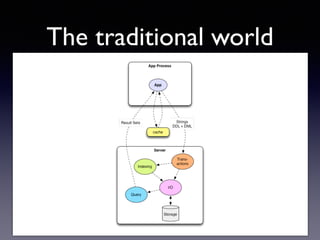
The traditional world
• Place-oriented-programming (PLOP)	

• designed decades ago	

• tiny RAM, tiny disks	

• Collocated components	

• Difficult to scale	

• Necessitates application-level sharding
The dreaded update-in-place
sharding
• lose 	

• consistency	

• transactions	

• queries
key-value stores
• lose	

• querying	

• really just storage systems	

• not “databases”
Deconstruction
• relocate subsystems	

• separate services each do one thing	

• simplification
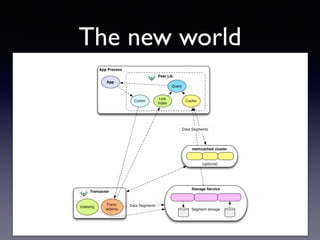
Datomic architecture
• Peers	

• Transactors	

• Storage services
The new world
Benefits
• Separating reads and writes	

• applications only read from storage	

• transactor 	

• handles transactions 	

• provides consistency	

• reflects changes to peers
Benefits
• Integrated data distribution	

• built-in in-memory caches	

• self-tunes to working set	

• automatic
Benefits
• Peers each have a query engine 	

• Datalog	

• simple rules and data patterns	

• declarative: implicit joins	

• declarative: meaning is evident	

• locality: datomic db and app data
Benefits
• Elasticity	

• as elastic as peers
Benefits
• Cloud ready	

• commodity hardware	

• resilient to failures
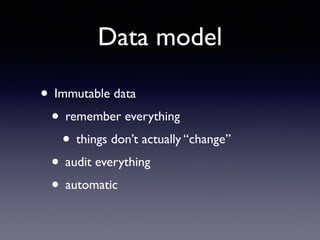
Data model
• Immutable data	

• remember everything	

• things don’t actually “change”	

• audit everything	

• automatic
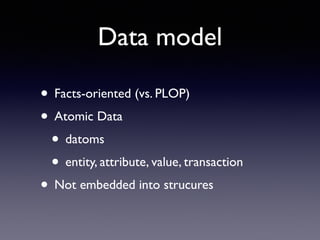
Data model
• Facts-oriented (vs. PLOP)	

• Atomic Data	

• datoms	

• entity, attribute, value, transaction	

• Not embedded into strucures
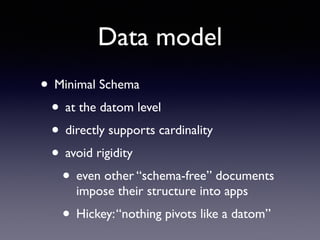
Data model
• Minimal Schema	

• at the datom level	

• directly supports cardinality	

• avoid rigidity	

• even other “schema-free” documents
impose their structure into apps	

• Hickey:“nothing pivots like a datom”
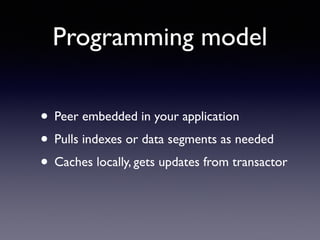
Programming model
• Peer embedded in your application	

• Pulls indexes or data segments as needed	

• Caches locally, gets updates from transactor
Programming model
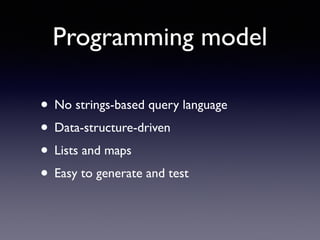
• No strings-based query language	

• Data-structure-driven	

• Lists and maps	

• Easy to generate and test
Programming model
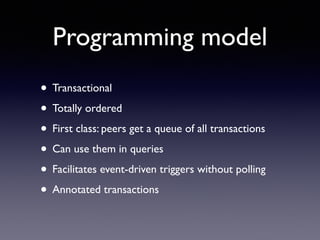
• Transactional	

• Totally ordered	

• First class: peers get a queue of all transactions	

• Can use them in queries	

• Facilitates event-driven triggers without polling	

• Annotated transactions
Programming model
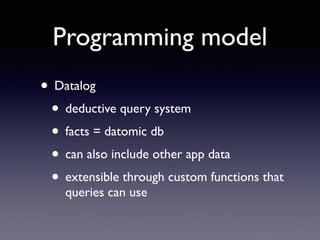
• Datalog	

• deductive query system	

• facts = datomic db	

• can also include other app data	

• extensible through custom functions that
queries can use
Programming model
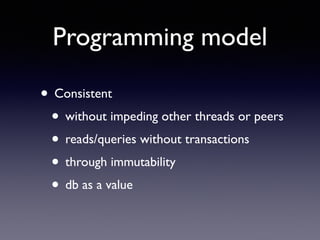
• Consistent	

• without impeding other threads or peers	

• reads/queries without transactions	

• through immutability	

• db as a value
Programming model
• Time	

• as-of queries	

• windowed queries
The so-what
• Simplicity	

• consistency	

• built-in caching	

• no manual sharding	

• configuration-free	

• cloud-scale
The so-what
• Evolvability	

• datom-level schema	

• application free to change “structural”
thinking
The so-what
• Local query power	

• each peer has full query engine	

• the db is effectively local	

• isolation from others: 	

• e.g. - analytics usage won’t bog down
transaction processing
The so-what
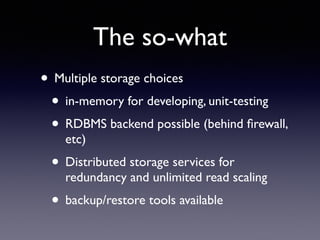
• Multiple storage choices	

• in-memory for developing, unit-testing	

• RDBMS backend possible (behind firewall,
etc)	

• Distributed storage services for
redundancy and unlimited read scaling	

• backup/restore tools available
The so-what
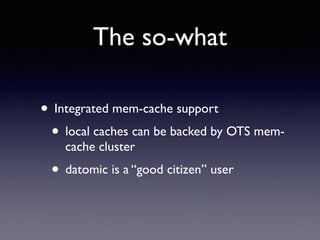
• Integrated mem-cache support	

• local caches can be backed by OTS mem-
cache cluster	

• datomic is a “good citizen” user
The so-what
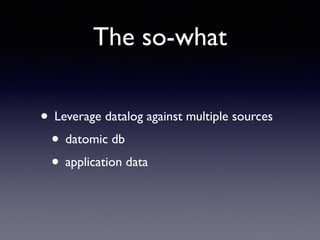
• Leverage datalog against multiple sources	

• datomic db	

• application data
The so-what
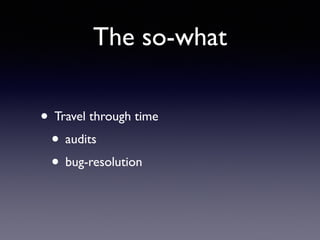
• Travel through time	

• audits	

• bug-resolution
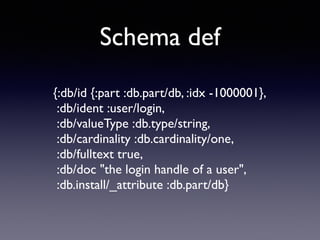
Schema def
{:db/id {:part :db.part/db, :idx -1000001},	

:db/ident :user/login,	

:db/valueType :db.type/string,	

:db/cardinality :db.cardinality/one,	

:db/fulltext true,	

:db/doc "the login handle of a user",	

:db.install/_attribute :db.part/db}
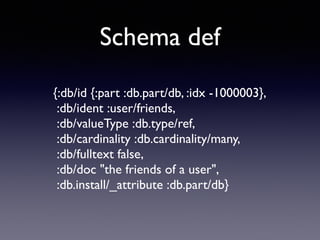
Schema def
{:db/id {:part :db.part/db, :idx -1000003},	

:db/ident :user/friends,	

:db/valueType :db.type/ref,	

:db/cardinality :db.cardinality/many,	

:db/fulltext false,	

:db/doc "the friends of a user",	

:db.install/_attribute :db.part/db}
transactions
[:db/add entity-id attribute value]
[:db/retract entity-id attribute value]
{:db/id entity-id!
attribute value!
attribute value!
... }
[:db.fn/retractEntity entity-id]
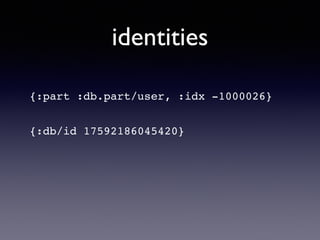
identities
{:part :db.part/user, :idx -1000026}
{:db/id 17592186045420}
queries
[:find ?e :in $ ?email !
:where !
[?e :person/email ?email]]
[:find variables :where clauses]
[:find ?e ?x !
:where !
[?e :age 42] [?e :likes ?x]]
queries
• lots more	

• pattern matching	

• logic programming	

• multiple data-sources
demonic
• datomic helper	

• work at the data-structure level	

• supports graphs: nested maps	

• only writes dirty data	

• “demarcations” as “batched datomic
transactions”	

• unit-testing support
Questions

Introduction to datomic