#PixieSessions
Overview
● 1. Intros: Me, and You
● 2. Existing skills, expectations
● 3. What is “content”?
● 4. Purpose, audience, relevance
● 5. Elements of storytelling
● 6. Optional extras: Content
strategy & Systems
About me
● Uni ate my youth
● Writer
● Editor
- insert spectacular ragequit -
● Publisher
- insert burnout and failure -
● Strategist
About You
● Who you are
● Where you've come from
● Your content skills (if any)
● Your expectations for this session
Things you've already done
● Branding & marketing
● Building ideas
● Using social media platforms
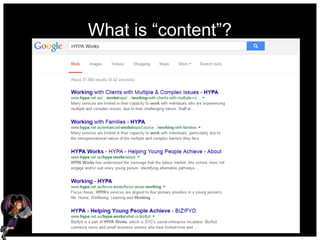
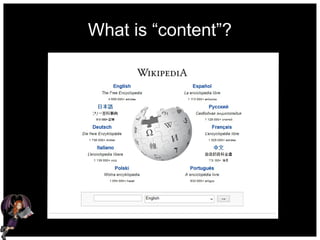
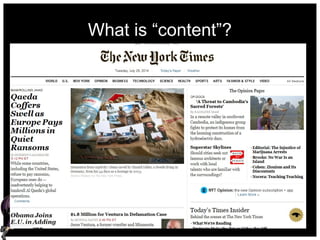
What is “content”?
CONTENT IS WHAT MAKES THE INTERNET
What is “content”?
CONTENT IS WHAT MAKES THE INTERNET
Think about that for a second.
What is “content”?
The internet is NOT:
What is “content”?
The internet is NOT:
Design
What is “content”?
The internet is NOT:
Design
UX (user experience)
What is “content”?
The internet is NOT:
Design
UX (user experience)
The pipes
What is “content”?
The internet is NOT:
Design
UX (user experience)
The pipes
The system or the frameworks
What is “content”?
CONTENT IS WHAT MAKES THE INTERNET
What is “content”?
CONTENT IS WHAT MAKES THE INTERNET
But increasingly, it's post-digital.
What is “content”?
CONTENT IS WHAT MAKES THE INTERNET
But increasingly, it's post-digital.
In other words: Context-less
What is “content”?
It's all well and good being abstract, so
let's look at an example or two.
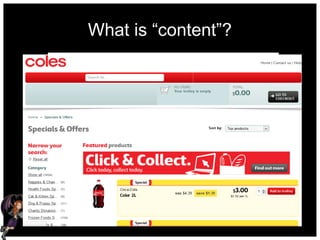
What is “content”?
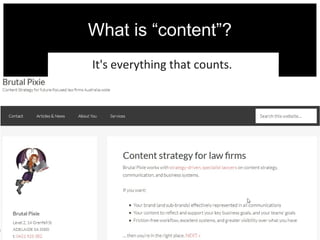
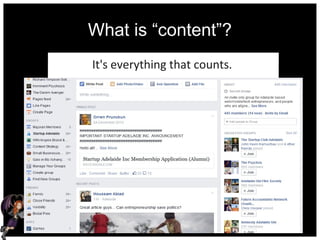
It's everything that counts.
What is “content”?
It's everything that counts.
What is “content”?
It's everything that counts.
What is “content”?
It's everything that counts.
What is “content”?
It's everything that counts.
What is “content”?
It's everything that counts.
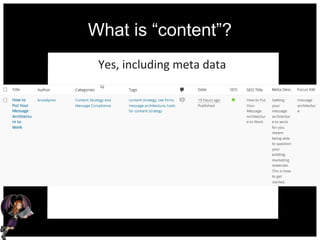
What is “content”?
Yes, including meta data
List everything that counts as “content”
Content 101: Purpose, Audience, Relevance
● Understanding purpose, audience &
audience needs is a key factor in
creating useful content
●
Content 101: Purpose, Audience, Relevance
● Understanding purpose, audience &
audience needs is a key factor in
creating useful content
● Context doesn't matter
Content 101: Purpose, Audience, Relevance
● Understanding purpose, audience &
audience needs is a key factor in
creating useful content
● Context doesn't matter
Content 101: Purpose, Audience, Relevance
● Understanding purpose, audience &
audience needs is a key factor in
creating useful content
● Context doesn't matter
● Personas are so important
Content 101: Purpose, Audience, Relevance
● Understanding purpose, audience &
audience needs is a key factor in
creating useful content
● Context doesn't matter
● Personas are so important
● Stereotype with care
Content 101: Purpose, Audience, Relevance
● Understanding purpose, audience &
audience needs is a key factor in
creating useful content
● Context doesn't matter
● Personas are so important
● Stereotype with care
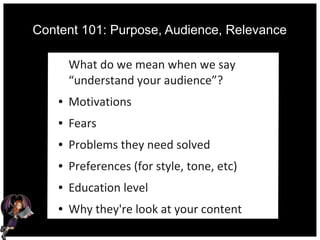
Content 101: Purpose, Audience, Relevance
What do we mean when we say
“understand your audience”?
● Motivations
● Fears
● Problems they need solved
● Preferences (for style, tone, etc)
● Education level
● Why they're look at your content
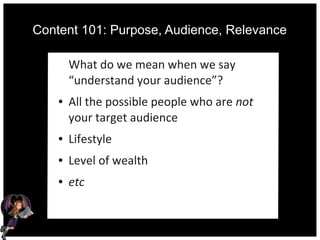
Content 101: Purpose, Audience, Relevance
What do we mean when we say
“understand your audience”?
● All the possible people who are not
your target audience
● Lifestyle
● Level of wealth
● etc
Content 101: Purpose, Audience, Relevance
You have to craft a vision of your
ideal audience member. Consider:
● Age, appearance, gender, quirks
● Income, lifestyle, working
arrangements
● Kids, relationships, friendships
● Hobbies, relaxation, holidays
● Goals, dreams, values
Content 101: Purpose, Audience, Relevance
Why you need personas:
● Your audience becomes real to you
● You can write to just one person
● You can read your message
architecture through their eyes
● You can read all of your content from
their perspective
Content 101: Purpose, Audience, Relevance
Your turn!
Create your personas.
Then we're going to introduce them.
Content 101: Purpose, Audience, Relevance
Name: Mark Tapley
Mark Tapley is a young man in his 20s. He loves
adventure. His problem was that he didn't know
how far he could push himself and retain his good
humour. So, he put himself into absurd situations as
a test. He irritates everybody with his optimism. He
nearly died by putting himself in bad situations, still
managed to be jolly, survived, and returned home
filled with exuberance and an entrepreneurial fire.
Now, Mark runs a pub called the Jolly Tapley with
his wife.
Content 101: Purpose, Audience, Relevance
Name: Mark Tapley
We would describe Mark as:
● A risk taker, one who will happily take risks and
tell you the good stories at the end of them
● An entrepreneur, one who isn't fussed about
failure
● That he's easy to get along with
● That he would be happy to try something new
● That he probably won't stand for a negative
attitude
Content 101: Purpose, Audience, Relevance
Name: Mark Tapley
We would describe Mark as:
● A risk taker, one who will happily take risks and
tell you the good stories at the end of them
● An entrepreneur, one who isn't fussed about
failure
● That he's easy to get along with
● That he would be happy to try something new
● That he probably won't stand for a negative
attitude
Content 101: Purpose, Audience, Relevance
A quick diversion: Scenarios. Scenarios can act
like pre-mortems.
● Put your persona into a situation and test
all possible outcomes
● Use your scenarios for customer journey
mapping, against your site or product, or
social media experience
● Map all possible interactions and journeys
so you have a landscape of possibility
Content 101: Purpose, Audience, Relevance
Got Purpose?
● Your entire reason for creating
content
Content 101: Purpose, Audience, Relevance
Got Purpose?
● Your entire reason for creating
content
● At the most basic level you have your
purpose, and your audience's purpose
Content 101: Purpose, Audience, Relevance
Got Purpose?
● Your entire reason for creating
content
● At the most basic level you have your
purpose, and your audience's purpose
● But you can have more than one and
so can your audience
Content 101: Purpose, Audience, Relevance
Got Purpose?
● Your entire reason for creating
content
● At the most basic level you have your
purpose, and your audience's purpose
● But you can have more than one and
so can your audience
● And your client has purposes too!
Content 101: Purpose, Audience, Relevance
● What do you want your audience to
do?
Content 101: Purpose, Audience, Relevance
● What do you want your audience to
do?
● To change attitude
Content 101: Purpose, Audience, Relevance
● What do you want your audience to
do?
● To change attitude
● To learn about a product
Content 101: Purpose, Audience, Relevance
● What do you want your audience to
do?
● To change attitude
● To learn about a product
● To take an action – if so, what action?
Content 101: Purpose, Audience, Relevance
● What do you want your audience to
do?
● To change attitude
● To learn about a product
● To take an action – if so, what action?
● To make a decision – if so, what
decision?
Content 101: Purpose, Audience, Relevance
● What do you want your audience to
do?
● To change attitude
● To learn about a product
● To take an action – if so, what action?
● To make a decision – if so, what
decision?
● To evaluate?
Content 101: Purpose, Audience, Relevance
How many more can you think of?
Content 101: Purpose, Audience, Relevance
So, that's YOU. What about your audience?
● To decorate a room
● To cook dinner
● To save money
● To learn how to replace a tyre on a
bicycle
● To be able to climb the Himalayas
Content 101: Purpose, Audience, Relevance
How many more can you think of?
Content 101: Purpose, Audience, Relevance
The difficult thing is getting a match!
Content 101: Purpose, Audience, Relevance
If your purpose matches your audience's
purpose perfectly, then you will have
100% engagement.
Content 101: Purpose, Audience, Relevance
Nice. But life isn't really like that.
Content 101: Purpose, Audience, Relevance
What do you do when purposes don't
match?
Content 101: Purpose, Audience, Relevance
What do you do when purposes don't
match?
● You can rethink your purpose
● You can rethink your strategy and do
something different
● You can aim for high levels of
relevance
Content 101: Purpose, Audience, Relevance
It is unrealistic to expect that you will be
able to match purposes all the time.
Instead, we look at delivering:
● The right content
● To the right person
● At the right time
● In the right format
Content 101: Purpose, Audience, Relevance
It is unrealistic to expect that you will be
able to match purposes all the time.
Instead, we look at delivering:
● The right content purpose, solution
● To the right person
● At the right time
● In the right format
Content 101: Purpose, Audience, Relevance
It is unrealistic to expect that you will be
able to match purposes all the time.
Instead, we look at delivering:
● The right content purpose, solution
● To the right person persona
● At the right time
● In the right format
Content 101: Purpose, Audience, Relevance
It is unrealistic to expect that you will be
able to match purposes all the time.
Instead, we look at delivering:
● The right content purpose, solution
● To the right person persona
● At the right time when it's needed
● In the right format
Content 101: Purpose, Audience, Relevance
It is unrealistic to expect that you will be
able to match purposes all the time.
Instead, we look at delivering:
● The right content purpose, solution
● To the right person persona
● At the right time when it's needed
● In the right format one they're using
Content 101: Purpose, Audience, Relevance
Relevance is all about solving problems.
It should be the reason why you're in
business: Solving problems.
Brain... melting...
BREAK TIME
Storytelling
We look at elements of good stories.
Storytelling
We look at elements of good stories.
But first, a diversion.
Storytelling
Stefan Sagmeister to Creatives: ‘No
F*ckhead, You Are Not a Storyteller’
http://vimeo.com/98368484
Storytelling
Stefan Sagmeister is a graphic designer.
This means he's a content creator.
Storytelling is the buzzword of the hour
– and what makes Stefan right?
Storytelling
Because you're not creating “stories”,
you are creating content for a particular
person with a particular purpose,
designed to achieve a particular
outcome.
Storytelling
Marketers now talk about the elements
of storytelling: ethos, logos, pathos.
Storytelling
Marketers now talk about the elements
of storytelling: ethos, logos, pathos.
They're not elements of storytelling.
They're the three facets of persuasive
writing and rhetoric.
Storytelling
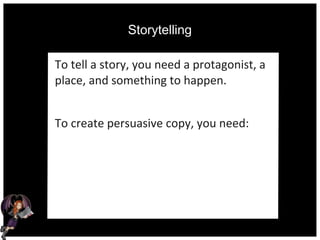
To tell a story, you need a protagonist, a
place, and something to happen.
Storytelling
To tell a story, you need a protagonist, a
place, and something to happen.
To create persuasive copy, you need:
Storytelling
To tell a story, you need a protagonist, a
place, and something to happen.
To create persuasive copy, you need:
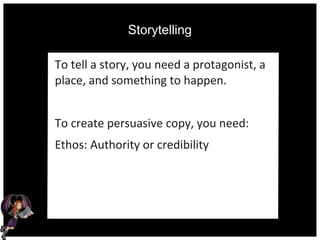
Ethos: Authority or credibility
Storytelling
To tell a story, you need a protagonist, a
place, and something to happen.
To create persuasive copy, you need:
Ethos: Authority or credibility
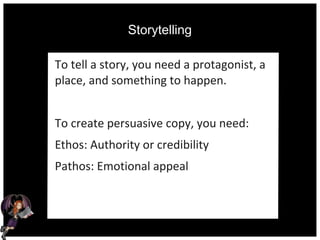
Pathos: Emotional appeal
Storytelling
To tell a story, you need a protagonist, a
place, and something to happen.
To create persuasive copy, you need:
Ethos: Authority or credibility
Pathos: Emotional appeal
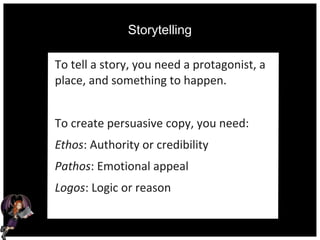
Logos: Logic or reason
Storytelling
To tell a story, you need a protagonist, a
place, and something to happen.
To create persuasive copy, you need:
Ethos: Authority or credibility
Pathos: Emotional appeal
Logos: Logic or reason
Storytelling
In a real-world example:
I have credibility and authority because
Sasha invited me to speak. The context
tells you I'm worth listening to.
My introduction hopefully created an
emotional bond. We're not that
different, you and I. I've failed – hard.
This preso is if this then that, built on
reason and logic.
Storytelling
Blog posts are easy pieces of content in
which to use ethos, logos, pathos: You
can take your time.
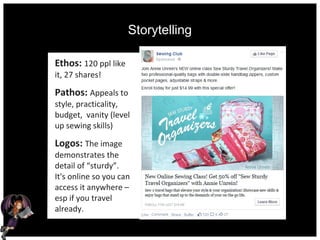
Short-form content like Facebook ads
requires you to blend imagery and
writing to do the same thing.
Storytelling
Ethos: 120 ppl like
it, 27 shares!
Pathos: Appeals to
style, practicality,
budget, vanity (level
up sewing skills)
Logos: The image
demonstrates the
detail of “sturdy”.
It's online so you can
access it anywhere –
esp if you travel
already.
Storytelling
This is all well and good. But how to spot
stories in the wild?
Storytelling
There's a great saying that a drill is
boring and impossible to write a story
around.
But it's what the man who wants to buy
the drill is going to do with it that is the
story.
Storytelling
There's a great saying that a drill is
boring and an impossible item for which
to write an effective story.
But it's what the man who wants to buy
the drill is planning to do with it that is
the story.
Storytelling
People don't buy things, they buy
emotions.
The man will buy the satisfaction of
building his own house extension (with
the right drill).
The kid will buy the happiness of fitting
in (with the right shoes).
Storytelling
There is a simple way of getting to your
core story.
That is:
1. Why do you do what you do?
2. With what?
Storytelling
Why?
Company X wants to help young men get
laid.
With what?
Deodorant.
Storytelling
INSTANT STORY.
Storytelling
Your turn! You're going to plan a piece
of content.
1. Create your core story.
2. Get your persona together.
3. Determine your purpose.
4. What type of content fits? (where, when, how)
5. Think channel, style, tone, etc
6. Think ethos, logos, pathos
7. What is the result?
Benchmark!
Where are we? Questions?
What have we missed?
Optional Extras: Content Strategy & Systems
What is content strategy?
The practice of planning for the creation,
delivery, and governance of useful
content.
The content itself isn't strategy.
Optional Extras: Content Strategy & Systems
What is content strategy?
The practice of planning for the creation,
delivery, and governance of useful
content.
The content itself isn't strategy.
Optional Extras: Content Strategy & Systems
A content strategist looks to the C.A.R.E.
Factor.
● Comprehensive (does a user have
everything she needs)
● Appropriate (properly labelled,
defined, easy to find)
● Relevant (to what the user is doing)
● Efficient(ly produced & managed).
Optional Extras: Content Strategy & Systems
A content strategist will do:
● Project summary
● Content Inventory
● Datascaping
● Missing content reporting
● Message architectures
● Audit & analysis of existing content
● Competitive audits
Optional Extras: Content Strategy & Systems
A content strategist will do:
● Readiness, editorial, process audits
● Gap and risk analyses
● Reports on project recommendations.
Optional Extras: Content Strategy & Systems
And also:
● Produce & maintain a content matrix
● Document processes for approval,
governance, translation
● SEO Keyword research
● Create content reviewer guides
● Workshop post-launch detail
● Create editorial calendars
● Work through archival & removal processes
Optional Extras: Content Strategy & Systems
Plus:
● We work on Change Management
Optional Extras: Content Strategy & Systems
If you take just one piece of strategy
with you today, take the notion of an
Editorial Calendar.
It will help you manage:
● What is being produced, and by whom
● When it needs to be delivered
● All media that is required
● Taxonomy needed to publish
● When it will be reviewed.
How to reach me if you have Qs
Call or text me 0421 925 382
Email me leticia@brutalpixie.com
Skype @brutalpixie
Twitter @brutalpixie
G+ +BrutalPixieOfficial
LinkedIn: bit.ly/LeticiaMooneyLinkedIn

Content 101 - Training in content for budding entrepreneurs

  • 1.
  • 2.
    Overview ● 1. Intros:Me, and You ● 2. Existing skills, expectations ● 3. What is “content”? ● 4. Purpose, audience, relevance ● 5. Elements of storytelling ● 6. Optional extras: Content strategy & Systems
  • 3.
    About me ● Uniate my youth ● Writer ● Editor - insert spectacular ragequit - ● Publisher - insert burnout and failure - ● Strategist
  • 4.
    About You ● Whoyou are ● Where you've come from ● Your content skills (if any) ● Your expectations for this session
  • 5.
    Things you've alreadydone ● Branding & marketing ● Building ideas ● Using social media platforms
  • 6.
    What is “content”? CONTENTIS WHAT MAKES THE INTERNET
  • 7.
    What is “content”? CONTENTIS WHAT MAKES THE INTERNET Think about that for a second.
  • 8.
  • 9.
    What is “content”? Theinternet is NOT: Design
  • 10.
    What is “content”? Theinternet is NOT: Design UX (user experience)
  • 11.
    What is “content”? Theinternet is NOT: Design UX (user experience) The pipes
  • 12.
    What is “content”? Theinternet is NOT: Design UX (user experience) The pipes The system or the frameworks
  • 13.
    What is “content”? CONTENTIS WHAT MAKES THE INTERNET
  • 14.
    What is “content”? CONTENTIS WHAT MAKES THE INTERNET But increasingly, it's post-digital.
  • 15.
    What is “content”? CONTENTIS WHAT MAKES THE INTERNET But increasingly, it's post-digital. In other words: Context-less
  • 16.
    What is “content”? It'sall well and good being abstract, so let's look at an example or two.
  • 17.
    What is “content”? It'severything that counts.
  • 18.
    What is “content”? It'severything that counts.
  • 19.
    What is “content”? It'severything that counts.
  • 20.
    What is “content”? It'severything that counts.
  • 21.
    What is “content”? It'severything that counts.
  • 22.
    What is “content”? It'severything that counts.
  • 23.
    What is “content”? Yes,including meta data
  • 24.
    List everything thatcounts as “content”
  • 25.
    Content 101: Purpose,Audience, Relevance ● Understanding purpose, audience & audience needs is a key factor in creating useful content ●
  • 26.
    Content 101: Purpose,Audience, Relevance ● Understanding purpose, audience & audience needs is a key factor in creating useful content ● Context doesn't matter
  • 27.
    Content 101: Purpose,Audience, Relevance ● Understanding purpose, audience & audience needs is a key factor in creating useful content ● Context doesn't matter
  • 28.
    Content 101: Purpose,Audience, Relevance ● Understanding purpose, audience & audience needs is a key factor in creating useful content ● Context doesn't matter ● Personas are so important
  • 29.
    Content 101: Purpose,Audience, Relevance ● Understanding purpose, audience & audience needs is a key factor in creating useful content ● Context doesn't matter ● Personas are so important ● Stereotype with care
  • 30.
    Content 101: Purpose,Audience, Relevance ● Understanding purpose, audience & audience needs is a key factor in creating useful content ● Context doesn't matter ● Personas are so important ● Stereotype with care
  • 31.
    Content 101: Purpose,Audience, Relevance What do we mean when we say “understand your audience”? ● Motivations ● Fears ● Problems they need solved ● Preferences (for style, tone, etc) ● Education level ● Why they're look at your content
  • 32.
    Content 101: Purpose,Audience, Relevance What do we mean when we say “understand your audience”? ● All the possible people who are not your target audience ● Lifestyle ● Level of wealth ● etc
  • 33.
    Content 101: Purpose,Audience, Relevance You have to craft a vision of your ideal audience member. Consider: ● Age, appearance, gender, quirks ● Income, lifestyle, working arrangements ● Kids, relationships, friendships ● Hobbies, relaxation, holidays ● Goals, dreams, values
  • 34.
    Content 101: Purpose,Audience, Relevance Why you need personas: ● Your audience becomes real to you ● You can write to just one person ● You can read your message architecture through their eyes ● You can read all of your content from their perspective
  • 35.
    Content 101: Purpose,Audience, Relevance Your turn! Create your personas. Then we're going to introduce them.
  • 36.
    Content 101: Purpose,Audience, Relevance Name: Mark Tapley Mark Tapley is a young man in his 20s. He loves adventure. His problem was that he didn't know how far he could push himself and retain his good humour. So, he put himself into absurd situations as a test. He irritates everybody with his optimism. He nearly died by putting himself in bad situations, still managed to be jolly, survived, and returned home filled with exuberance and an entrepreneurial fire. Now, Mark runs a pub called the Jolly Tapley with his wife.
  • 37.
    Content 101: Purpose,Audience, Relevance Name: Mark Tapley We would describe Mark as: ● A risk taker, one who will happily take risks and tell you the good stories at the end of them ● An entrepreneur, one who isn't fussed about failure ● That he's easy to get along with ● That he would be happy to try something new ● That he probably won't stand for a negative attitude
  • 38.
    Content 101: Purpose,Audience, Relevance Name: Mark Tapley We would describe Mark as: ● A risk taker, one who will happily take risks and tell you the good stories at the end of them ● An entrepreneur, one who isn't fussed about failure ● That he's easy to get along with ● That he would be happy to try something new ● That he probably won't stand for a negative attitude
  • 39.
    Content 101: Purpose,Audience, Relevance A quick diversion: Scenarios. Scenarios can act like pre-mortems. ● Put your persona into a situation and test all possible outcomes ● Use your scenarios for customer journey mapping, against your site or product, or social media experience ● Map all possible interactions and journeys so you have a landscape of possibility
  • 40.
    Content 101: Purpose,Audience, Relevance Got Purpose? ● Your entire reason for creating content
  • 41.
    Content 101: Purpose,Audience, Relevance Got Purpose? ● Your entire reason for creating content ● At the most basic level you have your purpose, and your audience's purpose
  • 42.
    Content 101: Purpose,Audience, Relevance Got Purpose? ● Your entire reason for creating content ● At the most basic level you have your purpose, and your audience's purpose ● But you can have more than one and so can your audience
  • 43.
    Content 101: Purpose,Audience, Relevance Got Purpose? ● Your entire reason for creating content ● At the most basic level you have your purpose, and your audience's purpose ● But you can have more than one and so can your audience ● And your client has purposes too!
  • 44.
    Content 101: Purpose,Audience, Relevance ● What do you want your audience to do?
  • 45.
    Content 101: Purpose,Audience, Relevance ● What do you want your audience to do? ● To change attitude
  • 46.
    Content 101: Purpose,Audience, Relevance ● What do you want your audience to do? ● To change attitude ● To learn about a product
  • 47.
    Content 101: Purpose,Audience, Relevance ● What do you want your audience to do? ● To change attitude ● To learn about a product ● To take an action – if so, what action?
  • 48.
    Content 101: Purpose,Audience, Relevance ● What do you want your audience to do? ● To change attitude ● To learn about a product ● To take an action – if so, what action? ● To make a decision – if so, what decision?
  • 49.
    Content 101: Purpose,Audience, Relevance ● What do you want your audience to do? ● To change attitude ● To learn about a product ● To take an action – if so, what action? ● To make a decision – if so, what decision? ● To evaluate?
  • 50.
    Content 101: Purpose,Audience, Relevance How many more can you think of?
  • 51.
    Content 101: Purpose,Audience, Relevance So, that's YOU. What about your audience? ● To decorate a room ● To cook dinner ● To save money ● To learn how to replace a tyre on a bicycle ● To be able to climb the Himalayas
  • 52.
    Content 101: Purpose,Audience, Relevance How many more can you think of?
  • 53.
    Content 101: Purpose,Audience, Relevance The difficult thing is getting a match!
  • 54.
    Content 101: Purpose,Audience, Relevance If your purpose matches your audience's purpose perfectly, then you will have 100% engagement.
  • 55.
    Content 101: Purpose,Audience, Relevance Nice. But life isn't really like that.
  • 56.
    Content 101: Purpose,Audience, Relevance What do you do when purposes don't match?
  • 57.
    Content 101: Purpose,Audience, Relevance What do you do when purposes don't match? ● You can rethink your purpose ● You can rethink your strategy and do something different ● You can aim for high levels of relevance
  • 58.
    Content 101: Purpose,Audience, Relevance It is unrealistic to expect that you will be able to match purposes all the time. Instead, we look at delivering: ● The right content ● To the right person ● At the right time ● In the right format
  • 59.
    Content 101: Purpose,Audience, Relevance It is unrealistic to expect that you will be able to match purposes all the time. Instead, we look at delivering: ● The right content purpose, solution ● To the right person ● At the right time ● In the right format
  • 60.
    Content 101: Purpose,Audience, Relevance It is unrealistic to expect that you will be able to match purposes all the time. Instead, we look at delivering: ● The right content purpose, solution ● To the right person persona ● At the right time ● In the right format
  • 61.
    Content 101: Purpose,Audience, Relevance It is unrealistic to expect that you will be able to match purposes all the time. Instead, we look at delivering: ● The right content purpose, solution ● To the right person persona ● At the right time when it's needed ● In the right format
  • 62.
    Content 101: Purpose,Audience, Relevance It is unrealistic to expect that you will be able to match purposes all the time. Instead, we look at delivering: ● The right content purpose, solution ● To the right person persona ● At the right time when it's needed ● In the right format one they're using
  • 63.
    Content 101: Purpose,Audience, Relevance Relevance is all about solving problems. It should be the reason why you're in business: Solving problems.
  • 64.
  • 65.
    Storytelling We look atelements of good stories.
  • 66.
    Storytelling We look atelements of good stories. But first, a diversion.
  • 67.
    Storytelling Stefan Sagmeister toCreatives: ‘No F*ckhead, You Are Not a Storyteller’ http://vimeo.com/98368484
  • 68.
    Storytelling Stefan Sagmeister isa graphic designer. This means he's a content creator. Storytelling is the buzzword of the hour – and what makes Stefan right?
  • 69.
    Storytelling Because you're notcreating “stories”, you are creating content for a particular person with a particular purpose, designed to achieve a particular outcome.
  • 70.
    Storytelling Marketers now talkabout the elements of storytelling: ethos, logos, pathos.
  • 71.
    Storytelling Marketers now talkabout the elements of storytelling: ethos, logos, pathos. They're not elements of storytelling. They're the three facets of persuasive writing and rhetoric.
  • 72.
    Storytelling To tell astory, you need a protagonist, a place, and something to happen.
  • 73.
    Storytelling To tell astory, you need a protagonist, a place, and something to happen. To create persuasive copy, you need:
  • 74.
    Storytelling To tell astory, you need a protagonist, a place, and something to happen. To create persuasive copy, you need: Ethos: Authority or credibility
  • 75.
    Storytelling To tell astory, you need a protagonist, a place, and something to happen. To create persuasive copy, you need: Ethos: Authority or credibility Pathos: Emotional appeal
  • 76.
    Storytelling To tell astory, you need a protagonist, a place, and something to happen. To create persuasive copy, you need: Ethos: Authority or credibility Pathos: Emotional appeal Logos: Logic or reason
  • 77.
    Storytelling To tell astory, you need a protagonist, a place, and something to happen. To create persuasive copy, you need: Ethos: Authority or credibility Pathos: Emotional appeal Logos: Logic or reason
  • 78.
    Storytelling In a real-worldexample: I have credibility and authority because Sasha invited me to speak. The context tells you I'm worth listening to. My introduction hopefully created an emotional bond. We're not that different, you and I. I've failed – hard. This preso is if this then that, built on reason and logic.
  • 79.
    Storytelling Blog posts areeasy pieces of content in which to use ethos, logos, pathos: You can take your time. Short-form content like Facebook ads requires you to blend imagery and writing to do the same thing.
  • 80.
    Storytelling Ethos: 120 ppllike it, 27 shares! Pathos: Appeals to style, practicality, budget, vanity (level up sewing skills) Logos: The image demonstrates the detail of “sturdy”. It's online so you can access it anywhere – esp if you travel already.
  • 81.
    Storytelling This is allwell and good. But how to spot stories in the wild?
  • 82.
    Storytelling There's a greatsaying that a drill is boring and impossible to write a story around. But it's what the man who wants to buy the drill is going to do with it that is the story.
  • 83.
    Storytelling There's a greatsaying that a drill is boring and an impossible item for which to write an effective story. But it's what the man who wants to buy the drill is planning to do with it that is the story.
  • 84.
    Storytelling People don't buythings, they buy emotions. The man will buy the satisfaction of building his own house extension (with the right drill). The kid will buy the happiness of fitting in (with the right shoes).
  • 85.
    Storytelling There is asimple way of getting to your core story. That is: 1. Why do you do what you do? 2. With what?
  • 86.
    Storytelling Why? Company X wantsto help young men get laid. With what? Deodorant.
  • 87.
  • 88.
    Storytelling Your turn! You'regoing to plan a piece of content. 1. Create your core story. 2. Get your persona together. 3. Determine your purpose. 4. What type of content fits? (where, when, how) 5. Think channel, style, tone, etc 6. Think ethos, logos, pathos 7. What is the result?
  • 89.
    Benchmark! Where are we?Questions? What have we missed?
  • 90.
    Optional Extras: ContentStrategy & Systems What is content strategy? The practice of planning for the creation, delivery, and governance of useful content. The content itself isn't strategy.
  • 91.
    Optional Extras: ContentStrategy & Systems What is content strategy? The practice of planning for the creation, delivery, and governance of useful content. The content itself isn't strategy.
  • 92.
    Optional Extras: ContentStrategy & Systems A content strategist looks to the C.A.R.E. Factor. ● Comprehensive (does a user have everything she needs) ● Appropriate (properly labelled, defined, easy to find) ● Relevant (to what the user is doing) ● Efficient(ly produced & managed).
  • 93.
    Optional Extras: ContentStrategy & Systems A content strategist will do: ● Project summary ● Content Inventory ● Datascaping ● Missing content reporting ● Message architectures ● Audit & analysis of existing content ● Competitive audits
  • 94.
    Optional Extras: ContentStrategy & Systems A content strategist will do: ● Readiness, editorial, process audits ● Gap and risk analyses ● Reports on project recommendations.
  • 95.
    Optional Extras: ContentStrategy & Systems And also: ● Produce & maintain a content matrix ● Document processes for approval, governance, translation ● SEO Keyword research ● Create content reviewer guides ● Workshop post-launch detail ● Create editorial calendars ● Work through archival & removal processes
  • 96.
    Optional Extras: ContentStrategy & Systems Plus: ● We work on Change Management
  • 97.
    Optional Extras: ContentStrategy & Systems If you take just one piece of strategy with you today, take the notion of an Editorial Calendar. It will help you manage: ● What is being produced, and by whom ● When it needs to be delivered ● All media that is required ● Taxonomy needed to publish ● When it will be reviewed.
  • 98.
    How to reachme if you have Qs Call or text me 0421 925 382 Email me leticia@brutalpixie.com Skype @brutalpixie Twitter @brutalpixie G+ +BrutalPixieOfficial LinkedIn: bit.ly/LeticiaMooneyLinkedIn