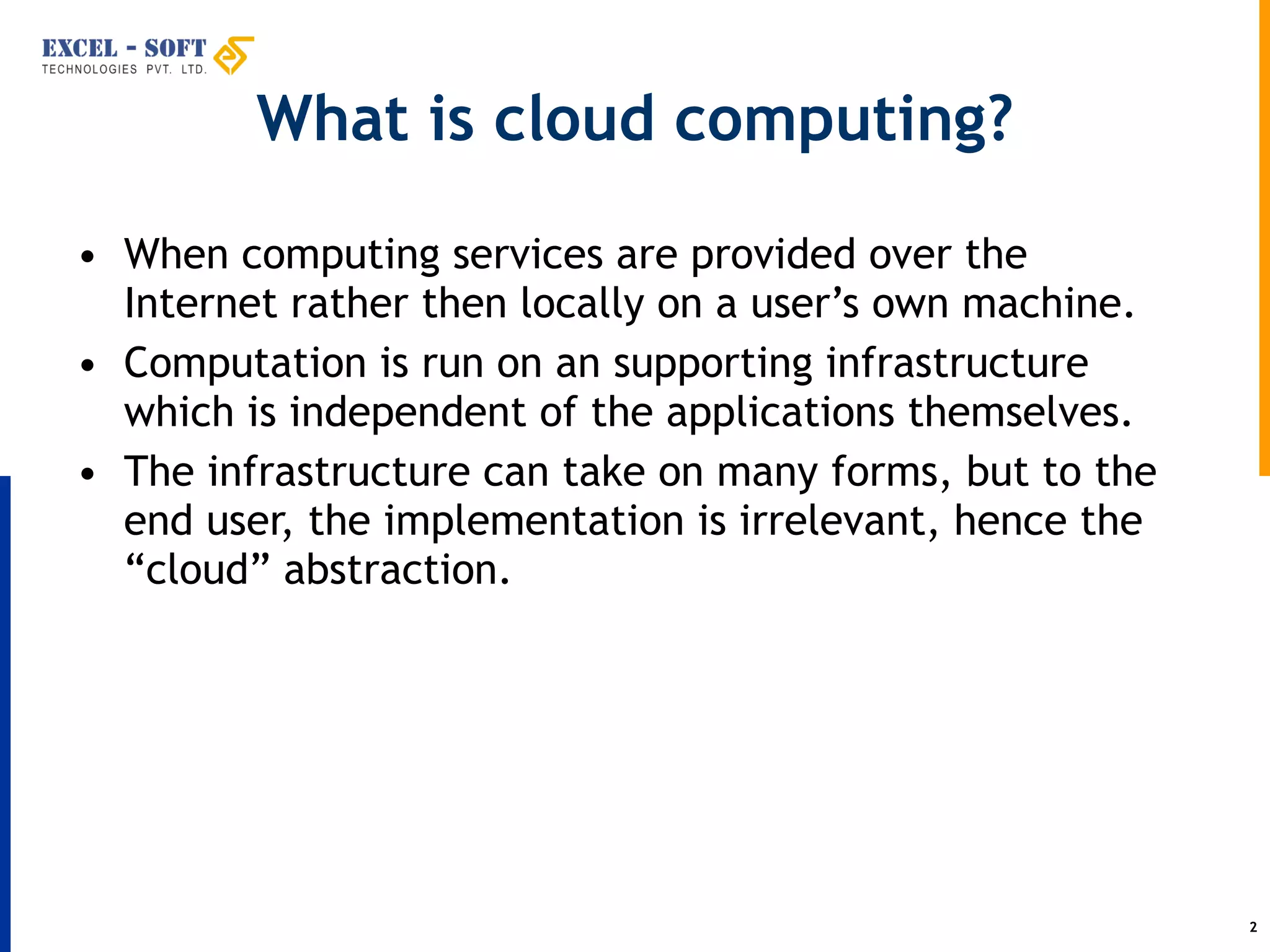
Cloud Computing
What is cloud computing? When computing services are provided over the Internet rather then locally on a user’s own machine. Computation is run on an supporting infrastructure which is independent of the applications themselves. The infrastructure can take on many forms, but to the end user, the implementation is irrelevant, hence the “cloud” abstraction.
Generic   Cloud   Architecture
Types of Cloud Computing Services Software as a service Software is provided to end users in an “On-demand” fashion. Reduces upfront costs, i.e. buying multiple licenses “ Utility-based” computing  Infrastructure as a service An “infrastructure” referring to much of the background  hardware  needs of an organization Platform as a service When the software needed to develop cloud applications are  themselves  provided as a service
Software as a service: Types Commercial software that can be used and configured over a network, file servers and remote configuration storage, one application used by many clients, application updateability.  Multi-level architectures: Level 1: Customized, Ad-hoc basis Level 2: Configurability Level 3: Configurability + multi-tenancy Level 4: Configurability + multi-tenancy + Scalability
Infrastructure as a service Components of Infrastructure as a service: Computing hardware E.g. Client Storage Space, Processing power needs Virtualization E.g. VM Ware, VirtualBox Networking Security, communication speeds, servers  Internet Access Connecting clients applications to servers anywhere Utility Computing E.g. Charging by hour, gigabyte, process load Contracts Specific service levels which must be adhered too.
Platform as a service Implements the “Software Lifecycle” on the cloud. Common S.E. practices: client elicitation, software design, component design, implementation, testing, maintenance, data handling and documentation How does it work? Cloud servers allow not just hosting of completed application, but applications  in progress U.I. design tools right inside the web browser to use them Provides testing in real situations: heavy client loads Automatic integration with other data sources on the cloud Tools for the developers to work efficiently with one another
Ideal Cloud Computing Low cost for users and providers Independence of device and software Efficient utilization of all resources Constant, or near-constant uptime through the use of resource distribution Ability to continually add new users and applications by easily increasing resources when necessary Data is secure with policies to protect its security
Benefits of Cloud Computing Almost zero upfront infrastructure investment Just-in-time Infrastructure More efficient resource utilization Usage-based costing Potential for shrinking the processing time
Players in Cloud Computing Amazon EC2 GoGrid Right Scale Rackspace Cloud
Thanks Vishwanath Subbanna

Cloud Computing

  • 1.
  • 2.
    What is cloudcomputing? When computing services are provided over the Internet rather then locally on a user’s own machine. Computation is run on an supporting infrastructure which is independent of the applications themselves. The infrastructure can take on many forms, but to the end user, the implementation is irrelevant, hence the “cloud” abstraction.
  • 3.
    Generic Cloud Architecture
  • 4.
    Types of CloudComputing Services Software as a service Software is provided to end users in an “On-demand” fashion. Reduces upfront costs, i.e. buying multiple licenses “ Utility-based” computing Infrastructure as a service An “infrastructure” referring to much of the background hardware needs of an organization Platform as a service When the software needed to develop cloud applications are themselves provided as a service
  • 5.
    Software as aservice: Types Commercial software that can be used and configured over a network, file servers and remote configuration storage, one application used by many clients, application updateability. Multi-level architectures: Level 1: Customized, Ad-hoc basis Level 2: Configurability Level 3: Configurability + multi-tenancy Level 4: Configurability + multi-tenancy + Scalability
  • 6.
    Infrastructure as aservice Components of Infrastructure as a service: Computing hardware E.g. Client Storage Space, Processing power needs Virtualization E.g. VM Ware, VirtualBox Networking Security, communication speeds, servers Internet Access Connecting clients applications to servers anywhere Utility Computing E.g. Charging by hour, gigabyte, process load Contracts Specific service levels which must be adhered too.
  • 7.
    Platform as aservice Implements the “Software Lifecycle” on the cloud. Common S.E. practices: client elicitation, software design, component design, implementation, testing, maintenance, data handling and documentation How does it work? Cloud servers allow not just hosting of completed application, but applications in progress U.I. design tools right inside the web browser to use them Provides testing in real situations: heavy client loads Automatic integration with other data sources on the cloud Tools for the developers to work efficiently with one another
  • 8.
    Ideal Cloud ComputingLow cost for users and providers Independence of device and software Efficient utilization of all resources Constant, or near-constant uptime through the use of resource distribution Ability to continually add new users and applications by easily increasing resources when necessary Data is secure with policies to protect its security
  • 9.
    Benefits of CloudComputing Almost zero upfront infrastructure investment Just-in-time Infrastructure More efficient resource utilization Usage-based costing Potential for shrinking the processing time
  • 10.
    Players in CloudComputing Amazon EC2 GoGrid Right Scale Rackspace Cloud
  • 11.